
China EV Charging-as-a-Service Market Size and Share
Market Overview
| Study Period | 2019 - 2031 |
|---|---|
| Forecast Data Period | 2026 - 2031 |
| Base Year Market Size (2025) | USD 76.20 Million |
| Market Size (2026) | USD 94.01 Million |
| Market Size (2031) | USD 287.01 Million |
| Growth Rate (2026 - 2031) | 25.01 % |
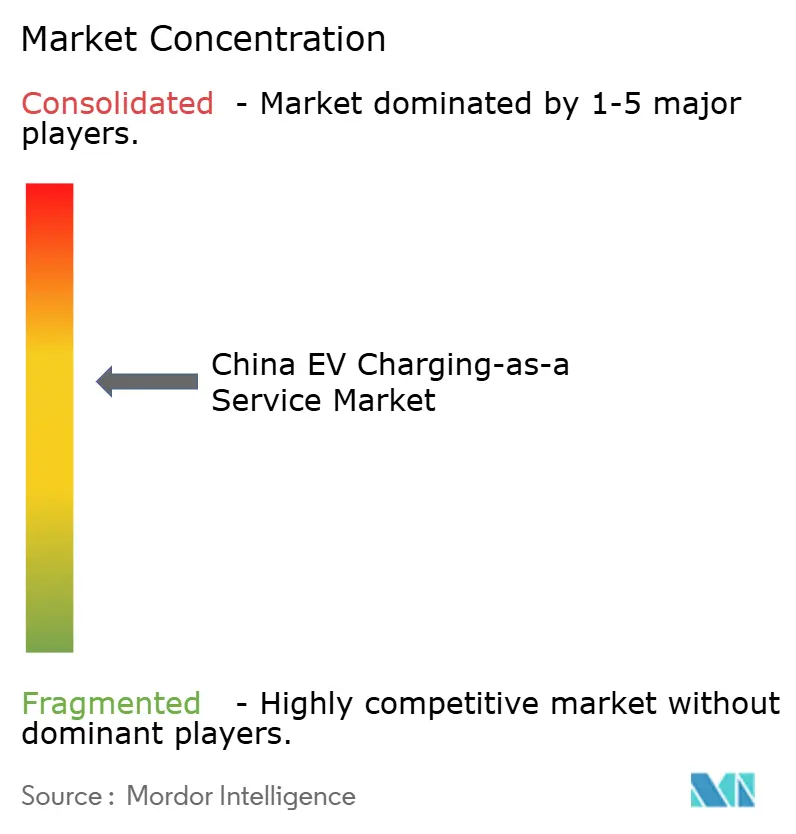
| Market Concentration | Medium |
Major Players *Disclaimer: Major Players sorted in no particular order Image © Mordor Intelligence. Reuse requires attribution under CC BY 4.0. | |
China EV Charging-as-a-Service Market Analysis by Mordor Intelligence
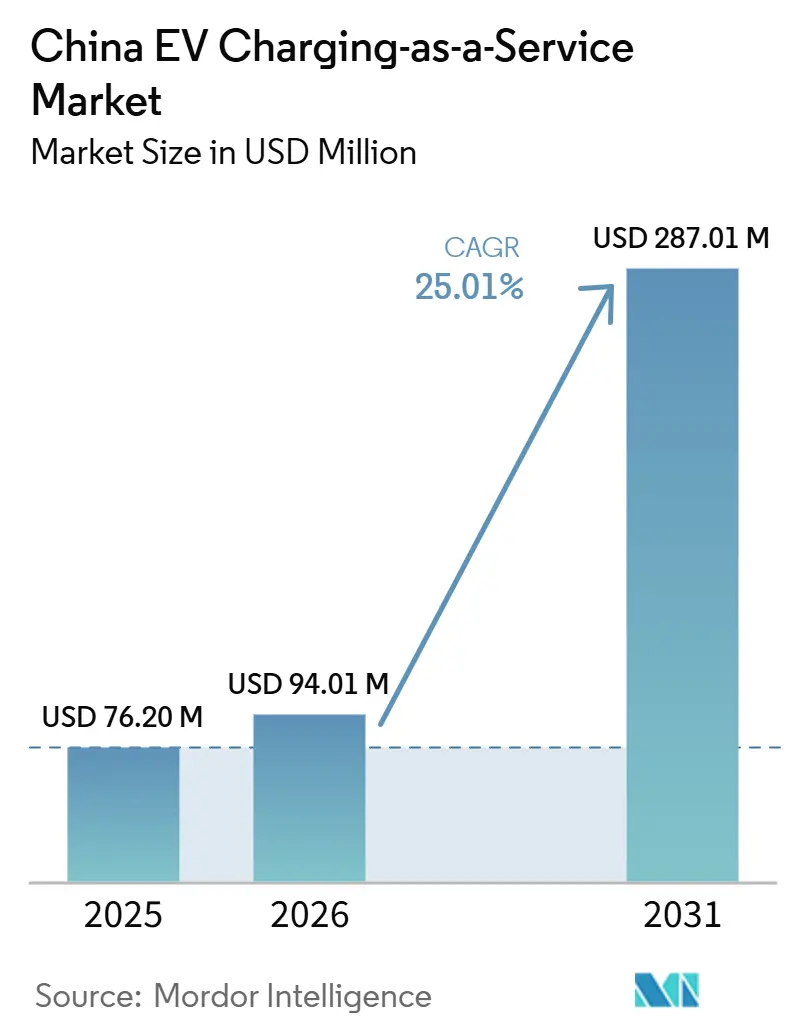
The China EV Charging-as-a-Service market was valued at USD 76.20 million in 2025 and estimated to grow from USD 94.01 million in 2026 to reach USD 287.01 million by 2031, at a CAGR of 25.01% during the forecast period (2026-2031). Fleet-oriented service contracts that bundle hardware, software, electricity procurement, and maintenance convert what was once a lumpy capital outlay into a predictable operating expense for logistics companies, ride-hailing platforms, and corporate motor pools. Government capital subsidies that cover up to 30% of depot DC fast-charger costs, together with time-of-use tariff discounts that drive payback periods below five years, have turned depot charging into a mainstream financing proposition. Simultaneously, artificial-intelligence load-management software lets operators arbitrage wholesale electricity prices while offering fleets guaranteed overnight uptime, which shields profit margins from spot-market volatility. The rapid electrification of parcel vans and ride-hailing sedans adds a structural, high-utilization demand signal that underpins the long-run economics of the China EV Charging-as-a-Service market.
Key Report Takeaways
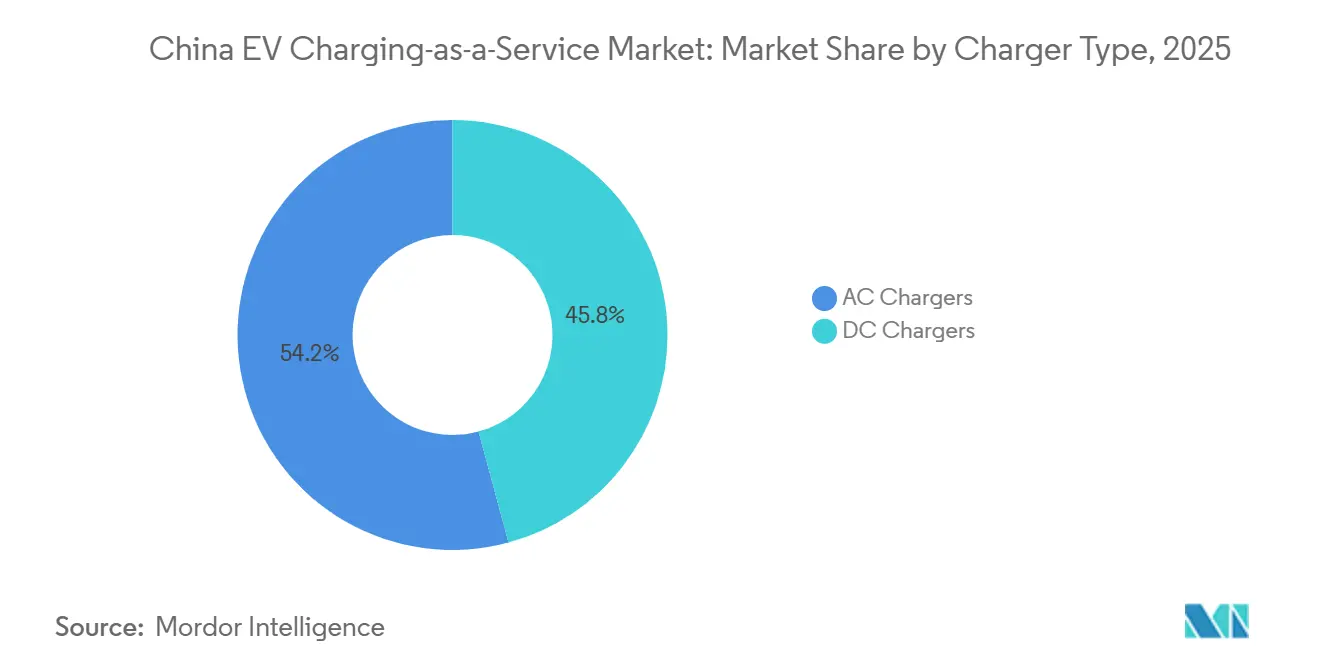
- By charger type, AC units held 54.21% revenue share in 2025, while DC fast chargers are advancing at a 26.33% CAGR through 2031.
- By fleet service type, company vehicle motor pools captured 41.33% of the China EV Charging-as-a-Service market share in 2025; delivery and logistics fleets are on track to expand at a 27.04% CAGR through 2031.
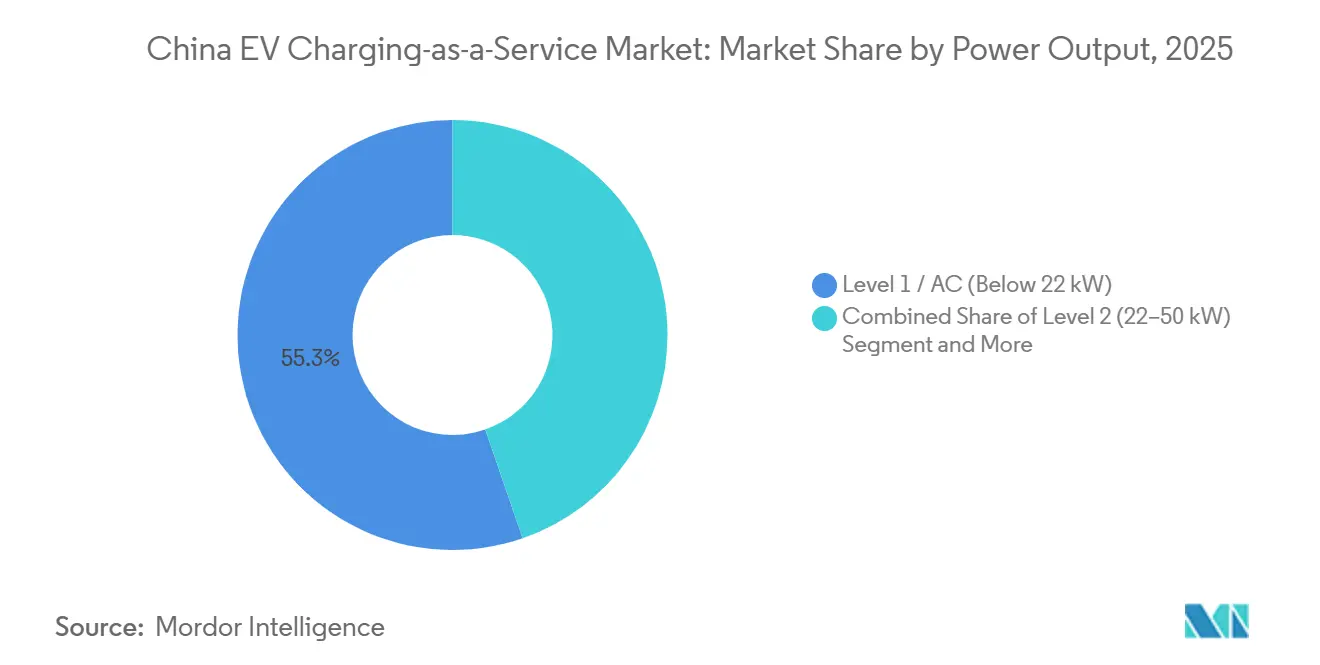
- By power output, level 1 / AC (below 22 kW) accounted for 55.27% of the China EV Charging-as-a-Service market size in 2025, whereas high-power chargers above 150 kW are forecast to grow at a 28.33% CAGR to 2031.
- By end-use, public networks commanded 68.04% share of the China EV Charging-as-a-Service market size in 2025, while semi-public depots are expanding at a 25.41% CAGR between 2026 and 2031.
Note: Market size and forecast figures in this report are generated using Mordor Intelligence’s proprietary estimation framework, updated with the latest available data and insights as of January 2026.
Worldwide, activity is shaped by contributions from multiple countries and regions, with China representing one among them. The global report on ev charging as a service market by Mordor Intelligence reflects how these countries and regional layers combine into a single system.
China EV Charging-as-a-Service Market Trends and Insights
Drivers Impact Analysis*
| Driver | (~) % Impact on CAGR Forecast | Geographic Relevance | Impact Timeline |
|---|---|---|---|
| Government Subsidies and Tariff Incentives | +4.5% | Nationwide focus on Guangdong, Jiangsu, Zhejiang, and Beijing-Tianjin-Hebei | Medium term (2-4 years) |
| E-Commerce Delivery Boom | +4.2% | Tier-1 and tier-2 cities in the Yangtze River Delta and Pearl River Delta | Short term (≤2 years) |
| PPP Financing Models | +3.8% | Early traction in Anhui and Guizhou provincial capitals | Medium term (2-4 years) |
| Urban Low-Emission-Zone Mandates | +3.5% | First-mover tier-1 municipalities | Short term (≤2 years) |
| AI-Based Load Balancing Platforms | +2.5% | Beijing, Shanghai, Shenzhen, Guangzhou | Long term (≥4 years) |
| Battery-Swap-Ready Parking Bays | +2.0% | National pilots in Chongqing, Xiamen, and highway corridors | Long term (≥4 years) |
| Source: Mordor Intelligence | |||
Government Subsidies and Tariff Incentives for Depot DC Fast Charging
Between 2025 and 2027, central and provincial programs are set to invest significantly in charging infrastructure. Depot operators in coastal manufacturing hubs can secure capital grants to offset a portion of their equipment and installation expenses. Off-peak electricity rates offer substantial savings compared to daytime commercial tariffs, enhancing internal rates of return for high-utilization depots. Nationwide interoperability rules, adhering to the GB/T standard, further bolster these returns by preventing vendor lock-in and expanding the potential fleet base. With these combined incentives, the China EV Charging-as-a-Service market is emerging as a prime target for infrastructure funds seeking stable, utility-like cash flows [1]“Notice on Promoting DC Fast Charging Subsidies,” National Energy Administration, nea.gov.cn.
E-Commerce Same-Day Delivery Boom Requiring Overnight Fleet Charging
In 2024, China processed a significant volume of parcels, with projections indicating that by 2027, a majority of these will be delivered the same or next day. To meet these tight delivery deadlines, operators are increasingly opting to swap or recharge their vans during the six-hour night shift lull, rather than depending on public chargers during the day. Depot DC units, offering high charging capacities, can replenish vehicle ranges efficiently. This efficiency allows trucks to be available for multiple delivery waves each day. Major cities like Guangzhou, Shanghai, Wuhan, and Changsha are emerging as hotspots for ultra-fast charging sites, largely because they house large e-commerce fulfillment centers alongside urban depots. This predictable surge in overnight demand not only guarantees a steady revenue stream for service providers but also strengthens the long-term prospects of China's EV Charging-as-a-Service market.
PPP Financing Models Enabling Rapid Semi-Public Charger Rollout
Municipal governments provide land-use rights and grid upgrades, while private investors supply capital and manage the asset under long-term concessions. In Anqing, blending concessional loans with tax holidays significantly reduced the payback period for a logistics-park project. Liupanshui adopted this model across multiple parks, demonstrating that standardized public-private templates can expedite due diligence and secure more affordable debt. Fleet operators enter into multiyear take-or-pay contracts, enabling developers to securitize anticipated cash flows. This financing strategy accelerates deployment timelines, expands geographic reach, and amplifies the total addressable share of China's EV Charging-as-a-Service market [2]“PPP Logistics Park Charging Project,” Anhui Provincial Development and Reform Commission, fgw.ah.gov.cn.
Urban Low-Emission-Zone Mandates Accelerating Logistics Fleet Electrification
By 2027, Beijing aims to prohibit diesel trucks from operating on the Second Ring Road. Similarly, Shanghai and Shenzhen have proposed draft directives echoing this move. Conditional incentives, including waived parking fees and expedited depot permits, have significantly reduced development cycles. As compliance deadlines loom, fleet buyers are increasingly gravitating towards turnkey charging service bundles, ensuring certified zero-tailpipe emissions reporting. This regulatory momentum not only bolsters demand visibility but also draws in long-term capital into China's EV Charging-as-a-Service market.
Restraints Impact Analysis*
| Restraint | (~) % Impact on CAGR Forecast | Geographic Relevance | Impact Timeline |
|---|---|---|---|
| Distribution Transformer Congestion Costs | -2.8% | Beijing, Shanghai, Shenzhen, Guangzhou | Short term (≤2 years) |
| Volatile Spot Electricity Prices | -2.3% | Provinces with liberalized power markets | Medium term (2-4 years) |
| OEM-Integrated Charging Networks | -2.2% | Nationwide, premium EV clusters | Long term (≥4 years) |
| Restrictions on Depot Expansion | -1.8% | Guangdong, Zhejiang, Jiangsu corridors | Medium term (2-4 years) |
| Source: Mordor Intelligence | |||
Distribution Transformer Congestion Costs in Tier-1 Urban Cores
As localized EV density in megacities surpasses critical thresholds, legacy grids face overload challenges. Depot developers are compelled to finance transformer replacements and grapple with approval waits that can extend for significant periods. Such delays not only tie up working capital but also diminish internal rates of return. Consequently, suburban plots boasting spare capacity emerge as a more appealing option in the short term. This bottleneck curtails the immediate expansion of China's EV Charging-as-a-Service market, particularly in its most lucrative demand centers.
Volatile Spot Electricity Prices Eroding CaaS Profit Margins
In liberalized markets like Shandong and Guangdong, spot prices can fluctuate dramatically between daytime peaks and overnight troughs. Service providers locked into fixed-price fleet contracts typically absorb this upside volatility, unless they possess storage capabilities or hold demand-response licenses. When hedging strategies falter, gross margins can decline significantly. This financial pressure pushes operators to hasten their adoption of AI load management and battery-buffer deployment. While such volatility heightens risk, it simultaneously offers arbitrage opportunities for astute players, intensifying the competitive dynamics within China's EV Charging-as-a-Service market.
*Our forecasts treat driver/restraint impacts as directional, not additive. The impact forecasts reflect baseline growth, mix effects, and variable interactions.
Segment Analysis
By Charger Type: AC Dominance Yields to DC Momentum
AC hardware owned 54.21% of the China EV Charging-as-a-Service market in 2025, thanks to low hardware costs and minimal grid-upgrade requirements. Overnight dwell times in company motor pools align with 7 kW-40 kW charge rates, helping operators sidestep peak-demand tariffs. DC fast chargers, however, are projected to expand at 26.33% through 2031. That trajectory is anchored in 50 kW-150 kW depot installs that turn vans around in under three hours, unlocking double-shift vehicle utilization. BYD’s 1 MW pilot, rolled out with TELD and Star Charge, shows how a single ultra-high-power gun can service 40-50 vans per day, quadrupling revenue per square meter versus AC bays.
The China EV Charging-as-a-Service market share of DC cabinets rises each time logistics fleets add a new wave of 800-V or 1,000-V vehicle platforms. Public data reveals that the nationwide average delivered power experienced a notable increase by February 2026, highlighting a significant shift in power density. While AC continues to dominate in homes and workplaces, the economics of depots are increasingly favoring DC. This shift is driven by rising parcel volumes and tightening delivery windows.


By Fleet Service Type: Logistics Overtakes Corporate Pools
Company vehicle and motor pools generated 41.33% of 2025 revenue, offering stable, multi-year contracts with predictable overnight charging patterns. Yet delivery and logistics fleets are growing at a 27.04% CAGR as e-commerce giants accelerate same-day guarantees. Electrified parcel vans boast energy costs one-third those of diesel trucks, but only if depot chargers can deliver 200 km of range within a single shift break. Fleet concentration in mega-city logistics parks gives service providers scale at a single site, amplifying investment efficiency.
Ride-hailing fleets sit between the two poles, blending depot DC fast charging for overnight top-ups with public ultra-fast sessions during the day. Xiaoju Energy, Didi’s charging arm, already derives a major share of its electricity volume from commercial fleets, validating the centrality of B2B demand to the China EV Charging-as-a-Service market. As low-emission zones proliferate, parcel operators will overtake corporate pools in revenue contribution, cementing logistics as the market’s defining use-case.
By Power Output: Ultra-Fast Charging Reshapes Economics
Level 1 / AC (below 22 kW) installations accounted for 55.27% of the China EV Charging-as-a-Service market size in 2025 because of their compatibility with existing low-voltage feeders and reduced permit friction. Nevertheless, high-power chargers rated above 150 kW are forecast to surge at 28.33% through 2031. GAC’s 720 kW liquid-cooled guns exemplify the technological leap, pumping 200 km of range in five minutes and enabling micro-hub logistics models that rotate vans every two hours. Higher power reduces the total number of stalls required, which offsets their larger per-unit capex in land-scarce urban cores.
As battery chemistries move from 1C to 3C charge acceptance, high-power cabinets lower opportunity cost for fleets, allowing them to compress delivery windows without expanding vehicle counts. The trade-off pivots on utilization: fewer ultra-fast stalls must serve more vehicles to break even. Operators with robust AI scheduling achieve 15+ sessions per day, validating the investment thesis and reinforcing the up-powering trend inside the China EV Charging-as-a-Service market.

By End-Use: Public Networks Dominate, Semi-Public Gains
Public networks held 68.04% of 2025 revenue because national subsidies favor open-access coverage and because roadside visibility aids driver adoption. Yet average daily sessions languish below 10, limiting capital recovery. Semi-public depots—accessible to multiple vetted fleets but not walk-ups—post 12-18 sessions per gun and hit payback in under five years, the cornerstone of their 25.41% growth outlook. PPP concessions that marry municipal land with private capex accelerate semi-public rollouts in second-tier cities that lack public-station density.
Highway corridors will continue to rely on public 50 kW-150 kW chargers spaced every 50 km, but urban freight will pivot toward reservation-based semi-public hubs integrated with fleet management systems. The bifurcation lets operators fine-tune product-market fit: public stalls maximize geographic coverage, whereas semi-public depots maximize asset utilization. Both remain integral to the China EV Charging-as-a-Service market’s maturity path.
Geography Analysis
Guangdong, Jiangsu, Zhejiang, Shandong, and Shanghai collectively dominate China's public charging landscape, accounting for a significant portion of the nation's installed charging capacity and delivered kilowatt-hours. Leading the charge, Guangdong stands out due to the e-commerce density of the Pearl River Delta. By late 2025, Tier-1 cities achieved a milestone of one public charger for every few electric vehicles (EVs). However, each station faces a frustrating wait for grid upgrade approvals, prompting developers to seek locations in suburban areas. In the heart of downtown, ultra-fast charging units are becoming the norm, capitalizing on the premium value of limited land space.
Meanwhile, in Tier-2 and Tier-3 cities like Anhui, Henan, and Sichuan, standardized Public-Private Partnership (PPP) templates are being embraced to attract private investments. This approach not only accelerates approval processes but also amplifies the number of charging depots. By early 2026, Hebei, in collaboration with a coordinated subsidy pool from Beijing and Tianjin, saw a significant increase in its station count. This underscores the significance of regional harmonization in mitigating investor risks. Furthermore, rural pilot projects in Shanxi and Inner Mongolia are broadening depot coverage to cater to cold-chain agriculture, emphasizing a commitment to inclusivity that extends beyond the coastal megacities.
In Shandong and Guangdong, grid liberalization has introduced spot-price volatility. Savvy operators are leveraging AI scheduling and battery storage to navigate these fluctuations, creating pronounced profitability disparities across regions. In Zhejiang, land-use restrictions are limiting depot expansions, driving a surge in demand for high-capacity chargers that maximize energy output within constrained spaces. This intricate interplay of policies and grid dynamics is not just shaping capital investments and site designs but is also defining competitive strategies in China's burgeoning EV Charging-as-a-Service market.
Mordor Intelligence provides coverage of the ev charging as a service market across other key regional markets, including Europe, each with their regulatory frameworks and demand patterns. Detailed country-level analysis extends to India, South Korea, and United States incorporating local coverage and market participation, as required.
Competitive Landscape
By December 2025, the top operators commanded a significant share of public charging piles, indicating a moderate market concentration. TELD, StarCharge, and YKC collectively manage extensive public charging networks, utilizing their asset-heavy, multi-brand strategies to dominate a substantial portion of charging sessions. BYD Flash Charging has expanded its global presence, strategically pairing its proprietary units with vehicle sales to cultivate a loyal customer base. Meanwhile, NIO Power's battery swap network hasn't met its utilization goals but has secured customers through enticing battery-lease packages.
State Grid and China Southern Power Grid focus their efforts on highway corridors and rural townships. In contrast, they've left urban depots to private investors, a gap that multi-province players are quick to fill. GAC Pilot demonstrates the service advantage held by operators closely tied to original equipment manufacturers (OEMs). In a notable move, Huawei has introduced advanced liquid-cooled hubs, merging its telecommunications real estate with charging solutions [3]“Super-Charge Alliance Announcement 2025,” Huawei Digital Energy, huawei.com. This strategy not only reduces site-acquisition costs but also signals a significant convergence between industries.
With interoperability mandates set to roll out in 2026, smaller regional firms, especially those unprepared for the 3C certification, face mounting pressures as quality standards tighten. Operators that can adeptly bundle energy-arbitrage software, depot management tools, and financing solutions stand to benefit from economies of scale, further fueling the ongoing consolidation trend in China's EV Charging-as-a-Service market.
China EV Charging-as-a-Service Industry Leaders
TELD New Energy Co., Ltd.
StarCharge
State Grid Corporation of China
YKC Clean Energy Technologies
NIO Power
- *Disclaimer: Major Players sorted in no particular order

Recent Industry Developments
- April 2026: BYD and Yum China launch “nine-minute” charging drive-thrus at KFC locations, powered by second-generation Blade batteries that reach 97% state-of-charge within nine minutes.
- March 2026: BYD partners with JD.com to open the first co-developed fast-charging station in Shenzhen, integrating retail and vehicle-service amenities.
- October 2025: The National Energy Administration issues a Three-Year Action Plan to double charging-facility service capacity to 28 million units and 300 GW by 2027.
- May 2025: State Grid Zhejiang Power pilots a solar-plus-storage EV station in Ningbo’s Fubei village, advancing rural charging penetration.


China EV Charging-as-a-Service Market Report Scope
The scope includes segmentation by charger type (AC chargers and DC chargers), fleet service type (company vehicle and motor pools, delivery and logistics, and passenger fleets), power output (level 1/AC (below 22 kW), level 2 (22-50 kW), fast (50-150 kW), and high-power (above 150 kW)), and end-use (semi-public charging setup and public charging setup). Market size and growth forecasts are presented by value in USD.
| AC Chargers |
| DC Chargers |
| Company Vehicle and Motor Pools |
| Delivery and Logistics |
| Passenger Fleets |
| Level 1 / AC (Below 22 kW) |
| Level 2 (22 - 50 kW) |
| Fast (50 - 150 kW) |
| High-Power (Above 150 kW) |
| Semi-Public Charging Setup |
| Public Charging Setup |
| By Charger Type | AC Chargers |
| DC Chargers | |
| By Fleet Service Type | Company Vehicle and Motor Pools |
| Delivery and Logistics | |
| Passenger Fleets | |
| By Power Output | Level 1 / AC (Below 22 kW) |
| Level 2 (22 - 50 kW) | |
| Fast (50 - 150 kW) | |
| High-Power (Above 150 kW) | |
| By End-Use | Semi-Public Charging Setup |
| Public Charging Setup |


Key Questions Answered in the Report
What is the current size of the China EV Charging-as-a-Service market?
The China EV Charging-as-a-Service market size reached USD 76.20 million in 2025 and is projected at USD 94.01 million for 2026.
How fast is the market expected to grow?
It is forecast to expand at a 25.01% CAGR between 2026 and 2031, reaching USD 287.01 million by the end of the period.
Which charger type is growing the quickest?
DC fast chargers are the fastest-growing segment, expanding at a 26.33% CAGR through 2031 as fleets prioritize turnaround speed.
Why are logistics fleets critical to charging-service demand?
E-commerce growth requires overnight recharging that public networks cannot meet, pushing parcel operators toward depot-based service contracts.
Page last updated on:


 Your data is secure and never sold or shared.


