
South Korea Forklift Rental Market Size and Share
Market Overview
| Study Period | 2019 - 2031 |
|---|---|
| Forecast Data Period | 2026 - 2031 |
| Base Year Market Size (2025) | USD 457.63 Million |
| Market Size (2026) | USD 478.41 Million |
| Market Size (2031) | USD 597.32 Million |
| Growth Rate (2026 - 2031) | 4.54 % |
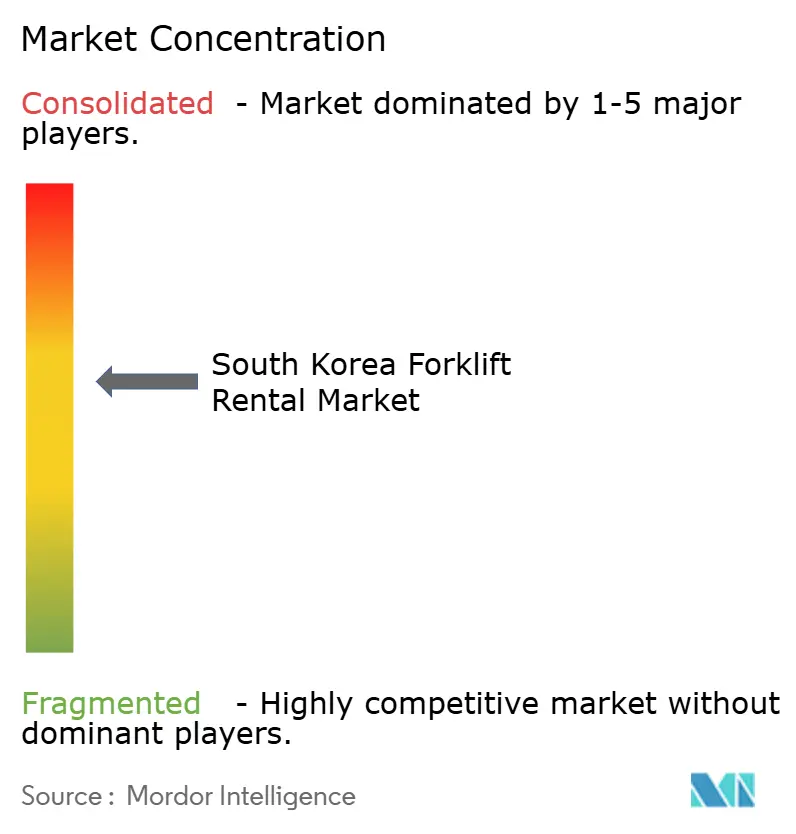
| Market Concentration | Medium |
Major Players *Disclaimer: Major Players sorted in no particular order Image © Mordor Intelligence. Reuse requires attribution under CC BY 4.0. | |
South Korea Forklift Rental Market Analysis by Mordor Intelligence
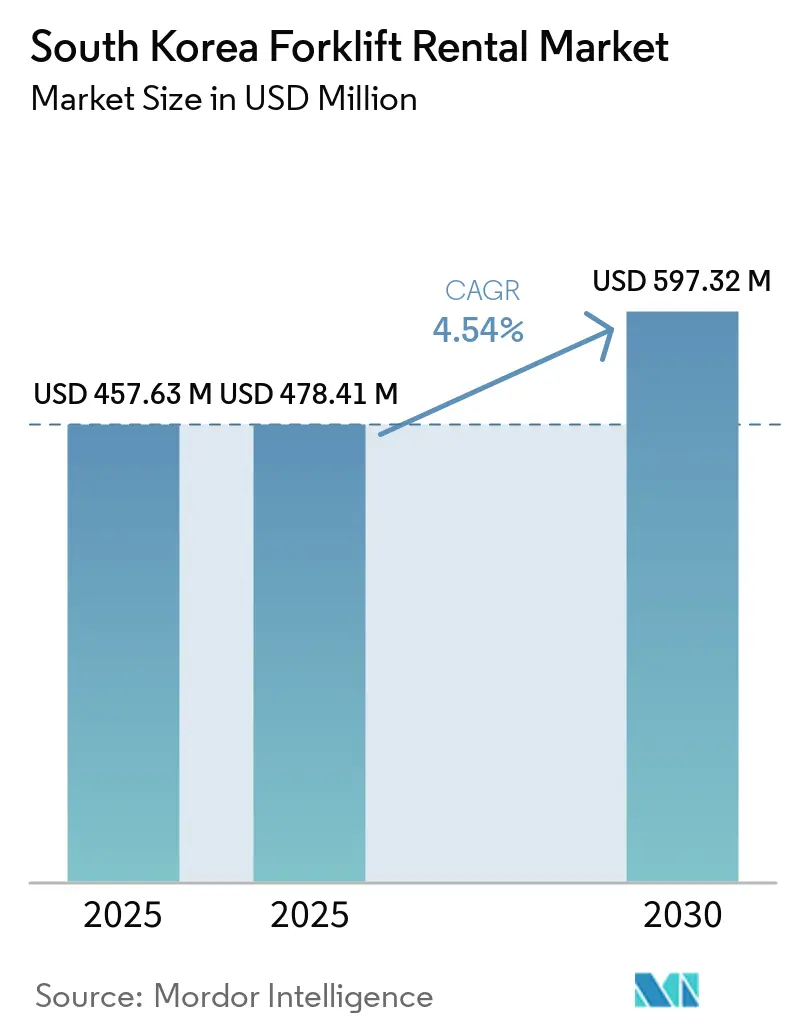
The South Korea forklift rental market size was valued at USD 457.63 million in 2025 and is estimated to expand from USD 478.41 million in 2026 to reach USD 597.32 million by 2031, registering a CAGR of 4.54% between 2026 and 2031. Demand continues to swing toward rental because e-commerce peaks, zero-emission subsidies, and built-in telematics make flexible fleets cheaper and easier to manage than owned trucks. Rental contracts are lengthening in step with OEM analytics platforms that cut downtime and shift risk away from end users. Regionally, the Seoul Capital Area accounts for the largest share of the market value. The Busan-Ulsan-Daegu region is projected to experience the fastest growth, driven by investments in ports, airports, and electric-vehicle-related infrastructure.
Key Report Takeaways
- By load capacity, units less than 3.5 tons accounted for 45.14% of the South Korean forklift rental market size in 2025 and are expected to post a 4.57% CAGR to 2031.
- By rental duration, short-term contracts accounted for 51.27% of the South Korean forklift rental market size in 2025; long-term leases are set to grow at a 4.55% CAGR between 2026 and 2031.
- By power source, electric units accounted for 58.35% of the South Korean forklift rental market in 2025 and are projected to grow at a 4.61% CAGR through 2031.
- By class, Class III held the largest 34.11% of the South Korean forklift rental market size in 2025, while Class I electric rider trucks are expected to post the quickest growth at 4.64% CAGR to 2031.
- By end-use industry, warehousing and logistics held 37.65% of the South Korean forklift rental market share in 2025 and is projected to grow at a 4.67% CAGR through 2031.
- By geography, the Seoul Capital Area led with 56.27% of the South Korean forklift rental market share in 2025, while the Gyeongsang Region is projected to expand at a 4.68% CAGR to 2031.
Note: Market size and forecast figures in this report are generated using Mordor Intelligence’s proprietary estimation framework, updated with the latest available data and insights as of January 2026.
Competitive positioning in South korea includes both locally based firms and those operating across multiple regions. The market landscape in the global forklift rental industry research shows how these players are arranged internationally.
South Korea Forklift Rental Market Trends and Insights
Drivers Impact Analysis*
| Driver | (~) % Impact on CAGR Forecast | Geographic Relevance | Impact Timeline |
|---|---|---|---|
| E-Commerce Warehousing Expansion | +1.2% | Seoul Capital Area, Gyeongsang Region (Daegu) | Medium term (2-4 years) |
| Government Incentives for Zero-Emission Logistics Equipment | +0.9% | National, with early gains in Seoul, Incheon, Ulsan | Short term (≤ 2 years) |
| Rising Construction of Smart Logistics Centres | +0.8% | Seoul Capital Area, Chungcheong Region (Gumi), Gyeongsang Region | Medium term (2-4 years) |
| OEM-Backed Long-Term Leasing Programs Improve Fleet Utilisation | +0.7% | National, concentrated in Seoul, Busan, Ulsan | Long term (≥ 4 years) |
| After-Sales Analytics Platforms Lower Total Rental Lifecycle Costs | +0.5% | Seoul Capital Area, Gyeongsang Region | Medium term (2-4 years) |
| Ageing Workforce Accelerates Shift to Rental with Operator-Assist Tech | +0.4% | National, acute in construction and manufacturing hubs | Long term (≥ 4 years) |
| Source: Mordor Intelligence | |||
E-Commerce Warehousing Expansion Boosts Peak-Period Rental Demand
Coupang’s USD 538 million Jecheon and USD 385 million Daegu fulfillment centers create sharp seasonal spikes that favor month-long forklift rentals over ownership. Retailers such as Daiso now outsource both automation and trucks to rental firms that bundle telematics with software, raising switching costs once data is stored in the provider’s cloud. The Seoul Capital Area’s 2025 share of 56.27% mirrors this warehousing density, yet Busan Port’s plan to more than double capacity to 39.66 million TEU will push new rentals southward. As users experience the flexibility of spot contracts during peak weeks, many opt for year-round leases rather than revert to capex purchases.
Government Incentives for Zero-Emission Logistics Equipment (Electric and Hydrogen Forklifts)
State grants of up to USD 7,692 per electric unit and up to USD 123,077 for hydrogen forklifts reduce acquisition costs for rental fleets and enable lessors to quote competitive rates. These incentives improve the business case for fleet electrification by lowering upfront capital requirements, which remains a key barrier for rental operators managing large equipment portfolios. Doosan Bobcat and Korea Logis Pool have already deployed hydrogen trucks in Gwangyang, showing that subsidies have shifted from pilot programs to broader commercial rollout. This transition indicates growing confidence in low-emission forklift technologies across logistics and industrial applications. Since residual values remain high, providers can lease electric units over shorter cycles and still recover their investments, allowing them to refresh fleets more frequently while maintaining profitability.
Rising Construction of Smart Logistics Centers Under Korea's New Deal
Projects such as the Incheon Port Smart Center and the Gumi Smart Joint Logistics Center use narrow aisles and high racks to maximize storage density, requiring operators to deploy electric reach trucks capable of operating in spaces less than 2 m wide while maintaining efficient pallet handling at height. This operating environment increases the need for compact, maneuverable, and battery-powered equipment that can support high-throughput warehouse operations. Rental firms charge premiums for connected equipment that integrates with warehouse management systems, enabling fleet tracking, utilization monitoring, and improved coordination across warehouse workflows, thereby driving demand for Class I trucks. Hyundai Motor Group’s long-term USD 96.31 billion automation budget indicates increased adoption of vertical storage across supplier parks, reinforcing the shift in the fleet mix toward agile electric rider trucks that can support automated, space-optimized logistics operations.
OEM-Backed Long-Term Leasing Programs Improve Fleet Utilization
Doosan Bobcat, Hyundai Material Handling, and Toyota Material Handling Korea bundle telematics, predictive maintenance, and operator training into 3-5-year contracts to strengthen customer retention and create recurring service revenue. These integrated offerings allow fleet operators to monitor equipment performance, schedule maintenance before failures occur, and improve operator efficiency through structured training. Lotte Rental reports that lithium-electric conversions reduce customer fuel costs by USD 385-462 per truck per month, delivering a quantifiable return that encourages users to commit to longer contract terms. Through data-driven servicing, providers convert maintenance from a cost center into a margin lever, while customers reduce uptime risk, improve fleet reliability, and gain better visibility into operating costs.
Restraints Impact Analysis*
| Restraint | (~) % Impact on CAGR Forecast | Geographic Relevance | Impact Timeline |
|---|---|---|---|
| Supply-Chain Shortages Limit New Forklift Availability for Rental Fleets | -0.6% | National, acute in Seoul and Gyeongsang regions | Short term (≤ 2 years) |
| High Electricity Prices Narrow TCO Gap Vs IC Engine Rentals | -0.4% | National, most pronounced in Seoul Capital Area | Medium term (2-4 years) |
| Fragmented Dealer Network Outside Seoul-Incheon Slows Service Response | -0.3% | Jeolla, Gangwon, Jeju regions | Long term (≥ 4 years) |
| Stricter Safety Regulations Raise Compliance Costs | -0.3% | National, enforcement concentrated in Seoul, Busan, Ulsan | Medium term (2-4 years) |
| Source: Mordor Intelligence | |||
Supply-Chain Shortages Limit New Forklift Availability for Rental Fleets
China supplies nearly 89% of permanent magnets, while Japan provides most precision reducers, creating a concentrated supply base for critical electric forklift components. As a result, electric forklift lead times can extend to a year when trade frictions intensify, or cross-border shipments face delays. During peak periods, rental firms must either keep aging diesel units in service to meet customer demand or decline contracts when fleet availability is constrained, significantly reducing forecast growth. Operators have responded by signing multiyear purchase agreements with OEMs to secure production slots and component availability. Still, these agreements tie up working capital, limit procurement flexibility, and increase pressure on smaller players[1].
High Electricity Prices Narrow TCO Gap vs IC Engine Rentals
Industrial tariffs increased by 70-73% from 2022 to 2024, raising operating costs for equipment providers and end users. Even with the scheduled daytime tariff reduction in 2026, single-shift sites that charge equipment at night face a 5.1 won/kWh increase, as their charging patterns limit the benefits of lower daytime rates. Providers must either absorb the additional cost, which pressures margins, or raise lease rates, which reduces the cost advantage of electric equipment, particularly for budget-sensitive construction clients. Subsidies still offset this headwind and continue to support the adoption of electric equipment. Still, the risk remains if future power tariff increases outpace policy support or reduce the long-term savings expected from electrification.
*Our forecasts treat driver/restraint impacts as directional, not additive. The impact forecasts reflect baseline growth, mix effects, and variable interactions.
Segment Analysis
By Load Capacity: Compact Units Dominate Urban Logistics
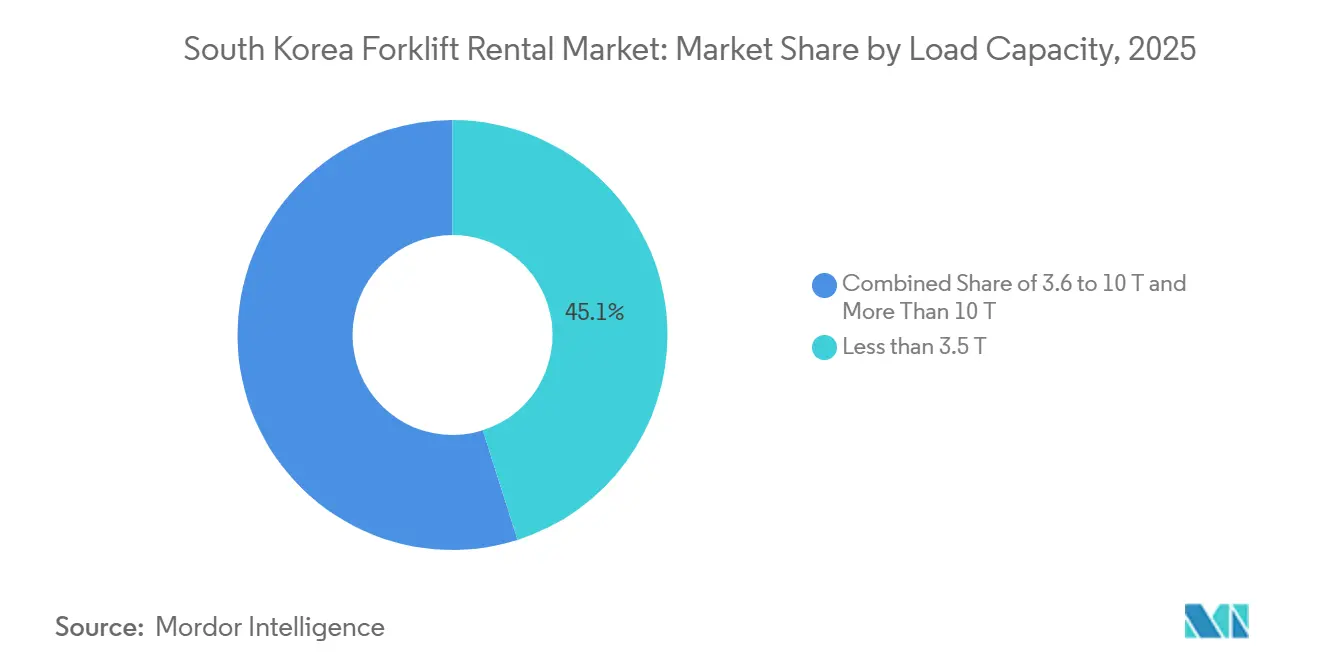
Units less than 3.5 tons accounted for 45.14% of the South Korean forklift rental market share in 2025 and are projected to grow at a 4.57% CAGR through 2031. E-commerce facilities are expanding rapidly, and warehouse operators increasingly need compact trucks that can navigate tight docks and aisles as narrow as 2 meters without disrupting workflow. Government subsidies also provide the greatest cost savings on small electric units, making this segment the most practical and accessible entry point for zero-emission adoption across businesses of all sizes.
Manufacturing facilities, ports, and steel mills continue to require forklifts exceeding 10 tons; however, rental penetration in this segment remains low, as operators prefer to own and directly control high-value assets. The 3.6-10-ton segment faces constrained demand as clients split duty cycles between light electric units for indoor operations and heavy diesel forklifts for yard work. This practical split in usage patterns reduces the need for mid-range rentals, leaving this segment caught between two clearly defined operational preferences.

By Rental Duration: Spot Demand Leads, Long-Term Leases Gain Traction
Short-term contracts of under one month accounted for 51.27% of the South Korean forklift rental market share in 2025, driven by peak-season e-commerce activity and project-based demand. Retailers and logistics operators rely on these arrangements to manage sudden volume spikes without committing to long-term financial obligations. At the same time, embedded telematics and predictive maintenance are making 3- to 5-year contracts more financially attractive, with that segment projected to grow at a CAGR of 4.55% in the South Korean forklift rental market.
Mid-term rentals between one and twelve months are losing share, as customers either transition to managed long-term agreements once demand stabilizes or revert to short-term hire for purely seasonal needs. This middle ground often fails to offer the flexibility of spot hire or the cost efficiency of longer commitments. Providers also prefer longer contracts, as customer acquisition costs are spread across more invoices, improving overall margin predictability and reducing the burden of frequent client onboarding.
By Power Source: Electric Dominance Accelerates Despite Price Headwinds
Electric forklifts accounted for 58.35% of the South Korean forklift rental market share in 2025 and are projected to grow at a 4.61% CAGR, supported by government subsidies, lower daytime electricity tariffs, and corporate ESG targets. Fleet managers increasingly find the economics straightforward: Lotte Rental data indicate monthly fuel savings of approximately USD 400 per truck, which supports a favorable ROI for customers operating double or triple shifts. As energy costs rise and sustainability reporting becomes standard practice, more businesses are switching to electric.
Diesel and LPG forklifts remain relevant for outdoor applications, where range and refueling speed still matter. Hydrogen-powered units are gaining traction at ports where battery swapping slows container flow and operational continuity is critical. Overall, the internal combustion engine segment continues to lose market share as electrification becomes the default choice for indoor and mixed-use operations. That said, supply chain delays in battery procurement remain a short-term constraint on electric fleet growth, tempering an otherwise steady transition.
By Class: Narrow-Aisle Demand Shifts Mix Toward Class I
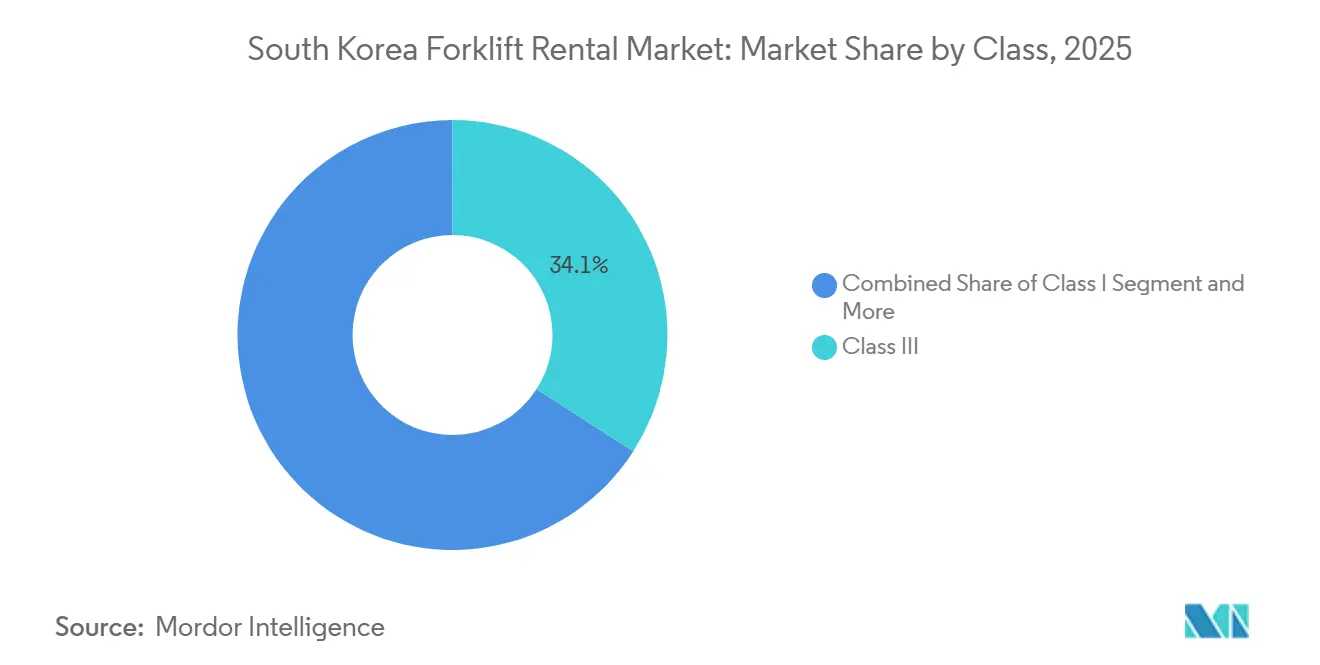
Class III walk-behinds accounted for 34.11% of the South Korean forklift rental market share in 2025, reflecting their widespread use in retail and light warehousing operations. Class I electric riders are projected to record the fastest CAGR of 4.64%, driven by smart distribution centers that stack pallets up to 12 m high and operate with narrower aisles. Connected reach trucks integrate with warehouse management systems, enabling rental providers to charge premium rates and guarantee equipment uptime, making them an increasingly preferred choice among operators.
Class IV and V diesel cushion and pneumatic forklifts continue to serve yards and construction sites, where outdoor terrain and heavy loads remain a practical reality. However, their market share is declining annually as zero-emission regulations tighten in urban areas. Operators are increasingly weighing the compliance risks and maintenance costs of older engines against the operational simplicity and predictable expenses of managed electric fleets. This shift is gradually reshaping rental demand across these segments.
By End-Use Industry: Warehousing Leads, Construction Faces Labor Constraints
Warehousing and logistics accounted for 37.65% of the South Korean forklift rental market share in 2025 and grew at a 4.67% CAGR, driven by Coupang, Daiso, and inbound semiconductor cargo. Rapid e-commerce fulfillment cycles and tighter inventory management have pushed operators to rely more heavily on rental fleets rather than owned equipment. Construction growth lags despite a 120,000-worker deficit, as many contractors still prefer outright purchases for long-duration projects, slowing rental penetration in that segment.
Automotive EV expansion in Ulsan and Busan is driving demand for specialized battery pack rentals, as manufacturers require equipment that meets strict handling standards. Food cold-chain operations require electric forklifts but face margin pressure from oversupplied storage capacity, making cost control a daily concern for operators. Aerospace and defense budgets are increasing; however, procurement regulations require ISO-certified fleets, favoring large lessors with strong audit trails and consistent compliance records.
Geography Analysis
The Seoul Capital Area accounted for 56.27% of the South Korean forklift rental market share in 2025, driven by dense fulfillment clusters linked to Samsung chip operations and Coupang parcel logistics. The region's infrastructure maturity and high operational density make it the natural anchor of South Korea's forklift market, and that position is unlikely to shift in the near term.
The Gyeongsang Region is projected to record the fastest CAGR of 4.68% through 2031. The expansion of Busan Port and the development of Gadeokdo Airport are generating sustained cargo volumes, while Hyundai's electric vehicle plant is driving growth in associated supplier parks. Hydrogen forklifts appear here first because refueling stations come bundled with port logistics projects [2]. For operators already active in the area, this creates a practical first-mover advantage in hydrogen-powered material handling.
The Chungcheong Region is benefiting from the Gumi smart manufacturing hub, which serves the semiconductor and electronics industries. The Jeolla, Gangwon, and Jeju regions continue to lag due to limited dealer networks that slow service delivery. Aging rural workforces are increasing demand for operator-assist technologies; however, rental market growth in these areas depends on providers establishing local support depots. Without that investment, demand will remain unmet, leaving a visible gap between what the market needs and what it can access.
Mordor Intelligence tracks the forklift rental market across other major regions such as North America, with additional country-level coverage spanning Indonesia, United States, Saudi Arabia, Brazil, and United Arab Emirates, each reflecting localized structural drivers, restraints and more.
Competitive Landscape
The South Korean forklift rental market is fragmented, with most companies holding small market shares. Competition is distributed across national operators, OEM-backed lessors, and regional rental providers. No single player dominates, and the gap between the largest and smallest operators remains wide enough to sustain a diverse competitive landscape.
OEMs such as Doosan Bobcat and Hyundai Material Handling are gaining share from independent providers by offering direct, long-term leases integrated with analytics, preventive maintenance support, and fleet performance monitoring. Technology has become a key competitive area as customers prioritize safety, uptime, and operating efficiency. Solutions such as Nextcore IoT, SkyAutoNet vision systems, and Grow-Space positioning differentiate large fleets that can absorb USD 3,000 per truck in safety upgrade costs and spread these investments across a larger installed base, making it harder for smaller operators to keep pace.
Smaller regional players face pressure under the Serious Accidents Punishment Act, which is increasing compliance requirements, raising operating costs, and driving consolidation among operators with limited capital. Those unable to meet rising standards are finding it difficult to remain competitive on their own. Hydrogen pilots in Gwangyang and Busan indicate a premium niche where subsidy economics and port duty cycles align, particularly for high-utilization applications that can support early adoption of alternative-power forklifts.
South Korea Forklift Rental Industry Leaders
-
AJ Networks
-
KION Group
-
Doosan Bobcat
-
Lotte Rental
-
Hyundai Material Handling
- *Disclaimer: Major Players sorted in no particular order
Recent Industry Developments
- April 2026: German intralogistics company Jungheinrich launched its new AntOn by Jungheinrich smart warehouse trucks in South Korea at the KOREA MAT 2026 exhibition—an effort aimed at supporting the development of a large, localized distributor rental network. The product portfolio included lithium-ion reach trucks, automated pallet trucks, and digital fleet management systems with advanced telematics capabilities.
- November 2024: Doosan Bobcat, Gwangyang City, and Korea Logis Pool signed a memorandum of understanding (MOU) to supply hydrogen forklifts, with rental services included in the rollout plan.
- October 2024: Doosan Bobcat acquired Doosan Mottrol, bolstering vertical integration of hydraulic components for its forklift and construction-equipment lines.
South Korea Forklift Rental Market Report Scope
The scope of the report includes Load Capacity (Less Than 3.5 T, 3.6 to 10 T, and More Than 10 T), Rental Duration (Short-term/Spot, Mid-term, and Long-term Lease), Power Source (Electric, Internal Combustion (Diesel/LPG), and Hybrid / Hydrogen Fuel-cell), Class (Class I, Class II, Class III, Class IV, and Class V), End-Use Industry (Warehousing and Logistics, Construction, Automotive, Food and Beverage, Aerospace and Defense, and Others (Retail, Pharma, etc.)), and Region (Seoul Capital Area, Gyeongsang Region, Chungcheong Region, Jeolla Region, and Gangwon and Jeju). The Market Forecasts are Provided in Terms of Value (USD).
| Less Than 3.5 T |
| 3.6 to 10 T |
| More Than 10 T |
| Short-term / Spot (Less than 1 month) |
| Mid-term (1 to 12 months) |
| Long-term Lease (3 to 5 years) |
| Electric |
| Internal Combustion (Diesel/LPG) |
| Hybrid / Hydrogen Fuel-cell |
| Class I |
| Class II |
| Class III |
| Class IV |
| Class V |
| Warehousing and Logistics |
| Construction |
| Automotive |
| Food and Beverage |
| Aerospace and Defense |
| Others (Retail, Pharma, etc.) |
| Seoul Capital Area |
| Gyeongsang Region (Busan, Ulsan, Daegu) |
| Chungcheong Region |
| Jeolla Region |
| Gangwon and Jeju |
| By Load Capacity | Less Than 3.5 T |
| 3.6 to 10 T | |
| More Than 10 T | |
| By Rental Duration | Short-term / Spot (Less than 1 month) |
| Mid-term (1 to 12 months) | |
| Long-term Lease (3 to 5 years) | |
| By Power Source | Electric |
| Internal Combustion (Diesel/LPG) | |
| Hybrid / Hydrogen Fuel-cell | |
| By Class | Class I |
| Class II | |
| Class III | |
| Class IV | |
| Class V | |
| By End-use Industry | Warehousing and Logistics |
| Construction | |
| Automotive | |
| Food and Beverage | |
| Aerospace and Defense | |
| Others (Retail, Pharma, etc.) | |
| By Region | Seoul Capital Area |
| Gyeongsang Region (Busan, Ulsan, Daegu) | |
| Chungcheong Region | |
| Jeolla Region | |
| Gangwon and Jeju |
Key Questions Answered in the Report
What are the current market size and growth prospects of the South Korean forklift rental market?
The South Korea forklift rental market size was valued at USD 457.63 million in 2025 and is estimated to expand from USD 478.41 million in 2026 to reach USD 597.32 million by 2031, registering a CAGR of 4.54% between 2026 and 2031.
Which sectors rent the most forklifts in 2025?
Warehousing and logistics users accounted for 37.65% of demand in 2025 and are expected to remain the largest customer base through 2031.
How do government incentives shape rental pricing?
Subsidies lower the lessor’s capital cost, letting providers quote competitive monthly rates while still protecting margins.
Which region is set to grow fastest for rentals?
The Gyeongsang Region, anchored by Busan Port and Ulsan’s EV projects, is projected to post a 4.68% CAGR through 2031.
What do executives weigh when choosing between renting and owning forklifts?
Key factors include peak-season flexibility, embedded telematics for uptime guarantees, compliance with zero-emission rules, and avoidance of large upfront capex.