
Saudi Arabia Forklift Rental Market Size and Share
Market Overview
| Study Period | 2019 - 2031 |
|---|---|
| Forecast Data Period | 2026 - 2031 |
| Base Year Market Size (2025) | USD 131.25 Million |
| Market Size (2026) | USD 139.53 Million |
| Market Size (2031) | USD 189.47 Million |
| Growth Rate (2026 - 2031) | 6.31 % |
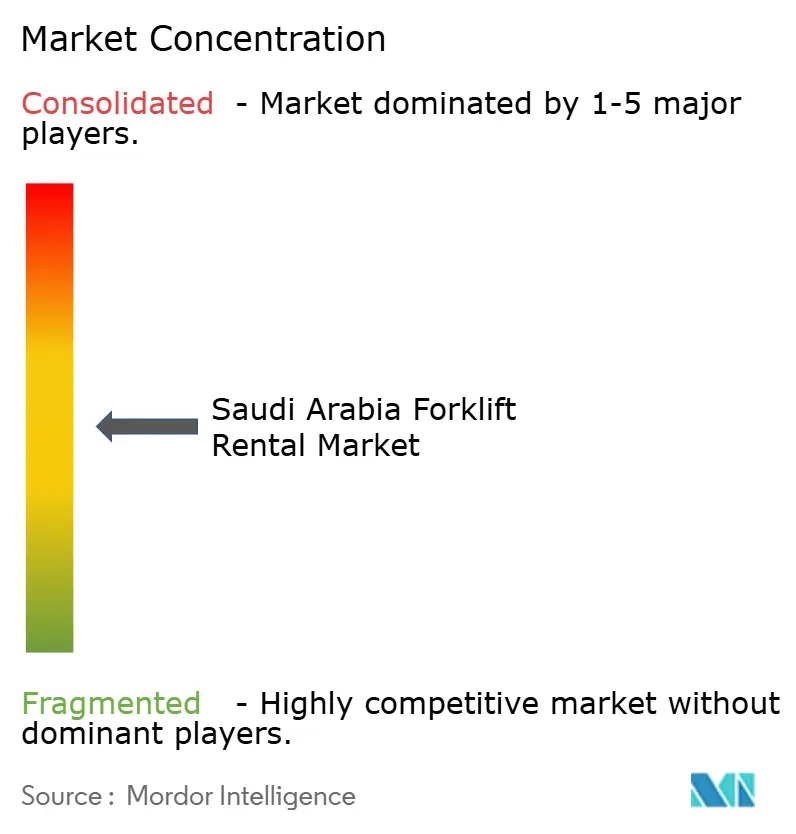
| Market Concentration | Medium |
Major Players *Disclaimer: Major Players sorted in no particular order Image © Mordor Intelligence. Reuse requires attribution under CC BY 4.0. | |
Saudi Arabia Forklift Rental Market Analysis by Mordor Intelligence
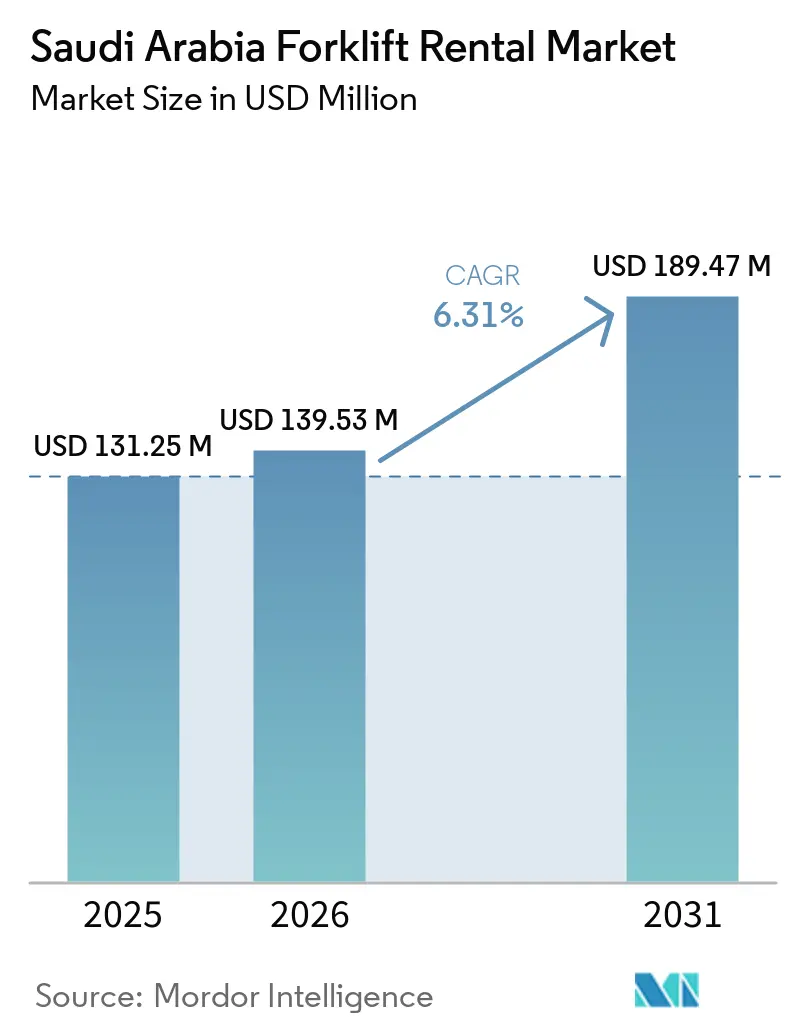
The Saudi Arabia forklift rental market size was valued at USD 131.25 million in 2025 and is estimated to grow from USD 139.53 million in 2026 to USD 189.47 million by 2031, at a CAGR of 6.31% during the forecast period (2026-2031). In a bid to conserve cash, developers, contractors, and e-commerce operators are increasingly opting for operating leases over ownership. This trend is bolstered by Vision 2030's ambitious non-oil capital-expenditure pipeline and the imposition of stringent Saudization wage floors, which have driven up payroll costs. The demand for these leases is further underscored by a significant increase in warehouse floor space, which is being added across multiple hubs. This expansion has been pivotal in ensuring consistent fleet utilization for both commissioning and daily operations. As lithium-ion battery prices decline and the rollout of fast chargers accelerates nationwide, electric models are taking the lead in new orders. Meanwhile, mega-projects like NEOM, Qiddiya, and the Red Sea Project are generating a steady demand for heavy-lift operations, pushing the limits beyond the utilization break-even point typically associated with outright purchases.
Key Report Takeaways
- By load capacity, the 3.6 to 10 ton segment led with 46.25% of the Saudi Arabia forklift rental market share in 2025, while the above-10-ton category is projected to expand at a 9.63% CAGR through 2031.
- By rental duration, mid-term contracts (1–12 months) accounted for 42.10% of demand in 2025, whereas long-term leases (3–5 years) are forecast to grow at an 8.76% CAGR to 2031.
- Electric forklifts captured 55.30% share in 2025 and are set to advance at a 12.18% CAGR over 2026-2031, outpacing internal-combustion alternatives.
- Class IV internal-combustion cushion-tire models held 30.95% of demand in 2025, while Class I electric rider trucks are poised for a 10.07% CAGR through 2031.
- Warehousing and logistics accounted for 39.85% of demand in 2025, yet the e-commerce subsegment is expected to grow at a 13.48% CAGR through 2031.
- Eastern Province accounted for 33.90% of revenues in 2025, but Western Province is on track for the fastest regional expansion, with a 11.36% CAGR to 2031.
Note: Market size and forecast figures in this report are generated using Mordor Intelligence’s proprietary estimation framework, updated with the latest available data and insights as of January 2026.
Proportional positioning is established by comparing country level and regional contributions against the global total, including that of Saudi arabia. The forklift rental market share in our global report expresses these relative weights.
Saudi Arabia Forklift Rental Market Trends and Insights
Drivers Impact Analysis*
| Driver | (~) % Impact on CAGR Forecast | Geographic Relevance | Impact Timeline |
|---|---|---|---|
| Vision 2030 Logistics Build-Out | +2.1% | National, concentrated in Eastern and Western Provinces | Long term (≥ 4 years) |
| E-Commerce Warehouse Boom | +1.8% | National, with early gains in Riyadh, Jeddah, Dammam | Medium term (2–4 years) |
| Mega-Projects (NEOM, Red Sea, Qiddiya) | +1.6% | Western Province primary, spill-over to Northern Region | Long term (≥ 4 years) |
| Cap-Ex Shift to Rental Model | +0.9% | National, accelerated in industrial zones | Short term (≤ 2 years) |
| Green-Hydrogen Forklift Pilots | +0.7% | Eastern Province industrial complexes, NEOM development | Medium term (2–4 years) |
| Localization Tax Incentives on E-Forklifts | +0.5% | National, concentrated in manufacturing hubs | Short term (≤ 2 years) |
| Source: Mordor Intelligence | |||
Vision 2030 Logistics Build-Out Transforms Equipment Demand
A significant expansion of warehouses has spurred a nationwide surge in leasing, both during facility fit-outs and subsequent operations. The Ministry of Transport and Logistics Services is spearheading a large privatization initiative, nudging developers to opt for forklift operating leases to sidestep balance-sheet strains. King Abdulaziz Port's Terminal 2, boasting an additional quay and increased capacity, necessitates rental companies to pre-stage Class IV and V trucks for efficient container handling. In a strategic move, automotive aftermarket hubs like Alissa Universal Motors have established large spare-parts warehouses, further entrenching their presence in the Eastern Province. While the Eastern Province accounted for a significant portion of demand, the Western Province is on a faster trajectory, signaling a geographic shift, especially as Jeddah's port-centric parks prepare to commence operations[1].
E-Commerce Warehouse Boom Drives Rental Acceleration
Noon expanded its network significantly, inaugurating a new center in Riyadh, while Amazon made a substantial leap by doubling its footprint in Saudi Arabia with a large fulfillment facility[2]. Operators in this space favor flexible leases, often adjusting to align with peaks during Ramadan and year-end, which explains the mid-term segment's notable share. These operators are increasingly turning to lithium-ion electric fleets, drawn by their rapid charging capabilities, which have driven growth in the power-source segment. Given the tight margins in e-commerce logistics, rental firms are responding by offering telematics, enabling real-time utilization tracking and performance-based pricing. While the warehousing-and-logistics segment commands a substantial share, its e-commerce component is poised for robust growth, outpacing the traditional 3PL growth rate.
Mega-Projects Create Sustained Industrial Equipment Demand
NEOM's Oxagon, the tourism expansion along the Red Sea, and Qiddiya's entertainment district are setting the stage for decades of construction. Developers are responding by securing multi-year leases, a strategy designed to navigate the fluctuations of diesel prices and the rising costs of spare parts. Byrne, after selling a majority equity stake to GFH Financial Group, established a dedicated depot in NEOM and is in the process of setting up a headquarters in Jubail. The Heavy Equipment Conference announced joint ventures worth billions, focusing on domestic production of cranes and reach-stackers, a move that significantly reduces import lead times. However, these mega-projects are not immune to the whims of oil-price fluctuations. For instance, Aramco's decision to slash capital expenditure has led to delays in downstream expansions, leaving pre-positioned fleets in Jubail underutilized.
Cap-Ex Shift to Rental Model Optimizes Cash Flow
In the sweltering heat, machines experience a shortened lifespan, especially when exposed to abrasive dust. This reality makes rentals appealing, particularly for users who average below optimal utilization or about six hours daily. Rental providers, on the other hand, shoulder the burden of maintenance costs. This includes not just routine upkeep but also overhauls of cooling systems. Furthermore, they offer the flexibility to scale their fleet based on demand phases. According to EJAR, there's a notable shift from CAPEX to OPEX. This trend aligns with the broader equipment-rental market, which is projected to grow significantly. The financial prudence adopted during the pandemic underscored a preference for liquidity. Meanwhile, competitive pressures mount as affordable Chinese OEMs, such as SANY and XCMG, challenge established players, prompting them to devise more attractive lease offerings.
Restraints Impact Analysis*
| Restraint | (~) % Impact on CAGR Forecast | Geographic Relevance | Impact Timeline |
|---|---|---|---|
| Oil-Price Investment Cyclicality | -0.8% | National, concentrated in Eastern Province industrial zones | Short term (≤ 2 years) |
| Skilled-Operator Shortage | -0.6% | National, acute in Northern and Southern Regions | Medium term (2–4 years) |
| Saudization Cost Pressures | -0.4% | National, varying by company size and sector | Medium term (2–4 years) |
| Spare Parts Supply Chain Delays | -0.3% | Western and Central logistics corridors | Short term (≤ 2 years) |
| Source: Mordor Intelligence | |||
Oil-Price Investment Cyclicality Affects Industrial Spending
Aramco allocates significant capital expenditure primarily towards upstream assets, leaving downstream budgets exposed, especially when Brent prices dip below a certain threshold. Similarly, SABIC mirrors this prioritization in its spending plan. As a result, expansions in Jubail are being tempered by weak polyethylene margins. At the same time, a fiscal deficit is hindering the establishment of new government logistics zones, leading to delays in forklift orders. While substantial investments are projected for Vision 2030, a significant portion is channeled into non-oil projects, which promise more reliable timelines. In response to these dynamics, rental companies are broadening their horizons, venturing into warehousing, construction, and automotive sectors as a buffer against oil market fluctuations.
Skilled-Operator Shortage Constrains Market Growth
In Jubail, while Saudization quotas have set the minimum engineering wage at SAR 8,000 per month, the number of vacancies exceeds the number of qualified Saudi candidates by a significant margin. National initiatives aim to localize a substantial number of jobs, intensifying wage inflation for both depot and field-service personnel. The availability of Saudi planning engineers stands in stark contrast to the job openings, leading rental firms to establish in-house training academies. For instance, Dayim operates an IPAF-certified center, and Byrne has recruited graduates from Jubail Industrial College. This talent crunch extends to operator positions, constraining the turnkey services increasingly sought after by around-the-clock e-commerce warehouses. Furthermore, delays in accreditation programs not only impede swift workforce expansion but also stifle revenue streams reliant on service offerings.
*Our forecasts treat driver/restraint impacts as directional, not additive. The impact forecasts reflect baseline growth, mix effects, and variable interactions.
Segment Analysis
By Load Capacity: Heavy-Duty Demand Accelerates Industrial Growth
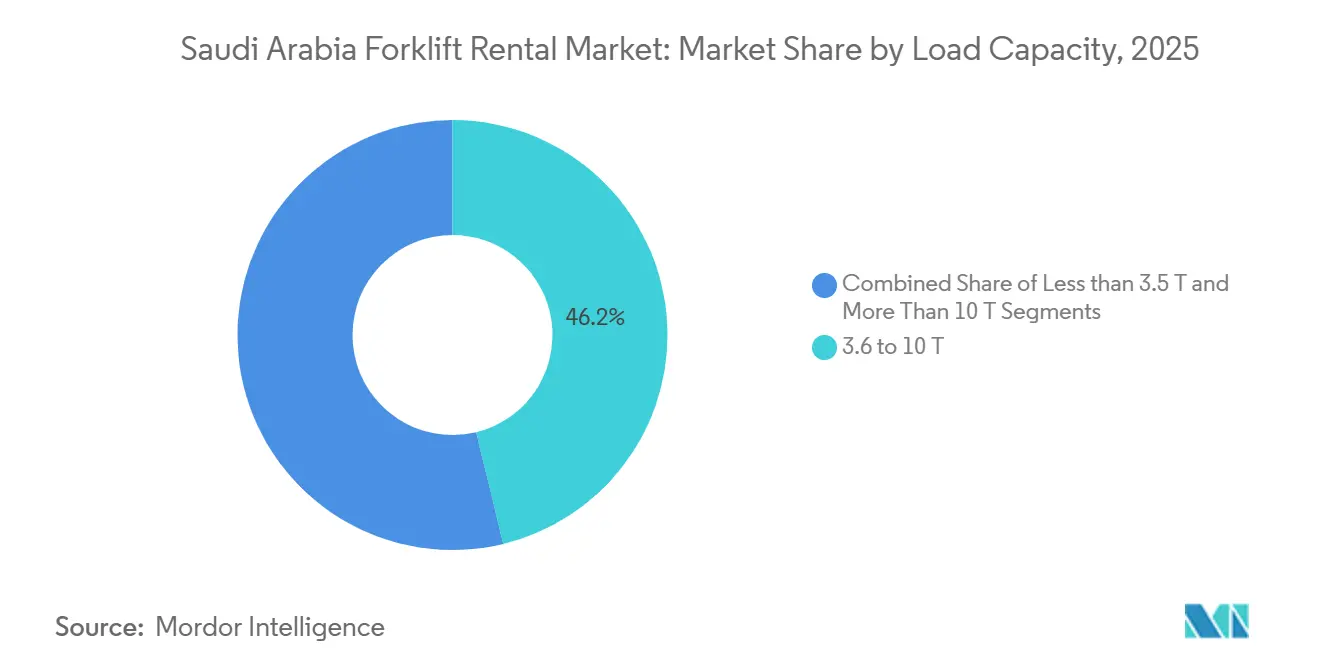
The 3.6 to 10 ton segment commanded 46.25% market share in 2025, reflecting broad industrial applications across warehousing, construction, and manufacturing sectors that require moderate lifting capacity for standard operations. Heavy-duty forklifts above 10 tons are the fastest-growing segment, with a 9.63% CAGR through 2031, driven by mega-project requirements and industrial complex expansions that demand specialized material-handling capabilities. The King Salman Energy Park (SPARK) and similar industrial developments require heavy-duty equipment for petrochemical processing and large-scale manufacturing operations, creating sustained demand for high-capacity units. Light-duty units under 3.5 tons serve niche applications in retail and small-scale logistics operations, maintaining steady demand but limited growth potential as the market shifts toward larger-scale industrial applications.
Local production enhances fleet agility: AHQ's rough-terrain crane plant and Wolffkran's tower-crane factory are set to commence operations. The sub-3.5-tonne segment plays a pivotal role in narrow-aisle e-commerce hubs, prioritizing energy efficiency and maneuverability over payload. With lithium-ion models achieving faster charging cycles, rental companies are strategically aligning smaller units with multi-shift fulfillment centers in Riyadh and Jeddah. As a result, the Saudi Arabian forklift rental industry is charting two distinct growth trajectories: mass-market mid-payload units cater to widespread logistics, while heavy-lift trucks are predominantly stationed at mega-project sites.

By Rental Duration: Long-Term Contracts Gain Strategic Preference
Mid-term rentals (1 to 12 months) capture 42.10% market share in 2025, aligning with construction project timelines and seasonal demand fluctuations that characterize Saudi industrial activity patterns. Long-term leases (3-5 years) grow fastest, with a 8.76% CAGR through 2031, reflecting companies' strategic shift toward predictable operational expenses and equipment modernization cycles that rental arrangements facilitate more effectively than ownership. The 59 logistics centers planned under Vision 2030 create multi-year equipment requirements that favor long-term rental contracts, providing revenue stability for equipment providers while offering cost predictability for logistics operators. Short-term spot rentals remain relevant for emergency replacements and peak-season capacity augmentation, though their market share contracts as companies optimize equipment planning processes.
The Regional Headquarters (RHQ) program's requirement for multinational companies to establish Saudi operations creates demand for flexible rental arrangements that accommodate business development uncertainties while maintaining operational capabilities. CEVA Logistics and Almajdouie Logistics' October 2024 joint venture demonstrates how strategic partnerships require long-term equipment commitments to support integrated logistics operations across multiple facilities. The shift toward longer rental durations reflects equipment users' preference for operational flexibility without capital commitment, particularly as technological advancement accelerates equipment obsolescence cycles.
By Power Source: Electric Dominance Reflects Sustainability Mandates
Electric forklifts held a 55.30% share in 2025 and are forecast to grow at a 12.18% CAGR through 2031 as battery costs decline and charging coverage spreads. Smart Mobility and Foxconn FIT are set to launch a charger plant at SPARK Dammam, boosting the availability of industrial fast chargers. EVIQ plans to install public fast chargers across several cities, alleviating range anxiety for operators in the material handling industry.
The forklift rental industry in Saudi Arabia is exploring hydrogen technology; Abdul Latif Jameel Machinery has advanced its fuel-cell tests at Princess Nourah University. While internal-combustion units remain vital for outdoor, heavy-duty tasks—particularly on construction sites without grid access—hybrid variants, though niche, provide diesel redundancy and reduced indoor emissions. A tax-break decree for locally assembled electric forklifts is spurring their adoption in cold-chain and FMCG warehouses.
By Truck Class: Versatile Class IV Leads Market Applications
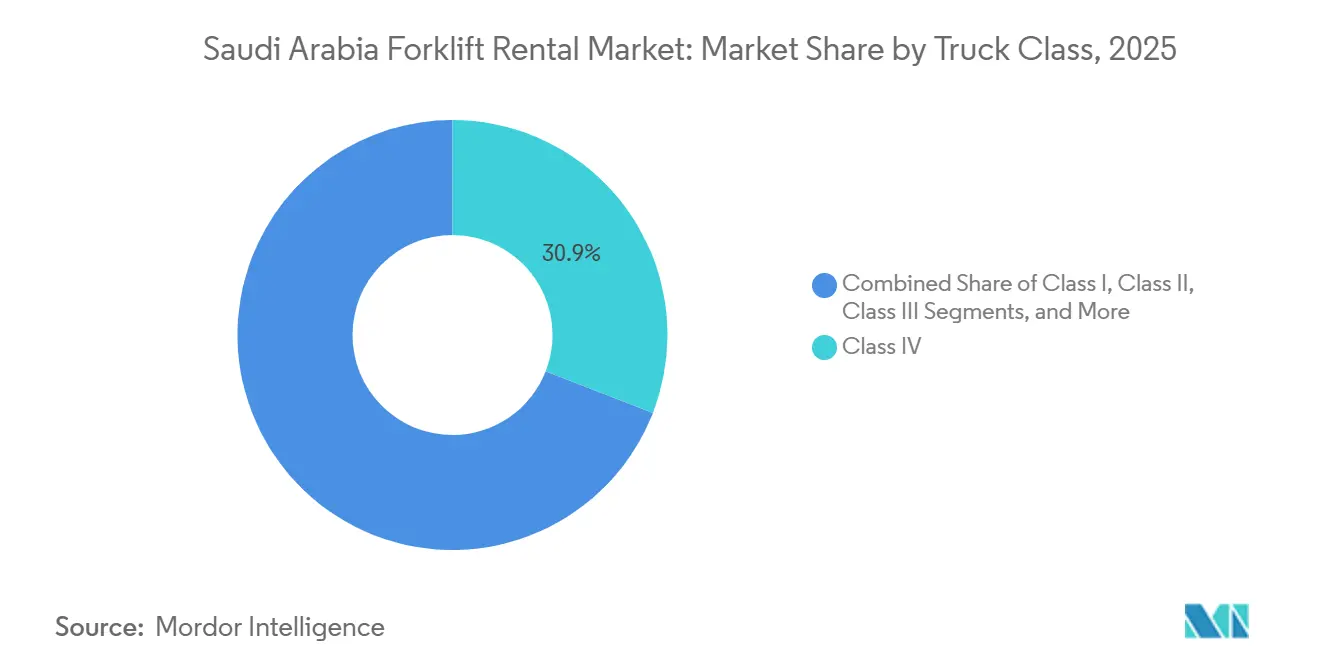
Class IV internal-combustion cushion-tire trucks delivered 30.95% of 2025 revenue, buoyed by port container handling and outdoor construction. Yet Class I electric rider trucks are poised for a 10.07% CAGR, driven by warehouse densification and environmental mandates in fulfillment centers. DP World’s Jeddah Logistics Park, set to offer extensive pallet positions, will depend significantly on Class I and II fleets for its put-away and picking tasks. To facilitate future asset rotation, Dayim introduced a certified used-equipment marketplace, providing maintenance records and telematics histories to enhance confidence in residual values.
However, automation brings a potential challenge: autonomous mobile robots might reduce the long-term demand for Class I in new sites. On the other hand, Class V pneumatic-tire units, especially those over 10 tonnes, are predominantly found at mega-project depots, resonating with the heavy-lift focus of modular construction. This division underscores a rapidly evolving Saudi Arabian forklift rental market, distinguishing between indoor electric efficiency and outdoor heavy-duty strength.
By End-Use Industry: E-Commerce Drives Warehousing Transformation
Warehousing and logistics applications dominate with 39.85% market share in 2025, though e-commerce warehousing subsegments are accelerating at a 13.48% CAGR through 2031 as digital commerce infrastructure scales rapidly across Saudi urban centers. With substantial construction output projected and ongoing mega-project developments, the demand for material handling equipment in the construction sector remains robust. In the automotive sector, a surge in industrial investment has expanded manufacturing capacity, necessitating greater material-handling support. Meanwhile, sectors such as food and beverage, aerospace and defense, retail, and pharmaceuticals continue to show steady demand, driven by the country's economic diversification efforts.
Saudi Arabia's logistics market is experiencing sector-wide expansion, bolstering forklift rental demand across various industries. Arabian Machinery & Heavy Equipment Co. (AMHEC), with a significant fleet of light equipment, caters to major clients such as Saudi Aramco and SABIC, underscoring the strong ties between rental firms and pivotal industrial players. Furthermore, with numerous planned logistics centers spanning a vast area, the demand landscape is diverse. This not only lessens rental companies' reliance on any single industry's cycles but also unveils growth avenues across a spectrum of sectors.
Geography Analysis
Eastern Province produced 33.90% of the 2025 turnover. Dammam's expansive integrated logistics zone and Jubail's thriving petrochemical clusters anchor the region's economic activities. King Abdulaziz Port, which accounts for a significant share of the kingdom's non-oil imports, expanded capacity, driving increased demand for Class IV and V rentals. However, the long-term outlook remains uncertain due to sensitivity to oil prices. Notably, Aramco's strategic pause on certain downstream projects reflects a significant cap-ex realignment.
Western Province is forecast to expand at a 11.36% CAGR. DP World is spearheading the development of the Jeddah Logistics Park, set to debut with extensive warehousing and pallet slots. Meanwhile, Jeddah Islamic Port undergoes modernization to enhance its capacity, and Mawani invests in a cold-chain zone, collectively broadening the spectrum of end-use requirements.
Riyadh, at the heart of the Central Region, is witnessing a surge in e-commerce hubs and the construction of Qiddiya's entertainment complex. Both Noon and Amazon inaugurated their facilities, with Noon boasting a large space and Amazon a sprawling site, leading to a spike in mid-term leases. Riyadh's ambitious Vision 2030 aims to accelerate the adoption of electric vehicles (EVs), bolstering the forecasted rise in electric forklifts. While the Northern and Southern Regions produce smaller volumes, they are buoyed by mining and agriculture, industries that require rough-terrain units to navigate uneven landscapes. Together, the Eastern and Western Provinces are projected to dominate, accounting for the majority of value in Saudi Arabia's forklift rental market.
Mordor Intelligence examines the forklift rental market across diverse other regional markets as well, including North America, while also offering granular country-level perspectives for United Arab Emirates, United States, Indonesia, South Korea, and Brazil and more.
Competitive Landscape
International OEM-backed dealers and independent local renters are actively competing in a moderate landscape. Abdul Latif Jameel Machinery Trading Co., Ltd. boasts one of the largest branded fleets, partnering with key OEM distributors such as Alkhorayef Group and Al-Jomaih Equipment. Meanwhile, regional distribution and field service are anchored by Kanoo Machinery and Zahid Group (EJAR).
Byrne Equipment Rental, with its large fleet and significant market share in the UAE, demonstrates the scale required to serve major industrial clients. Concurrently, the company's strategic emphasis on the Red Sea and NEOM regions highlights its geographic specialization. White-space opportunities are emerging in specialized applications, including green hydrogen forklift pilots and automated warehouse integration, where technology adoption creates premium rental segments with higher margins and longer contract durations. White-space opportunities emerge in specialized applications, including green hydrogen forklift pilots and automated warehouse integration, where technology adoption creates premium rental segments with higher margins and longer contract durations[3].
Regulatory compliance through SASO’s Saber certification favors incumbents with documented safety records. Suppliers that add lithium-ion or hydrogen fuel-cell models, along with predictive-maintenance analytics, are achieving price premiums and multi-year renewals. No single participant controls more than 25% of spend, keeping pricing rational but not restrictive.
Saudi Arabia Forklift Rental Industry Leaders
-
Abdul Latif Jameel Machinery Trading Co., Ltd
-
Kanoo Machinery
-
Alkhorayef Group
-
Zahid Group (EJAR)
-
Al-Jomaih Equipment
- *Disclaimer: Major Players sorted in no particular order
Recent Industry Developments
- January 2026: In collaboration with Toyota, Abdul Latif Jameel Machinery has progressed its hydrogen fuel-cell forklift pilot at Princess Nourah University. This initiative aims to explore the potential of hydrogen fuel-cell technology for material-handling equipment, aligning with global sustainability goals and the growing demand for eco-friendly industrial solutions.
- May 2025: Dayim Equipment Rental has rolled out its first batch of state-of-the-art forklifts in the UAE, underscoring a pivotal step in its expansion blueprint. These forklifts stem from a strategic USD 15 million order with Hangcha Forklift. This initial delivery heralds a broader deployment to bolster Dayim’s extended rental agreements across the UAE, Saudi Arabia, Kuwait, and other key markets.
Saudi Arabia Forklift Rental Market Report Scope
The Saudi Arabia forklift rental market report is segmented by load capacity (less than 3. 5 t, 3. 6 to 10 t, and more than 10 t), rental duration (short-term/spot, mid-term, and long-term lease), power source (electric, internal combustion, and hybrid), truck class (class I, class II, class III, class IV, and class V), end-use industry (warehousing and logistics, construction, automotive, food and beverage, and aerospace and defense, and others), and geography. The market forecasts are provided in terms of value (USD).
| Less than 3.5 T |
| 3.6 to 10 T |
| More Than 10 T |
| Short-term/Spot (Less than 1 month) |
| Mid-term (1 to 12 months) |
| Long-term Lease (3 to 5 years) |
| Electric |
| Internal Combustion (Diesel/LPG) |
| Hybrid |
| Class I |
| Class II |
| Class III |
| Class IV |
| Class V |
| Warehousing and Logistics |
| Construction |
| Automotive |
| Food and Beverage |
| Aerospace and Defense |
| Others (Retail, Pharma, etc.) |
| Central Region (Riyadh) |
| Eastern Province (Dammam, Jubail) |
| Western Province (Jeddah, Makkah) |
| Northern Region |
| Southern Region |
| By Load Capacity | Less than 3.5 T |
| 3.6 to 10 T | |
| More Than 10 T | |
| By Rental Duration | Short-term/Spot (Less than 1 month) |
| Mid-term (1 to 12 months) | |
| Long-term Lease (3 to 5 years) | |
| By Power Source | Electric |
| Internal Combustion (Diesel/LPG) | |
| Hybrid | |
| By Truck Class | Class I |
| Class II | |
| Class III | |
| Class IV | |
| Class V | |
| By End-use Industry | Warehousing and Logistics |
| Construction | |
| Automotive | |
| Food and Beverage | |
| Aerospace and Defense | |
| Others (Retail, Pharma, etc.) | |
| By Region | Central Region (Riyadh) |
| Eastern Province (Dammam, Jubail) | |
| Western Province (Jeddah, Makkah) | |
| Northern Region | |
| Southern Region |
Key Questions Answered in the Report
How large will the Saudi Arabia forklift rental market be by 2031?
It is projected to reach USD 189.47 million by 2031, reflecting a 6.31% CAGR from 2026.
Which region will grow fastest through 2031?
Western Province, buoyed by Jeddah Logistics Park and port upgrades, is set for an 11.36% CAGR.
What load-capacity range leads current demand?
The 3.6 to 10 ton segment held 46.25% share in 2025 due to its versatility across warehousing and automotive logistics.
How are rental firms mitigating oil-price volatility?
They diversify fleets across warehousing, construction, and automotive, adopt telematics-based pricing, and manage fleet age to redeploy assets quickly.