
Europe High Voltage Switchgear Market Size and Share
Market Overview
| Study Period | 2021 - 2031 |
|---|---|
| Forecast Data Period | 2026 - 2031 |
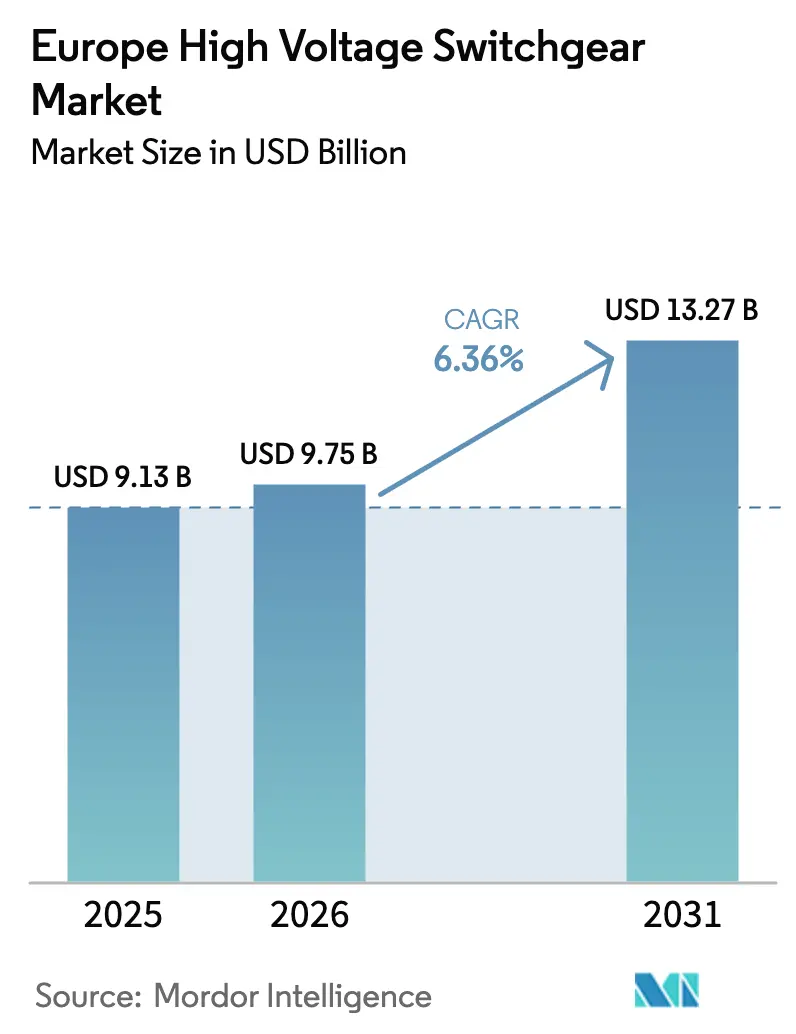
| Base Year Market Size (2025) | USD 9.13 Billion |
| Market Size (2026) | USD 9.75 Billion |
| Market Size (2031) | USD 13.27 Billion |
| Growth Rate (2026 - 2031) | 6.36 % |
| Market Concentration | Medium |
Major Players *Disclaimer: Major Players sorted in no particular order Image © Mordor Intelligence. Reuse requires attribution under CC BY 4.0. | |
Europe High Voltage Switchgear Market Analysis by Mordor Intelligence
The Europe High Voltage Switchgear Market size is projected to be USD 9.13 billion in 2025, USD 9.75 billion in 2026, and reach USD 13.27 billion by 2031, growing at a CAGR of 6.36% from 2026 to 2031.
The region’s growth rests on three pillars: stringent revisions to the EU F-gas Regulation that accelerate a pivot toward SF₆-free equipment, a once-in-a-generation overhaul of transmission assets installed during the 1970s–1980s build-out, and an expanding roster of HVDC interconnectors that anchor offshore wind and data-center loads to mainland grids. Utilities are front-loading orders to beat looming compliance deadlines, even as metal-price volatility pressures their capital budgets. In parallel, industrial players, battery gigafactories, green-hydrogen electrolyzers, and semiconductor fabs are contracting directly for factory-assembled switchgear to compress construction schedules and safeguard power quality, broadening the customer base beyond traditional network owners. Competitive dynamics are fluid: incumbents still command scale in gas-insulated switchgear, yet the rise of vacuum, clean-air, and fluoronitrile-CO₂ platforms is lowering barriers for regional specialists, reshaping supplier shortlists for new tenders.
Key Report Takeaways
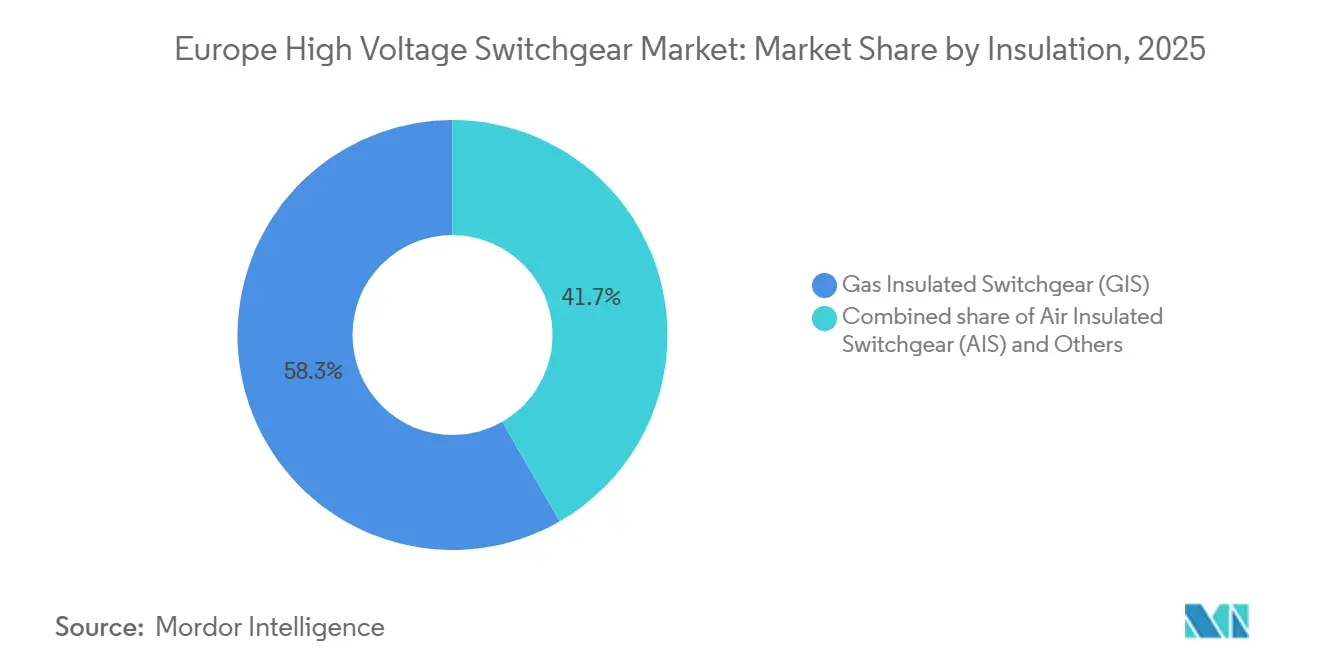
- By insulation type, gas-insulated switchgear captured 58.31% of the European high voltage switchgear market share in 2025, while SF₆-free alternatives under “Others” are forecast to advance at a 12.63% CAGR through 2031.
- By current type, AC equipment dominated with 88.17% of the European high voltage switchgear market share in 2025; DC switchgear is projected to expand at a 9.22% CAGR to 2031.
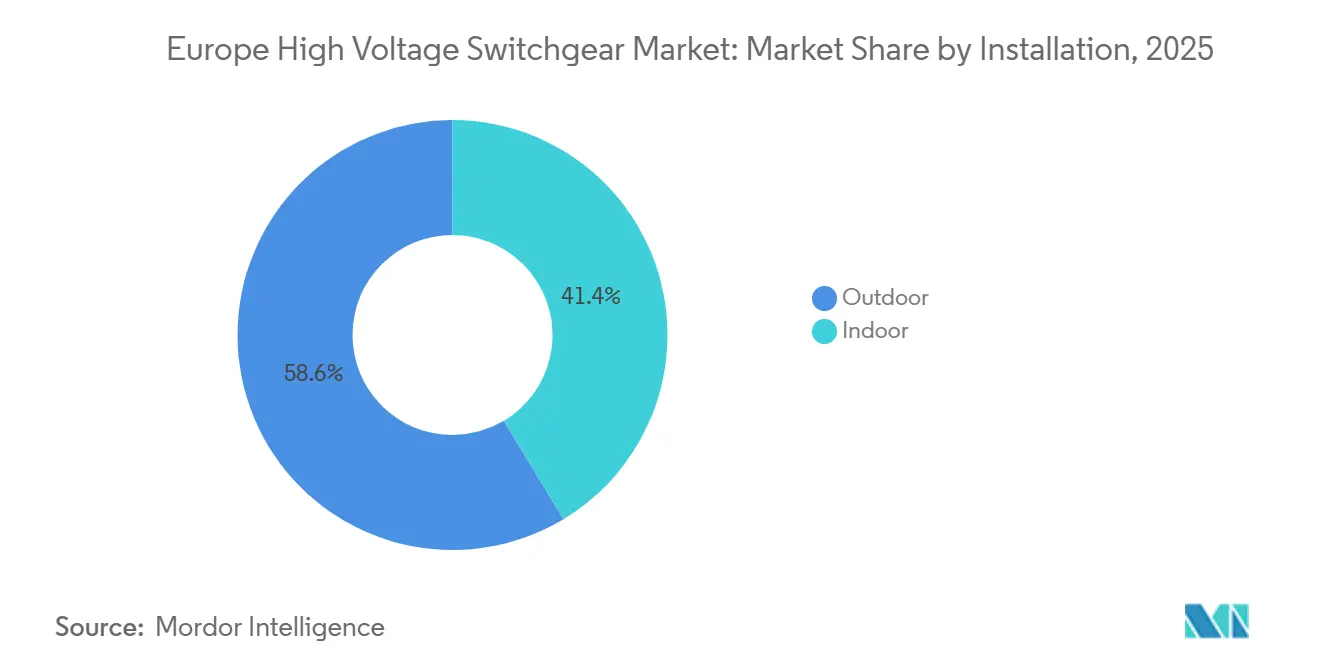
- By installation, outdoor configurations held a 58.63% slice of the European high voltage switchgear market size in 2025 and are set for 6.85% CAGR growth out to 2031.
- By end-user, utilities commanded a 67.50% share in 2025, whereas industrial customers posted the highest 8.91% CAGR forecast through 2031.
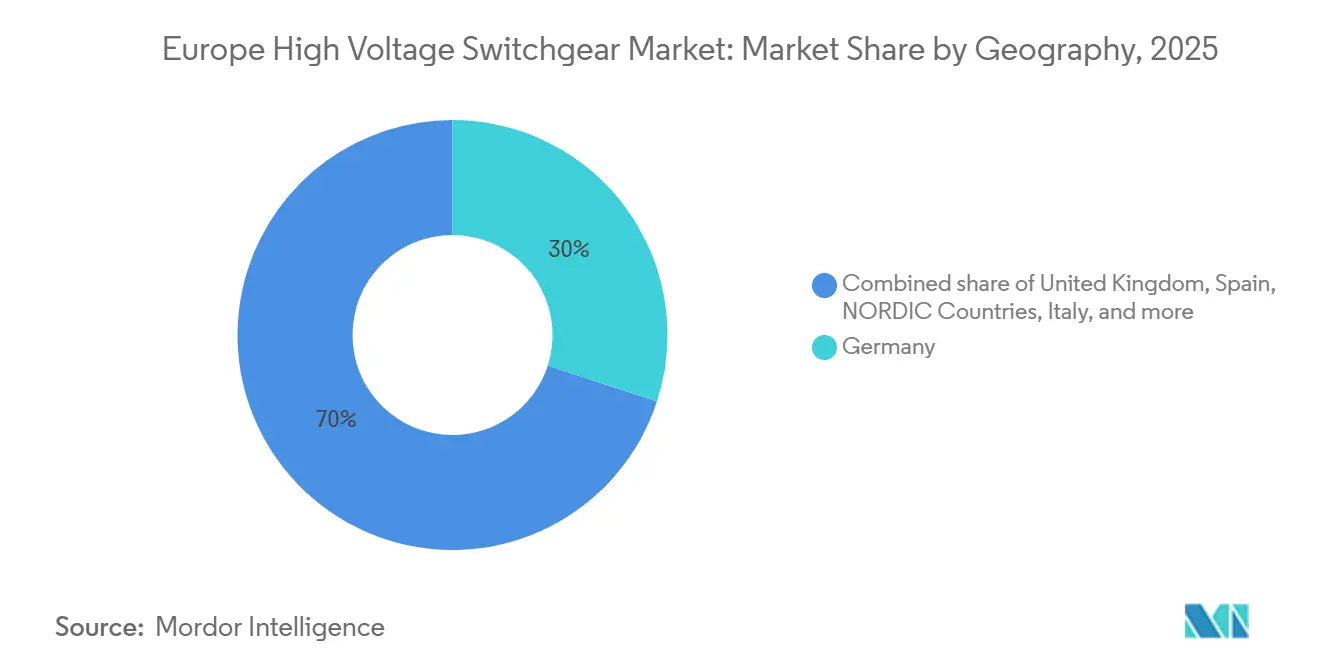
- By geography, Germany led revenue with 27.99% in 2025; the United Kingdom is the fastest riser at 9.47% CAGR for 2026–2031.
Note: Market size and forecast figures in this report are generated using Mordor Intelligence’s proprietary estimation framework, updated with the latest available data and insights as of January 2026.
Proportional positioning is established by comparing regional contributions against the global total, including that of Europe. The high voltage switchgear market share in our global report expresses these relative weights.
Market Trends and Insights
Drivers Impact Analysis of Europe High Voltage Switchgear Market*
| Driver | (~) % Impact on CAGR Forecast | Geographic Relevance | Impact Timeline |
|---|---|---|---|
| Grid-modernization capex rebound post-COVID-19 | +1.2% | Germany, UK, France, Nordic countries | Medium term (2–4 years) |
| Renewable-driven interconnector build-out | +1.8% | UK, Nordic, Germany, Spain | Long term (≥ 4 years) |
| Mandatory replacement of aging 1970–90s assets | +1.5% | Germany, France, Italy, Spain | Long term (≥ 4 years) |
| Data-center and HPC cluster electrification | +0.9% | Germany, Netherlands, Ireland, Nordic | Short term (≤ 2 years) |
| EU Green-Taxonomy loans favoring SF₆-free gear | +1.0% | EU-wide, early uptake in Germany, France, Netherlands | Medium term (2–4 years) |
| Source: Mordor Intelligence | |||
Grid-Modernization Capex Rebound Post-COVID-19
Transmission system operators are spending at a pace unseen since the early 2010s, reversing a half-decade of austerity. ENTSO-E’s 2024 Ten-Year Network Development Plan earmarked EUR 584 billion for grid works to 2032, with roughly 18% devoted to high-voltage substations and switchgear.[1]ENTSO-E, “Ten-Year Network Development Plan 2024,” entsoe.eu Germany’s four TSOs alone committed EUR 110 billion for 2024–2030 upgrades, embedding large multi-year switchgear orders.[2]Bundesnetzagentur, “Netzentwicklungsplan Strom 2025,” bundesnetzagentur.de The United Kingdom cleared 26 GW of new transmission projects in 2025, implying 140 new or refurbished substations. Rising copper and aluminum prices add procurement risk, yet operators are accelerating tenders to lock in factory slots before SF₆-free production ramps stress global supply lines.
Renewable-Driven Interconnector Build-Out
Offshore wind integration is rewriting Europe’s transmission topology. The North Sea Wind Power Hub advanced a 10 GW artificial-island concept in 2025 that will host hundreds of HVDC breakers and DC switchgear modules.[3]TenneT, “North Sea Wind Power Hub Position Paper 2025,” tennet.eu The Baltic Synchronization program is deploying back-to-back converters on the Polish and Lithuanian borders, necessitating new DC yards. Spain’s second Biscay Gulf corridor, now in tender, scales to 2 GW and deepens DC hardware demand. These projects create parallel replacement demand for coastal AC assets upgraded to bidirectional power flows.
Mandatory Replacement of Aging 1970–90s HV Assets
Aging fleets are hitting end-of-life thresholds. France’s RTE reports 22% of its 400 kV and 225 kV switchgear exceeds 40 years, triggering a EUR 12 billion renewal through 2035. Italy’s Terna mapped 1,800 km of lines and 85 substations for overhaul by 2030, allocating EUR 1.8 billion for new bays. Germany is decommissioning 1980s SF₆ units to meet 2030 phase-down targets, adding complexity through live-line work and bypass circuits.
Data-Center and HPC Cluster Electrification Surge
Hyperscale campuses now draw power comparable to mid-sized cities. Ireland’s EirGrid records data centers at 21% of national consumption in 2025 and expects 1.2 GW of incremental load that needs 18 new 110 kV GIS-equipped substations.[4]EirGrid, “All-Island Generation Capacity Statement 2025,” eirgrid.ie Frankfurt added eight facilities in 2024–2025, each requiring dedicated HV feeders. The Netherlands temporarily capped new builds in 2024, underscoring grid bottlenecks linked to switchgear delivery lead times.
Restraints Impact Analysis of Europe High Voltage Switchgear Market*
| Restraint | (~) % Impact on CAGR Forecast | Geographic Relevance | Impact Timeline |
|---|---|---|---|
| Stricter SF₆-emission caps raise compliance costs | -0.7% | EU-wide, strict in Germany, France, Netherlands | Short term (≤ 2 years) |
| High GIS upfront CAPEX amid budget squeezes | -0.5% | Southern and Eastern Europe | Medium term (2–4 years) |
| Copper and aluminum volatility inflates risk | -0.4% | EU-wide, acute on mega interconnectors | Short term (≤ 2 years) |
| Source: Mordor Intelligence | |||
Stricter SF₆-Emission Caps Raise Compliance Costs
The 2024 F-gas revision mandates a 60% SF₆ supply cut by 2030, forcing utilities to deploy leak-detection, gas-recovery, and staff-training programs that elevate ownership cost by 8–12%. Germany logged an 18% emissions drop from 2020-2024, but its 12,000 t legacy gas stock remains a decommissioning liability. Shrinking supply lifted SF₆ spot prices by 40% since 2023, sharpening the replacement case yet squeezing budgets.
High GIS Upfront CAPEX Amid Utility Budget Squeezes
GIS costs 30–50% more than AIS per bay, translating to over EUR 8 million extra on a 400 kV, 12-bay yard. Terna’s weighted average cost of capital rose to 6.2% in 2024, prompting deferral of several GIS upgrades. Red Eléctrica similarly opted for AIS life-extension schemes that save near-term cash but raise long-run maintenance risk.
*Our forecasts treat driver/restraint impacts as directional, not additive. The impact forecasts reflect baseline growth, mix effects, and variable interactions.
Europe High Voltage Switchgear Market Segment Analysis
By Insulation:
SF₆-Free Platforms Gain MomentumGas-insulated technology secured 58.31% of 2025 revenue, yet the “Others” category, vacuum, air-plus, and fluoronitrile-CO₂ mixes, shows the strongest 12.63% CAGR outlook, reshaping high voltage switchgear market dynamics. The high voltage switchgear market size for SF₆-free variants is projected to exceed USD 3.2 billion by 2031 as more utilities bid clean-air platforms into urban and offshore schemes. ABB’s AirSeT landed its first 380 kV order with TenneT in 2024, signaling utility comfort with vacuum interrupters at transmission voltages. Siemens Energy’s blue GIS now spans 40+ substations across Germany and France.[5]Siemens Energy, “Blue GIS Reference Book 2025,” siemens-energy.com Early clean-air prototypes faced dielectric-strength questions in humid zones, extending commissioning times, yet iterative design and expanded factory tests are reducing field-validation hurdles.


By Current Type:
DC Switchgear AcceleratesWhile AC equipment represented 88.17% of 2025 sales, DC hardware is projected to post a 9.22% CAGR, underpinned by 20 GW of HVDC capacity now under construction in the North Sea and Baltic corridors. Hitachi Energy’s hybrid DC breaker dominates delivered projects on NordLink and Viking Link. Solid-state prototypes by ABB and Siemens Energy promise faster clearing speeds but remain in pilot status. Hyperscale operators such as Microsoft trialed 380 V DC distribution that trimmed facility energy use by 7%, reinforcing a nascent data-center pull toward low-voltage DC switchgear. The high voltage switchgear market share for DC remains modest but rising as converter-rich networks become the norm for remote renewables.
By Installation:
Outdoor DominatesOutdoor assemblies accounted for 58.63% revenue in 2025 and are tracking a 6.85% CAGR to 2031, buoyed by land-rich rural substations that favor air-insulated footprints. Natural convection cooling curbs OPEX, though exposure to salt and industrial pollutants demands advanced coatings. ABB’s 2024 silicone-rubber insulator cut maintenance intervals by an estimated 30%. Indoor GIS, representing 41.37%, is entrenched in Berlin, London, and Amsterdam, where land trades above EUR 1,000 per m². Digital-sensor density is easier to embed in climate-controlled halls, a factor shaping urban replacement strategies.
By End-User:
Industrial Segment SurgesUtilities held 67.50% of 2025 demand, yet the industrial cohort is pacing at 8.91% CAGR, the fastest within the high voltage switchgear market. Northvolt’s Ett gigafactory draws 150 MW at peak, requiring a 145 kV yard with eight GIS bays. Ørsted’s 2 GW H2RES offshore wind-to-hydrogen hub will run modular DC switchgear for electrolyzers. The high voltage switchgear market size allocated to industrial buyers is expected to double between 2025 and 2031 as battery, hydrogen, and semiconductor projects codify direct grid connections.
Geography Analysis
Europe High Voltage Switchgear Market
Germany contributed 27.99% of the 2025 turnover, channeling EUR 20 billion toward substation and switchgear refresh under Energiewende. The United Kingdom exhibits a 9.47% CAGR outlook, buoyed by a GBP 60 billion plan that earmarks 140 substations for offshore wind take-off. Nordic TSOs together pledge EUR 18 billion to hydropower links and DC corridors, lifting demand in Norway, Sweden, Denmark, and Finland. Baltic synchronization will inject EUR 1.2 billion into converter-station switchgear on the Polish-Lithuanian border. The rest of Europe cluster benefits from EU cohesion funds targeting Poland, Romania, and Bulgaria, while data-center clusters in the Netherlands and Ireland intensify local switchgear procurement.
Mordor Intelligence examines the high voltage switchgear market across diverse other regional markets as well, including North America, Middle East and Africa, and Asia.
Regulatory Landscape
The European regulatory environment for high voltage switchgear is being shaped by the EU drive to accelerate grid build-out while reducing the climate impact of insulating gases. The updated EU F-gas framework tightens the phase-down of SF6 supply (including a 60% supply cut by 2030 referenced in market context), which is reinforcing utility and lender preference for SF6-free platforms in new tenders and replacement programs.
Permitting and cross-border infrastructure rules are also being streamlined under EU grid initiatives. On 10 December 2025, the European Commission presented the European Grids Package (COM(2025) 1006) to speed up procedures for grid projects and connections, while EU-level work on trans-European energy infrastructure (TEN-E) continues to prioritize cross-border projects. For switchgear suppliers, these steps are translating into more standardized, time-bound project pipelines for substations and interconnectors, with procurement increasingly tied to environmental performance alongside deliverability under tighter connection and permitting timelines.
Competitive Landscape
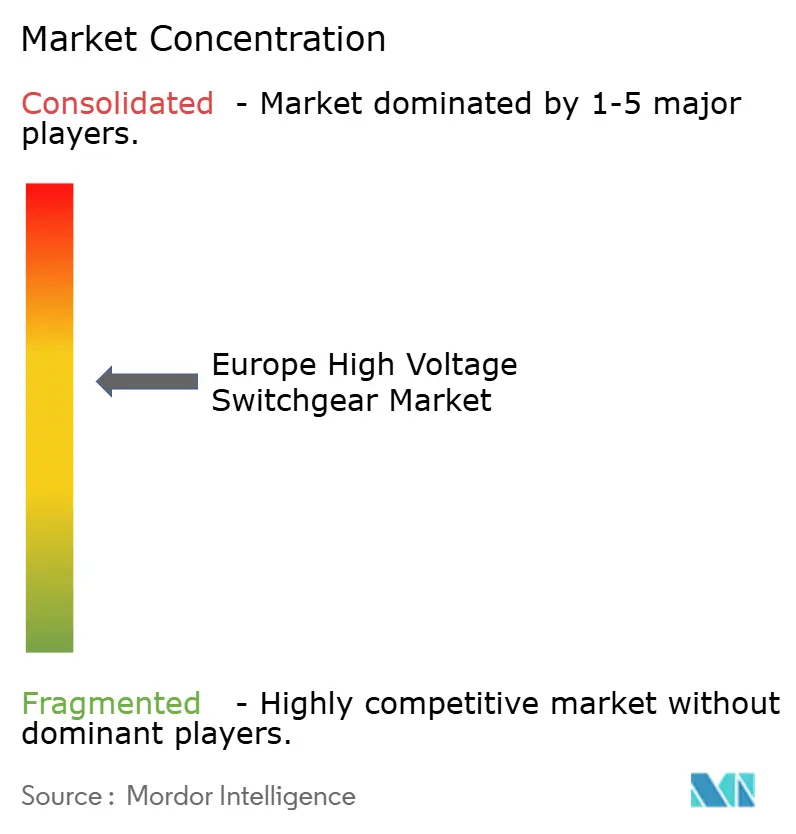
Europe’s supplier base is moderately concentrated. ABB, Siemens Energy, Hitachi Energy, and Schneider Electric control 55–60% of revenue, yet SF₆-free adoption is creating white-space for agile entrants. ABB booked USD 2 billion in SF₆-free orders during 2024–2025, lifting the clean-portfolio mix to 32%. Siemens Energy reported 50+ blue GIS installations and became the de facto spec in recent Dutch and German tenders. Hitachi Energy leverages HVDC know-how to front-run offshore interconnector awards. Schneider Electric monetizes its EcoStruxure digital layer, adding USD 457 million in 2024 software and services. Regional firms like Ormazabal, Lucy Electric, and Efacec are winning modular factory-built lines suited to data-center and industrial clients, where speed trumps bespoke design. Sensor-rich panels, edge computing, and IEC 61850 compliance are emerging as table stakes that deepen after-sales annuity streams.
Europe High Voltage Switchgear Industry Leaders
ABB Ltd
Siemens AG
Hitachi Energy Ltd
Schneider Electric SE
General Electric Company (GE Grid Solutions)
- *Disclaimer: Major Players sorted in no particular order
Europe High Voltage Switchgear Market Companies Covered in this Report
- ABB Ltd
- Siemens AG
- Hitachi Energy Ltd
- Schneider Electric SE
- General Electric Company (GE Grid Solutions)
- Mitsubishi Electric Corporation
- Toshiba Energy Systems & Solutions
- Hyosung Heavy Industries
- Eaton Corporation plc
- SGC - SwitchGear Company
- Ormazabal (Velatia)
- Lucy Electric Ltd
- Efacec Power Solutions
- CG Power & Industrial Solutions Ltd
- Hyundai Electric & Energy Systems
- Fuji Electric Co., Ltd
- KONCAR - Power Plant & Electrical Engineering
- KOHL GmbH
- R&S Group
- PFISTERER Holding AG
- Nexans S.A.
- Chint Group Co., Ltd

Market Opportunities and Future Outlook
SF6-free high voltage switchgear creates a commercialization pathway in Europe as utilities align procurement with F-gas compliance and sustainability-linked financing. In June 2026, Hitachi Energy and TenneT Germany completed on-site testing of a 420 kV SF6-free gas-insulated switchgear installation at the Erzhausen substation, which provides an operational reference at transmission voltage and helps de-risk specifications for future tenders. This builds on the report context of earlier SF6-free traction, including multi-substation deployments across Germany and France, and it supports a broader shift in supplier shortlists from conventional GIS toward vacuum, clean-air, and fluoronitrile-CO2 solutions.
Interconnectors and converter-station build-outs also add demand whitespace for DC-related switchgear and integrated substation packages. In June 2026, Hitachi Energy secured an approximately EUR 770 million contract with Terna and STEG for the Elmed converter stations, directly linking HVDC expansion to demand for high voltage switchgear within turnkey converter projects. Supplier investments aimed at easing manufacturing constraints create additional opportunities around lead-time reduction and localized delivery, including ABB’s announced USD 200 million investment program across multiple European countries in 2026 and Siemens’ disclosed EUR 300 million investment in Germany to expand switchgear manufacturing. These developments align with the report’s demand themes around grid modernization, aging-asset replacement, and large-load connections, including data centers and industrial electrification, where factory-built and rapidly deployable substation and switchgear configurations are increasingly favored.
Recent Industry Developments in Europe High Voltage Switchgear Market
- June 2026: Hitachi Energy completed on-site testing of world’s first SF6-free 420 kV gas-insulated switchgear at TenneT Germany’s Erzhausen substation. The achievement demonstrates a tangible SF6-free HVGIS deployment that aligns with Europe’s push toward lower environmental impact equipment. It reshapes market expectations for SF6-free technology adoption across transmission networks and strengthens Hitachi Energy’s role in delivering cleaner grid solutions.
- June 2026: Hitachi Energy awarded ~€770 million contract with Terna and STEG for Elmed converter stations (DC interconnection) including HV switchgear. The award expands cross-border HVDC interconnectors using SF6-free switchgear and signals a broad regional rollout of cleaner insulation technology. It solidifies Hitachi Energy’s leadership in major European interconnector projects and accelerates the SF6-free transition across continental grids.
- June 2026: Siemens Energy awarded contract by 50Hertz for North Sea Connector 2 to supply SF6-free gas-insulated switchgear manufactured in Berlin. The project advances SF6-free GIS deployment for a key cross-border interconnector. The contract enhances Siemens Energy’s footprint in German grid modernization and supports the ongoing SF6-free transition across the European transmission network.


Europe High Voltage Switchgear Market Report Scope and Research Methodology
Market Definition and Coverage
For this report, the market includes revenue generated from high voltage switchgear used to control, protect, and isolate high voltage power circuits across Europe, covering new installations as well as replacement and upgrade demand in grid and customer facilities.
Scope exclusions: We exclude medium-voltage switchgear, low-voltage switchboards, and routine field services that are billed separately from equipment supply.
Segments Covered in This Report
- By Insulation
- Gas Insulated Switchgear (GIS)
- Air Insulated Switchgear (AIS)
- Others
- By Current Type
- AC Switchgear
- DC Switchgear
- By Installation
- Indoor
- Outdoor
- By End-User
- Utilities
- Residential
- Commercial
- Industrial
- By Geography
- Germany
- United Kingdom
- France
- Italy
- Spain
- NORDIC Countries
- Russia
- Rest of Europe
Data Sources, Market Sizing, and Validation
Desk Research
We first built a clean fact base around the European power network and the investment cycle, then used it to anchor demand for high voltage switchgear. Public sources such as Eurostat, ENTSO-E publications, the International Energy Agency, national transmission system operator plans, and European Commission energy and grid updates helped us map what is happening with load growth, renewable connections, and cross-border transmission.
To translate that context into a sizing model, we also reviewed supplier annual reports, investor presentations, and reputable industry news for project timing, product mix shifts (GIS versus AIS), and price direction. We used selected paid subscriptions for company financials and news, plus patents and import-export shipment-level signals, to cross-check shipment momentum and technology migration in cases where public reporting lagged. The desk sources listed here are illustrative, and many other public and subscription sources were also used for data collection, validation, and clarification.
Primary Interviews and Surveys
Our primary work focused on validating what gets ordered and installed across major European countries, and how purchasing behavior shifts by utility, industry, and large commercial buyers. We spoke with a mix of manufacturers, EPC and substation contractors, distributors, and grid experts, and then used their input to confirm typical voltage classes, replacement cycles, procurement lead times, and the practical split between retrofit and greenfield programs.
Distribution of primary research fieldwork respondents
| Company type | Respondent position |
|---|---|
| Top tier: 30% | CXOs: 13% |
| Mid tier: 56% | Functional/Unit leaders: 35% |
| Smaller Players: 14% | Managers: 52% |
Market-Sizing & Forecasting
The core model starts with a top-down build that reconstructs the addressable demand pool from Europe-wide transmission and distribution capex signals, planned substation additions, and grid reinforcement programs, which are then filtered by the share that typically requires high voltage equipment. We then corroborated the totals using selective bottom-up checks, mainly sampled project counts multiplied by typical switchgear package values, along with supplier revenue splits where disclosure was available.
Key inputs used (illustrative, not exhaustive) included transmission line additions and refurbishment plans, substation build and extension pipelines, renewable interconnection volumes, the GIS versus AIS mix by application, and country-level replacement intensity linked to asset age and reliability upgrades. When country or end-user detail was thin, we applied gap-handling rules that kept assumptions consistent across comparable markets, and we re-tested them with interview feedback.
For forecasting, scenario analysis was used to reflect different pacing for grid connection reforms, permitting, and utility tender cycles, and the final path was selected after checking it against expert expectations for project timing and equipment price movement.
Data Validation & Update Cycle
We ran multi-step checks so the outputs stayed consistent with real-world signals. Model results were compared against independent indicators such as utility capex trends, major tender announcements, and observed ordering lead times, and outliers were reviewed country by country before sign-off.
A separate analyst review challenged the main assumptions, including product mix and average selling price progression, and then checked that the totals reconcile across years. The report is refreshed annually, with interim updates when material events affect demand or pricing, and a final pre-delivery pass is completed so clients receive the latest updated view.
Mordor Intelligence's Europe High Voltage Switchgear Market Size Compared Against Other Published Estimates
Published market values for European high voltage switchgear can look far apart because scope boundaries and timing choices are rarely identical, and because some figures mix equipment with services or adjacent voltage classes. Differences in how retrofit demand is treated also matter, since replacement projects can be priced and scheduled very differently from greenfield builds.
The benchmark table shows a spread that is mainly explained by what gets counted as high voltage equipment revenue, and by how quickly pricing and project delays are refreshed in the model. Under Mordor Intelligence's scope, the total is kept to Europe-only equipment revenues for high voltage switchgear and is aligned to a 2025 base year, rather than folding in medium-voltage panels, extended service contracts, or longer-dated project pipelines that are not yet converted into orders.
Benchmark comparison
| Source | Market Size | Gaps in Research Methodology |
|---|---|---|
| Mordor Intelligence | USD 9.13 B (2025) | |
| Regional Consultancy A | USD 5.80 B (2026) | Uses a narrower definition that appears to emphasize transmission utility orders only, and it treats industrial and large commercial substations as out of scope, which lowers the addressable revenue base. |
| Trade Journal B | USD 10.40 B (2026) | The estimate likely combines high voltage equipment with adjacent items such as medium-voltage assemblies or multi-year service bundles, and it may apply a faster price uplift without matching it to tender timing and delivery cycles. |
Taken together, the comparisons point to two practical drivers, which are scope boundaries and how price and project timing are handled. By keeping the market tied to equipment revenues and validating country-level assumptions against project signals, the resulting value stays easier to trace and repeat when assumptions are updated.


Key Questions Answered in the Report
How large is the European high voltage switchgear market in 2026?
It is on track to reach USD 9.75 billion in 2026, following the 6.36% CAGR trajectory set between 2026 and 2031.
Which insulation technology is growing fastest?
SF₆-free solutions - vacuum, clean-air, and fluoronitrile-CO₂ mixes - are advancing at 12.63% CAGR, the quickest among all insulation types.
Why is DC switchgear gaining attention?
New HVDC interconnectors for offshore wind and hyperscale data-center adoption of direct-current power are lifting DC switchgear demand at a 9.22% CAGR.
What role do industrial projects play in demand growth?
Battery gigafactories, hydrogen electrolyzers, and semiconductor fabs require dedicated substations, driving the industrial segment's 8.91% CAGR.
How are EU regulations influencing technology choices?
The updated F-gas Regulation and EU Taxonomy restrict high-GWP gases, pushing utilities and lenders toward vacuum and clean-air switchgear platforms.
Which country is expanding the fastest?
The United Kingdom posts the highest regional growth, projected at 9.47% CAGR through 2031, supported by a GBP 60 billion grid-upgrade plan.
Page last updated on:


 Your data is secure and never sold or shared.


