Market Overview
| Study Period | 2019 - 2030 |
|---|---|
| Base Year For Estimation | 2024 |
| Forecast Data Period | 2025 - 2030 |
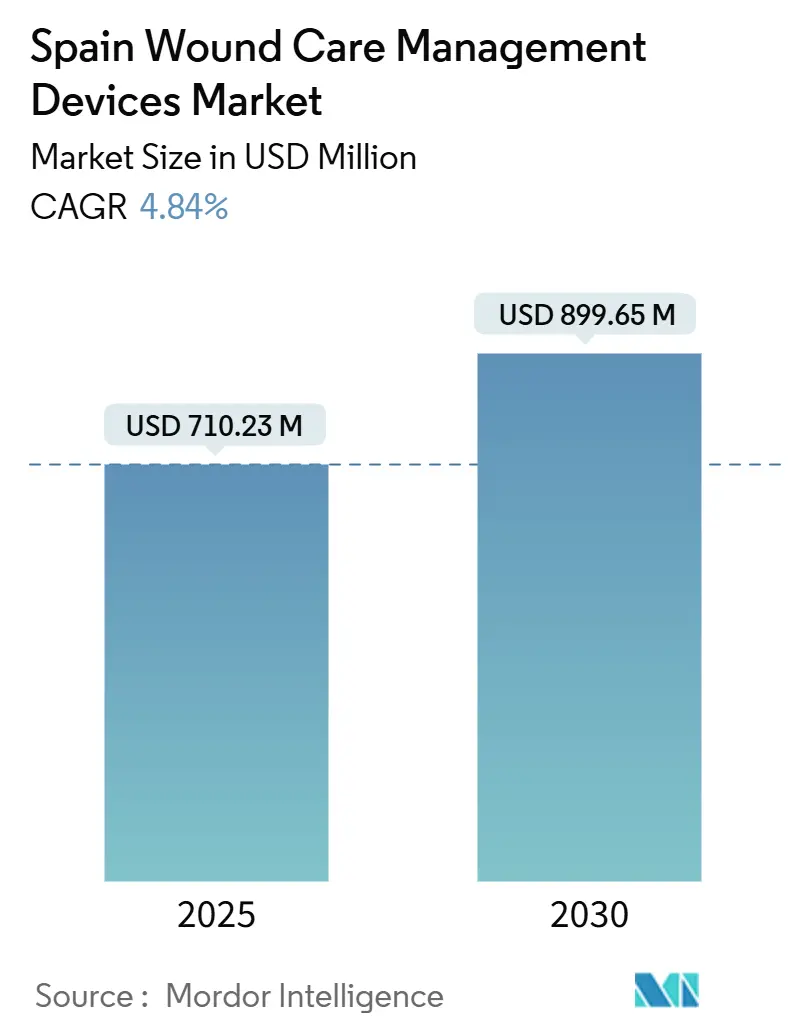
| Market Size (2025) | USD 710.23 Million |
| Market Size (2030) | USD 899.65 Million |
| Growth Rate (2025 - 2030) | 4.84% CAGR |
| Market Concentration | Medium |
Major Players
*Disclaimer: Major Players sorted in no particular order Image © Mordor Intelligence. Reuse requires attribution under CC BY 4.0. |
|
Spain Wound Care Management Devices Market Analysis by Mordor Intelligence
The Spain wound care management devices market size stands at USD 710.23 million in 2025 and is forecast to reach USD 899.65 million by 2030, advancing at a 4.84% CAGR during the period. Rising life expectancy, with 37.2% of residents expected to be over 65 by 2052, intensifies demand for chronic-wound therapies. A national type 2 diabetes prevalence of 14.7%, and 30.3% among people older than 70, further fuels the Spain wound care management devices market as diabetic foot ulcers require specialized care. Decentralized procurement across 17 Autonomous Communities drives cost variation yet stimulates adoption of advanced dressings and negative pressure wound therapy (NPWT) to lower per-patient costs. Chronic wounds account for 60.34% of revenue, while acute wounds are growing faster in tandem with recovering surgical procedures [1]Miguel Ángel Díaz-Herrera, "The financial burden of chronic wounds in primary care: A real-world data analysis on cost and prevalence," ScienceDirect, sciencedirect.com. Technology-enabled home care, including tele-monitoring and portable NPWT, underpins a rapid shift from hospital to community settings.
Key Report Takeaways
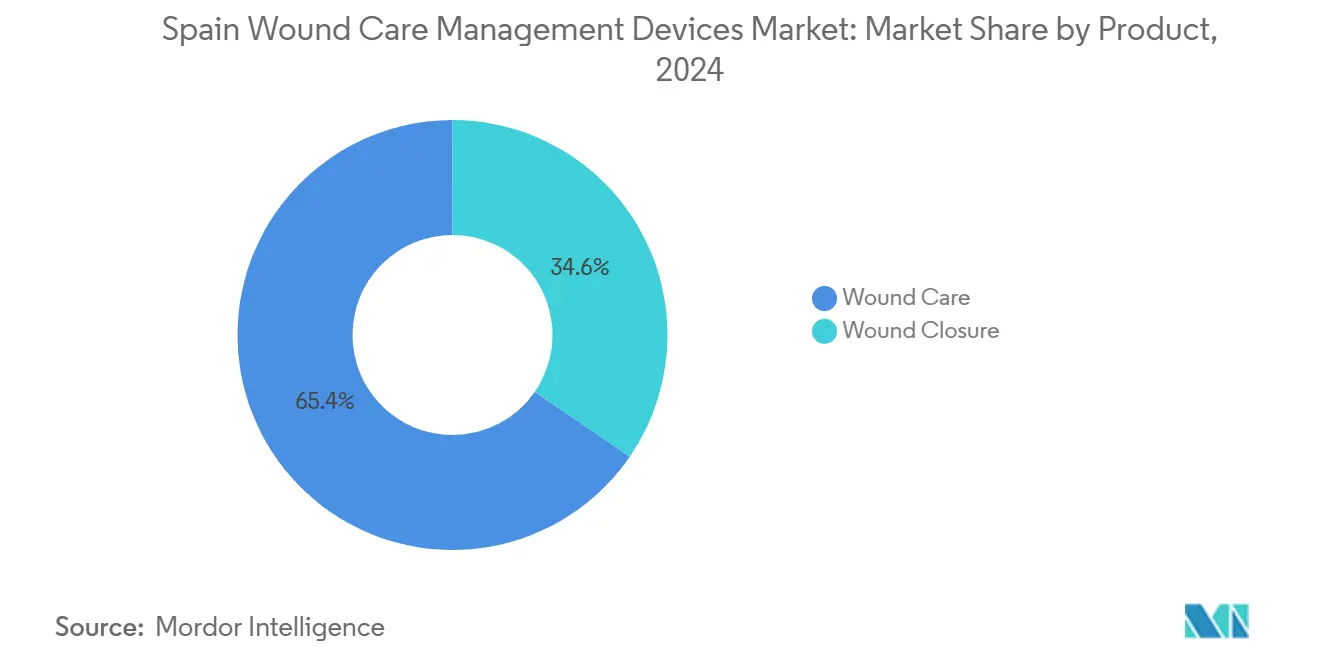
- By product category, wound care devices led with 65.41% revenue share of the Spain wound care management devices market in 2024; wound closure products post the fastest 5.23% CAGR through 2030.
- By wound type, chronic wounds held 60.34% of the Spain wound care management devices market share in 2024, while acute wounds record the highest 5.34% CAGR outlook to 2030.
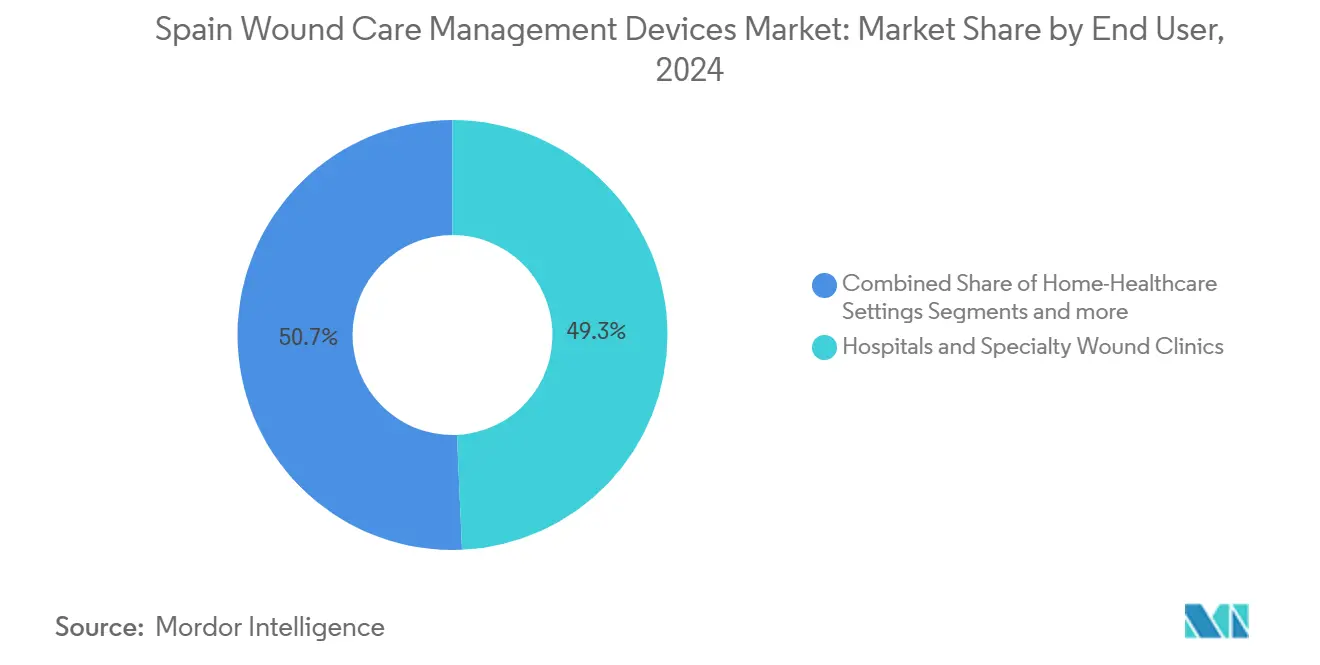
- By end user, hospitals and specialty clinics accounted for 49.29% of the Spain wound care management devices market size in 2024, whereas home healthcare is projected to expand at a 5.87% CAGR during 2025-2030.
- By mode of purchase, institutional procurement dominated with 64.56% share in 2024; retail/OTC channels are forecast to grow at 5.67% CAGR to 2030.
Spain Wound Care Management Devices Market Trends and Insights
Drivers Impact Analysis
| Driver | (~) % Impact on CAGR Forecast | Geographic Relevance | Impact Timeline |
|---|---|---|---|
| Growing prevalence of diabetic foot & pressure ulcers | +1.2% | National, higher in urban areas | Long term (≥ 4 years) |
| Rising volume of elective & trauma surgeries | +0.8% | Major metropolitan regions | Medium term (2-4 years) |
| Ageing population boosting chronic-wound incidence | +1.5% | Rural communities | Long term (≥ 4 years) |
| Hospital-to-home shift & home-based NPWT adoption | +0.9% | Catalonia, Madrid, Andalusia | Medium term (2-4 years) |
| Regional clinical-nurse-led wound units cutting recurrence | +0.4% | Andalusia, Valencia, Catalonia | Short term (≤ 2 years) |
| E-health tele-monitoring platforms reducing follow-up visits | +0.6% | Pilot programs nationwide | Medium term (2-4 years) |
| Source: Mordor Intelligence | |||
Growing Prevalence of Diabetic Foot & Pressure Ulcers
Diabetic foot ulcers are now the primary diagnosis in 90.5% of Spain’s specialized wound units, generating EUR 2.063 million per infected case when hospitalization is required [2]Roberto Da Ros, "Burden of Infected Diabetic Foot Ulcers on Hospital Admissions and Costs in a Third-Level Center," MDPI, mdpi.com. Hospital stays account for 88% of that expense and lengthen healing to 194 days versus 136 days for outpatient care. Advanced thermographic AI yields 95% diagnostic accuracy for peripheral neuropathy, prompting earlier interventions that lower ulcer incidence [3]Albert Siré Langa, "Advanced AI-Driven Thermographic Analysis for Diagnosing Diabetic Peripheral Neuropathy and Peripheral Arterial Disease," MDPI, mdpi.com. Health authorities view investment in advanced dressings and NPWT as a cost-saving strategy that curbs amputations and readmissions.
Rising Volume of Elective & Trauma Surgeries
Elective procedures rebounded in 2024-2025, sustaining demand for post-operative closure and infection-prevention devices. Vacuum-assisted closure therapy reduced healing time and length of stay in 41 complex cases at the University Clinic of Navarra. Polyurethane foam multilayer dressings cut dressing changes by 47.1% and weekly costs by 58.7%. Surgeons increasingly prescribe single-use NPWT systems that enable earlier discharge and support community-based follow-ups.
Ageing Population Boosting Chronic-Wound Incidence
Chronic diseases generate 80% of primary-care visits among older Spaniards, and structured nurse-training in Andalusia halved chronic-wound prevalence within two years. Pressure-ulcer treatment already absorbs EUR 600 million annually yet remains below US and UK levels due to protocol differences. Demographic pressure accelerates demand for smart mattresses, antimicrobial dressings, and sensor-enabled bandages that prevent ulcer formation.
Hospital-to-Home Shift & Home-Based NPWT Adoption
Portable NPWT delivers similar closure rates to inpatient systems yet saves EUR 4,155.98 per healed wound through fewer resources and faster discharge. Catalonia, Madrid, and Andalusia spearhead tele-monitoring pilots that connect community nurses with specialists, promoting continuity of care. Budget constraints delay nationwide roll-out, but expanding electronic prescription coverage builds the digital foundation for large-scale remote wound surveillance.
Restraints Impact Analysis
| Restraint | (~) % Impact on CAGR Forecast | Geographic Relevance | Impact Timeline |
|---|---|---|---|
| Limited national reimbursement for advanced dressings | -0.7% | National, variable across regions | Medium term (2-4 years) |
| High per-patient cost of NPWT & bio-engineered grafts | -0.5% | Budget-constrained regions | Long term (≥ 4 years) |
| Fragmented procurement across 17 Autonomous Communities | -0.3% | Nationwide | Short term (≤ 2 years) |
| Shortage of certified wound-care specialists in primary care | -0.4% | Rural areas | Medium term (2-4 years) |
| Source: Mordor Intelligence | |||
Limited National Reimbursement for Advanced Dressings
Advanced devices need CE marking through the Spanish Agency of Medicines and Medical Devices (AEMPS), yet decisions on funding rest with each region, creating a patchwork of coverage. Manufacturers negotiate multiple formularies, slowing time-to-market even when cost-effectiveness is proven via health technology assessments.
High Per-Patient Cost of NPWT & Bio-Engineered Grafts
NPWT capital requirements deter hospitals with tight budgets, although clinical data confirm lower total care costs once adopted. Spanish engineers are prototyping low-cost vacuum systems yielding comparable outcomes, but perception of high upfront cost persists among administrators focused on annual spending rather than lifetime savings.
Segment Analysis
By Product: Wound Care Dominance Drives Innovation
Advanced wound care solutions held 65.41% of the Spain wound care management devices market in 2024, led by antimicrobial foam dressings that trimmed weekly treatment expenses by 58.6%. The Spain wound care management devices market size for wound closure products is growing at a 5.23% CAGR, driven by demand for tissue adhesives that lower infection risk and enable faster outpatient turnover. Smith+Nephew marked 12.2% sales growth within its local advanced wound unit following the release of the Red Dot-winning RENASYS EDGE NPWT platform, reinforcing brand momentum.
Sutures remain dominant in closure devices, yet smart sealants containing growth factors are entering operating rooms. Bio-engineered topical agents continue to capture niche demand for antimicrobial control, while enzymatic debridement gels receive attention in diabetic care pathways. Emerging Internet-of-Things-enabled dressings transmit temperature and exudate data, allowing clinicians to predict infection onset and adjust therapy without unnecessary dressing removal.
Get Detailed Market Forecasts at the Most Granular Levels
Download PDF
By Wound Type: Chronic Wounds Lead Despite Acute Growth
Chronic wounds accounted for 60.34% of the Spain wound care management devices market share in 2024 as diabetic foot, venous leg, and pressure ulcers prevail in an aging society. The Spain wound care management devices market size for acute wounds is projected to grow at 5.34% CAGR to 2030, reflecting surgical rebounds and trauma incidence.
Diabetic foot ulcers represent the largest chronic segment, correlating with 14.7% diabetes prevalence. Pressure ulcers pose significant resource burdens, yet structured prevention programs demonstrate a 50% reduction in prevalence when spearheaded by advanced practice nurses. Acute surgical wounds benefit from prophylactic NPWT and antimicrobial hydrofiber dressings that shorten closure times.
By End User: Home Healthcare Emerges as Growth Driver
Hospitals and specialist clinics captured 49.29% of revenue in 2024, underlining their role in complex wound treatment. Home-care settings, however, will expand by 5.87% CAGR as portable NPWT and tele-consultation solutions mature. Flexible reimbursement for home visits and the elderly's preference for domestic recovery underpin this growth.
Long-term care facilities maintain steady demand given Spain’s growing institutionalized elderly population. Community pharmacies broaden access by stocking advanced dressings vetted through clinical-nurse guidance, limiting unnecessary emergency consultations.
Note: Segment shares of all individual segments available upon report purchase
Get Detailed Market Forecasts at the Most Granular Levels
Download PDF
By Mode of Purchase: Retail Growth Challenges Institutional Dominance
Institutional tenders claimed 64.56% of sales in 2024, but patient self-care and direct-to-consumer channels are widening at 5.67% CAGR. Consumers value convenience and privacy when treating chronic wounds, turning to e-commerce sites integrated with pharmacist advice tools.
Regional value-based procurement pilots, such as Andalusia’s dressings framework, shift evaluation criteria from unit price to total care cost, favoring premium technologies with proven outcome savings.
Geography Analysis
Spain’s decentralized model shapes procurement and adoption patterns within the Spain wound care management devices market. Catalonia, Madrid, and Andalusia lead purchases owing to larger budgets, academic hospitals, and higher patient volumes. These regions host most of the nation’s 42 specialized wound units, 35.7% of which are hospital-based and 40.5% located in health centers, leaving rural areas to depend on primary-care nurses for wound management.
Northern regions such as the Basque Country leverage European innovation networks to pilot AI-enabled thermographic screening and remote-monitoring solutions. Early adopters report reduced clinic visits and lower recidivism through predictive analytics. Mediterranean coastal provinces face the highest burden of chronic ulcers due to demographic aging and lifestyle factors. Valencia’s La Fe University Hospital documented improved outcomes using vacuum therapy across pediatric and adult cohorts, demonstrating technology transfer potential to neighboring regions.
Andalusia’s advanced practice nursing model, credited with halving chronic-wound prevalence, is being replicated in Extremadura and Castilla-La Mancha. Despite progress, rural municipalities still contend with specialist shortages, highlighting demand for intuitive, low-maintenance devices that primary-care teams can deploy. Region-specific reimbursement differences oblige suppliers to tailor bids, yet national adoption of electronic medical records fosters data harmonization that supports wider tele-wound programs.
Competitive Landscape
The Spain wound care management devices market shows moderate concentration with top multinationals and nimble domestic innovators vying for formulary placement. Smith+Nephew’s RENASYS EDGE launch strengthened its position by offering user-friendly controls and remote pressure monitoring.
Mölnlycke’s Mepilex Border Flex study in Spain confirmed fewer dressing changes and cost savings, bolstering tender competitiveness. Coloplast leverages intimate collaboration with stoma and continence care teams to cross-sell wound dressings in hospital and community settings. Domestic biotech players such as Histocell and Genia BioPharma target regenerative grafts tailored to local clinical preferences. These SMEs partner with university hospitals to validate efficacy and accelerate regional adoption.
Digital-health integration is now a key differentiator. Platforms that combine wound photography, measurement algorithms, and clinician dashboards provide real-time insights, helping vendors demonstrate outcome-based value. Procurement bodies increasingly demand proof of total-cost reduction, triggering alliances where manufacturers co-develop training modules, data analytics, and supply-chain services. Companies able to align commercial goals with cost containment and clinical outcomes gain strategic advantage in a fragmented yet performance-driven environment.
Spain Wound Care Management Devices Industry Leaders
-
Medtronic PLC
-
Smith & Nephew
-
ConvaTec Group PLC
-
Coloplast A/S
-
Solventum
- *Disclaimer: Major Players sorted in no particular order

Need More Details on Market Players and Competitors?
Download PDF
Recent Industry Developments
- April 2025: Convatec confirmed plans for initial market release of ConvaNiox, a nitric-oxide-based antimicrobial technology targeting diabetic foot ulcers.
- March 2025: Monlycke AB cited a Spanish study showing reduced dressing changes and costs after switching chronic-wound patients to Mepilex Border Flex.
- April 2024: Gradiant and IIS Galicia Sur launched ICAREWOUNDS, a European consortium aimed at comprehensive chronic-wound care models.
Research Methodology Framework and Report Scope
Market Definitions and Key Coverage
Our study defines Spain's wound-care management devices market as all single-use and durable products that actively clean, protect, close, or accelerate healing of acute and chronic skin breaches; advanced dressings, negative-pressure kits, closure staples, sutures, tissue adhesives, hemostats, and low-frequency therapy units delivered through medical channels.
Scope exclusion: over-the-counter antiseptic creams and purely diagnostic imaging tools fall outside this estimate.
Segmentation Overview
- By Product
- Wound Care
- Dressings
- Traditional Gauze & Tape Dressings
- Advanced Dressings
- Wound-Care Devices
- Negative Pressure Wound Therapy (NPWT)
- Oxygen & Hyperbaric Systems
- Electrical Stimulation Devices
- Other Wound Care Devices
- Other Wound Care Products
- Dressings
- Wound Closure
- Sutures
- Surgical Staplers
- Tissue Adhesives, Strips, Sealants & Glues
- Wound Care
- By Wound Type
- Chronic Wounds
- Diabetic Foot Ulcer
- Pressure Ulcer
- Venous Leg Ulcer
- Other Chronic Wounds
- Acute Wounds
- Surgical/Traumatic Wounds
- Burns
- Other Acute Wounds
- Chronic Wounds
- By End User
- Hospitals & Specialty Wound Clinics
- Long-term Care Facilities
- Home-Healthcare Settings
- By Mode of Purchase
- Institutional Procurement
- Retail / OTC Channel
Detailed Research Methodology and Data Validation
Primary Research
Mordor analysts interviewed hospital wound-unit nurses, community pharmacists, procurement officers, and two device distributors across Madrid, Catalonia, Andalusia, and the Basque Country. These conversations clarified dressing mix, typical therapy durations, home-health uptake, and discount spreads, validating and fine-tuning secondary assumptions.
Desk Research
We began with publicly available datasets; Spanish Ministry of Health hospital discharge files, EUROPAC diabetes registry updates, Eurostat procedure volumes, and import codes 3005 and 9018 from Agencia Tributaria customs to size the treated-wound pool. Trade-association papers from EWMA, peer-reviewed journals such as Journal of Wound Care, and filings found via D&B Hoovers or Dow Jones Factiva enriched price corridors and company shares. Current tender prices listed on the national procurement portal and patent counts gathered through Questel helped us benchmark technology penetration and ASP shifts. This listing is illustrative; dozens of additional sources were screened to cross-check figures and narrative themes.
Market-Sizing & Forecasting
A top-down construct converts inpatient and outpatient wound episodes into device demand using prevalence-to-treatment ratios and average consumables per case; results are then tested with bottom-up roll-ups from sampled supplier revenues and channel checks before alignment. Key variables include diabetes prevalence, elective-surgery backlog clearance, aging-population growth, home-care penetration, and average selling price trends observed in regional tenders. A multivariate regression, supplemented by scenario analysis for reimbursement reforms, projects volumes to 2030; where bottom-up gaps appear, weighted moving averages of adjacent data points bridge them.
Data Validation & Update Cycle
Outputs undergo variance checks against historical spending curves and import trends, followed by a two-step analyst review. We refresh every 12 months and trigger ad-hoc revisions when material events, such as major recalls, policy shifts, or large tenders, alter market dynamics. A final pre-publication sweep ensures clients receive the latest vetted view.
Why Mordor's Spain Wound Care Management Baseline Commands Reliability
Published estimates often diverge because firms choose dissimilar product baskets, price bases, and refresh cadences.
Key gap drivers include narrower scopes that ignore retail dressings, broad baskets that add topical drugs, or heavy reliance on list prices without discount reality. Our disciplined blend of treated-case reconstruction, live tender ASPs, and cross-channel validation yields a balanced, decision-ready figure.
Benchmark comparison
| Market Size | Anonymized source | Primary gap driver |
|---|---|---|
| USD 710.23 mn (2025) | Mordor Intelligence | - |
| USD 47.31 mn (2024) | Regional Consultancy A | Counts only hospital-procured devices, excludes retail dressings, and lacks primary validation |
| USD 583.7 mn (2023) | Global Consultancy A | Merges advanced dressings with therapy devices but omits closure consumables; limited forecast horizon |
| USD 2.70 bn (2023) | Industry Association B | Bundles pharmaceuticals and OTC topicals, applies high ASP inflation, and long extrapolation |
Taken together, the comparison shows how choice of scope and input rigor can shift totals by orders of magnitude, whereas Mordor's transparent case-based modeling and annual refresh cycle provide a dependable baseline that stakeholders can readily audit and replicate.
Need A Different Region or Segment?
Customize Now
Key Questions Answered in the Report
What is the current value of the Spain wound care management devices market?
The market is valued at USD 710.23 million in 2025 and is projected to reach USD 899.65 million by 2030, reflecting a 4.84% CAGR outlook.
Which product category leads the Spain wound care management devices market?
Advanced wound care devices, including antimicrobial foam dressings and NPWT systems, held 65.41% share in 2024.
Why are home-care settings growing faster than hospitals?
Portable NPWT and tele-monitoring platforms enable safe wound management at home, delivering comparable clinical results while lowering costs and freeing hospital capacity.
How does Spain’s decentralized healthcare system affect device procurement?
Each of the 17 Autonomous Communities controls its own tenders and reimbursement lists, forcing suppliers to navigate varied criteria and timelines.
Which wound type drives the highest revenue?
Chronic wounds, especially diabetic foot and pressure ulcers, represented 60.34% of 2024 revenue due to an aging population and high diabetes prevalence.
What main barrier limits advanced dressing adoption?
Regional reimbursement gaps and the perceived high upfront cost of NPWT and bio-engineered grafts slow market penetration despite long-term savings evidence.
Page last updated on: