Market Overview
| Study Period | 2019 - 2030 |
|---|---|
| Base Year For Estimation | 2024 |
| Forecast Data Period | 2025 - 2030 |
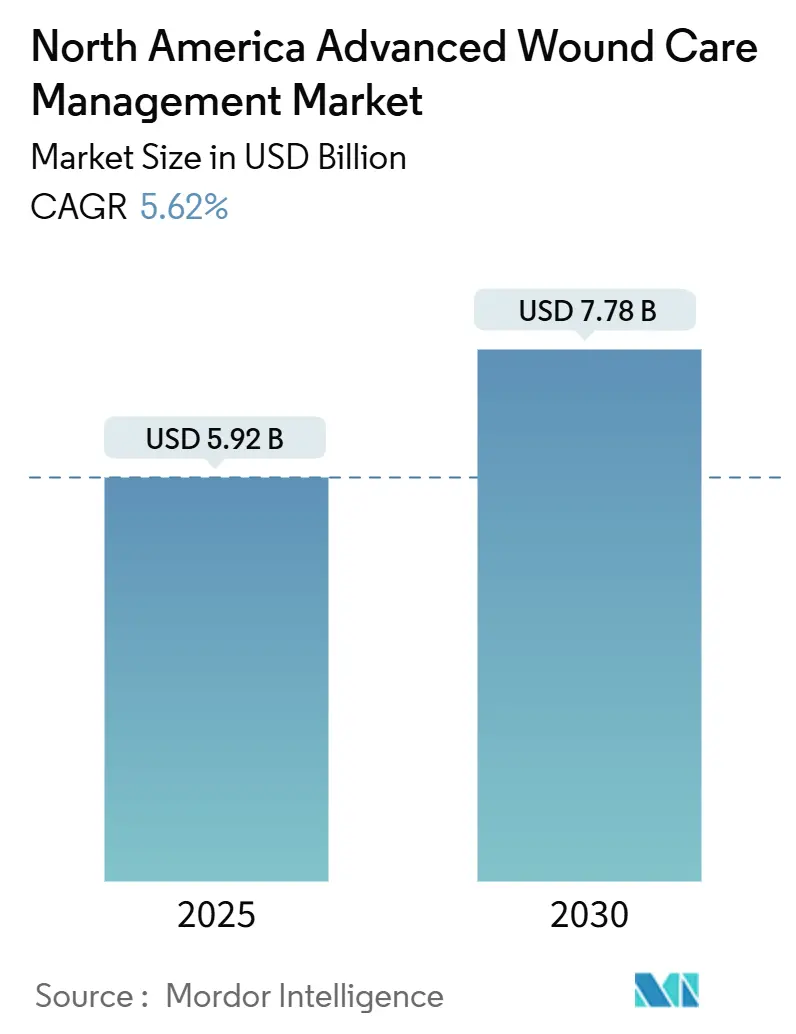
| Market Size (2025) | USD 5.92 Billion |
| Market Size (2030) | USD 7.78 Billion |
| Growth Rate (2025 - 2030) | 5.62% CAGR |
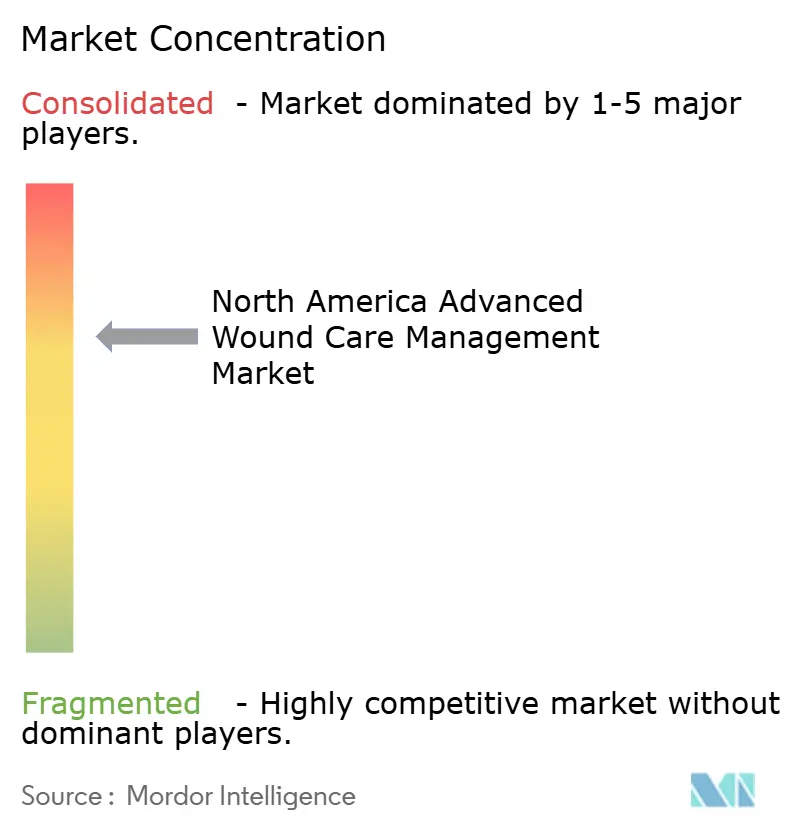
| Market Concentration | Medium |
Major Players
*Disclaimer: Major Players sorted in no particular order Image © Mordor Intelligence. Reuse requires attribution under CC BY 4.0. |
|
North America Advanced Wound Care Management Market Analysis by Mordor Intelligence
The North America advanced wound care management market size reached USD 5.92 billion in 2025 and is projected to reach USD 7.78 billion by 2030, reflecting a 5.62% CAGR. Chronic wounds remain the largest clinical burden by volume, while innovation and care-delivery shifts are changing product mix and site-of-care economics across the North America advanced wound care management market. Active wound care is the fastest-growing product cluster due to payer receptivity to biologics where cost-per-healed-wound improves overall episode costs. Care is migrating from hospitals to home, supported by remote monitoring and portable devices approved for in-home use across the North America advanced wound care management market. The United States drives scale and reimbursement depth, Mexico leads growth on improved access and coverage, and Canada advances through provincial telehealth and formulary decisions that shape adoption.
Key Report Takeaways
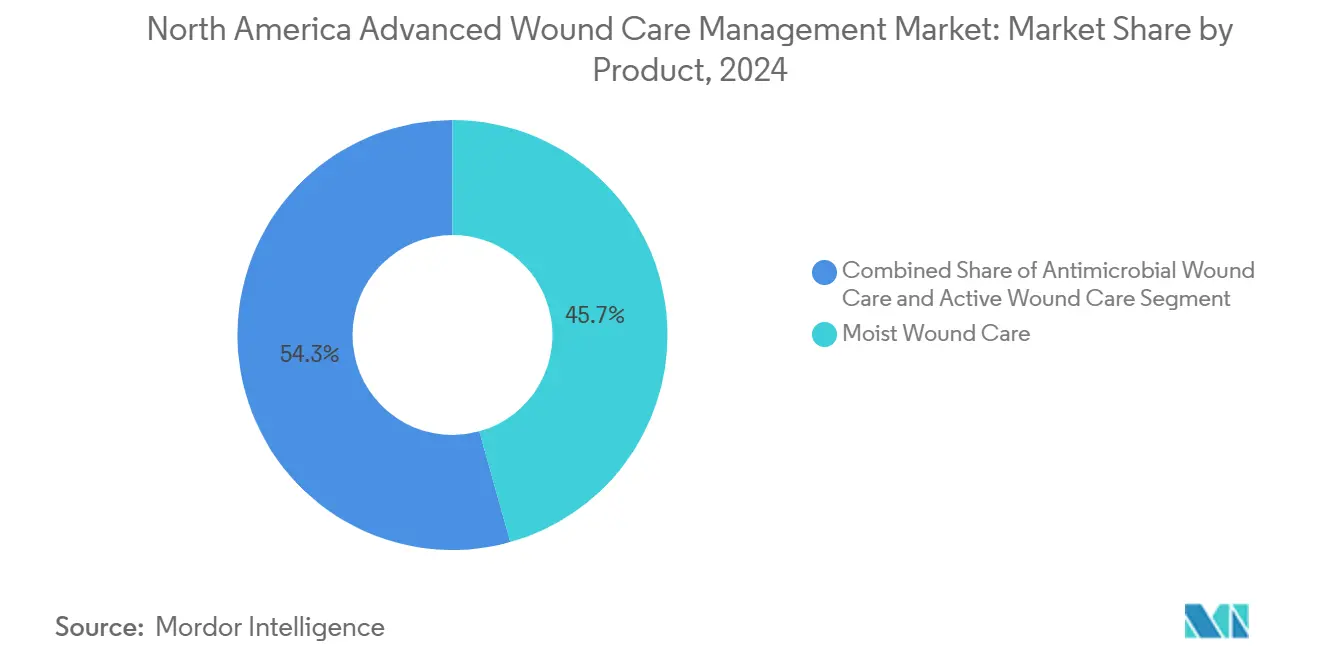
- By product category, moist wound care led with 45.67% revenue share in 2024. Active wound care is projected to expand at a 7.54% CAGR to 2030.
- By wound type, chronic wounds accounted for 61.54% of 2024 treatment volume. Acute wounds are forecast to grow at a 7.21% CAGR through 2030.
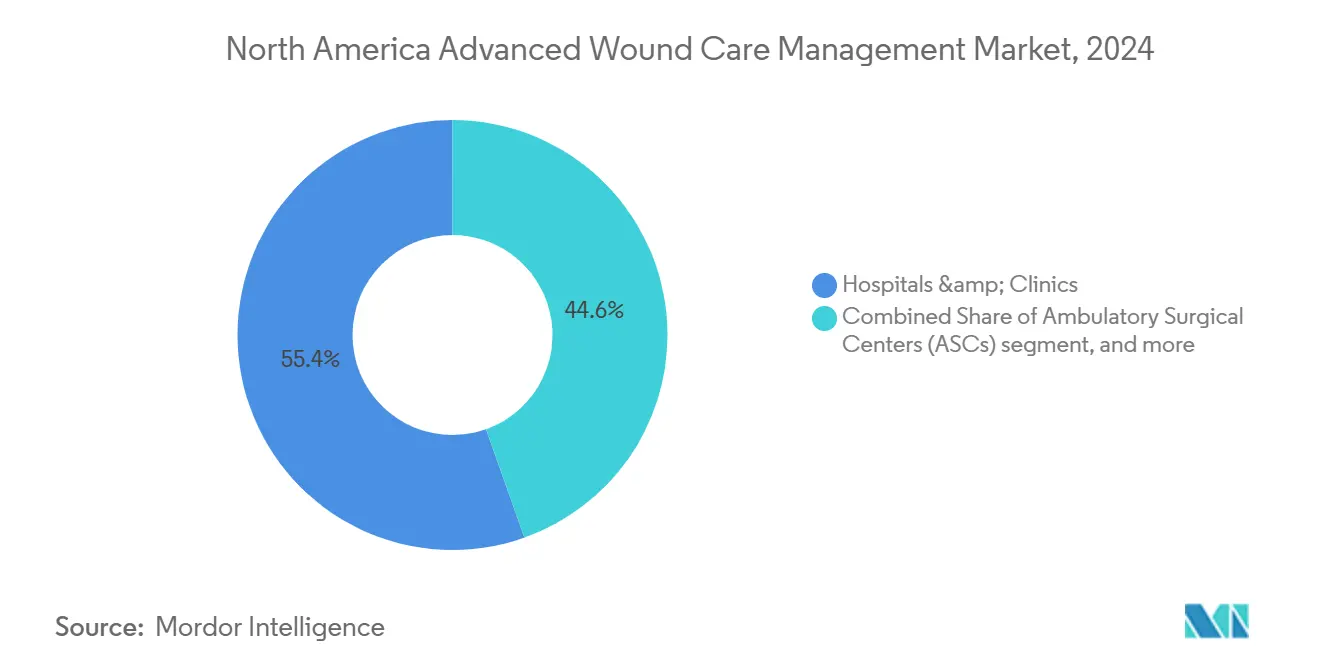
- By end user, hospitals and clinics held a 55.43% share in 2024. Home healthcare settings are projected to grow at an 8.54% CAGR through 2030.
- By mode of purchase, OTC channels held a 63.24% share in 2024. OTC channels are on track to grow at a 7.23% CAGR through 2030.
- By geography, the United States accounted for an 88.43% share in 2024. Mexico is the fastest-growing at a 6.43% CAGR through 2030.
North America Advanced Wound Care Management Market Trends and Insights
Driver Impact Analysis
| Driver | (~) % Impact on CAGR Forecast | Geographic Relevance | Impact Timeline |
|---|---|---|---|
| Rising Incidence of Chronic Wounds | +1.8% | US & Canada core, spillover to Mexico | Long term (≥ 4 years) |
| Growing Geriatric Population | +1.5% | US & Canada dominant, urban Mexico emerging | Long term (≥ 4 years) |
| Technological Advancements in Wound Care Products | +1.2% | US early adoption, Canada lag, Mexico niche pockets | Medium term (2-4 years) |
| Increasing Healthcare Expenditure | +0.7% | US leading, Canada provincial variation, Mexico rising | Medium term (2-4 years) |
| Rising Awareness and Prevention Programs | +0.3% | National, with gains in underserved US rural areas | Short term (≤ 2 years) |
| Strategic Collaborations and Partnerships | +0.2% | Global players in US, regional alliances in Mexico | Short term (≤ 2 years) |
| Source: Mordor Intelligence | |||
Rising Incidence of Chronic Wounds
Chronic wounds such as diabetic foot ulcers, pressure ulcers, and venous leg ulcers represented 61.54% of the 2024 treatment mix, reflecting the combined effects of aging, obesity, and diabetes across the North America advanced wound care management market. Diagnosed diabetes cases in the United States exceeded 38 million in 2024, and clinical literature indicates that up to 15% of people with diabetes develop foot ulcers over their lifetime, with a sizeable subset progressing to amputation without advanced intervention. Pressure ulcers affect millions of Americans in hospitals and long-term care, which reinforces demand for advanced dressings and negative-pressure therapies in high-risk settings[1]Michael S. Conte et al., “Current Status and Principles for the Treatment and Prevention of Diabetic Foot Ulcers,” Circulation, ahajournals.org. Biofilm formation is implicated in a large share of non-healing wounds, which strengthens the case for antimicrobial and biofilm-disruption technologies in the North America advanced wound care management market. Mexico’s public health data show a rising burden of diabetes-related lower-extremity complications, which has triggered new clinic capacity and targeted subsidies for advanced wound management. The FDA’s 510(k) program continued to clear wound-contact materials and antimicrobial dressings in 2024, supporting product refresh cycles and clinical adoption.
Growing Geriatric Population
The 65-plus cohort in North America is expanding, which increases the prevalence of pressure ulcers, delayed surgical healing, and multi-morbidity that complicates wound closure in the North America advanced wound care management market. By 2030 all U.S. baby boomers will be Medicare-eligible, creating a 73 million beneficiary pool with elevated wound risk and sustained demand for advanced therapies. Canada faces a similar aging profile with seniors projected to comprise about one quarter of the population by 2030, which is reinforcing home-based models and provincial telehealth to extend specialist access[2]Daniel Paniagua-Herrera, “The Health Care Situation of People Living with Diabetes in Mexico,” Revista Diabetes, revistadiabetes.org. This demographic shift favors devices and dressings that reduce caregiver burden, such as self-adherent foams and transparent films that enable visual checks without removal. Mexico’s 60-plus population has grown quickly since 2020, and families are leaning on OTC channels and private nursing for chronic-wound care, aligning with observed OTC volume and growth. Payer controls like prior authorization and clinical criteria are shaping site-of-care and product choice, which creates a split between hospital use of advanced biologics and outpatient default to moisture-retentive dressings.
Technological Advancements in Wound Care Products
Active wound care that includes biomaterials, skin substitutes, and growth factors is projected to grow at 7.54% through 2030 due to evidence of faster closure and payer willingness to cover higher upfront costs when episode economics improve. FDA clearances have advanced allografts and bioengineered matrices that leverage placental and porcine tissue as well as recombinant growth factors, which are expanding options for recalcitrant diabetic and venous ulcers. Medicare coverage expansions cited by U.S. manufacturers have increased eligibility for certain cellular and tissue-based products, which has raised procedure volumes in outpatient settings. Portable negative-pressure devices such as PICO enable early discharge and home management while maintaining therapy continuity under clinician oversight. Antimicrobial innovation is diversifying beyond silver to formulations such as polyhexamethylene biguanide and medical-grade honey that target pathogens while limiting cytotoxicity, which aligns with infection-control goals. The FDA’s Digital Health Center of Excellence has supported connected imaging and measurement apps that standardize wound documentation and integrate with health records for remote monitoring.
Increasing Healthcare Expenditure
U.S. national health expenditure was USD 4.8 trillion in 2024, and complex wound care consumes a notable share through hospital days, surgical revisions, and infection management, which sustains demand for advanced products in the North America advanced wound care management market. Medicare’s hospital outpatient payment updates in 2024 supported application services for cellular and tissue-based products, which aligned with value-based pressure to close wounds within defined windows. In Canada, provincial funding and formulary controls create uneven access where some provinces enable home-based negative pressure for post-surgical patients while others limit higher-cost biologics to specialist clinics. Ontario’s community care programs allocate targeted funds per chronic-wound episode such as CAD 300 (USD 222), which influences product selection and frequency of dressing changes. Mexico’s public insurers fund foundational wound care, and private insurers have begun to add benefits for prevention and advanced treatments, which supports higher-value product adoption in urban centers. Medicare coverage pathways that favor hospital-administered therapies, combined with limited pharmacy benefit coverage for dressings, reinforce OTC purchasing for simpler products and retain specialty channels for high-cost biologics.
Restraints Impact Analysis
| Restraint | (~) % Impact on CAGR Forecast | Geographic Relevance | Impact Timeline |
|---|---|---|---|
| High Cost of Advanced Wound Care Products | -0.9% | US commercial plans, Canada provinces, Mexico private sector | Medium term (2-4 years) |
| Stringent Regulatory Approvals | -0.5% | US FDA dominant, Health Canada parallel, COFEPRIS lag | Long term (≥ 4 years) |
| Limited Reimbursement Policies | -0.7% | US Medicare gaps, Canada provincial caps, Mexico out-of-pocket | Medium term (2-4 years) |
| Lack of Skilled Healthcare Professionals | -0.4% | Rural US, Northern Canada, underserved Mexico regions | Short term (≤ 2 years) |
| Source: Mordor Intelligence | |||
High Cost of Advanced Wound Care Products
Bioengineered skin substitutes and cellular allografts are priced from USD 800 to USD 2,500 per application, which can exceed episode payments for uncomplicated wounds in several coverage programs and limit patient uptake. Medicare’s 20% Part B coinsurance means out-of-pocket amounts can reach USD 500 per treatment when list prices are high, which redirects some cases to standard moist dressings. Manufacturers have reported that prior-authorization denials and copay burdens lead to abandonment at the point of sale, which slows adoption of premium biologics. Hospitals under inpatient DRG payments must balance biologic use against fixed reimbursements, which drives selective deployment for high-risk cases and preserves volume for lower-cost foams and alginates. In Mexico, private clinics serve a price-sensitive middle-income segment where a single advanced dressing can be a significant share of household income, which supports a two-tier product mix. U.S. hospital price transparency has revealed wide variation in charges for skin-substitute procedures, yet patient shopping is limited by clinical urgency and referral patterns.
Stringent Regulatory Approvals
The FDA’s PMA pathway for higher-risk wound devices demands robust clinical evidence and multi-year timelines, which can strain mid-sized manufacturers and consolidate innovation within larger portfolios in the North America advanced wound care management market. Draft guidance on real-world evidence for wound endpoints in 2024 signaled flexibility, although standardizing imaging and documentation across sites remains a practical challenge. Health Canada’s device reviews and labeling requirements add time and complexity to multi-country launches and can delay Canadian availability of newer technologies. COFEPRIS has historically followed FDA and Health Canada decisions with a lag, which affects the pace of adoption in Mexico relative to the U.S. and Canada[3]. Post-market surveillance obligations under FDA reporting rules require tracking adverse events for wound products, which imposes compliance costs that can be significant for smaller firms. ISO 13485 certification and regular audits are needed for quality management and are prerequisites for broad distribution.
Segment Analysis
By Product: Biomaterial Innovation Challenges Moist Dressing Incumbency
Moist wound care held 45.67% of the North America advanced wound care management market share in 2024, spanning foam, hydrocolloid, film, alginate, hydrogel, and collagen formats that support a moist healing environment under widely used protocols. Foam dressings lead within this subsegment due to absorbency and ease of use for venous leg ulcers and pressure injuries in home and long-term care, which sustains repeat purchasing. Hydrocolloid and alginate dressings are used for moderate to heavy exudate, while films often serve as secondary covers that reduce nursing time by allowing visual checks. Active wound care is projected to grow at 7.54% through 2030 as payers support biologics where total episode costs fall with faster closure in the North America advanced wound care management market. Hospital infection-control teams are gradually adding non-silver antimicrobials to formularies, which broadens options for biofilm-laden wounds. Manufacturers are integrating antimicrobial layers into bordered foams to simplify stocking and selection in ambulatory settings. Collagen dressings fill a niche when tendon or bone is exposed, but higher per-unit costs and wear-time constraints limit broader use in generalist settings. Regulatory clearances for contact materials require biocompatibility per ISO 10993 and safety data that support routine use in diverse care settings. Health Canada’s oversight of Class III products that include live cells or recombinant factors adds post-market reporting that can slow Canadian access compared with the United States. The growth gap between commoditized moist dressings and higher-value active therapies is steering incumbent strategies toward private-label contracts and GPO partnerships while challengers lean on peer-reviewed evidence and value analyses. This product dynamic will continue to reshape category mix in the North America advanced wound care management industry as providers match patients to interventions that close wounds within target windows.
Note: Segment shares of all individual segments available upon report purchase
Get Detailed Market Forecasts at the Most Granular Levels
Download PDF
By Wound Type: Chronic Wounds Command Volume, Acute Wounds Drive Growth
Chronic wounds accounted for 61.54% of clinical activity in 2024, reflecting extended care cycles for diabetic foot ulcers, pressure injuries, and venous ulcers that require consistent moisture management and offloading. Diabetic foot ulcers recur frequently after closure, which sustains demand for foam dressings and selective use of biologics when conservative therapy stalls in the North America advanced wound care management market. Pressure injuries in skilled-nursing and home-bound seniors generate steady use of silicone-bordered foams and repositioning protocols, which aligns with the rise of home healthcare. Venous and arterial ulcers prompt use of compression with antimicrobial dressings, which drives bundled offerings for vascular practices. The North America advanced wound care management industry increasingly targets biofilm control within chronic wounds to accelerate time to closure.
Acute wounds held a smaller 2024 share but are forecast to grow at 7.21% through 2030, reflecting expanding ambulatory surgery volumes and greater adoption of negative-pressure incisional therapy to reduce complications. Surgical-site events still impose heavy costs per episode, which strengthens the case for prophylactic antimicrobials and portable negative-pressure systems. Burn care is adopting bioengineered dermal substitutes and collagen scaffolds that speed re-epithelialization in specialized centers. Traumatic injuries create episodic demand in regions with higher industrial or construction activity, which supports inventory of hemostatic dressings in EMS and urgent care. Oversight includes ongoing surveillance for surgical meshes and implants that influence wound healing, while mandated staffing ratios in some states support early identification of post-operative complications.
By End User: Home Healthcare Settings Disrupt Hospital-Centric Models
Hospitals and clinics retained 55.43% share in 2024, driven by complex chronic wounds that need debridement, negative-pressure therapy, and multidisciplinary oversight that is concentrated in institutional settings. Academic centers operate referral programs that standardize protocols and support education, which encourages adoption of advanced therapies where indicated across the North America advanced wound care management market. Ambulatory surgery centers gained procedures with Medicare’s expanded ASC-list, which reduced facility costs for selected skin-substitute applications.
Home healthcare is projected to grow at 8.54% annually as hospital-at-home programs and telehealth workflows demonstrate comparable healing outcomes at lower cost. Care at home favors self-adherent foams, transparent films for visual checks, and single-dose antimicrobial gels that reduce dosing errors. Portable negative-pressure systems such as PICO and Prevena are FDA-cleared for home use, which supports early discharge without compromising therapy continuity. Telehealth imaging platforms such as Swift Medical extend specialist reach and enable remote plan adjustments within standard care pathways. Long-term care facilities maintain a stable share with basic moisture-retentive products under per-diem budgets, while freestanding wound centers concentrate high-intensity services like hyperbaric oxygen and advanced grafting.
Note: Segment shares of all individual segments available upon report purchase
Get Detailed Market Forecasts at the Most Granular Levels
Download PDF
By Mode of Purchase: OTC Dominance Reflects Self-Care Shift and Access Barriers
OTC channels captured 63.24% of the North America advanced wound care management market in 2024 by transaction volume, supported by retail pharmacy and e-commerce access that eases replenishment for minor wounds and ulcer maintenance. OTC products include foams, hydrocolloids, films, and non-prescription antimicrobials that patients select under clinician guidance between visits, which reduces delays from benefit authorization. Subscription delivery through major retailers reduces stockouts for rural patients who manage chronic wounds at home.
Prescription channels retain high-value products such as biologics, certain antimicrobials, and negative-pressure components that require physician orders and specialty pharmacy logistics. Slower growth in the prescription channel reflects benefit design, step edits, and prior authorization that can delay starts by several days in the North America advanced wound care management market. FDA monograph rules limit OTC labeling to minor-wound claims, which keeps advanced indications in prescription categories even when consumers use OTC dressings as part of long-term regimens. Health Canada requires DINs for non-prescription wound products and enforces safety and labeling standards for pharmacy sale. In Mexico, COFEPRIS permits OTC sale of basic dressings while reserving more advanced antimicrobials for prescription, which splits access between retail and hospital channels.
Geography Analysis
The United States held 88.43% of the North America advanced wound care management market share in 2024, supported by high per-capita health spending, deep insurer coverage, and a dense network of wound centers that use both traditional and advanced products. Medicare and Medicaid cover large beneficiary populations with elevated wound risk, which sustains demand for dressings, debridements, biologics, and negative-pressure therapy across care settings. Market expansion in the United States is tied to innovation and value-based payment models that reward earlier closure, not to greenfield access, within the North America advanced wound care management market. FDA’s review and surveillance infrastructure supports rapid product iteration and safe deployment. National and local coverage determinations for skin substitutes widened access criteria in 2024 in select indications, which manufacturers cited as tailwinds for procedure growth.
Canada contributes a mid-single-digit share under provincial control of coverage and drug-device formularies that create variation across the North America advanced wound care management market. Ontario uses exceptional-access processes for higher-cost dressings while Alberta’s plans support broader negative-pressure coverage at home under specific criteria. Federal and provincial research investments emphasize telehealth for remote and Indigenous communities to mitigate high diabetes prevalence and access barriers to urban wound centers. Health Canada’s timelines and cautious adoption pace often follow U.S. experience, which reduces clinical risk but slows Canadian uptake of the latest wound technologies. Group purchasing in hospitals exerts downward price pressure on commoditized categories like foams and hydrocolloids. Mexico is the fastest-growing geography at a 6.43% CAGR through 2030, driven by expanded private insurance, medical tourism for elective procedures, and public programs targeting diabetic amputations in the North America advanced wound care management market. Public systems cover foundational care while private hospitals in major cities use cellular allografts and negative-pressure therapies covered by employer or individual policies. USMCA preferences encourage local production in states such as Jalisco and Nuevo León that supply domestic and export markets, which improves pricing and availability. COFEPRIS reforms launched to shorten device approval times through reliance on FDA and Health Canada clearances aim to accelerate access but are still in transition. Compliance in Mexico relies on registration and GMP audits with stronger enforcement in large metros, prompting reputable suppliers to use ISO 13485 quality systems to maintain trust and export readiness.
Competitive Landscape
The North America advanced wound care management market remains moderately fragmented with top global players sharing space with focused biologics firms and regional distributors that serve long-term care and home-health channels. Strategic emphasis is moving toward integrated ecosystems that combine devices, digital monitoring, and service models that build switching costs and drive adherence. Partnerships between device makers and telehealth platforms enable remote troubleshooting and data capture that support earlier intervention and supply optimization.
In the active wound care segment, product competition centers on cost-per-healed-wound outcomes for diabetic foot and venous ulcers, which payers scrutinize during coverage and policy updates in the North America advanced wound care management market. Companies reported that wider Medicare criteria in 2024 increased eligible volumes, although price competition pressured average selling prices for biologics. Negative-pressure portfolios are defended by intellectual property and incremental design improvements such as longer battery life and connectivity for home use. Patent expirations approaching 2026 to 2030 may invite new entrants and litigation that shapes pricing.
Digital wound-imaging tools are becoming a differentiator and are being bundled with consumables or offered as subscriptions to integrate with hospital and home-health workflows in the North America advanced wound care management market. Regulatory and registration costs for multi-country distribution concentrate pan-regional scale within larger firms while enabling smaller specialists to succeed within a single national market. Consolidation has been limited, but logistics and distribution assets that steer formulary decisions in ASC and home-health channels are attractive targets for private capital.
North America Advanced Wound Care Management Industry Leaders
-
3M Company
-
Smith + Nephew
-
Integra Life Sciences
-
Johnson & Johnson (Ethicon)
-
Baxter International Inc.
- *Disclaimer: Major Players sorted in no particular order
Need More Details on Market Players and Competitors?
Download PDF
Recent Industry Developments
- November 2025: Solventun entered into a definitive agreement to acquire Acera Surgical (Acera), a privately held bioscience company focused on developing and commercializing fully engineered materials for regenerative wound care for USD 725 million in cash plus up to USD 125 million in contingent cash payments based on the achievement of certain future milestones.
- November 2024: Geistlich entered into an exclusive national distribution partnership agreement with StimLabs, a leading wound care company in the United States. With immediate effect, StimLabs will assume all commercial activities for Geistlich’s Derma-Gide Advanced Wound Matrix, offering a leading and clinically proven solution for acute and chronic wounds.
Research Methodology Framework and Report Scope
Market Definitions and Key Coverage
Our study defines the North America advanced wound care management market as revenue generated from advanced wound dressings, negative-pressure and oxygen devices, wound-closure consumables, active or biologic therapies, and prescription topical agents that treat chronic or acute wounds across hospitals, ambulatory surgical centers, home health, long-term care, and specialty wound clinics in the United States, Canada, and Mexico.
Scope exclusion: Conventional cotton gauze, basic adhesive bandages, and veterinary wound products are outside scope.
Segmentation Overview
- By Product
- Moist Wound Care
- Foam Dressings
- Hydrocolloid Dressings
- Film Dressings
- Alginate Dressings
- Hydrogel Dressings
- Collagen Dressings
- Other Advanced Dressings
- Antimicrobial Wound Care
- Silver
- Non-silver
- Active Wound Care
- Biomaterials
- Skin-substitute
- Growth Factors
- Moist Wound Care
- By Wound Type
- Chronic Wounds
- Diabetic Foot Ulcer
- Pressure Ulcer
- Venous & Arterial Ulcer
- Other Chronic Wounds
- Acute Wounds
- Surgical Wounds
- Burns
- Traumatic & Other Acute Wounds
- Chronic Wounds
- By End User
- Hospitals & Clinics
- Ambulatory Surgical Centers (ASCs)
- Home Healthcare Settings
- Long-Term Care & Skilled Nursing Facilities
- Specialty Wound Care Centers
- By Mode of Purchase
- Prescription-based (Rx)
- Over-the-Counter (OTC)
- By Country
- United States
- Canada
- Mexico
Detailed Research Methodology and Data Validation
Primary Research
Mordor analysts held structured calls with wound care nurses, supply chain heads, and distributor managers across all three countries, followed by a brief online survey of home health clinicians. Insights on device utilization, net price movement, and setting level shifts validated assumptions flagged during secondary work.
Desk Research
We pulled patient and procedure volumes from CDC, CMS, the Public Health Agency of Canada, and Mexico's INEGI, then overlaid these with OECD health expenditure files to size demand. Trade codes for advanced dressings on Volza and FDA 510(k) or Health Canada listings mapped supply and launch timing. Company filings via D&B Hoovers, price lists captured through Dow Jones Factiva, and clinical studies in journals such as Wound Repair and Regeneration informed pricing and adoption trends. These sources are illustrative; numerous other open access and paid assets supported the desk review.
Market Sizing & Forecasting
A top down episode model converts diabetes, pressure injury, burn, and surgical case counts into treatable wounds, which are then multiplied by treatment intensity and net average selling price to reach the 2024 base value. Supplier roll ups and sampled ASP × unit checks serve as bottom up reference points. Core variables include diabetic prevalence, inpatient surgeries, nursing home occupancy, device penetration curves, and price erosion. Multivariate regression, enriched with scenario analysis, projects demand to 2030; when data gaps appear, conservative proxies from adjacent care segments are applied and stress tested.
Data Validation & Update Cycle
Outputs undergo variance scans against historical patterns, public filings, and sentinel hospital audits. An analyst peer review precedes sign off, and the model refreshes yearly, with interim updates triggered by material policy or technology shifts.
Why Mordor's North America Wound Care Management Baseline Commands Reliability
Published estimates diverge because firms mix traditional dressings, apply list prices, or broaden regional scopes.
By anchoring on discrete advanced products, net pricing, and an annual refresh, Mordor delivers a balanced, transparent view.
Benchmark comparison
| Market Size | Anonymized source | Primary gap driver |
|---|---|---|
| USD 5.53 B (2025) | Mordor Intelligence | - |
| USD 5.10 B (2024) | Regional Consultancy A | Excludes Mexico; applies global ASP to U.S. mix |
| USD 6.64 B (2024) | Research Publisher B | Bundles semi advanced dressings; uses list prices |
| USD 15.18 B (2024) | Industry Tracker C | Adds traditional gauze and biologics; assumes uniform growth |
These contrasts show that our disciplined scope, verified pricing, and transparent variables give decision makers the most dependable baseline.
Need A Different Region or Segment?
Customize Now
Key Questions Answered in the Report
What is the current size and 2030 outlook for the North America advanced wound care management market?
The market reached USD 5.92 billion in 2025 and is projected to reach USD 7.78 billion by 2030, reflecting a 5.62% CAGR based on current growth dynamics.
Which product categories are leading growth in North America advanced wound care?
Active wound care products such as cellular matrices and growth factor therapies are the fastest-growing at a 7.54% CAGR, while moist wound care remains the largest by share.
How is the site of care shifting in North America advanced wound management?
Hospitals and clinics hold the largest share today, but home healthcare settings are growing at 8.54% annually due to telehealth, connected devices, and payer support for lower-cost sites.
Which countries are driving growth within North America advanced wound care?
The United States dominates with an 88.43% share, while Mexico is the fastest-growing at a 6.43% CAGR through 2030 as coverage and private insurance expand.
What factors are propelling adoption of advanced therapies in North America advanced wound care?
Rising chronic-wound burden, an aging population, payer-aligned episode economics, and FDA-cleared portable and digital tools are pushing adoption across care settings.
How do OTC channels influence adoption in North America advanced wound care?
OTC channels captured 63.24% of transactions in 2024 and are growing at 7.23%, as self-care for minor wounds and ulcer maintenance reduces friction from prior authorization and copays.
Page last updated on: