Market Overview
| Study Period | 2019 - 2030 |
|---|---|
| Base Year For Estimation | 2024 |
| Forecast Data Period | 2025 - 2030 |
| Market Size (2025) | USD 116.23 Billion |
| Market Size (2030) | USD 136.85 Billion |
| Growth Rate (2025 - 2030) | 3.32% CAGR |
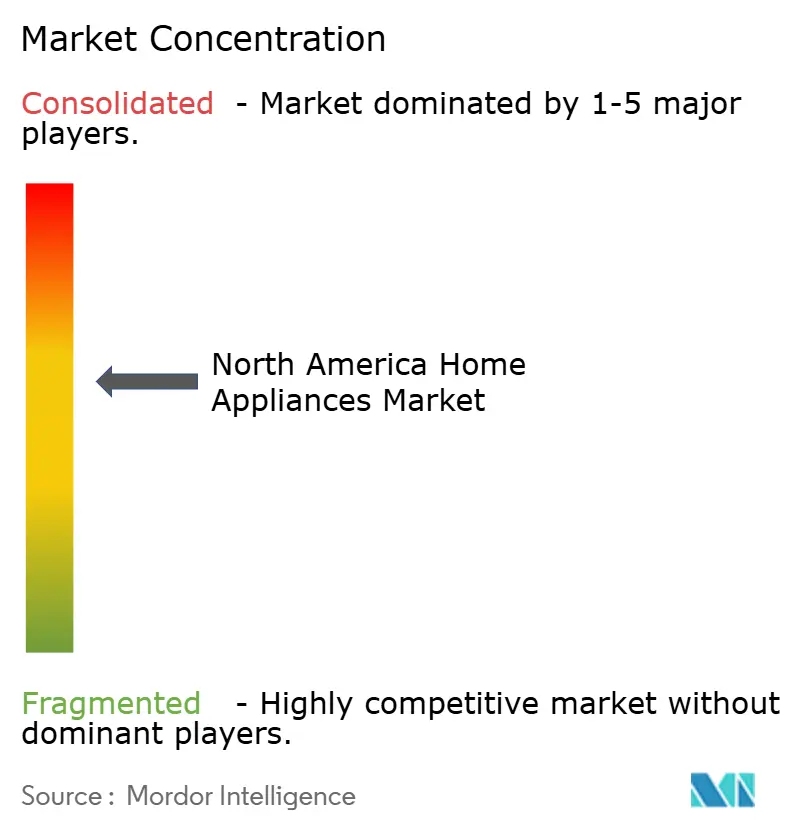
| Market Concentration | Medium |
Major Players
*Disclaimer: Major Players sorted in no particular order Image © Mordor Intelligence. Reuse requires attribution under CC BY 4.0. |
|
North America Home Appliances Market Analysis by Mordor Intelligence
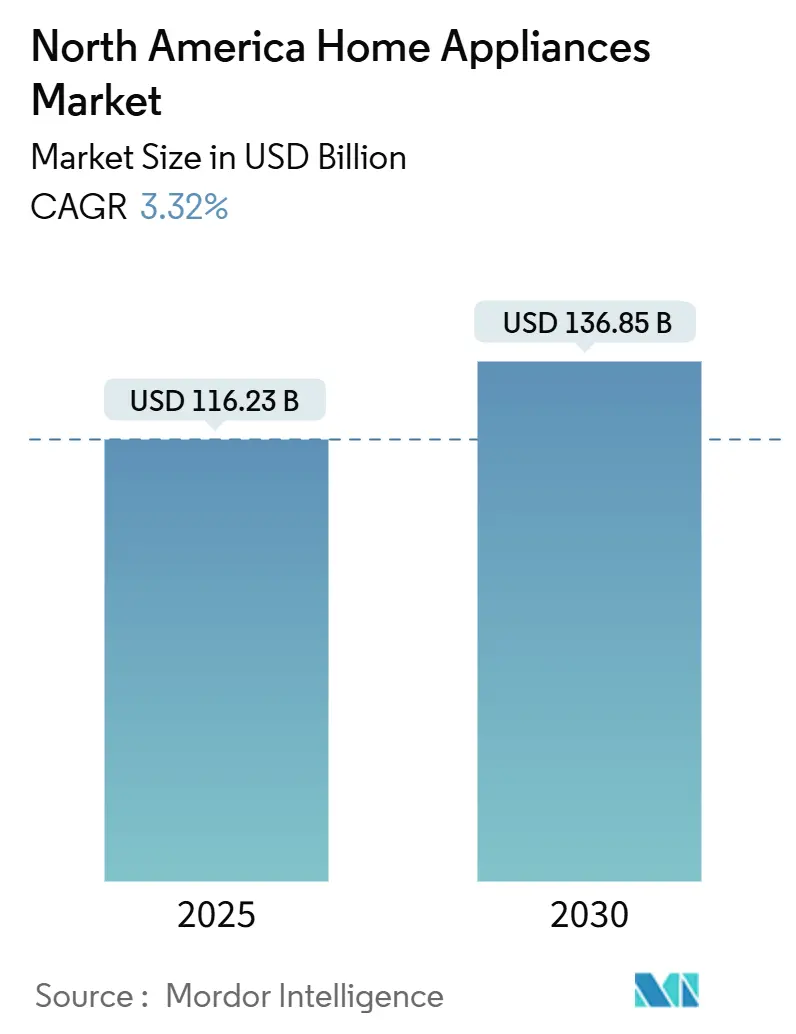
The North America home appliances market size reached USD 116.23 billion in 2025 and is projected to advance to USD 136.85 billion by 2030, reflecting a 3.32% CAGR over the forecast window. Smart-home connectivity, expanding e-commerce fulfilment, and energy-efficiency mandates continue to add fresh revenue streams that temper the maturity of traditional replacement demand across the North America home appliances market. Manufacturers are redirecting capital toward Matter-compliant platforms, heat-pump compressors, and induction technologies to satisfy regulatory timelines and earn utility incentives. Nearshoring investments in Mexico, combined with rising tariff barriers on Asian imports, are restructuring regional cost bases while semiconductor shortages and freight volatility still weigh on lead times. Competitive dynamics therefore concentrate around incumbents capable of funding R&D, managing compliance, and sustaining omni-channel service models across the North America home appliances market.
Key Report Takeaways
- By product type, refrigerators led with 25.34% of the North America home appliances market share in 2024; washing machines are set to grow at a 4.12% CAGR to 2030.
- By distribution channel, multi-brand stores held 45.67% share of the North America home appliances market size in 2024, while online platforms posted the highest projected CAGR at 4.61% through 2030.
- By geography, the United States commanded 77.12% of the North America home appliances market size in 2024, but Mexico is forecast to expand at a 4.82% CAGR to 2030.
North America Home Appliances Market Trends and Insights
Drivers Impact Analysis
| Driver | (~) % Impact on CAGR Forecast | Geographic Relevance | Impact Timeline |
|---|---|---|---|
| Smart-home penetration & IoT integration | +0.8% | North America, strongest in U.S. urban markets | Medium term (2-4 years) |
| Energy-efficiency regulations & ENERGY STAR incentives | +0.6% | United States and Canada, with spillover to Mexico | Long term (≥ 4 years) |
| Residential remodelling surge post-COVID | +0.5% | North America, concentrated in suburban U.S. markets | Short term (≤ 2 years) |
| E-commerce channel expansion & last-mile innovation | +0.4% | North America, strongest growth in Canada and Mexico | Medium term (2-4 years) |
| State heat-pump appliance mandates | +0.3% | U.S. West Coast and Northeast states | Long term (≥ 4 years) |
| Utility-funded low-income replacement rebates | +0.2% | United States, focused on low-income communities | Medium term (2-4 years) |
| Source: Mordor Intelligence | |||
Smart-Home Penetration & IoT Integration
Connected adoption is broadening beyond early adopters as interoperability standards stabilize and installation complexity falls. In 2024, BSH introduced the first consumer-available Matter-enabled French-door refrigerator, signalling a shift from positioning IoT as a premium add-on toward embedding connectivity across mainstream models[1]BSH, “Bosch Home Appliances Announces Distribution Partnership with The Home Depot,” BSH-Group News, bsh-group.com. Partnerships linking appliance OEMs with major automation platforms now support onboarding processes that take minutes rather than hours, which lifts conversion rates in the North American home appliances market. LG and Samsung are placing equal emphasis on software updates and hardware refreshes, turning over-the-air upgrades into a post-sale engagement tool that can lengthen customer lifetime value. As a result, network-ready features are becoming table stakes even in mid-price segments of the North American home appliances market. Companies lacking native software expertise face rising integration costs or must rely on white-label solutions that erode brand differentiation.
Energy-Efficiency Regulations & ENERGY STAR Incentives
Department of Energy standards effective from 2024 tighten allowable kilowatt-hour consumption across all core categories, forcing accelerated R&D spending on variable-speed compressors, induction coils, and heat-pump dryers[2]U.S. Department of Energy, “Appliance and Equipment Standards Program,” Energy Efficiency & Renewable Energy, energy.gov. Canada’s parallel framework creates harmonization benefits for manufacturers operating integrated regional supply chains, while Mexico’s draft norms foreshadow continent-wide convergence. On the demand side, the Inflation Reduction Act rebates provide up to USD 840 for qualifying electric dryers, nudging households toward efficient models and boosting unit value in the North American home appliances market. Yet fragmented state-level administration produces uneven sales lift, requiring granular channel planning. Smaller brands struggle to recover certification expenses, which expands scale advantages for incumbents already active across the North America home appliances industry.
Residential Remodeling Surge Post-COVID
Elevated kitchen and bath renovation activity, fuelled by hybrid work lifestyles, still runs above pre-pandemic averages even as mortgage rates dampen discretionary outlays. Professional-grade ranges, column refrigerators, and dual-drawer dishwashers capture upside as homeowners convert daily cooking into an experiential pursuit. Demand is geographically skewed toward high-income suburban zip codes, creating pockets of premium growth inside the broader North America home appliances market. Prolonged contractor backlogs extend appliance lead times, compelling retailers to refine inventory forecasting and cross-dock logistics. Although remodelling momentum is normalizing, the installed base of recently upgraded homes locks in higher ASPs and embedded smart-hub penetration through 2030.
E-Commerce Channel Expansion & Last-Mile Innovation
Online penetration is rising as white-glove delivery, haul-away services, and same-day installation mitigate the complexity of moving 300-pound appliances. Bosch’s February 2025 listing on HomeDepot.com illustrates how premium brands leverage omnichannel partner infrastructure to reach do-it-yourself consumers without sacrificing service quality[3]BSH, “Bosch Home Appliances Announces Distribution Partnership with The Home Depot,” BSH-Group News, bsh-group.com. Discount refurbishers such as QG Appliances 4 Less use factory-certified returns to target value-oriented shoppers, opening new sub-segments within the North America home appliances market. Augmented-reality kitchen planners and AI-based product configurators now replicate in-store consultation online, lifting digital conversion. The resulting share gains challenge multi-brand showrooms to differentiate with experiential merchandising and same-day store pickup.
Restraints Impact Analysis
| Restraint | (~) % Impact on CAGR Forecast | Geographic Relevance | Impact Timeline |
|---|---|---|---|
| Semiconductor & logistics supply constraints | -0.7% | North America, strongest on U.S. manufacturing | Short term (≤ 2 years) |
| Inflation-driven consumer price sensitivity | -0.5% | North America, concentrated in the middle-income segments | Medium term (2-4 years) |
| PFAS & refrigerant phase-out compliance costs | -0.3% | United States and Canada | Long term (≥ 4 years) |
| Declining home mobility is dampening replacement cycles | -0.2% | United States suburban markets | Medium term (2-4 years) |
| Source: Mordor Intelligence | |||
Semiconductor & Logistics Supply Constraints
The North American home appliances market continues to face challenges due to persistent chip shortages, which are driving redesigns around available microcontrollers. This situation is increasing bill-of-materials costs and raising quality-control risks. Additionally, port congestion and tariff hikes are escalating inbound freight rates, further pressuring manufacturers to localize production. BSH's USD 238 million refrigeration plant in Monterrey highlights the growing trend of near shoring to reduce lead times and mitigate trans-Pacific shipping risks. However, greenfield capacity investments require a multiyear payback period, limiting immediate benefits. OEMs that fail to secure dual-sourcing options for components risk losing shelf space to competitors leveraging forward-buy contracts to ensure supply chain stability.
Inflation-Driven Consumer Price Sensitivity
Between 2023 and 2025, average selling prices are projected to increase by 11%, driven by higher material, freight, and labor costs passed through to retail prices. This trend is prompting middle-income households to delay replacements or shift toward refurbished units, which is diverting volumes from new-unit sales and compressing gross margins in the North America home appliances market. The expansion of the refurbished channel is exerting downward pressure on profitability. Financing promotions and entry-level product launches are mitigating demand erosion but may dilute premium brand equity. If disposable income growth remains sluggish, price elasticity could intensify, compelling manufacturers to adjust their portfolios strategically to maintain profitability. Balancing affordability and brand positioning will be critical for sustaining market competitiveness.
Segment Analysis
By Product Type: Major Appliances Drive Market Foundation
Refrigerators retained the leading 25.34% North America home appliances market share in 2024, supported by their essential status, large cubic-foot capacities, and premiumization through smart cooling algorithms. Washing machines posted the highest 4.12% CAGR outlook, propelled by heat-pump dryer combos and AI-enabled load sensing that optimize water and power use, thereby leveraging utility rebates to unlock incremental upgrades. The shift to induction cooktops is equally notable as state gas bans draw builders toward electric specifications, enriching the average transaction value within the North America home appliances market size for cooking appliances. Air conditioners confront dual challenges of refrigerant transitions and seasonal demand volatility, yet inverter technology adoption stabilizes margins. Dishwashers and ovens benefit from sustained residential remodelling and restaurant-at-home cooking trends, although extended lead times persist due to semiconductor allocation. Across categories, IoT firmware updates extend functional life, but also raise expectations for continual software support, an obligation that favours scale players with dedicated digital teams. Continuous integration of voice-assistant compatibility further embeds appliances into broader smart-home ecosystems, a linkage that can stimulate ancillary accessory sales.
Consumers increasingly evaluate total ownership cost, combining energy savings, maintenance alerts, and potential resale premiums when selecting major appliances in the North American home appliances market. Consequently, R&D expenditure tilts toward sensor arrays and machine-learning on-device inference that calibrates cycles dynamically, while hardware innovation, such as variable-capacity compressors, maintains steady but incremental progress.

Note: Segment shares of all individual segments available upon report purchase
Get Detailed Market Forecasts at the Most Granular Levels
Download PDF
By Distribution Channel: Online Growth Challenges Traditional Retail
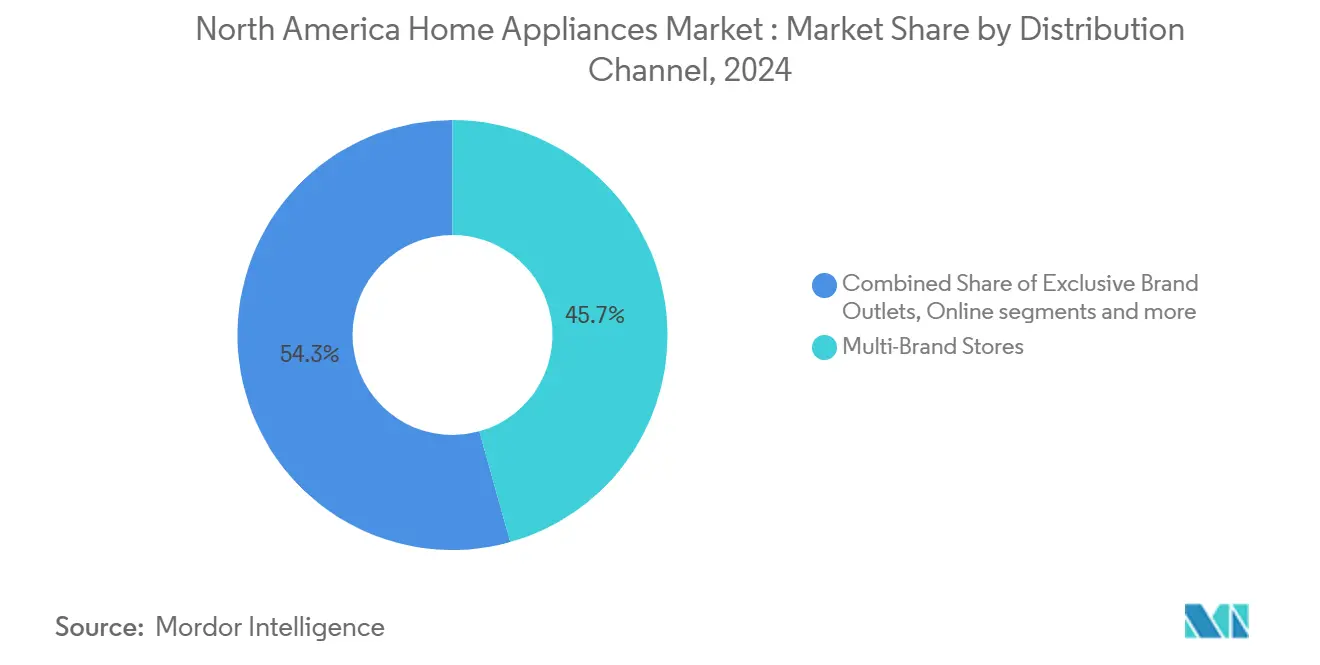
Multi-brand showrooms commanded 45.67% share of the North America home appliances market size in 2024, owing to their comparative product displays, financing desks, and established installation crews. Nevertheless, online channels record a 4.61% CAGR as logistics providers perfect white-glove delivery that includes haul-away and same-day hookup, removing legacy barriers in the North American home appliances market. Consumers leverage 3-D configurators, augmented-reality overlays, and AI chat agents to finalize complex purchases without store visits, cutting transaction friction. Pure-play e-commerce operators partner with regional service technicians to meet warranty obligations, blurring the historical service gap between digital and physical channels.
Exclusive brand boutiques preserve a higher gross margin, especially for luxury labels where personalized consultation justifies appointment-only showrooms, while builder-direct sales pipelines secure large batch orders tied to residential developments. Warehouse clubs maintain competitive relevance via bulk-buy pricing, though their limited SKU breadth restricts premium assortment. Meanwhile, discount refurbishers inject price transparency, nudging full-line retailers to introduce certified-pre-owned sections to protect share inside the North America home appliances market.
Note: Segment shares of all individual segments available upon report purchase
Get Detailed Market Forecasts at the Most Granular Levels
Download PDF
Geography Analysis
The United States retained 77.12% of regional value in 2024, anchoring the North America home appliances market with deep installed bases, mature service networks, and robust smart-home adoption. Heat-pump incentives under the Inflation Reduction Act elevate electrification adoption, while California and New York gas-exit regulations drive induction range demand. Yet slower home mobility narrows full-suite replacement frequency, obliging brands to focus on feature-driven upsell campaigns rather than volume expansion.
Mexico delivers the fastest 4.82% CAGR through 2030, buoyed by rising middle-class incomes, urbanization, and continuous residential construction that embraces modern kitchen layouts. BSH’s Monterrey plant underscores investor confidence in local demand and regional export potential, cutting lead times and tariff exposure for the wider North America home appliances market. Improved grid reliability and credit access accelerate penetration of energy-intensive products such as air conditioners and electric dryers.
Canada exhibits steady growth that mirrors U.S. trends, although a smaller population caps absolute revenue despite similar per-capita unit density. Energy-efficiency policy symmetry with the United States enables platform commonality, reducing SKU proliferation. Premium positioning gains traction through design-centric marketing exemplified by Monogram’s partnership with designer Lauren Kyle McDavid, which targets renovation projects in affluent urban cores[4]Monogram, “Monogram Luxury Appliances Launches Partnership with Celebrity Designer Lauren Kyle McDavid,” Newswire, newswire.ca. Cold-climate heating loads continue to shape demand for high-efficiency dryers and dual-fuel ranges, requiring modest product adaptations even within shared regulatory frameworks.
Get Analysis on Important Geographic Markets
Download PDF
Competitive Landscape
Competition remains moderate yet intensifying as Whirlpool, GE Appliances, LG, and Samsung deploy vertical integration, IoT differentiation, and near-shoring to retain share inside the North America home appliances market. BSH’s early Matter adoption establishes interoperability leadership, while GE Appliances links major units to ABB smart panels to deliver unified household energy dashboards. These initiatives bind appliances to broader residential electrification ecosystems, raising switching costs.
Scale advantages manifest in component procurement, certification throughput, and continuous software support, reinforcing barriers for smaller brands. Nonetheless, challengers like SharkNinja exploit social media engagement and direct-to-consumer logistics to carve niches, especially in countertop appliances adjacent to the core North America home appliances market. Strategic M&A activity, such as NIBE’s acquisition of Miles Industries’ Valor hearth business, signals entry avenues for HVAC players seeking cross-selling into kitchen and laundry.
Supply-chain uncertainties keep spare-part inventories tight; accordingly, integrated OEM-retailer collaborations emphasize predictive maintenance and subscription replacement programs that lock customers into brand ecosystems. Regulatory compliance around PFAS and refrigerants elevates R&D budgets, but also underpins premium positioning by allowing brands to market health and sustainability credentials. Those unable to absorb escalating costs may exit, accelerating consolidation momentum in the North America home appliances industry.
North America Home Appliances Industry Leaders
-
Whirlpool Corporation
-
Electrolux AB
-
Samsung Electronics
-
LG Electronics
-
GE Appliances (Haier)
- *Disclaimer: Major Players sorted in no particular order
Need More Details on Market Players and Competitors?
Download PDF
Recent Industry Developments
- April 2025: Monogram luxury appliances launched a two-year collaboration with Canadian designer Lauren Kyle McDavid, establishing the Monogram Design Council to co-create content and showroom experiences. The partnership targets affluent renovation customers who value aesthetics and personalized consultation, reinforcing Monogram’s premium positioning in a market where design differentiation commands higher margins. Expanding brand storytelling through design ambassadors helps Monogram defend its share against European luxury imports in Canada and select U.S. metro areas.
- March 2025: Midea Group confirmed plans to open an R&D center in Dallas during Q3 2025, its first dedicated innovation hub in the United States. The facility will tailor refrigeration and laundry platforms to North American efficiency standards and consumer preferences, shortening product-development cycles that previously relied on China-based labs. Localized engineering capability is expected to accelerate Midea’s penetration of mid-tier segments, intensifying price competition for incumbent brands.
- February 2025: Bosch Home Appliances began a nationwide distribution partnership with The Home Depot, instantly adding more than 2,300 brick-and-mortar outlets and HomeDepot.com to its U.S. sales network. The alliance pairs Bosch’s premium lineup with Home Depot’s white-glove delivery and installation services, enhancing consumer access while supporting the retailer’s push into higher-margin categories. Wider showroom visibility is expected to lift Bosch’s share in built-in dishwashers and induction cooktops across the North America home appliances market.
- February 2025: GE Appliances entered a strategic alliance with ABB to integrate ReliaHome smart panels into the EcoBalance platform, allowing homeowners to manage solar arrays, EV chargers, and major appliances from a single app. By tying load-heavy products like washers and induction ranges to dynamic energy dashboards, GE positions itself to capture value from utility demand-response programs that are expanding across the United States. The collaboration strengthens GE’s differentiation at a time when electrification incentives are driving appliance-HVAC convergence.
North America Home Appliances Market Report Scope
A gadget that helps with household chores like cooking, cleaning, and food preservation is called a home appliance, sometimes known as a domestic appliance, an electric appliance, or a household appliance. The report contains a complete background analysis of the North American home appliances market, which includes an assessment of the industry associations, overall economy, and emerging market trends by segment. Moreover, significant changes in the market dynamics and market overview are covered in the report. The North American home appliances market is segmented by major appliances, which include refrigerators, freezers, dishwashing machines, washing machines, cookers, and ovens; by small appliances, including vacuum cleaners, small kitchen appliances, hair clippers, irons, toasters, grills, and roasters, and hair dryers; and by distribution channel including supermarkets/hypermarkets, specialty stores, and e-commerce stores. The report offers market size and forecast values for the North American home appliances market in USD for the above segments.
By Product Type
| Major Home Appliances | Refrigerators |
| Freezers | |
| Washing Machines | |
| Dishwashers | |
| Ovens (Incl. Combi & Microwave) | |
| Air Conditioners | |
| Other Major Home Appliances | |
| Small Home Appliances | Coffee Makers |
| Food Processors | |
| Grills & Roasters | |
| Electric Kettles | |
| Juicers & Blenders | |
| Air Fryers | |
| Vacuum Cleaners | |
| Electric Rice Cookers | |
| Toasters | |
| Countertop Ovens | |
| Other Small Home Appliances |
By Distribution Channel
| Multi-Brand Stores |
| Exclusive Brand Outlets |
| Online |
| Other Distribution Channels |
By Geography
| United States |
| Canada |
| Mexico |
| By Product Type | Major Home Appliances | Refrigerators |
| Freezers | ||
| Washing Machines | ||
| Dishwashers | ||
| Ovens (Incl. Combi & Microwave) | ||
| Air Conditioners | ||
| Other Major Home Appliances | ||
| Small Home Appliances | Coffee Makers | |
| Food Processors | ||
| Grills & Roasters | ||
| Electric Kettles | ||
| Juicers & Blenders | ||
| Air Fryers | ||
| Vacuum Cleaners | ||
| Electric Rice Cookers | ||
| Toasters | ||
| Countertop Ovens | ||
| Other Small Home Appliances | ||
| By Distribution Channel | Multi-Brand Stores | |
| Exclusive Brand Outlets | ||
| Online | ||
| Other Distribution Channels | ||
| By Geography | United States | |
| Canada | ||
| Mexico | ||
Need A Different Region or Segment?
Customize Now
Key Questions Answered in the Report
How big is the North America home appliances market in 2025?
The North America home appliances market size stands at USD 116.23 billion in 2025.
Which product category leads sales across North America?
Refrigerators hold the top position, accounting for 25.34% of the North American home appliances market share in 2024.
What is the fastest-growing region in North America for appliance demand?
Mexico shows the highest growth, advancing at a 4.82% CAGR through 2030 as middle-class incomes and near-shored production expand.
How quickly are online channels growing for appliance purchases?
Online platforms are forecast to grow at a 4.61% CAGR, outpacing traditional retail due to improved white-glove delivery and virtual consultation tools.
Which regulations most affect appliance design in North America?
Updated Department of Energy efficiency standards and state-level gas-exit mandates drive investment in induction cooking, heat-pump dryers and low-GWP refrigerants.
What technology trend most differentiates leading brands?
Matter-enabled smart-home interoperability is emerging as the primary differentiation vector, allowing unified control across diverse connected devices.
Page last updated on: