
Zinc Chloride Market Size and Share
Market Overview
| Study Period | 2021 - 2031 |
|---|---|
| Market Volume (2026) | 190.33 kilotons |
| Market Volume (2031) | 229.46 kilotons |
| Growth Rate (2026 - 2031) | 3.81 % |
| Fastest Growing Market | Asia Pacific |
| Largest Market | Asia Pacific |
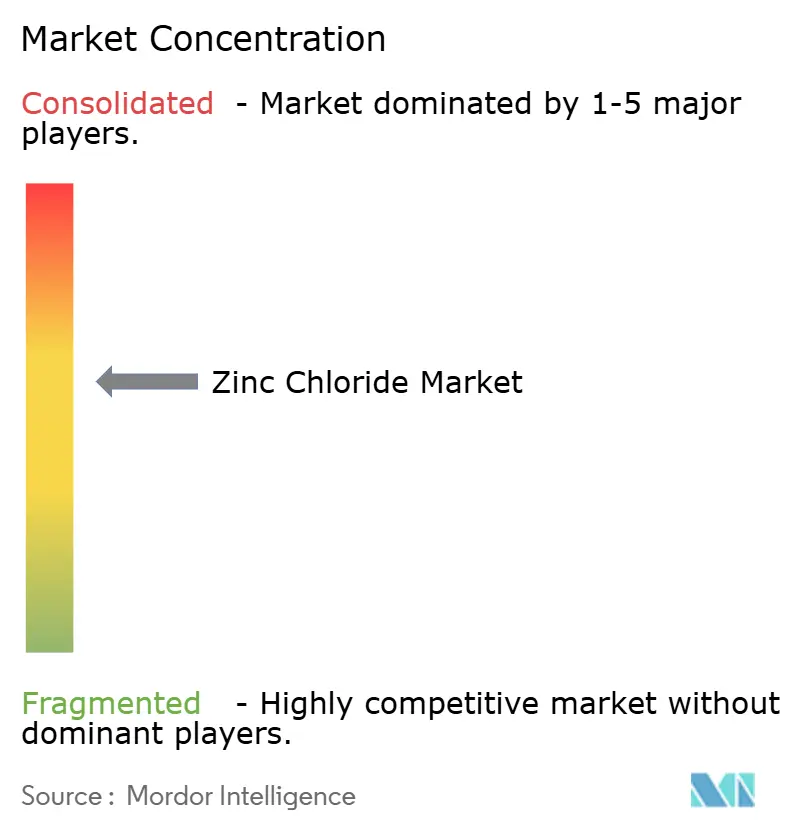
| Market Concentration | Medium |
Major Players *Disclaimer: Major Players sorted in no particular order Image © Mordor Intelligence. Reuse requires attribution under CC BY 4.0. | |
Zinc Chloride Market Analysis by Mordor Intelligence
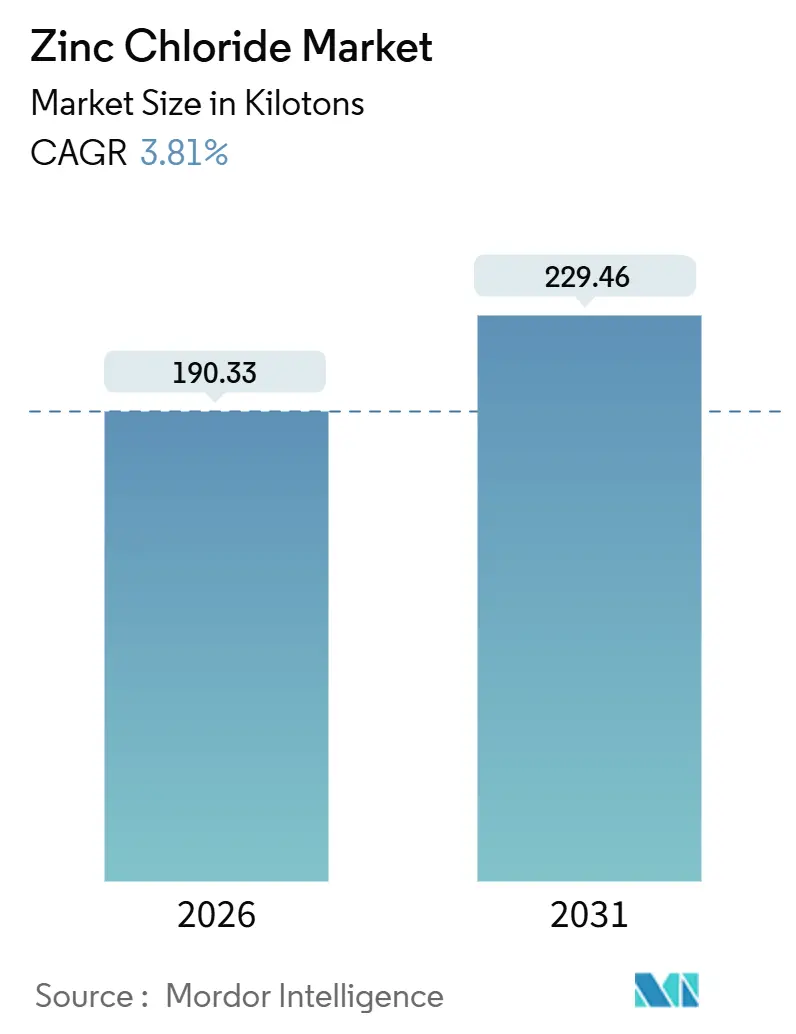
The Zinc Chloride Market size is estimated at 190.33 kilotons in 2026, and is expected to reach 229.46 kilotons by 2031, at a CAGR of 3.81% during the forecast period (2026-2031). Growing municipal investments in tertiary wastewater treatment, pilot-scale adoption of aqueous zinc-ion batteries, and the continuing shift from ammonium- to zinc-based galvanizing fluxes are underpinning demand growth. Integrated smelters with captive metal feedstock are shielding margins from zinc price volatility and leveraging low-carbon credentials to secure forward contracts in Europe and North America. Meanwhile, research groups in China and India are demonstrating deep-eutectic solvent and quick-setting cement formulations that widen the downstream aperture for zinc chloride, adding fresh avenues for value creation. Competitive intensity remains moderate because a handful of vertically integrated producers enjoy economies of scale, while high-purity grades command defensible premiums through stringent impurity controls and DMF filings.
Key Report Takeaways
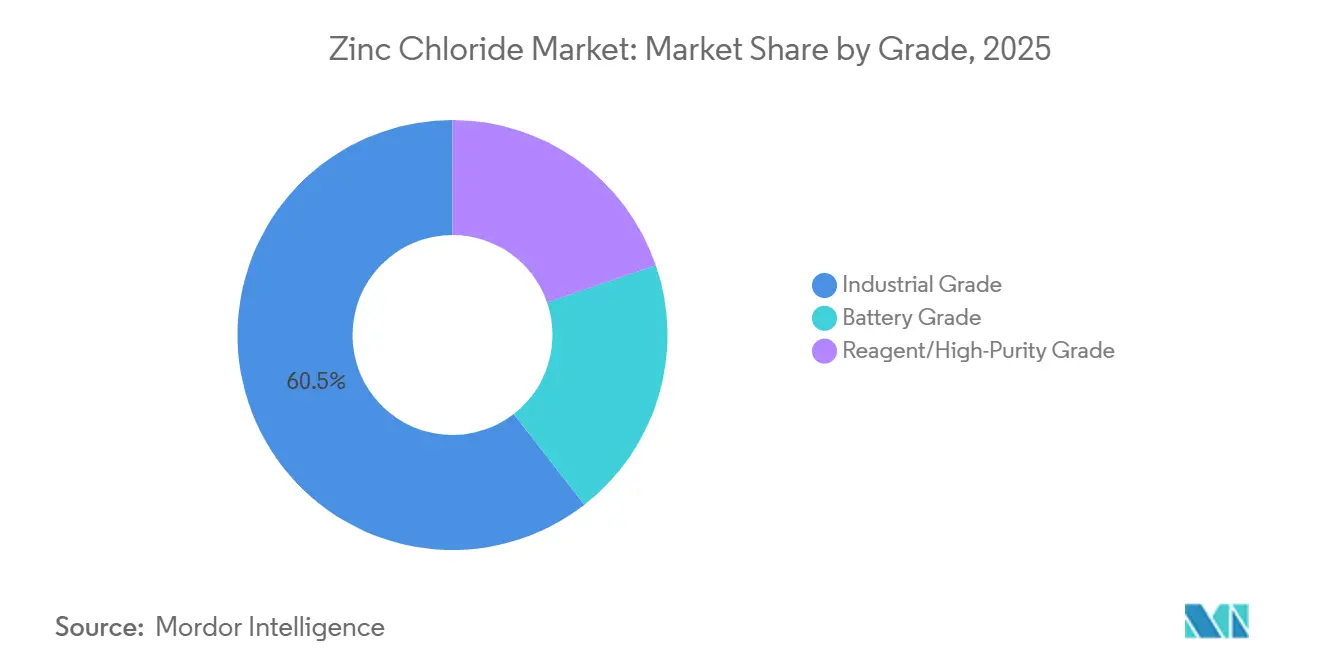
- By grade, industrial grade captured 60.51% of zinc chloride market share in 2025, whereas battery grade is forecast to expand at a 5.63% CAGR to 2031.
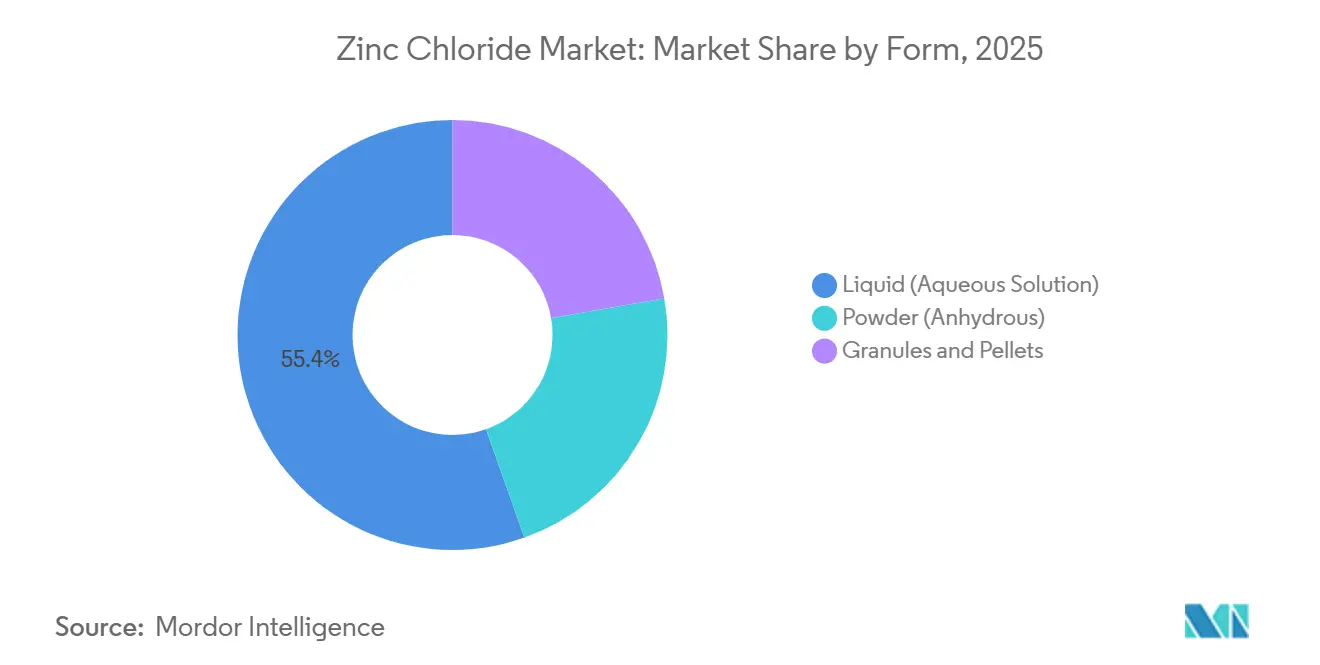
- By form, liquid (aqueous solution) accounted for 55.44% of the zinc chloride market size in 2025, while granules and pellets are pacing ahead at a 4.81% CAGR through 2031.
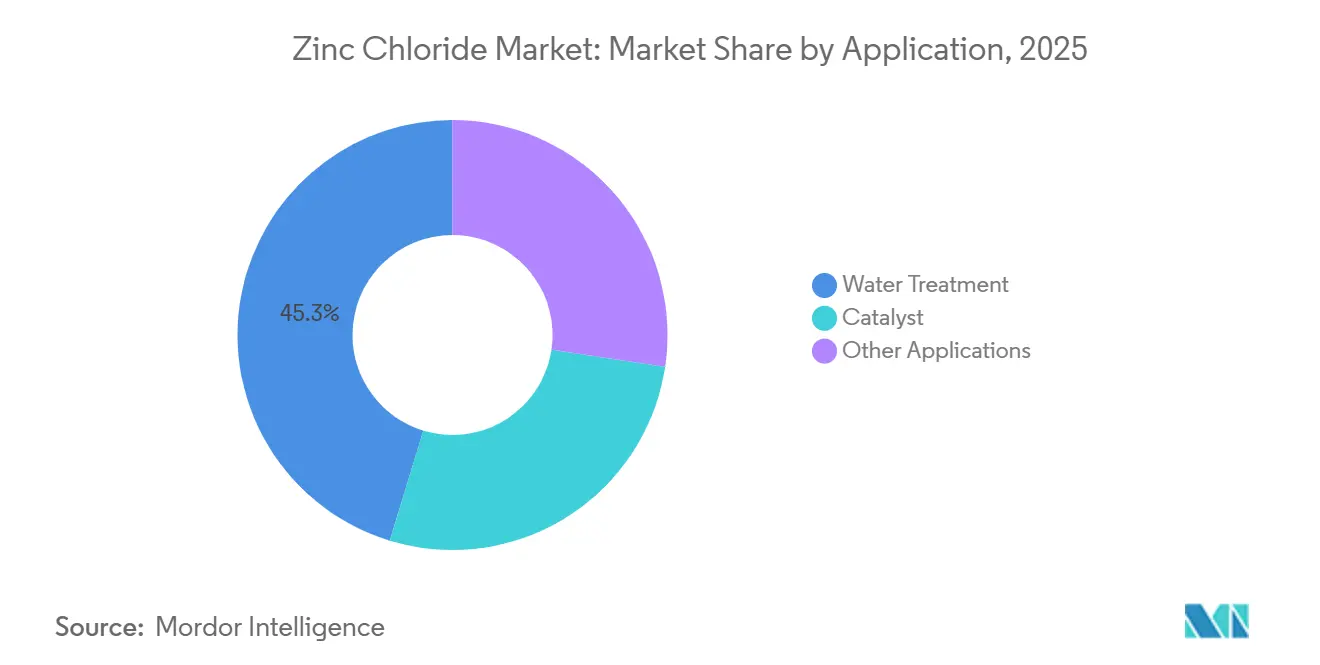
- By application, water treatment led with 45.29% revenue share in 2025; catalyst is set to grow at a 4.92% CAGR to 2031.
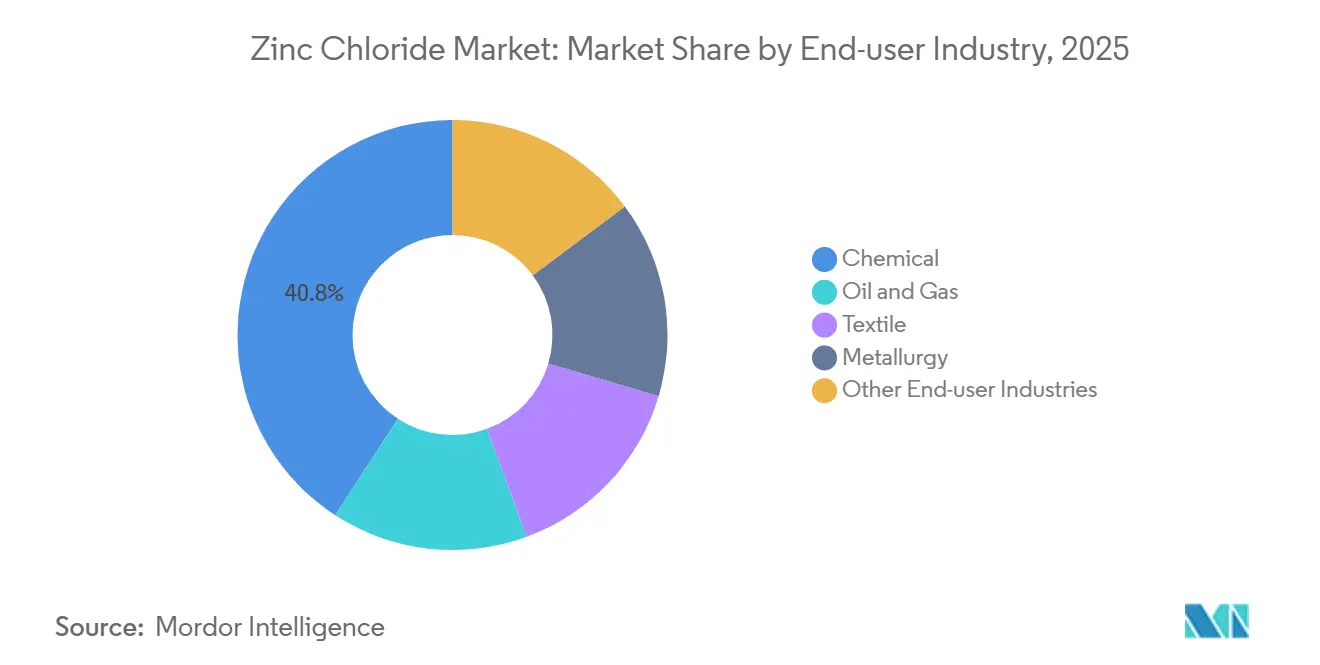
- By end-user industry, chemicals retained 40.81% of the zinc chloride market share in 2025, yet oil and gas is projected to post a 5.01% CAGR to 2031.
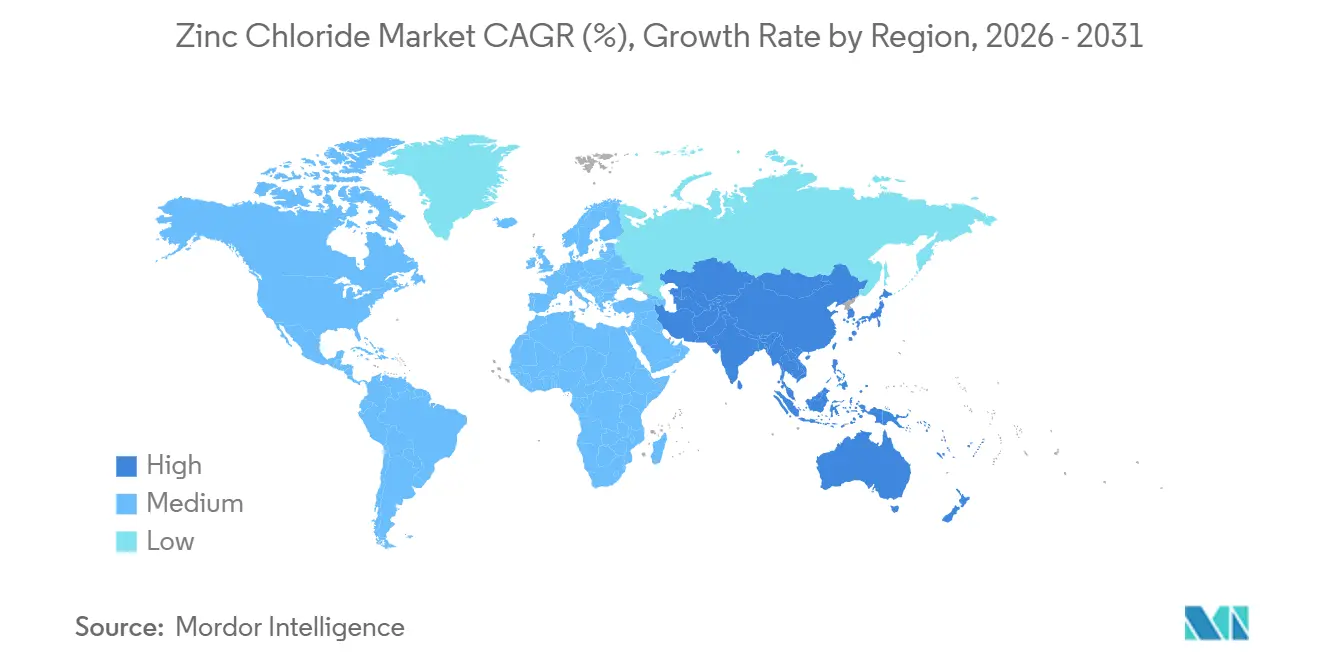
- By geography, Asia Pacific dominated with 45.83% zinc chloride market share in 2025 and is tracking a 4.75% CAGR to 2031.
Note: Market size and forecast figures in this report are generated using Mordor Intelligence’s proprietary estimation framework, updated with the latest available data and insights as of January 2026.
Market Trends and Insights
Drivers Impact Analysis of Zinc Chloride Market*
| Driver | (~) % Impact on CAGR Forecast | Geographic Relevance | Impact Timeline |
|---|---|---|---|
| Rapid expansion of water-scarce municipalities boosting ZnCl₂ wastewater disinfection | +1.2% | APAC (India, China), Middle-East, North Africa | Medium term (2-4 years) |
| Battery-grade ZnCl₂ demand from lithium-free zinc-ion pilot projects | +0.9% | Global, with concentration in China, Japan, South Korea | Long term (≥4 years) |
| Ammonium-chloride substitution by ZnCl₂ in galvanizing fluxes | +0.7% | North America, Europe, APAC (China, India) | Short term (≤2 years) |
| Emergence of ZnCl₂-based deep-eutectic solvents for biomass fractionation | +0.5% | Europe, North America, APAC (China) | Medium term (2-4 years) |
| Quick-setting low-carbon cement using ZnCl₂-activated alkali binders | +0.4% | APAC (China, India), Middle-East | Medium term (2-4 years) |
| Source: Mordor Intelligence | |||
Rapid Expansion of Water-Scarce Municipalities Boosting ZnCl₂ Wastewater Disinfection
Acute water stress across India, North Africa, and parts of China is impelling utilities to retrofit tertiary treatment stages that rely on zinc chloride for simultaneous heavy-metal precipitation and microbial inactivation. Zinc ions form stable complexes with phosphates and sulfides, trimming chemical oxygen demand while delivering broad-spectrum antimicrobial activity. Field trials in Gujarat showed that adding 65% ZnCl₂ solution to textile effluents cut biological oxygen demand by 30% and enabled dye-house water recycling at industrial scale. Vertically integrated suppliers in South Asia are capitalizing on this pull by offering bulk liquid ZnCl₂ under long-term offtake agreements priced against a zinc LME index. Regulatory drives that mandate zero-liquid discharge in the Gulf Cooperation Council countries are accelerating uptake of the same chemistry in desalination plants. Overall, tightening freshwater budgets and escalating discharge fees reinforce this structural driver through 2031.
Battery-Grade ZnCl₂ Demand from Lithium-Free Zinc-Ion Pilot Projects
Laboratory breakthroughs in aqueous zinc-ion cells are translating into multimegawatt pilot lines in China and South Korea. A four-electron Zn-I₂ cell using 2 M ZnCl₂ delivered 20,000 stable cycles and 723 Wh/kg based on iodine mass, bringing parity with stationary lithium-iron-phosphate batteries[1]. Because transition-metal impurities catalyze parasitic hydrogen evolution, battery developers specify ≥99.995% purity zinc chloride with total heavy metals less than 50 ppm. Producers that document Scope-3 footprints below 1 tCO₂e per tonne of ZnCl₂ are now entering approved-vendor lists for data-center backup projects in Jiangsu province. Industry association roadmaps expect cumulative global demand for battery-grade zinc chloride to grow five-fold by 2031, although ramp-up will be gated by refinery-level purification capacity.
Ammonium-Chloride Substitution by ZnCl₂ in Galvanizing Fluxes
Steel coaters in Europe, North America, and China are phasing out pure ammonium chloride fluxes in favor of zinc-ammonium chloride blends rich in ZnCl₂ to curb ammonia fume emissions. Trials on high-carbon plate showed a 12% reduction in white rust incidence when surface pre-flux ZnCl₂ content exceeded 55%. A 2024 European patent discloses recovering ZnCl₂ from galvanizer sludge via controlled chlorination, reducing virgin zinc input by 18%. As environmental permits tighten around ammoniacal emissions, flux formulators see steady conversion momentum over the next two years, adding uplift to industrial-grade zinc chloride consumption.
Emergence of ZnCl₂-Based Deep-Eutectic Solvents for Biomass Fractionation
Deep-eutectic solvents containing zinc chloride and lactic acid dissolve lignin selectively, enabling recovery of cellulose fibers for bioplastic feedstocks. Poplar wood delignification efficiencies above 97% were achieved at 120 °C, with ZnCl₂ recycled nine times without measurable loss in activity. Pilot demonstrations in Saxony and Jiangsu aim to process 50 kilotons of agricultural residues annually by 2028. The circular-bioeconomy incentives embedded in the EU Green Deal and China’s dual-carbon policy underpin medium-term adoption, especially as solvent cost curves improve through closed-loop metal recovery.
Restraints Impact Analysis of Zinc Chloride Market*
| Restraint | (~) % Impact on CAGR Forecast | Geographic Relevance | Impact Timeline |
|---|---|---|---|
| Stringent EU waste-brine regulations on liquid ZnCl₂ disposal | -0.6% | Europe (EU27, UK) | Short term (≤2 years) |
| Zinc metal price volatility compressing tier-2 producer margins | -0.5% | Global, acute in Asia Pacific and South America | Short term (≤2 years) |
| PFAS-like regulatory scrutiny on zinc-salt leachates | -0.3% | North America, Europe | Medium term (2-4 years) |
| Source: Mordor Intelligence | |||
Stringent EU Waste-Brine Regulations on Liquid ZnCl₂ Disposal
Revisions to the Waste Framework Directive in 2024 classified liquid zinc chloride at ≥10% concentration as an H410 chronic aquatic toxin, obligating closed-loop or high-temperature incineration with flue-gas scrubbing[2]. Textile processors in Portugal estimate compliance raises effluent treatment costs by 20%, nudging them toward granular zinc chloride that falls outside liquid-waste thresholds. REACH registration dossiers must now detail cradle-to-gate metal balances, encouraging galvanizers to crystallize and re-dissolve on-site rather than ship bulk solution. These measures exert immediate headwinds on European demand for liquid grades until solid handling systems scale up.
Zinc Metal Price Volatility Compressing Tier-2 Producer Margins
Spot zinc climbed to 126 cents per pound on the LME in 2024, a 4.9% year-on-year jump, before spiking above USD 3,000 per tonne during a short squeeze in October 2025. Producers without captive smelters pass through only part of the cost rise due to quarterly contracts with galvanizers and textile firms. Margins for Chinese toll converters dipped below 5% in 2025, triggering shutdowns of smaller batch plants in Hebei. By contrast, integrated players such as Korea Zinc hedge risk by reallocating metal between cathode copper foil and zinc chloride lines to balance profitability. Volatility remains a structural risk, pressing independent operators to secure long-term metal offtake or pursue forward hedging, both of which tie up working capital.
*Our forecasts treat driver/restraint impacts as directional, not additive. The impact forecasts reflect baseline growth, mix effects, and variable interactions.
Zinc Chloride Market Segment Analysis
By Grade:
Battery-Purity Edges Toward Commercial ScaleBattery-grade is forecast to grow at a 5.63% CAGR, making it the fastest-expanding grade. Developers of zinc-iodine and zinc-air prototypes specify chloride salts with sub-ppm nickel and copper to avoid dendrite formation. A leading Chinese producer validated 30 M zinc chloride electrolyte that cuts hydration shells and raises Coulombic efficiency above 99.5%. In contrast, the bulk of the zinc chloride market size still resides in industrial grade with 60.51% market share in 2025 due to galvanizing fluxes and chemical synthesis, where impurity constraints are looser, and price sensitivity remains acute. Producers offering life-cycle-assured, low-carbon battery grade command premiums of 20-25% over commodity rates.

By Form:
Granular Adoption Accelerates in EuropeLiquid (aqueous solution) remains the workhorse format with 55.44% share in 2025 due to ease of dosing, yet granular and pellet forms are registering 4.81% CAGR as galvanizers in Germany, Spain, and France shift to dry flux blends that limit ammoniacal emissions. Granules also eliminate spill-response costs, an advantage that resonates under the EU’s tightened hazardous-waste codes. Southeast Asian output is set to climb after AGC’s chlor-alkali expansion in Thailand goes on-stream in 2027, lowering the regional chlorine cost base and enlarging supply for anhydrous zinc chloride pellets. Powdered forms retain niche demand in pharmaceutical synthesis and laboratory reagents where moisture exclusion is paramount.
By Application:
Catalysts Outpace the BaseWater treatment accounts for 45.29% market size in 2025, propelled by the reuse mandates in drought-stricken megacities. Yet catalyst applications for deep-eutectic solvents, Friedel–Crafts reactions, and cellulose dissolution are projected to outpace the base at 4.92% CAGR. A European pulp mill converting sawdust to cellulosic sugars with a ZnCl₂-lactic deep-eutectic solvent logged nine solvent recycles without performance drop, slashing variable cost per tonne of output. The success of such pilots underpins rapid scaling in both Europe and coastal China.
By End-user Industry:
Oil and Gas Leads GrowthWhile the chemical sector dominates the market with 40.81% share, oil and gas present the fastest growth as offshore projects pivot back online. Completion fluids blending zinc bromide with zinc chloride reach densities up to 19.2 lb/gal, suitable for ultra-deep wells in the Gulf of Mexico and Brazil. Scale inhibitors formulated with ZnCl₂ record 90% ion-capture efficiency, extending tubing life in high-salinity reservoirs. As upstream capex rebounds, demand for oil-field-grade zinc chloride rises in tandem.
Geography Analysis
APAC and Europe Zinc Chloride Market
Asia Pacific maintained 45.83% zinc chloride market share in 2025, supported by Shandong’s smelting hub and India’s capacity ramp-up. China’s single-site 50,000 t/y plant delivers sub-USD 1,000/t liquid product thanks to chlorine integration and captive power. India leverages Hindustan Zinc’s renewable electricity to position low-carbon derivatives for export into Europe’s carbon-border adjustment mechanism. Robust galvanizing and water-treatment activity drives Asia Pacific’s regional CAGR of 4.75% to 2031.
North America, EMEA and APAC Zinc Chloride Market
North America benefits from strong oilfield fluid offtake, whereas Europe’s stricter disposal codes temper growth but spur product-mix upgrades toward pellets and reclaimed ZnCl₂. Southeast Asia gains cost advantage once Thai chlor-alkali expansions stabilize chlorine supply, permitting local pellet manufacturing for cement additives. Africa and the Middle-East exhibit steady uptake tied to desalination brine processing and municipal water reuse.
Regulatory Landscape
Zinc chloride (CAS 7646-85-7, EC 231-592-0) is regulated in the European Union under REACH, requiring European Chemicals Agency (ECHA) registration for manufacturers and importers above the 1 tonne per year threshold, and it carries harmonized classification and labeling under the CLP Regulation (EC) No 1272/2008. In April 2026, ECHA launched an awareness and enforcement campaign urging registrants to update dossiers, which increases the compliance burden for zinc chloride joint submissions and for dossiers that are not aligned with the latest harmonized CLP classifications.
In the United States, zinc chloride is managed within the EPA framework under TSCA for chemical reporting and recordkeeping obligations, and trade flows are shaped by customs classification (HTS 2827.39.65, MFN duty rate 1.6%). For suppliers serving regulated downstreams such as municipal water treatment and metal finishing, these regimes translate into continuing obligations around hazard communication, dossier maintenance, and import documentation to support uninterrupted market access.
Value Chain Analysis
The value chain starts with upstream zinc units (zinc metal or zinc oxide) and hydrochloric acid (HCl), which are reacted via hydrochlorination to form zinc chloride, followed by purification to remove trace metals (notably iron, lead, and copper). This purification step is a key value-add for battery-grade and reagent/high-purity grades where impurity ceilings are tight, while industrial grade is produced at larger scale for galvanizing fluxes, water treatment dosing, and chemical synthesis.
Midstream handling and conversion are shaped by zinc chloride's hygroscopic nature, which raises packaging, storage, and logistics requirements (airtight containers and moisture-controlled transport). It also influences the choice between liquid solutions versus granular or pellet forms. Downstream channels include direct supply to municipal and industrial water-treatment operators, galvanizers and flux formulators, chemical manufacturers (catalyst and synthesis uses), and emerging battery electrolyte programs. Participants across the chain include TIB Chemicals AG and Zaclon LLC, along with Asia-based producers such as Global Chemical Co., Ltd. and regional manufacturers in China and India.
Competitive Landscape
The zinc chloride market features integrated miners such as Hindustan Zinc and Korea Zinc alongside regional chemical specialists. Together, the top five suppliers hold roughly 43% of global capacity, yielding a market concentration score of 6. Recent strategy pivots include Korea Zinc’s USD 13 billion decarbonization and battery-materials program, positioning it for captive battery-grade ZnCl₂ streams. Metrochem and ChemCon defend high-purity niches through DMF filings and ISO-accredited cleanrooms. Cost-led Chinese players focus on bulk industrial grade, while European formulators differentiate with REACH-registered, pelletized products tailored to waste-brine regulations. Emerging disruptors stem from zinc-ion battery consortia that seek audited traceability for electrolyte salts.
Zinc Chloride Industry Leaders
-
TIB Chemicals AG
-
Zaclon LLC
-
Global Chemical Co., Ltd.
-
Pan-Continental Chemical Co., Ltd.
-
Weifang Hengfeng Zinc Industry
- *Disclaimer: Major Players sorted in no particular order
Zinc Chloride Market Companies Covered in this Report
- American Elements
- BALAJI CHEMICALS
- Eurocontal
- Flaurea Chemicals
- GFS Chemicals, Inc.
- Global Chemical Co., Ltd.
- Hunan Hecheng Pharmaceutical Chemical Co., Ltd.
- JINCHANG XINGTAI CHEMICAL CO.,LTD
- Pan-Continental Chemical Co., Ltd.
- S.A. Lipmes
- ShengLong Zinc
- TIB Chemicals AG
- Vijay Chemical Industries
- Weifang Dongfangsheng Chemical Co.,Ltd.
- Weifang Hengfeng Zinc Industry
- Zaclon LLC
Market Opportunities and Future Outlook
Product-mix and compliance-led whitespace is opening around solid formats and closed-loop handling in Europe, where REACH and CLP alignment and tighter waste-brine expectations are pushing users to reduce liquid disposal complexity and document cradle-to-gate substance stewardship. Differentiation for suppliers is also shifting toward traceability and impurity control for high-purity zinc chloride, reflecting downstream specifications for electrolyte-grade material and other high-documentation applications.
Named company actions point to where near-term opportunity is being pursued. TIB Chemicals expanded zinc chloride capability in Mannheim in March 2025 to support pharmaceutical-grade material aligned with EU GMP expectations. Zaclon LLC signed multi-year supply agreements in January 2025 with US municipal water authorities for liquid zinc chloride linked to corrosion-control programs under EPA Lead and Copper Rule Revisions. Together, these moves suggest two commercial lanes for producers: (i) higher-margin, documentation-heavy grades (pharma and high purity) and (ii) contract-oriented municipal water-treatment supply, where buyers reward consistent quality, logistics reliability, and regulatory-ready documentation.
Recent Industry Developments in Zinc Chloride Market
- June 2026: Zaclon LLC highlighted its positioning as a US manufacturer of zinc chemicals, including zinc chloride, reinforcing domestic sourcing messaging for industrial and municipal customers. The emphasis supports procurement conversations where buyers prioritize local supply continuity and documented manufacturing origin, particularly for water-treatment programs that prefer stable, long-term suppliers.
- March 2025: TIB Chemicals AG expanded zinc chloride production at its Mannheim, Germany site, adding capability aimed at pharmaceutical-grade material aligned with EU GMP requirements. The upgrade strengthens TIB's ability to serve documentation-intensive, higher-purity demand segments where batch control and quality assurance can command premium pricing.
- April 2024: TIB Chemicals AG completed the reopening of its modernized zinc chloride plant in Ludwigshafen, Germany following renovations focused on efficiency and environmental standards. The modernization supports more compliant European supply and helps the producer compete as EU customers adjust product selection and handling practices under tighter chemical stewardship expectations.
Zinc Chloride Market Report Scope and Research Methodology
Market Definition and Coverage
This market covers the sales of zinc chloride (ZnCl2) supplied as a chemical input, typically in solid or liquid form, to downstream customers across industrial and specialty uses, and measured on a volume basis.
Scope exclusions: Excluded from this sizing are other zinc chemicals and derivatives (such as zinc sulfate or zinc phosphate) and blended formulations where zinc chloride is not sold as the primary product.
Segments Covered in This Report
- By Grade
- Industrial Grade
- Battery Grade
- Reagent/High-Purity Grade
- By Form
- Liquid (Aqueous Solution)
- Powder (Anhydrous)
- Granules and Pellets
- By Application
- Water Treatment
- Catalyst
- Other Applications
- By End-user Industry
- Chemical
- Oil and Gas
- Textile
- Metallurgy
- Other End-user Industries
- By Geography
- Asia-Pacific
- China
- India
- Japan
- South Korea
- ASEAN Countries
- Rest of Asia-Pacific
- North America
- United States
- Canada
- Mexico
- Europe
- Germany
- United Kingdom
- France
- Italy
- Spain
- NORDIC Countries
- Rest of Europe
- South America
- Brazil
- Argentina
- Rest of South America
- Middle-East and Africa
- Saudi Arabia
- South Africa
- Rest of Middle-East and Africa
- Asia-Pacific
Data Sources, Market Sizing, and Validation
Desk Research
Desk work starts with building a clear supply and demand picture for zinc chloride, so the model is tied to realistic production and consumption signals. We lean on public and official sources such as USGS mineral statistics, UN Comtrade trade flows, and national environment and water agencies that publish treatment standards. We also use customs or tariff schedules to help separate zinc salts.
We review company filings, product technical data sheets, and investor presentations to understand typical grades, packaging, and purity needs across end uses such as water treatment and galvanizing. Where available, a paid subscription focused on company financials and news helps us track capacity announcements, plant outages, and pricing commentary that is not always visible in public reports. The desk sources listed are illustrative only, and other references are used for data collection, cross-checking, and follow-up clarification.
Primary Interviews and Surveys
Primary inputs come from interviews and structured checks with producers, distributors, and downstream users that purchase zinc chloride for processing and formulation. We cover major consumption regions, and these discussions are used to confirm typical grade mix, application split, and how demand shifts with water treatment activity, metal processing runs, and battery-related chemical consumption.
Distribution of primary research fieldwork respondents
| Company type | Respondent position | Region |
|---|---|---|
| Top tier: 31% | CXOs: 18% | APAC: 46% |
| Mid tier: 49% | Functional/Unit leaders: 29% | EMEA: 33% |
| Smaller Players: 20% | Managers: 53% | Americas: 21% |
Market-Sizing & Forecasting
Sizing is built using a top-down path where production, trade, and consumption indicators are reconstructed into an addressable zinc chloride demand pool by region, and then converted into market totals in kilotons. To keep the totals grounded, we corroborate results with selective bottom-up checks such as sampled supplier volumes, distributor channel feedback, and typical application-level usage rates multiplied by activity levels.
Inputs used in the model include import and export movements for zinc chloride and close salt categories, operating rates in metal processing and galvanizing, water treatment throughput and dosing intensity (where published), battery-related chemical demand signals, and observed price and purity requirements that influence substitution and procurement patterns. When a bottom-up check is incomplete for smaller geographies, gaps are handled using proxy indicators such as trade reliance, industrial output trends, and expert-agreed penetration assumptions, then reviewed for reasonableness.
For forecasting, scenario analysis is used to reflect uncertainty in industrial output, environmental compliance spending, and the pace of growth in applications that consume zinc salts. Those scenarios are anchored to expert expectations gathered in primary calls, and then rolled into a central case that remains consistent with the observed historical run-rate and the forward activity indicators.
Data Validation & Update Cycle
Outputs are validated through multiple cross-checks so unusual jumps are explained before the numbers are finalized. We compare the model totals against independent signals such as trade balances, known capacity additions, and downstream activity indicators, and then variances are reviewed in an internal analyst pass before sign-off.
The study is refreshed on an annual cycle, and interim updates are made when material events occur, for example, a major capacity change or policy shift impacting water treatment chemicals. Before delivery, a final review is completed so clients receive an updated view that reflects the latest public releases and any new primary feedback.
Mordor Intelligence's Zinc Chloride Market Sizing Compared With Other Published Estimates
It is common to see different published market sizes for zinc chloride because studies do not always track the same unit of measure, year timing, and product scope. Differences also come from how prices are treated, how trade is netted out, and whether assumptions are checked with industry participants.
Some publications present a value-based figure that can also pick up adjacent zinc salt categories or blended treatment products, which increases the reported total. Mordor Intelligence counts only zinc chloride sold as a distinct product (anhydrous or hydrated, in liquid or solid forms) and reports the market in kilotons, which reduces inflation from price swings and keeps the scope aligned to direct ZnCl2 demand.
Benchmark comparison
| Source | Market Size | Gaps in Research Methodology |
|---|---|---|
| Mordor Intelligence | USD 190.33 B (2026) | |
| Trade Research Group A | USD 0.32 B (2024) | Uses value in USD and does not clearly separate pure zinc chloride sales from broader zinc salt and application mix, so price assumptions and included product bundles can lift the total. |
| Industry Publisher B | USD 0.35 B (2024) | Reports revenue-based sizing with a longer-range growth curve and limited visibility on how currency timing and grade-level price progression are handled, which can change the base-year estimate. |
The spread in the table mainly comes from unit choice and how tightly the product is defined. By keeping the scope tied to ZnCl2 volumes and then validating the demand drivers through repeated checks, our estimate stays traceable to observable activity signals and can be replicated when assumptions are updated.
Key Questions Answered in the Report
What is the size of zinc chloride market?
What is the size of the zinc chloride market?
Which grade is growing fastest in the zinc chloride space?
Battery-grade zinc chloride is set to expand at a 5.63% CAGR over 2026-2031 on the back of zinc-ion battery pilots.
Why are liquid zinc chloride users in Europe shifting to pellets?
EU disposal rules classify concentrated liquid ZnCl₂ as a chronic aquatic toxin, so pellets help avoid costly waste-brine compliance.
How does zinc chloride support oilfield operations?
It densifies completion fluids and improves scale-inhibitor retention above 90%, which is critical for deep offshore wells.