
Wound Irrigation System Market Size and Share
Market Overview
| Study Period | 2020 - 2031 |
|---|---|
| Market Size (2026) | USD 361.47 Million |
| Market Size (2031) | USD 443.61 Million |
| Growth Rate (2026 - 2031) | 4.21 % |
| Fastest Growing Market | Asia-Pacific |
| Largest Market | North America |
| Market Concentration | Medium |
Major Players
*Disclaimer: Major Players sorted in no particular order Image © Mordor Intelligence. Reuse requires attribution under CC BY 4.0. |
|
Wound Irrigation System Market Analysis by Mordor Intelligence
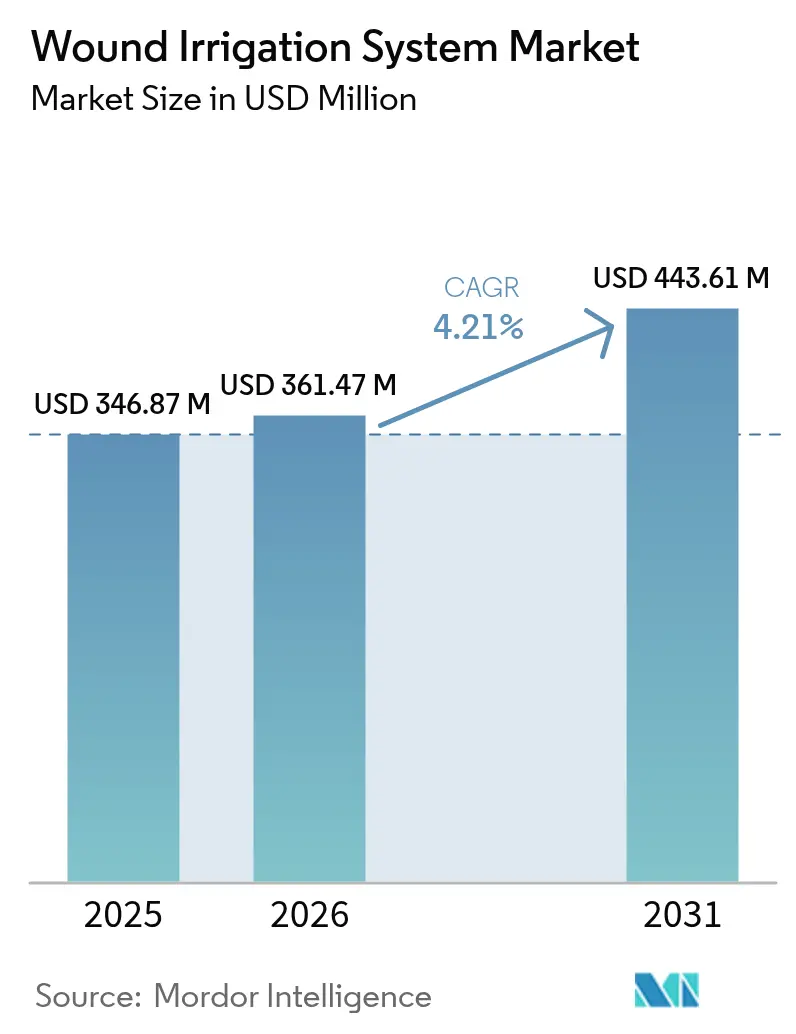
The wound irrigation system market size was valued at USD 346.87 million in 2025 and estimated to grow from USD 361.47 million in 2026 to reach USD 443.61 million by 2031, at a CAGR of 4.21% during the forecast period (2026-2031). Growth is sustained by the aging global population, increasing chronic disease prevalence, and the clinical imperative to prevent surgical site infections. Battery-operated devices are gaining traction in ambulatory settings, while manual systems remain a staple in acute‐care facilities because of their lower capital cost. Regulatory endorsements—such as the Centers for Disease Control and Prevention’s 2024 classification of intra-operative antiseptic lavage as an essential practice—are reinforcing product adoption in surgical theaters. Meanwhile, advances in antimicrobial solutions and IoT-enabled pressure sensors are widening the technology gap between entry-level and premium offerings, prompting mid-tier hospitals to refresh purchasing strategies to keep pace with evolving clinical standards.
Key Report Takeaways
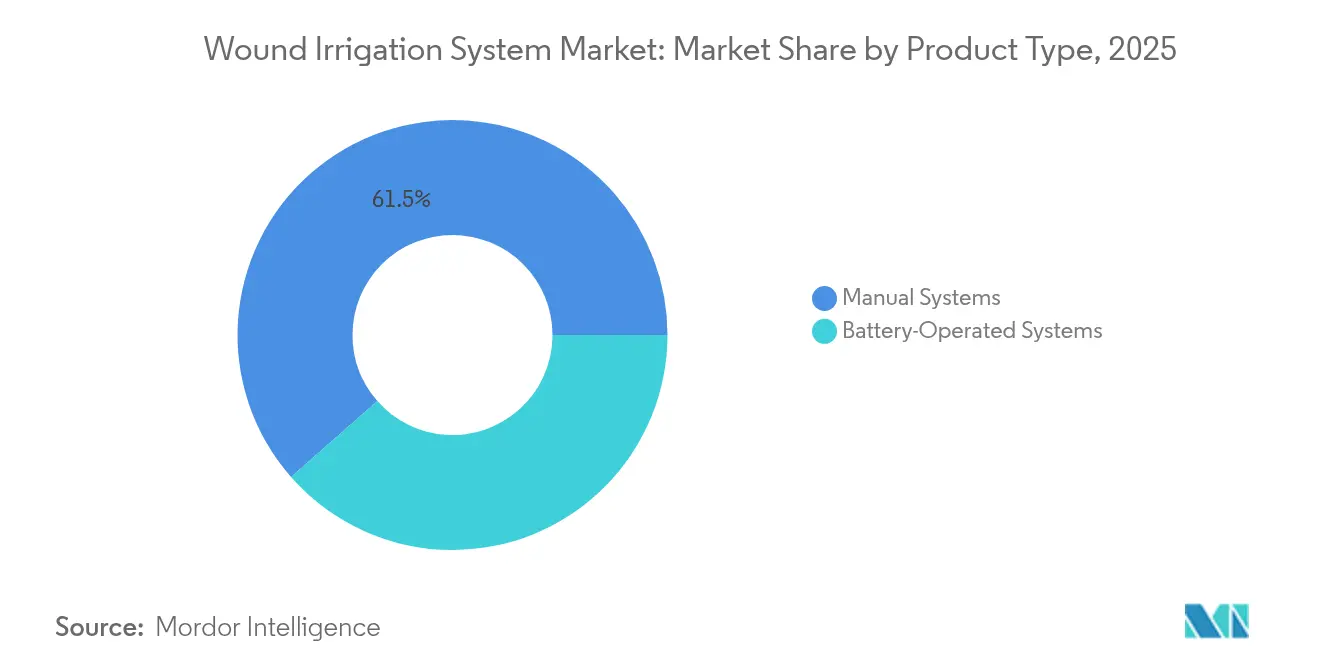
- By product type, manual systems captured 61.48% of the wound irrigation system market share in 2025, while battery-operated systems are forecast to expand at 5.02% CAGR through 2031.
- By application, surgical wounds accounted for 46.10% of the wound irrigation system market share in 2025; chronic wounds are projected to grow fastest at 4.95% CAGR to 2031.
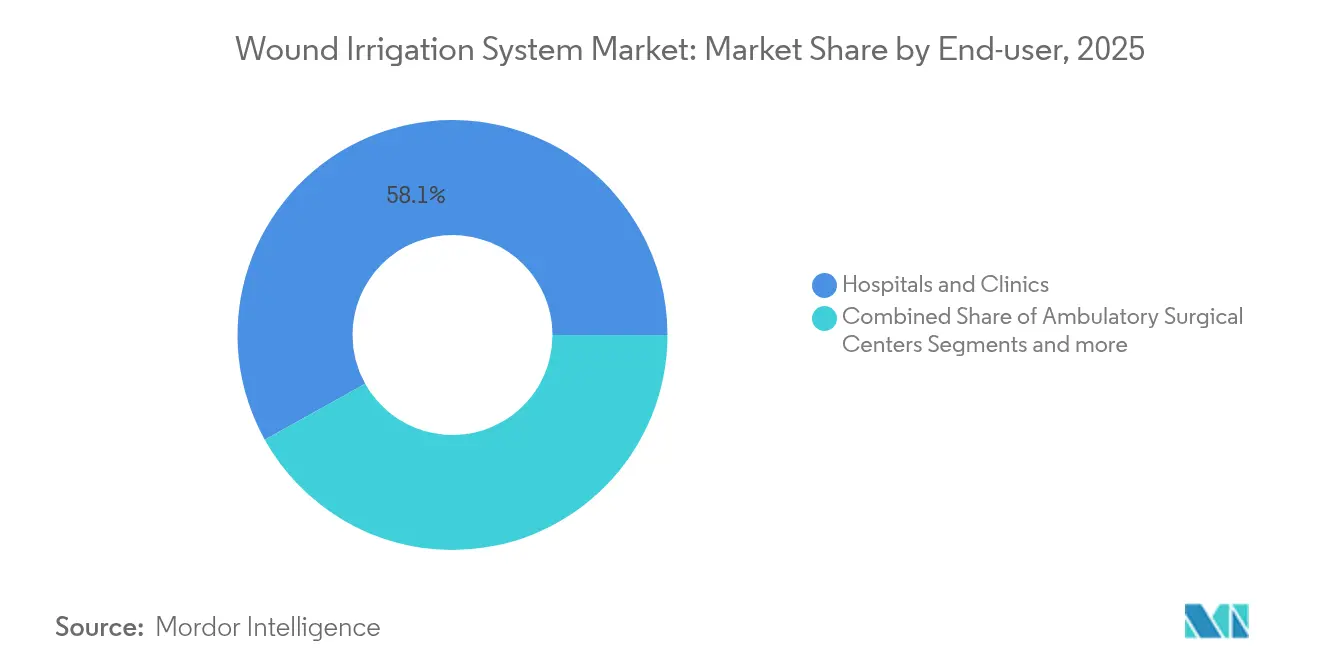
- By end-user, hospitals and clinics held 58.10% share of the wound irrigation system market size in 2025, whereas ambulatory surgical centers are poised for 5.12% CAGR over the same horizon.
- By geography, North America led with 41.05% revenue share in 2025; Asia-Pacific is expected to post the highest regional CAGR of 5.18% through 2031.
Note: Market size and forecast figures in this report are generated using Mordor Intelligence’s proprietary estimation framework, updated with the latest available data and insights as of 2026.
Global Wound Irrigation System Market Trends and Insights
Drivers Impact Analysis*
| Driver | ( ~ )% Impact on CAGR Forecast | Geographic Relevance | Impact Timeline |
|---|---|---|---|
| Rising incidence of traumatic & surgical wounds | +1.2% | Global; higher impact in North America & Europe | Medium term (2-4 years) |
| Advanced product lines for wound care | +0.8% | North America & EU, expanding to Asia-Pacific | Long term (≥ 4 years) |
| Aging population & chronic disease load | +1.5% | Global; pronounced in developed markets | Long term (≥ 4 years) |
| Shift toward outpatient & home NPWT | +0.7% | North America & EU; early adoption in urban Asia-Pacific | Short term (≤ 2 years) |
| Antimicrobial citrate-based solutions | +0.6% | Global; early adoption in North America & Europe | Medium term (2-4 years) |
| IoT-enabled flow & pressure sensors | +0.5% | North America & EU; gradual expansion to Asia-Pacific | Medium term (2-4 years) |
| Source: Mordor Intelligence | |||
Rising Incidence of Traumatic and Surgical Wounds
Surgical volumes continue to climb worldwide, and traumatic injuries remain a major public health challenge. The World Health Organization reports that surgical site infections affect up to 21.1% of patients in developing systems, underscoring the clinical importance of effective lavage [1]World Health Organization, “Global guidelines for the prevention of surgical site infection,” who.int . Infection rates reach 11.7% in spine surgeries at resource-limited neurosurgical centers, with Staphylococcus aureus the leading pathogen [2]Dumura Jeneral Alfin, "Surgical site infection rate in spine surgery, incidence, and risk factors: a ten-year retrospective cohort review in a developing neurosurgical centre," BMC Surgery, bmcsurg.biomedcentral.com. Hypervirulent, carbapenem-resistant Klebsiella pneumoniae strains heighten risk, prompting hospitals to pair irrigation with multimodal infection-prevention bundles that have cut surgical site infection rates by up to 95%. Consequently, procurement teams increasingly specify devices that deliver consistent flow and pressure to remove biofilm and debris efficiently. These dynamics place the wound irrigation system market at the heart of hospital quality-improvement programs.
Availability of Advanced Product Lines for Wound Care Management
Manufacturers are converging irrigation, sensing, and data analytics into unified platforms that simplify clinician workflows. Caltech’s iCares smart bandage demonstrates real-time biomarker monitoring by sampling exudate and transmitting data wirelessly, a capability now being integrated with powered irrigation tips to guide cleansing intervals. Citrate-based solutions capable of disrupting biofilm more effectively than saline are gaining regulatory traction, while the FDA’s 2024 approval of the plant-based Traumagel hydrogel exemplifies the broader shift toward bio-derived, hemostatic adjuncts. Electric bandages that harness water-powered, electronics-free circuits to accelerate healing by 30% are also entering trials. These innovations raise clinician expectations and reshape purchasing criteria, further fueling premium product growth in the wound irrigation system market.
Growing Aging Population and Chronic Diseases Leading to Chronic Wounds
Chronic wounds now affect 26.4 per 1,000 inpatients in large Chinese tertiary hospitals, and diabetic foot ulcers remain a costly global burden. Basic science shows that senescent cells promote repair through PDGF-AA secretion yet impede closure when over-accumulated, highlighting the need for gentle yet thorough irrigation that preserves viable tissue [3]Arisa Kita, "Cellular senescence and wound healing in aged and diabetic skin," Frontiers in Physiology, frontiersin.org. Decubitus ulcer incidence nearly doubled between 1990 and 2021, and related fatalities more than doubled. As populations age, hospitals and home-health providers increasingly rely on portable lavage kits that complement negative-pressure therapy and reduce dressing changes. This demographic driver cements long-term demand for the wound irrigation system market.
Shift Toward Outpatient and Home-Based NPWT
Cost containment is accelerating the migration of complex wound care to ambulatory and home settings. Outpatient NPWT reduces mean wound area from 11.3 cm² to 8.0 cm² within 16 days, improving closure rates and lowering drug costs. The global NPWT segment is expected to reach USD 10.8 billion by 2033 at 5.3% CAGR, with compact single-use devices driving most gains. UnitedHealthcare added outpatient NPWT coverage in its 2025 policy update, signaling mainstream payer acceptance. Portable irrigation systems with rechargeable power sources are therefore becoming a necessary accessory, pushing the wound irrigation system market deeper into home-health channels.
Restraints Impact Analysis*
| Restraint | ( ~ )% Impact on CAGR Forecast | Geographic Relevance | Impact Timeline |
|---|---|---|---|
| High cost of wound irrigation systems | -0.9% | Global; acute in emerging markets | Short term (≤ 2 years) |
| Reimbursement gaps in low- & middle-income | -0.6% | Asia-Pacific, MEA, Latin America | Medium term (2-4 years) |
| Environmental regulations on disposables | -0.4% | Europe & North America; expanding globally | Long term (≥ 4 years) |
| Conflicting guidelines on antiseptic efficacy | -0.3% | Global with regional variation | Short term (≤ 2 years) |
| Source: Mordor Intelligence | |||
High Cost of Wound Irrigation Systems
Upfront prices for powered irrigation devices and proprietary solution packs strain hospital budgets, especially when payer schedules lag technology costs. Medicare’s 2025 Physician Fee Schedule reduced average reimbursement for wound care services by 2.93% while adding caregiver training codes that shift expenses to families. Durable medical equipment rules also mandate extensive documentation for NPWT supplies, delaying cash flow for suppliers. Although outcome studies show lower overall treatment cost through faster closure and fewer nursing visits, financial gatekeepers in emerging markets often defer upgrades, moderating near-term growth in the wound irrigation system market.
Reimbursement Gaps in Low- and Middle-Income Countries
Coverage remains inconsistent outside high-income regions. China’s regulatory updates streamline approvals, yet competitive local manufacturing pushes prices down and narrows margins, discouraging insurers from adding advanced irrigation devices to formularies. India’s medical device market, still 70% import dependent, faces similar reimbursement hurdles despite its growth toward USD 50 billion by 2025. Out-of-pocket payment therefore dominates in many settings, limiting adoption of premium systems even when clinical evidence is robust. Manufacturers must localize production or develop lower-cost SKUs to close this affordability gap.
*Our forecasts treat driver/restraint impacts as directional, not additive. The impact forecasts reflect baseline growth, mix effects, and variable interactions.
Segment Analysis
By Product Type: Manual Systems Provide Scale, Battery Devices Drive Innovation
Manual units generated 61.48% of 2025 revenue, the largest slice within the wound irrigation system market size, reflecting their entrenched role in routine debridement. Hospitals rely on them for predictable flow, easy sterility checks, and low maintenance. Battery-operated platforms, now growing at 5.02% CAGR, appeal to ambulatory surgical centers that prioritize portability and shorter turnover times. The Pulsavac Plus AC line offers dual suction and irrigation without battery waste, cutting environmental impact while matching powered-flow consistency.
Hybrid solutions illustrate convergence. Irrimax’s 2024 IRRISEPT kits let clinicians pair antimicrobial solution bags with either manual compression or powered handles, enabling flexible protocols across resource settings. This versatility encourages large GPOs to standardize on single solution platforms, anticipating continued share gains for battery-enhanced systems.


By Application: Surgical Wounds Dominate; Chronic Wounds Emerge
Surgical wounds delivered 46.10% of 2025 sales, underpinned by statutory infection-control mandates that specify intra-operative lavage. The wound irrigation system market share for surgical indications is secured by OR budgets and procedure growth. Chronic wounds, however, are advancing at 4.95% CAGR, reflecting diabetes and vascular comorbidity trends. Citrate-based antiseptics that disrupt biofilm in orthopedic implants are showing promise in early trials.
Real-world evidence from outpatient joint arthroplasty centers shows novel irrigants lowering post-operative infection rates, reinforcing demand in surgical segments while chronic-wound clinicians adopt the same formulations for recalcitrant ulcers. This cross-over effect broadens the total addressable wound irrigation system market.
By End-User: Hospitals Hold Scale, ASCs Accelerate
Hospitals and clinics controlled 58.10% of the wound irrigation system market size in 2025, benefitting from central purchasing and bundled infection-prevention programs. Yet procedure migration is shifting volume to ASCs, which are expected to post 5.12% CAGR. Single-use irrigation tips paired with portable pumps allow ASCs to meet turn-over metrics without extensive sterile reprocessing cycles, reducing labor overhead.
Home-health agencies and long-term-care settings represent a smaller but rising cohort. Reimbursement clarity for portable NPWT spurs home discharge, and telehealth consults support remote wound assessments. Manufacturers are responding with compact irrigation cartridges that connect directly to NPWT canisters, positioning for steady growth outside acute-care walls within the wound irrigation system market.
Geography Analysis
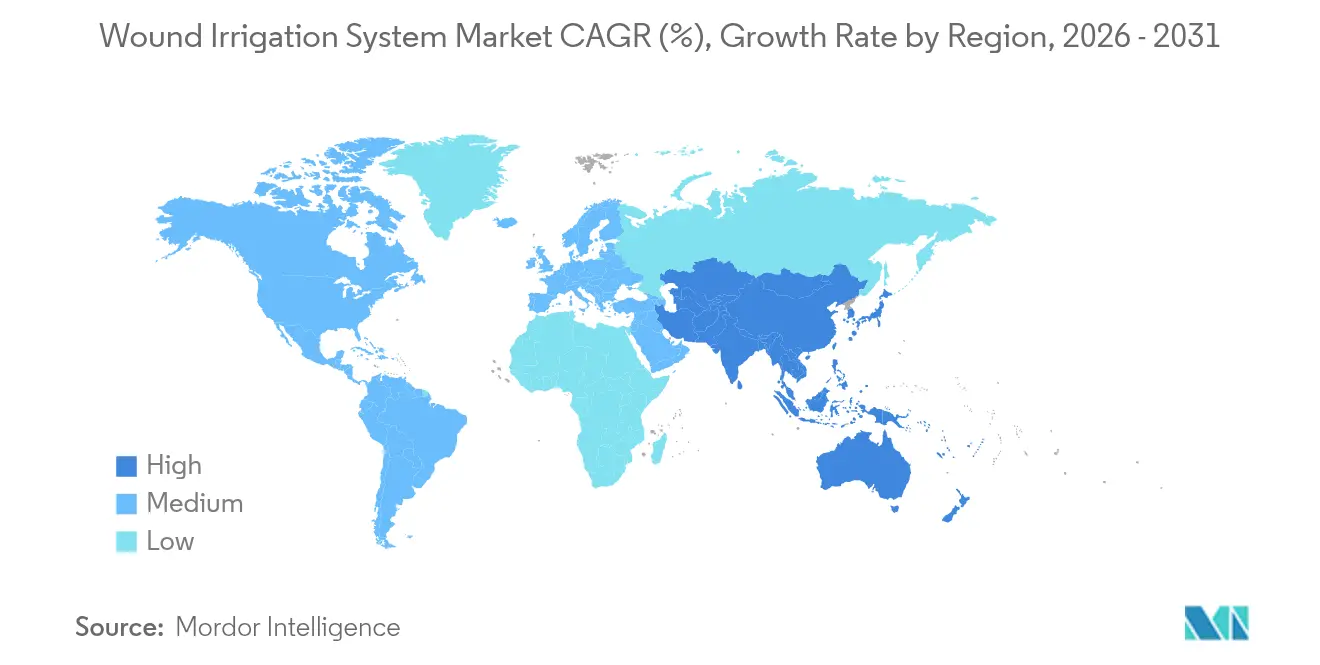
North America’s leadership stems from deep clinical integration of evidence-based protocols and payer policies that reimburse both saline and antiseptic solutions. Recent billing revisions impose modest payment cuts, yet hospital quality metrics tied to infection rates sustain demand. ASCs in the United States are fast-tracking procurement of battery consoles paired with single-use tips, enabling shorter case times and compliance with device tracking mandates. Canada mirrors these trends, albeit with provincial purchasing collaboratives that emphasize unit cost control.
Europe remains a mature but steadily evolving theater. Hospitals in Germany and the United Kingdom increasingly specify biodegradable consumables to meet sustainability targets. The European Centre for Disease Prevention and Control’s surveillance highlights persistent gram-negative resistance, driving adoption of citrate-infused solutions in orthopedic and trauma suites. Nordic health systems pilot IoT-enabled pressure feedback modules that verify flow rates and document lavage volumes automatically in electronic health records.
Asia-Pacific exhibits the fastest expansion as tertiary hospitals upgrade surgical suites. Japan’s shift to ISO-aligned post-market surveillance encourages suppliers to incorporate unique device identifiers and digital lot tracing. China’s 14th Five-Year Plan incentivizes domestic med-tech pioneers to co-develop powered irrigation pumps, accelerating local competition. In India, private hospital chains bundle irrigation kits with NPWT rentals, targeting diabetic foot clinics in tier-two cities. Collectively, these forces raise regional demand elasticity, underpinning the Asia-Pacific growth premium in the wound irrigation system market.

Regulatory Landscape
In the United States, wound irrigation and jet lavage systems are regulated by the US Food and Drug Administration (FDA) as Class II medical devices (for example, under 21 CFR 880.5475 for jet lavage), typically requiring a 510(k) submission alongside compliance with the Quality Management System Regulation (QMSR) under 21 CFR Part 820, which incorporates ISO 13485-aligned requirements. BD’s February 2026 FDA 510(k) clearance (K253445) for the BD Surgiphor 1000 mL Antimicrobial Irrigation System for powered lavage workflows reinforces how special controls and intended-use labeling shape product positioning.
In Europe, market access is governed by Regulation (EU) 2017/745 (MDR), which raises expectations around clinical evaluation, post-market surveillance, and technical documentation, including classification considerations when substances are incorporated into a device (Annex VIII). Compliance requirements continued to tighten in 2026 as ISO 20417:2026 (information supplied by the manufacturer) was published, and the European Commission updated harmonized standards through Commission Implementing Decision (EU) 2026/1231, covering areas such as biological evaluation (ISO 10993 series), washer-disinfectors (ISO 15883 series), and symbols (ISO 15223-1). Together, these updates increase the focus on labeling, traceability, and validated reprocessing or single-use rationales for irrigation-related components and accessories.
Competitive Landscape
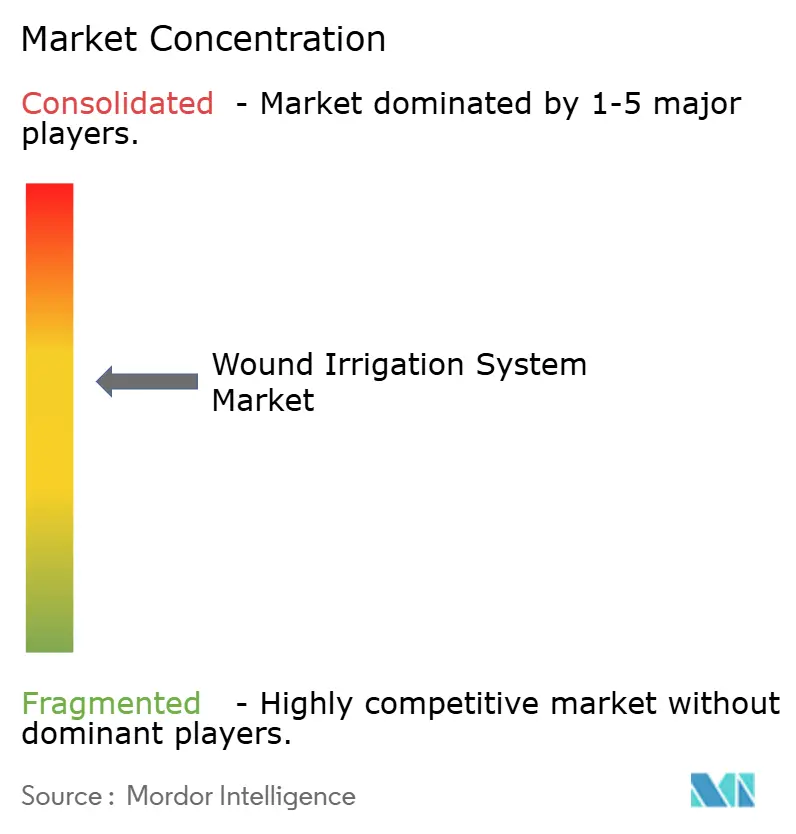
The wound irrigation system industry is moderately concentrated, with the top five players controlling well under 50% of global sales. Zimmer Biomet and Stryker maintain flagship lines anchored in pulse lavage technology, while BD leverages infusion-therapy expertise to widen its footprint. ARCHIMED’s September 2024 acquisition of Irrimax adds an established antimicrobial solution to its medical device portfolio, signaling continued consolidation. Meanwhile, Smith & Nephew earmarked USD 1.24 billion for wound-care R&D, including IoT module integration for irrigation pumps.
Technology differentiation is accelerating. Start-ups apply miniaturized flow sensors that auto-regulate pressure within therapeutic bands, reducing tissue trauma and standardizing debridement quality. Large incumbents respond with smart consoles that pair bar-coded solution packs to pre-set clinical pathways, capturing usage data for value-based-care reporting. Sustainability is a rising battleground: several vendors pilot tubing constructed from polylactic acid blends that degrade in commercial compost facilities, lowering hospital waste audits.
Regionally, domestic manufacturers in China and India undercut multinational list prices by 20-30%, prompting global companies to license or co-produce to preserve share. In Europe, compliance with MDR drives up certification costs, favoring firms with deep regulatory infrastructure. North American group purchasing organizations negotiate tiered rebates tied to infection-rate performance, pushing suppliers to produce robust outcomes data. These dynamics ensure a competitive yet opportunity-rich landscape for the wound irrigation system market.
Wound Irrigation System Industry Leaders
-
Zimmer Biomet
-
Stryker
-
Becton, Dickinson and Company
-
CooperSurgical Inc.
-
Westmed Inc.
- *Disclaimer: Major Players sorted in no particular order

Market Opportunities and Future Outlook
The near-term opportunity is in standardized, ready-to-use antimicrobial irrigation formats that fit powered lavage and operating room workflows, where manufacturers can reduce variability tied to manual mixing and support contamination-control protocols. BD’s market actions reinforce this direction, with expansion of the BD Surgiphor Surgical Wound Irrigation System into select European countries in November 2025 (after CE approval), followed by US FDA 510(k) clearance for the Surgiphor 1000 mL system for powered lavage in March 2026. Together, these steps point to supplier prioritization of packaged, regulator-reviewed solutions over open, ad hoc preparation.
Additional opportunity exists in aligning product labeling and documentation with evolving compliance and information requirements across regions, while targeting outpatient and ambulatory settings that rely on portability and consistent pressure delivery. The 2026 updates to manufacturer information requirements (ISO 20417:2026) and the EU harmonized standards under MDR provide a clearer basis for differentiated claims around labeling, instructions for use, traceability, and validated use conditions. Companies that offer closed-system consumables, pressure-controlled delivery, and workflow-compatible kits can use this structure to compete in hospitals, ambulatory surgical centers, and homecare providers. As professional bodies further formalize wound cleansing and surgical irrigation guidance, products that pair device ergonomics with sterile, single-patient-use solution delivery and clear use-parameters have a defined path to compete beyond price.
Recent Industry Developments
- March 2026: Becton, Dickinson and Company (BD) received US FDA 510(k) clearance for the BD Surgiphor 1000 mL Antimicrobial Irrigation System designed for powered lavage. The clearance strengthens BD's position in regulated, standardized surgical irrigation workflows and supports broader hospital adoption where protocol-driven infection prevention is tied to product labeling and validated use conditions.
- November 2025: BD launched the BD Surgiphor Surgical Wound Irrigation System in select European countries following CE approval. The rollout extends BD's addressable base in Europe and increases competitive pressure on incumbent pulse lavage and irrigation kit suppliers competing for operating room standardization.
- August 2024: ARCHIMED completed the acquisition of Irrimax Corporation, adding the Irrisept Antimicrobial Wound Lavage system to its portfolio. The deal consolidates antimicrobial lavage offerings under a larger platform and can shift channel reach and bundled contracting dynamics for hospitals and group purchasing organizations.


Research Methodology Framework and Report Scope
Market Definition and Coverage
This market covers devices used to irrigate a wound using a controlled flow of cleansing fluid during treatment, including manual and battery-powered systems used in clinical and supervised care settings.
Scope exclusions: standalone negative-pressure wound therapy pumps and general wound dressings are excluded from this sizing.
Segmentation Overview
-
By Product Type
- Manual Systems
- Battery-Operated Systems
-
By Application
- Surgical Wounds
- Chronic Wounds
- Traumatic and Burn Wounds
-
By End-user
- Hospitals and Clinics
- Ambulatory Surgical Centers
- Homecare Settings
- Others
-
By Geography
-
North America
- United States
- Canada
- Mexico
-
Europe
- Germany
- United Kingdom
- France
- Italy
- Spain
- Rest of Europe
-
Asia-Pacific
- China
- Japan
- India
- Australia
- South Korea
- Rest of Asia-Pacific
-
Middle East and Africa
- GCC
- South Africa
- Rest of Middle East and Africa
-
South America
- Brazil
- Argentina
- Rest of South America
-
North America
Data Sources, Market Sizing, and Validation
Desk Research
Desk research was used to build the starting demand picture and to keep assumptions grounded in real clinical activity. We leaned on public healthcare statistics and guidance, including CDC infection prevention resources, World Health Organization publications, OECD health data, and national health ministry datasets that track procedures and hospital utilization.
To translate clinical activity into an addressable market, we also reviewed sources such as peer-reviewed wound care and surgical site infection journals, selected customs and trade statistics for relevant medical device categories, and public documents from regulators such as the FDA (product classification and safety communications). Company filings, investor presentations, and reputable press were used to sense-check product positioning and geographic footprint. We used paid subscriptions for company financials, news screening, and patent landscaping where public trails were limited. These sources are illustrative, and many other references were used to collect data, validate assumptions, and clarify unclear points during the research process.
Primary Interviews and Surveys
Primary work was used to pressure-test model assumptions that desk sources do not explain well, especially clinical usage patterns, typical replacement cycles, and the realistic adoption of powered irrigation. We spoke with a mix of hospital and ambulatory care stakeholders, procurement and infection control voices, and channel-side participants across major regions, so gaps on pricing, use frequency, and care setting mix could be closed before finalization.
Distribution of primary research fieldwork respondents
| Company type | Respondent position | Region |
|---|---|---|
| Top tier: 29% | CXOs: 17% | APAC: 48% |
| Mid tier: 53% | Functional/Unit leaders: 36% | EMEA: 34% |
| Smaller Players: 18% | Managers: 47% | Americas: 18% |
Market-Sizing & Forecasting
The market value was built using a top-down approach where procedure activity and treated-wound volumes were reconstructed by region, and then filtered by where irrigation is clinically used across acute, surgical, burn, and chronic wounds. After that demand pool was formed, it was converted into revenue using a practical set of price and utilization assumptions that were refreshed through interviews.
To keep totals realistic, we corroborated the output with selective bottom-up approximations, such as sampled average selling price (ASP) checks by care setting, channel feedback on typical order sizes, and a light roll-up of visible supplier revenue where disclosures exist. Key inputs that influenced the model (illustrative, not exhaustive) included surgical volume trends, chronic wound prevalence signals, infection prevention protocol adoption, manual versus powered device mix, typical irrigation frequency per episode of care, and region-wise ASP levels after currency normalization.
For forecasting, scenario analysis was used around procedure growth, outpatient shift, and powered-system penetration, and then a smoothing step was applied so year-to-year movement aligns with how hospital purchasing usually changes. Where a bottom-up signal was missing for a smaller country or care setting, we filled gaps using proxy indicators (procedure volumes, hospital bed capacity, and care setting mix), followed by a final calibration against interview feedback.
Data Validation & Update Cycle
We validate the model by triangulating it against independent signals, including procedure volumes, healthcare spend direction, and plausible device utilization per case, and then checking whether implied ASPs sit within what respondents consider workable. Outliers are reviewed at the country and region level, and large variances trigger a re-check of inputs and, when needed, a short re-contact cycle with experts to confirm what changed.
Before sign-off, the work goes through multi-step analyst review so assumptions, math, and definitions stay consistent across the time series. Reports are refreshed annually, with interim updates when material events occur, and a final pre-delivery review is done so clients receive the most current view available at the time of purchase.
Mordor Intelligence's Wound Irrigation System Market Size Compared With Other Published Estimates
Published market values for wound irrigation systems can look different even when they sound like they cover the same thing, because the underlying counting rules often change from one source to another. The biggest drivers are usually what gets included as a wound irrigation system, which care settings are counted, the price level assumed for manual versus powered devices, and how often the numbers are refreshed.
In this study, the spread mainly comes from whether adjacent wound care items are pulled into the total, and whether the model starts from procedure-driven demand or from revenue claims with limited cross-checks. The table also shows timing effects, since some figures use earlier base years or different currency conversion points, which can shift the displayed USD value even if unit demand is similar.
Benchmark comparison
| Source | Market Size | Gaps in Research Methodology |
|---|---|---|
| Mordor Intelligence | USD 361.47 M (2026) | |
| Industry Tracker A | USD 304.50 M (2024) | Uses an earlier base year and a narrower pricing build that can understate the shift toward powered irrigation in higher-acuity settings, and year-to-year conversion timing can also move the USD figure. |
| Media Bulletin B | USD 307.87 M (2025) | Relies heavily on a single base-year value and applies a long, smooth CAGR with limited visibility on care setting mix and manual versus battery-powered split, which can dampen near-term step changes. |
Overall, the range is explained by base-year choice, device-scope decisions, and how ASP progression is handled as adoption shifts by setting. This is why procedure-linked demand checks and care-setting splits were kept explicit in the model applied by Mordor Intelligence.


Key Questions Answered in the Report
What is the current value of the wound irrigation system market?
The wound irrigation system market size stands at USD 361.47 million in 2026 and is projected to reach USD 443.61 million by 2031.
Which product type dominates sales?
Manual irrigation systems captured 61.48% of the wound irrigation system market share in 2025, owing to their low cost and familiarity in hospital workflows.
Which region is growing fastest?
Asia-Pacific is forecast to record a 5.18% CAGR through 2031, the highest among all regions, driven by healthcare infrastructure expansion and policy alignment.
Why are ambulatory surgical centers important for future growth?
ASCs are expected to post 5.12% CAGR because procedure migration and portable, battery-operated devices align with their cost-efficiency and quick-turnover models.
How are environmental concerns influencing product design?
European and North American hospitals increasingly seek biodegradable consumables, prompting manufacturers to pilot polylactic-acid tubing and battery-free pump designs to cut medical waste.
What is driving technology innovation in this field?
Integration of IoT sensors, real-time biomarker monitoring, and antimicrobial citrate solutions is elevating performance standards and opening new competitive angles in the wound irrigation system industry.
Page last updated on:


 Your data is secure and never sold or shared.


