
Wood Adhesives Market Size and Share
Market Overview
| Study Period | 2020 - 2031 |
|---|---|
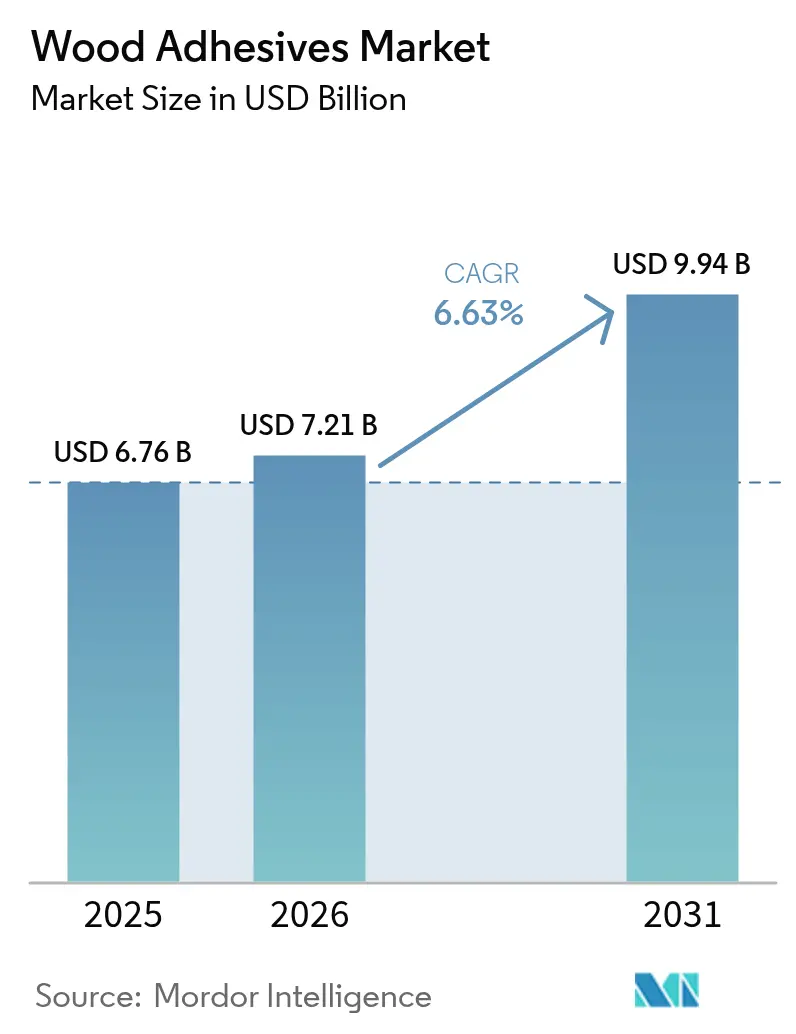
| Market Size (2026) | USD 7.21 Billion |
| Market Size (2031) | USD 9.94 Billion |
| Growth Rate (2026 - 2031) | 6.63 % |
| Fastest Growing Market | Asia-Pacific |
| Largest Market | Asia-Pacific |
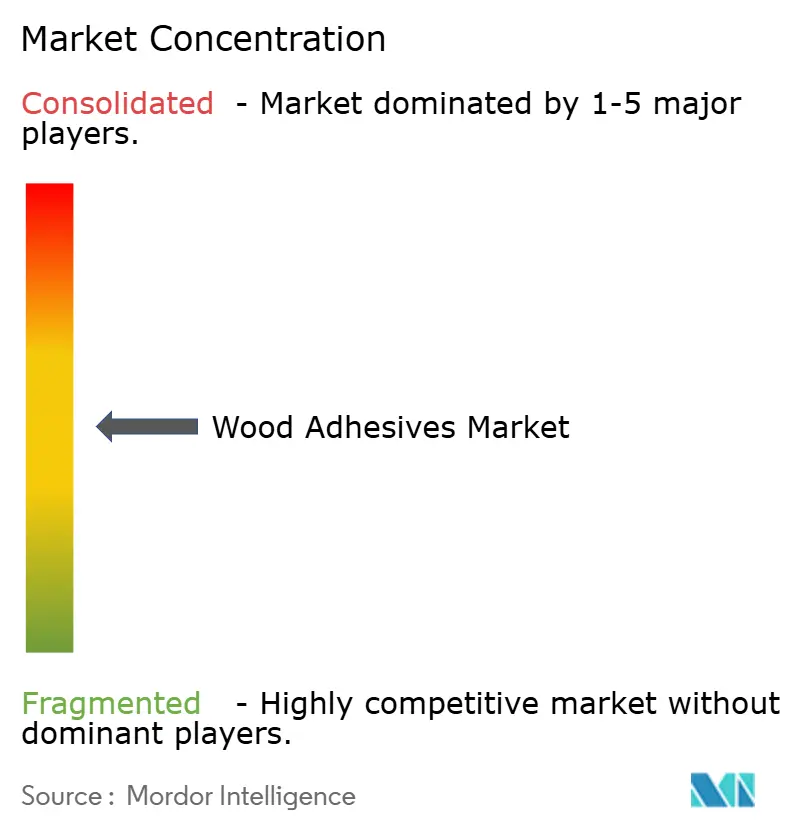
| Market Concentration | Medium |
Major Players *Disclaimer: Major Players sorted in no particular order Image © Mordor Intelligence. Reuse requires attribution under CC BY 4.0. | |
Wood Adhesives Market Analysis by Mordor Intelligence
The Wood Adhesives Market size was valued at USD 6.76 billion in 2025 and estimated to grow from USD 7.21 billion in 2026 to reach USD 9.94 billion by 2031, at a CAGR of 6.63% during the forecast period (2026-2031).
The steadily rising output of engineered wood, especially in Asia Pacific where capacity climbed 8% to 221 million m³ in 2024, anchors demand for high-performance bonding solutions. Rapid migration toward low-VOC, water-based chemistries and the accelerating adoption of mass-timber structures sustain growth momentum, while incremental innovations in synthetic and bio-based resins broaden application windows. Competitive intensity remains moderate, with scale leaders investing in Industry 4.0 process control and targeted M&A to protect share amid tightening environmental rules. Long-term opportunities center on structural adhesives for cross-laminated timber (CLT), reversible bonding chemistries for circular design, and region-specific formulations that optimize cost-to-performance metrics.
Key Report Takeaways
- By resin type, synthetic resins led with 56.25% revenue share in 2025, and are advancing at a 7.05% CAGR to 2031.
- By technology, water-based systems captured 37.90% of the wood adhesives market share in 2025, and are projected to expand at 6.95% CAGR through 2031.
- By application, furniture commanded 30.10% of the wood adhesives market size in 2025; cabinets is the fastest-growing end-user at 6.72% CAGR through 2031.
- By end-user, the residential construction segment commanded 44.05% of the wood adhesives market size in 2025; industrial and specialized woodwork is the fastest-growing end-user at 7.55% CAGR through 2031.
- By geography, Asia Pacific held 41.70% revenue share of the wood adhesives market in 2025 and is forecast to grow at 7.12% CAGR to 2031.
Note: Market size and forecast figures in this report are generated using Mordor Intelligence’s proprietary estimation framework, updated with the latest available data and insights as of 2026.
Market Trends and Insights
Drivers Impact Analysis of Wood Adhesives Market*
| Driver | (~) % Impact on CAGR Forecast | Geographic Relevance | Impact Timeline |
|---|---|---|---|
| Surging engineered-wood production in Asia Pacific | +2.10% | Asia Pacific core, spill-over to global supply chains | Medium term (2-4 years) |
| Rapid shift to low-VOC, water-based systems | +1.80% | Global, with regulatory leadership in California & EU | Short term (≤ 2 years) |
| Renovation boom in Europe furniture sector | +1.30% | Europe, with secondary impact in North America | Medium term (2-4 years) |
| Mass-timber (CLT & glulam) adoption in high-rise projects | +1.10% | North America & EU, emerging in Asia Pacific | Long term (≥ 4 years) |
| Integration of Industry 4.0 technologies enhancing precision in adhesive application and curing. | +0.60% | Global, with early adoption in developed markets | Long term (≥ 4 years) |
| Source: Mordor Intelligence | |||
Surging Engineered-Wood Production in Asia Pacific
China’s plywood capacity rose 8% to 221 million m³ in 2024 even as producer numbers fell 19%, revealing scale efficiencies that heighten demand for sophisticated adhesives. Vietnam’s record wood-product exports to the United States and China’s 13.27 million m³ plywood export volume show r egional output feeding worldwide value chains. Local growth drives domestic consumption, while export-oriented manufacturing multiplies volumes for water-resistant, heat-stable bonding agents. Concurrent bio-polymer investments across China, Thailand, and India further stimulate sustainable resin development.
Rapid Shift to Low-VOC, Water-Based Systems
Water-based chemistries already command 38.12% share and are growing 7.14% as regulations tighten. California’s CARB Phase II limits formaldehyde to 0.05 ppm for hardwood plywood, while the EU will cap emissions at 0.062 mg/m³ by August 2026[1]. Producers, notably H.B. Fuller, now allocate 60% of R&D budgets to sustainable formulations such as Swiftmelt 1850 for recyclable packaging. Water-based systems lower handling costs and improve shop-floor safety while advances in polymer cross-linkers are closing historical performance gaps.
Renovation Boom in Europe Furniture Sector
European furniture demand is stabilizing at 4-6% annual growth as homeowners prioritize sustainability and flexible interiors. In 2024, German OSB prices experienced a slight increase. signifying steady consumption despite macro headwinds. Homann Holzwerkstoffe posted EUR 354.5 million revenue in 2024 and targets 50% bio-based adhesive use by 2030, reflecting tighter circular-economy criteria. Renovation projects challenge formulators with dissimilar substrates, accelerated cure cycles, and salvageable joints for future recycling.
Mass-Timber (CLT & Glulam) Adoption in High-Rise Projects
More than 2,100 US mass-timber projects are registered, up from 1,650 one year earlier. Code revisions now recognize timber skyscrapers such as Milwaukee’s 32-story Edison building, catalyzing specialized structural-grade adhesives. Hexion offers melamine and resorcinol resins tailored for CLT panels that pass Green certification and withstand prolonged fire exposure. Demand centers on long-life strength, moisture tolerance, and heat-stable bonds across massive surface areas.
Restraints Impact Analysis of Wood Adhesives Market*
| Restraint | (~) % Impact on CAGR Forecast | Geographic Relevance | Impact Timeline |
|---|---|---|---|
| Volatile petro-feedstock (phenol, formaldehyde) prices | -1.40% | Global, with particular impact on cost-sensitive markets | Short term (≤ 2 years) |
| Stricter indoor-air VOC caps in California & EU | -1.20% | California & EU core, with global supply chain implications | Short term (≤ 2 years) |
| Limited supply of bio-based polyols/starches | -0.80% | Global, with supply constraints in developed markets | Medium term (2-4 years) |
| Source: Mordor Intelligence | |||
Volatile Petro-Feedstock Prices
Phenol-formaldehyde resin costs fluctuated sharply in 2024, squeezing margins when feedstock represents 75% of cost of sales as reported by H.B. Fuller. Smaller manufacturers struggle to hedge volatility, prompting contract revisions and greater reliance on spot markets. Price spikes pass through the supply chain unevenly, risking demand substitution when rising adhesive costs cannot be absorbed by furniture or panel producers.
Limited Supply of Bio-Based Polyols/Starches
USDA pinpoints infrastructure gaps that restrict biomass flow for industrial biochemicals. Pilot-scale breakthroughs, such as Beijing Forestry University’s xylan-based hot-melt with 30 MPa lap-shear strength, illustrate performance viability yet remain hindered by feedstock scarcity[2]. Stora Enso’s NeoLigno lignin binder demonstrates commercial intent but faces capex and sourcing hurdles[3]. Supply deficits slow the wood adhesives industry’s transition to fully renewable inputs, tempering potential CAGR upside.
*Our forecasts treat driver/restraint impacts as directional, not additive. The impact forecasts reflect baseline growth, mix effects, and variable interactions.
Wood Adhesives Market Segment Analysis
By Resin Type:
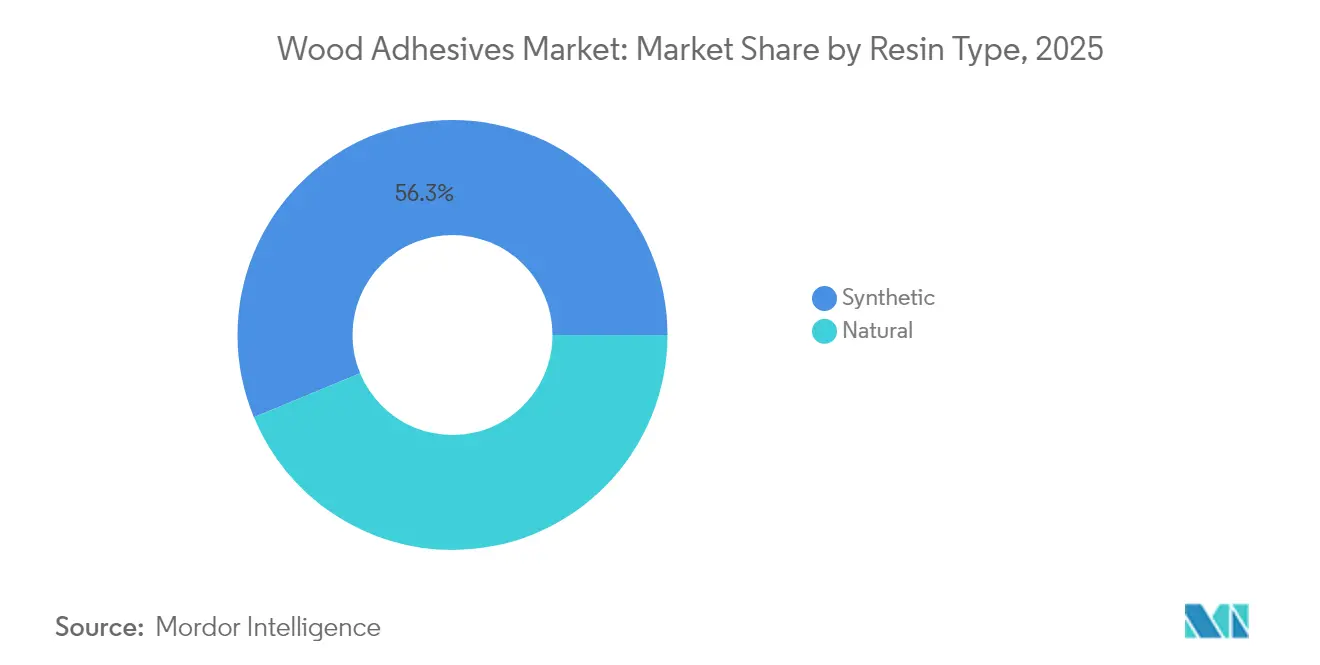
Synthetic Dominance Drives InnovationSynthetic resins accounted for 56.25% of 2025 revenue, underscoring cost-to-performance leadership even as environmental scrutiny intensifies. This segment is expected to clock 7.05% growth through 2031 as ultra-low-emitting (ULEF) and no-added-formaldehyde (NAF) chemistries reach commercial maturity. Makers are blending bio-fillers—such as modified corn-cob powder that hikes bond strength up to 19.6%—to curb emissions by 27.8%. Synthetic platforms thus set performance benchmarks while steadily lowering environmental footprints, sustaining their primacy in the wood adhesives market.
Eco-adoption is fastest in jurisdictions with tight indoor-air codes, channeling R&D toward phenol substitutes without compromising structural integrity. Acorn-enhanced phenolic resins attaining 0.93 MPa shear strength show that hybrid chemistry can marry bio-content with proven curing behavior. As IoT-enabled reactors optimize reaction kinetics and feed precision, manufacturers unlock further gains in consistency and throughput.

By Technology:
Water-Based Systems Lead Environmental TransitionWater-based processes held 37.90% share in 2025 and will scale at 6.95% as global emission caps converge. These formulations reduce plant energy loads because they forgo high-temperature flash-off and lower solvent recovery expenses. Celanese and Henkel now convert captured CO₂ into polymer backbones, shrinking cradle-to-gate footprints by 25%. Application equipment has evolved, using laser-guided nozzles that meter thin, uniform films to offset historically higher water weight.
Reactive hot-melts, UV-curable dispersions, and digital-tailored hybrid emulsions round out the technology mix, each suited to niche throughput and environmental profiles. Continuous inline monitoring enables real-time viscosity adjustments, ensuring bond repeatability at speed and elevating the wood adhesives market’s operational efficiency.
By Application:
Furniture Leadership Amid Cabinet GrowthFurniture remained the largest consumer at 30.10% in 2025, anchored by standardized production lines that favor high-output, cost-efficient adhesives. Cabinet manufacturing is rising at 6.72% CAGR as remodelers opt for premium finishes that demand stronger, invisible joints. Green adhesives for oriented strand board now achieve 94% of traditional bending strength benchmarks, signaling viable uptake for low-emission substrates.
Retail buyers increasingly request traceability for indoor-air compliance, pressing suppliers to validate every bonding layer. Adhesives that enable end-of-life dismantling gain traction in Europe’s take-back schemes, giving rise to reversible cross-link technologies that can be de-activated at moderate heat without damaging surface veneers.
By End-User:
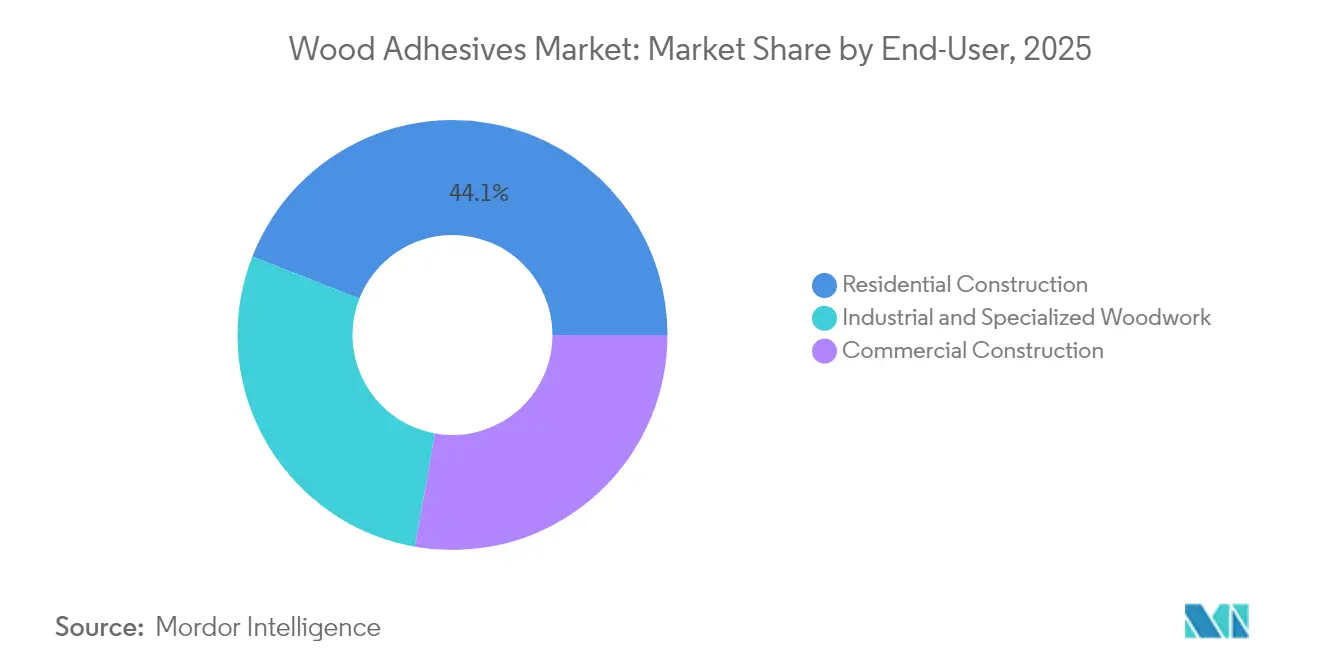
Residential Construction Dominance with Industrial GrowthResidential building absorbed 44.05% of adhesive volume in 2025. Home renovations lean on water-based, fast-grab products to shorten downtime. Industrial and specialized woodwork, however, will post the fastest 7.55% CAGR through 2031 because cross-laminated timber, acoustical panels, and energy-efficient façades require precision bonding delivered by automated lines.
AI-guided robots like those integrated after Hexion’s Smartech acquisition modulate spread rates and UV-intensity in real time, trimming scrap and elevating structural reliability. Industrial users thus treat adhesive capability as a core quality lever, reinforcing steady scaling of the wood adhesives market.
Geography Analysis
North America, APAC, Europe and Middle East Wood Adhesives Market
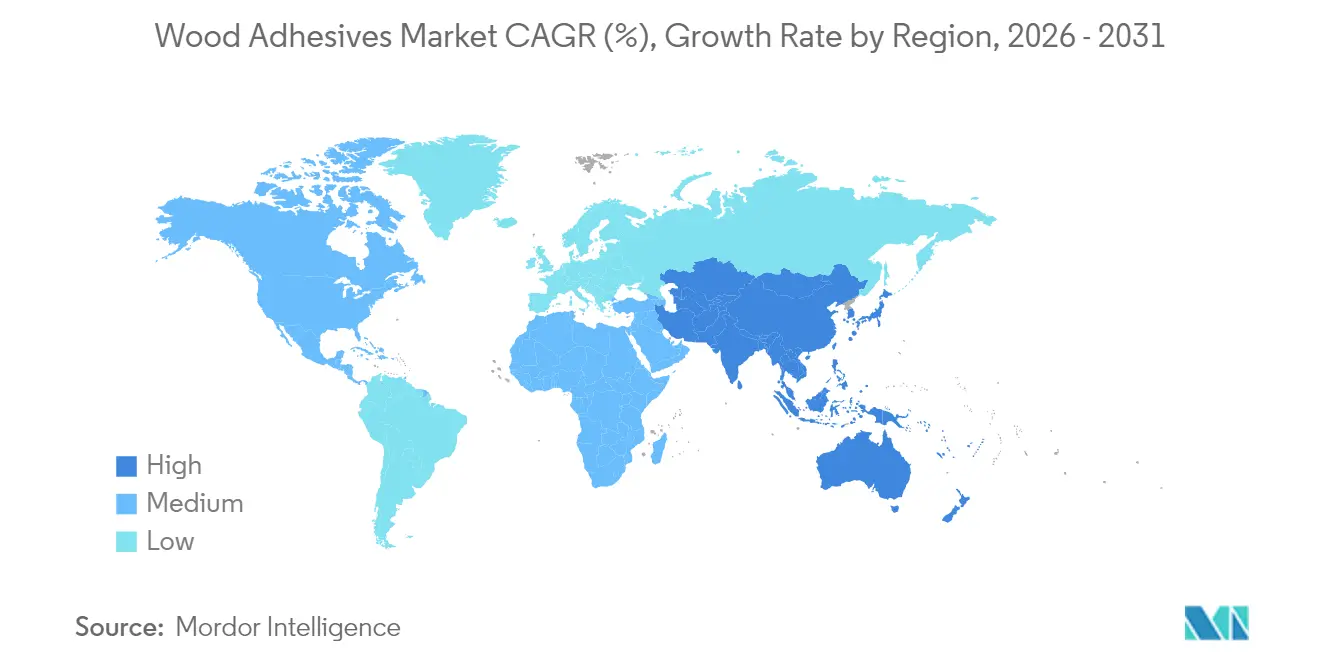
Asia Pacific accounted for 41.70% of 2025 spending and is tracking 7.12% CAGR to 2031 due to export-oriented panel plants and vast domestic infrastructure programs. China shipped 13.27 million m³ of plywood worth USD 5.271 billion in 2024, servicing buyers in Taiwan, Vietnam, and the Middle East. North America’s wave of mass-timber towers and federal infrastructure packages fuels specialty structural adhesive uptake. Europe’s stricter chemical and recycling mandates push rapid conversion to low-VOC systems, often catalyzing technology spillovers into other regions.
South America and Middle East Wood Adhesives Market
Brazil and Chile continue to invest in forestry mills, inviting entrants such as Sika to add local blending units. Middle East capacity additions in engineered-wood lines underscore global supply interdependencies, where feedstock, technology, and end-use trends cross-pollinate to advance the wood adhesives market worldwide.
Value Chain Analysis
The wood adhesives value chain starts with upstream feedstocks and specialty additives, including petro-based inputs for UF/PF/MF systems and polyurethane components, alongside growing interest in renewable inputs such as lignin and protein. Adhesive formulators and resin producers convert these inputs into engineered products, including water-based, hot-melt, PUR, and structural systems, which are supplied to panel makers and wood product manufacturers for plywood, OSB, MDF/particleboard, furniture, cabinets, and mass-timber (CLT/glulam) applications. Downstream, large industrial accounts are served through direct technical-sales models linked to application equipment and process support, while smaller furniture and joinery shops rely more on distributors and retail/DIY channels.
Compliance and functionality requirements increasingly shape sourcing and partnerships across the chain. In the EU, the formaldehyde emission limit for wood-based panels under Regulation (EU) 2023/1464 tightens to 0.062 mg/m3 from August 6, 2026, which raises the importance of access to CE-marked panel markets that depend on low-emission adhesive systems and verified input quality. On innovation and integration, chemical-to-wood-industry collaborations are expanding the adhesive layer beyond bonding, including the April 2026 CitroTech and Hexion 50/50 joint venture to deploy fire-retardant chemistry for plywood, OSB, and engineered wood, and 2026 industrial scale-up activity around formaldehyde-free alternatives such as BindEthics Ecohesive for engineered-wood manufacturers.
Competitive Landscape
The competitive field is moderately fragmented. Henkel’s Adhesive Technologies unit registered EUR 10.97 billion revenue in 2024, illustrating scale leverage on purchasing and R&D intensity. H.B. Fuller allocates 60% of new-product spending to sustainability-linked solutions, defending share amid tightening VOC norms. Sika uses bolt-on acquisitions and regional plant debottlenecking to capture growth from Asia and South America.
Strategic collaborations are rife. Dow, Henkel, and Kraton achieved a 25% carbon-footprint cut in TECHNOMELT hot-melts through bio-materials substitution. Hexion’s Smartech deal injects AI process control that boosts press-line yield by up to 6% while minimizing resin waste. Emerging specialists in lignin-based resins or reversible bonds address niches that large incumbents prefer to partner with rather than build from scratch.
Regional challengers exploit logistics proximity and local compliance knowledge to outmaneuver global brands on service. Nonetheless, innovation capital and brand trust still advantage multinationals, especially in long-cycle structural projects where liability risk skews purchaser preference to historically vetted suppliers.
Wood Adhesives Industry Leaders
-
Henkel AG & Co. KGaA
-
H.B. Fuller Company
-
Arkema Group (Bostik)
-
Sika AG
-
Akzo Nobel N.V.
- *Disclaimer: Major Players sorted in no particular order
Wood Adhesives Market Companies Covered in this Report
- 3M
- Aica Kogyo Co. Ltd
- Akzo Nobel N.V.
- Arkema Group (Bostik)
- Ashland
- BASF SE
- Dow
- Dynea AS
- Franklin International
- H.B. Fuller Company
- Henkel AG & Co. KGaA
- Huntsman Corporation
- Jowat SE
- Jubilant Agri and Consumer Products Limited (JACPL)
- KLEIBERIT
- Pidilite Industries Ltd
- Sika AG
- Weyerhaeuser
Market Opportunities and Future Outlook
A gap is emerging around structural and engineered-wood adhesives that add performance attributes while meeting tighter emissions and documentation demands. In the United States, the mass-timber pipeline of more than 2,100 registered projects reinforces demand for structural-grade systems for CLT and glulam. In Europe, the August 2026 formaldehyde limit of 0.062 mg/m3 for wood-based panels increases the premium on ultra-low-emitting and formaldehyde-free formulations. This combination favors suppliers that can pair product performance with compliance enablers such as Environmental Product Declarations and traceable raw-material strategies, supporting downstream customers that need green building certifications and market access.
Supply security and localization also create opportunity in cost-sensitive, fast-growing manufacturing hubs. In India, backward integration into resins is moving from strategy to execution, highlighted by Century Adhesives and Chemicals commencing commercial production at a new resin manufacturing unit in Naidupetta, Andhra Pradesh in May 2026, which can shorten lead times and reduce procurement volatility for wood-adhesive users. On sustainable-chemistry front, consolidation and scale-up are moving technologies from niche to broader adoption: Bakelite completed the acquisition of Poland-based Sestec in July 2025 to add 100% bio-based protein adhesive capability and a production site, and BindEthics advanced its Ecohesive formaldehyde-free adhesive to production-grade industrial scale-up in July 2026 with a validated route toward 2,000-litre manufacturing volumes. Together, these steps point to near-term commercial openings for bio-based and formaldehyde-free systems where performance, availability, and certification readiness converge.
Recent Industry Developments in Wood Adhesives Market
- July 2026: BindEthics advanced its Ecohesive formaldehyde-free adhesive to production-grade industrial scale-up, validating a route toward 2,000-litre manufacturing volumes and signaling readiness for broader commercial rollout. The development expands the practical footprint of bio-based adhesives in engineered wood and supports certification-ready volumes.
- May 2026: Henkel introduced 1K-PUR Loctite HB XE for CLT and glulam applications, targeting improved fire-safety performance and faster press cycles. The product introduction strengthens Henkel's position in structural timber adhesives amid growing demand in the wood construction segment.
- April 2026: CitroTech and Hexion announced a 50/50 joint venture to deploy fire-retardant chemistry for plywood, OSB, and engineered wood, expanding the range of performance-enhanced adhesives in structural panels. The collaboration highlights continued integration of fire-retardant solutions within the wood-adhesives ecosystem.
Wood Adhesives Market Report Scope and Research Methodology
Market Definition and Coverage
This market covers adhesives that are formulated and sold mainly for bonding wood and wood-based materials in products like panels, furniture, and joinery, and it is measured in value terms at the point of sale of the adhesive.
Scope exclusions: This sizing excludes non-wood-focused bonding products mainly used for packaging, automotive assembly, or general construction where wood is not the primary substrate.
Segments Covered in This Report
- By Resin Type
- Natural
- Synthetic
- By Technology
- Water-based
- Solvent-based
- Other Technologies
- By Application
- Furniture
- Plywood
- Cabinets
- Doors and Windows
- Other Applications
- By End-User
- Residential Construction
- Commercial Construction
- Industrial and Specialized Woodwork
- By Geography
- Asia-Pacific
- China
- India
- Japan
- South Korea
- Rest of Asia-Pacific
- North America
- United States
- Canada
- Mexico
- Europe
- Germany
- United Kingdom
- France
- Italy
- Rest of Europe
- South America
- Brazil
- Argentina
- Rest of South America
- Middle East and Africa
- Saudi Arabia
- South Africa
- Middle East and Africa
- Asia-Pacific
Data Sources, Market Sizing, and Validation
Desk Research
Desk work starts with mapping demand for wood products where adhesive use is structural or repetitive, then matching that to what is publicly reported on production and trade. We referenced sources including the US Census Bureau (wood products and construction data), the US International Trade Commission trade statistics, UN Comtrade for cross-country trade flows, FAO forestry and wood products series, and standards and technical publications from organizations such as ASTM.
To ground the model in commercial behavior, we also reviewed company annual reports, investor presentations, product technical data sheets, and association websites discussing panels, furniture, and building materials. In a few cases, paid subscriptions for company financials and news, import and export shipment level data, and patent databases were used to cross-check capacity statements, formulation trends, and major end-use exposures. These sources are illustrative, and we also used other public references for data collection, validation, and clarification.
Primary Interviews and Surveys
Primary input was gathered through expert discussions and structured surveys with adhesive suppliers, distributors, formulators, and procurement or production teams at wood panel and furniture manufacturers. Since this is a global market, we ensured the respondent input covered APAC, EMEA, and the Americas so regional differences in resin mix, regulations, and demand cycles could be reflected in the assumptions used for valuation and volume attribution.
Distribution of primary research fieldwork respondents
| Company type | Respondent position | Region |
|---|---|---|
| Top tier: 37% | CXOs: 22% | APAC: 52% |
| Mid tier: 41% | Functional/Unit leaders: 18% | EMEA: 30% |
| Smaller Players: 22% | Managers: 60% | Americas: 18% |
Market-Sizing & Forecasting
The sizing uses top-down logic where wood panel output, furniture manufacturing activity, and construction fit-out indicators are translated into an adhesive demand pool, then priced using typical market ASP ranges by chemistry and application. After the model is assembled, we cross-check it with selective bottom-up approximations such as sampled supplier revenues by product line, channel feedback on average selling prices, and volume-to-value conversions for high-usage applications like plywood and composite panels.
Key inputs include engineered wood panel production trends (plywood, particleboard, and similar boards), housing and renovation activity affecting interiors demand, the mix shift toward water-based systems, regulatory pressure on VOC and formaldehyde emissions, and region-level manufacturing concentration that changes purchasing patterns. For forecasting, we apply scenario analysis with a base case guided by expert views on construction starts, panel capacity additions, and resin availability, then adjust if a region shows a different cycle. Where bottom-up checks are incomplete for smaller countries, gaps are handled by applying calibrated per-unit adhesive intensity and price proxies from similar markets before rolling up totals.
Data Validation & Update Cycle
Outputs are validated through stepwise triangulation where totals are compared against independent signals such as wood products output, trade movements of related inputs, and reported performance of relevant suppliers. Outliers are flagged and investigated, then corrected after re-checking conversion factors, currency timing, and the assumed application mix, followed by a second analyst review before sign-off.
The report is refreshed annually, and interim updates are made when material events occur, including sharp feedstock price swings, major capacity changes in engineered wood, or regulation shifts that alter product mix. Before delivery, we run a fresh consistency pass so the numbers and supporting narrative reflect the latest available public data and recent primary feedback.
Mordor Intelligence's Wood Adhesives Market Size Compared Against Other Published Estimates
Published market sizes for wood adhesives often vary, and the table below makes that spread visible without needing complex math. Differences usually come from what is counted as a wood adhesive, which end uses are included, and whether values are reported at manufacturer selling price or another pricing point.
The gap is also driven by how firms treat adjacent categories like general construction adhesives, packaging glues, and broader bonding chemicals, plus how they apply price progression during volatile feedstock periods. Currency conversion timing, the mix of resin chemistries, and how frequently assumptions are refreshed can shift the reported totals even when the growth story looks similar.
Benchmark comparison
| Source | Market Size | Gaps in Research Methodology |
|---|---|---|
| Mordor Intelligence | USD 7.21 B (2026) | |
| Industry Research Publisher A | USD 7.03 B (2023) | Uses an earlier base year and a different forecast window, and its definition leans heavily on engineered wood panel applications, which can undercount smaller joinery and cabinet uses depending on the conversion factors used. |
| Industry Research Publisher B | USD 10.98 B (2024) | Broader scope coverage includes multiple non-core applications and substrate combinations beyond wood-to-wood bonding, which tends to lift the total compared with a narrower wood-products demand pool. |
The table shows that the higher estimate is explained mainly by scope breadth, and in Mordor Intelligence's model the market is tied back to wood and wood-based product demand signals, then priced using application-linked ASP logic. With clear activity indicators and a repeatable set of checks, we can reconcile the range and keep the final value traceable to practical variables that buyers can debate and update.
Key Questions Answered in the Report
What is the current size of the wood adhesives market?
The wood adhesives market stands at USD 7.21 billion in 2026.
How fast is the wood adhesives market expected to grow?
The market is forecast to expand at a 6.63% CAGR, reaching USD 9.94 billion by 2031.
Which resin type holds the largest share in the wood adhesives market?
Synthetic resins lead with 56.25% revenue share in 2025.
Why are water-based adhesives gaining popularity?
Tight VOC and formaldehyde limits in California and the EU, coupled with comparable performance, drive 6.95% CAGR in water-based systems.
Which region dominates the wood adhesives market?
Asia Pacific captured 41.70% of global revenue in 2025, supported by robust engineered-wood capacity.
What are the main challenges for bio-based wood adhesives?
Limited feedstock supply and scaling constraints temper adoption despite strong regulatory and customer pull.