
Wireless Testing Market Size and Share
Market Overview
| Study Period | 2020 - 2031 |
|---|---|
| Market Size (2026) | USD 18.16 Billion |
| Market Size (2031) | USD 32.29 Billion |
| Growth Rate (2026 - 2031) | 12.18 % |
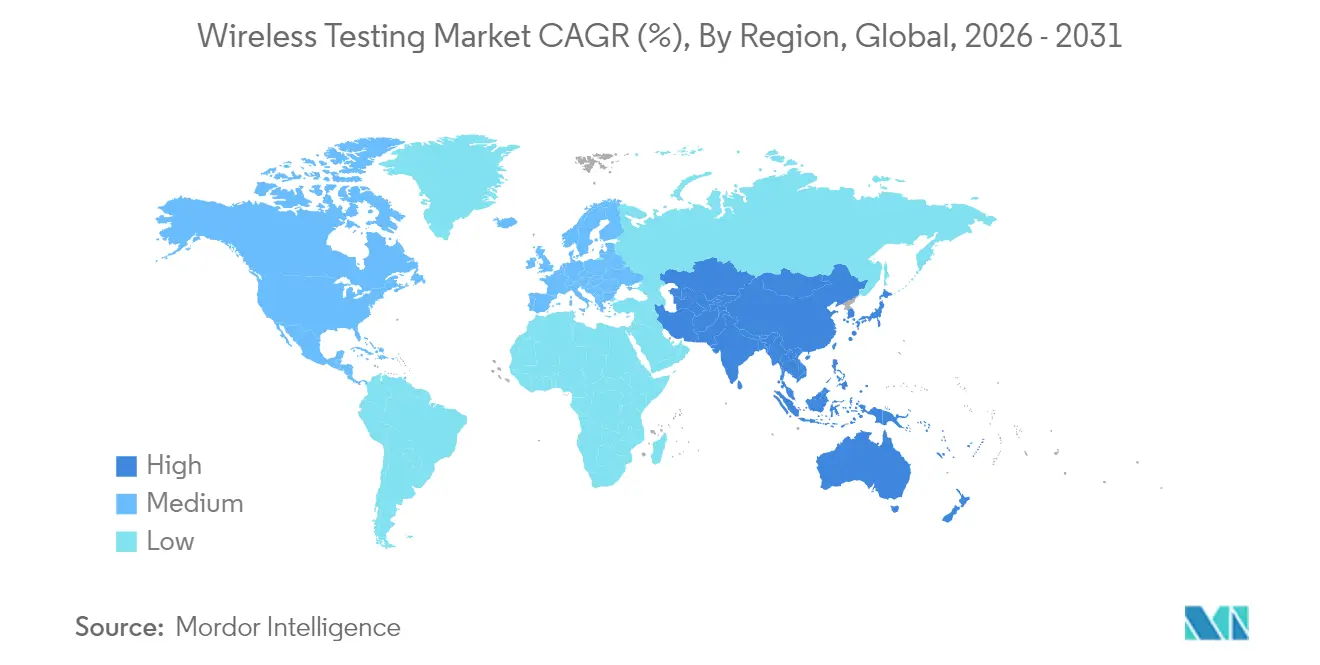
| Fastest Growing Market | Asia-Pacific |
| Largest Market | North America |
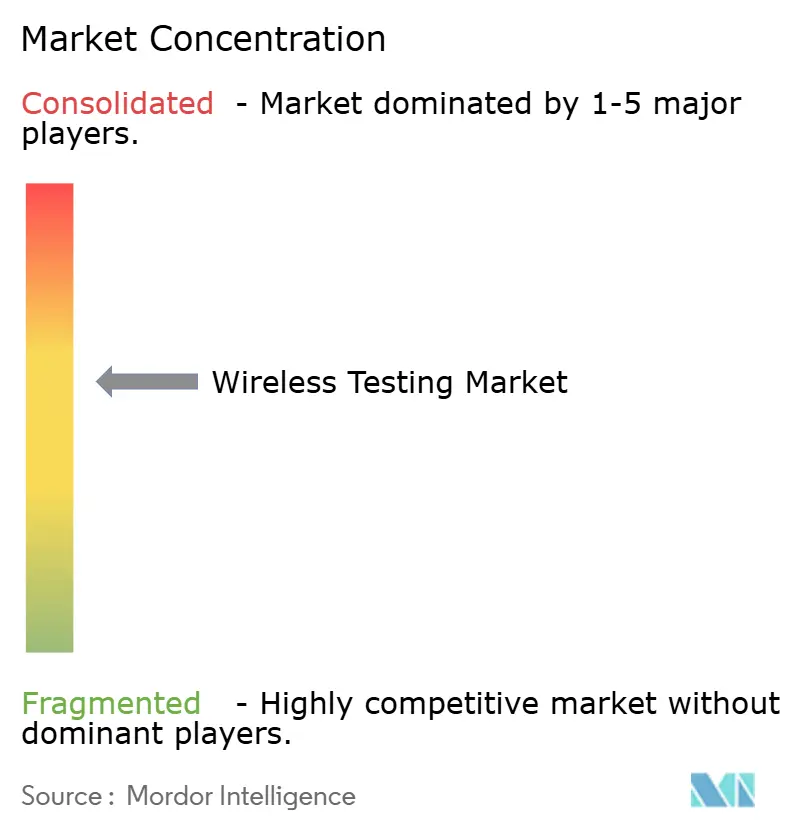
| Market Concentration | Medium |
Major Players *Disclaimer: Major Players sorted in no particular order Image © Mordor Intelligence. Reuse requires attribution under CC BY 4.0. | |
Wireless Testing Market Analysis by Mordor Intelligence
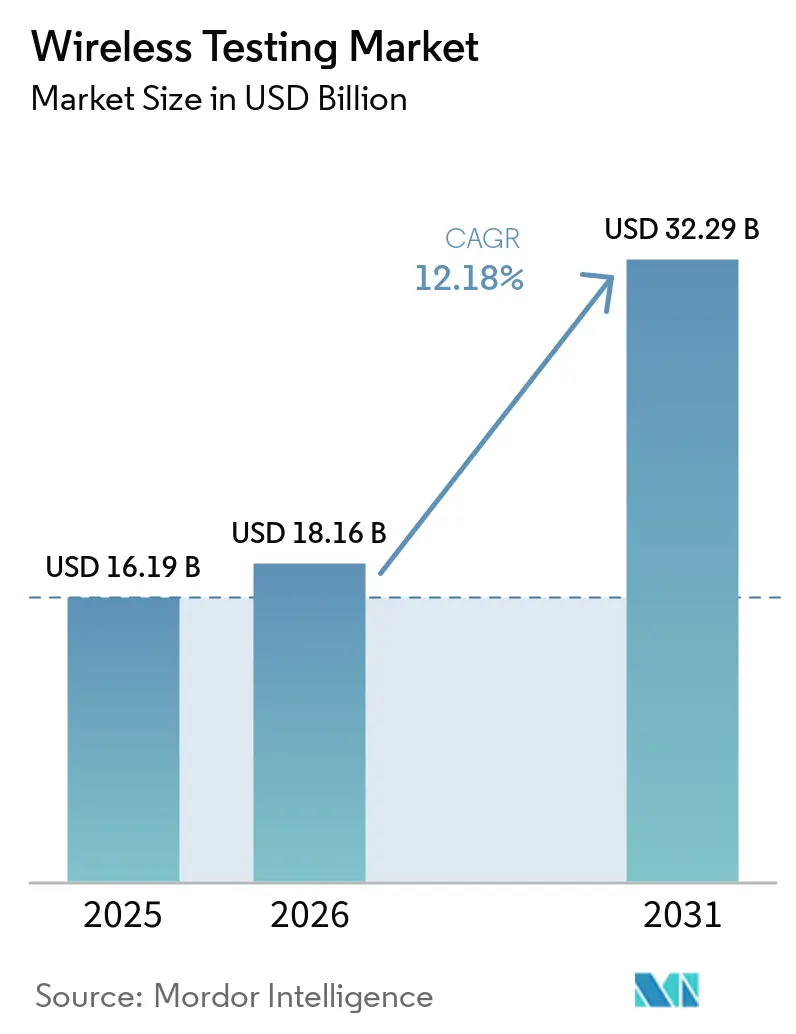
The Wireless Testing Market size is expected to grow from USD 16.19 billion in 2025 to USD 18.16 billion in 2026 and is forecast to reach USD 32.29 billion by 2031 at 12.18% CAGR over 2026-2031.
Ongoing migration to 5G-Advanced networks, the rapid spread of multi-radio IoT devices, and the European Union’s cybersecurity mandate for radio equipment are expanding verification scope well beyond traditional electromagnetic compatibility checks. At the same time, national operators in China, Japan, and the United States are investing billions of dollars in open-interface architectures that demand real-time validation of beamforming, massive-MIMO, and network-slicing performance under live traffic loads. These conditions are steering the wireless testing market away from reactive pass-fail compliance toward predictive, AI-driven validation frameworks capable of flagging service degradations before field rollout. Competitive dynamics now favor test houses and equipment vendors that can combine cloud-native automation, cybersecurity analytics, and end-to-end protocol expertise inside a unified service bundle.
Key Report Takeaways
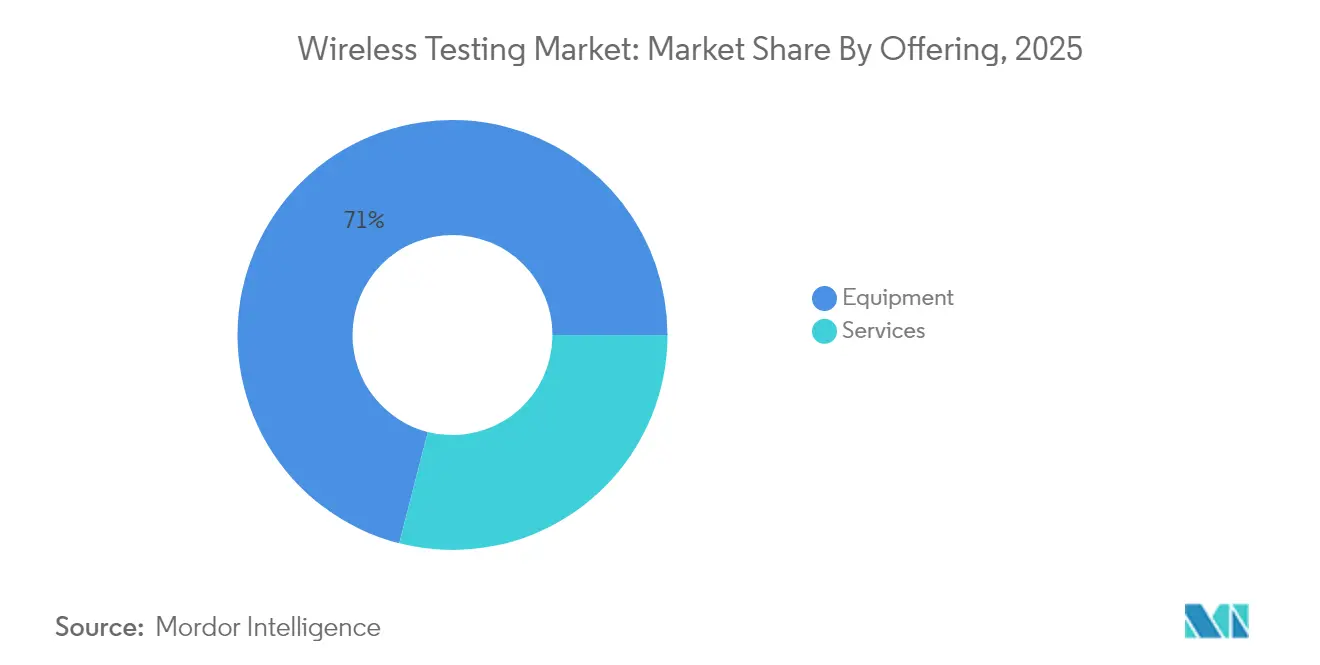
- By offering, equipment accounted for 71.02% of the wireless testing market share in 2025, while managed testing services are set to expand at an 11.05% CAGR through 2031
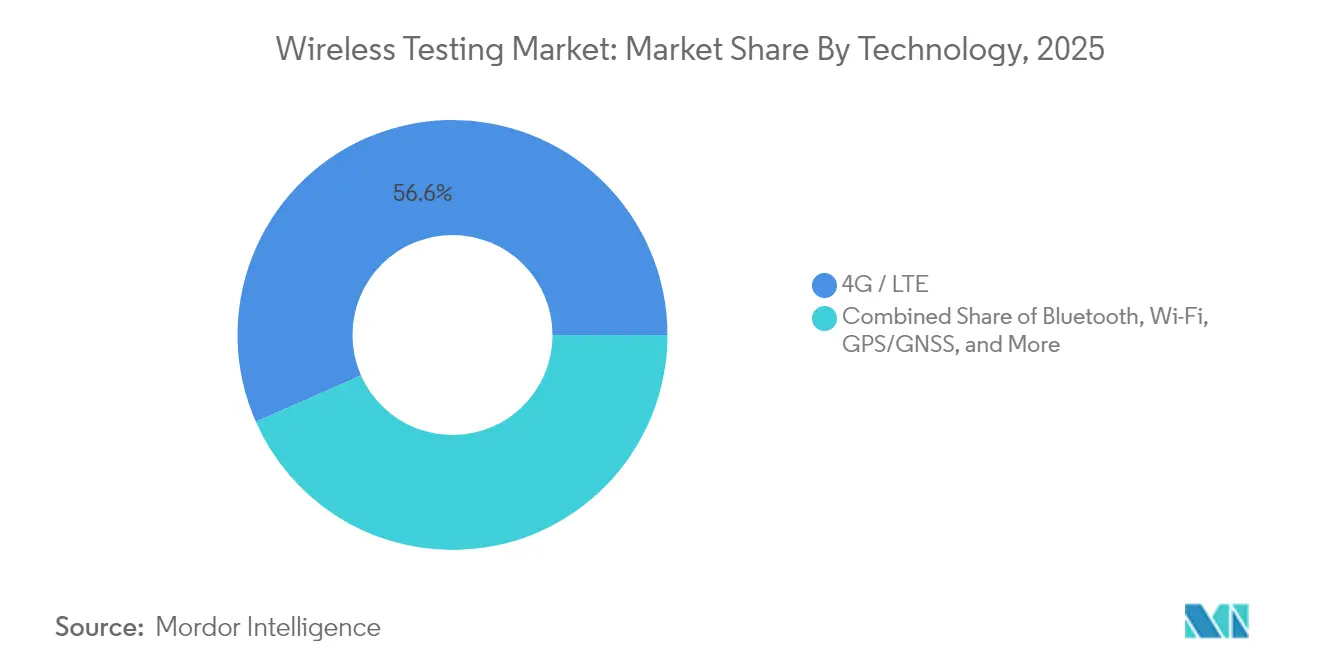
- By technology, cellular (LTE + 5G) held 56.62% revenue share in 2025; the 5G segment alone is projected to register an 18.2% CAGR to 2031
- By application, consumer electronics captured 33.55% of the wireless testing market size in 2025; automotive connectivity is advancing at a 14.72% CAGR between 2026-2031
- By geography, North America led with 32.18% revenue share in 2025, whereas Asia-Pacific is expected to log a 12.63% CAGR to 2031
Note: Market size and forecast figures in this report are generated using Mordor Intelligence’s proprietary estimation framework, updated with the latest available data and insights as of 2026.
Market Trends and Insights
Drivers Impact Analysis of Wireless Testing Market*
| Driver | (~) % Impact on CAGR Forecast | Geographic Relevance | Impact Timeline |
|---|---|---|---|
| Rapid expansion of 5G infrastructure | 3.20% | China and the United States deployment hubs | Short term (≤ 2 years) |
| AI-driven self-healing networks need predictive test analytics | 1.70% | Early adoption in developed markets worldwide | Long term (≥ 4 years) |
| Growing demand for cloud computing & IoT devices | 1.80% | North America & EU enterprise; APAC manufacturing | Long term (≥ 4 years) |
| Surge in private 5G / industrial wireless networks | 1.90% | North America & EU industrial corridors | Long term (≥ 4 years) |
| Source: Mordor Intelligence | |||
Rapid Expansion of 5G Infrastructure
Global operators plan to invest USD 259 billion in 5G roll-outs across Asia-Pacific alone by 2030, pushing the wireless testing market toward ultra-wideband, multi-antenna calibration environments that can benchmark massive-MIMO throughput and beam-forming accuracy in near-real time. Wi-Fi 7 coexistence checks are one application within the wireless testing market for Wi-Fi. Japan’s NTT DOCOMO, KDDI, and SoftBank together budget more than USD 13 billion to reach nationwide population coverage, forcing test labs to simulate network-slicing latency and Open RAN interoperability within temperature-controlled chambers that mirror local climatic extremes. These operators now demand holistic validation that covers RF metrics, cloud-native core integration, and service-level key performance indicators. Vendors able to blend channel emulation, traffic generation, and cybersecurity scanning inside a single over-the-air test cycle are capturing premium contracts. As 5G-Advanced capabilities such as non-terrestrial networking materialize, scenario-based testing that blends satellite and terrestrial links is becoming table-stakes, pulling fresh revenue into the wireless testing market.
AI-Driven Self-Healing Networks Needing Predictive Test Analytics
Network orchestration suites now embed large-language-model agents that autonomously tune cell parameters, recover from outages, and reroute traffic, all without human triggers[3]. Test strategies, therefore, pivot from static regression scripts to behavioural prediction under stochastic traffic loads. VIAVI Solutions and Northeastern University illustrate this shift by running a city-scale digital twin that spots anomalies minutes before they degrade throughput. Certification workflows must certify AI decision-paths, training-data integrity, and model bias across thousands of simulated failure events. This complexity lifts average engagement sizes, with buyers asking for continuous validation as a service rather than once-off device approvals. Providers that combine hardware-in-the-loop, containerized emulation, and explainable-AI dashboards are driving new benchmarks for wireless testing market competitiveness.
Growing Demand for Cloud Computing and IoT Devices
Enterprises accelerating cloud adoption run multitudes of battery-powered IoT sensors that hop between public and private networks, each with strict uptime and data-privacy thresholds. Test sequences must prove proper behavior across low-power states, co-existence with legacy radios, and resilience against coordinated cyberattacks mandated under the EU’s August 2025 Radio Equipment Directive. Device makers increasingly outsource this burden to third-party labs that maintain accreditation for emerging EN 18031 cybersecurity standards, stimulating high-margin service revenue. The result is a virtuous cycle where demand for predictive test analytics feeds back into continuous-integration pipelines, tightening bonds between firmware updates and validation certificates. As industrial IoT expands into condition monitoring and digital-twin asset tracking, the wireless testing market secures fresh spend from sectors that historically relied on wired links.
Surge in Private 5G/Industrial Wireless Networks
Manufacturing hubs across North America, Germany, and Southeast Asia deploy dedicated 3.5 GHz factory grids to automate machine vision and real-time robotics. These facilities require latency-focused acceptance tests that measure time-sensitive networking hand-offs, electromagnetic resilience near heavy machinery, and seamless handovers between indoor cells. Specialist labs offering onsite channel sounding, spectrum auditing, and client-edge performance monitoring win multi-year framework deals, elevating recurring revenue streams. Equipment suppliers are refreshing product lines with portable spectrum analysers and cloud-linked protocol decoders designed for ruggedized plant floors, reinforcing the wireless testing market momentum.
Restraints Impact Analysis of Wireless Testing Market*
| Restraint | (~) % Impact on CAGR Forecast | Geographic Relevance | Impact Timeline |
|---|---|---|---|
| High cost of advanced test equipment & skilled labour | -1.80% | Global; sharpest in developing regions | Long term (≥ 4 years) |
| RF-component supply-chain volatility is delaying calibration cycles | -1.10% | Asia-Pacific sourcing concentration | Short term (≤ 2 years) |
| Source: Mordor Intelligence | |||
High Cost of Advanced Test Equipment and Skilled Labour
Advanced 5G channel emulators and millimeter-wave signal generators now surpass USD 1 million per station, with lifetime support contracts adding 40% to ownership cost over five years. As test complexity rises, certified RF engineers command six-figure salaries that many domestic labs in emerging economies cannot match. Market leaders such as Keysight generated USD 4.98 billion in fiscal 2024 revenue, underscoring scale advantages that allow bulk component sourcing and multi-site asset utilization. Smaller competitors left to rent time on shared chambers face thin margins and elongated payback periods. This cost asymmetry encourages industry consolidation, with acquisition-driven platforms integrating regional labs into global networks to pool talent and equipment.
RF-Component Supply-Chain Volatility Delaying Calibration Cycles
Persistent shortages in low-phase-noise oscillators and high-frequency attenuators hamper scheduled recalibration of spectrum analysers, forcing test houses to extend maintenance windows and reschedule customer slots[4]. Semiconductor equipment investments are forecast to reach USD 139 billion by 2026, yet allocation favors high-volume fabs, leaving niche RF parts in short supply. Qorvo’s 2025 pivot toward premium handset components illustrates how shifting fab priorities can obsolete legacy test fixtures mid-cycle, adding unexpected capital outlays. Labs operating on thin margins struggle to absorb these shocks, occasionally pausing accreditation renewals until fresh component batches arrive. Such disruptions trim capacity and stretch delivery lead-times, placing a drag on near-term wireless testing market growth.
*Our forecasts treat driver/restraint impacts as directional, not additive. The impact forecasts reflect baseline growth, mix effects, and variable interactions.
Wireless Testing Market Segment Analysis
By Offering:
Equipment Dominance Faces Service DisruptionEquipment generated USD 11.5 billion in 2025, equal to 71.02% of wireless testing market share, but its grip is loosening as managed testing services outpace at an 11.05% CAGR through 2031. Capital-intensive signal generators, over-the-air chambers, and channel emulators form the backbone of every lab, yet buyers increasingly question ownership when firmware refresh cycles arrive annually. The wireless testing market size attributable to managed services will therefore close the gap as customers prioritize fast certification turnarounds over capital budgets. Tier-one vendors help this transition by bundling cloud-linked analytics dashboards, enabling remote monitoring of pass-fail metrics in near real time. In parallel, government-funded facilities such as the USD 21.7 million VALOR lab in Arizona open subscription-based access to specialty Open-RAN interoperability suites, accelerating the shift toward outcome-based engagements. For equipment makers, rental programs and usage-based pricing mitigate cannibalization while keeping utilization rates high.
Professional service providers leverage AI-assisted test-script generation and automated report templates to slash project cycle times. This agility resonates with start-ups launching multi-standard IoT gadgets that must secure global market entry within months. Meanwhile, established handset brands still purchase top-end gear to protect intellectual property, ensuring the equipment segment retains sizable absolute revenue even as its share declines. Overall, dual-track demand sustains the wireless testing market while encouraging hybrid business models that blend hardware leasing, managed compliance, and continuous regression testing on shared infrastructure.

By Technology:
5G Acceleration Outpaces Legacy Standards4G/LTE protocols accounted for 56.62% of 2025 revenue, but inside that umbrella, the 5G slice will lift the wireless testing market size by an 18.2% CAGR to 2031. Sub-6 GHz and millimeter-wave test routines now include dynamic spectrum-sharing verification, non-stand-alone to stand-alone migration checks, and slicing-aware throughput analytics. Laboratories thus retool benches with vector-signal-analyser bandwidths exceeding 2 GHz and multi-antenna anechoic chambers large enough for 64T64R arrays. Rohde & Schwarz and Qualcomm recently demonstrated 13 GHz links for pre-6G use-cases, hinting at escalating frequency coverage requirements. Wi-Fi remains vital: tri-band Wi-Fi 7 adds 320 MHz channels and multi-link operation, demanding concurrent verification of 2.4 GHz, 5 GHz, and 6 GHz radios. Bluetooth Low Energy retains prominence in wearables, yet new high-speed modes require updated packet-error-rate and coexistence benchmarks that stretch legacy analysers.
The coexistence of cellular, Wi-Fi, UWB, and satellite links inside single devices forces combinatorial test matrices. Equipment vendors respond with modular architectures where software-defined radio cards swap in frequency-specific front ends, prolonging chassis life. Service providers differentiate by offering library-based simulation of country-specific regulatory masks, compressing certification timelines for global launches. Consequently, technology diversification solidifies recurring revenue streams, anchoring the wireless testing market against single-protocol downturns.
By Application:
Automotive Transformation Drives InnovationConsumer electronics still led with 33.55% revenue in 2025, yet connected-vehicle platforms will lift automotive test spend at a 14.72% CAGR. Vehicle-to-everything links must display sub-millisecond latency and functional-safety compliance under Doppler shifts and metallic multipath unique to moving chassis. This pushes labs to adopt hardware-in-the-loop rigs that inject synthetic traffic scenarios during over-the-air measurements. Bureau Veritas and Intertek deploy end-to-end suites covering NFC payment validation, Wi-Fi hotspot functionality, and 5G telematics security testing. Parallel demand persists from medical devices, aerospace, and smart-grid controllers, each enforcing its own coexistence and reliability checklists. Cross-industry learning accelerates innovation: test cases born in surgical implants now inform automotive cybersecurity audits, and vice versa. As autonomy levels climb, AI sensor-fusion stacks enter validation scope, opening another frontier for the wireless testing market.
Growth in enterprise network upgrades keeps IT & telecommunications spending steady, while energy utilities adopt LTE-M and NB-IoT meters to balance renewable inputs. Each vertical compound's protocol overlaps, making multi-standard certification indispensable. In response, certification bodies weave horizontal frameworks that reuse base RF tests across verticals, saving clients both time and cost and reinforcing long-term service contracts.
Geography Analysis
North America Wireless Testing Market
North America commanded 32.18% revenue in 2025 thanks to early 5G rollouts, large defense budgets, and an entrenched ecosystem of tier-one equipment vendors. Keysight’s USD 4.98 billion 2024 revenue underlines the depth of local R&D expenditure that continually spins off next-generation oscilloscopes and channel emulators. Federal support strengthens domestic labs, exemplified by the National Telecommunications and Information Administration backing VIAVI’s Open-RAN test center with USD 21.7 million, guaranteeing local access to future-proof validation environments. Automotive and aerospace primes further amplify demand by integrating secure private 5G networks inside production campuses, a trend that funnels complex compliance projects into regional service providers.
APAC Wireless Testing Market
Asia-Pacific is shaping up as the fastest-growing territory, with a projected 12.63% CAGR. China Mobile, China Unicom, and China Telecom together plan more than USD 3 billion in 5G-Advanced upgrades during 2025, including 400,000 base-station refits that each require acceptance measurements for beamforming and edge-computing latency. Japan’s operators allocate an additional USD 14 billion for dense-urban coverage and Open-RAN pilots, creating parallel streams of lab and field-test activity. Manufacturing-heavy economies such as South Korea and Taiwan overlay private mid-band grids across chip fabs, spawning intricate coexistence checks between Wi-Fi 7, 5G, and industrial TSN protocols. Consequently, regional certification houses invest in multi-standard chambers and AI-enabled log-analysis engines to absorb surging workload, ensuring the wireless testing market maintains double-digit growth.
Europe Wireless Testing Market
Europe retains a pivotal role by anchoring global regulatory frameworks. The Radio Equipment Directive’s August 2025 cybersecurity clauses mandate security vetting alongside RF and EMC checks, broadening test engagement scope and extending project timetables. Germany hosts leading manufacturers such as Rohde & Schwarz, which reported EUR 2.93 billion (USD 3.13 billion) in fiscal 2024 revenue and continues expanding turnkey Bluetooth and Wi-Fi suites. Nordic countries pioneer private 5G ports and mining sites, stimulating over-the-air interference studies under arctic conditions. Southern Europe accelerates smart-meter deployments, linking energy-sector needs with telecom test architectures. Together, these initiatives stabilize European demand and feed global standardization efforts that ultimately harmonize testing criteria, benefiting the wider wireless testing market.
Regulatory Landscape
Wireless testing demand is being shaped by tighter market-access controls that couple radio compliance with security assurances. In the European Union, cybersecurity provisions tied to the Radio Equipment Directive broaden conformity assessment beyond RF/EMC to include security checks, reinforcing the need for labs that can test against emerging cybersecurity standards while maintaining traditional ETSI-based radio compliance pathways. In the United Kingdom, the 2026 revised Telecommunications Security Code of Practice under the Telecommunications (Security) Act 2021 adds practical technical guidance for demonstrating compliance, lifting documentation and verification depth for equipment and network-related deployments.
Regimes are also diverging on spectrum and approval mechanics, increasing the need for country-specific test matrices. India moved on 6 GHz policy via a January 2026 Gazette notification (G.S.R. 47(E)) that set frequency band limits for Wi-Fi equipment, while the UAE maintains a formal type-approval regime through TDRA and India continues to route certain approvals through DoT eServices. In the United States, FCC actions emphasized integrity of telecommunications certification bodies and measurement facilities, including greater transparency requirements, and created a pathway that prioritizes certain equipment authorization applications when testing is performed in Trusted Test Labs. This elevates the strategic value of accredited, traceable, in-scope lab footprints for global OEMs.
Value Chain Analysis
The value chain starts with standards and regulatory requirements (3GPP, Wi-Fi Alliance, CTIA, FCC/CE pathways) that define conformance and OTA methodologies, followed by RF component and module suppliers that influence fixtures, calibration schedules, and measurement uncertainty. Test equipment OEMs (such as Anritsu and Rohde & Schwarz) provide core instrumentation (signal generation and analysis, channel emulation, OTA chambers, protocol stacks) that is integrated by system partners and chamber specialists into turnkey lab setups. Certification and test service providers (for example, Element, VIAVI, and broader TIC groups) then deliver accredited execution, reporting, and ongoing regression programs for device makers and network vendors.
Downstream, buyers span handset and IoT device OEMs, automotive connectivity programs, and network operators that increasingly require interoperability and performance validation for open architectures. Open RAN programs have pulled operators (such as AT&T and Verizon) and public funding mechanisms (NTIA Public Wireless Supply Chain Innovation Fund) into the chain as direct sponsors of testbed capacity and automation, accelerating lab-as-a-service models. Recent capability moves illustrate tighter integration: Element expanded North American wireless testing and certification capacity following its CETECOM acquisition, while Anritsu and ETS-Lindgren collaborated around CTIA-certified 5G mmWave (FR2) OTA systems, strengthening the linkage between instrument vendors, chamber providers, and accredited lab delivery.
Competitive Landscape
The wireless testing market exhibits moderate consolidation, with the top five providers controlling an estimated 55-60% of global revenue. Keysight, Rohde & Schwarz, and Anritsu uphold leadership through continuous instrument refreshes that stretch from sub-GHz spectrum to THz exploratory bands. Strategic partnerships amplify reach: Rohde & Schwarz teamed with Ceva to unveil the industry’s first Bluetooth over-the-air test mode, eliminating cabled fixtures, accelerating wearable device throughput checks. Similarly, VIAVI collaborates with ETS-Lindgren to integrate Massive-MIMO chambers that validate Open-RAN radio units under realistic array steering scenarios.
Software-centric entrants challenge incumbents by delivering cloud-hosted regression farms where engineers upload firmware and receive pass-fail analytics within hours. Their pay-per-use pricing resonates with IoT start-ups and regional handset makers, forcing legacy vendors to offer subscription tiers atop hardware. M&A activity remains brisk as scale economics reward broad protocol coverage and distributed lab footprints. Test houses snap up niche cybersecurity specialists to bundle penetration testing within certification packets, while instrument firms acquire AI start-ups that automate waveform analysis. Market differentiation now revolves around end-to-end capability: customers favor suppliers that certify physical layer metrics, simulate network behaviours, and audit data-protection compliance in one integrated workflow, reinforcing the wireless testing market’s shift toward holistic platforms.
Defensive strategies hinge on intellectual property protection and standards-body influence. Leading vendors chair 3GPP and IEEE working groups, shaping forthcoming protocol drafts to align with their measurement roadmaps. They also deploy digital marketplaces where third-party developers sell automated test scripts, raising switching costs. Competitive pressure nonetheless intensifies as open-source toolchains mature, allowing smaller labs to replicate baseline tests cheaply. Consequently, tier-one providers emphasize premium features such as AI-driven anomaly detection and quantum-safe security validation to preserve margin moat. Over the next five years, the wireless testing industry is likely to settle into an oligopoly of global platforms flanked by regional specialists serving high-regulation verticals.
Wireless Testing Industry Leaders
-
SGS SA
-
Bureau Veritas SA
-
Intertek Group plc
-
DEKRA SE
-
Anritsu Corporation
- *Disclaimer: Major Players sorted in no particular order
Wireless Testing Market Companies Covered in this Report
- Keysight Technologies Inc.
- Rohde and Schwarz GmbH and Co KG
- Anritsu Corporation
- VIAVI Solutions Inc.
- SGS SA
- Bureau Veritas SA
- Intertek Group plc
- DEKRA SE
- UL Solutions Inc.
- TÜV SÜD AG
- TÜV Rheinland AG
- TÜV Nord AG
- National Instruments (NI)
- Spirent Communications plc
- Teledyne LeCroy Inc.
- Fortive (Tektronix)
- EXFO Inc.
- LitePoint (Teradyne)
- Cobham Limited
- Emite
- Tektronix
Market Opportunities and Future Outlook
A whitespace is forming around multi-domain validation bundles that combine RF conformance, OTA, protocol, and cybersecurity into a single engagement, reflecting regulatory and operator-driven expansion of verification scope. The EU cybersecurity mandate attached to radio equipment compliance (effective from August 2025 in this report context) increases demand for labs that can pair ETSI radio test suites with security validation and documentation support. This creates room for service providers and equipment vendors that integrate cybersecurity analytics into automated test cycles.
Investment in shared, pre-commercial test ecosystems is also expanding the addressable use cases beyond device certification into network, application, and AI-driven experience validation. In June 2026, Vinnova granted 150 million SEK to Digital Arena Sweden to establish a national test center for 5G and 6G, and Ericsson announced a pre-commercial 6G test environment with Lund University and KTH under the same initiative. In Germany, Open6GHub+ launched in January 2026 to connect 6G transfer activities with AI-based core networks and network digital twins, aligning with the market shift toward continuous, software-defined validation. Alongside operator-led Open RAN test initiatives and expanding Wi-Fi 7 and 5G-Advanced feature sets, these programs support opportunities for modular, cloud-automated testing services and for equipment platforms designed to shorten upgrade cycles through software-centric architectures.
Recent Industry Developments in Wireless Testing Market
- June 2026: Anritsu enhanced its SmartStudio NR/IP Performance software to add 5G RedCap device test support. The update broadens validation coverage for reduced-capability 5G endpoints used in IoT and industrial deployments. It strengthens Anritsu's position in recurring software-led test workflows rather than one-time instrumentation sales.
- March 2026: SGS acquired Granite River Labs Services to expand its digital infrastructure and high-speed wired and wireless connectivity testing capabilities. The transaction deepens SGS coverage across modern connectivity stacks. It increases its ability to offer single-provider qualification programs for OEMs that need both compliance and performance validation.
- June 2024: Anritsu secured industry-first GCF certification related to NTN NB-IoT RF conformance testing. This milestone advanced standardized test readiness for non-terrestrial connectivity scenarios. It helped accelerate broader ecosystem validation for satellite-integrated cellular services.
Wireless Testing Market Report Scope and Research Methodology
Market Definition and Coverage
For this study, the wireless testing market is defined as revenues earned from equipment and external services used to test wireless devices and networks for conformance, performance, and interoperability across major wireless standards.
Scope exclusions: The sizing excludes pure-play software emulators and tools that do not directly interact with RF signals.
Segments Covered in This Report
- By Offering
- Equipment
- Wireless Device Testing
- Oscilloscopes
- Signal Generators
- Spectrum Analysers
- Network Analysers
- Wireless Network Testing
- Network Testers
- Network Scanners
- OTA Testers
- Wireless Device Testing
- Services
- Testing and Certification
- Managed Testing Services
- Calibration and Support
- Equipment
- By Technology
- Bluetooth
- Wi-Fi
- GPS/GNSS
- 4G/LTE
- 5G
- Other (2G, 3G, Zigbee, UWB etc.)
- By Application
- Consumer Electronics
- Automotive
- IT and Telecommunication
- Energy and Power
- Medical Devices
- Aerospace and Defence
- Other Applications
- By Geography
- North America
- United States
- Canada
- Mexico
- South America
- Brazil
- Argentina
- Rest of South America
- Europe
- Germany
- United Kingdom
- France
- Italy
- Spain
- Russia
- Rest of Europe
- Asia-Pacific
- China
- India
- Japan
- South Korea
- Rest of Asia-Pacific
- Middle East and Africa
- Middle East
- GCC
- Turkey
- Rest of Middle East
- Africa
- South Africa
- Egypt
- Nigeria
- Rest of Africa
- Middle East
- North America
Data Sources, Market Sizing, and Validation
Desk Research
Desk research was used to set the fact base for demand drivers and to keep assumptions aligned with real rollout timelines for wireless standards. We referred to public sources such as ITU telecom indicators, FCC equipment authorization and spectrum releases, ETSI technical standards, and NIST measurement and test publications, along with customs and trade statistics where they help explain equipment movement.
To convert this context into sizing inputs, we also reviewed company annual reports, investor presentations, and reputable press to understand shifts between lab testing, OTA testing, and certification-led services. In a few cases, paid subscriptions for company financials and a patent database were used to clarify revenue ranges and technology direction where public disclosures were limited. The desk sources mentioned above are illustrative, and additional public references were used to fill gaps, validate assumptions, and clarify specific data points.
Primary Interviews and Surveys
Primary work focused on checking how budgets are split across device makers, network operators, and third-party test labs, and then validating the share between equipment purchases and outsourced testing services. We also spoke with engineering, quality, and procurement roles across APAC, EMEA, and the Americas so adoption timing for 5G, Wi-Fi, and IoT standards could be cross-checked and reflected in the final assumptions.
Distribution of primary research fieldwork respondents
| Company type | Respondent position | Region |
|---|---|---|
| Top tier: 35% | CXOs: 13% | APAC: 44% |
| Mid tier: 48% | Functional/Unit leaders: 28% | EMEA: 37% |
| Smaller Players: 17% | Managers: 59% | Americas: 19% |
Market-Sizing & Forecasting
Sizing starts with a top-down build that reconstructs the addressable spend from wireless device shipments and network deployment activity, which is then converted into testing intensity by standard and by typical test touchpoints. This works well in wireless testing because demand tends to follow product launches, spectrum use, and network upgrades rather than a single standalone buying cycle.
Key inputs used in the model include shipment trends for smartphones, wearables, and IoT modules, the pace of 5G rollouts and upgrades, Wi-Fi standard transitions (such as Wi-Fi 6 and Wi-Fi 7), certification and compliance needs by band and region, and the typical share of outsourced lab testing versus in-house labs. Pricing is handled through blended ASP ranges for core instruments and through service rate ranges, which are then adjusted for mix shifts toward OTA and higher frequency testing.
Forecasts were built using scenario analysis, where adoption speed for new standards and the slope of ASP changes are varied and then aligned back to what interviewees consider realistic procurement cycles. Results are corroborated with selective bottom-up approximations, such as sampled supplier revenue ranges, channel checks, and ASP-to-volume calculations for visible equipment categories, and then adjusted when gaps appear. Where coverage gaps exist, proxy ratios like test spend per shipped unit are used and then re-checked through primary inputs before totals are finalized.
Data Validation & Update Cycle
Validation is handled through several passes that compare model outputs against independent signals and then flag large variances for review. We check whether growth patterns match standard transition timing, whether regional splits align with deployment intensity, and whether service-to-equipment shares stay consistent with procurement behavior described by respondents.
Before sign-off, assumptions and calculations are reviewed by another analyst, followed by a final consistency check across years so step changes are explained and not accidental. Reports refresh annually, and interim updates are triggered when material events occur, such as major standard changes, regulatory shifts, or sharp changes in device shipment outlook. Right before delivery, a final scan of the latest public releases is completed so clients receive the most up-to-date view.
Mordor Intelligence's Wireless Testing Market Size Compared Against Other Published Estimates
Published market sizes for wireless testing can look far apart because publishers draw the scope line differently and also vary on what they treat as testing revenue. Even when the growth story is similar, base year selection, currency timing, and the way services are counted can push totals in different directions.
By tracking device shipments and network rollout indicators, refreshing the service versus equipment mix, and checking that only RF-interacting tools and certified third-party testing services are included, Mordor Intelligence reduces the risk of over-counting from software-only validation tools and unrelated lab work that sometimes gets bundled into broader estimates.
Benchmark comparison
| Source | Market Size | Gaps in Research Methodology |
|---|---|---|
| Mordor Intelligence | USD 16.19 B (2025) | |
| Industry Research Publisher A | USD 24.79 B (2025) | May include a broader offering set where software-only test tools and general lab and inspection services are counted alongside RF test equipment and certification-led wireless testing services, which expands the pool. |
| Global Research Publisher B | USD 25.07 B (2025) | Often applies wider application coverage with higher blended spending per device and network program, and can assume faster ASP expansion without the same touchpoint-based checks on testing intensity. |
The spread across the three values mainly comes from what is included and how tightly totals are tied to observable demand drivers like shipments and rollout cadence. With clear inputs and repeatable checks, the model stays easy to audit and update as standards and compliance requirements evolve.
Key Questions Answered in the Report
What is the current size of the wireless testing market?
The wireless testing market size stands at USD 18.16 billion in 2026 and is projected to reach USD 32.29 billion by 2031 at a 12.18% CAGR.
Which region is expected to grow the fastest through 2031?
Asia-Pacific is forecast to post a 12.63% CAGR, powered by aggressive 5G-Advanced deployments in China and large-scale network modernization in Japan.
Why are managed testing services gaining traction over equipment sales?
Escalating protocol complexity and the high cost of owning millimeter-wave chambers make outsourced, outcome-based testing more economical for many device makers.
How do Europe’s 2025 cybersecurity rules affect wireless testing timelines?
The Radio Equipment Directive adds mandatory network-protection and data-privacy checks, extending certification cycles and raising demand for specialized security validation.
Which application area will offer the highest growth in testing demand?
Automotive connectivity leads with a projected 14.72% CAGR as vehicle-to-everything, ADAS, and autonomous driving functions require rigorous low-latency and safety compliance testing.
What technologies will shape next-generation test requirements?
5G-Advanced, Wi-Fi 7, satellite-integrated non-terrestrial networks, and AI-driven self-healing orchestration will all introduce multi-band, multi-layer scenarios that traditional test frameworks cannot address.