
Wind Turbine Gearbox Repair and Refurbishment Market Size and Share
Market Overview
| Study Period | 2021 - 2031 |
|---|---|
| Market Size (2026) | USD 5.28 Billion |
| Market Size (2031) | USD 6.43 Billion |
| Growth Rate (2026 - 2031) | 4.05 % |
| Fastest Growing Market | Asia Pacific |
| Largest Market | Europe |
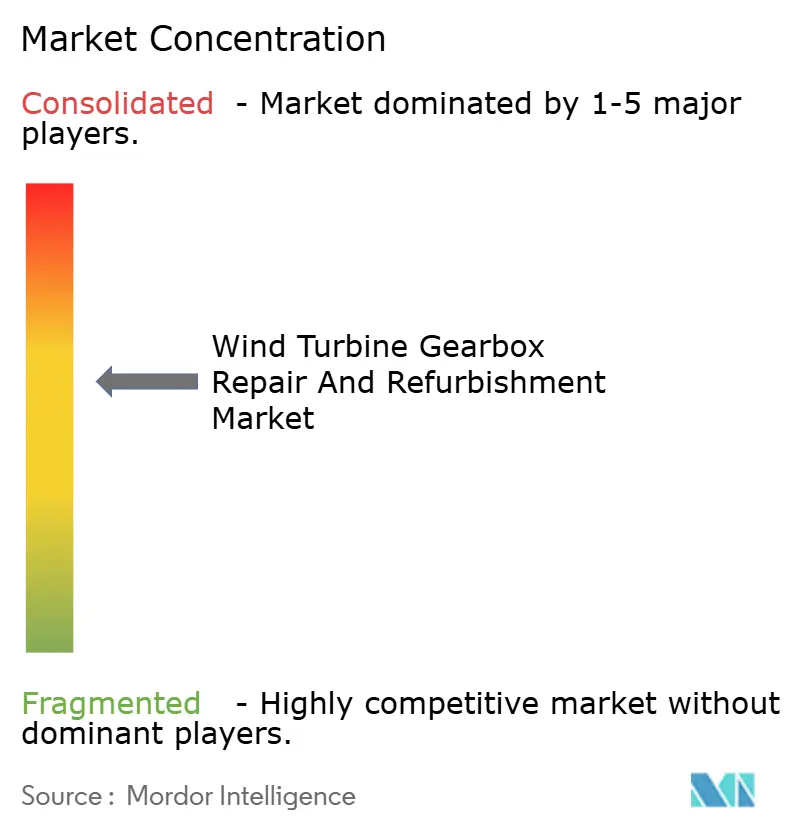
| Market Concentration | Medium |
Major Players *Disclaimer: Major Players sorted in no particular order Image © Mordor Intelligence. Reuse requires attribution under CC BY 4.0. | |
Wind Turbine Gearbox Repair and Refurbishment Market Analysis by Mordor Intelligence
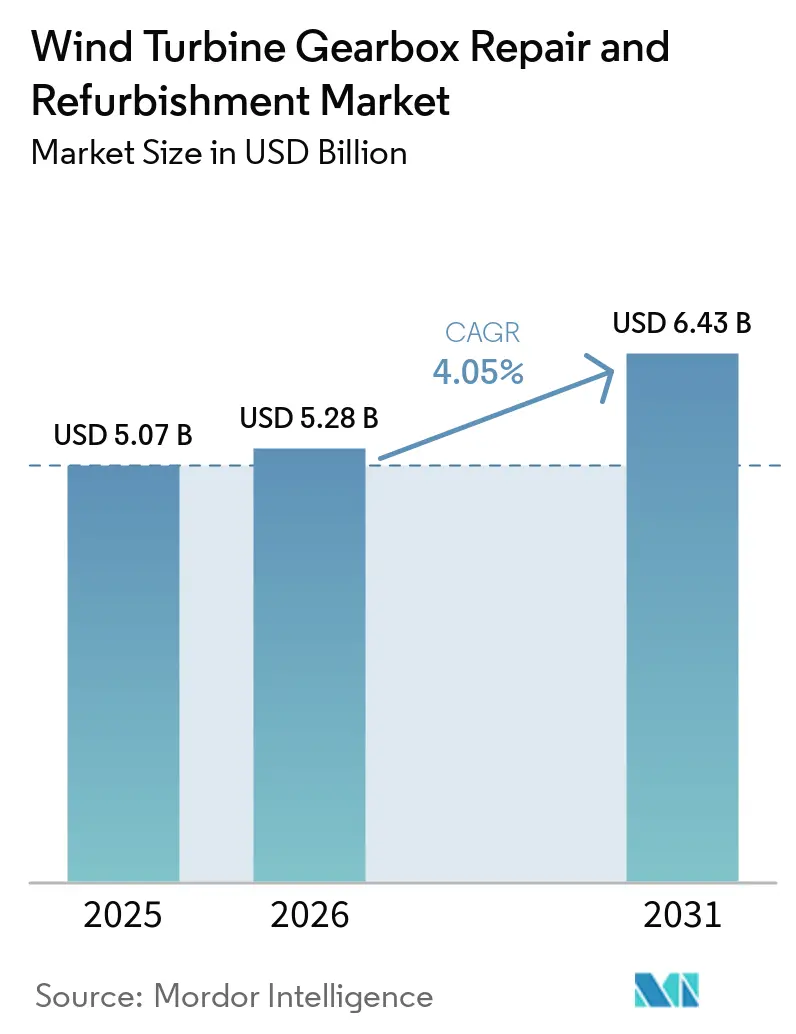
Wind Turbine Gearbox Repair And Refurbishment Market size in 2026 is estimated at USD 5.28 billion, growing from 2025 value of USD 5.07 billion with 2031 projections showing USD 6.43 billion, growing at 4.05% CAGR over 2026-2031.
This advance emerges from the collision of aging onshore fleets, capacity-constrained gearbox manufacturing, and escalating demand for uptime guarantees. The European fleet’s demographic shift, an 18-month post-pandemic lead time for new gearboxes, and insurance-driven service protocols align to make repair economics more attractive than outright replacement. Independent service providers (ISPs) are leveraging multibrand expertise to erode the incumbent position of original equipment manufacturers (OEMs). Meanwhile, offshore turbines bring higher ticket values and logistics costs exceeding 30% of total maintenance spend, pushing providers to refine exchange-pool and uptower repair models. As data-driven predictive maintenance spreads from Asia Pacific to other regions, operators gain the ability to intervene weeks before catastrophic bearing failures, preserving annual energy production and lowering the levelized cost of electricity.
Key Report Takeaways
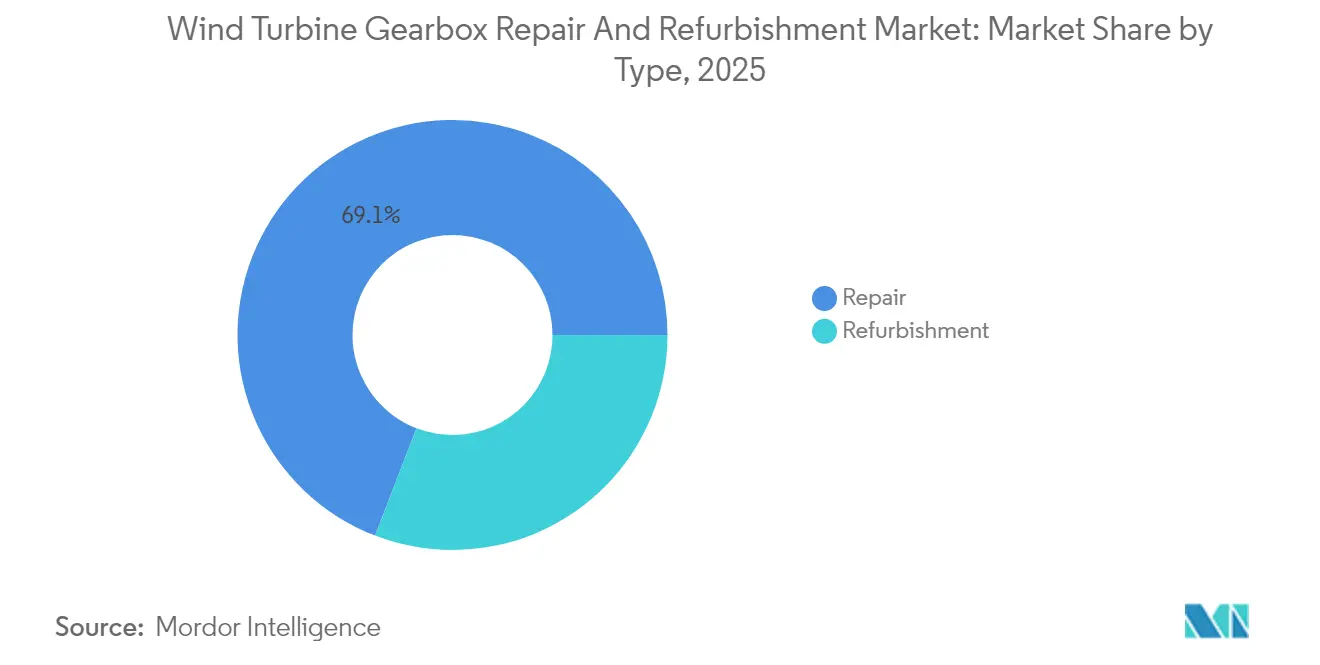
- By type, repair held 69.14% of the wind turbine gearbox repair and refurbishment market share in 2025, while refurbishment is forecast to expand at a 4.7% CAGR to 2031.
- By gearbox failure component, bearings captured 60.55% of 2025 repair orders; gear components will see a 4.95% CAGR through 2031.
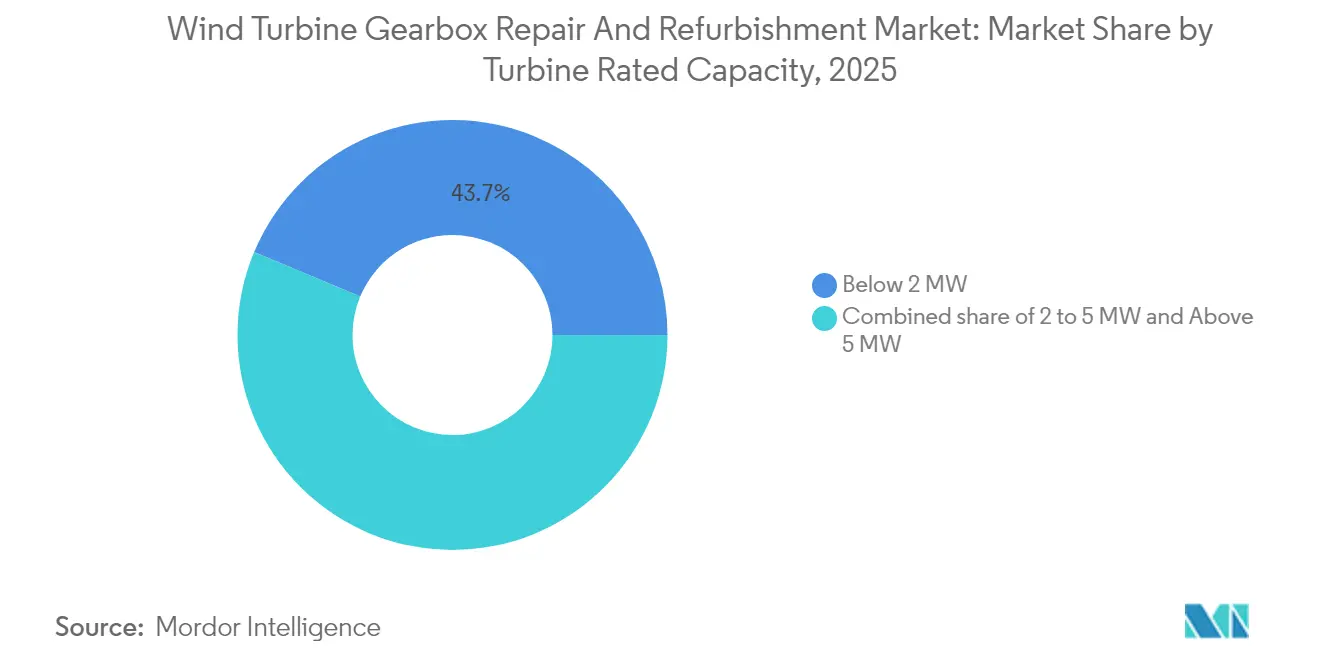
- By turbine rated capacity, the below 2 MW segment accounted for 43.70% of the wind turbine gearbox repair and refurbishment market size in 2025, whereas the above 5 MW segment is expanding at a 4.65% CAGR.
- By service provider, OEM service divisions commanded a 58.05% share in 2025, yet Independent Service Providers (ISP) are advancing at a 5.3% CAGR.
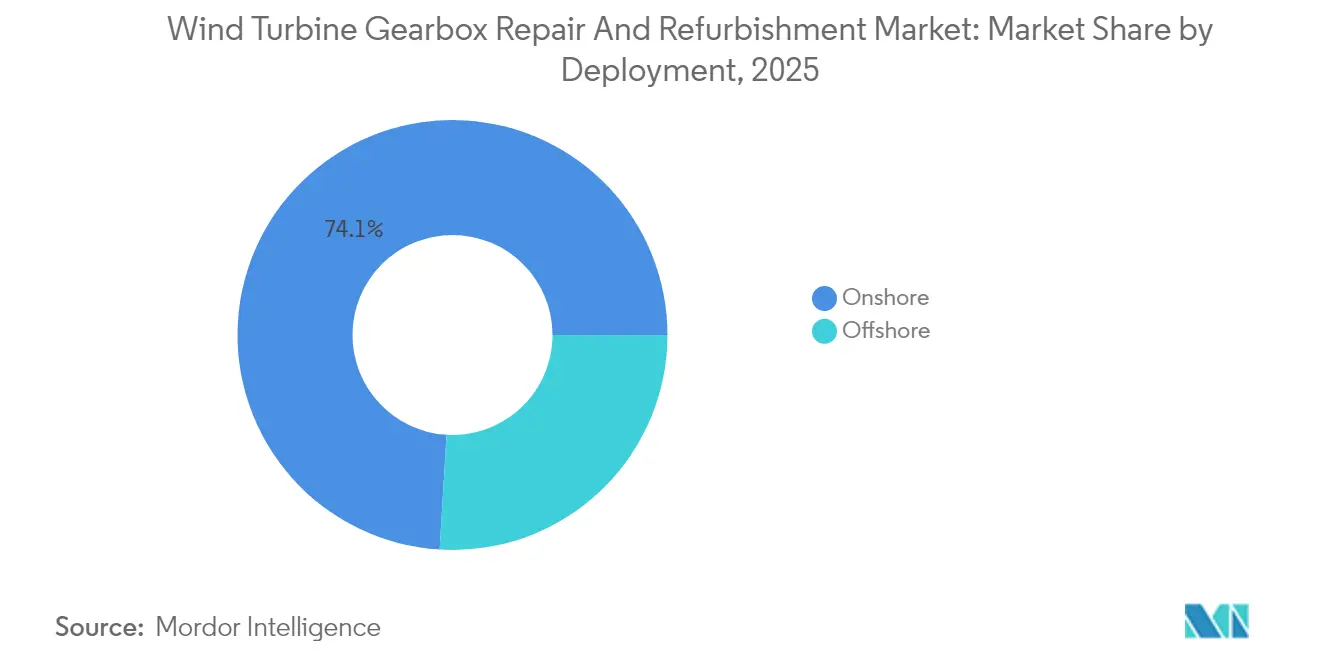
- By deployment, offshore represented 25.95% of 2025 revenue and is poised for the fastest 6.85% CAGR to 2031.
- By geography, Europe accounted for 37.45% revenue in 2025; Asia Pacific is set to grow at a 6.55% CAGR through 2031.
Note: Market size and forecast figures in this report are generated using Mordor Intelligence’s proprietary estimation framework, updated with the latest available data and insights as of 2026.
Market Trends and Insights
Drivers Impact Analysis of Wind Turbine Gearbox Repair and Refurbishment Market*
| Driver | (~) % Impact on CAGR Forecast | Geographic Relevance | Impact Timeline |
|---|---|---|---|
| Rapid ageing of >10-year onshore turbine fleet | 1.20% | Global, concentrated in Europe & North America | Medium term (2-4 years) |
| OEM-backed global repair-hub roll-outs | 0.80% | Global, with focus on North America & Europe | Long term (≥ 4 years) |
| Shift from time-based to data-driven predictive maintenance contracts | 0.60% | APAC core, spill-over to Europe & North America | Medium term (2-4 years) |
| Scarcity of new gearbox supply & 18-month lead-time post-COVID | 0.90% | Global | Short term (≤ 2 years) |
| Insurance-mandated proactive repairs to lower outage payouts | 0.40% | Europe & North America primarily | Medium term (2-4 years) |
| Modular, exchange-pool business models cutting crane hours by 35-50% | 0.30% | Global, early adoption in Europe | Long term (≥ 4 years) |
| Source: Mordor Intelligence | |||
Rapid Ageing of Over 10-Year Onshore Turbine Fleet
Installations commissioned between 2010-2014 are now hitting the 7-10-year window when gearboxes typically demand major intervention.[1] The absence of advanced condition monitoring on many legacy turbines pushes operators toward reactive repairs that cost USD 250,000-300,000 each. Europe feels the crunch first because early wind build-outs in Germany and Denmark created synchronized maintenance cycles. This demographic swell will intensify through 2027, ensuring sustained demand for the wind turbine gearbox repair and refurbishment market.
OEM-Backed Global Repair-Hub Roll-Outs
OEMs invest in centralized remanufacturing hubs to shorten turnaround times and capture aftermarket margins. GE Vernova earmarked USD 100 million for gearbox refurbishment capacity in Amarillo, Texas, under a broader USD 600 million U.S. supply-chain program. Siemens Gamesa runs a Spanish refurbishment plant that completes 10-week overhaul cycles for Eneco’s Princess Amalia farm. Centralized hubs maintain specialized tooling for planetary gear repairs and enable predictive inventory stocking, further enlarging the wind turbine gearbox repair and refurbishment market.
Shift from Time-Based to Data-Driven Predictive Maintenance Contracts
Sensor and machine-learning advances let operators detect temperature spikes, vibration anomalies, and lubrication faults days before failure. Predictive strategies cut direct O&M costs by 8% and lost production by 11% when a quarter of major failures are preempted. Asian developers equip new turbines with SCADA-linked condition monitoring, then contract for availability-based service. Diagnostic vendors such as Kavaken use case libraries to improve root-cause accuracy, further embedding predictive culture across the wind turbine gearbox repair and refurbishment industry.
Scarcity of New Gearbox Supply & 18-Month Lead Time
Raw-material bottlenecks and niche manufacturing capacity have stretched the wind turbine gearbox delivery times to 18 months. Operators cannot tolerate such downtime, so they opt for refurbishment or exchange-pool solutions in which pre-overhauled units sit in regional depots ready for swap-out. Scarcity also sparks in-situ repair innovations that avoid full gearbox removal, elevating service share for ISPs.
Restraints Impact Analysis of Wind Turbine Gearbox Repair and Refurbishment Market*
| Restraint | (~) % Impact on CAGR Forecast | Geographic Relevance | Impact Timeline |
|---|---|---|---|
| Accelerated migration to direct-drive turbines eliminating gearboxes | -0.70% | Global, led by offshore developments | Long term (≥ 4 years) |
| High logistics cost for offshore gearbox handling (>30% of ticket) | -0.50% | Offshore markets globally | Medium term (2-4 years) |
| Limited availability of class-certified refurbishment facilities in LATAM & MEA | -0.30% | LATAM & MEA regions | Long term (≥ 4 years) |
| IP-restricted design data hindering multi-brand repairs | -0.20% | Global, particularly affecting ISPs | Medium term (2-4 years) |
| Source: Mordor Intelligence | |||
Accelerated Migration to Direct-Drive Turbines Eliminating Gearboxes
Offshore developers prefer direct-drive configurations that remove the gearbox and improve reliability, especially where access is difficult. Peer-reviewed comparisons show geared turbines incur 9.3% higher OPEX per MW than direct-drive counterparts.[2]Yet rare-earth magnet requirements and higher capital expense confine adoption to large offshore projects, limiting near-term displacement of the existing geared fleet.
High Logistics Cost for Offshore Gearbox Handling
Ocean-based repairs demand heavy-lift vessels priced over USD 100,000 daily and restricted by weather windows. ScienceDirect studies estimate that logistics accounts for over 30% of offshore gearbox tickets. Floaters add complexity because jack-up vessels cannot anchor, raising innovation demand for autonomous maintenance platforms.
*Our forecasts treat driver/restraint impacts as directional, not additive. The impact forecasts reflect baseline growth, mix effects, and variable interactions.
Wind Turbine Gearbox Repair and Refurbishment Market Segment Analysis
By Type:
Repair Dominance Drives Current RevenueThe wind turbine gearbox repair and refurbishment market for repair services reached USD 3.51 billion in 2025, 69.14% of total revenue. Operators historically run gearboxes to failure, favoring quick repairs that restore availability. Refurbishment, however, is advancing at 4.7% CAGR as asset owners seek extended warranties and lifecycle gains. GE Vernova’s Spanish hub embeds engineering upgrades into refurbished drivetrains, cutting repeat interventions and signalling a strategic pivot toward proactive overhauls. The segment evolution shows how the wind turbine gearbox repair and refurbishment market balances immediate uptime needs with long-term asset optimization.
Refurbishment’s higher materials scope allows bearing upgrades, gear re-profiling, and lubrication redesigns targeting known failure modes. Insurers often grant longer coverage on refurbished units, enhancing owner economics. With aging fleets entering their second decade, refurbishment will progressively narrow the revenue gap to repair across the wind turbine gearbox repair and refurbishment industry.

By Gearbox Failure Component:
Bearing Failures Dominate Service DemandBearings triggered 60.55% of failures in 2025, driving specialized replacement and lubrication services. Contaminants, variable loads, and micro-pitting cause premature wear, making bearing health the focal point of predictive analytics. Gear tooth damage follows at a smaller share, yet a 4.95% CAGR will be seen as white-etching cracks gain industry attention. Lubrication-system optimization can avoid up to 50% of energy loss and extend component life. Service providers that master bearing diagnostics and flush-and-fill services capture the bulk of near-term value in the wind turbine gearbox repair and refurbishment market.
By Turbine Rated Capacity:
Sub-2 MW Fleet Drives Current ActivitySub-2 MW turbines generated 43.70% of 2025 gearbox work orders because early-generation machines now reach maintenance-intensive years. India’s Repowering Policy incentivizes overhauls across 25.4 GW of such capacity, guaranteeing a 1.5× output uplift after refurbishment. While mainstream 2-5 MW turbines form a diverse middle cohort requiring multibrand know-how, >5 MW machines deliver the fastest 4.65% CAGR thanks to rising installation rates and high-value gearboxes. Service providers segment their offerings accordingly: legacy specialists tackle ageing 1-2 MW fleets, whereas OEMs and tier-one ISPs build expertise for newer multi-megawatt classes.
By Service Provider:
OEM Advantage Faces ISP ChallengeOEM divisions retained 58.05% of 2025 revenue on the strength of design IP and installed-base contracts. Yet ISPs’ 5.3% CAGR underscores a cost-driven shift in owner preferences. Deutsche Windtechnik manages more than 7,100 turbines across multiple brands, illustrating the scale that independent models can achieve. Utilities with large portfolios keep small in-house shops for critical repairs, but most outsource heavy work, reinforcing the wind turbine gearbox repair and refurbishment market’s dual-track structure.
By Deployment:
Onshore Volume Versus Offshore Growth PotentialOnshore turbines contributed 74.05% of 2025 revenue, supported by easy crane access and mature supply lines. Although only 25.95% in 2025, offshore is projected for a 6.85% CAGR during 2026-2031. Logistics costs above 30% per job compel operators to use exchange-pool gearboxes delivered by purpose-built service vessels. Dual-gearbox concepts permit continued generation during maintenance, though at higher capex. This split shapes provider strategy: onshore specialists focus on rapid response and cost control; offshore experts sell reliability at premium rates.
Geography Analysis
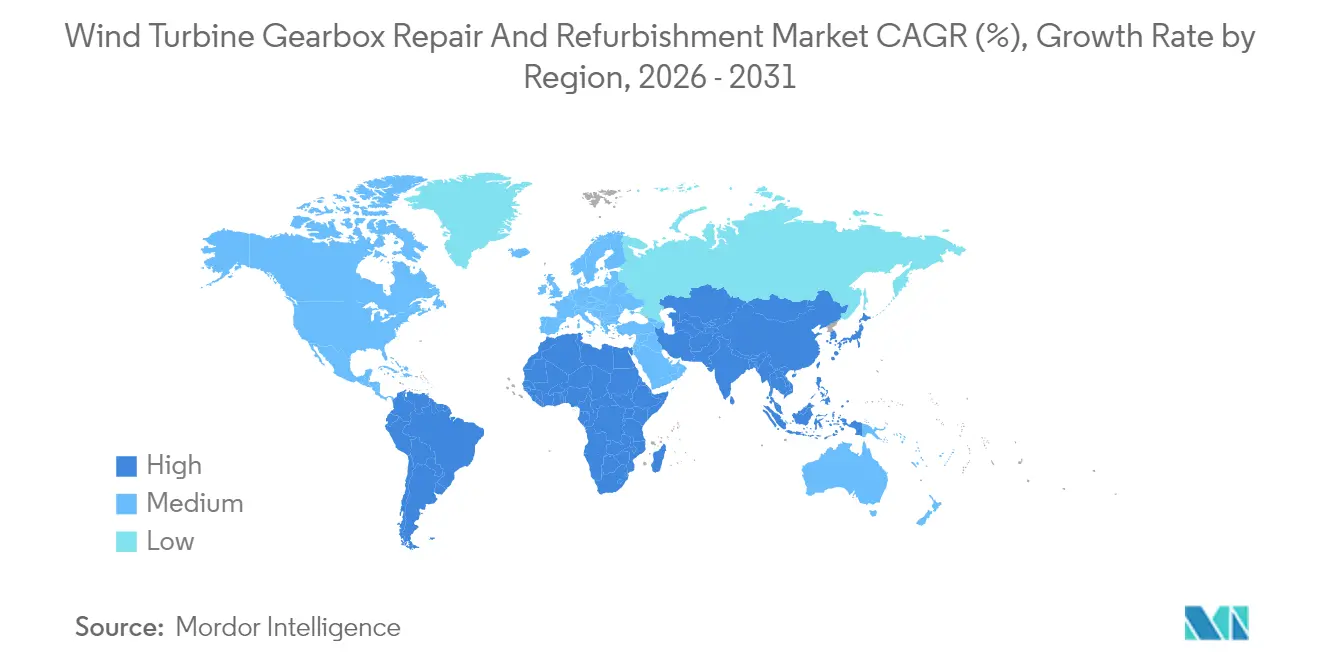
Europe Wind Turbine Gearbox Repair and Refurbishment Market
Europe delivered 37.45% of global revenue in 2025, reflecting the continent’s early adoption and now-aging fleet. Policies such as WindEurope’s Clean Industrial Deal push domestic servicing capacity to protect competitiveness. Offshore wind in the North Sea lifts demand for advanced logistics and uptower repair tools. Predictive maintenance roll-outs gain regulatory favor, ensuring steady workload growth inside the wind turbine gearbox repair and refurbishment market.
APAC Wind Turbine Gearbox Repair and Refurbishment Market
Asia Pacific is the fastest-growing region at 6.55% CAGR to 2031. China’s vast fleet is shifting from warranty to multiyear service agreements that emphasize predictive monitoring, while India’s Repowering Policy funnels sub-2 MW turbines into refurbishment pipelines. Domestic champions like Goldwind collaborate with ISPs on component exchange pools, but technology-transfer rules preserve local content advantages.
North America, LATAM and MEA Wind Turbine Gearbox Repair and Refurbishment Market
North America maintains a sizeable installed base serviced by OEM hubs like GE Vernova’s Amarillo remanufacturing facility, ensuring fast turnaround for U.S. operators. Latin America, the Middle East & Africa remain nascent, constrained by limited class-certified workshops, yet maturing fleets promise incremental demand across the wind turbine gearbox repair and refurbishment market.
Regulatory Landscape
Global standards and guidance shaping gearbox service practices are evolving largely through drivetrain design, reliability, and condition-monitoring frameworks rather than repair-specific rules. The IEC 61400-4 series was updated across 2025 and 2026, including IEC 61400-4:2025 (design requirements for wind turbine gearboxes) and IEC/TS 61400-4-1:2026 (a reliability assessment method based on failure modes), alongside IEC/TR 61400-4-2:2026 covering lubrication characteristics, system layout, and monitoring practices. ISO 16079-2:2020 also provides a recognized reference for wind-turbine drivetrain condition monitoring and diagnostics, supporting the move toward predictive maintenance documentation and evidence-based interventions.
Because IEC 61400-4:2025 is written for new gearbox designs and does not set requirements for repaired or refurbished gearboxes, or for extending service life beyond original design life, refurbishment quality compliance largely falls to OEM specifications, internal QA systems, and site-level industrial safety codes. Offshore regulatory developments also affect service documentation: the U.S. Department of the Interior initiated a review of offshore wind energy regulations in August 2025, which can tighten maintenance recordkeeping, component traceability, and inspection readiness for drivetrain work performed offshore.
Competitive Landscape
Competition rests on multibrand technical capability, turnaround speed, and predictive analytics. GE Vernova’s USD 600 million U.S. manufacturing program underscores OEM reliance on aftermarket profit streams. Siemens Gamesa, ZF Friedrichshafen, and Flender leverage design data to secure long-term service deals. ISPs such as Moventas and Connected Wind Services carve share by offering cost-effective uptower repairs and bearing retrofits. Patent activity in uptower planet-gear extraction and AI-driven vibration diagnostics signals sustained technological differentiation. Exchange-pool models require capital depth, favoring larger groups; however, niche providers can win on agility within local markets.
As fleets age, owners tender multibrand, multi-year contracts that blend condition-monitoring, remote diagnostics, and on-site interventions. Players integrating all three under a unified service envelope will capture sticky revenue streams, cementing their place in the wind turbine gearbox repair and refurbishment industry.
Wind Turbine Gearbox Repair and Refurbishment Industry Leaders
-
Siemens Gamesa Renewable Energy SA
-
GE Vernova
-
ZF Friedrichshafen AG
-
Moventas Gears Oy
-
SKF Group
- *Disclaimer: Major Players sorted in no particular order
Wind Turbine Gearbox Repair and Refurbishment Market Companies Covered in this Report
- Siemens Gamesa Renewable Energy SA
- GE Vernova (incl. Winergy)
- ZF Friedrichshafen AG
- Dana-Brevini SpA
- Moventas Gears Oy
- Stork Gears & Services BV
- NGC (Nanjing High Speed)
- SKF Group (Driveline Services)
- Timken Power Systems
- Romax Technology (Hexagon)
- ME Production A/S
- Connected Wind Services A/S
- Turbine Repair Solutions
- Grenaa Motorfabrik A/S
- Bachmann electronic GmbH
- Flender GmbH
- ENERCON GmbH
- Vestas Service & Solutions
- Bonfiglioli Riduttori SpA
- Heli Gearbox (Zhejiang Hengfengtai)
Read Analysis of Wind Turbine Gearbox Repair and Refurbishment Companies
Market Opportunities and Future Outlook
The market has a gap in standardized, evidence-backed life-extension pathways for the large installed base of geared turbines, where operators weigh downtime, warrantyability, and lead times for new gearboxes (up to 18 months in constrained periods). Service offerings are widening toward multibrand coverage and end-to-end loops (diagnostics, uptower work, exchange pools, and workshop overhauls), with Vestas, GE Vernova, and Winergy marketing multibrand gearbox service propositions aimed at mixed fleets and post-warranty operations. Offshore operators face logistics costs that can exceed 30% of maintenance spend, so exchange-pool and single-visit execution models create room for providers to stage refurbished units and coordinate vessels, cranes, and documentation to reduce repeat mobilizations.
Technology adoption is also creating more measurable improvement levers in repair and remanufacturing. In April 2026, TAKKION added in-house isotropic superfinishing capability (via REM Surface Engineering technology) as part of its gearbox remanufacturing program, pointing to ongoing investment in surface engineering to address wear and repeat-failure modes. In 2026, peer-reviewed research continues to validate condition monitoring and digital approaches relevant to gearbox service decisions, including studies on SCADA combined with high-frequency vibration and acoustic analysis for aging fleets, as well as digital-twin and remaining-useful-life frameworks that quantify site-driven variation in component life. These findings strengthen the basis for defensible trigger points for bearing and gear interventions and support availability-based contracts that combine monitoring, planned swaps, and refurbishment pipelines.
Recent Industry Developments in Wind Turbine Gearbox Repair and Refurbishment Market
- July 2026: Moventas was selected by Iberdrola as a supplier for wind turbine gearbox repairs and supply in Europe for a three-year term. The award reinforces multi-year, multi-site sourcing models that favor providers with exchange capacity, spare-part access, and consistent turnaround performance across regions.
- March 2026: Gamesa Gearbox secured a three-year contract with Scottish Power to provide repair, replacement, and exchange services for wind turbine gearboxes across the UK. The contract supports wider use of exchange models that reduce outage time versus waiting on new gearbox deliveries, and it raises competitive pressure on both OEM service units and ISPs in a mature European service market.
- September 2025: Eriks opened a dedicated yaw gearbox refurbishment cell at its Centre of Excellence in Aberdeen, UK, supported by a GBP 500,000 investment and positioned around a 16-hour repair process for 2.3 MW turbines. The upgrade adds localized refurbishment throughput close to North Sea operating bases, improving responsiveness for wind-farm operators managing short weather windows and high downtime costs.
Wind Turbine Gearbox Repair and Refurbishment Market Report Scope and Research Methodology
Market Definition and Coverage
For this study, the market counts revenue earned from repairing, refurbishing, and reconditioning wind turbine gearboxes, including associated component work and service labor, across onshore and offshore wind fleets.
Scope exclusions: It does not count new gearbox manufacturing sales, routine turbine O&M that is not gearbox related, and unrelated driveline component replacements outside the gearbox boundary.
Segments Covered in This Report
- By Type
- Repair
- Refurbishment
- By Gearbox Failure Component
- Bearings
- Gears
- Shafts and Housings
- Others (Seals, Lubrication system)
- By Turbine Rated Capacity
- Below 2 MW
- 2 to 5 MW
- Above 5 MW
- By Service Provider
- OEM Service Divisions
- Independent Service Providers (ISP)
- In-house Utility Workshops
- By Deployment
- Onshore
- Offshore
- By Geography
- North America
- United States
- Canada
- Mexico
- Europe
- Germany
- United Kingdom
- France
- Italy
- NORDIC Countries
- Russia
- Rest of Europe
- Asia-Pacific
- China
- India
- Japan
- South Korea
- ASEAN Countries
- Rest of Asia-Pacific
- South America
- Brazil
- Argentina
- Rest of South America
- Middle East and Africa
- Saudi Arabia
- United Arab Emirates
- South Africa
- Egypt
- Rest of Middle East and Africa
- North America
Data Sources, Market Sizing, and Validation
Desk Research
Desk research was used to frame the demand pool and cost structure behind gearbox repair and refurbishment, before any modeling assumptions were locked. We referenced public energy and wind data sources such as IEA wind statistics, IRENA renewable capacity databases, Global Wind Energy Council publications, US EIA datasets, and NREL technical papers on drivetrain reliability and failure modes.
We also reviewed utility and developer filings, operator sustainability reports, and reputable press releases for service interval claims, offshore exposure, and refurbishment practices. Where needed, paid database subscriptions for company financials and intelligence, patent lookups, and shipment level import and export checks were used to cross-check service revenue signals and parts flows. These sources are illustrative, and many other public and internal references were also reviewed for data collection, validation, and research clarification.
Primary Interviews and Surveys
Primary work focused on validating real service activity and pricing ranges, since repair volumes can move quickly with wind fleet aging and offshore availability constraints. We spoke with a mix of gearbox service providers, wind farm operators, and component repair specialists across key regions, and then reconciled feedback on turnaround times, typical scope of a refurbishment event, and what triggers replacement versus rebuild.
Inputs from these discussions were used to fill gaps left by public data, to pressure-test utilization assumptions, and to confirm that the final market totals reflect practical field conditions rather than theoretical service intervals.
Distribution of primary research fieldwork respondents
| Company type | Respondent position | Region |
|---|---|---|
| Top tier: 35% | CXOs: 16% | APAC: 38% |
| Mid tier: 43% | Functional/Unit leaders: 33% | EMEA: 36% |
| Smaller Players: 22% | Managers: 51% | Americas: 26% |
Market-Sizing & Forecasting
The main sizing logic starts from a top-down demand reconstruction, where installed wind capacity by region is converted into an operating gearbox population, which is then translated into expected repair and refurbishment events using age mix and failure behavior. To keep the totals realistic, selective bottom-up approximations were also run, such as sampled service pricing per event multiplied by estimated annual event counts, followed by checks against service revenue hints visible in public disclosures.
Key model inputs included the onshore versus offshore fleet split, turbine capacity bands (below 2 MW, 2 to 5 MW, and above 5 MW), typical refurbishment scope by component group (bearings, gears, shafts and housings, and other items like seals and lubrication), average turnaround time constraints, and regional labor and parts cost differences. When bottom-up signals were missing for smaller workshops or in-house utility repair lines, coverage ratios were applied and then adjusted using interview feedback on local outsourcing rates.
Forecasting relied on scenario analysis built around additions to installed capacity, aging of the existing fleet, expected offshore share progression, and refurbishment intensity as turbines move past mid-life. The scenario weights were aligned to what operators and service teams described as their likely maintenance strategy under different availability and parts lead time conditions.
Data Validation & Update Cycle
Outputs were validated through triangulation across independent signals, and then reviewed for outliers at the regional and global level before sign-off. If a region showed an unusual jump, the drivers were traced back to fleet age, offshore exposure, and pricing assumptions, and follow-up calls were triggered when the variance could not be explained cleanly.
A multi-step analyst review is used to confirm that scope boundaries and unit conversions are applied consistently, including currency timing and inflation handling. Reports are refreshed annually, and interim updates are made when material events shift service demand or pricing. Before delivery, a final review pass is completed so clients receive the latest updated view.
Mordor Intelligence's Wind Turbine Gearbox Repair Refurbishment Market Size Compared With Other Published Estimates
Different published market sizes for gearbox repair and refurbishment can look far apart because the service boundary is not always consistent, and because some models treat replacement and broader turbine maintenance spend as part of the same pool. Another common reason is timing, since some publishers use an older base year or mix nominal and real pricing without clearly stating it.
Installed wind capacity checks, offshore share references, and component-level scope checks (bearings, gears, shafts and housings, plus related sealing and lubrication work) are the evidence points that keep Mordor Intelligence aligned to a service-only demand pool set at USD 5.28 B (2026), rather than a wider MRO spend number.
Benchmark comparison
| Source | Market Size | Gaps in Research Methodology |
|---|---|---|
| Mordor Intelligence | USD 5.28 B (2026) | |
| Industry Publisher A | USD 1.69 B (2025) | Uses a narrower interpretation of the service wallet, and the base-year pricing and refurbishment event definition appear to exclude several component-scope activities that are often bundled in full gearbox refurbishment work. |
| Industry Publisher B | USD 5.03 B (2024) | Reports an earlier base year and applies a broader segmentation structure that can pull in adjacent driveline service lines depending on how repair types and service providers are counted, which changes the total addressable revenue. |
Across the three figures, the spread is mainly explained by what is counted as a gearbox refurbishment event, how onshore and offshore work is priced, and which year is treated as the starting point. By keeping the scope tied to gearbox repair and refurbishment services and then validating assumptions against fleet and offshore exposure signals, the estimate stays easier to replicate and track over time.
Key Questions Answered in the Report
What is the projected size of the wind turbine gearbox repair and refurbishment market by 2031?
The market is expected to reach USD 6.43 billion by 2031, supported by a 4.05% CAGR.
Which region is growing the fastest?
Asia Pacific is forecast to grow at 6.55% CAGR thanks to China’s ageing fleet and India’s repowering policy.
Why do bearings account for the majority of gearbox failures?
Variable loads, contamination, and lubrication challenges make bearings the most vulnerable component, driving 60.55% of 2025 failures.
How are exchange-pool programs changing maintenance economics?
They cut crane time by up to 50% by swapping a failed gearbox for a pre-refurbished unit, then overhauling the removed gearbox off-site.
Do direct-drive turbines threaten the gearbox service market?
Yes, over the long term, especially offshore, but higher capital costs and rare-earth supply constraints temper immediate adoption, so existing geared fleets will still need service for 15-20 years.
What distinguishes refurbishment from repair?
Refurbishment involves a comprehensive overhaul with component upgrades that extend warranty coverage, whereas repair focuses on fixing the immediate failure to restore operation.