
Automotive Whiplash Protection System Market Size and Share
Market Overview
| Study Period | 2019 - 2030 |
|---|---|
| Forecast Data Period | 2025 - 2030 |
| Historical Data Period | 2019 - 2023 |
| Growth Rate | 12.00 % |
| Fastest Growing Market | Asia Pacific |
| Largest Market | Asia Pacific |
| Market Concentration | Low |
Major Players *Disclaimer: Major Players sorted in no particular order Image © Mordor Intelligence. Reuse requires attribution under CC BY 4.0. | |
Automotive Whiplash Protection System Market Analysis by Mordor Intelligence
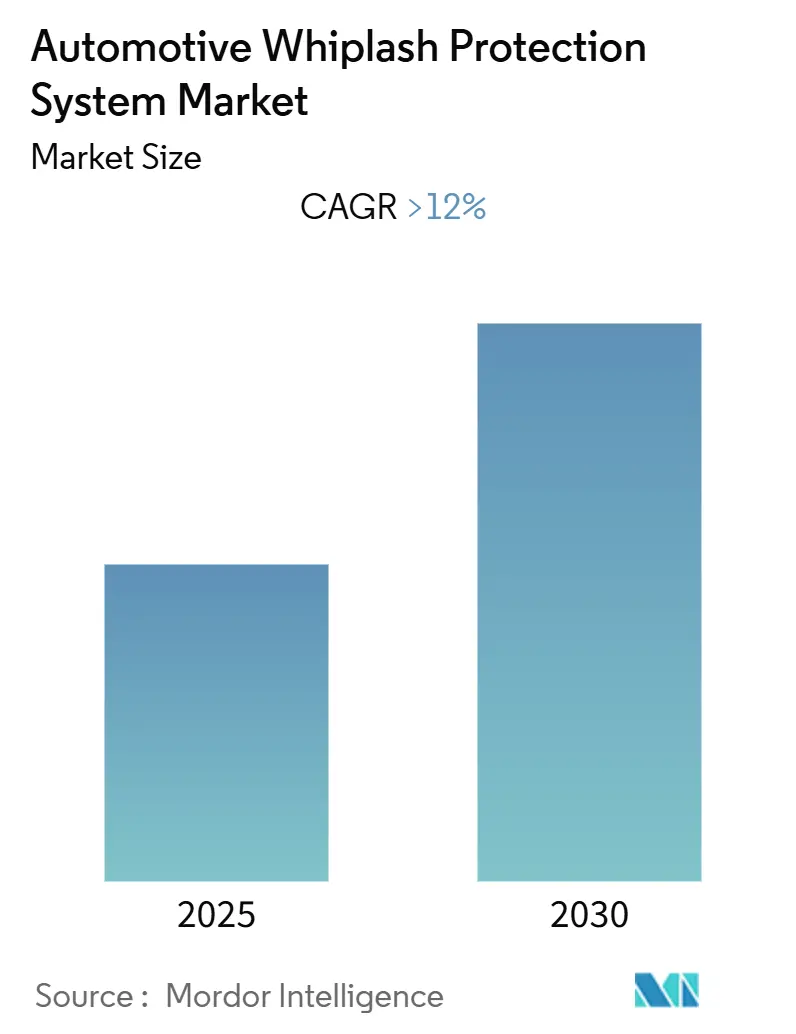
The automotive whiplash protection system market is expected to register a CAGR of greater than 12% during the forecast period.
- Whiplash injury is the most common injury in car crashes, more than one million whiplash injuries occur each year due to car crashes. The passive safety systems in vehicles such as airbags and seatbelts have evolved at a swift pace and now OEMs are also including whiplash protection systems. With growing focus on safety systems by customers and governments all over the world, the whiplash protection system market is expected to see high growth rate.
- Initially whiplash protection systems were offered only in the luxury vehicles due to extreme budget conscious nature of the buyers. As the safety systems are getting advanced and cheaper paired with growing consumer awareness, increase in purchase capacity OEMs have started including this safety feature in budget cars as well.
- Global automobile sales fell by four percentage in 2019, representing the second consecutive year of declining demand. Before the pandemic hit, it has been estimated that international car sales were on track to reach 80 million sales in 2020; however, as economic woes continue, demand for new motor vehicles is forecasted to be in the negative throughout 2020, but the sales are expected to increase rapidly during the later period of the forecasted period.
Note: Market size and forecast figures in this report are generated using Mordor Intelligence’s proprietary estimation framework, updated with the latest available data and insights as of January 2026.
Global Automotive Whiplash Protection System Market Trends and Insights
Technological Developments Will Help This Market Grow
The automotive whiplash protection system equipped seat; the entire backrest is designed to protect the front occupant's neck in case of rear impact. This system uses a specially designed hinge mount that attaches the back rest to the seat bottom, which has a pre-determined rate of rearward movement in the event of certain types of rear impacts. The seatback also has a series of spring that allows the cushion to move slightly rearward upon impact. This combined with high-mounted head restraints, help limit the whipping motion of the head that often occurs during a rear-end impact. Volvo undertook the most comprehensive study that examined the whiplash protection system over a period of more than 10 years. The company developed WHIPS which is deployed in event of rear-end collision, where the angle and speed of the collision and the nature of the colliding vehicle have an influence. Volvo has published that they have successfully reduced short-term injuries by 33% and long-term injuries by more than 54% using the WHIPS system. However, the cost of the system remains to be the major constraint. The extra cost incurred in designing and testing the system makes it expensive.
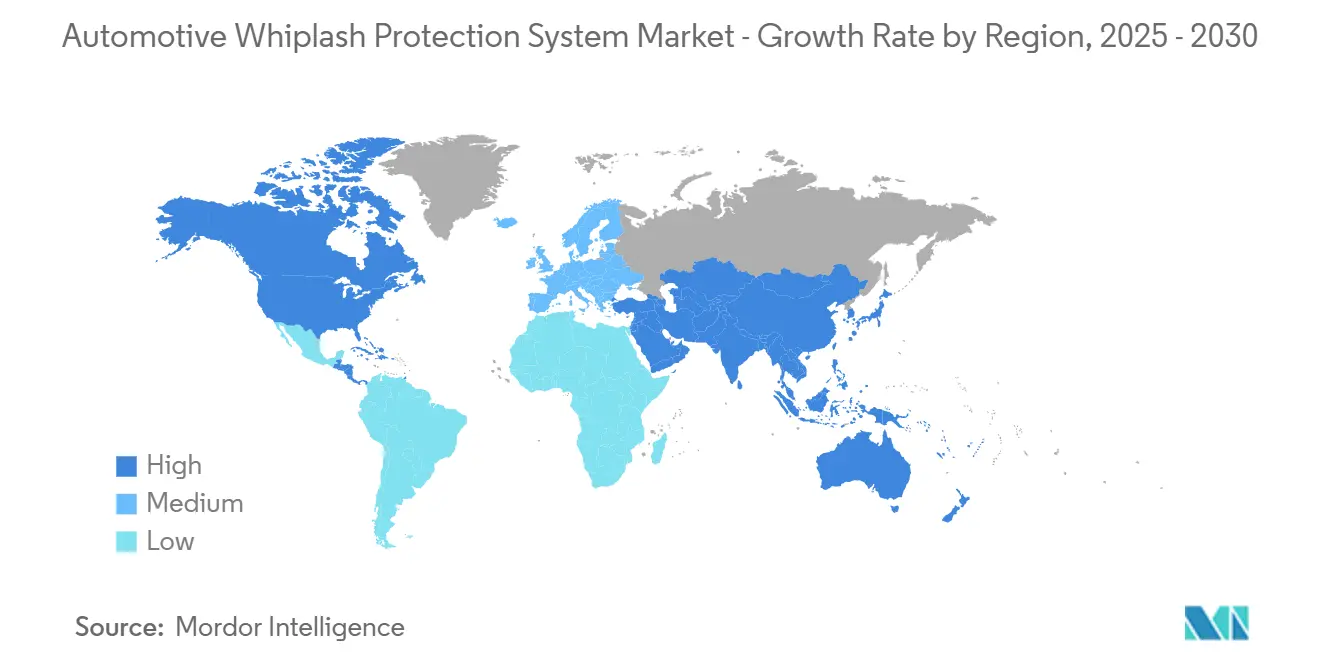
The Reactive head restrain system is expected to be the most preferred automotive whiplash protection system. Pendulum system is expected to show a slow growth rate during the forecasted period. Compact passenger vehicles are expected to be the largest users of whiplash protection systems in the market.
OEMs are investing into development of the whiplash protection technology to reduce cost and produce more effective product. On March 20, 2020 Volvo has started a new safety initiative of Open sourcing safety related data for all OEMs and suppliers. This market is expected to grow during the forecasted period due to above mentioned factors.
North America Captures the Largest Market
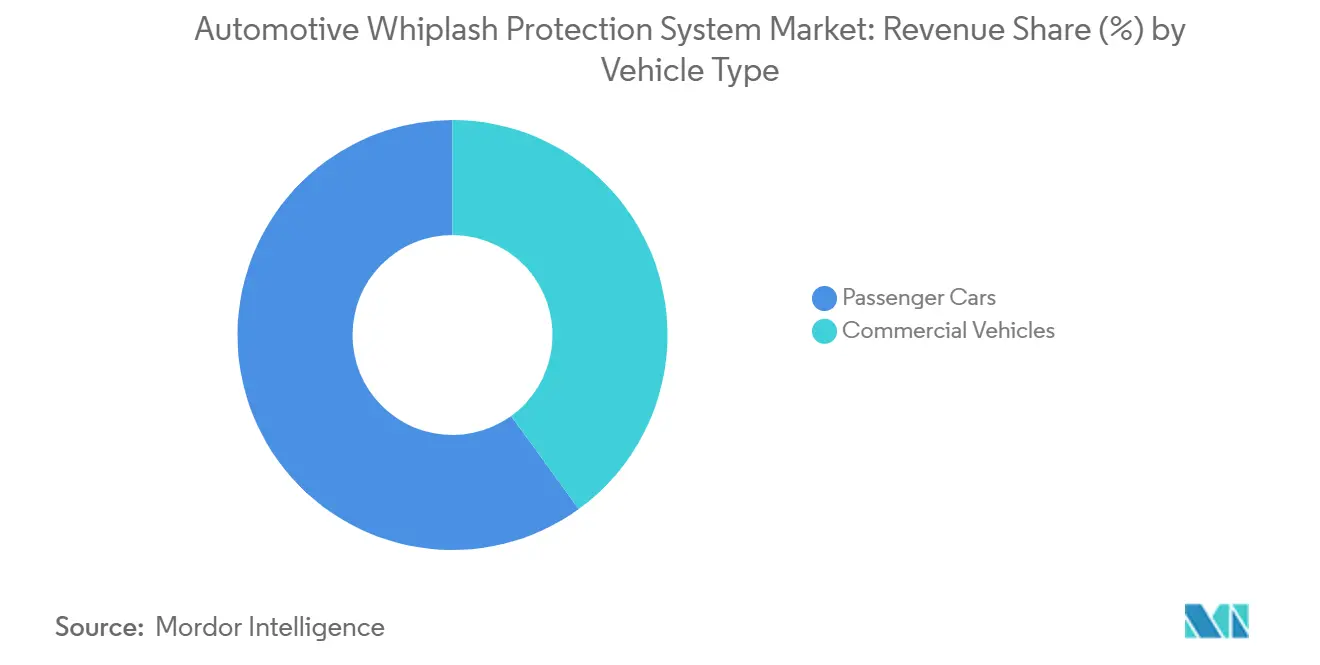
The United States continues to dominate the automotive whiplash protection system market. The United States continues to be the leader in terms of car volume sales, sold over 4.7 million units in 2019. Different markets have different demands; The United States of America is the leading manufacturer of automotive safety systems. In 2019, just under 17 million light weight vehicles were sold in the United States. Increasing luxury car sales across the United States of America is having a positive impact on the automotive whiplash system market; this has led to investment in R&D by OEMs to develop efficient and low-cost whiplash protection systems. BMW (324830 units), Mercedes-Benz (316090 Units), and Lexus (298110 Units) were the top leading luxury brands by sales in 2019. An increase in production standards of manufacturing, sustainable innovation, and excellent technical know-how based in the country will help to strengthen the position of the United States of America to emerge as a leading automotive whiplash protection system during the forecast period. Going forward, OEMs must be active in achieving the commitment or face the possibility of brand erosion due to being behind in safety advances. Safety systems being incorporated into government safety ratings may alter consumer perception one way or another in a positive way.
Competitive Landscape
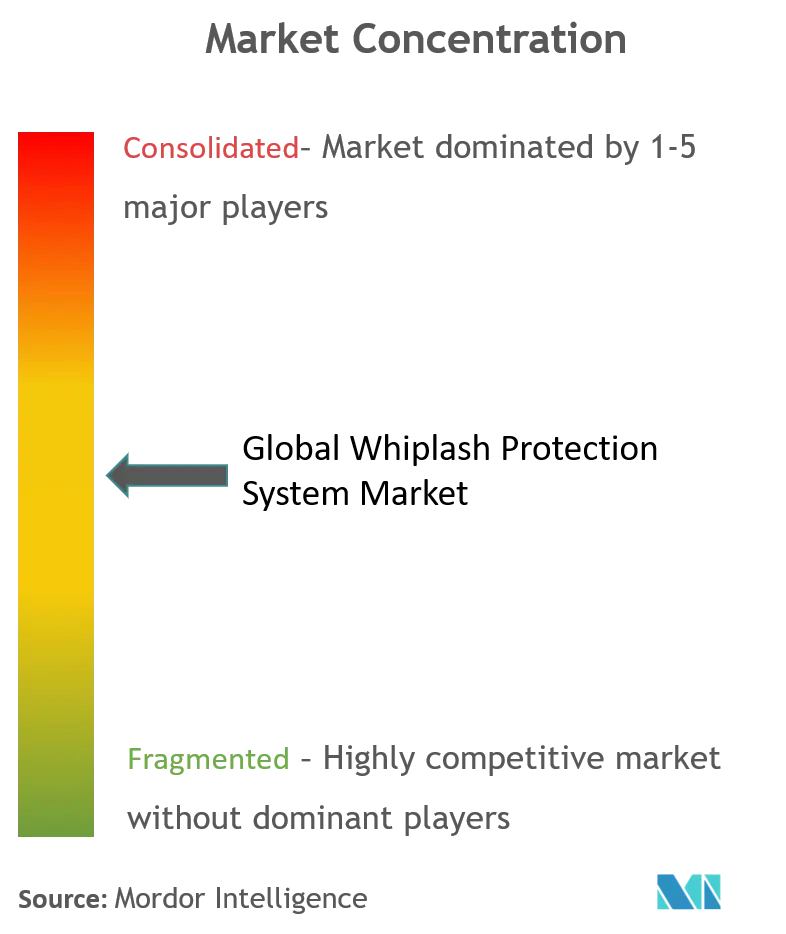
The automotive whiplash protection system market is consolidated with few major players dominating the market. Key players in this market are Continental AG, Robert Bosch GmbH, Delphi Automotive, Denso Corporation, Hyundai Mobis, and Takata Corporation.
Automotive Whiplash Protection System Industry Leaders
-
Robert Bosch GmbH
-
Continental AG
-
Denso
-
Autoliv Inc.
-
Lear Corporation
- *Disclaimer: Major Players sorted in no particular order
Market Opportunities and Future Outlook
Safety-rating protocols that explicitly measure rear-impact neck protection are tightening the link between seat design choices and safety performance reported to consumers. Euro NCAP continues to formalize whiplash assessment through dynamic sled testing and protocol requirements for seats and head restraints, and IIHS introduced a new whiplash prevention test program in January 2026 using a BioRID-II dummy with an articulated spine and two sled pulses (16 km/h and 24 km/h). With these programs in place, OEMs and Tier-1s have clearer pathways to differentiate through improved seatback geometry, reactive and proactive head restraints, and energy management tuned to low-to-moderate rear impacts.
Seat content is also expanding alongside comfort-led cabin layouts, which increases the value of integrating whiplash protection into more reclined occupant postures. Forvia Seating won a seat-supply contract for Luxeed (Chery) featuring zero-gravity reclining chairs, with production starting in August 2026, increasing the need to maintain rear-impact neck protection in more reclined occupant positions. Suppliers are pairing occupant safety needs with seat innovation and industrialization, including ZF LIFETEC's four-airbag concept targeting comfort-oriented seating positions (including reclined scenarios). Adient commercialized new seat-content solutions in 2026 (Sculpted Soft Trim manufacturing and ProForce Massage Flow), and Uno Minda announced an INR 320 crore seating-systems facility investment in Maharashtra via a JV with TACHI-S. Taken together, these moves broaden the supply base for advanced seating systems, including whiplash-focused structures and head restraint designs, across high-volume passenger vehicle programs.
Recent Industry Developments
- July 2026: Uno Minda announced an INR 320 crore investment in a new Maharashtra facility through its joint venture with TACHI-S to manufacture four-wheeler passenger vehicle seating systems. The greenfield capacity buildout expands localized seat-system supply, supporting higher integration of safety-oriented seat structures and head restraint architectures alongside comfort features.
- January 2026: The Insurance Institute for Highway Safety (IIHS) launched a new whiplash prevention test program for vehicle front seats and head restraints, targeting neck injuries in low-to-moderate-speed rear crashes. The protocol uses a BioRID-II dummy with an articulated spine and evaluates performance across two sled pulses (16 km/h and 24 km/h), raising the bar for seat and head restraint designs that perform well in consumer-facing safety results.
- August 2025: Adient unveiled the modular Modugo seat concept, highlighting a reconfigurable, scalable seat architecture approach for automakers. A modular seat platform can accelerate the rollout of upgraded whiplash protection elements (seatback structures, head restraints, and tuned energy management) across multiple vehicle programs while simplifying manufacturing and variant management.
Research Methodology Framework and Report Scope
Market Definition and Coverage
This market covers the revenue earned from whiplash protection systems used in vehicle seats and head restraints to reduce neck injury risk in rear impact events. We count revenue at the OEM fitment level across passenger and commercial vehicles.
Scope exclusions: Standalone standard headrests without reactive or proactive whiplash functions, and non-whiplash restraint products like airbags and seatbelts, are excluded.
Segmentation Overview
- Vehicle Type
- Passenger Cars
- Commercial Vehicle
- System Type
- Reactive Head Restraint
- Proactive Head Restraint
- Others
- Geography
- North America
- United States
- Canada
- Rest of North America
- Europe
- Germany
- United Kingdom
- France
- Italy
- Rest of Europe
- Asia Pacific
- India
- China
- Japan
- South Korea
- Rest of Asia-Pacific
- Rest of the World
- Brazil
- Mexico
- South Africa
- Other Countries
- North America
Data Sources, Market Sizing, and Validation
Desk Research
Desk work started with anchoring the demand pool using public auto production and sales signals, which helps estimate how many new vehicles can carry these systems. We referenced sources such as OICA production statistics, national transport agencies and crash safety regulators, insurance and road safety bodies, and technical papers in peer reviewed automotive safety journals.
Next, we cross-checked technology adoption using OEM safety feature disclosures, supplier brochures available in the public domain, and credible press coverage of seat and head restraint upgrades. To keep assumptions consistent across regions, we also used paid subscriptions for company financials and intelligence, patent lookups, and shipment-level import and export checks where relevant for major components. The sources listed here are illustrative only, and other public documents and datasets were also used for data collection, validation, and clarification.
Primary Interviews and Surveys
Primary work focused on validating fitment rates by vehicle class, typical content per seat, and pricing ranges that vary by region and the platform cycle. We spoke with a mix of seat and safety system stakeholders, and also with vehicle program and procurement roles, then sanity-checked findings across APAC, EMEA, and the Americas so regional production mixes were not overgeneralized.
Distribution of primary research fieldwork respondents
| Company type | Respondent position | Region |
|---|---|---|
| Top tier: 36% | CXOs: 12% | APAC: 46% |
| Mid tier: 48% | Functional/Unit leaders: 41% | EMEA: 35% |
| Smaller Players: 16% | Managers: 47% | Americas: 19% |
Market-Sizing & Forecasting
Sizing was built using a top-down reconstruction from new vehicle production and sales by region, followed by an attach rate for whiplash protection features and an average value per equipped seat set. To keep totals realistic, we then corroborated outputs with selective bottom-up checks, including sampled supplier revenue splits, platform level content mapping, and price-band validation from interviews.
Key inputs used in the model included light vehicle and commercial vehicle production trends, penetration of reactive versus proactive head restraint designs, average seats per vehicle, take rates by trim level, and pricing movement tied to material and mechanism complexity. Where direct pricing was hard to confirm for specific countries, we handled gaps by using regional price corridors and adjusting for mix shifts in vehicle class and safety regulation intensity.
For forecasting, scenario analysis was used, because adoption can move quickly when a platform refresh adds a safety package or when rating protocols tighten. The forward view was kept consistent with expert expectations on production cycles, seat design changeovers, and the speed at which new safety features move from premium trims into higher-volume models.
Data Validation & Update Cycle
Model outputs were checked against independent signals such as vehicle production totals, stated safety feature availability, and the implied revenue per equipped vehicle, which helped flag outliers early. When variances showed up, assumptions were revisited, and targeted re-contacts were done with interviewees to confirm whether the issue came from pricing, fitment, or vehicle mix.
Before sign-off, the work goes through multi-step analyst review, including consistency checks across regions and year-to-year movement tests so abrupt jumps are explained by a clear driver. Reports are refreshed annually, with interim updates for material events such as regulation changes or sudden production swings, and a final pre-delivery pass is completed so clients receive the most current view.
Mordor Intelligence's Whiplash Protection System Market Size Measured Against Other Published Estimates
Published market values for whiplash protection systems can vary a lot, even when they look like they cover the same topic. In most cases, the gap comes from what each publisher counts as a whiplash system, which year is treated as current, and how fast pricing is assumed to change.
Standard headrests with no active or reactive whiplash function sit outside Mordor Intelligence's scope, and some other estimates appear to fold those into a broader seat or restraint value, which can lift totals. Differences also come from whether only OEM installed systems are counted versus adding aftermarket replacements, and from using aggressive penetration ramps that are not rechecked against vehicle platform cycles and regional production mix.
Benchmark comparison
| Source | Market Size | Gaps in Research Methodology |
|---|---|---|
| Mordor Intelligence | USD 0.00 B (2025) | |
| Global Consultancy A | USD 3.10 B (2025) | Uses a wider definition that can include aftermarket and adjacent seat safety content, which raises the value per vehicle beyond whiplash-specific head restraint mechanisms. |
| Industry Research Group B | USD 1.72 B (2025) | Applies a narrower counted set of systems and a lower assumed penetration in high-volume vehicle trims, which reduces the equipped-vehicle pool used for the current year. |
The spread across sources is mainly explained by scope and penetration assumptions, not by a single math error. By keeping the counted feature set tied to whiplash-specific hardware and checking adoption against production and platform realities, the estimate stays traceable to clear steps that can be repeated as new model-year data arrives.
Key Questions Answered in the Report
What is the current automotive whiplash protection system market size?
The automotive whiplash protection system market is projected to register a CAGR of greater than 12% during the forecast period (2025-2030)
Who are the key players in automotive whiplash protection system market?
Robert Bosch GmbH, Continental AG, Denso, Autoliv Inc. and Lear Corporation are the major companies operating in the Whiplash Protection System Market.
Which is the fastest growing region in automotive whiplash protection system market?
Asia Pacific is estimated to grow at the highest CAGR over the forecast period (2025-2030).
Which region has the biggest share in automotive whiplash protection system market?
In 2025, the Asia Pacific accounts for the largest market share in the market.
What years does this automotive whiplash protection system market cover?
The report covers the automotive whiplash protection system market historical market size for years: 2019, 2020, 2021, 2022, 2023 and 2024. The report also forecasts the Whiplash Protection System Market size for years: 2025, 2026, 2027, 2028, 2029 and 2030.