
Water Tank Trucking Market Size and Share
| Study Period | 2019 - 2030 |
| Market Size (2025) | USD 1.96 Billion |
| Market Size (2030) | USD 3.51 Billion |
| CAGR (2025 - 2030) | 12.73% |
| Fastest Growing Market | Europe |
| Largest Market | North America |
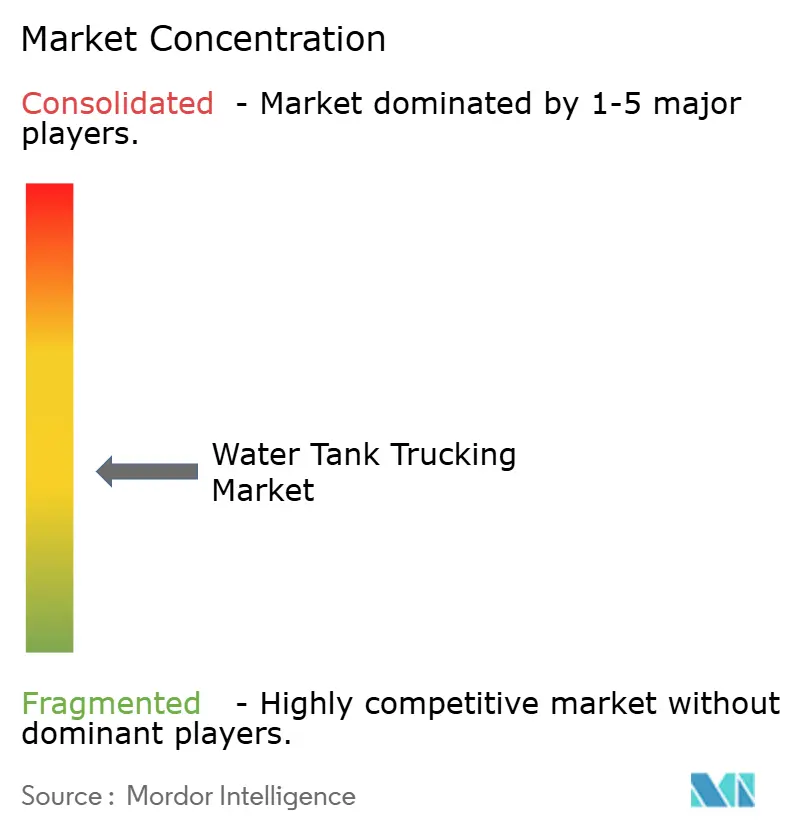
| Market Concentration | Medium |
Major Players *Disclaimer: Major Players sorted in no particular order |
Water Tank Trucking Market Analysis by Mordor Intelligence
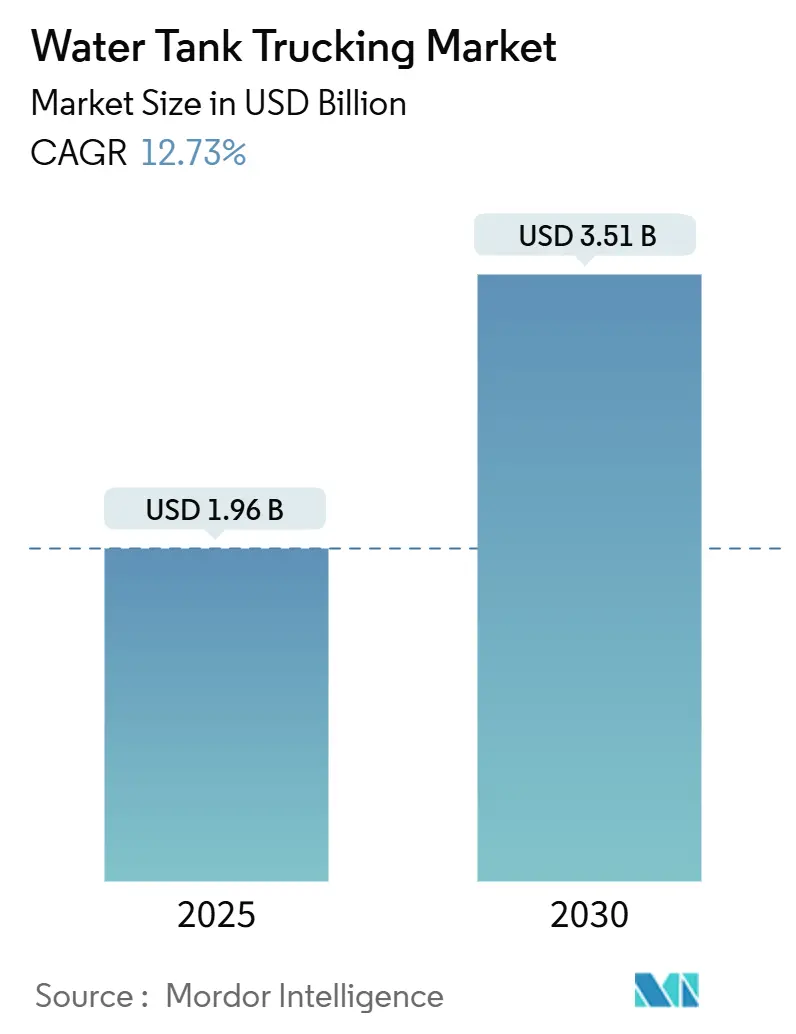
The Water Tank Trucking Market size is estimated at USD 1.96 billion in 2025, and is expected to reach USD 3.51 billion by 2030, at a CAGR of 12.73% during the forecast period (2025-2030).
Water tank trucking is vital for sectors like construction, agriculture, and municipal services. As areas grapple with inadequate water infrastructure, the demand for water transportation has surged. These trucks play a pivotal role, delivering water to construction sites for dust control, firefighting, and concrete mixing. In agriculture, they're indispensable for irrigation, especially in water-scarce regions.
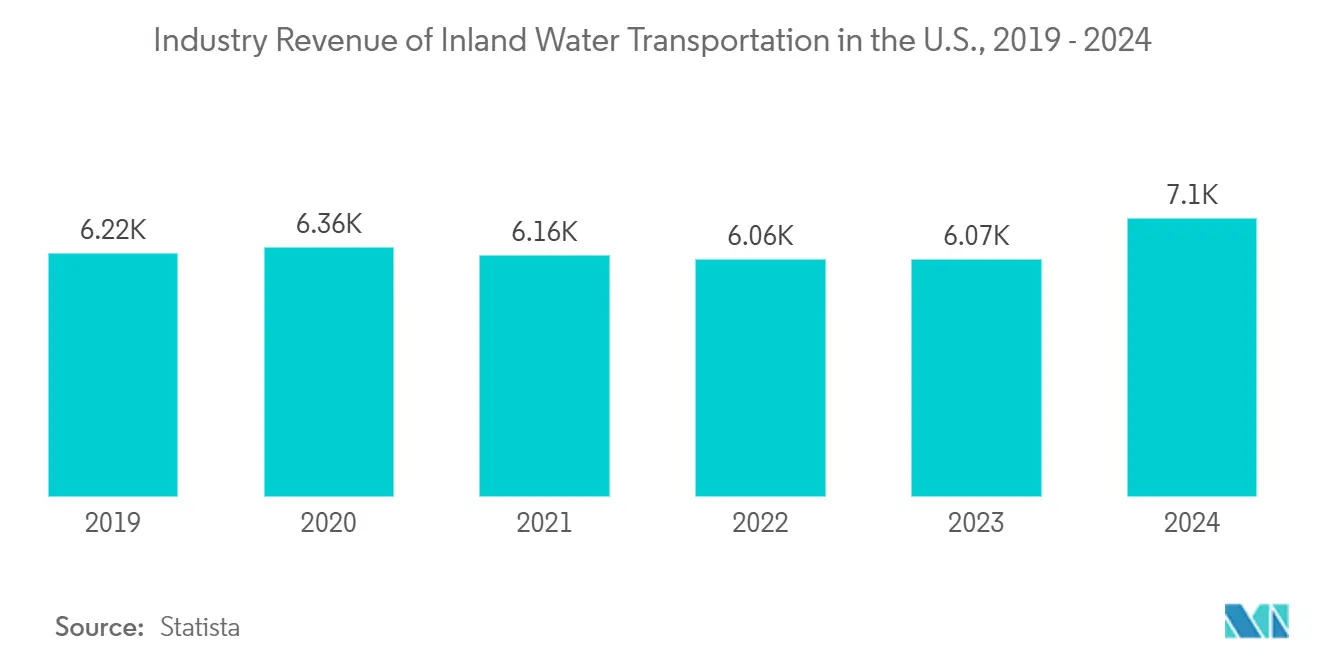
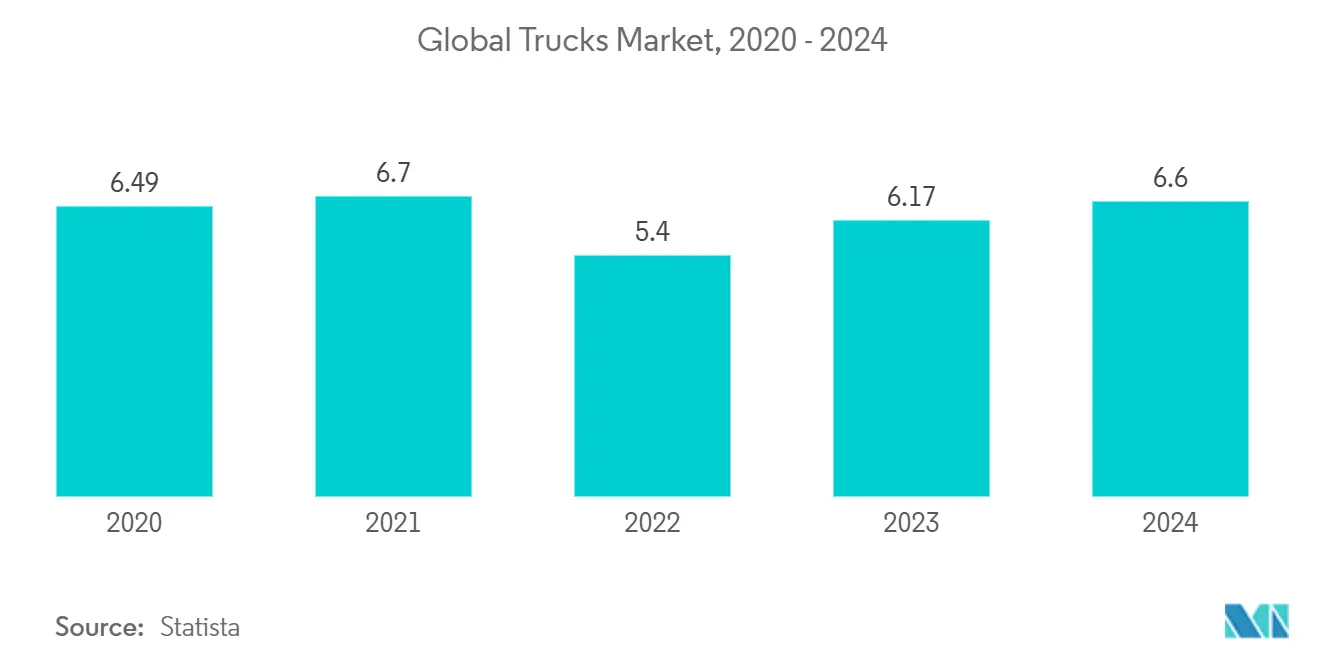
Industry experts highlight the significance of trucking in trade: trucks move nearly two-thirds of the goods' value between the U.S. and Canada, and trucking revenues make up 80.7% of the U.S. freight bill. In Q1 2024, commercial truck sales hit 113,169, marking a 4.1% dip from the prior year. While heavy-duty electric trucks are set to represent under 7% of the electric truck market by 2026, they're still pivotal in the shift towards sustainability. Furthermore, truck driver employment is projected to rise by 4% by 2032. These dynamics bolster trucking demand, fueling the growth of the water tank trucking sector.
Driving the expansion of the water tank trucking market are concerns over water conservation, heightened industrial activities, and an uptick in global drought occurrences. The industry is witnessing innovations, with the development of eco-friendly water tank trucks boasting features like GPS tracking, automated management, and enhanced water containment. This not only boosts operational efficiency but also curtails waste. Regions in Asia-Pacific and Africa, facing water scarcity and swift industrial growth, are seeing a notable uptick in demand for water delivery services, further propelling the market's expansion.
Global Water Tank Trucking Market Trends and Insights
Industrial Demand Fuels Surge in Water Tank Trucking
As various sectors increasingly depend on water for their operations, industrial demand has significantly driven the surge in water tank trucking. The construction and mining industries stand out as primary sectors amplifying their reliance on water trucking services. Construction sites utilize substantial water quantities for dust control, mixing materials like concrete, and safeguarding workers in high-heat conditions.
In parallel, mining operations depend on water for mineral processing, cooling machinery, and managing dust and waste. With industrial activities on the rise, the demand for water delivery via tank trucks has surged, ensuring smooth operations, especially in regions lacking adequate water infrastructure.
Beyond construction and mining, the oil and gas sector also plays a pivotal role in the escalating demand for water tank trucking. Hydraulic fracturing, commonly known as fracking, necessitates significant water volumes to fracture rock formations and extract hydrocarbons. As global energy demands escalate, so does the need for water trucking services to bolster these operations.
With the expansion of these industries, the demand for efficient water delivery systems capable of transporting large water volumes has become paramount, propelling the growth of the water tank trucking market. This industrial dependence on water delivery is poised to persist, especially as global resource extraction and infrastructure development gain momentum.
Technology Advancements Propel Water Tank Trucking Market
Advancements in technology are significantly boosting the water tank trucking market, enhancing both efficiency and sustainability. A standout innovation is the use of GPS tracking combined with route optimization software. With these tools, water tank trucking firms can chart the most efficient delivery paths, leading to reduced fuel use and lower operational costs, all while bolstering service reliability.
Moreover, real-time tracking facilitates superior delivery management, ensuring timely water deliveries. This capability is crucial for companies striving to meet the rising demand for swift and dependable services, especially in urgent industrial or emergency contexts.
Beyond logistics, the advent of smart water management systems is transforming the operations of water tank trucks. Today's tankers come equipped with sensors that monitor water levels, pressure, and temperature. This technology not only optimizes water distribution and curtails waste but also bolsters safety by identifying potential malfunctions early on.
Additionally, the push for eco-friendlier tanker designs like those crafted from lighter, durable materials and featuring insulated tanks not only boosts energy efficiency but also lessens environmental impact. Such technological strides are not just enhancing the operational prowess of water tank trucking firms; they're also steering the market towards a future that prioritizes sustainability and resource conservation.
Competitive Landscape
The water tank trucking market boasts a competitive landscape teeming with a mix of players, spanning from global giants to nimble regional service providers. At the forefront are vehicle manufacturers crafting specialized water tank trucks, alongside logistics firms and fleet operators delivering the water. Industry titans like Volvo Group, Daimler AG, MAN Truck & Bus AG, and Tata Motors lead the charge, rolling out diverse truck models tailored for sectors ranging from construction to municipal services. These manufacturers vie for dominance through product quality, truck customization, fuel efficiency, and cutting-edge tech features, including GPS tracking and automated water management systems.
Beyond the major manufacturers, regional entities and smaller logistics firms are pivotal, especially in locales with heightened demand for localized services, such as rural or drought-prone areas. These players often stake their competitive edge on service reliability, swift response times, and deep regional insights. With a surging demand for water tank trucking services, especially in burgeoning markets like Asia-Pacific, the competition is heating up. Firms are homing in on operational efficiency, stellar customer service, and advanced fleet management software. Moreover, innovations like smart water tracking, remote monitoring, and eco-friendly trucks are carving out distinct advantages in this bustling arena.
Water Tank Trucking Industry Leaders
-
Volvo Group
-
Daimler AG
-
MAN Truck & Bus AG
-
Tata Motors
-
Scania AB
- *Disclaimer: Major Players sorted in no particular order
Recent Industry Developments
- January 2025: Essar's Green Mobility initiative, through its subsidiary GreenLine Mobility Solutions Ltd, has partnered with Mondelez International (India) to introduce LNG-powered trucks for eco-friendly product transportation. Unveiled at Mondelez's facility in Alwar, Rajasthan, this initiative underscores the company's dedication to sustainability and its ESG commitments, with a focus on reducing carbon emissions and boosting supply chain efficiency.
- May 2024: Cummins Inc. has teamed up with Isuzu Motors Limited, a prominent global truck manufacturer, to unveil a new 6.7-liter engine. This engine, co-developed by both companies, is tailored for Isuzu's latest medium-duty truck series. Dubbed the "Isuzu DB6A," the engine is set to power on-highway truck applications targeting the Japanese market, with plans for availability in the Asia Pacific and other global markets.
Global Water Tank Trucking Market Report Scope
Water tank trucking involves using specialized vehicles, known as water tank trucks or tankers, to transport water. These trucks are engineered to deliver substantial water quantities to various destinations, particularly in regions lacking access to conventional water infrastructure like pipelines. Industries such as construction, agriculture, firefighting, and municipal services commonly rely on water tank trucks.
In the construction sector, water tank trucks are pivotal for dust control, site cleanup, and concrete mixing. In agriculture, they're vital for irrigation, especially in water-scarce regions. Furthermore, these trucks are crucial in delivering potable water to rural or underserved communities. Water tank trucking proves indispensable in emergency responses, such as natural disasters or droughts, necessitating large-scale water distribution. Equipped with sizable tanks, these trucks often come with pumps or valves, ensuring efficient water delivery and management.
The Water Tank Trucking Market is segmented by type, distinguishing between by Product Type (Rigid tanker trucks and Articulated tanker trucks), by Capacity (Below 5,000 gallons, 5,001 - 10,000 gallons, 10,000 - 15,000 gallons, and Above 15,000 gallons), by Water Type (Potable Water and Non-Potable Water), by Application (Municipal water supply, Construction, Mining, Waste management, Military & defense, Others), by End User (Industrial, Commercial, and Residential), and by geography (North America, South America, Europe, Asia Pacific, Middle East & Africa).
The report offers the market sizes and forecast for the Water Tank Trucking Market in value (USD billion) for all the above segments and impact of geopolitical events and pandemic on the market.
| Rigid tanker trucks |
| Articulated tanker trucks |
| Below 5,000 gallons |
| 5,001 - 10,000 gallons |
| 10,000 - 15,000 gallons |
| Above 15,000 gallons |
| Potable Water |
| Non-Potable Water |
| Municipal water supply |
| Construction |
| Mining |
| Waste management |
| Military & defense |
| Others |
| Industrial |
| Commerical |
| Residential |
| North America |
| South America |
| Europe |
| Asia Pacific |
| Middle East & Africa |
| By Product Type | Rigid tanker trucks |
| Articulated tanker trucks | |
| By Capacity | Below 5,000 gallons |
| 5,001 - 10,000 gallons | |
| 10,000 - 15,000 gallons | |
| Above 15,000 gallons | |
| By Water Type | Potable Water |
| Non-Potable Water | |
| By Application | Municipal water supply |
| Construction | |
| Mining | |
| Waste management | |
| Military & defense | |
| Others | |
| By End User | Industrial |
| Commerical | |
| Residential | |
| By Geography | North America |
| South America | |
| Europe | |
| Asia Pacific | |
| Middle East & Africa |
Key Questions Answered in the Report
How big is the Water Tank Trucking Market?
The Water Tank Trucking Market size is expected to reach USD 1.96 billion in 2025 and grow at a CAGR of 12.73% to reach USD 3.51 billion by 2030.
What is the current Water Tank Trucking Market size?
In 2025, the Water Tank Trucking Market size is expected to reach USD 1.96 billion.
Who are the key players in Water Tank Trucking Market?
Volvo Group, Daimler AG, MAN Truck & Bus AG, Tata Motors and Scania AB are the major companies operating in the Water Tank Trucking Market.
Which is the fastest growing region in Water Tank Trucking Market?
Europe is estimated to grow at the highest CAGR over the forecast period (2025-2030).
Which region has the biggest share in Water Tank Trucking Market?
In 2025, the North America accounts for the largest market share in Water Tank Trucking Market.
What years does this Water Tank Trucking Market cover, and what was the market size in 2024?
In 2024, the Water Tank Trucking Market size was estimated at USD 1.71 billion. The report covers the Water Tank Trucking Market historical market size for years: 2019, 2020, 2021, 2022, 2023 and 2024. The report also forecasts the Water Tank Trucking Market size for years: 2025, 2026, 2027, 2028, 2029 and 2030.
Water Tank Trucking Market Report
Statistics for the 2025 Water Tank Trucking market share, size and revenue growth rate, created by Mordor Intelligence™ Industry Reports. Water Tank Trucking analysis includes a market forecast outlook for 2025 to 2030 and historical overview. Get a sample of this industry analysis as a free report PDF download.