
Vulvodynia Treatment Market Size and Share
Market Overview
| Study Period | 2020 - 2031 |
|---|---|
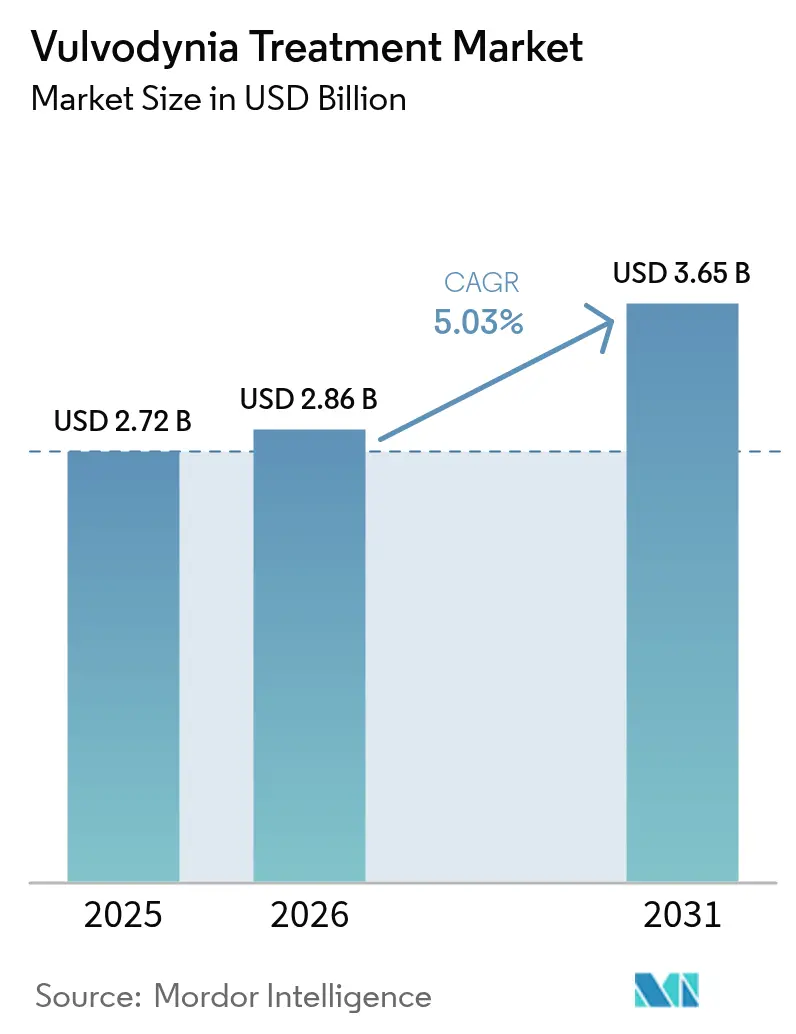
| Market Size (2026) | USD 2.86 Billion |
| Market Size (2031) | USD 3.65 Billion |
| Growth Rate (2026 - 2031) | 5.03 % |
| Fastest Growing Market | Asia-Pacific |
| Largest Market | North America |
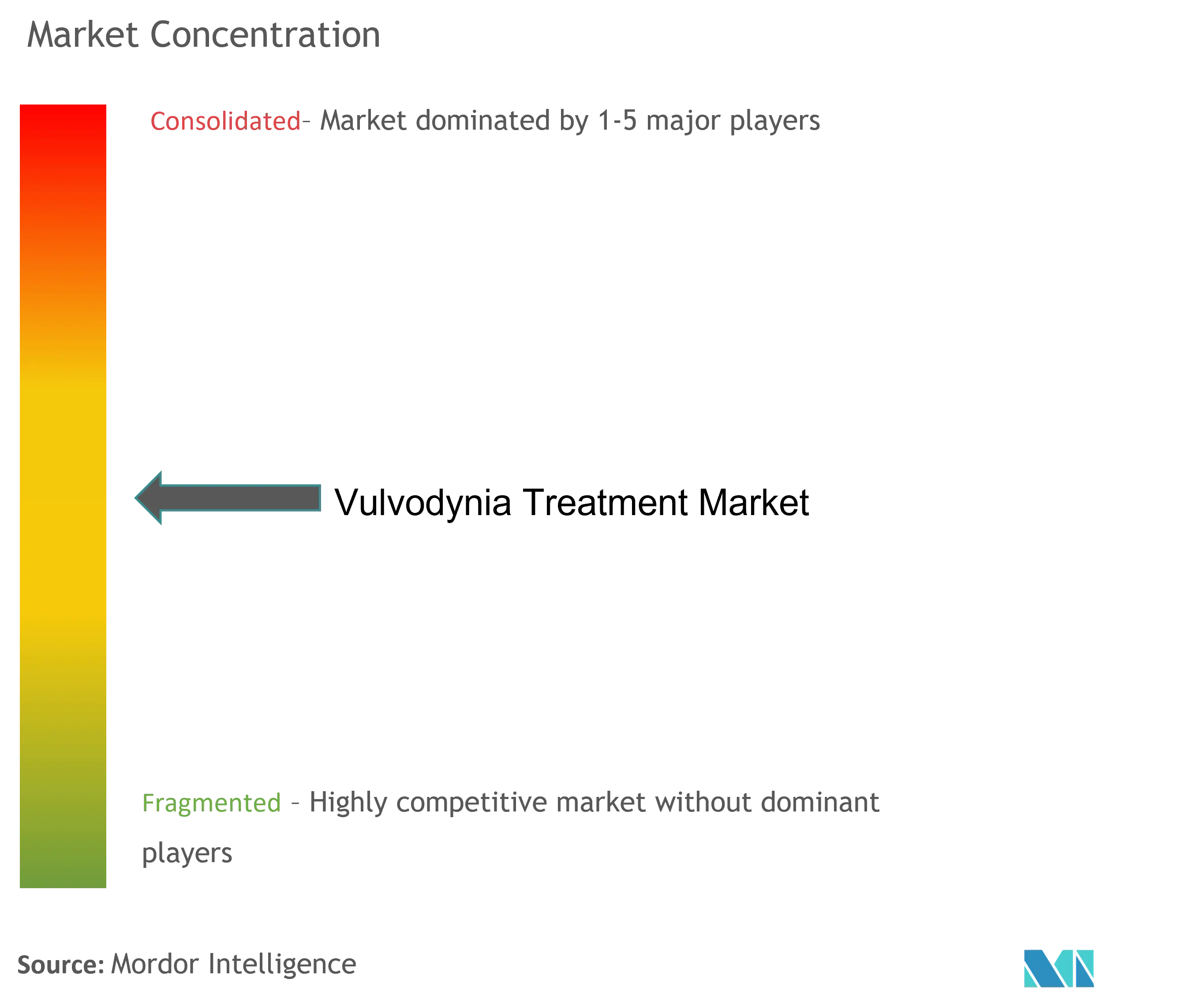
| Market Concentration | Medium |
Major Players *Disclaimer: Major Players sorted in no particular order Image © Mordor Intelligence. Reuse requires attribution under CC BY 4.0. | |
Vulvodynia Treatment Market Analysis by Mordor Intelligence
vulvodynia treatment market size in 2026 is estimated at USD 2.86 billion, growing from 2025 value of USD 2.72 billion with 2031 projections showing USD 3.65 billion, growing at 5.03% CAGR over 2026-2031. The sustained uptick reflects stronger diagnostic protocols, broader public-health outreach, and expanding therapeutic innovation. Rising prevalence estimates that up to 16% of women experience chronic vulvar pain and increasing clinician acknowledgment are boosting patient inflows. Improved muco-adhesive delivery technologies, surging telehealth adoption, and consolidation moves among women’s-health manufacturers are further lifting revenue potential. Local anesthetics remain entrenched as first-line care because of rapid relief and limited systemic exposure, while neuromodulatory classes such as SNRIs are advancing in line with growing acceptance of central sensitization theories.
Key Report Takeaways
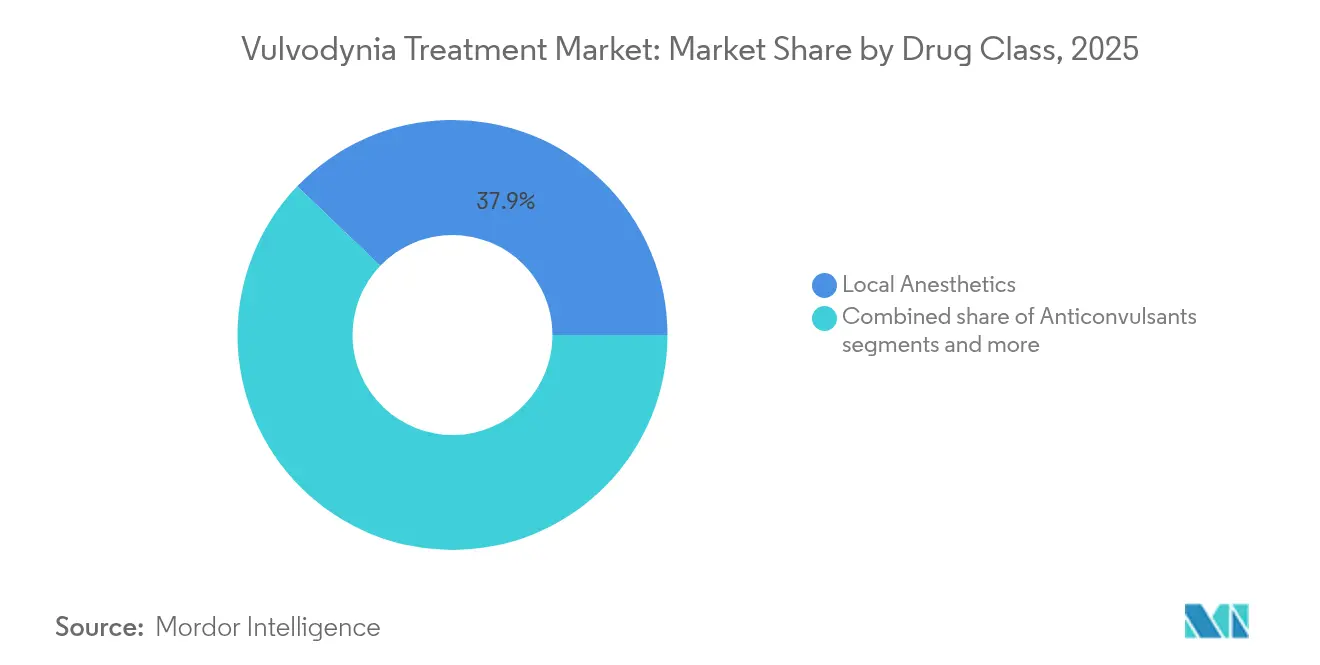
- By drug class, local anesthetics led with 37.85% of vulvodynia treatment market share in 2025 while SNRIs posted the highest projected CAGR at 5.61% through 2031.
- By route of administration, topical products captured 62.15% share of the vulvodynia treatment market size in 2025; transdermal films are set to expand at a 6.02% CAGR between 2026 and 2031.
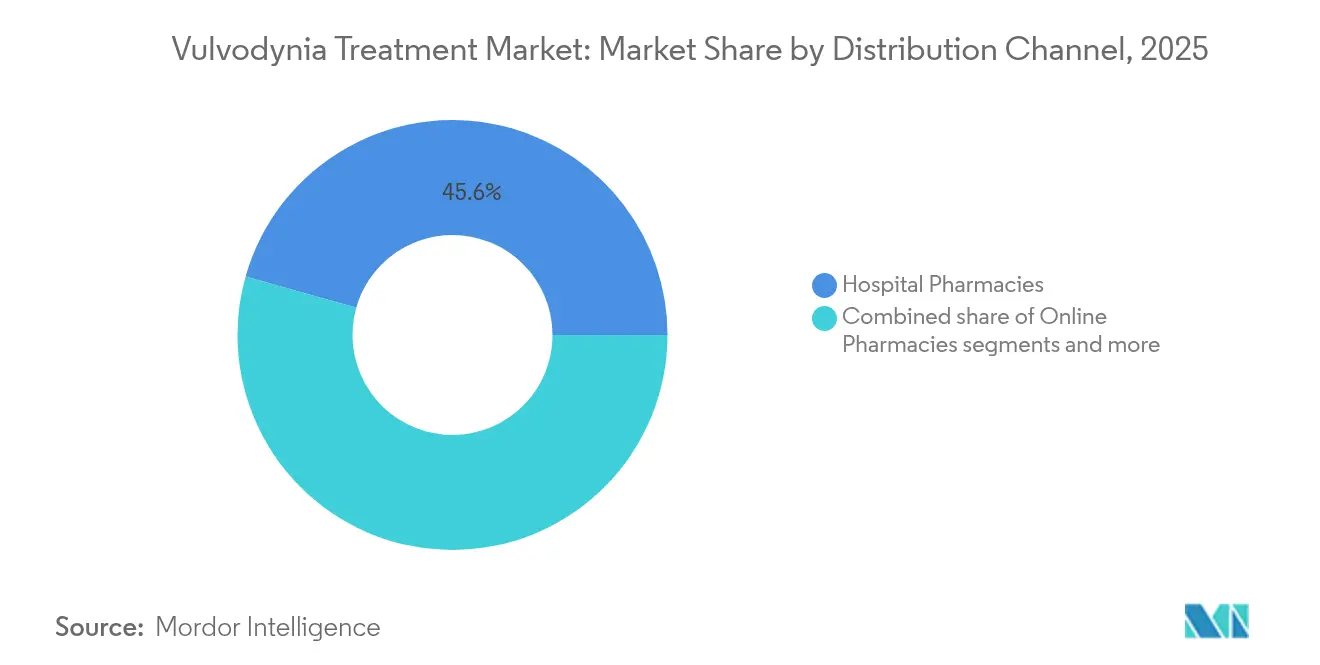
- By distribution channel, hospital pharmacies accounted for 45.62% share of the vulvodynia treatment market size in 2025, whereas online pharmacies are advancing at a 6.31% CAGR to 2031.
- By geography, North America held 41.88% revenue share in 2025 and Asia-Pacific is projected to record a 6.75% CAGR, the fastest among all regions, through 2031.
Note: Market size and forecast figures in this report are generated using Mordor Intelligence’s proprietary estimation framework, updated with the latest available data and insights as of 2026.
Market Trends and Insights
Drivers Impact Analysis of Vulvodynia Treatment Market*
| Driver | (~) % Impact on CAGR Forecast | Geographic Relevance | Impact Timeline |
|---|---|---|---|
| Rising prevalence & better diagnosis rates | +1.2% | Global, with early gains in North America & Europe | Medium term (2-4 years) |
| Awareness campaigns by women's-health NGOs | +0.8% | Global, spill-over to emerging markets | Long term (≥ 4 years) |
| Greater adoption of topical anesthetics (5% lidocaine, etc.) | +1.0% | North America & EU core, expansion to APAC | Short term (≤ 2 years) |
| Expansion of e-commerce & tele-prescription channels | +0.9% | Global, accelerated in APAC and emerging markets | Medium term (2-4 years) |
| High-intensity laser therapy (HILT) clinics gaining traction | +0.7% | North America & EU, selective APAC markets | Long term (≥ 4 years) |
| Pipeline muco-adhesive thin films for rapid drug delivery | +0.6% | Global, pending regulatory approvals | Long term (≥ 4 years) |
| Source: Mordor Intelligence | |||
Rising Prevalence and Better Diagnosis Rates
Clinical surveys now place lifetime vulvodynia prevalence between 8% and 16%, a figure long underestimated because of diagnostic ambiguity. New American College of Obstetricians and Gynecologists guidelines promote standardized pain assessment during routine pelvic exams, pushing earlier case recognition. Dedicated vulvovaginal disorder clinics in the United States and Germany report 40%–60% higher detection after embedding validated pain scales into electronic health records. Heightened detection broadens the patient base, incentivizing pipeline investment across topical and systemic therapies.
Greater Adoption of Topical Anesthetics
A 5% lidocaine formulation remains the frontline agent because it delivers quick relief without systemic adverse events. Specialty compounding firms now combine lidocaine with prilocaine or gabapentin, responding to 15% of patients who require extended analgesia. The American Academy of Dermatology reported that proactive FDA engagement solved the 2024 lidocaine shortage, restoring a stable supply chain for topical anesthetics.
Expansion of E-commerce and Tele-prescribing
Sensitive patient populations gravitate toward digital pathways that provide confidentiality and doorstep delivery. Online pharmacies specializing in women’s health logged a 6.68% CAGR for vulvodynia prescriptions in 2024 while integrating HSA/FSA payment options to lower out-of-pocket costs. Telemedicine networks also connect rural clinics to metropolitan vulvar pain specialists, shrinking diagnostic wait times from six months to six weeks.
Awareness Campaigns by Women’s-Health NGOs
Organizations such as the National Vulvodynia Association leverage social media, webinars, and clinician toolkits to destigmatize vulvar pain. Campaigns reach 2 million users annually and drive measurable jumps in search queries for “vulvar pain treatment” across India, Brazil, and Nigeria[1]. The resulting dialogue nudges policymakers to update benefit designs, which gradually improves insurance coverage for multidisciplinary care.
Restraints Impact Analysis of Vulvodynia Treatment Market*
| Restraint | (~) % Impact on CAGR Forecast | Geographic Relevance | Impact Timeline |
|---|---|---|---|
| Absence of FDA-approved vulvodynia-specific drugs | -1.8% | Global, most acute in regulated markets | Long term (≥ 4 years) |
| Limited reimbursement for multimodal regimens | -1.3% | North America & EU, expanding to other regions | Medium term (2-4 years) |
| Heterogeneous etiology complicates treatment protocols | -0.9% | Global, particularly challenging in emerging markets | Medium term (2-4 years) |
| Periodic API shortages of lidocaine & price spikes | -0.7% | Global, with acute supply chain vulnerabilities | Short term (≤ 2 years) |
| Source: Mordor Intelligence | |||
Absence of FDA-Approved Vulvodynia-Specific Drugs
Therapies are prescribed off-label, creating reimbursement uncertainty and constraining promotional activities. A National Institutes of Health comparative study enrolling 400 women at Duke University seeks to generate head-to-head evidence but final results will not emerge before 2027. The regulatory vacuum slows uptake of novel molecules, dampening the vulvodynia treatment market growth potential despite strong clinical need.
Limited Reimbursement for Multimodal Regimens
Optimal care blends pharmacotherapy, pelvic-floor physiotherapy, psychological counseling, and sometimes laser or injectables. Payer policies typically reimburse single interventions rather than integrated programs, forcing patients to shoulder up to USD 5,000 in annual out-of-pocket costs in the United States [2]. Emerging value-based bundles piloted by university hospitals aim to prove cost offsets through reduced repeat visits and enhanced quality-of-life metrics.
*Our forecasts treat driver/restraint impacts as directional, not additive. The impact forecasts reflect baseline growth, mix effects, and variable interactions.
Vulvodynia Treatment Market Segment Analysis
By Drug Class:
Local Anesthetics Retain Command as SNRIs AccelerateThe segment registered a 37.85% share in 2025, underscoring the entrenched preference for lidocaine-centered regimens that offer localized and rapid relief. This leadership is poised to persist given continued physician confidence and patient familiarity. However, SNRIs post the fastest 5.61% CAGR, reflecting mounting evidence that duloxetine modulates central pain pathways and improves comorbid mood disorders. Anticonvulsants maintain niche relevance, though cardiovascular safety alerts for gabapentin and pregabalin temper near-term acceleration. Tricyclic antidepressants, led by amitriptyline, exhibit stable demand supported by 59.3% responder rates. Hormonal therapies, notably topical estradiol for post-menopausal vulvodynia, re-enter clinician toolkits as supportive evidence grows.
Continued preference for local anesthetics feeds a robust compounding ecosystem that crafts lidocaine-prilocaine blends, thereby reinforcing pharmacist engagement in care pathways. Meanwhile, biotechnology firms pursue injectable innovations such as botulinum toxin for spastic pelvic-floor musculature. These novel modalities could capture incremental share but will rely on clinician education given procedural learning curves.

By Route of Administration:
Topical Dominance Faces Transdermal InnovationTopical formulations accounted for 62.15% of the vulvodynia treatment market size in 2025, mirroring widespread endorsement of localized therapy among gynecologists and dermatologists. Patient self-administration and the capacity to titrate dose frequency underpin enduring uptake. Transdermal films, although nascent, display a 6.02% CAGR and promise improved adherence via extended drug residence. Oral systemic therapies preserve relevance for centrally mediated pain yet encounter adherence hurdles tied to dizziness, somnolence, or gastrointestinal distress. Injectable options, spearheaded by botulinum toxin and platelet-rich plasma, command specialist attention in tertiary centers but remain niche in volumes.
Breakthrough thin-film products, once cleared, could peel share from conventional creams by offering mess-free application. Manufacturers are also experimenting with vaginal suppositories integrating baclofen, currently under a Phase 2 protocol at the University of Louisville, to tackle overlapping pelvic-pain syndromes. These innovations foreshadow an evolving competitive stack in administration routes.
By Distribution Channel:
Hospital Pharmacies Lead Digital TransformationHospital pharmacies held 45.62% share in 2025, reflecting the heavy diagnostic and multidisciplinary nature of vulvodynia care. Onsite compounding, direct clinician interface, and access to device-based adjuncts reinforce their primacy. Yet online pharmacies exhibit the liveliest 6.31% CAGR, catalyzed by patient demand for privacy, logistical convenience, and integrated tele-prescription workflows. Retail chains sustain presence but lag innovation, partly due to limited pharmacist specialization in chronic vulvar pain.
The rise of e-commerce platforms focusing on women’s sexual health augments market reach into rural geographies and culturally conservative societies. Several hospitals now partner with digital pharmacies to maintain continuity of supply after discharge, merging clinical oversight with at-home convenience.
Geography Analysis
North America Vulvodynia Treatment Market
North America generated 41.88% of 2025 revenue, powered by dense networks of vulvar pain clinics, academic research funding, and broad insurer coverage for evidence-based treatments. Cross-border telehealth linkages are shortening waitlists, while FDA fast-track designations for women’s-health drugs could further energize the region’s pipeline.
APAC Vulvodynia Treatment Market
Asia-Pacific is projected to record a 6.75% CAGR through 2031, the briskest worldwide. Rising disposable income, public campaigns that normalize conversations about intimate health, and accelerated smartphone penetration collectively broaden access to virtual consults and online pharmacies. Government-sponsored women’s-health programs in China and India finance pelvic-floor therapy pilot projects, signaling policy momentum.
EMEA and South America Vulvodynia Treatment Market
Europe maintains steady growth anchored by universal coverage. Germany and the United Kingdom lead clinical trial density, although stringent reimbursement review slows the adoption of premium-priced innovations. South America and the Middle East & Africa remain early-stage. Urban Brazil witnesses growth in private women’s-health clinics, whereas rural sub-Saharan Africa struggles with cultural taboos and clinician shortages.
Regulatory Landscape
Vulvodynia treatment remains dominated by off-label prescribing because, as of July 2026, there are no vulvodynia-specific pharmacological treatments approved by the FDA or EMA. That situation creates constraints for payer acceptance and labeling-linked promotion, and it shifts the emphasis toward clinical guidelines and specialty care pathways that combine topical anesthetics, neuropathic-pain agents (including SNRIs and anticonvulsants), and hormonal creams.
Registered clinical research is helping shape the evidence base in the absence of new approvals. This includes a February 2026 double-blind, placebo-controlled study evaluating incobotulinumtoxinA for provoked vestibulodynia (ClinicalTrials.gov NCT07486830) and a May 2026 multicenter randomized controlled trial investigating dry needling for provoked vestibulodynia (ClinicalTrials.gov NCT07534345). Alongside these trials, Initiator Pharma’s push to initiate Phase 2a work in vulvodynia points to growing use of standardized endpoints that could support future label-expansion discussions in regulated markets.
Value Chain Analysis
The vulvodynia treatment value chain relies on established APIs and finished-dose manufacturing for pain and neuropathic-pain medicines, then connects those inputs to vulvar pain care through specialty prescribing and pharmacy execution. Because much of care is off-label, compounding and formulation customization remain central, particularly for topical lidocaine-based combinations and hormone creams, with hospital and specialty pharmacies supporting diagnosis-linked dispensing and ongoing regimen adjustment.
Upstream innovation flows from academic centers and specialty clinics into sponsors and CROs through registered proof-of-concept programs that test targeted mechanisms and procedures. Examples include Initiator Pharma’s Phase 2 trial registry activity for pudafensine (ClinicalTrials.gov NCT07391241, initiated in late 2025 with 2026 milestones) and the Center for Vulvovaginal Disorders evaluating incobotulinumtoxinA in a controlled trial setting (ClinicalTrials.gov NCT07486830). Downstream, tele-prescribing and online pharmacy fulfillment are increasingly part of the access model for privacy-sensitive patients, while specialist-administered interventions (including injections, nerve blocks, and other procedure-based therapies) keep tertiary clinics and referral networks central.
Competitive Landscape
Competitive intensity remains moderate with no player surpassing double-digit individual revenue. Big-pharma companies leverage existing neuropathic-pain portfolios but face indication-specific marketing restrictions. Cosette Pharmaceuticals’ USD 430 million purchase of Mayne Pharma adds 12 patent-protected women’s-health assets, signaling momentum toward focused portfolios. Daré Bioscience readies a Phase 3 trial for Sildenafil Cream 3.6% aimed at female sexual arousal disorder yet poised for off-label vulvodynia spin-offs.
Strategic imperatives include securing FDA approvals to shift from off-label to on-label promotion, integrating telehealth platforms to capture e-commerce growth, and investing in muco-adhesive films that promise competitive differentiation. Technology start-ups deliver symptom-tracking apps and patient communities, generating real-world data that feed clinical-development algorithms. Meanwhile, academic-industry consortia pursue regenerative therapies such as platelet-rich plasma, an area under investigation at Mayo Clinic. Overall, the arena is primed for alliances that unite pharmacologic innovation with digital-engagement capabilities.
Vulvodynia Treatment Industry Leaders
-
Upsher-Smith Laboratories
-
Viatris Inc.
-
Cadila Pharmaceuticals
-
Bayer AG
-
Stada Arzneimittel AG
- *Disclaimer: Major Players sorted in no particular order
Vulvodynia Treatment Market Companies Covered in this Report
- Pfizer
- Teva Pharmaceutical Industries
- Endo International
- GlaxoSmithKline
- Abbvie
- Sun Pharmaceuticals Industries
- Mylan (Viatris)
- Zydus Group
- Amneal Pharma
- Glenmark Pharma
- Hologic
- Scilex Holding
- Hisamitsu Pharmaceutical
- Grünenthal GmbH
- Taro Pharmaceutical Industries
- Merz Pharma (Botulinum-toxin)
- Dr. Reddy’s Laboratories
Market Opportunities and Future Outlook
A key whitespace is the shift from broad off-label symptom management toward mechanism-based, indication-seeking therapies backed by controlled data packages. Initiator Pharma’s pudafensine Phase 2 proof-of-concept trial (NCT07391241) and the Center for Vulvovaginal Disorders’ Phase 2 evaluation of incobotulinumtoxinA for provoked vestibulodynia (NCT07486830, primary completion estimated in 2026) reflect that approach, building the kind of evidence that is needed for payer engagement and more standardized treatment algorithms.
Non-pharmacologic and tissue-based interventions also offer room for development, supported by a 2026 systematic review that reported modalities such as photobiomodulation, shockwave therapy, and TENS outperforming placebo for pain reduction in vulvodynia patients. The April 2024 Vulvodynia Therapeutic Research Summit, backed by the International Society for the Study of Women’s Sexual Health and the National Vulvodynia Association, among others, set a priority list spanning drug repurposing candidates (including ketotifen fumarate) and device-based approaches. That prioritization has helped clarify R&D targeting for developers building clinic-based offerings alongside pharmacotherapy.
Recent Industry Developments in Vulvodynia Treatment Market
- April 2026: Initiator Pharma reported progress in enrollment for its Phase IIa proof-of-concept study of pudafensine in women with vulvodynia, with half of the planned 24 participants dosed. The update sustains attention on mechanism-based candidates working to move beyond off-label standards of care and signals that patient recruitment is achievable in this indication.
- December 2025: Initiator Pharma initiated patient enrollment for the Phase IIa clinical study (IP2015CS05) of pudafensine in women with vulvodynia. This marked a shift from planning to execution and expanded the set of active, sponsor-led clinical assets directly targeting vulvodynia.
- April 2024: The International Society for the Study of Women's Sexual Health, National Vulvodynia Association, Gynecologic Cancers Research Foundation, and Tight Lipped sponsored the Vulvodynia Therapeutic Research Summit to prioritize pharmacological and device-based research directions. The summit helped sharpen the development roadmap by ranking candidates and modalities, aligning academic and industry efforts around shared endpoints and practical trial designs.
Vulvodynia Treatment Market Report Scope and Research Methodology
Market Definition and Coverage
For this methodology, the vulvodynia treatment market covers the value of therapies used to manage chronic vulvar pain, counted when treatment is prescribed, dispensed, or administered through recognized care settings.
Scope exclusions: We exclude purely diagnostic visits and lab tests, and we also exclude general gynecology products that are not used with a vulvodynia treatment intent.
Segments Covered in This Report
- By Drug Class
- Local Anesthetics
- Anticonvulsants
- Tricyclic Antidepressants
- SNRIs
- Hormonal Therapies
- Others
- By Route of Administration
- Topical
- Oral
- Injectable
- Others
- By Distribution Channel
- Hospital Pharmacies
- Retail Pharmacies & Drug Stores
- Online Pharmacies
- By Geography
- North America
- United States
- Canada
- Mexico
- Europe
- Germany
- United Kingdom
- France
- Italy
- Spain
- Rest of Europe
- Asia-Pacific
- China
- India
- Japan
- South Korea
- Australia
- Rest of Asia-Pacific
- South America
- Brazil
- Argentina
- Rest of South America
- Middle East and Africa
- GCC
- South Africa
- Rest of Middle East and Africa
- North America
Data Sources, Market Sizing, and Validation
Desk Research
Desk research started with clinical and epidemiology signals to understand who gets treated and how care typically progresses. We used public sources such as the US Centers for Disease Control and Prevention for healthcare statistics context, the World Health Organization for broader women's health indicators, and PubMed indexed peer-reviewed literature to ground prevalence, diagnosis patterns, and therapy use in actual care pathways.
To connect medical practice to commercial sizing, we reviewed references such as the National Institutes of Health and clinical guideline materials that discuss chronic vulvar pain management. We then complemented this with country-level health ministry releases where relevant. On the market side, we checked company filings, investor presentations, and reputable press coverage to map product exposure and geographic focus, then relied on paid subscription databases for company financials where needed and for patent and publication landscaping when public disclosures were limited. These examples are not exhaustive, and we also used other public and internal references for data collection, validation, and clarification.
Primary Interviews and Surveys
Primary work focused on confirming how treatment mix shifts by severity, care setting, and patient persistence, where desk sources can be thin. We spoke with clinicians, pharmacy and distribution stakeholders, and executives involved in women's health portfolios across the Americas, EMEA, and APAC, and then used their inputs to stress test pricing, adoption, and regimen duration assumptions.
The same discussions were used to validate which therapies are counted only when tied to vulvodynia management, rather than general pain or gynecology use, and to sanity check regional diagnosis rates against referral and access barriers.
Distribution of primary research fieldwork respondents
| Company type | Respondent position | Region |
|---|---|---|
| Top tier: 34% | CXOs: 12% | APAC: 47% |
| Mid tier: 45% | Functional/Unit leaders: 33% | EMEA: 33% |
| Smaller Players: 21% | Managers: 55% | Americas: 20% |
Market-Sizing & Forecasting
Sizing was built using a top-down and bottom-up mix. We first constructed treated patient pools by geography, then converted them into spend using therapy utilization and pricing logic. In practice, we start from population and women's health indicators, apply literature-supported prevalence ranges, and then narrow to diagnosed and treated cohorts using clinician-validated diagnosis rates and care-seeking behavior.
Revenue is modeled using a small set of repeatable inputs, including the share of patients using topical versus oral versus injectable approaches, typical duration of use, refill or repeat visit cadence, and country-level price levels with reimbursement sensitivity. Where a therapy can be used for multiple conditions, we apply an attribution factor informed by interviews so only vulvodynia-linked use is counted.
Forecasts were produced using scenario analysis, since diagnosis awareness, telehealth routing, and physician comfort with off-label regimens can move together and shift demand quickly. Bottom-up checks were added through selective rollups of relevant product revenues where disclosures exist, followed by sampled price-times-volume logic to surface gaps and bring estimates back in line.
Data Validation & Update Cycle
Model outputs were checked against independent signals such as women's health prescription directionality, reported therapeutic area revenue trends, and the expected relationship between diagnosis rates and specialist access by region. When a number looked off, we re-checked the underlying inputs, and triggered interview follow-ups to confirm whether the issue came from pricing, regimen duration, or an overstatement of treated prevalence.
Before sign-off, the work is reviewed in steps, including peer checks on assumptions and year-over-year movements. We also ran a final consistency pass across regions and totals. Reports refresh annually, with interim updates when major events occur, and a last pre-delivery review to ensure clients receive the most current view.
Mordor Intelligence's Vulvodynia Treatment Market Size Measured Against Other Published Estimates
Published market values can vary a lot in this space because authors often start from different treated patient assumptions, and they also differ on whether they count only treatment revenues or include broader service-related spending.
The benchmark table shows a much lower number than some widely circulated figures. In Mordor Intelligence's model, the value is limited to treatment revenues aligned to vulvodynia management by drug class, route of administration, and pharmacy channel, rather than folding in wider women's health pain care that is not tied to this condition.
Benchmark comparison
| Source | Market Size | Gaps in Research Methodology |
|---|---|---|
| Mordor Intelligence | USD 2.86 B (2026) | |
| Trade Journal A | USD 5.41 B (2024) | This estimate appears to use a broader treatment definition that can capture general chronic pain and women's health spend, and it likely applies higher diagnosis and treatment rates without validating them against specialist access constraints. |
| Industry Publisher B | USD 0.80 B (2024) | This figure is closer to a drugs-only view and can undercount non-drug interventions and channel mix, and it may use conservative pricing and shorter duration assumptions that reduce modeled annual spend per treated patient. |
The spread in numbers mainly comes from what is being counted and how the treated cohort is constructed, not from math differences alone. By keeping the steps tied to clear diagnosis, treatment mix, duration, and price inputs that can be checked region by region, the resulting value is easier to replicate and to explain when assumptions need to be updated.
Key Questions Answered in the Report
What is the current value of the vulvodynia treatment market?
The vulvodynia treatment market size stood at USD 2.86 billion in 2026.
What CAGR is projected for the vulvodynia treatment market between 2026 and 2031?
The market is forecast to grow at a 5.03% CAGR during 2026-2031.
Which drug class holds the largest share of the vulvodynia treatment market?
Local anesthetics lead with 37.85% share in 2025.
Which geographic region is expected to grow fastest in the vulvodynia treatment market?
Asia-Pacific is projected to record the highest 6.75% CAGR through 2031.
Why is reimbursement a restraint for vulvodynia therapies?
Payers often cover single treatments but not full multimodal regimens, leaving patients to pay significant out-of-pocket costs.
What recent acquisition signals consolidation in vulvodynia therapeutics?
Cosette Pharmaceuticals acquired Mayne Pharma for USD 430 million in February 2025 to bolster its womens-health portfolio.