
Virtualized Evolved Packet Core Market Size and Share
Market Overview
| Study Period | 2020 - 2031 |
|---|---|
| Market Size (2026) | USD 11.31 Billion |
| Market Size (2031) | USD 36.49 Billion |
| Growth Rate (2026 - 2031) | 26.41 % CAGR |
| Fastest Growing Market | Asia Pacific |
| Largest Market | North America |
| Market Concentration | High |
Major Players *Disclaimer: Major Players sorted in no particular order. Image © Mordor Intelligence. Reuse requires attribution under CC BY 4.0. |
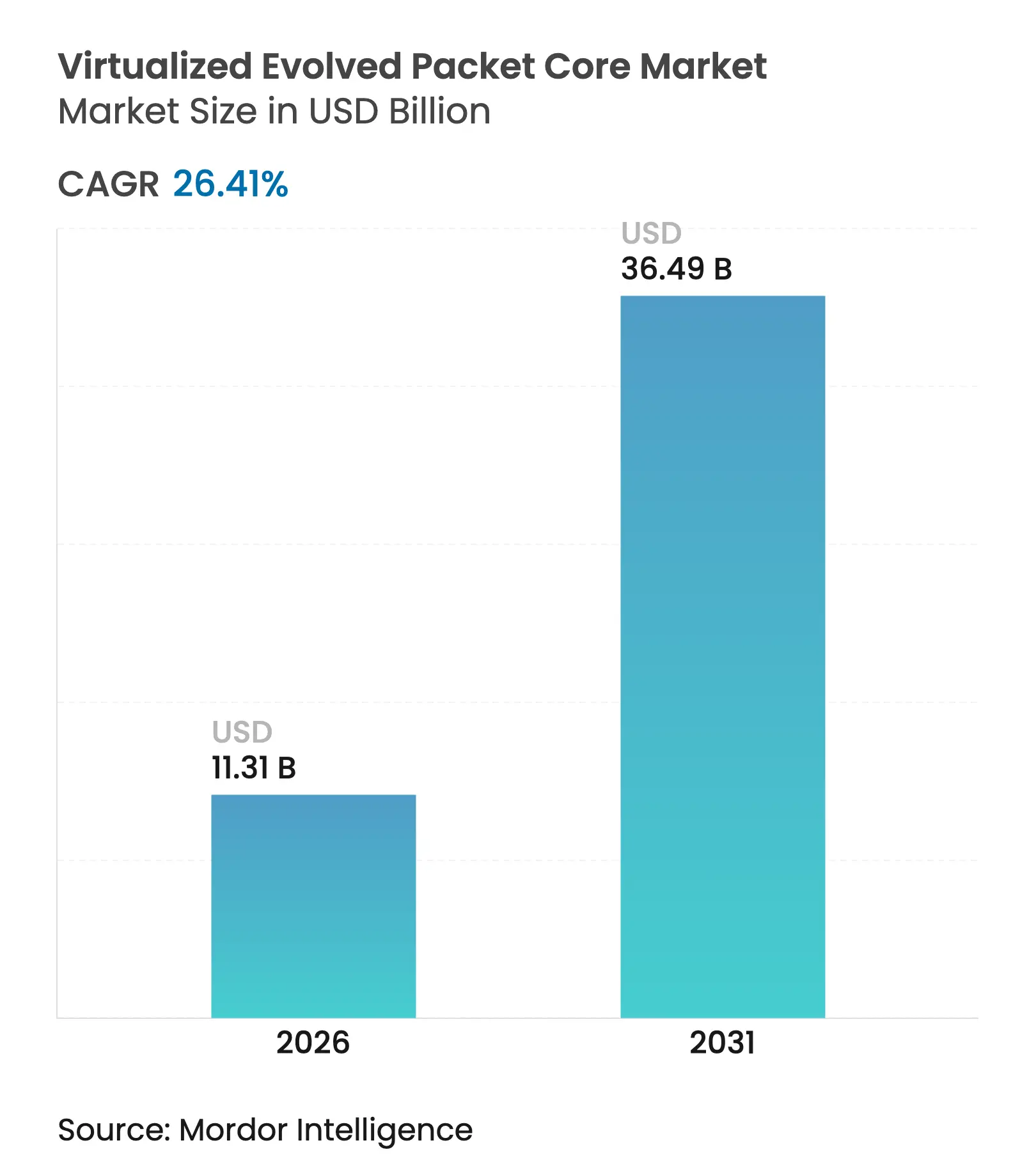

Virtualized Evolved Packet Core Market Analysis by Mordor Intelligence
Growth stems from 5G standalone rollouts, rising enterprise demand for private mobile networks, and operator sustainability mandates that favor energy-efficient virtualized cores. Telcos accelerate software-defined network functions to slash capital and operating outlays, while hyperscale public-cloud partnerships allow rapid service launches and global coverage. Asia Pacific drives adoption on the back of government-backed digital programs, whereas North America pushes differentiation through network slicing and edge-cloud synergies. Meanwhile, Europe emphasizes compliance and energy efficiency, a stance that shapes technical requirements and vendor selection.
Key Report Takeaways
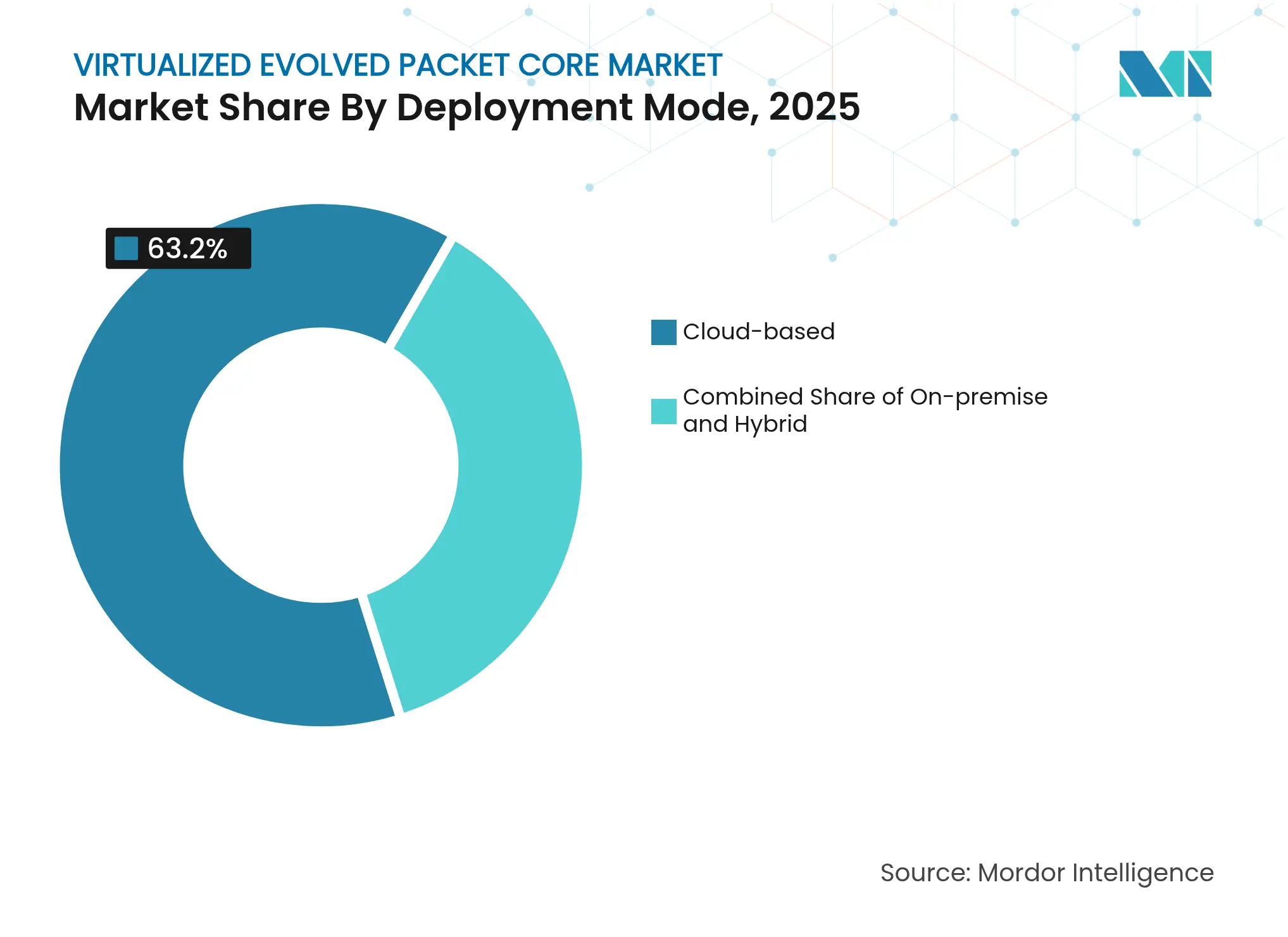
- By deployment mode, cloud-based implementations captured 63.20% of the Virtualized Evolved Packet Core market share in 2025; hybrid deployments are forecast to advance at a 29.8% CAGR to 2031.
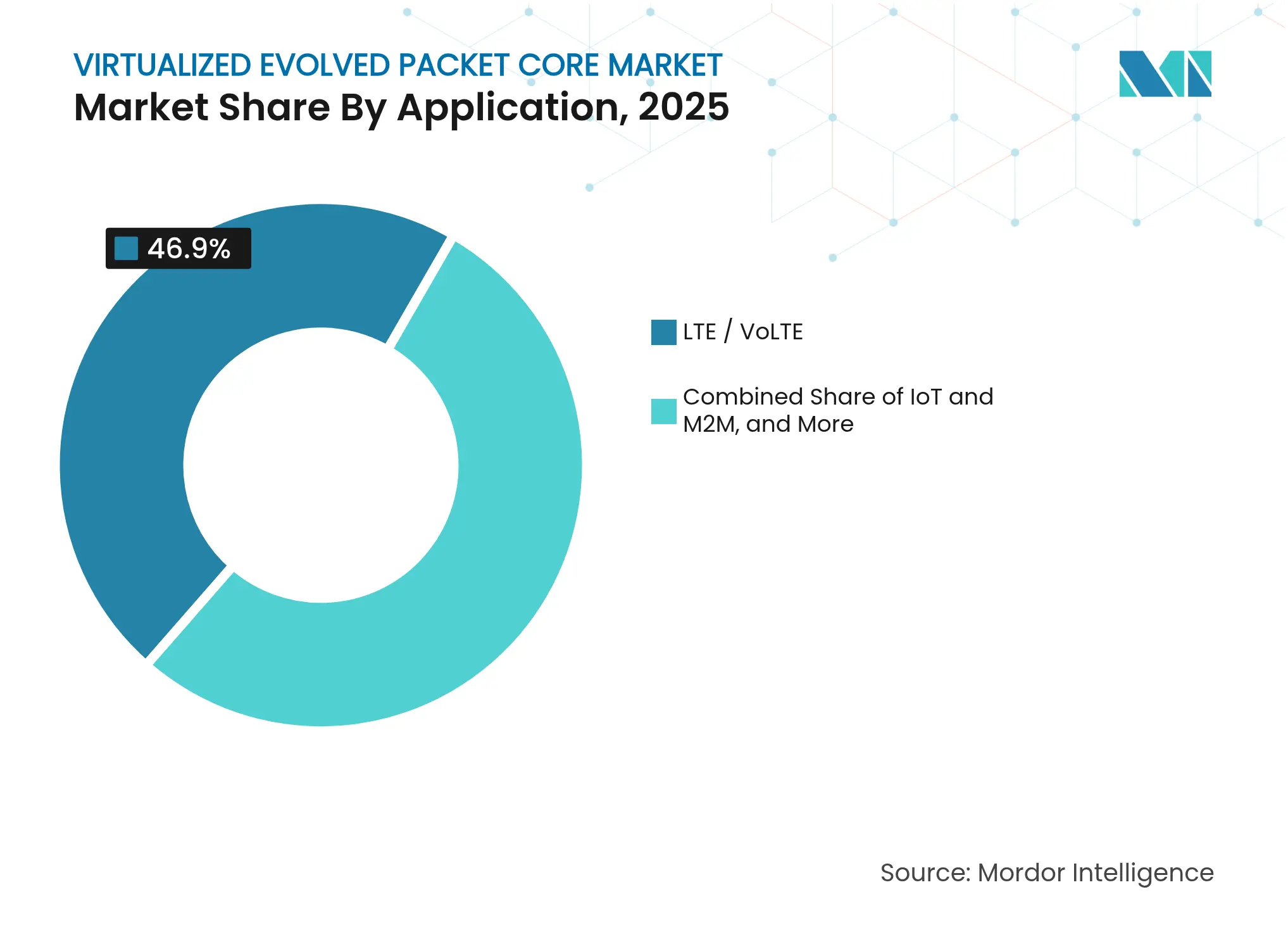
- By application, LTE/VoLTE held 46.90% revenue share of the Virtualized Evolved Packet Core market size in 2025, while 5G standalone core is projected to expand at 34.55% CAGR through 2031.
- By end user, telecom operators dominated with 71.10% share of the Virtualized Evolved Packet Core market in 2025; enterprise users post the fastest growth at 28.35% CAGR through 2031.
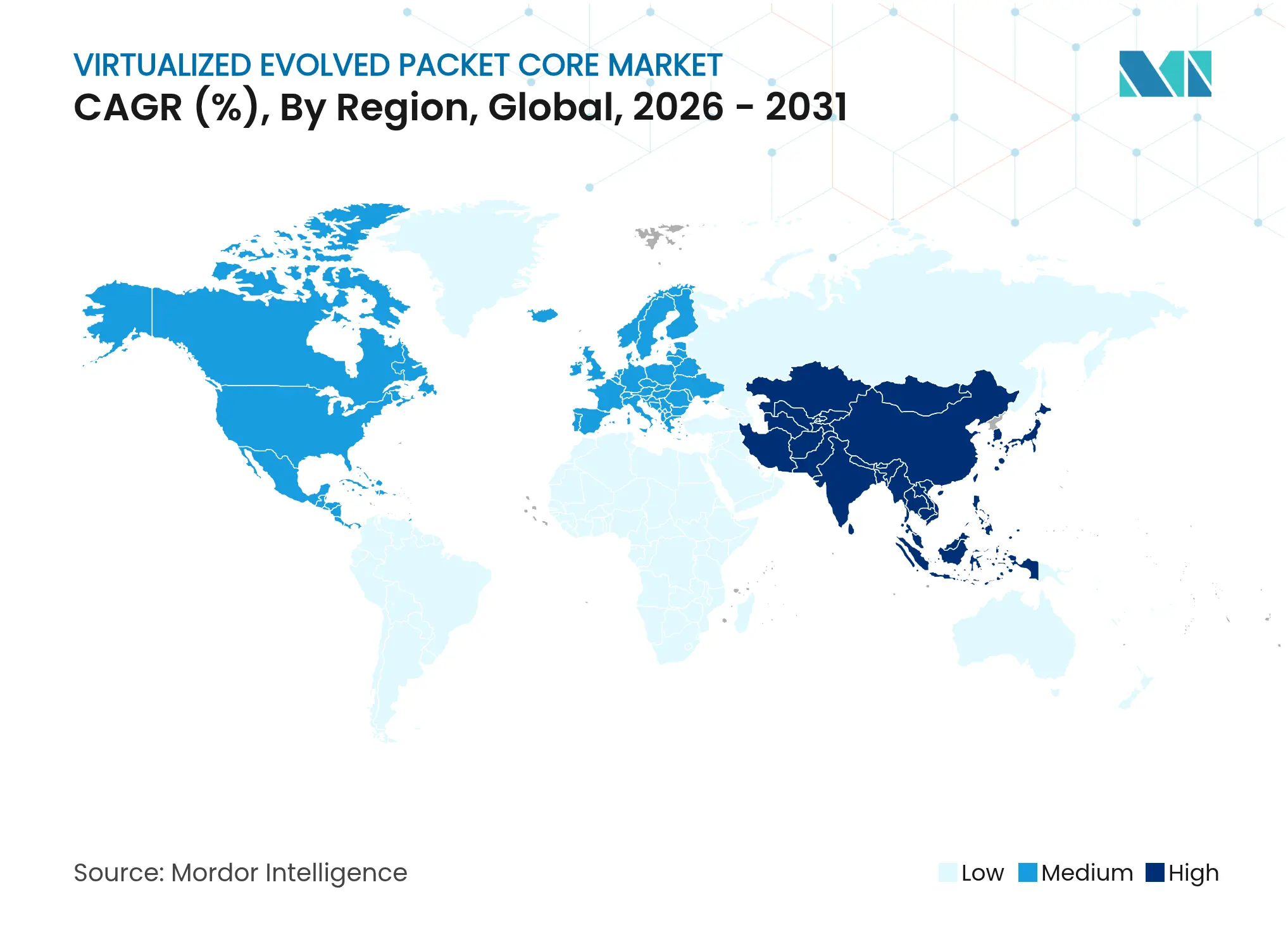
- By geography, Asia Pacific accounted for 37.75% of the Virtualized Evolved Packet Core market size in 2025 and is advancing at 25.63% CAGR between 2026-2031.
Note: Market size and forecast figures in this report are generated using Mordor Intelligence's proprietary estimation framework, updated with the latest available data and insights as of 2026.
Global Virtualized Evolved Packet Core Market Trends and Insights
Drivers Impact Analysis
| Driver | Impact on CAGR Forecast (~%) | Geographic Relevance | Impact Timeline |
|---|---|---|---|
Accelerated 5G rollouts demanding cloud-native cores | +8.70% | Global (North America, APAC) | Short term (≤ 2 years) |
CapEx / OpEx savings from network-function virtualization | +6.10% | Global | Medium term (2–4 years) |
Private LTE/5G networks for Industry 4.0 & campus connectivity | +5.30% | North America, EU → APAC | Long term (≥ 4 years) |
Telco sustainability mandates for energy-efficient core networks | +2.40% | EU → North America, APAC | Long term (≥ 4 years) |
| Source: Mordor Intelligence | |||
Accelerated 5G Rollouts Demanding Cloud-Native Cores
Cloud-native service-based architectures are mandatory for true 5G standalone networks, making vEPC a non-negotiable investment for operators pursuing network slicing and premium-tier services. Ericsson secured more than 120 commercial 5G core contracts by late 2024, powering 37 live 5G SA networks worldwide, providing tangible proof of commercial readiness[1]. Early movers such as T-Mobile leveraged nationwide 5G SA to introduce network-slice-enabled video calling, which positions them for differentiated pricing models. Competitive pressure compels lagging carriers to accelerate modernization or risk churn. Cloud-native cores also give smaller mobile virtual network operators fast-track entry into enterprise IoT niches. Consequently, the Virtualized Evolved Packet Core market experiences a compounding adoption cycle in the short term.
CapEx/OpEx Savings from Network-Function Virtualization
Operators record sizeable cost reductions as vEPC setups shift workloads to commodity hardware and shared cloud resources. Studies show 68% lower capital outlays and 67% savings on operating expense versus monolithic hardware cores. Digital Nasional Berhad achieved 99.8% network uptime and cut customer-complaint resolution time by 90% after moving to intent-based automated operations on a virtualized core. Energy savings add a further 22% efficiency, meeting both budget and sustainability goals. Faster service launches shorten time-to-revenue from over a year to less than six months. These economics shift vEPC from optional to essential in board-level investment plans. Vendors now embed AI-powered orchestration to shrink operational workloads even further.
Private LTE/5G Networks for Industry 4.0 and Campus Connectivity
Enterprises have begun deploying dedicated cellular solutions that deliver latency, reliability, and security beyond Wi-Fi limitations. BMW’s Spartanburg plant and Toyota Material Handling’s U.S. facilities transitioned to private 5G, improving automated-guided-vehicle coordination and predictive maintenance analytics. China already hosts more than 5,325 private 5G networks that span 40 industrial sectors and enable over 20,000 production use cases[2]. This scale demonstrates the technology’s broad viability and fuels the enterprise segment’s 29% CAGR. The Virtualized Evolved Packet Core market benefits because each private network requires a flexible, software-defined core to manage slice isolation and QoS. Vendors respond with tailored packaging, including SaaS consumption models that appeal to mid-size manufacturers.
Telco Sustainability Mandates for Energy-Efficient Core Networks
Regulators and investors evaluate carrier decarbonization trajectories, making energy efficiency a procurement criterion. Nokia’s “extreme deep sleep” power-saving mode cuts consumption by up to eight times during off-peak hours. VMware estimates that virtualization technologies have already avoided 1.2 billion metric tons of CO2 since deployment inception. Operators facing volatile power prices recognize direct OPEX risk and pivot to vEPC to minimize footprint. The European Union’s draft Green Deal telecom guidelines will raise the bar further, rewarding early adopters. As a result, energy-efficient designs become a core competitive differentiator within the Virtualized Evolved Packet Core market.
Restraints Impact Analysis
| Restraint | Impact on CAGR Forecast (~%) | Geographic Relevance | Impact Timeline |
|---|---|---|---|
Operator inertia toward legacy physical EPCs | –3.8% | Global (mature markets) | Short term (≤ 2 years) |
Security & compliance concerns on multi-tenant cloud | –2.9% | North America, EU → Global | Medium term (2–4 years) |
| Source: Mordor Intelligence | |||
Operator Inertia Toward Legacy Physical EPCs
Sunk investments and mission-critical risk aversion slow virtualization plans. Three UK replaced Nokia’s end-of-life CloudBand only when forced to modernize, underscoring reluctance to disrupt stable traffic flows. Verizon’s protracted 5G SA launch shows that even innovation leaders grapple with migration complexity. Mature markets face elevated regulatory oversight and stringent service-level expectations, making change management even more difficult. As a result, physical cores persist for longer than their economic utility justifies, dampening short-term momentum in the Virtualized Evolved Packet Core market.
Security and Compliance Concerns on Multi-Tenant Cloud
The UK Telecoms Security Act mandates roughly 258 controls, revealing how traditional frameworks strain to cover cloud-native functions. Operators must harden workloads, segment networks, and manage secrets with zero-trust rigor, tasks that inflate initial deployment effort. Google Cloud, AWS, and Microsoft introduce telecom-specific compliance blueprints, yet data sovereignty questions linger, particularly in Europe. Some carriers elect to keep packet-core control planes on-premises, adopting hybrid models that slow full-scale public-cloud adoption. These concerns temper otherwise compelling economics for virtualization.
Segment Analysis
By Deployment Mode: Cloud Dominance Accelerates
Cloud implementations represented 63.20% of the Virtualized Evolved Packet Core market share in 2025, reflecting carriers’ preference for elastic scaling and rapid service iteration. The cloud cohort is forecast to grow at 31.5% CAGR, outpacing on-premises and hybrid alternatives as hyperscalers strengthen telecom feature sets. Samsung, TELUS, and AWS created North America’s first virtual roaming gateway, which proves that cross-border service innovations flourish when control-plane elements run natively on the public cloud. These examples underpin a broad shift where infrastructure ownership yields to agility.
Operators that retain data on-site embrace transitional hybrid models to satisfy sovereignty rules without forfeiting cloud economics. Ericsson’s Compact Packet Core reduces deployment complexity by 80% and cuts energy use by 30%, making cloud‐ready bundles attractive to tier-2 carriers. As more contracts stipulate outcome-based pricing, the Virtualized Evolved Packet Core market embeds managed-service add-ons such as AI-assisted operations. Small regional telcos and MVNOs leverage SaaS delivery to launch new offers in weeks rather than quarters, broadening the customer base.
Note: Segment shares of all individual segments available upon report purchase
By Application: 5G SA Core Disrupts LTE Dominance
LTE/VoLTE still commanded 46.90% of the Virtualized Evolved Packet Core market size in 2025 because most mobile subscribers reside on 4G networks. However, 5G SA cores exhibit a 34.55% CAGR, indicating a structural transition toward service-based architectures that unlock network API monetization. Bharti Airtel picked Ericsson to deliver standalone signaling and charging, illustrating the commercial link between SA and revenue diversification.
Broadband Wireless Access capitalizes on SA capacity to compete with fiber, while IoT gains deterministic latency for industrial robotics. Operators introduce subscription tiers tied to slice attributes, converting technical differentiation into ARPU uplift. Consequently, future volume may remain LTE-heavy, yet value creation migrates to SA-enabled offerings. The Virtualized Evolved Packet Core industry thus aligns product roadmaps with low-latency, uRLLC, and massive-IoT profiles that only standalone cores support.
Note: Segment shares of all individual segments available upon report purchase
By End User: Enterprise Acceleration Reshapes Market
Telecom carriers retained 71.10% revenue share in 2025, yet enterprise demand expands at a 28.35% CAGR, driving portfolio recasting toward private network bundles rcrwireless.com. Manufacturers like Toyota Material Handling replaced plant-wide Wi-Fi with Ericsson private 5G, confirming that deterministic performance justifies investment at factory scale rcrwireless.com. MVNOs adopt cloud-native cores to address vertical niches, while cloud providers enter the arena with vEPC-as-a-Service for mid-tier operators.
Public-sector agencies apply dedicated slices for mission-critical communications during emergencies, further diversifying use cases. NTT and LyondellBasell’s multi-site private 5G deployment signals how global enterprises treat cellular connectivity as strategic infrastructure ntt.com. As enterprise sophistication rises, vendors ship pre-integrated application stacks that bundle MEC, analytics, and cybersecurity, raising overall deal sizes. These dynamics enlarge addressable revenue and set new functional baselines for the Virtualized Evolved Packet Core market.
Geography Analysis
Asia Pacific generated 37.75% of the 2025 Virtualized Evolved Packet Core market size, supported by China’s 5,325 live private 5G networks that include more than 20,000 industrial use cases. Government incentives and spectrum policies accelerate manufacturing adoption, with Beijing investing USD 3 billion in 5G-Advanced coverage across 300 cities in 2025. India’s 52% 5G SA coverage, well ahead of Europe’s 2%, illustrates how emerging economies leapfrog legacy architectures via cloud-first rollouts. These programs supply scale that compels vendors to localize R&D and production, reinforcing Asia Pacific’s leadership in the Virtualized Evolved Packet Core market.
North America emphasizes premium service tiers through network slicing and O-RAN integration. Verizon deployed more than 130,000 O-RAN-capable radios and launched slice-based video calling to capture high-value subscribers. Enterprise alliances produce headline case studies: BMW’s Spartanburg plant realized uptime gains after adopting private 5G, and Samsung, TELUS, and AWS demonstrated roaming innovation via fully virtualized cores. Regulatory clarity around spectrum leasing further supports campus deployments, bolstering regional contribution to the Virtualized Evolved Packet Core market.
Europe shows mixed momentum. Three UK awarded Ericsson a 9 Tbps cloud-native core contract, and O2 Telefónica surpassed 1 million users on its AWS-hosted core within six months. Yet overall 5G SA availability stands at 2%, restrained by strict security rules such as the UK Telecoms Security Act and by a risk-averse culture that favors stability over aggressive modernization. Operators focus on energy efficiency and open-RAN experimentation, evidenced by Deutsche Telekom’s O-RAN Town initiative. These priorities temper immediate spending but create long-term demand for highly interoperable, low-power vEPC solutions within the Virtualized Evolved Packet Core market.

Competitive Landscape
Market Concentration
Vendor consolidation reshapes competition as legacy infrastructure giants absorb complementary assets. Nokia’s USD 2.3 billion bid for Infinera bolsters optical transport, while HPE’s USD 14 billion move on Juniper Networks injects AI-driven automation into its telco cloud stack. Ericsson remains the contract volume leader with more than 120 commercial 5G cores and collaborates with Google Cloud to deliver cognitive operations that reach 98% anomaly-detection accuracy. Huawei unveiled AI-centric 5.5G that aligns autonomous operations and new monetization metrics, intensifying feature competition.
Technology differentiation concentrates on closed-loop automation and energy savings. Qualcomm’s Edgewise Suite supports intent-based optimization via natural-language inputs, while Ericsson’s Compact Packet Core slashes configuration times by 80%. White-space entrants such as Working Group Two supply multi-tenant, cloud-native cores that let MVNOs issue programmable SIMs quickly, broadening customer choice. Standardization under 3GPP Release 18 introduces defined APIs for edge-computing interaction, pushing vendors to balance interoperability with proprietary enhancements.
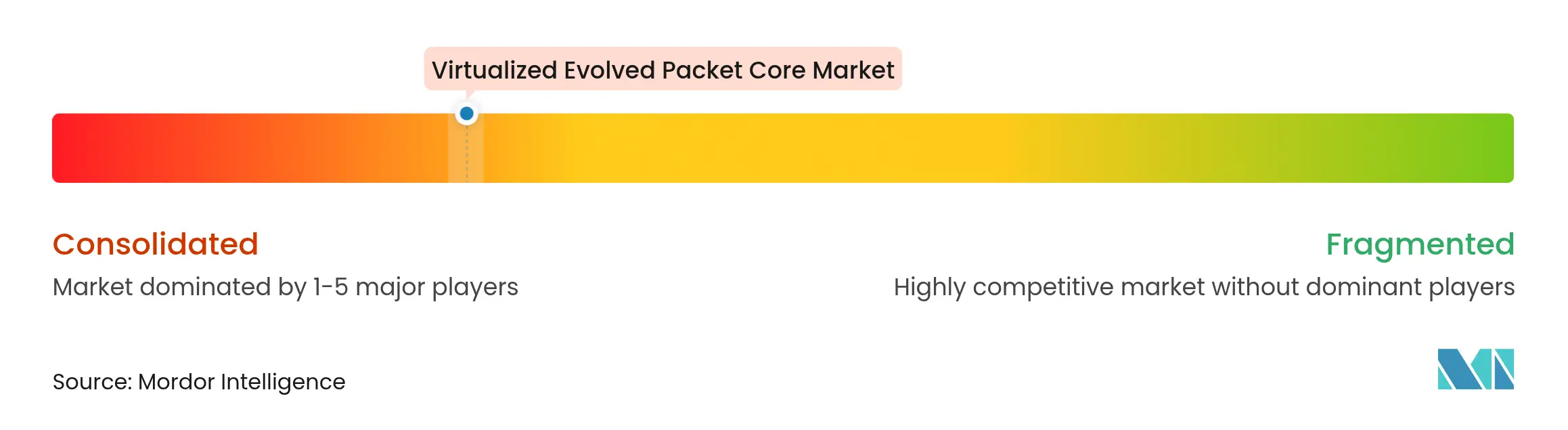
Energy credentials become a bidding requirement, and vendors tout deep-sleep modes or ARM-based acceleration to win eco-conscious tenders. Strategic alliances, exemplified by Ericsson and Dell jointly marketing Cloud RAN on PowerEdge servers, underscore the value of pre-integrated solutions that compress deployment cycles. Altogether, the Virtualized Evolved Packet Core market features moderate concentration yet active innovation, as players race to blend core, RAN, and edge capabilities into end-to-end platforms.
Virtualized Evolved Packet Core Industry Leaders

*Disclaimer: Major Players sorted in no particular order
Recent Industry Developments
- March 2025: Huawei launched AI-Centric 5.5G solutions at MWC Barcelona, championing autonomous operations and multi-factor monetization.
- March 2025: O2 Telefónica Germany signed a multi-year AWS deal to expand 5G core data-plane capacity with Outposts racks and Graviton processors.
- February 2025: O2 Telefónica activated its first cloud RAN site on Ericsson software, marking Europe’s debut 5G SA deployment with virtualized RAN components.
- January 2025: Three UK chose Ericsson for a 9 Tbps cloud-native core, replacing Nokia to handle surging data traffic that exceeded 2 Tbps in Dec 2024.
Table of Contents for Virtualized Evolved Packet Core Industry Report
1. INTRODUCTION
- 1.1 Study Assumptions and Market Definition
- 1.2 Scope of the Study
2. RESEARCH METHODOLOGY
3. EXECUTIVE SUMMARY
4. MARKET LANDSCAPE
- 4.1 Market Overview
- 4.2 Market Drivers
- 4.2.1 Rapid growth in LTE/4G subscriber base
- 4.2.2 Accelerated 5G roll-outs demanding cloud-native cores
- 4.2.3 CapEx / OpEx savings from network-function virtualization
- 4.2.4 Private LTE/5G networks for Industry 4.0 and campus connectivity
- 4.2.5 Edge-cloud synergies enabling distributed user-plane off-load
- 4.2.6 Telco sustainability mandates for energy-efficient core networks
- 4.3 Market Restraints
- 4.3.1 Operator inertia toward legacy physical EPCs
- 4.3.2 Security and compliance concerns on multi-tenant cloud
- 4.3.3 Inter-operability gaps across open, disaggregated cores
- 4.3.4 Unpredictable hyperscale cloud TCO for 5G SA workloads
- 4.4 Value/Supply-Chain Analysis
- 4.5 Regulatory Landscape
- 4.6 Technological Outlook
- 4.7 Investment Analysis (Baseline-specific)
- 4.8 Porter's Five Forces Analysis
- 4.8.1 Threat of New Entrants
- 4.8.2 Bargaining Power of Buyers
- 4.8.3 Bargaining Power of Suppliers
- 4.8.4 Threat of Substitutes
- 4.8.5 Intensity of Competitive Rivalry
5. MARKET SIZE AND GROWTH FORECASTS (VALUE)
- 5.1 By Deployment Mode
- 5.1.1 Cloud-based
- 5.1.2 On-premise
- 5.1.3 Hybrid
- 5.2 By Application
- 5.2.1 IoT and M2M
- 5.2.2 Mobile Private Networks (MPN) and MVNO
- 5.2.3 Broadband Wireless Access (BWA)
- 5.2.4 LTE/VoLTE/VoWiFi
- 5.2.5 5G Non-Standalone (NSA) Core
- 5.2.6 5G Standalone (SA) Core
- 5.3 By End User
- 5.3.1 Telecom Operators
- 5.3.2 Enterprises and Industrial Verticals
- 5.3.3 Government and Public Safety
- 5.3.4 Cloud Service Providers
- 5.3.5 MVNE/MVNOs
- 5.4 By Geography
- 5.4.1 North America
- 5.4.1.1 United States
- 5.4.1.2 Canada
- 5.4.1.3 Mexico
- 5.4.2 South America
- 5.4.2.1 Brazil
- 5.4.2.2 Argentina
- 5.4.2.3 Rest of South America
- 5.4.3 Europe
- 5.4.3.1 Germany
- 5.4.3.2 United Kingdom
- 5.4.3.3 France
- 5.4.3.4 Russia
- 5.4.3.5 Italy
- 5.4.3.6 Spain
- 5.4.3.7 Rest of Europe
- 5.4.4 Asia-Pacific
- 5.4.4.1 China
- 5.4.4.2 Japan
- 5.4.4.3 India
- 5.4.4.4 South Korea
- 5.4.4.5 Australia and New Zealand
- 5.4.4.6 Rest of Asia-Pacific
- 5.4.5 Middle East and Africa
- 5.4.5.1 Middle East
- 5.4.5.1.1 GCC Countries
- 5.4.5.1.2 Turkey
- 5.4.5.1.3 Rest of Middle East
- 5.4.5.2 Africa
- 5.4.5.2.1 South Africa
- 5.4.5.2.2 Nigeria
- 5.4.5.2.3 Egypt
- 5.4.5.2.4 Rest of Africa
6. COMPETITIVE LANDSCAPE
- 6.1 Market Concentration
- 6.2 Strategic Moves
- 6.3 Market Share Analysis
- 6.4 Company Profiles (includes Global level Overview, Market level overview, Core Segments, Financials as available, Strategic Information, Market Rank/Share for key companies, Products and Services, and Recent Developments)
- 6.4.1 Ericsson
- 6.4.2 Huawei Technologies
- 6.4.3 Nokia
- 6.4.4 Cisco Systems
- 6.4.5 ZTE
- 6.4.6 Samsung Electronics
- 6.4.7 NEC Corporation
- 6.4.8 Mavenir
- 6.4.9 Microsoft (Affirmed Networks)
- 6.4.10 Athonet (HPE)
- 6.4.11 Telrad Networks
- 6.4.12 Core Network Dynamics
- 6.4.13 VMware
- 6.4.14 Juniper Networks
- 6.4.15 Red Hat (IBM)
- 6.4.16 Intel
- 6.4.17 Hewlett Packard Enterprise
- 6.4.18 Casa Systems
- 6.4.19 Parallel Wireless
- 6.4.20 Druid Software
7. MARKET OPPORTUNITIES AND FUTURE OUTLOOK
- 7.1 White-space and Unmet-need Assessment
Scope and Methodology
Virtualized evolved packet core is a framework used for virtualizing the functions required to converge voice and data on 4G Long-term evolution networks. It supports 2G, 3G, non-3GPP standards, wireless broadband, and the 5G core network. It is a mobile-core network system that accommodates LTE access systems and it is powered by a carrier-grade virtualization platform and software-defined networking (SDN) technology.
| By Deployment Mode | Cloud-based | ||
| On-premise | |||
| Hybrid | |||
| By Application | IoT and M2M | ||
| Mobile Private Networks (MPN) and MVNO | |||
| Broadband Wireless Access (BWA) | |||
| LTE/VoLTE/VoWiFi | |||
| 5G Non-Standalone (NSA) Core | |||
| 5G Standalone (SA) Core | |||
| By End User | Telecom Operators | ||
| Enterprises and Industrial Verticals | |||
| Government and Public Safety | |||
| Cloud Service Providers | |||
| MVNE/MVNOs | |||
| By Geography | North America | United States | |
| Canada | |||
| Mexico | |||
| South America | Brazil | ||
| Argentina | |||
| Rest of South America | |||
| Europe | Germany | ||
| United Kingdom | |||
| France | |||
| Russia | |||
| Italy | |||
| Spain | |||
| Rest of Europe | |||
| Asia-Pacific | China | ||
| Japan | |||
| India | |||
| South Korea | |||
| Australia and New Zealand | |||
| Rest of Asia-Pacific | |||
| Middle East and Africa | Middle East | GCC Countries | |
| Turkey | |||
| Rest of Middle East | |||
| Africa | South Africa | ||
| Nigeria | |||
| Egypt | |||
| Rest of Africa | |||
