
Market Overview
| Study Period | 2020 - 2031 |
|---|---|
| Forecast Data Period | 2026 - 2031 |
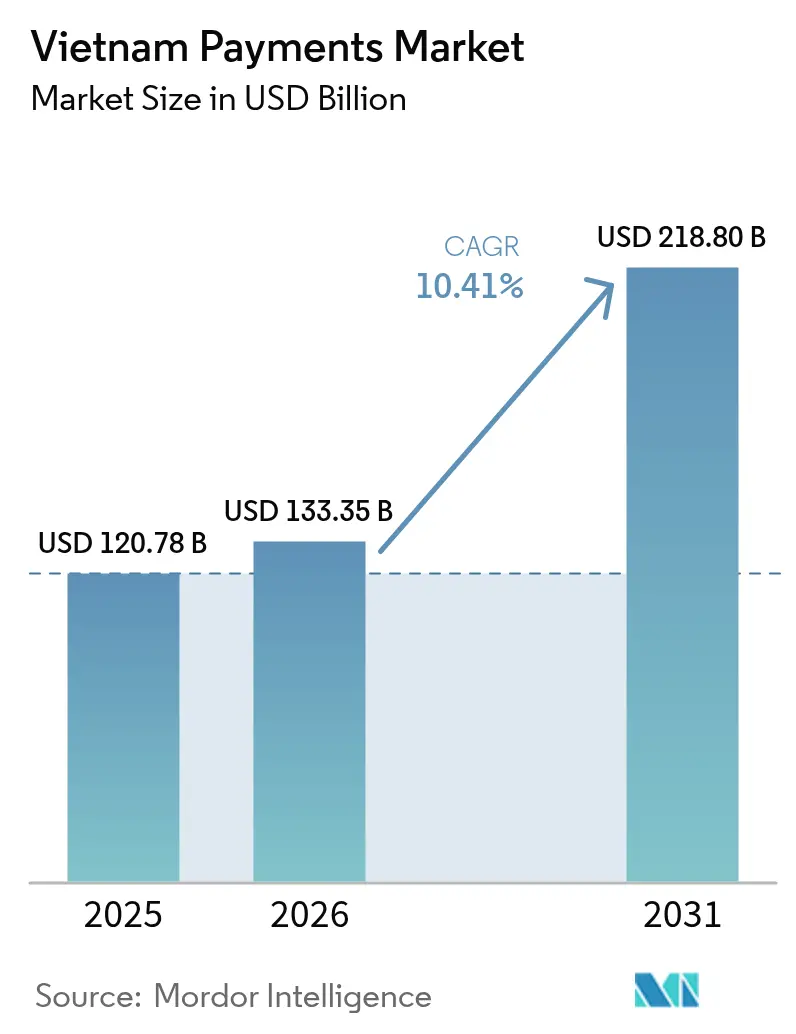
| Base Year Market Size (2025) | USD 120.78 Billion |
| Market Size (2026) | USD 133.35 Billion |
| Market Size (2031) | USD 218.8 Billion |
| Growth Rate (2026 - 2031) | 10.41% CAGR |
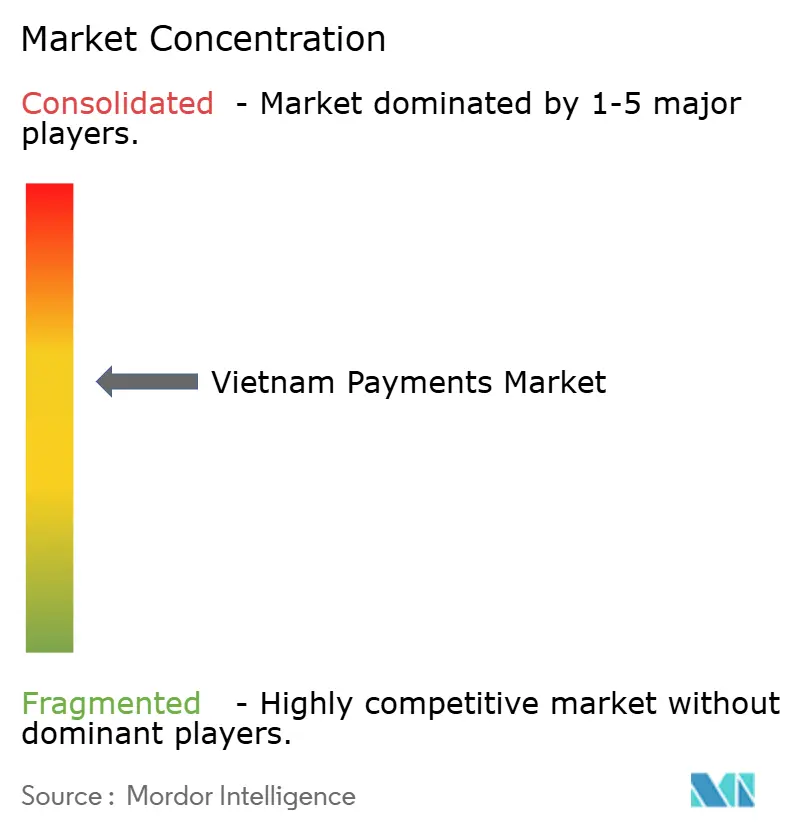
| Market Concentration | Medium |
Major Players *Disclaimer: Major Players sorted in no particular order Image © Mordor Intelligence. Reuse requires attribution under CC BY 4.0. | |
Vietnam Payments Market Analysis by Mordor Intelligence
The Vietnam payment market size is expected to grow from USD 120.78 billion in 2025 to USD 133.35 billion in 2026 and is forecast to reach USD 218.8 billion by 2031 at 10.41% CAGR over 2026-2031. Robust e-commerce growth, proliferating real-time rails, and a sustained push from the State Bank of Vietnam (SBV) to achieve 80% cashless transactions by 2030 continue to accelerate adoption. Digital wallets still command the largest share yet account-to-account (A2A) transfers now post the quickest gains as consumers migrate toward VietQR-enabled instant payments. Retail remains the biggest end-user group, but healthcare is growing faster thanks to electronic medical record mandates that embed digital payments into patient workflows. Policy clarity and open-API rules lower entry barriers, intensifying rivalry among local wallets, universal banks, and global card networks. Taken together, these forces position the Vietnam payment market to outpace every other major economy in Southeast Asia through 2030.
Key Report Takeaways
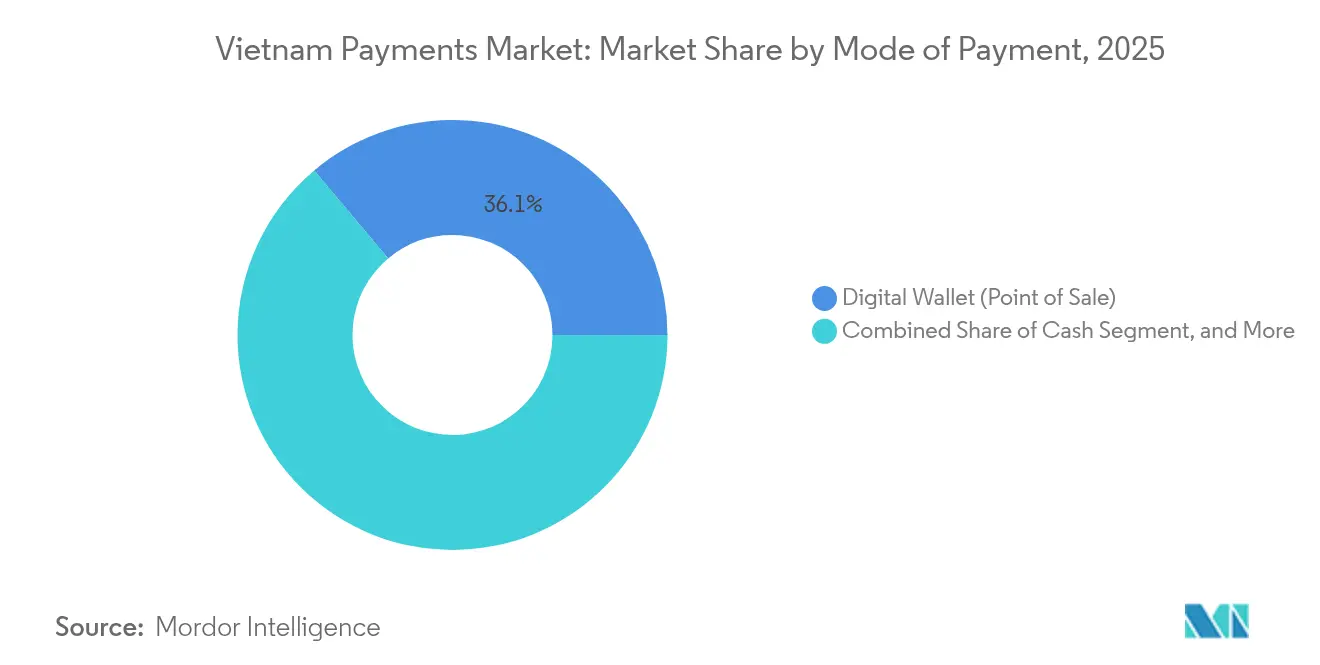
- By mode of payment, digital wallets led with 36.12% of Vietnam payment market share in 2025, while A2A transfers are advancing at an 11.64% CAGR through 2031.
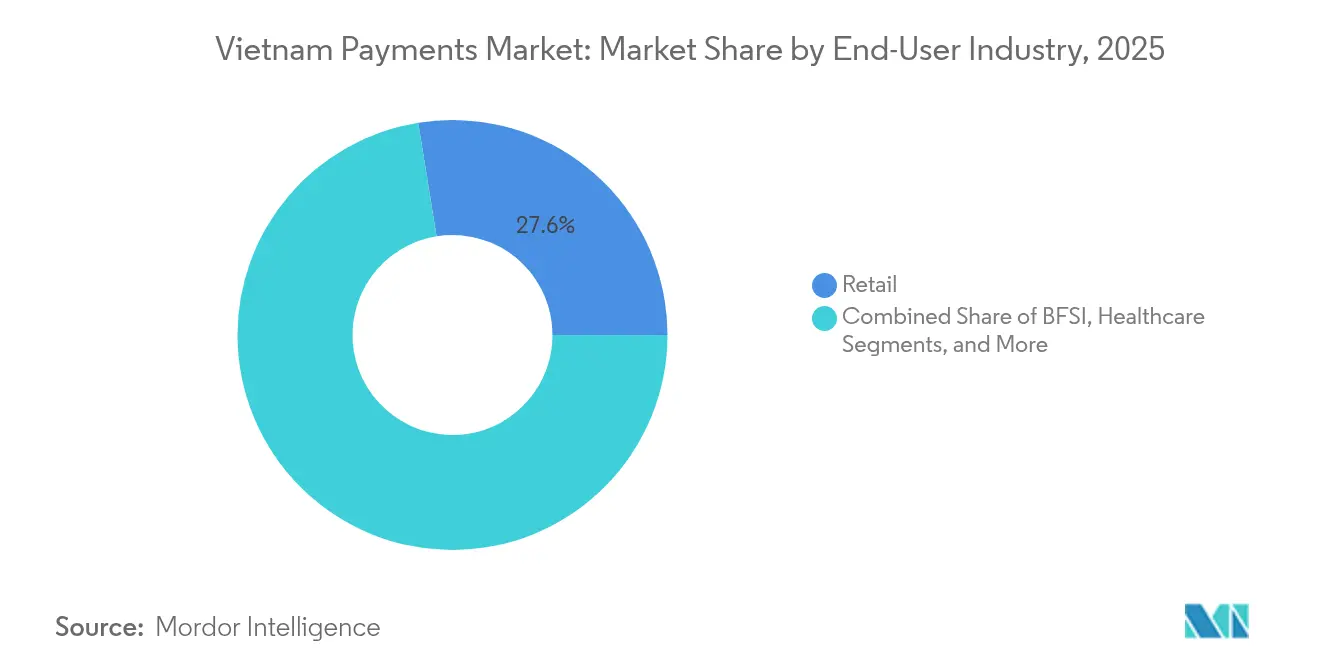
- By end-user industry, retail held 27.55% of Vietnam payment market size in 2025; healthcare is projected to post the fastest 11.17% CAGR through 2031.
Note: Market size and forecast figures in this report are generated using Mordor Intelligence’s proprietary estimation framework, updated with the latest available data and insights as of 2026.
Vietnam Payments Market Trends and Insights
Drivers Impact Analysis*
| Driver | (~) % Impact on CAGR Forecast | Geographic Relevance | Impact Timeline |
|---|---|---|---|
| Rising e-commerce and m-commerce penetration | +2.8% | National, with concentration in Ho Chi Minh City, Hanoi, Da Nang | Medium term (2-4 years) |
| Government cashless-economy programmes | +3.2% | National, with rural focus through Mobile Money initiatives | Long term (≥ 4 years) |
| Expansion of real-time payment rails (Napas 247, VNPay QR) | +2.1% | National infrastructure with urban-first deployment | Short term (≤ 2 years) |
| Social-commerce payments via Zalo/Meta ecosystems | +1.9% | National, with higher penetration in Tier 2-3 cities | Medium term (2-4 years) |
| Embedded finance in super-apps (Grab, Gojek) | +1.7% | Urban centers and major metropolitan areas | Medium term (2-4 years) |
| SME supply-chain digitisation and B2B e-invoicing | +1.5% | National, with focus on enterprises >VND 200 billion revenue | Long term (≥ 4 years) |
| Source: Mordor Intelligence | |||
Rising E-commerce and M-commerce Penetration
Vietnamese consumers have shifted decisively toward mobile shopping, with app-based checkouts accounting for a majority of online transactions in 2025. Social-commerce storefronts embedded inside Zalo, Facebook, and TikTok simplify one-click purchasing, reducing reliance on browser redirects.[1]ZaloPay, “Developer API Documentation,” ZALOPAY.Payment providers therefore prioritize API-first architectures that slot easily into these platforms, ensuring high authorization rates and frictionless consumer journeys. Companies such as ZaloPay now bundle seller dashboards, logistics booking, and BNPL options to defend transaction share from cash-on-delivery. As smartphone ownership exceeds 80% in major urban clusters, the Vietnam payment market embeds directly into daily social media use, closing the gap between browsing and buying.
Government Cashless-Economy Programs
The SBV’s National Payment Strategy aims for 80% cashless transactions by 2030, buttressed by Decree 52/2024 that standardizes security, data localization, and interoperability.[2]State Bank of Vietnam, “National Payment Strategy and Regulatory Framework,” SBV.GOV.VN Mobile Money pilots, capped at VND 10 million balances, enrolled 8.8 million users in 2024—72% located in rural provinces underserved by brick-and-mortar banks. These pilots demonstrate that simplified KYC tied to mobile phone numbers can unlock latent demand outside the top cities. By requiring ISO 20022 messaging for all new rails and mandating open APIs, regulators align Vietnam with wider ASEAN standards and give domestic firms a springboard for cross-border scale.
Expansion of Real-time Payment Rails
NAPAS 247 handled 8.9 billion instant transfers in 2024, up 33.8% year on year, making Vietnam a regional leader in 24/7 settlement.[3]National Payment Corporation of Vietnam, “NAPAS 247 Transaction Statistics,” NAPAS.COM.VN Merchant VietQR acceptance has reached 85%, enabling shoppers to scan a single interoperable code regardless of their bank or wallet. Real-time rails now support government fee collection, utility bills, and payroll, widening beyond retail P2M flows. Because the network is ISO 20022-native, Vietnamese providers are technically ready for ASEAN QR linkage, which commenced with Thailand in 2024 and will add Cambodia and Laos next. This infrastructure means the Vietnam payment market can offer cross-border instant transfers at materially lower cost than legacy correspondent banking.
Social-commerce Payments via Zalo/Meta Ecosystems
Livestream sales inside Facebook, Instagram, and Zalo bypass traditional e-commerce checkout pages, creating demand for embedded payment APIs that confirm orders in chat threads. ZaloPay’s Shopify connector extends this embedded approach to global storefront platforms, letting Vietnamese SMEs collect international cards while settling domestically. Larger average order values in livestream sessions encourage wallets to layer financing tools such as pay-later, protecting share from card issuers. As Decree 52/2024 compels stronger customer authentication, entrenched social platforms enjoy scale advantages in fraud prevention, raising entry thresholds for niche wallets and new-to-market fintechs.
Restraints Impact Analysis*
| Restraint | (~) % Impact on CAGR Forecast | Geographic Relevance | Impact Timeline |
|---|---|---|---|
| Entrenched cash culture in rural provinces | -1.4% | Rural provinces, particularly Mekong Delta and Northern mountains | Long term (≥ 4 years) |
| Limited e-wallet and QR code interoperability | -0.8% | National, with higher impact in competitive urban markets | Medium term (2-4 years) |
| Escalating A2A payment fraud and regulatory throttling | -1.1% | National, with concentration in high-volume urban transactions | Short term (≤ 2 years) |
| Data-sovereignty hurdles for foreign PSPs | -0.6% | National, affecting international payment service providers | Medium term (2-4 years) |
| Source: Mordor Intelligence | |||
Entrenched Cash Culture in Rural Provinces
Cash remains dominant in remote areas where patchy network coverage and low smartphone adoption hamper digital migration. Agricultural households in the Mekong Delta favor tangible currency that aligns with irregular harvest income, and many merchants resist transaction fees that accompany card or wallet acceptance. SBV-driven digital literacy programs and telecom rollouts aim to narrow the gap, yet cultural preferences and concerns over data privacy slow progress. Even so, Mobile Money’s rapid uptake hints that low-friction, phone-number-based services can gradually displace cash if reinforced by agent networks and bill-payment use cases.
Limited E-wallet and QR Code Interoperability
While VietQR unites the banking sector, proprietary wallet codes still fragment acceptance, forcing small merchants to juggle multiple stickers and settlement dashboards. MoMo’s deep user base and ZaloPay’s social graph both lock consumers into walled gardens that complicate universal acceptance. The forthcoming Open-API circular, slated for 2026, will oblige licensees to open transfer and balance endpoints, but implementation remains two years away. Until then, merchants incur duplicate integration costs that weigh heavier on micro-SMEs, and consumers face inconsistent cashback and fee structures that sometimes nudge them back to cash.
*Our forecasts treat driver/restraint impacts as directional, not additive. The impact forecasts reflect baseline growth, mix effects, and variable interactions.
Segment Analysis
By Mode of Payment: Digital Wallets Lead While A2A Transfers Accelerate
Digital wallets captured 36.12% of Vietnam payment market share in 2025 on the back of MoMo’s 69% and ZaloPay’s 44% user penetration. However, A2A payments are forecast to grow at an 11.64% CAGR, buoyed by VietQR’s 85% merchant reach and NAPAS 247’s 8.9 billion annual transactions. This migration toward real-time bank transfers reduces top-up friction and merchant MDRs, making wallets compete on value-added services instead of closed-loop balance storage. Vietnam payment market size for A2A flows is projected to more than double by 2031 as consumers trust direct bank connections and enjoy instant refunds and charge-back parity.
POS card usage still accounts for significant volume, with debit acceptance at 95% of stores, but credit still lags because prudential capital rules deter aggressive card issuance. Cash-on-delivery retains around 30% share of rural e-commerce checkouts, though this proportion erodes each year as Mobile Money expands. Decree 52/2024’s enhanced authentication rules play to the strengths of established banks that already comply with multifactor protocols, accelerating wallet-to-bank substitution. By 2030, analysts expect wallets to act primarily as orchestration layers, routing payments to real-time rails beneath rather than holding user deposits.


By End-User Industry: Healthcare Digitization Outpaces Retail Growth
Retail commanded 27.55% of Vietnam payment market size in 2025, sustained by high QR acceptance at convenience stores and supermarkets. Yet healthcare is on track for an 11.17% CAGR thanks to government mandates that 71% of hospitals now satisfy. Direct bank connections support 31.4% of hospitals, while alternative channels such as kiosks linked to Mobile Money cover a further 15.4%. These integrations shrink checkout times and cut administrative overhead, giving hospital managers a clear ROI.
Entertainment and hospitality rebound alongside inbound tourism and now incorporate tokenized card-on-file models that travelers trust. Visa’s 2024 consumer survey found 48% of outbound Vietnamese tourists plan cashless trips, encouraging hotels and airlines to integrate multiple wallets. Transport continues its steady climb, with ride-hailing operators embedding MoMo and ZaloPay to secure frictionless hand-offs between ordering, navigation, and payment. Finally, government e-invoicing thresholds push B2B corporates into automated accounts-payable flows, broadening revenue streams for treasury-focused fintechs beyond consumer retail.
Geography Analysis
Ho Chi Minh City and Hanoi together generate 60% of Vietnam payment market transaction value while hosting only 25% of the population. Urban merchants post 95% digital acceptance, backed by fiber networks and dense banking footprints. Conversely, Mobile Money’s 8.8 million users skew 72% rural, demonstrating that simplified, SIM-based accounts thrive where smartphones and bank branches are scarce.
Cross-border ties push the Vietnam payment market beyond domestic confines. 2024’s QR interoperability with Thailand enables tourists to scan VietQR codes overseas and vice versa, and ASEAN working groups plan Cambodian and Lao links next. Digital remittances into Vietnam reached USD 15.9 billion in 2024, 6.2% of GDP, underscoring the economy’s integration into migrant labor corridors.
Decree 52/2024 imposes uniform technical standards nationwide, but readiness varies. Tier-2 cities such as Da Nang, Can Tho, and Hai Phong now exhibit adoption curves that mirror Hanoi’s 2019 baseline, helped by public-private fiber projects and SBV subsidies for merchant POS kits. Meanwhile, the Mekong Delta lags as cash crops and fragmented logistics inhibit digital uptake. Government telecom build-outs scheduled through 2027 aim to close this gap, pairing 4G coverage with payments training at community banks.
Regulatory Landscape
Vietnam’s payments market is governed primarily by the State Bank of Vietnam (SBV) for cashless payment services and system oversight, with the Ministry of Industry and Trade (MoIT) overseeing e-commerce platform governance. Decree 52/2024/ND-CP, effective July 1, 2024, set out the core legal framework for non-cash payments across payment accounts, intermediary services, and supervision, while SBV Circular 08/2024/TT-NHNN (effective August 15, 2024) established operating requirements for the National Interbank Electronic Payment System.
Rulemaking tightened further with SBV Circular 30/2025/TT-NHNN (effective November 18, 2025), amending Circular 15/2024/TT-NHNN and phasing in system and customer-identity related requirements from April 1, 2026. On the commerce side, the Law on E-Commerce No. 122/2025/QH15 and its guiding Decree 248/2026/ND-CP took effect July 1, 2026, expanding compliance and reporting expectations for e-commerce platforms and integrated payment use cases. MoIT (via iDEA) then began dissemination activities in early July 2026 to support implementation.
Value Chain Analysis
Vietnam’s payments value chain begins with policy and licensing, where SBV covers payment service providers and intermediaries and MoIT governs e-commerce platforms. Transactions are then initiated through mobile banking, e-wallets, and merchant acceptance solutions provided through banks and payment intermediaries. NAPAS supports the switching and clearing layer as the national electronic clearing and financial switching facility connecting 68+ banks and financial institutions, with retail instant transfers (including typical interbank retail transactions under VND 500 million) routed through NAPAS 247 for 24/7 settlement. Merchant acceptance is increasingly standardized through VietQR, managed by NAPAS and based on EMVCo, enabling interoperable QR acceptance across 40+ banks and major e-wallets.
Downstream, acquirers, payment gateways, and aggregators connect merchants across online and offline channels. Vertical workflow providers, such as hospital kiosk operators and e-commerce platform plug-ins, embed payments into sector-specific journeys. Key bottlenecks remain interoperability gaps outside the most mature push-payment flows, such as pull payments and recurring billing, as well as compliance-driven KYC and authentication updates that require coordinated changes across issuing banks, wallets, and infrastructure. Cross-border QR initiatives also extend the chain beyond domestic rails through NAPAS-linked connectivity work with UnionPay International, linking VietQR acceptance to outbound and inbound travel corridors.
Competitive Landscape
The Vietnam payment market displays moderate concentration: the top five providers control a combined share near 60%, balancing wallet scale against bank incumbency. MoMo’s 69% active wallet penetration leads, followed by ZaloPay’s 44%, while VNPay leverages a bank consortium model to retain merchant QR share. Domestic banks, VietinBank, Agribank, BIDV, still settle the lion’s share of salary, loan, and utility transactions, wielding capital heft and regulatory familiarity.
2024 saw Visa ink three-way deals with MoMo, VNPay, and ZaloPay that extend card tokenization into wallet apps and enable outbound cross-border QR scanning. These alliances blur the lines between cards and wallets, positioning Visa as an embedded infrastructure layer rather than a standalone scheme. NAPAS, for its part, speeds up API rollouts that allow smaller fintechs to build payroll or subscription services without deep core-bank links.
White-space niches persist. B2B payment automation remains under-served, with only 15% of large corporates using integrated payables engines. Healthcare kiosks, rural agent networks, and export-oriented SMEs also sit on the product roadmap of both banks and fintechs. The forthcoming open-API framework is expected to compress onboarding times from months to days, lowering barriers for cloud-native entrants eager to specialize in vertical niches.
Vietnam Payments Industry Leaders
VietinBank Group
Vietnam Bank for Agriculture and Rural Development
Bank for Investment and Development of Vietnam
PayPal Holdings Inc.
M Service JSC (MoMo)
- *Disclaimer: Major Players sorted in no particular order

Market Opportunities and Future Outlook
A core opportunity is scaling interoperable infrastructure and improving onboarding efficiency as policy pushes cashless adoption into broader consumer and merchant segments. Decision No. 928/QD-TTg (National Financial Inclusion Strategy 2026-2030, signed May 25, 2026) sets targets including 95% of adults aged 15+ with transaction accounts and cashless payment value reaching 30 times GDP by 2030, which increases demand for low-cost acceptance such as VietQR, simpler account opening and verification, and broader geographic coverage beyond the two dominant cities. Corporate payment digitization is pulled by compliance, including Decree 320/2025/ND-CP (effective December 15, 2025), which links tax deductibility for transactions of VND 5 million or more to non-cash payment documentation, supporting uptake of bank-led A2A, B2B payables tooling, and integrated invoicing-to-payment workflows.
Competitive dynamics also open space for new propositions at infrastructure and cross-border layers. MobiFone Digital Payment’s March 27, 2026 launch as a second licensed financial switching and electronic clearing operator alongside NAPAS points to continued investment in switching, clearing, and value-added network services, including fraud controls, routing, and merchant enablement. Cross-border QR is moving from pilots to live corridors, with NAPAS and VietinBank’s July 2, 2026 Vietnam-Singapore QR payment connection with Liquid Group, which creates practical entry points for travel, remittances, and export-oriented SMEs that need multi-currency acceptance and settlement integrated into domestic accounts.
Recent Industry Developments
- July 2026: NAPAS, VietinBank, and Liquid Group launched a Vietnam-Singapore cross-border QR payment link, enabling Singapore users to scan VietQR at participating merchants in Vietnam with real-time currency conversion between SGD and VND. The link expands VietQR utility beyond domestic P2M and strengthens Vietnam’s regional interoperability playbook by anchoring a live corridor with a Singapore-side payments platform.
- April 2026: BIDV, NAPAS, and Hana Bank officially launched cross-border QR payment services between Vietnam and South Korea. By connecting Vietnamese QR acceptance with a major Northeast Asia travel and trade corridor, the launch supports inbound spending at Vietnamese merchants while adding competitive pressure for other banks and wallets to broaden their own cross-border QR coverage.
- December 2024: HDBank extended MediPay kiosks to 150 hospitals, automating payment capture and record retrieval within hospital workflows. This strengthened healthcare as a practical embedded-payments vertical, where kiosk-based and bank-linked acceptance reduces queues and administrative handling while supporting mandated digitization initiatives.


Research Methodology Framework and Report Scope
Market Definition and Coverage
For this report, the Vietnam payments market is defined as the value of consumer and business payments executed in Vietnam through cash and non-cash instruments across point-of-sale and online checkout, as these flows are used to complete purchases for goods and services.
Scope exclusions: We exclude pure money transfer and remittance flows that are not linked to a purchase transaction, and we also exclude backend-only software revenue that does not represent payment value.
Segmentation Overview
- By Mode of Payment
- Point of Sale
- Debit Card Payments
- Credit Card Payments
- Account-to-Account (A2A) Payments
- Digital Wallet
- Cash
- Other PoS Modes
- Online Sale
- Debit Card Payments
- Credit Card Payments
- Account-to-Account (A2A) Payments
- Digital Wallet
- Cash-on-Delivery
- Other Online Modes
- Point of Sale
- By End-User Industry
- Retail
- Entertainment
- Hospitality
- Healthcare
- Transport and Logistics
- Other Industries
Data Sources, Market Sizing, and Validation
Desk Research
We start by mapping the Vietnam payments ecosystem and the main rails used in the market, and then we align what can be measured consistently across years. Public statistics help set guardrails on how fast cashless value and volumes are moving, and they also indicate what channel mix is realistic.
Key references included official releases and time series such as the State Bank of Vietnam payment system statistics (cards, POS and ATM activity, transfer indicators), General Statistics Office macro series (population, income, retail sales), Ministry of Industry and Trade and e-commerce program publications, and customs and trade summaries where relevant for payment-linked consumption signals. We also reviewed peer-reviewed or conference papers on cashless adoption. In parallel, we reviewed company filings and investor decks of listed financial institutions, bank and payment intermediary disclosures, and reputed press for regulatory changes and rollout timelines. Where needed, we used a paid subscription for company financials and intelligence, plus a patent database, to cross-check entity scale and product focus. These desk sources are illustrative only, and many additional documents were used for data collection, validation, and clarification.
Primary Interviews and Surveys
To validate what desk sources cannot explain well, we run expert interviews and structured surveys with banks, payment intermediaries, acquirers, merchants, and large online sellers, so adoption and pricing assumptions reflect what is happening in Vietnam. Discussions also focus on channel shifts between in-store and online checkout, the role of QR and card acceptance expansion, and how different merchant categories influence transaction values across major cities and provincial demand.
Distribution of primary research fieldwork respondents
| Company type | Respondent position | Region |
|---|---|---|
| Top tier: 27% | CXOs: 12% | |
| Mid tier: 58% | Functional/Unit leaders: 40% | |
| Smaller Players: 15% | Managers: 48% |
Market-Sizing & Forecasting
Sizing is built using a top-down and bottom-up combination, where a demand pool is reconstructed from Vietnam retail and services consumption and then filtered through payment-mode usage across point-of-sale and online sale. In practice, we convert the spend pool into paid value by applying cash versus non-cash splits, channel mix, and payment instrument penetration, and then we convert that into annual payment value for the market boundary.
To keep the model realistic, we rely on a short list of measurable inputs that matter most for payments in Vietnam, such as retail sales growth, e-commerce sales momentum, cashless transaction value and volume growth signals, card and account ownership trends, acceptance expansion (POS and QR availability), and average ticket size movements by merchant category. Where data is missing for specific years or categories, the gap is handled through conservative interpolation anchored to macro growth and to the closest observable payment series, followed by checks with interview feedback.
Forecasting is run through scenario analysis that is guided by consensus from primary discussions on adoption speed, regulation-driven changes, and merchant onboarding pace, and the scenario outputs are then sanity-checked against expected GDP and consumption growth ranges. Selective bottom-up approximations are also used, such as sampled merchant-category ticket sizes multiplied by estimated transaction counts, plus channel checks on online versus in-store shares, which helps adjust totals when a single indicator moves unusually.
Data Validation & Update Cycle
Outputs are validated by comparing the modeled payment value with independent signals that should move in the same direction, such as published cashless payment growth indicators, retail consumption trends, and observable acceptance expansion. When large variances appear, we revisit assumptions, and we re-contact respondents to confirm whether the change is structural (for example, a regulatory push) or temporary (for example, a short-term promotion cycle).
Before sign-off, the model goes through multi-step analyst review that includes unit checks, year-over-year variance checks, and cross-year consistency tests so the final numbers do not depend on one data point. The report is refreshed annually, and interim updates are added when material events occur, such as new payment rules, major fee changes, or sudden shifts in online commerce. Before delivery, we do a final update pass so the client receives the most current view available at that time.
Mordor Intelligence's Vietnam Payments Market Sizing Compared With Other Published Estimates
Published payment market values for Vietnam can look far apart because the word payments is used loosely, and some studies mix transaction value with revenues, or include adjacent flows like transfers that do not represent purchase payments. Differences also show up when authors convert local currency at different points in time, or when they annualize partial-year indicators without a clear seasonality check.
The table shows a spread mainly because some estimates expand scope beyond purchase payments, and in Mordor Intelligence's model the market is counted as payment value across point-of-sale and online sale linked to retail and services end-use, rather than adding broader account-to-account transfer value that can inflate totals.
Benchmark comparison
| Source | Market Size | Gaps in Research Methodology |
|---|---|---|
| Mordor Intelligence | USD 120.78 B (2025) | |
| Industry Association A | USD 185.00 B (2025) | Often reported as overall cashless transaction value across payment systems, which can include transfers and bill payments not tied to retail or services checkout, and may not separate online versus in-store purchase value cleanly. |
| Regional Consultancy B | USD 95.00 B (2025) | May narrow the market to card and wallet rails only, excluding cash-at-delivery and some bank transfer checkout methods, and can understate value if merchant acceptance expansion is not fully reflected. |
Taken together, the comparison suggests that the most common reason for gaps is scope, followed by how channel and instrument splits are applied year by year. By tying the estimate to observable consumption, payment-mode adoption, and acceptance signals, the final number stays traceable to clear inputs that can be rechecked when new official statistics are released.


Key Questions Answered in the Report
What is the 2026 size of the Vietnam payment market?
It stands at USD 133.35 billion, rising toward USD 218.8 billion by 2031.
Which payment method is growing fastest in Vietnam?
Account-to-account (A2A) transfers, projected to expand at an 11.64% CAGR through 2031.
Why is healthcare a high-growth payment vertical?
Regulatory mandates require electronic medical records and digital payments in 71% of hospitals, driving an 11.17% CAGR.
How are regulators fostering cashless adoption?
Through Decree 52/2024, open-API standards, and Mobile Money pilots targeting 80% cashless transactions by 2030.
Which cities lead digital payment volume?
Ho Chi Minh City and Hanoi generate 60% of transaction value thanks to near-universal merchant acceptance.
Page last updated on:


