
Market Overview
| Study Period | 2020 - 2031 |
|---|---|
| Forecast Data Period | 2026 - 2031 |
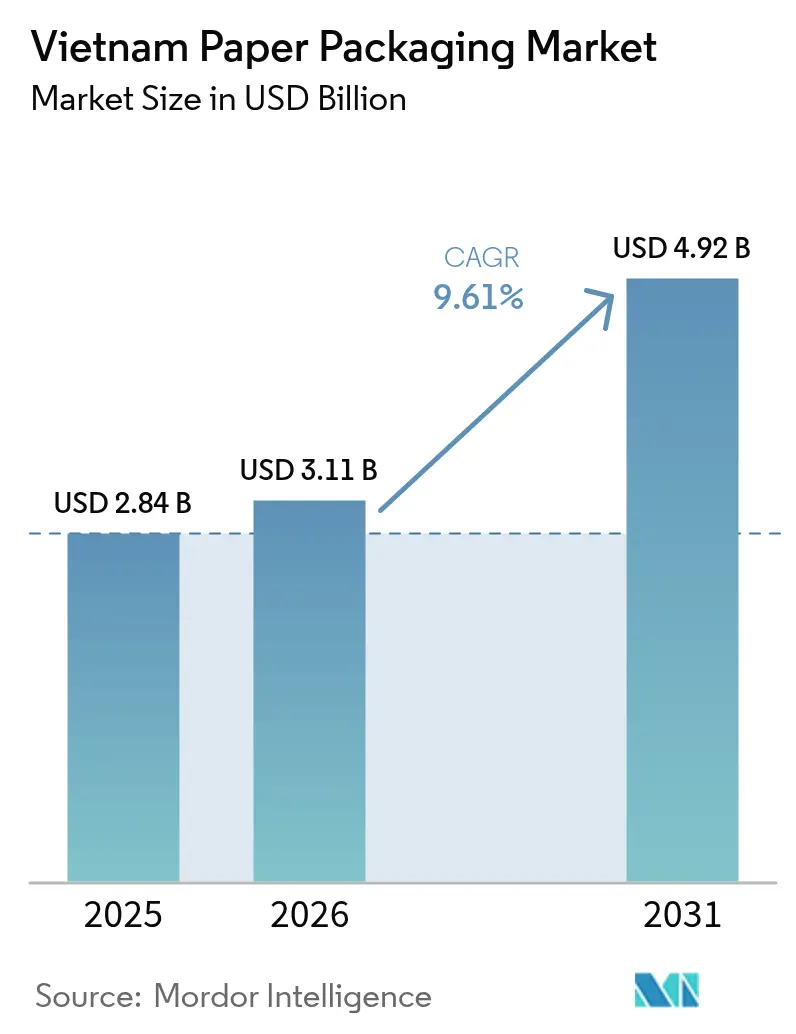
| Base Year Market Size (2025) | USD 2.84 Billion |
| Market Size (2026) | USD 3.11 Billion |
| Market Size (2031) | USD 4.92 Billion |
| Growth Rate (2026 - 2031) | 9.61 % |
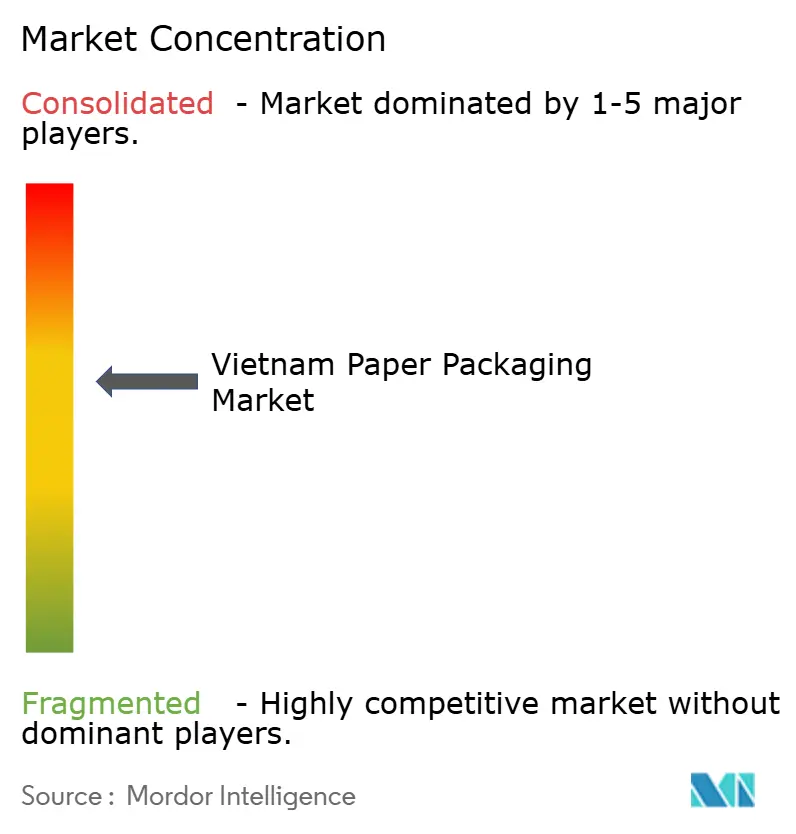
| Market Concentration | Medium |
Major Players *Disclaimer: Major Players sorted in no particular order Image © Mordor Intelligence. Reuse requires attribution under CC BY 4.0. | |
Vietnam Paper Packaging Market Analysis by Mordor Intelligence
The Vietnam paper packaging market size was valued at USD 2.84 billion in 2025 and estimated to grow from USD 3.11 billion in 2026 to reach USD 4.92 billion by 2031, at a CAGR of 9.61% during the forecast period (2026-2031). This expansion significantly outpaces the global average, underscoring Vietnam’s strategic role in Southeast Asia’s evolving supply chain framework. Rising middle-class consumption, robust foreign direct investment, and regulatory incentives such as extended producer responsibility requirements are accelerating demand for paper-based formats. The surge in e-commerce parcel volumes, the relocation of fast-moving consumer goods and electronics production, and brand-owner carbon-cut commitments all converge to bolster the Vietnam paper packaging market.[1]SD Link, “The Growth Potential of Smart Logistics in Vietnam 2025,” sdlink.vn Meanwhile, virgin-fiber shortages and volatile recovered-paper import rules create supply-side friction that keeps prices and capacity expansion in sharp focus.
Key Report Takeaways
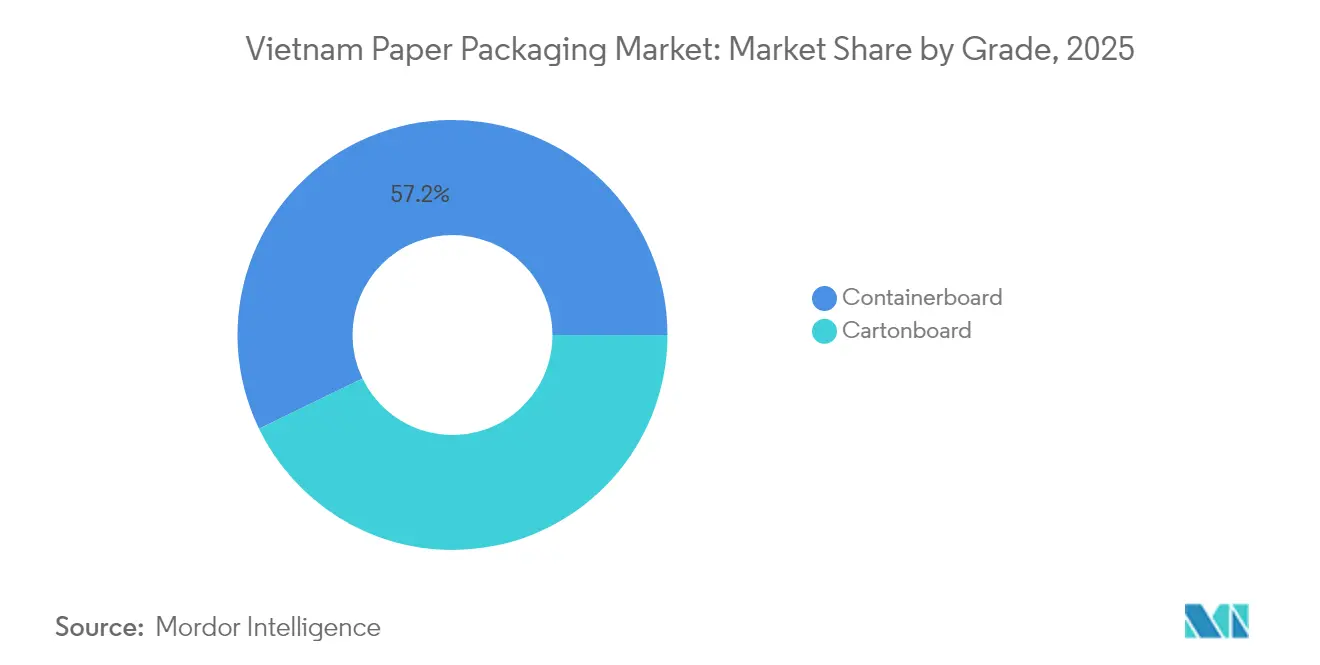
- By grade, containerboard captured 57.18% of the Vietnam paper packaging market share in 2025.
- By product, the Vietnam paper packaging market size for folding cartons is projected to grow at a 10.96% CAGR between 2026-2031.
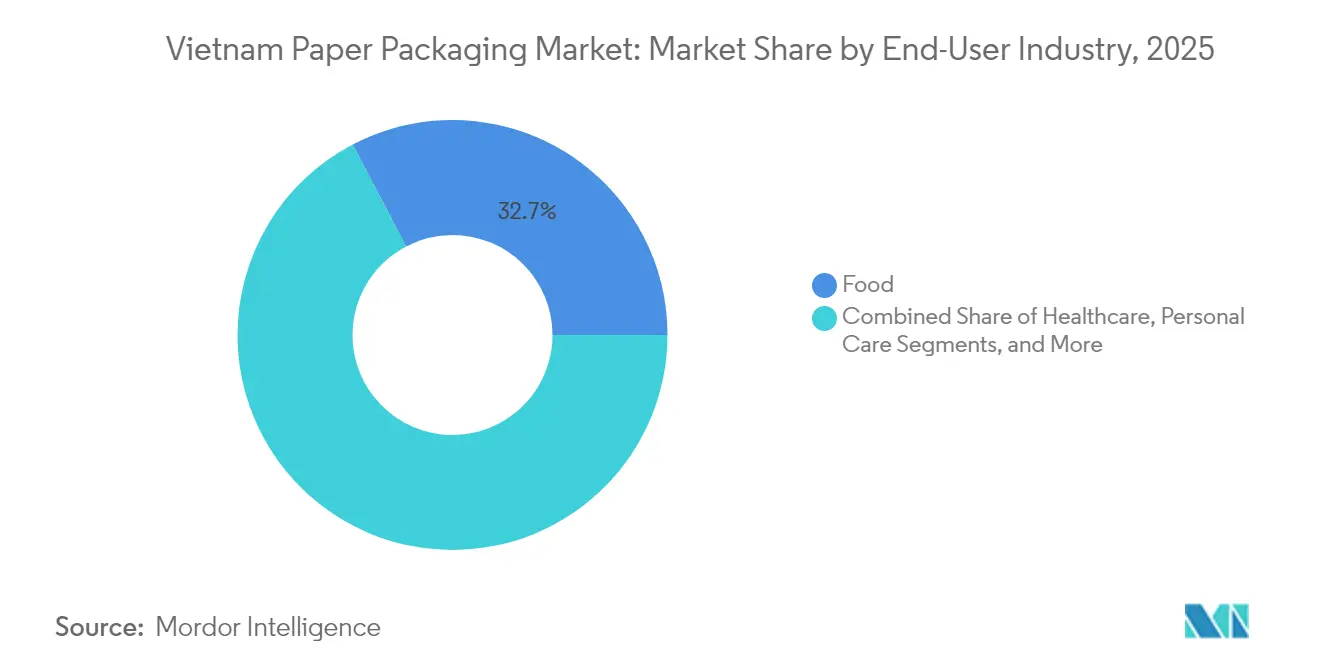
- By end-user industry, food applications captured 32.68% of the Vietnam paper packaging market share in 2025.
- By packaging format, the Vietnam paper packaging market size for molded fiber and pulp is projected to grow at a 11.78% CAGR between 2026-2031.
Note: Market size and forecast figures in this report are generated using Mordor Intelligence’s proprietary estimation framework, updated with the latest available data and insights as of 2026.
Vietnam Paper Packaging Market Trends and Insights
Drivers Impact Analysis*
| Driver | (~) Impact on CAGR Forecast | Geographic Relevance | Impact Timeline |
|---|---|---|---|
| Booming e-commerce parcel volumes | +2.1% | National, with concentration in Ho Chi Minh City, Hanoi, Da Nang | Short term (≤ 2 years) |
| Rapid FMCG and electronics off-shoring into Vietnam | +1.8% | Northern and Southern industrial zones, spillover to Central Vietnam | Medium term (2-4 years) |
| Plastic phase-out regulations (EPR and DRS) | +1.4% | National, early adoption in major cities | Medium term (2-4 years) |
| Foreign brand owners' Scope-3 carbon cuts push lightweight recycled board | +1.2% | Export-oriented hubs, multinational supplier networks | Long term (≥ 4 years) |
| Rise of social-commerce micro-fulfillment in tier-2 cities | +0.9% | Secondary urban centers, emerging e-commerce corridors | Medium term (2-4 years) |
| Tax-incentivized investments in high-speed digital printing lines | +0.7% | Industrial development zones, technology parks | Short term (≤ 2 years) |
| Source: Mordor Intelligence | |||
Booming e-commerce parcel volumes
National e-commerce turnover rose at a double-digit pace in 2024, driving aggregate parcel flows across Ho Chi Minh City, Hanoi, and Da Nang. The uptick amplifies demand for corrugated shipping containers engineered to survive multimodal logistics chains. Micro-fulfillment centers in tier-2 cities are shifting order profiles toward smaller-format boxes that fit parcel lockers and two-wheeler delivery racks. Vietnam’s Decision 221/QD-TTg targets a 9%–11% logistics GDP contribution, prompting automation upgrades that require standardized packaging dimensions for high-speed sortation. Capital spending of USD 5 billion earmarked for smart-logistics infrastructure through 2030 cements near-term volume visibility. The Vietnam paper packaging market gains immediate tailwinds from this parcel boom.
Rapid FMCG and electronics off-shoring into Vietnam
Over 66% of 2025’s fresh FDI pledges flowed into processing and manufacturing, catalyzing plant-level demand for transport-worthy cartons in Northern and Southern industrial belts. Snack-food producers, exemplified by the USD 90 million Ha Nam facility, anchor steady containerboard pull-through while prioritizing 100% sustainable sourcing goals. Electronics assemblers relocating from China specify anti-static liners, moisture barriers, and white-top kraftliners that meet global quality codes. Localization mandates by multinational corporations promote in-country board production to cut import reliance and Scope-3 emissions. As a result, the Vietnam paper packaging market secures long-run orders tied to foreign plant commissioning schedules.
Plastic phase-out regulations (EPR and DRS)
Decree 05/2025/ND-CP escalated carton-paper recycling quotas to 20% and lifted small-business exemptions, expanding producer compliance obligations nationwide. Twenty-four accredited recyclers now underpin a formal take-back network that feeds recovered fiber to domestic mills. The proposed Deposit-Return System could divert 77,000 tons of packaging waste annually, creating 6,400 formal jobs. Although compliance costs weigh on smaller converters, early adopters that integrate recycled content gain regulatory goodwill and preferred-supplier status with eco-conscious brand owners. Consequently, paper emerges as a functional substitute for banned plastic formats in the Vietnamese paper packaging market.
Foreign brand owners' Scope-3 carbon cuts push lightweight recycled board
Global companies impose emissions scorecards on suppliers, spurring demand for boards that use less fiber yet retain stacking strength. A EUR 217 million expansion lifts domestic output of advanced aseptic cartons to 30 billion units per year. Tetra Recart lines turn out 6,000 boxes per hour, achieving shelf-stable performance without preservatives. Lightweight recycled fluting and coated recycled board now qualify for high-graphics print, allowing exporters to hit carbon targets without sacrificing brand aesthetics. The Vietnam paper packaging market benefits as more multinationals specify these grades for regional sourcing.
Restraints Impact Analysis*
| Restraint | (~) Impact on CAGR Forecast | Geographic Relevance | Impact Timeline |
|---|---|---|---|
| Structural shortfall of domestic virgin fiber; import dependence | -1.6% | National, acute in Northern industrial zones | Long term (≥ 4 years) |
| Volatile recovered-paper import policy and quality controls | -1.1% | Port cities, recycling facility locations | Medium term (2-4 years) |
| US/EU trade actions on wood products tighten pulpwood feedstock | -0.8% | Export-oriented manufacturers, international supply chains | Medium term (2-4 years) |
| Industrial power-tariff hikes squeeze SME corrugators | -0.7% | SME manufacturing clusters, energy-intensive operations | Short term (≤ 2 years) |
| Source: Mordor Intelligence | |||
Structural shortfall of domestic virgin fiber; import dependence
Vietnam’s mills cannot meet surging kraftliner demand because the country lacks large-scale, sustainable forestry plantations. In early 2023, total packaging-paper consumption hit 284,530 tons even as imports rose 9.2% month-on-month, underscoring the gap.[2]Vietnam Pulp and Paper Association, “Monthly Bulletin March 2023,” rippi.com.vn Currency swings and freight costs translate quickly into linerboard prices, affecting converter margins. Premium grades that rely on long fiber face periodic shortages, forcing users to down-spec or pay surcharges. The fiber deficit, therefore, acts as a structural drag on the Vietnam paper packaging market.
Volatile recovered-paper import policy and quality controls
Customs inspections targeting contaminant thresholds lengthen dwell times at seaports, complicating mill scheduling. Periodic quota freezes on certain recovered-paper categories trigger spot-price spikes that ripple through the supply chain. Converters lacking vertical integration pass costs to end users, eroding competitiveness against plastic substitutes. Until stable guidelines emerge, the Vietnam paper packaging market remains exposed to input-price volatility.
*Our forecasts treat driver/restraint impacts as directional, not additive. The impact forecasts reflect baseline growth, mix effects, and variable interactions.
Segment Analysis
By Grade: Containerboard Dominance Amid Cartonboard Acceleration
Containerboard held 57.18% of the Vietnam paper packaging market share in 2025, a reflection of Vietnam’s export-oriented profile that relies on robust corrugating medium for global shipping. White-top kraftliner commands premium pricing in electronics clusters, whereas recycled fluting satisfies domestic food-and-beverage logistics. Semi-chemical fluting attracts buyers, balancing cost and strength. Cartonboard, although smaller, records an 11.13% CAGR to 2031, propelled by rising pharmaceutical labeling needs and retail-ready displays. Solid bleached sulfate and folding boxboard deliver high-graphics surfaces essential for brand differentiation among multinational FMCG firms. Coated recycled board and uncoated recycled board gain traction as eco-labels become purchasing criteria. Tetra Pak’s capacity boost dedicates 55% output to local buyers, signaling confidence in premium carton uptake.
The Vietnam paper packaging market size for containerboard is projected to rise steadily alongside warehouse construction in industrial parks. Meanwhile, the Vietnam paper packaging market size for cartonboard stands to benefit from regulatory pressure favoring lightweight formats with higher recycled content. Market positioning is thus shifting from commodity liner toward value-added board engineered for specific end uses and shorter print runs.


By Product: Corrugated Boxes and Containers Lead While Folding Cartons Accelerate
Corrugated Boxes and Containers accounted for 50.12% of the Vietnam paper packaging market size in 2025, as e-commerce and export shipping dominated volume patterns. Large shippers require B- and C-flute cases that strike a balance between crush resistance and stacking efficiency for sea freight. The rollout of USD 5 billion in smart-logistics infrastructure through 2030 ensures continued corrugated throughput. Folding cartons, however, are expanding at an 10.96% CAGR as healthcare and personal-care brands seek tamper-evident, shelf-ready solutions. Digital print subsidies accelerate carton customization, which supports premium pricing.
Down-gauge opportunities in corrugated remain limited until fiber supply stabilizes. In contrast, cartons utilize lightweight coated substrates to minimize material usage and align with Scope 3 emission targets. Molded pulp inserts integrated into folding-carton formats further differentiate offerings. The Vietnam paper packaging market is continuing to evolve from bulk shippers toward hybrid SKUs that combine structural protection with point-of-sale appeal.
By End-User Industry: Food Sector Stability Contrasts Healthcare Dynamism
Food applications accounted for 32.68% of the Vietnam paper packaging market share in 2025, driven by strong agricultural exports and rising domestic consumption of processed food. Shelf-stable beverage cartons benefit from the expansion of aseptic technology, which extends product reach into rural areas without cold-chain constraints. In contrast, healthcare packaging is expected to grow at a 10.05% CAGR as Vietnam localizes pharmaceutical production under industrial policy incentives. Tamper-evident folding cartons with braille embossing and moisture-barrier liners become standard.
Electronics account for a rising slice of demand after semiconductor investment surges, necessitating anti-static corrugated partitions. The personal-care and household-care segments follow urbanization trends, adopting high-graphics cartons that convey a premium positioning. The Vietnam paper packaging market thus pivots toward specialized end uses where compliance standards and branding drive incremental tonnage and higher margins.
By Packaging Format: Rigid Dominance Amid Molded Fiber Innovation
Rigid formats, including corrugated and solid board, commanded a 50.55% share of the Vietnam paper packaging market in 2025, reflecting Vietnam’s export container flows. Semi-rigid folding cartons anchor retail shelves, while flexible paper laminates serve niche food-service wrappers. Molded fiber, although accounting for less than 10% of the volume, is projected to post a 11.78% CAGR, driven by plastic-reduction mandates and the growing demand for electronics cushioning. Lightweight, form-fit pulp trays substitute for EPS foams, providing curb-side recyclability.
EPR quotas that require 20% recycled content favor molded-fiber solutions designed from post-consumer waste streams. Flexible formats are gaining momentum in single-serve beverage pouches lined with aqueous dispersions, which enable monomaterial recycling. The Vietnam paper packaging market, therefore, exhibits a format transition that rewards converters who invest in specialized tooling and barrier-coating expertise.
Geography Analysis
Northern industrial parks surrounding Hanoi draw electronics and automotive suppliers that require high-strength corrugated and specialty anti-static liners. Proximity to the China border ensures rapid component inflows, making the region the primary consumption hub for premium kraft grades. Southern economic zones anchored by Ho Chi Minh City handle high-volume FMCG export traffic, driving steady containerboard demand and supporting vertically integrated mills. Coastal ports such as Cai Mep reduce shipping lead times, further cementing the south’s share in the Vietnam paper packaging market size.
Central Vietnam, led by Da Nang, emerges as a growth corridor as infrastructure programs connect north and south logistics arteries. Government incentives lure foreign investors seeking diversification, creating green-field opportunities for mid-scale corrugators to supply new manufacturing clusters. Tier-2 cities in the Mekong Delta and Red River Delta adopt micro-fulfillment nodes for social commerce, boosting demand for right-sized cartons and digitally printed sleeves.
Border provinces benefit from ASEAN trade-corridor integration, necessitating multilingual labeling and compliance with varied regional standards. Here, folding-carton converters gain advantage by offering regulatory advisory and quick-turn artwork services. Overall, regional specialization enables the Vietnam paper packaging market to match localized needs, ensuring balanced national growth.
Regulatory Landscape
Vietnam’s paper packaging compliance is anchored in the Law on Environmental Protection 2020, which introduced Extended Producer Responsibility (EPR) obligations for packaging. Decree No. 110/2026/ND-CP, effective 25 May 2026, consolidated and superseded earlier implementing rules under Decree 08/2022/ND-CP and its amendments, formalizing how manufacturers and importers meet recycling responsibilities for packaging (including both direct and outer packaging across categories such as food, cosmetics, pharmaceuticals, and others).
Under Decree 110/2026/ND-CP, obligated companies must either organize recycling through self-collection and qualified recyclers/Producer Responsibility Organizations or make financial contributions to the Vietnam Environment Protection Fund (VEPF). The decree also adds cost guardrails by capping maximum adjustment rates (10% for recycling and 15% for waste treatment), and reinforces the use of authorized recycling parties listed via the National EPR Information System managed by the Ministry of Natural Resources and Environment. Packaging-related technical and environmental performance is further supported by Vietnam national standards (TCVN), including TCVN 12254:2018 (general packaging requirements), TCVN 12256:2018 (reuse), and TCVN 12259:2018 (organic recycling).
Competitive Landscape
The market features moderate concentration. SCG Packaging leverages regional scale and recently reported VND 7.77 trillion (USD 301 million) in Vietnamese revenue with EBITDA expansion supported by eco-efficient board grades.[3]Vietnam Investment Review, “SCG Achieves Strong EBITDA and Profit Growth,” vir.com.vnTetra Pak’s capacity additions strengthen the premium aseptic-carton niche and introduce high-throughput Recart® lines targeting shelf-ready food exports. Domestic mid-tier players focus on cost-competitive corrugated supply, while new entrants invest in digital presses to capture short-run carton work boosted by tax incentives.
Competitive intensity rises as foreign mills study joint ventures to secure fiber and tap Vietnam’s ASEAN-wide trade access. Sustainability remains the key differentiation lever: converters tout recycled-content certifications and carbon-footprint dashboards to appeal to international buyers. Companies that integrate upstream pulping or downstream logistics stand to widen margins. Nonetheless, SMEs retain a foothold by serving regional customers with flexible lead times.
Integration moves continue. SCG’s acquisition of Starprint augments downstream folding-carton capacity and flexible-packaging know-how, enabling cross-selling into electronics and healthcare accounts. Meanwhile, molded-fiber startups deploy proprietary tooling to penetrate premium electronics cushioning. These dynamics illustrate an evolving Vietnam paper packaging market where technology adoption and sustainability positioning shape competitive outcomes.
Vietnam Paper Packaging Industry Leaders
Starprint Vietnam Joint Stock Company
Tetra Pak International S.A.
SCG Paper Public Company Limited
Lee & Man Paper Manufacturing Ltd.
Oji Interpack Vietnam Co., Ltd
- *Disclaimer: Major Players sorted in no particular order

Market Opportunities and Future Outlook
EPR implementation under Decree 110/2026/ND-CP (effective 25 May 2026) shifts competitive advantage toward converters and mills that can document compliant recycling pathways or manage VEPF contribution workflows. This creates opportunities for services and systems that support recycled-content sourcing, take-back coordination, and reporting. For paper packaging suppliers serving regulated product categories (including food, cosmetics, and pharmaceuticals), compliance-ready offerings can be paired with materials that support circularity pathways referenced by TCVN packaging standards (for example, designs that enable reuse and recycling).
Capacity additions and technology-oriented projects in 2026 point to where demand pull is forming. Ninh Binh GDT Joint Stock Company began construction of a 360,000-tonnes-per-year packaging paper plant for electronic equipment packaging at Khanh Phu Industrial Park (VND 3,050 billion investment), SCGP announced a Baht 748 million expansion at its VKPC facility in Ho Chi Minh City adding 26,800 tonnes per year of fiber packaging capacity, and Minhan Paper placed an order for a second OCC recycling line at its Hung Yen facility designed for 700 t/d corrugating medium. These moves highlight opportunities in electronics-oriented grades, higher-automation fiber packaging lines, and expanded domestic recycled-fiber processing that reduces exposure to recovered-paper import volatility. Separately, Circular No. 12/2026/TT-BCT introduces QR-code traceability requirements for imported packaging (including corrugated paper and molded pulp) effective 1 July 2026, pushing packaging supply chains toward more formal traceability and data exchange, with spillover benefits for domestic suppliers that can meet traceability expectations in export-linked value chains.
Recent Industry Developments
- July 2026: Minhan Paper placed an order with Andritz for a second OCC recycling line for its Hung Yen province facility, designed for 700 tonnes per day of corrugating medium production. The project strengthens domestic recycled-fiber processing capability and supports more stable feedstock for containerboard grades tied to e-commerce and industrial demand.
- July 2025: Tetra Pak inaugurated the second-phase expansion of its aseptic carton packaging plant in VSIP II-A industrial park, Binh Duong, following a EUR 97 million investment. The upgrade lifted total capacity to over 30 billion packs annually and added multiple new formats, reinforcing Vietnam’s role as a regional supply base for beverage and food carton packaging.
- August 2024: Tetra Pak formally initiated construction of its Binh Duong facility expansion project. This step advanced a major capacity program for carton packaging materials, tightening the linkage between Vietnam’s industrial park manufacturing footprint and rising demand for paper-based packaging formats.


Research Methodology Framework and Report Scope
Market Definition and Coverage
For this methodology, the market covers the value of paper-based packaging sold and used in Vietnam, including common paperboard and containerboard grades that convert into cartons, corrugated packaging, and other paper packaging formats used by end-use industries.
Scope exclusions: We exclude plastic, metal, and glass packaging, and we also exclude equipment and services used to manufacture packaging.
Segmentation Overview
- By Grade
- Cartonboard
- Solid Bleached Sulphate (SBS)
- Solid Unbleached Sulphate (SUS)
- Folding Boxboard (FBB)
- Coated Recycled Board (CRB)
- Uncoated Recycled Board (URB)
- Other Cartonboard Grades
- Containerboard
- White-top Kraftliner
- Other Kraftliners
- White-top Testliner
- Other Testliners
- Semi-chemical Fluting
- Recycled Fluting
- Other Grades
- Cartonboard
- By Product
- Folding Cartons
- Corrugated Boxes and Containers
- Other Products
- By End-User Industry
- Food
- Beverage
- Healthcare
- Personal Care
- Household Care
- Electrical and Electronics
- Other End-User Industries
- By Packaging Format
- Rigid (Corrugated, Solid Board)
- Semi-rigid (Folding Cartons excluding Solid Board Boxes)
- Flexible Paper (Sachets, Wraps)
- Molded Fiber and Pulp Packaging Products
Data Sources, Market Sizing, and Validation
Desk Research
Desk research started with mapping Vietnam packaging demand using public statistics and industry references that are stable year to year. We used sources such as Vietnam General Statistics Office releases, Vietnam Customs import export trade tables for pulp, paper, and paperboard, World Bank macro indicators, UN Comtrade product flows, and FAO forestry and pulpwood context data, which helped us align the model with what the country can consume and produce.
To tighten assumptions, we also reviewed company annual reports and investor presentations of listed packaging and paper groups, press releases on capacity additions, and association and event websites that discuss packaging demand trends in food, beverage, and e-commerce. A paid subscription for company financials and a shipment level import export database were used selectively to cross-check revenue direction and trade mix, particularly for recovered paper and paperboard movements. These examples are not exhaustive, and many other public sources were also checked to collect inputs, validate patterns, and clear up data gaps.
Primary Interviews and Surveys
Primary work focused on validating what desk sources cannot show clearly, such as real conversion yields, pricing movement by grade, and the mix shift between corrugated and carton formats. We spoke with converters, paperboard suppliers, distributors, and large buyers in packaged food, beverage, personal care, and electronics, and then we rechecked assumptions with logistics and trade participants to confirm how imports and local output are being used. Since this is a single-country market, coverage was balanced across major industrial and consumption hubs so our checks reflect on-the-ground demand patterns.
Distribution of primary research fieldwork respondents
| Company type | Respondent position |
|---|---|
| Top tier: 39% | CXOs: 17% |
| Mid tier: 44% | Functional/Unit leaders: 39% |
| Smaller Players: 17% | Managers: 44% |
Market-Sizing & Forecasting
Market sizing used top-down and bottom-up logic, organized so the final totals stay traceable to real demand signals in Vietnam. On the top-down side, consumption was reconstructed using domestic paper and paperboard output, net trade indicators, and conversion into packaging use, and then it was further filtered through end-use demand signals such as packaged food volumes, beverage production trends, and e-commerce shipment growth. Where the inputs were noisy, we used primary feedback to set realistic loss factors and conversion ratios, which is where the market often gets overstated.
Bottom-up checks were then used to corroborate the totals, based on sampled supplier and converter revenue direction, capacity and utilization discussions, and ASP ranges by major grades and formats. Key inputs included paperboard price movement (local and imported), recovered paper availability, corrugating and carton demand mix, and changes in packaging intensity tied to retail and export manufacturing cycles. For forecasting, scenario analysis was used around price and volume drivers, and the assumptions were aligned to what industry respondents expect for capacity ramp-ups, regulation-led sustainability shifts, and trade sensitivity. When company-level numbers were missing, gaps were handled using peer averages by scale and product mix, followed by a reasonableness check against trade and production totals.
Data Validation & Update Cycle
Outputs were checked through triangulation across trade flows, production signals, and the implied packaging use per unit of end-market activity, and then outliers were reviewed before totals were finalized. We also ran variance checks by grade and format so that price jumps or sudden demand shifts did not create unrealistic swings across the time series, and follow-up calls were triggered when a key assumption moved beyond an expected band.
The report is refreshed annually, with interim updates when major events occur such as large capacity additions, sharp pulp or recovered paper price swings, or trade policy changes affecting inputs. Before delivery, a final analyst review pass is completed so the model reflects the latest available public data and the most recent primary feedback.
Mordor Intelligence's Vietnam Paper Packaging Market Size Versus Other Published Estimates
Published market sizes for Vietnam paper packaging can look far apart because different studies do not count the same set of paper grades, packaging formats, and sales channels, and they also pick different base years and price assumptions. The timing of currency conversion and the way imports are treated can add another layer of difference, especially in a market that relies on trade for key inputs.
Some external figures bundle a wider packaging definition by mixing in adjacent non-paper materials or by including packaging machinery and services, and then they apply broad price growth to push the value line up. In Mordor Intelligence, revenue is counted only for paper-based packaging products used in Vietnam, with grade-level and format-level checks tied back to net trade, local output, and realistic conversion yields.
Benchmark comparison
| Source | Market Size | Gaps in Research Methodology |
|---|---|---|
| Mordor Intelligence | USD 3.11 B (2026) | |
| Trade Journal A | USD 2.60 B (2024) | Uses an older base year and often treats the market as a single headline number without grade and format cross-checks, which can understate the uplift from recent demand growth and price movements. |
| Industry Portal B | USD 2.85 B (2025) | Matches the year closely but typically relies on simplified extrapolation and limited validation of conversion yields and import treatment, which can shift totals when trade and local production diverge. |
The spread across these published values mainly comes down to year selection, what is included in the product scope, and how paperboard pricing and trade are converted into packaging value. By keeping the model tied to observable Vietnam demand signals and then stress-testing it with primary checks on yields, ASP bands, and mix shifts, the final number stays balanced and repeatable for planning.


Key Questions Answered in the Report
What is the current value of the Vietnam paper packaging market size in 2026?
It stands at USD 3.11 billion.
How fast is the sector projected to grow between 2026 and 2031?
It is forecast to expand at a 9.61% CAGR, reaching USD 4.92 billion by 2031.
Which product category contributes the highest revenue?
Corrugated Boxes and Containers lead with 50.12% share of Vietnam paper packaging market size in 2025.
What is the primary catalyst behind rising corrugated-box demand?
Rapid growth in e-commerce parcel volumes across Ho Chi Minh City, Hanoi, and Da Nang is boosting consumption of sturdy shipping cartons.
How are Extended Producer Responsibility rules shaping material choices?
EPR mandates a 20% recycling rate for carton paper, encouraging brands to switch from plastic to lightweight recycled board and molded-fiber solutions.
Page last updated on:


 Your data is secure and never sold or shared.


