
Market Overview
| Study Period | 2020 - 2031 |
|---|---|
| Forecast Data Period | 2026 - 2031 |
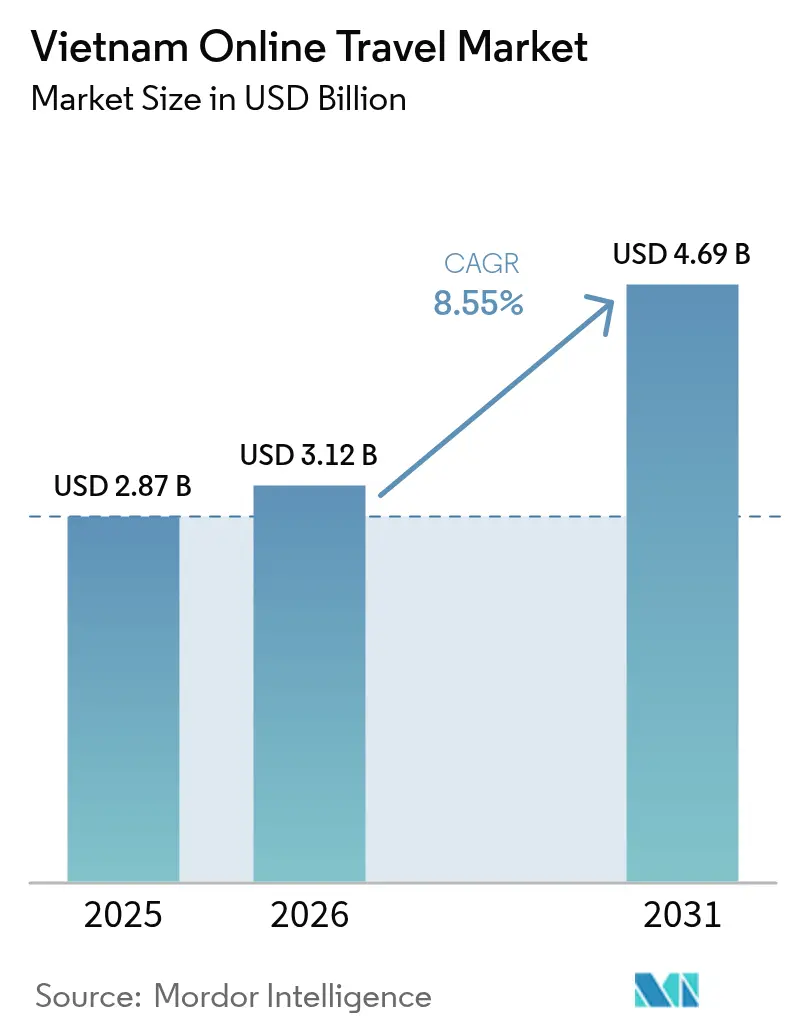
| Base Year Market Size (2025) | USD 2.87 Billion |
| Market Size (2026) | USD 3.12 Billion |
| Market Size (2031) | USD 4.69 Billion |
| Growth Rate (2026 - 2031) | 8.55 % |
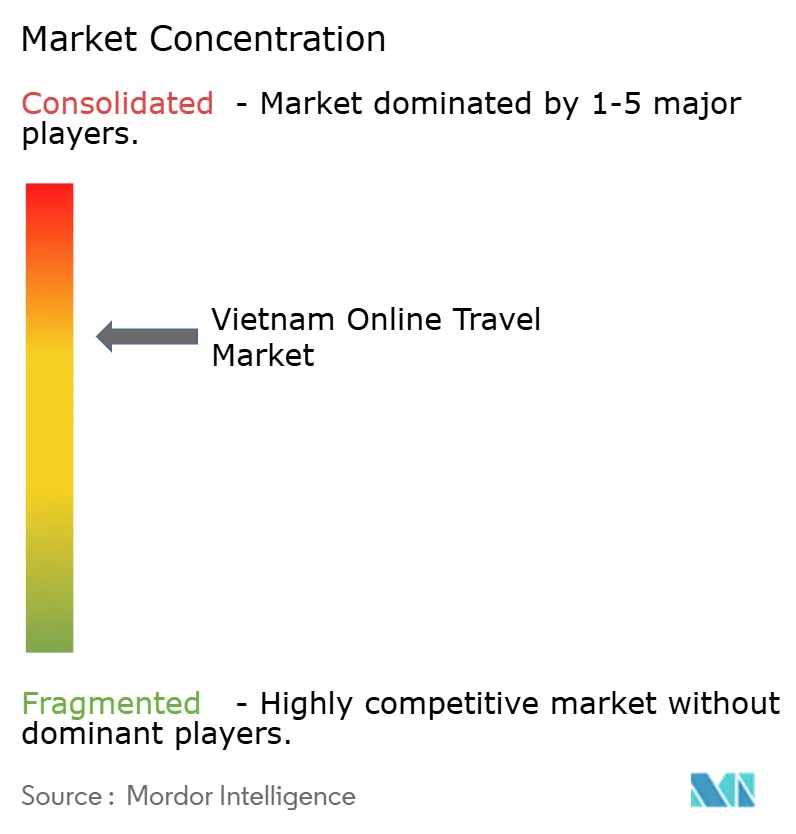
| Market Concentration | Medium |
Major Players *Disclaimer: Major Players sorted in no particular order Image © Mordor Intelligence. Reuse requires attribution under CC BY 4.0. | |
Vietnam Online Travel Market Analysis by Mordor Intelligence
The Vietnam Online Travel Market size was valued at USD 2.87 billion in 2025 and estimated to grow from USD 3.12 billion in 2026 to reach USD 4.69 billion by 2031, at a CAGR of 8.55% during the forecast period (2026-2031).
Accelerating digital-transformation policies, 78.8% internet penetration, and 87% smartphone usage keep transaction volumes high, while tourism’s rebound brings 17.6 million foreign visitors and 110 million domestic trips back into the pipeline. Mobile bookings dominate as digital-wallet users jump to 50 million and QR payments touch 62% penetration, removing friction from checkout flows. Expanded air routes by low-cost carriers lift seat capacity, and rail upgrades draw leisure travelers seeking greener journeys. The Vietnam online travel booking market faces price competition from foreign OTAs, yet domestic players exploit local language service and wallet partnerships to stay relevant.
Key Report Takeaways
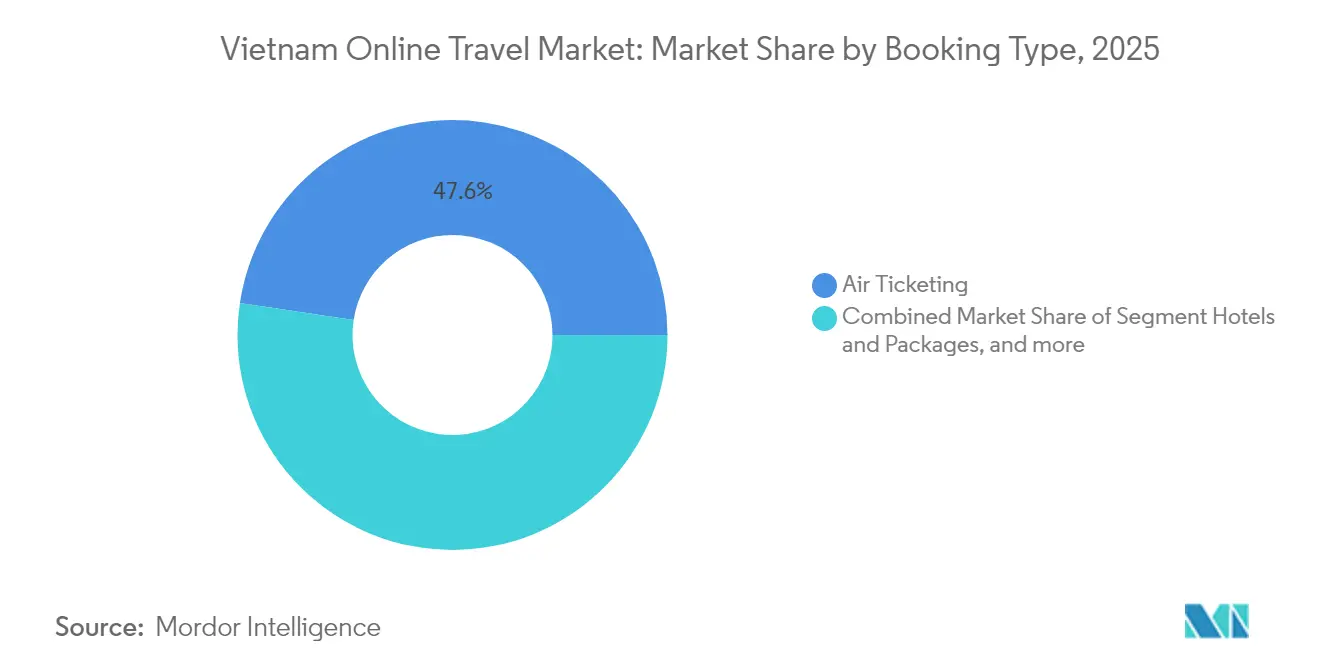
- By booking type, air ticketing led with 47.62% of the Vietnam Online Travel Market share in 2025; railway ticketing is poised for a 12.48% CAGR through 2031.
- By platform, mobile held 72.77% of the Vietnam online travel booking market share in 2025 and will rise at a 13.14% CAGR.
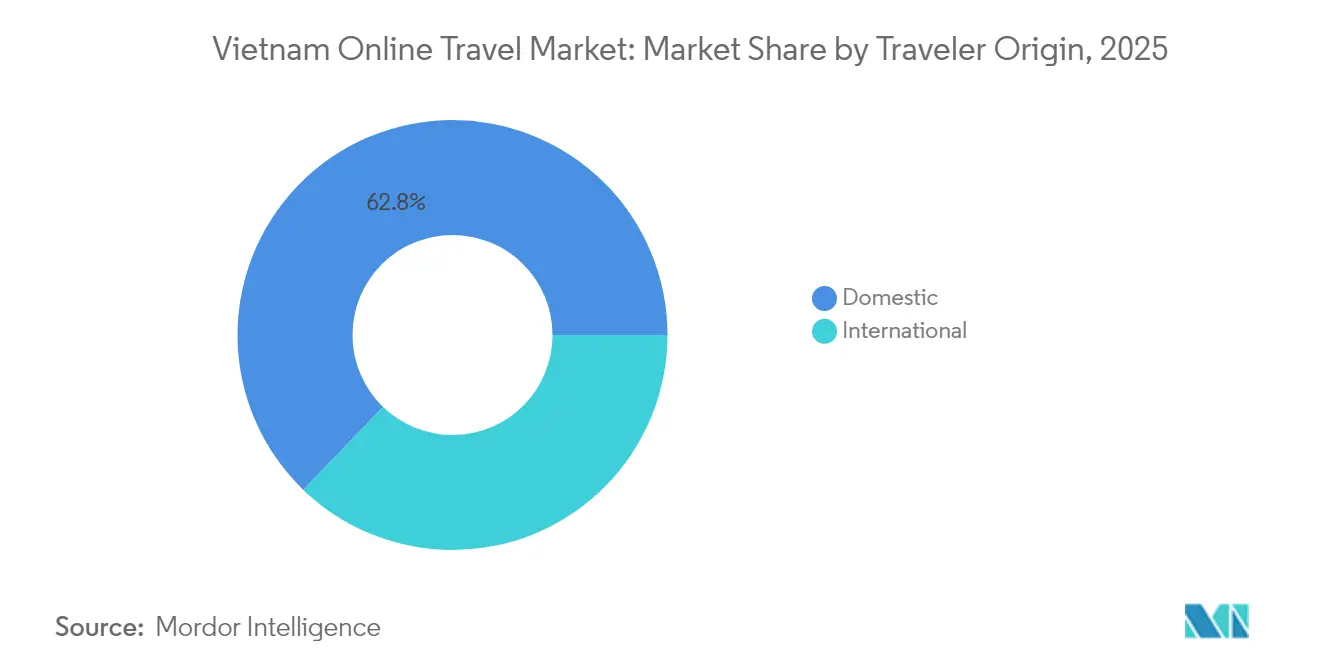
- By traveler origin, domestic bookings represented 62.78% of the Vietnam Online Travel Market in 2025, while the international segment grew fastest at 13.86% CAGR.
- By payment method, digital wallets commanded 46.12% of the Vietnam online travel booking market size in 2025 and will grow 15.2% a year.
- By region, Southern Vietnam captured 47.10% of 2025 revenue; Central Vietnam recorded the strongest 13.44% CAGR outlook.
Note: Market size and forecast figures in this report are generated using Mordor Intelligence’s proprietary estimation framework, updated with the latest available data and insights as of 2026.
Vietnam Online Travel Market Trends and Insights
Drivers Impact Analysis*
| Driver | (~) % Impact on CAGR Forecast | Geographic Relevance | Impact Timeline |
|---|---|---|---|
| Rising internet and smartphone penetration | 2.1% | Global, with strongest impact in Northern and Central Vietnam | Medium term (2-4 years) |
| Government smart-tourism and digital-transformation push | 1.8% | National, with pilot programs in major cities | Long term (≥ 4 years) |
| Low-cost carriers and expanded air connectivity | 1.5% | National, concentrated in major airport hubs | Medium term (2-4 years) |
| Surge in digital-wallet use enabling instant travel payments | 1.4% | Urban centers, expanding to rural areas | Short term (≤ 2 years) |
| Viral short-form video marketing of Vietnamese destinations | 1.2% | Global reach with domestic amplification | Short term (≤ 2 years) |
| Super-app ecosystems bundling travel services | 0.9% | Urban Vietnam, gradual rural expansion | Medium term (2-4 years) |
| Source: Mordor Intelligence | |||
Rising internet and smartphone penetration
Mobile connections stand at 127 million, equal to 126% of the population, and median download speeds of 75.72 Mbps keep booking apps responsive. Government 5G targets cover half of the current 4G sites by 2025 and 99% of the population by 2030, paving the way for AI itinerary builders and VR previews [1]. Higher connectivity also spurs spontaneous bookings for flash deals. The Vietnam online travel booking market, therefore, benefits from an ever-expanding digital audience, especially among Gen Z travelers who rely on super-apps for daily transactions.
Government smart-tourism and digital-transformation push
Decision 749/QĐ-TTg prioritizes tourism in the national digital-economy agenda and chases a 30% GDP share by 2030[2]. Hanoi’s stimulus plan earmarks VND 130 trillion for 2025 revenue via AI-powered promotion and real-time visitor dashboards. The obliges restaurants and attractions to accept e-payments, tightening links between physical experiences and online channels. These policies institutionalize digital habits, reinforcing the Vietnam online travel booking market across all age groups.
Low-cost carriers and expanded air connectivity
Vietnam Airlines aims for 25.4 million passengers in 2025, adding Hanoi–Milan and Ho Chi Minh City–Beijing services. Sun Group’s USD 99 million investment in Sun PhuQuoc Airways introduces 31 planes by 2030, boosting island capacity. Cheaper fares and denser route networks enlarge the inventory that OTAs can sell, while airline app promotions offer extra discounts to mobile shoppers, pushing further share gains for the Vietnam online travel booking market.
Surge in digital-wallet use enabling instant travel payments
Active e-wallets climbed 40% year on year to 50 million, and VietQR handled 1.29 billion transfers in 2023 with triple-digit growth early 2024. Partnerships between MoMo, VNPay, ZaloPay and Visa widen merchant acceptance. Rapid settlement reduces abandonment, and biometric log-in eases authentication. As checkout friction evaporates, conversion rates improve, and order values rise on upgrades such as seat selection and insurance.
Restraints Impact Analysis*
| Restraint | (~) % Impact on CAGR Forecast | Geographic Relevance | Impact Timeline |
|---|---|---|---|
| Foreign OTA dominance squeezing local margins | -1.8% | National, with strongest impact on local players | Long term (≥ 4 years) |
| Language and cultural barriers among older / rural users | -1.2% | Rural areas and secondary cities | Medium term (2-4 years) |
| High international airfares limiting inbound demand | -0.9% | International gateway cities | Short term (≤ 2 years) |
| Data-privacy and cyber-fraud concerns in mobile payments | -0.7% | Urban centers with high digital adoption | Medium term (2-4 years) |
| Source: Mordor Intelligence | |||
Foreign OTA dominance squeezing local margins
Booking.com, Agoda, and Traveloka collectively secure roughly 80% of digital travel turnover, leaving little headroom for local brands. Deep marketing budgets, global hotel inventory, and AI chatbots widen the gap. Domestic OTAs counter with Vietnamese interfaces and wallet tie-ups, yet still face a higher cost-per-acquisition. Margin pressure forces a shift toward niche products, rail passes, cultural tours, and B2B management to stay profitable in the Vietnam online travel booking market.
Language and cultural barriers among older / rural users
Only 43% of tourism workers have formal training, and fewer than 10% hold university degrees. Rural internet coverage lags, and many seniors distrust digital payments, pushing them toward offline agents. Small hotels lack integrated channel-management tools, so their rooms appear only on walk-in boards. These divides slow online migration in the Vietnam online travel booking market, though vernacular chat support and agent-assisted kiosks are gradually narrowing the gap.
*Our forecasts treat driver/restraint impacts as directional, not additive. The impact forecasts reflect baseline growth, mix effects, and variable interactions.
Segment Analysis
By Booking Type: Air still rules, rail gains pace
Air ticketing generated 47.62% of 2025 revenue for the Vietnam online travel booking market. Expansion by national and private airlines, coupled with app-only fare deals, keeps the segment dominant. Yet, railway ticketing posts a 12.48% CAGR outlook as the government upgrades tracks and coaches. Environmental messaging resonates with younger tourists seeking low-carbon trips, and rail API feeds now sync with major OTAs, allowing live seat selection. Hotels and packaged holidays hold the second-largest slice, boosted by chain upgrades such as TTC Hospitality’s asset rise to VND 4,544 billion. Bus and activity bookings contribute incremental sales and smooth seasonal swings. The Vietnam online travel booking market size for rail is therefore set to outstrip its modest base while air retains scale advantages.

By Platform: Mobile widens its lead
Mobile produced 72.77% of 2025 transactions, reflecting Vietnam’s 87% smartphone reach. Booking.com’s Trip Planner and Agoda’s AI coding tools personalize offers in Vietnamese, and Vietnam Airlines grants 10% app discounts on international legs. Voice search and vernacular chat reduce typing, appealing to first-time users. Desktop remains relevant for multi-stop corporate itineraries, yet its share slides each year. Wallet SDKs embedded in apps cut checkout to seconds, raising user stickiness. With 5G coverage targets approaching, the Vietnam online travel booking market will see mobile exceed three-quarters of gross bookings well before 2031.
By Traveler Origin: Foreign arrivals regain momentum
Domestic trips delivered 62.78% of 2025 sales, cushioning operators during border closures. The international segment now accelerates at 13.86% a year as visa-waiver extensions run to March 2028. China contributed 1.58 million visitors in Q1 2025, South Korea 1.26 million, together totaling 47% of the inbound volume. India records triple-digit growth on new direct flights and simplified e-visa flows. Russian arrivals rebound despite transit costs, aided by Vinpearl charter deals. Higher spend per booking and longer stays make this slice critical to future revenue diversity in the Vietnam online travel booking market.
By Payment Method: Wallets anchor cashless adoption
Digital wallets accounted for 46.12% of 2025 transactions and will grow 15.2% annually. Wallet-bank QR interoperability taps NAPAS rails, lowering merchant fees. Cards still cover 31% of value, especially for expatriate and corporate travelers, while bank transfers handle group tours needing collective approval. Cash keeps traction in remote areas yet shrinks as decree-led mandates push e-payments across food outlets and attractions. Elevated trust from PCI-CPoC certificates and AI fraud filters further cements wallet primacy in the Vietnam online travel booking market.
Geography Analysis
Southern Vietnam holds a 47.10% share on the strength of Ho Chi Minh City’s international gateway and Phu Quoc’s upscale resort pipeline. Tan Son Nhat Airport manages the bulk of foreign arrivals, and Sun Group’s terminal expansion expects over 100 aircraft slots for the APEC 2027 summit. Coastal resorts channel inbound leisure demand, while business travelers generate weekday occupancy. The Vietnam online travel booking market size for the south, therefore, eclipses other regions, yet growth has started to plateau as bases normalize.
Central Vietnam posts the fastest 13.44% CAGR. Da Nang’s international terminal upgrade draws charter flights from Northeast Asia, and UNESCO cities Hoi An and Hue lure cultural enthusiasts. Expressway completions in Quang Ngai–Hoai Nhon and Quy Nhon–Chi Thanh slash travel time, lifting weekend staycations. Cultural festivals and triathlons extend the season, and hospitality projects shift toward eco-friendly villas. The Vietnam online travel booking market captures these shifts as OTAs highlight bundled heritage passes and rail-seaside combos.
Northern Vietnam leverages Hanoi’s political status and heritage districts. The capital targets 31 million visitors and VND 130 trillion in tourism revenue in 2025 under a digital stimulus plan. High-speed roads now link Hanoi with upland cave systems and ethnic markets, broadening short-break choices. Business travel remains sturdy because top state agencies cluster in the city. While wallet usage is widespread in Hanoi, surrounding provinces still rely on cash or bank transfers. Tailored payment mixes therefore improve booking completion rates as the Vietnam online travel booking market broadens its geographic reach.
Regulatory Landscape
Vietnam’s online travel booking market sits within tourism governance overseen by the Ministry of Culture, Sports and Tourism (MCST) and the Vietnam National Authority of Tourism (VNAT), which manage travel-business licensing and accommodation classification. In June 2026, VNAT issued Official Dispatch 1744/CDLQGVN-LH to local tourism departments and businesses to strengthen tourism business management, reinforcing compliance and operational discipline across travel sellers, including online channels.
Regulatory direction is also moving toward digitization and state-led promotion. In June 2026, MCST issued Circular 15/2026/TT-BVHTTDL (effective August 15, 2026), which sets economic and technical norms for tourism promotion and branding services and affects how public-sector tourism marketing and related procurement are scoped and costed. At the same time, the government’s drafting process to revise the 2017 Law on Tourism includes steps such as simplifying administrative procedures and introducing electronic tour guide cards, aligning with broader digital-transformation efforts that influence online distribution and traveler servicing.
Value Chain Analysis
The Vietnam online travel value chain begins with travel supply creation and inventory management by airlines, rail operators, hotels, attractions, and tour operators. It then passes through technology and distribution layers, including channel managers, bedbanks, GDS/air consolidators, and payment rails, before reaching consumers through OTAs, metasearch, super-apps, and direct supplier apps. International OTAs such as Booking.com, Agoda, and Traveloka act as major demand aggregators, while domestic intermediaries like Vietravel, VNTrip, and BestPrice Travel emphasize localized servicing, packaging, and corporate travel management. Digital wallets and QR payment interoperability close the loop at checkout.
Recent strengthening has shown up in B2B enablement and institutional coordination. Amadeus expanded technology deployment with Vietnamese travel consolidators (including Hong Ngoc Ha Travel, En Viet, and PNR Travel) in 2025 to support improved digital ticketing and B2B platform capabilities, helping content flow faster across agents and OTAs. On the public side, 2026 reform priorities from MCST and government directives linked to Politburo Resolution 80-NQ-TW focus on tourism restructuring and smart-tourism requirements, pushing suppliers to digitize rates, availability, and traveler data integration. Fragmented distribution for small properties and uneven data transparency between platforms and service providers remain persistent bottlenecks.
Competitive Landscape
International giants dominate. Booking.com, Agoda, and Traveloka command roughly four-fifths of gross booking value, leaving 20% to domestic players. Booking Holdings uses generative AI to predict traveler intent and lift merchant revenues, while Agoda localizes payment options and loyalty perks for Asia-Pacific customers. Traveloka’s ecosystem approach blends travel with insurance and financing, driving more than 80% mobile usage.
Local challengers employ niche tactics. VNTrip highlights Vietnamese language service, VNPay wallet links, and 24×7 chat to attract domestic users. Vietravel exploits its 30-year agency network to bundle offline tours with online upsells. BestPrice Travel rolled out an AI assistant at VITM Hanoi 2025, signaling tech ambition. Railway tourism, sustainable lodges, and B2B expense management appear as white-space opportunities inside the Vietnam online travel booking market.
Cybersecurity remains a shared priority after 659,000 incidents were logged in 2024. Leaders invest in AI anomaly detection and tokenization to curb QR spoofing. As competition shifts from price wars to service depth, companies integrate live chat, voice booking and installment pay. The Vietnam online travel booking market thus sustains innovation momentum while gradually diversifying beyond air and hotel staples.
Vietnam Online Travel Industry Leaders
-
Bookings.com
-
Agoda
-
Traveloka
-
VNTrip.vn
-
Expedia Group
- *Disclaimer: Major Players sorted in no particular order
Market Opportunities and Future Outlook
Government-led digital tourism infrastructure is creating whitespace for platforms that can connect to national data and promotion systems. Decision 2710/QD-BVHTTDL (2024) sets requirements for a unified national tourism database, and Decision 1033/QD-TTg (2026) approved the National Digital Economy and Digital Society Development Programme (2026-2030), which prioritizes tourism digitization using AI and big data. For online travel sellers, these programs create room for verified content ingestion, standardized destination data, and API-based distribution to smaller operators that are not yet well supported by structured channel management.
Opportunities also sit with supply and content expansion by large integrated resort and attraction groups. These players are building partnerships that can translate into bookable inventory, bundles, and cross-selling through OTAs and super-app ecosystems. Vinpearl’s May 2026 strategic partnerships with Agoda, AirAsia MOVE, BeMyGuest, and GlobalTix support wider international distribution across its tourism and entertainment ecosystem, while Trip.com’s June 2026 MOUs with VinWonders and Sun World target global promotion of Vietnam’s offerings. The resulting product mix supports dynamic packaging, inbound-market merchandising, and more localized payment and customer support flows, particularly as mobile and wallet-led checkout continues to gain share in Vietnam.
Recent Industry Developments
- July 2026: Accor and Sun Group announced an expanded strategic partnership to develop more than 5,300 hotel, resort, and serviced residence keys in Vietnam across multiple brands. The pipeline increases branded room supply that can be distributed through OTAs and packaged with flights and experiences, strengthening inventory depth in key leisure and city destinations.
- June 2026: Trip.com Group announced new MOUs with VinWonders and Sun World to promote Vietnam’s tourism offerings globally. The agreements broaden access to bookable attractions and destination content on a major international platform, supporting more bundling of tickets, tours, and accommodation for inbound travelers.
- May 2026: Vinpearl signed strategic partnership agreements with Agoda, AirAsia MOVE, BeMyGuest, and GlobalTix to expand international access to its tourism and entertainment ecosystem. The tie-ups deepen connectivity between a large domestic supplier group and regional/global distribution channels, improving reach and conversion for bundled resort, theme park, and activity products.
Research Methodology Framework and Report Scope
Market Definition and Coverage
For this study, the Vietnam online travel market is defined as the value of travel services booked through online channels for Vietnam-related trips, where the booking is placed and confirmed on a website or app, across major travel products.
Scope exclusions: Offline and walk-in travel bookings, as well as trips only researched online but paid and confirmed fully offline, are excluded from the market value.
Segmentation Overview
- By Booking Type
- Air Ticketing
- Hotels and Packages
- Bus Ticketing
- Railway Ticketing
- Other Booking Types
- By Platform
- Desktop
- Mobile
- By Traveler Origin
- Domestic Travelers
- International Travelers
- By Payment Method
- Digital Wallets
- Cards
- Bank Transfer
- Cash on Delivery / Office Pay
- By Geography
- Northern Vietnam
- Central Vietnam
- Southern Vietnam
Data Sources, Market Sizing, and Validation
Desk Research
Desk research was used to set the market boundaries and build a clean starting view of travel demand, online adoption, and category splits before we moved into interviews. We referred to public and official sources such as the Vietnam National Authority of Tourism (VNAT), the General Statistics Office of Vietnam (GSO), the State Bank of Vietnam (SBV), the Civil Aviation Authority of Vietnam (CAAV), and airport operators such as Airports Corporation of Vietnam (ACV) to understand traveler movement and the shift toward online booking.
To avoid relying on one set of numbers, international references were also checked, such as UNWTO dashboards and IATA air passenger indicators, which help validate direction and reasonableness of travel recovery and capacity trends. Company filings, investor presentations, and reputable press coverage were used to understand channel strategies, mobile booking momentum, and price and promotion patterns. Where helpful, paid subscriptions were used for company financials and news intelligence, as well as patent databases to track feature themes that can affect conversion and repeat bookings. These sources are illustrative, and many other public and proprietary references were used for data collection, cross-checking, and clarification.
Primary Interviews and Surveys
Primary work was used to pressure test how online booking value is counted in practice across air ticketing, hotels and packages, and ground transport bookings. We spoke with a mix of online travel platforms, travel agencies with online channels, airlines and lodging groups, and supporting ecosystem experts to confirm take-rate behavior, discounting patterns, and the share of mobile bookings. To keep assumptions realistic, feedback was cross-checked across Northern, Central, and Southern Vietnam, and also across domestic and international traveler flows where booking behavior differs.
Distribution of primary research fieldwork respondents
| Company type | Respondent position |
|---|---|
| Top tier: 37% | CXOs: 15% |
| Mid tier: 48% | Functional/Unit leaders: 34% |
| Smaller Players: 15% | Managers: 51% |
Market-Sizing & Forecasting
Sizing was built using a top-down and bottom-up model design, where the main totals were reconstructed from Vietnam travel demand and digital booking penetration, and then tested using selective roll-ups. On the top-down side, the logic follows traveler volumes and traveler mix, and then applies online booking shares by booking type (air ticketing, hotels and packages, bus, rail, and other booking types) and by platform split (desktop versus mobile) to reach online booking value.
To keep inputs grounded, we used practical market signals that are observable and explainable, such as domestic versus international traveler origin, seasonality around peak travel months, payment method mix (wallets, cards, bank transfer, and cash-style pay options), average booking value by category, and cancellation or rebooking behavior that affects realized revenue. Where gaps existed, bottom-up checks were used, such as sampled price and volume builds for key routes and lodging nights, plus channel checks on conversion and discount depth, which were then used to adjust the market total back to a realistic range.
For forecasting, scenario analysis was used, because online travel in Vietnam is sensitive to shocks and step changes like visa policy, airline capacity, and payment adoption. Input assumptions for growth were aligned to expert feedback on travel demand normalization, mobile booking share gains, and platform-led promotions, and then cross-checked so the forecast curve stays consistent with travel and payments indicators.
Data Validation & Update Cycle
Validation was done through multiple rounds of cross-checks so that the final totals do not rely on one data stream. We compared model outputs against independent signals such as traveler counts, air passenger throughput, and digital payments adoption, and then reviewed any large year-on-year jumps at booking-type level before sign-off.
When inconsistencies appeared, assumptions were re-checked, source notes were revisited, and select interviewees were re-contacted to clarify definitions (for example, how packages are valued and when a booking is counted as completed). Reports are refreshed annually, and interim updates are done when material events occur that can move travel volumes or booking channels. Before delivery, an analyst completes a final review pass so clients receive the latest updated view.
Mordor Intelligence's Vietnam Online Travel Market Size Compared Against Other Published Estimates
Published values for Vietnam online travel often do not match because authors count different booking categories and apply different rules for what is considered an online transaction. Differences also come from whether the estimate is built from completed booking revenue by travel product or from broader digital spending totals that can blend travel with adjacent services.
By tracking booking-type revenue and refreshing traveler-origin, payment-method, and mobile-versus-desktop splits through field checks, Mordor Intelligence keeps the number tied to completed online bookings across air ticketing, hotels and packages, and ground transport, rather than wider online tourism spending that can include add-ons.
Benchmark comparison
| Source | Market Size | Gaps in Research Methodology |
|---|---|---|
| Mordor Intelligence | USD 2.87 B (2025) | |
| Trade Journal A | USD 4.00 B (2025) | Uses a broader online tourism value concept that may combine bookings with travel-adjacent services and does not clearly separate confirmed bookings from travel-related online spending. |
| Global Program B | USD 8.00 B (2030) | Presents a future target value for online travel and is not directly comparable to a base-year booking revenue estimate, with limited visibility on booking-type splits and the online booking definition. |
The spread in values is mainly explained by definition and time horizon, not by arithmetic differences. Once the scope is limited to confirmed online bookings and the build is traceable to booking types, traveler mix, and payment behavior, the market total becomes easier to reproduce and track over time.
Key Questions Answered in the Report
What is the forecast size of the Vietnam online travel booking market by 2031?
It is projected to reach USD 4.69 billion, growing at an 8.55% CAGR.
Which booking channel dominates the Vietnam online travel booking market?
Mobile apps dominate with 72.77% share and are still gaining ground.
How important are digital wallets for online travel in Vietnam?
Digital wallets already handle 46.12% of the payments and are forecast to grow 15.2% annually due to strong wallet–merchant partnerships.
Which region shows the fastest booking growth inside Vietnam?
Central Vietnam leads with a 13.44% CAGR, powered by Da Nang, Hoi An and UNESCO heritage tourism.
Who are the leading players in the Vietnam online travel booking market?
Booking.com, Agoda and Traveloka control around 80% of online turnover, while VNTrip and Vietravel are key local contenders.
What new transport developments will impact future bookings?
Expanded airline routes, Sun PhuQuoc Airways’ launch and upgraded rail lines will all add fresh inventory and reduce travel times, supporting further online growth.