
Market Overview
| Study Period | 2020 - 2031 |
|---|---|
| Forecast Data Period | 2026 - 2031 |
| Base Year Market Size (2025) | USD 3.71 Billion |
| Market Size (2026) | USD 3.84 Billion |
| Market Size (2031) | USD 4.66 Billion |
| Growth Rate (2026 - 2031) | 3.96 % |
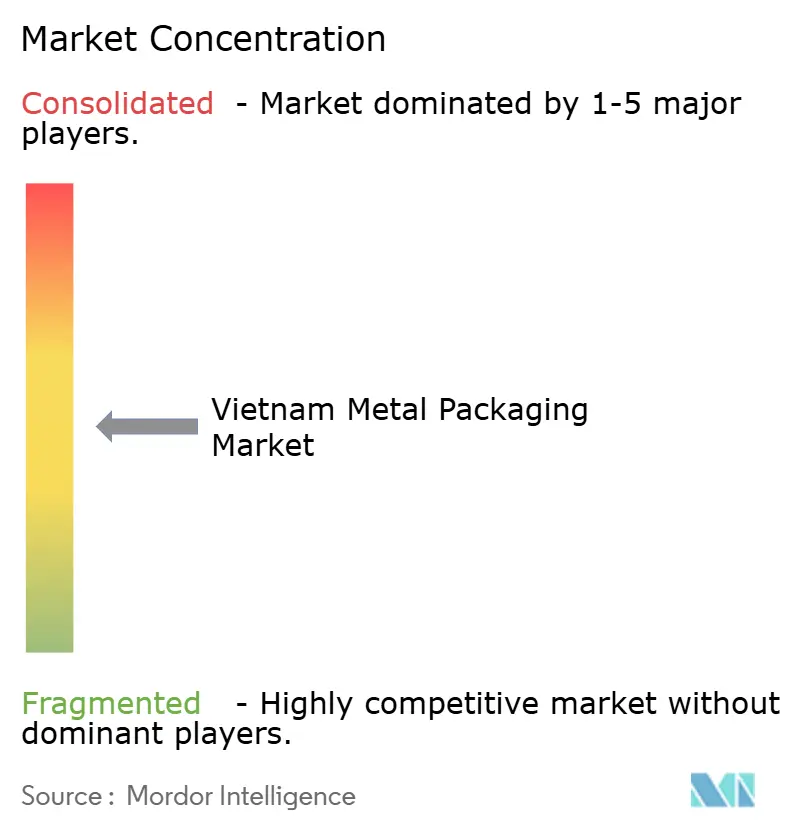
| Market Concentration | Medium |
Major Players *Disclaimer: Major Players sorted in no particular order Image © Mordor Intelligence. Reuse requires attribution under CC BY 4.0. | |
Vietnam Metal Packaging Market Analysis by Mordor Intelligence
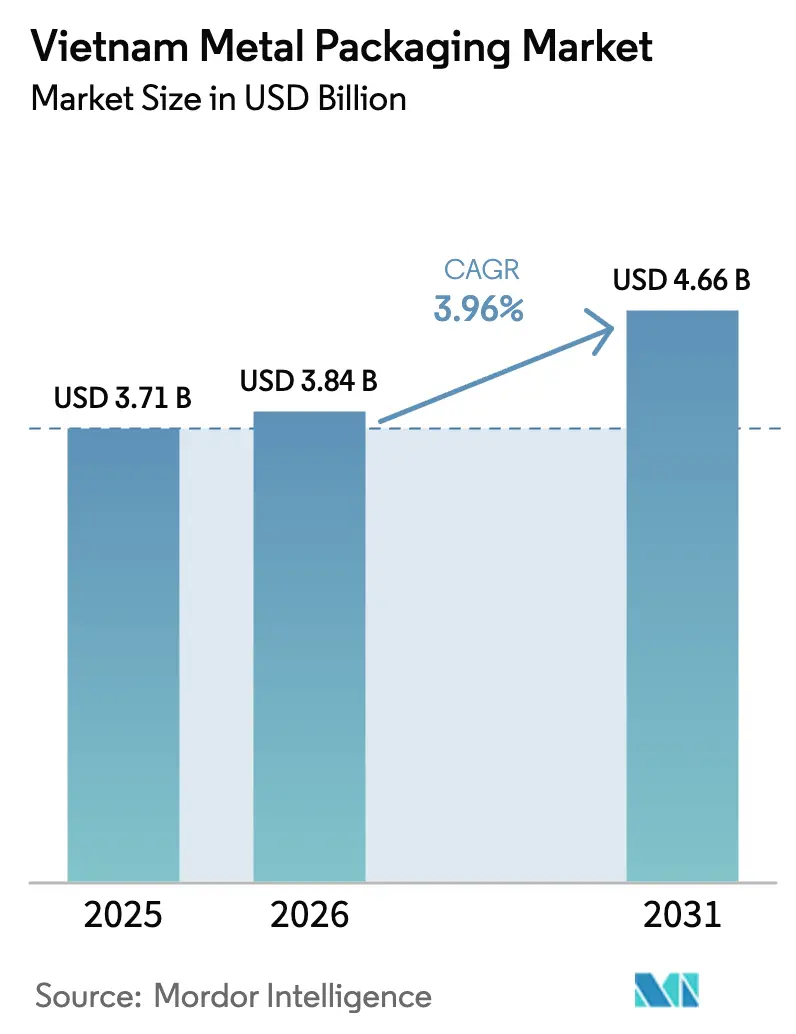
The Vietnam metal packaging market size is expected to increase from USD 3.71 billion in 2025 to USD 3.84 billion in 2026 and reach USD 4.66 billion by 2031, growing at a CAGR of 3.96% over 2026-2031. A wave of beverage-canning investments, favorable circular-economy policies, and rising urban disposable incomes are reinforcing demand, while aluminum-coil price swings and flexible-plastic substitution temper momentum. Multinational brewers, soft-drink producers, and seafood exporters are collectively lifting unit volumes, yet raw-material inflation is squeezing EBITDA margins for can makers that import 95% of their coil feedstock. Steel’s comeback in industrial barrels and drums, the growing preference for single-serve beverage formats, and e-commerce’s need for dent-resistant containers provide fresh avenues for suppliers able to balance cost and sustainability imperatives. As brands race to meet a 70% recycling mandate by 2030, metal’s recyclability advantage underpins its competitive moat, protecting the Vietnam metal packaging market from aggressive price promotions in flexible pouches.
Key Report Takeaways
- By material, aluminum led with 61.17% of the Vietnam metal packaging market share in 2025, whereas steel is forecast to expand at a 4.86% CAGR through 2031.
- By product type, beverage cans commanded 58.52% of the Vietnam metal packaging market share in 2025, while shipping barrels and drums are projected to advance at a 5.33% CAGR to 2031.
- By capacity, packages up to 1 liter accounted for 42.57% of the Vietnam metal packaging market share in 2025, and containers in the 1-to-25-liter bracket are expected to log a 4.48% CAGR through 2031.
- By end-use industry, beverages captured 38.23% share in 2025, yet industrial applications are on track to post a 5.24% CAGR to 2031.
Note: Market size and forecast figures in this report are generated using Mordor Intelligence’s proprietary estimation framework, updated with the latest available data and insights as of January 2026.
Vietnam Metal Packaging Market Trends and Insights
Drivers Impact Analysis*
| Driver | (~) % Impact on CAGR Forecast | Geographic Relevance | Impact Timeline |
|---|---|---|---|
| Surging Demand for Convenient, Ready-to-Eat Meals | +0.7% | National, with early gains in Hanoi, Ho Chi Minh City, Da Nang | Medium term (2-4 years) |
| Rising Urban Middle-Class Consumption Power | +0.9% | National, concentrated in urban centers and provincial capitals | Long term (≥ 4 years) |
| Government Push toward Circular Economy Targets | +0.8% | National, with pilot programs in Hanoi, Ho Chi Minh City, Binh Duong | Medium term (2-4 years) |
| Expansion of Domestic Beverage Canning Capacity | +1.2% | National, with major investments in Binh Duong, Quang Nam, Ba Ria-Vung Tau | Short term (≤ 2 years) |
| Growth of Export-Oriented Seafood Processing | +0.6% | Coastal provinces: Kien Giang, Ca Mau, Ben Tre, Ba Ria-Vung Tau | Medium term (2-4 years) |
| E-commerce Adoption Requiring Robust Transit Packaging | +0.5% | National, with spillover to rural provinces via logistics hubs | Long term (≥ 4 years) |
| Source: Mordor Intelligence | |||
Expansion of Domestic Beverage Canning Capacity
Vietnam recorded more than USD 600 million of brewery and soft-drink line upgrades between 2024 and 2025, effectively doubling aggregate canning throughput and positioning the country as Southeast Asia’s aluminum-can hub. Heineken alone committed USD 540 million to boosting capacity in Binh Duong, while Suntory PepsiCo increased output by 65% to 825 million liters per year. Faster line speeds, exemplified by Sunrise Packaging’s 2,000-cans-per-minute installation in March 2025, have trimmed unit costs by 12% and encouraged a switch from glass to cans for mainstream beers. Capacity additions are cascading upstream as Marubeni’s NM2 Aluminum Recycling project targets 50,000 tonnes of coil per year, easing reliance on imports.[1] The resulting supply security and cost stability are expanding the addressable market for Vietnam's metal packaging market.
Rising Urban Middle-Class Consumption Power
Vietnam’s urban middle class surpassed 36 million citizens in 2025, each earning more than USD 5,000 annually and favoring premium craft beers, ready-to-drink coffee, and imported spirits. Metal containers offer extended shelf life without refrigeration, a key advantage given the uneven cold-chain infrastructure. TBC-Ball’s 850-million-can plant in Binh Duong fulfills this upscale demand, supplying sleek cans that enhance shelf presence and meet Aluminium Stewardship Initiative standards. The same demographic is fueling a boom in pressurized household-care aerosols, with 47 new SKUs arriving in metal formats during 2024-2025. These lifestyle upgrades keep the Vietnam metal packaging market on a steady growth footing despite macro-economic volatility.
Government Push toward Circular Economy Targets
Decision 222 and Decree 05/2025 oblige brands to collect and recycle 70% of their packaging by 2030. Aluminum cans currently achieve 75% recovery in pilot schemes, well above flexible plastic’s 28% rate, allowing beverage companies to comply at lower cost. Resolution 122 reinforces this policy thrust by requiring a 50% cut in single-use plastics by 2030, prompting SABECO to reduce can-lid gauge 8% and commit to 100% recyclable formats. Investments in reverse-logistics networks, including Marubeni’s recycling venture, align economics with policy goals. Together, these mandates give the Vietnam metal packaging market a structural tailwind.
Surging Demand for Convenient Ready-to-Eat Meals
Retail modernization and time-pressed urban lifestyles are stimulating demand for canned meals that offer long ambient shelf life. Food-processing output advanced to USD 79.3 billion in 2024, up 7.4% year-on-year. Steel cans withstand high-temperature retort sterilization at 121 degrees Celsius, making them indispensable for export-ready seafood and prepared meals. European and North American buyers typically pay a 15-20% premium for hermetically sealed cans over pouches, feeding volume growth in the Vietnam metal packaging market. Domestic processors have responded with USD 180 million in line upgrades across Kien Giang and Ca Mau, widening demand for can-grade steel.
Restraints Impact Analysis*
| Restraint | (~) % Impact on CAGR Forecast | Geographic Relevance | Impact Timeline |
|---|---|---|---|
| Intensifying Competition from Flexible Plastics | -0.6% | National, with higher impact in food and personal-care segments | Short term (≤ 2 years) |
| Price Volatility of Imported Aluminum Coil | -0.8% | National, affecting all aluminum-can producers | Short term (≤ 2 years) |
| Environmental Opposition to Bauxite Mining | -0.3% | Central Highlands: Dak Nong, Lam Dong, Gia Lai | Long term (≥ 4 years) |
| Skill Gaps in High-Speed Can-Making Operations | -0.4% | National, concentrated in industrial zones lacking technical schools | Medium term (2-4 years) |
| Source: Mordor Intelligence | |||
Price Volatility of Imported Aluminum Coil
Spot aluminum hovered near USD 2,500 per tonne in early 2026 after peaking at USD 2,700 in 2024, a swing that compressed 8-12% EBITDA margins for can makers locked into annual supply contracts.[2] Showa Aluminum reported coil costs climbing to 68% of cost of goods sold in its 2024 filing, up from 62% in 2022, despite hedging 40% of 2026 needs. Dong depreciation added a further 3.2% cost burden in 2024.[3] Until domestic smelters come online, the Vietnam metal packaging market remains exposed to global commodity cycles that can abruptly erode profitability.
Intensifying Competition from Flexible Plastics
Flexible pouches cost 30-40% less than cans and weigh 85% less, enticing processors of sauces, ready meals, and personal-care goods to launch 120 new pouch SKUs in 2024-2025. The format claimed 18% of ready-meal volume in 2025, up from 12% in 2023, nibbling at food-can demand. Yet Decree 05/2025’s 70% recycling threshold and Resolution 122’s crackdown on single-use plastics raise compliance costs for flexible packaging, giving metal a defensive moat. Crown Holdings is leveraging this gap with embossed 330-milliliter sleek cans that resonate with craft brands and offset price gaps through premium shelf appeal.
*Our forecasts treat driver/restraint impacts as directional, not additive. The impact forecasts reflect baseline growth, mix effects, and variable interactions.
Segment Analysis
By Material: Aluminium Dominance Amid Steel Revival
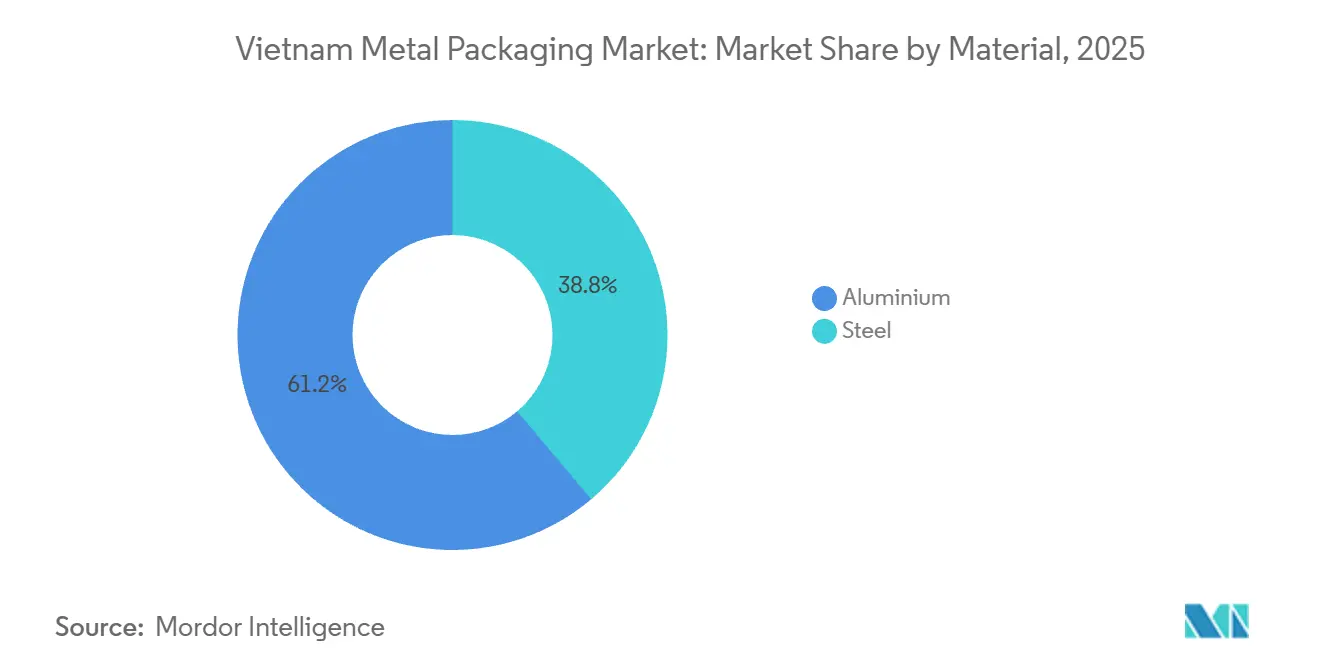
Aluminum secured 61.17% share of the Vietnam metal packaging market in 2025 as beverage giants installed 3.2 billion cans of annual capacity. In parallel, steel is expected to log a 4.86% CAGR through 2031, surpassing aluminum’s pace as seafood processors and paint makers migrate from plastic jerrycans to steel pails compliant with hazardous-goods rules. The Vietnam metal packaging market size for aluminum remains anchored by its 75% post-consumer collection rate and 18% freight-weight advantage versus steel, aiding multinationals under tightening Extended Producer Responsibility targets. Conversely, domestic steel capacity from Hoa Phat’s Dak Lak complex offers price stability and shorter lead times, tempting industrial buyers who prize supply security.
Aluminum’s future trajectory hinges on Marubeni’s 50,000-tonne recycling line, which slashes carbon footprints 95% and could elevate recycled content in beverage cans beyond 75%. Steel’s leap is spurred by e-commerce, where pails survive last-mile courier knocks that puncture flexible plastics, driving order-fulfillment providers to favor metal. With both substrates widening their addressable niches, the Vietnam metal packaging market shows healthy dual-material growth rather than a zero-sum battle.
By Product Type: Cans Lead While Drums Accelerate
Beverage and food cans contributed 58.52% of market share in 2025, cementing their primacy in the Vietnam metal packaging market. Shipping barrels and drums, buoyed by USD 9.2 billion in seafood exports and USD 45 billion in chemical shipments, are forecast to outpace every other product group at a 5.33% CAGR through 2031. The Vietnam metal packaging market share for cans remains insulated from pouch incursion, thanks to carbonation needs and consumer preference for metal freshness cues. Meanwhile, aerosol cans captured 8% of 2025 output as personal-care brands embraced pressurized dispensers.
Greif’s Ba Ria-Vung Tau facility reported 18% volume gains in 2024 as 200-liter steel drums found takers among fish-sauce exporters complying with EU food-contact rules. Drum durability also resonates with chemical shippers seeking IMO-approved barrels. Crown Holdings’ embossed sleek can, adopted by 22% of microbreweries within six months, illustrates the ongoing premiumization in can design that sustains higher margins. These dual trends reinforce diversified growth across the Vietnam metal packaging market.
By Capacity: Single-Serve Formats Drive Volume
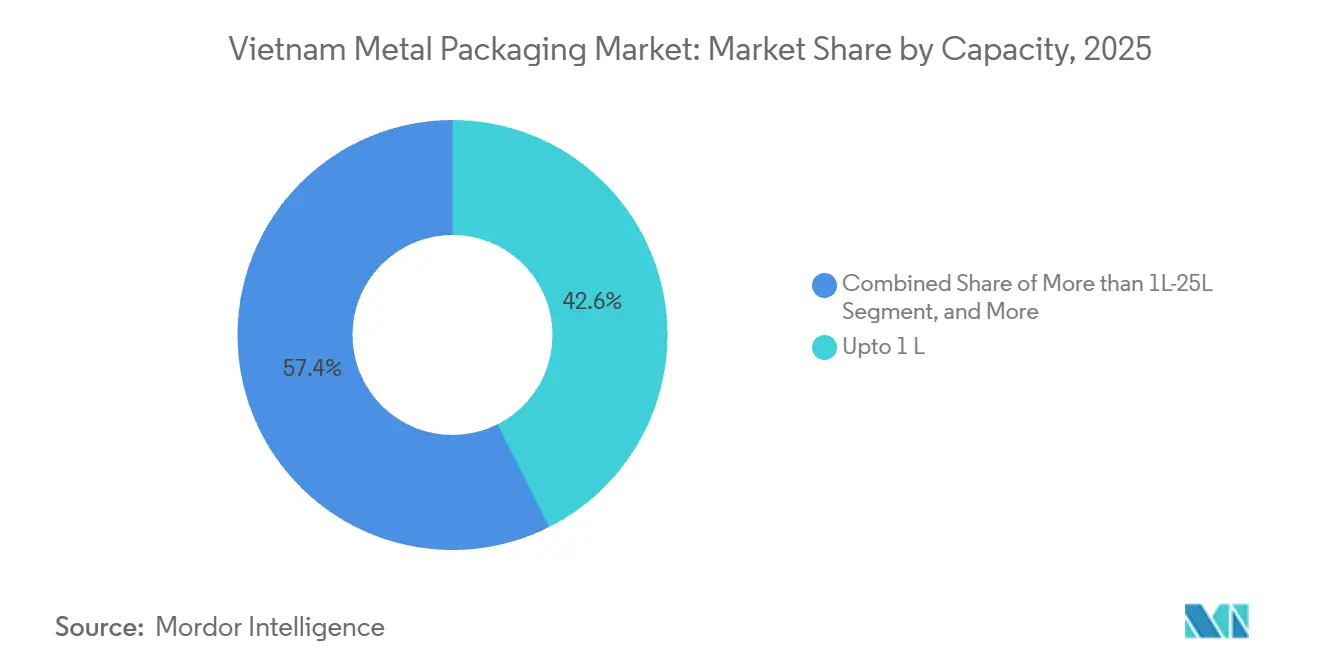
Packages up to 1 liter accounted for 42.57% of market share in 2025, as on-the-go consumption lifted 330-milliliter and 500-milliliter cans. Containers in the 1-to-25-liter band are set to grow 4.48% annually through 2031, driven by paint manufacturers replacing 40% of plastic jerrycans with steel pails to meet ISO 14001 targets. The Vietnam metal packaging market size for mid-volume pails benefits from lower damage rates in e-commerce, where metal withstands the last-mile journey better than flexible alternatives.
TBC-Ball’s 850-million-can line feeds demand for single-serve beverages, while online retailers in Ho Chi Minh City report 30% fewer returns for pail-packed DIY paints versus plastic equivalents. Industrial drums above 200 liters retain a 14% share thanks to seafood bulk exports, with processors in Kien Giang using steel barrels that tolerate retort sterilization. Collective demand across these capacity bands underscores the balanced expansion of the Vietnam metal packaging market.

By End-Use Industry: Beverage Anchors Industrial Surges
Beverage brands held 38.23% of market share in 2025, supported by USD 600 million in canning investments and per-capita beer consumption hitting 47 liters. Industrial applications, spanning paints, chemicals, and lubricants, are projected to clock a 5.24% CAGR to 2031, the sharpest climb among end-users. The Vietnam metal packaging market share for beverages benefits from carbonation integrity and premium branding, whereas industrial buyers value steel’s puncture resistance and compliance with IMDG codes.
Food processors account for 28% of volume, driven by canned tuna and tropical fruit exports that require hermetic seals for EU and U.S. distribution. Personal-care and pharmaceutical segments combined for 18% in 2025, with aerosol cans growing 12% year-on-year. Extended Producer Responsibility rules are nudging paint firms toward metal pails, while seafood exporters rely on drums to secure cold-chain integrity. This multipronged demand confirms the resilience of the Vietnam metal packaging market across consumer and industrial realms.
Geography Analysis
Southern provinces, including Binh Duong, Dong Nai, and Ba Ria-Vung Tau, host roughly 55% of installed capacity, leveraging proximity to Ho Chi Minh City’s 10 million consumers and export docks that channel seafood and chemicals abroad. TBC-Ball’s plant in Binh Duong’s Vietnam-Singapore Industrial Park IIA churns out 850 million cans annually for Heineken and craft breweries. Crown Holdings maintains twin lines in Ho Chi Minh City and Dong Nai, underpinning the Vietnam metal packaging market’s southern concentration.
Northern clusters around Hanoi contribute 25% capacity, buoyed by Sunrise Packaging’s 2,000-cans-per-minute upgrade in Bac Ninh. Logistics arteries connecting Haiphong port to China amplify export efficiency for shipping bulk lubricants in steel drums. Central Vietnam, anchored by Da Nang’s cargo throughput of 8.5 million tonnes in 2024, commands 12% of capacity, supported by Showa Aluminum’s unit in Quang Nam, which serves regional soft-drink bottlers.
The Mekong Delta accounts for 8% and specializes in steel cans for canned seafood and 200-liter drums for fish sauce. Capacity growth here lags due to fragmented infrastructure, yet rising EU demand for certified canned tuna is spurring new line installs in Kien Giang. Hoa Phat’s Dak Lak steel complex, commencing operations in June 2025, is expected to shorten coil lead times for central and northern can makers, reducing freight costs and balancing regional supply. Collectively, these geographic dynamics keep the Vietnam metal packaging market well diversified across the country’s north-south corridors.
Regulatory Landscape
Vietnam regulates metal packaging used for direct food contact through the Ministry of Health (MOH), notably via QCVN 12-3:2011/BYT issued under Circular 34/2011/TT-BYT (effective from March 1, 2012). The framework covers stainless steel, steel, aluminum, and associated internal coatings, and requires migration safety controls, including heavy-metal migration testing.
For manufacturers and importers of cans, lids, and other metal containers that contact food, compliance typically involves preparing and maintaining technical dossiers, plus completing required product declaration or self-declaration and related administrative filings with competent state agencies. These requirements affect material selection and coating systems for food and beverage metal packs and raise the value of documented quality systems for suppliers serving multinational beverage and food brands.
Value Chain Analysis
Vietnam's metal packaging value chain starts with upstream inputs, mainly imported aluminum coil and tinplate or steel sheet, along with coatings, inks, and can-making equipment. These inputs move into converting operations in key industrial corridors, such as Binh Duong industrial zones like VSIP II-A, where manufacturers form and print cans, ends, closures, and larger industrial packs such as pails and drums, then run QA, packing, and distribution.
Downstream, metal packaging is sold either directly to brand owners (beverage, food, aerosol, chemical, and paint) or via contract manufacturing and filling arrangements. Alongside converters such as Canpac Vietnam (end-to-end metal packaging supply), Vietnam also supports beverage contract filling capabilities, including Nihon Canpack (Vietnam) (Hokkan Holdings group), which provides processing and filling lines and drives demand for compliant, food-contact metal containers. Reverse logistics and recycling link back to upstream supply, shaped by circular-economy targets and EPR compliance needs in the country.
Competitive Landscape
The Vietnam metal packaging market is moderately fragmented, including companies such as Crown Holdings, Ball Corporation, and Showa Aluminum. Scale economies favor multinationals; Crown’s embossed sleek can captured 22% adoption among microbreweries six months after launch, illustrating the branding leverage wielded by global suppliers. TBC-Ball secured Aluminium Stewardship Initiative certification in 2022, enabling premium craft labels to meet imported-content disclosure rules, a differentiator that smaller players struggle to match.
Technology investment is the contest’s second pillar. Sunrise Packaging’s USD 55 million Bac Ninh upgrade shaved unit costs by 12% and signaled a move from commodity to value-added production. Greif’s 200-liter drum line leverages robotics to deliver defect rates below 0.5%, critical for hazardous-goods transport. Meanwhile, Marubeni’s recycling joint venture secures closed-loop coil, insulating affiliated can makers from LME volatility.
Regional conglomerates are pursuing M&A to gain instant capacity. SCG Packaging achieved full control of Duy Tan in June 2025 for USD 108.8 million, positioning itself against metal incumbents through multimaterial offerings. Adjacent players such as Tetra Pak and Indorama Ventures have also invested heavily, confirming Vietnam’s status as a strategic packaging hub. Competitive intensity is rising as regulatory deadlines loom, and suppliers that combine high-speed lines, recycling capability, and sustainability accreditation are best positioned to grow share within the Vietnam metal packaging market.
Vietnam Metal Packaging Industry Leaders
-
Canpac Vietnam Co., Ltd
-
Nihon Canpack (Vietnam) Co., Ltd.
-
Crown Holdings, Inc.
-
Showa Aluminum Can Corporation
-
TBC-Ball Beverage Can VN Ltd (Ball Corporation)
- *Disclaimer: Major Players sorted in no particular order
Market Opportunities and Future Outlook
Compliance-driven upgrades in food-contact metal packs represent a practical whitespace area, as suppliers align metal substrates, lacquers, and documentation practices with MOH requirements under QCVN 12-3:2011/BYT and Circular 34/2011/TT-BYT. This shifts advantage toward producers that can provide test evidence, traceability, and customer-ready dossiers for cans, lids, and closures used in food and beverage, particularly as brands manage packaging collection and recycling obligations under Vietnam's circular-economy agenda.
Operational scaling and end-use diversification also create opportunity, supported by active industrial footprints and multi-segment demand. Canpac Vietnam, operating from Binh Duong, reported net sales revenue growth in 2024 (up 13.25%) alongside asset expansion, signaling scope for better capacity utilization and portfolio expansion across food, coffee, aerosol, and industrial segments, including exports within Asia. In parallel, contract filling capability, including Nihon Canpack (Vietnam) with high-temperature sterilization and retort processing lines, supports growth in ready-to-drink and shelf-stable beverages, reinforcing demand for standardized, high-quality beverage cans and ends while increasing the premium for consistent line performance and defect control.
Recent Industry Developments
- January 2026: The Dong Nai Department of Industry and Trade accepted a product self-declaration from Crown Beverage Cans Vietnam Co. Ltd., following the company holding FSSC 22000 certification (issued July 11, 2025, valid until August 12, 2028). The step improves customer qualification for food and beverage applications where documented safety systems and local administrative acceptance are required, tightening the competitive bar for smaller can makers.
- December 2025: Baosteel began construction of a flat-rolled steel plant positioned to serve beverage-can and industrial-drum coil demand. The move highlights upstream focus on can-grade and drum-grade steel supply, a key lever for cost and lead-time competitiveness in Vietnam's steel packaging segments.
- August 2024: Crown Holdings achieved Aluminium Stewardship Initiative (ASI) Performance Standard V3 (2022) certification covering its Vietnam-based Asia Pacific Division management responsibilities and its two-piece aluminum beverage can manufacturing at CROWN Beverage Cans Danang Limited. With two production lines and 1.4 billion cans of annual capacity at Danang, the certification supports sustainability claims and procurement eligibility for brands prioritizing verified responsible aluminum sourcing.
Research Methodology Framework and Report Scope
Market Definition and Coverage
This market covers the value of metal packaging used in Vietnam across common pack formats, counted at the point where the packaging is sold into end users such as food, beverage, and industrial customers.
Scope exclusions: This sizing excludes non-metal packaging formats (such as paper, glass, and flexible plastics), even when they compete for the same filling lines.
Segmentation Overview
- By Material
- Aluminium
- Steel
- By Product Type
- Cans
- Food Cans
- Beverage Cans
- Aerosol Cans
- Bulk Containers
- Shipping Barrels and Drums
- Caps and Closures
- Other Product Types
- Cans
- By Capacity
- Upto 1 L
- More than 1L to 25L
- More than 25L to 200L
- Above 200L
- By End-use Industry
- Beverage
- Food
- Paint and Chemical
- Industrial
- Other End-use Industries
Data Sources, Market Sizing, and Validation
Desk Research
Desk work started with public demand and production signals that can be tracked consistently year to year. We referenced sources such as Vietnam General Statistics Office releases, Vietnam Customs trade statistics, UN Comtrade, World Bank macro indicators, and packaging and recycling policy releases from relevant ministries to understand consumption direction and material shifts.
To convert those signals into a market model, we also reviewed company annual reports, investor presentations, industry association websites, and credible business press for capacity additions, can line installations, and pricing commentary. Where it helped to standardize financial and trade series, paid subscriptions were used for company financials, patent lookups, and shipment-level import and export checks. These examples are not exhaustive, and many other sources were used for data collection, validation, and clarification.
Primary Interviews and Surveys
Primary inputs came from interviews and structured surveys with packaging converters, material and component suppliers, distributors, and large end users that buy metal packs for filling. We used these discussions to confirm which formats are expanding fastest, how contract pricing is reset, and what typical utilization and scrap recovery assumptions look like across Vietnam.
To reduce one-sided views, we balanced coverage across major consuming corridors and export-oriented manufacturing hubs, and we followed up when desk indicators and on-ground feedback did not align.
Distribution of primary research fieldwork respondents
| Company type | Respondent position |
|---|---|
| Top tier: 39% | CXOs: 13% |
| Mid tier: 46% | Functional/Unit leaders: 27% |
| Smaller Players: 15% | Managers: 60% |
Market-Sizing & Forecasting
Sizing used a top-down build that starts from Vietnam demand pools in packaged food, beverages, and industrial goods, which are then translated into metal packaging use through penetration rates and pack-mix splits. Those totals were checked against selective bottom-up approximations, such as supplier roll-ups for key formats and sampled price-times-volume calculations, before the final totals were adjusted.
A few of the inputs that materially shape the model include beverage canning volumes, processed food output and export trends, shifts between aluminum and steel in specific packs, average pack weights that change with lightweighting, and import dependence for coil and sheet that affects conversion costs and pricing. Where direct data was missing for smaller end uses, gaps were handled through conservative proxy ratios that were validated in expert calls.
For forecasts, we relied on scenario analysis anchored to macro and category demand outlook, then refined with expert expectations on capacity additions, utilization, and the pace of recycling and regulation-driven substitution.
Data Validation & Update Cycle
Validation is done by comparing the modeled totals against independent signals, including trade flows of relevant inputs, announced capacity movements, and category-level packaging intensity checks. Any sharp jumps are reviewed for one-off effects, currency timing, or a pack-mix change, and assumptions are revisited before internal sign-off.
Reports are refreshed annually, and interim updates are made when there are material events that can shift prices, demand, or supply. Before delivery, we do a final review pass so the numbers reflect the latest available information and any recent market developments.
Mordor Intelligence's Vietnam Metal Packaging Market Size Measured Against Other Published Estimates
Published market sizes for Vietnam metal packaging often differ because the coverage lines are drawn differently, and the math behind volumes, prices, and time cutoffs is not the same across sources. The spread usually comes from whether only cans are counted or whether closures, drums, and other metal formats are also included, followed by how quickly pricing assumptions get updated.
Metal can-only reporting is the biggest driver of smaller totals, and some estimates also apply simplified price escalation without checking coil and sheet movements or contract reset timing. Caps and closures, as well as industrial drums used in chemicals and logistics, sit inside Mordor Intelligence's scope, which lifts the value versus sources that focus mainly on beverage cans.
Benchmark comparison
| Source | Market Size | Gaps in Research Methodology |
|---|---|---|
| Mordor Intelligence | USD 3.71 B (2025) | |
| Trade Journal A | USD 2.11 B (2024) | Uses an earlier base year and appears to reflect a narrower can-led view, with limited visibility on caps, closures, and industrial packs that contribute meaningful value. |
| Industry Publisher B | USD 1.60 B (2024) | Likely scoped to metal can packaging and does not clearly reconcile pricing to Vietnam-specific input costs and contract reset cadence, which can understate value in inflationary periods. |
Overall, the table shows that scope is the main reason totals do not line up, and the remaining gap is usually timing and pricing logic. By keeping the model tied to observable demand pools and then checking it with supplier and channel feedback, the final number stays traceable to clear steps that can be repeated and stress-tested.
Key Questions Answered in the Report
How big is the Vietnam metal packaging market in 2026?
The market reached USD 3.84 billion in 2026, reflecting solid growth driven by beverage-canning investments.
What is the expected CAGR for Vietnam’s metal packaging demand to 2031?
Aggregate value is projected to rise at a 3.96% CAGR, reaching USD 4.66 billion by 2031.
Which material is growing fastest within Vietnamese metal packaging?
Steel containers, especially barrels and drums, are forecast to grow 4.86% per year through 2031 as seafood and chemical exporters favor robust transit packaging.
How are government regulations shaping packaging choices?
Decree 05/2025 imposes a 70% recycling target by 2030, steering brands toward highly recyclable aluminum cans and steel pails.
Why do beverage cans dominate over pouches in Vietnam?
Carbonation integrity, premium branding, and higher recycling rates keep cans ahead, despite the lower cost of flexible plastics.
Which regions concentrate most metal-packaging capacity?
Southern provinces, led by Binh Duong and Dong Nai, account for about 55% of national capacity because of proximity to Ho Chi Minh City's consumer base and export ports.