
Market Overview
| Study Period | 2020 - 2031 |
|---|---|
| Forecast Data Period | 2026 - 2031 |
| Base Year Market Size (2025) | USD 359.5 Million |
| Market Size (2026) | USD 382.77 Million |
| Market Size (2031) | USD 523.74 Million |
| Growth Rate (2026 - 2031) | 6.47 % |
| Market Concentration | Medium |
Major Players *Disclaimer: Major Players sorted in no particular order Image © Mordor Intelligence. Reuse requires attribution under CC BY 4.0. | |
Vietnam Mattress Market Analysis by Mordor Intelligence
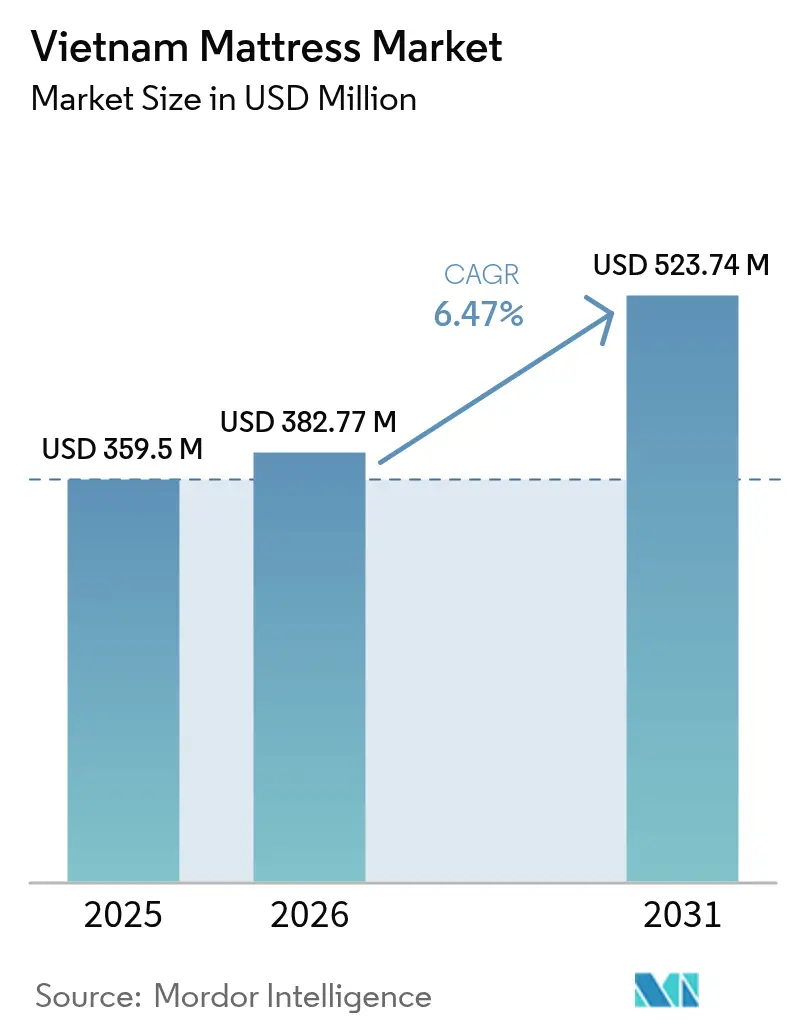
The Vietnam mattress market size is expected to grow from USD 359.5 million in 2025 to USD 382.77 million in 2026 and is forecast to reach USD 523.74 million by 2031 at 6.47% CAGR over 2026-2031. Expanding middle-class incomes, a deepening focus on sleep health, and accelerating hospitality construction together underpin the growth outlook of the Vietnam mattress market. E-commerce’s rapid infiltration of Tier-2 and Tier-3 cities widens consumer reach, while tourism-led hotel openings amplify commercial demand. Supply-chain localization and natural-latex sourcing from within ASEAN help manufacturers ease import exposure and comply with new environmental rules. Firms that combine omnichannel retail, certified sustainable materials, and flexible production are positioned to capture the next leg of expansion within the Vietnam mattress market.
Key Report Takeaways
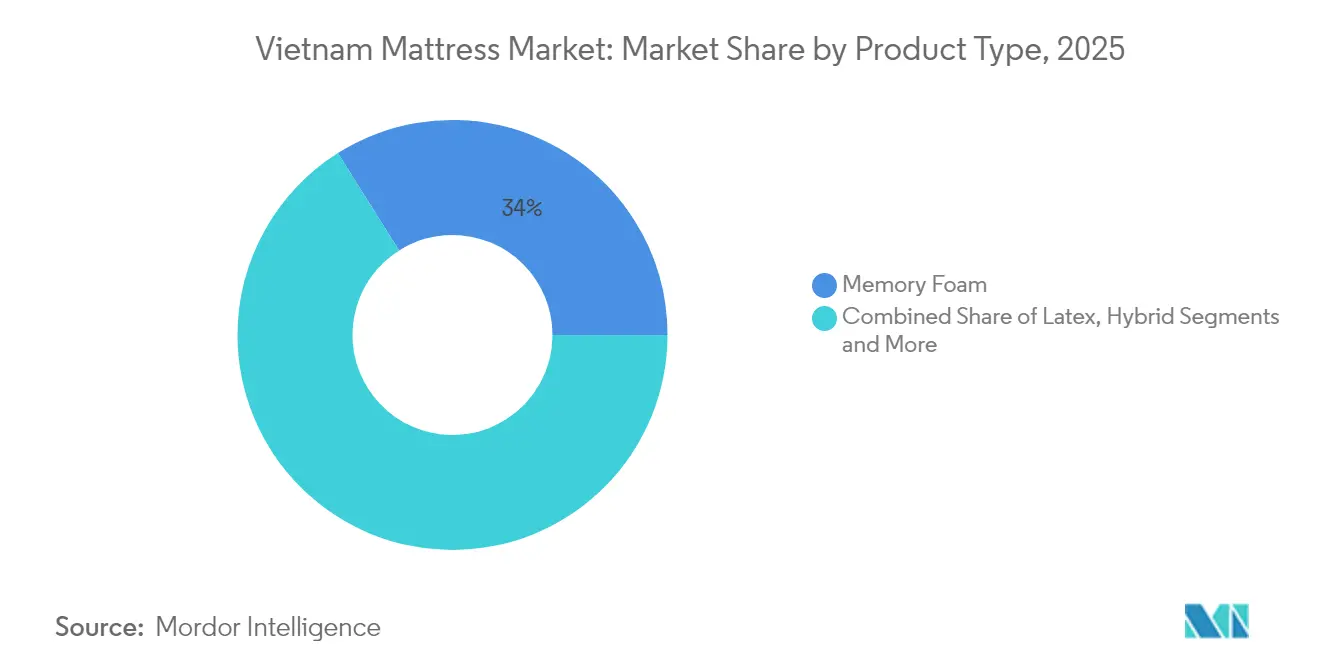
- By product type, memory foam led with 33.95% of Vietnam mattress market share in 2025; hybrid mattresses are forecast to expand at a 6.76% CAGR through 2031.
- By mattress size, queen-size units commanded 34.20% of the Vietnam mattress market size in 2025, while king-size models are expected to grow fastest at a 7.31% CAGR between 2026-2031.
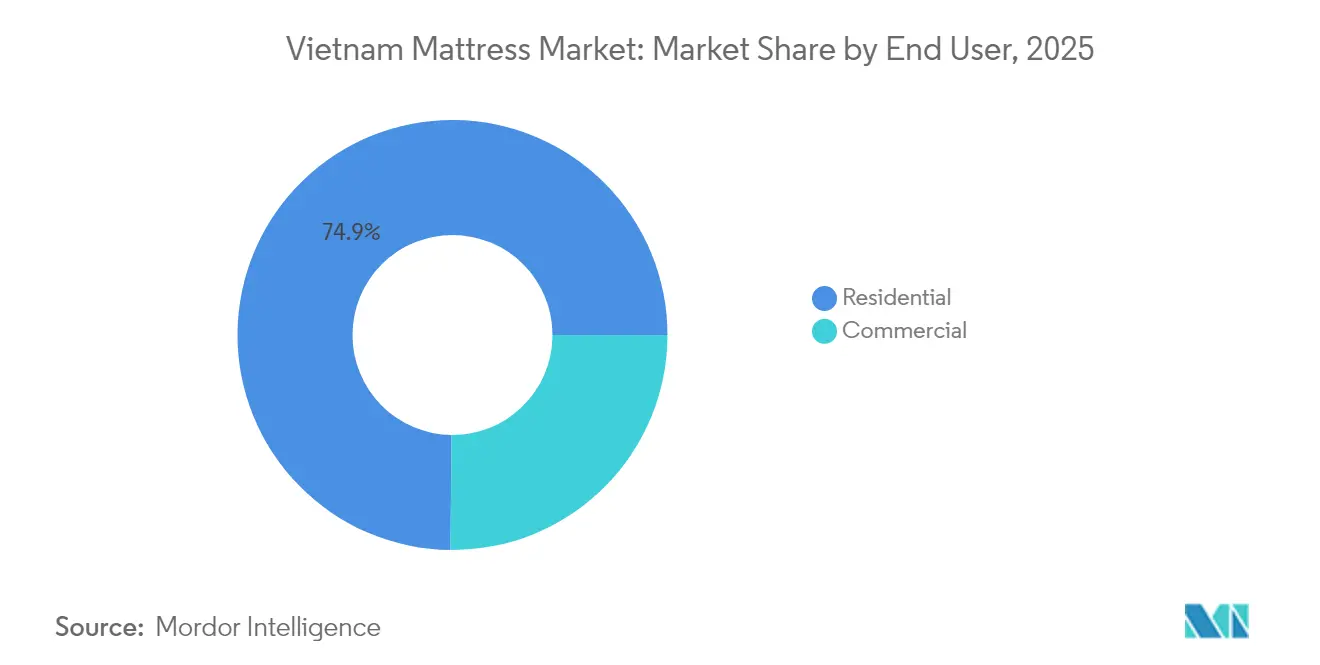
- By end user, the residential segment accounted for 74.85% of the Vietnam mattress market size in 2025; the commercial segment is advancing at a 7.10% CAGR through 2031.
- By distribution channel, B2C retail controlled 70.85% of Vietnam mattress market share in 2025 and is projected to post an 8.03% CAGR over the forecast period.
- By geography, Northern Vietnam held 41.20% of the Vietnam mattress market share in 2025, whereas Central Vietnam is expected to log the fastest 7.52% CAGR to 2031.
Note: Market size and forecast figures in this report are generated using Mordor Intelligence’s proprietary estimation framework, updated with the latest available data and insights as of 2026.
Market Trends and Insights
Drivers Impact Analysis of Vietnam Mattress Market*
| Driver | (~) % Impact on CAGR Forecast | Geographic Relevance | Impact Timeline |
|---|---|---|---|
| Rising disposable incomes & sleep-health awareness | +1.8% | National, urban centers | Medium term (2-4 years) |
| Booming domestic hospitality pipeline | +1.2% | Central & Northern coastal regions | Short term (≤ 2 years) |
| Rapid e-commerce penetration into Tier-2/3 | +1.0% | Central & Southern provinces | Medium term (2-4 years) |
| Anti-dumping duties redirecting FDI | +0.8% | National manufacturing hubs | Long term (≥ 4 years) |
| ASEAN-sourced latex under new EU rules | +0.6% | Export-oriented factories | Long term (≥ 4 years) |
| Early smart-bed adoption in premium cities | +0.4% | Hanoi & Ho Chi Minh City | Long term (≥ 4 years) |
| Source: Mordor Intelligence | |||
Rising Disposable Incomes & Sleep-Health Awareness
Vietnam’s enlarging middle class is directing more of its budget toward wellness categories, and better sleep has turned into a visible lifestyle priority. Consumers now expect an 8-10-year mattress lifespan and willingly pay premiums for certified comfort and durability. Domestic producer Kymdan markets 100% natural-latex models with warranties up to 25 years, validating buyers’ readiness for higher upfront costs[1]. Government stimulus that lifts household spending further magnifies this trend. Manufacturers responding with ergonomic designs and low-VOC certifications are capturing loyalty inside the Vietnam mattress market. Health consciousness is driving demand for certified products, with consumers increasingly seeking mattresses with Greenguard and UL certifications for environmental safety and spinal support benefits. The shift toward premium segments creates opportunities for manufacturers to differentiate through advanced materials, ergonomic design, and health-focused marketing strategies that resonate with Vietnam's evolving consumer priorities.
Booming Domestic Hospitality Pipeline
Hotel construction is surging, led by projects such as Tru by Hilton’s 14-property rollout and large coastal resorts capable of hosting thousands of guests. Each new room requires multiple mattress sets across its life cycle, directly enlarging commercial-segment volumes. International hotel chains impose rigorous supplier standards, rewarding ISO-certified manufacturers that can meet bulk orders on tight timelines. Developers’ preference for queen- and king-size beds is reinforcing growth in larger mattress formats. Central Vietnam, home to many beachfront projects, is emerging as a hotspot for contract procurement. The geographic concentration of hotel developments along Vietnam's central coast positions this region for accelerated mattress market growth, supported by tourism infrastructure investments and improved accessibility.
Rapid E-commerce Penetration into Tier-2/3 Cities
Vietnam’s online retail value is forecast to top USD 25 billion in 2024, and mattresses are migrating quickly to direct-to-consumer carts. Digital platforms remove geographic barriers, allowing rural households to compare brands previously confined to big-city showrooms. Domestic chain Vua Nệm pairs a 130-store footprint with an intuitive web channel that includes 100-night trials and free return pickup, illustrating best-practice omnichannel execution. Younger buyers rank doorstep delivery and transparent reviews above in-store testing, accelerating online share. Traditional outlets must integrate mobile engagement and next-day fulfillment to protect their presence in the Vietnam mattress market. Free delivery and wide product selection have become top consumer priorities, forcing traditional retailers to adapt their value propositions or risk market share erosion to digitally native competitors.
Anti-dumping Duties on Chinese Mattresses Redirecting FDI
Import tariffs on Chinese mattresses have sparked a supply-chain migration toward Vietnam, giving local plants a larger role in regional sourcing. Several global brands have opened production lines in Dong Nai and Binh Duong to sidestep duties and shorten lead times to ASEAN customers. Foreign direct investors bring process technology and training that raise industry benchmarks for local suppliers. Parallel U.S. duties on Vietnamese exports compel factories to shift toward value-added designs and branded output rather than undifferentiated OEM volume. Manufacturers mastering both compliance and upmarket positioning stand to gain share inside the Vietnam mattress market. Companies that navigate trade compliance requirements while maintaining cost competitiveness will benefit from sustained demand as international buyers continue diversifying their supplier bases away from over-concentrated manufacturing regions.
Restraints Impact Analysis of Vietnam Mattress Market*
| Restraint | (~) % Impact on CAGR Forecast | Geographic Relevance | Impact Timeline |
|---|---|---|---|
| Fragmented foam supply inflating input cost | −1.4% | National manufacturing corridors | Short term (≤ 2 years) |
| Low replacement cycles in rural areas | −0.9% | Central & Northern rural districts | Long term (≥ 4 years) |
| Intensifying price war from grey-market imports | −0.8% | Urban border trade zones | Medium term (2-4 years) |
| Limited recycling infrastructure | −0.5% | Major municipal regions | Medium term (2-4 years) |
| Source: Mordor Intelligence | |||
Fragmented Foam Supply Inflating Input Costs
Vietnam relies heavily on imported polyurethane feedstock, leaving manufacturers susceptible to currency swings and freight disruptions. Small and mid-sized firms often purchase through multiple distributors, accepting mark-ups that compress margins. In contrast, large players such as Pearl Polyurethane Systems doubled local capacity to 20,000 tons per year in 2025, improving negotiation leverage and costs. Until domestic chemical production scales further, foam-price volatility will challenge stable pricing in the Vietnam mattress market. Long-term contracts with upstream suppliers and recycling initiatives offer partial relief. Raw material price volatility affects different mattress segments disproportionately, with budget-conscious consumers becoming more price-sensitive during inflationary periods, potentially slowing market growth in price-competitive segments. The lack of integrated foam production capabilities within Vietnam necessitates import dependency, exposing manufacturers to currency fluctuations and international supply chain disruptions that can rapidly erode profitability margins.
Low Replacement Cycles in Rural Areas
Households outside tier-one cities typically replace mattresses every 12-15 years, well beyond the 8-10-year cycle common in urban centers. Income constraints, limited product awareness, and difficult logistics curtail new-purchase frequency. Rural consumers remain attached to low-cost innerspring models, slowing adoption of premium memory-foam or latex variants. Manufacturers must introduce entry-level SKUs and installment financing to accelerate turnover. Bridging the urban-rural gap is essential for unlocking the full demand potential of the Vietnam mattress market. The price war dynamics are most pronounced in urban markets where distribution channels are more accessible and consumer awareness of brand authenticity may be lower, requiring manufacturers to invest heavily in brand protection and consumer education initiatives that increase operational costs without directly contributing to revenue growth.
*Our forecasts treat driver/restraint impacts as directional, not additive. The impact forecasts reflect baseline growth, mix effects, and variable interactions.
Vietnam Mattress Market Segment Analysis
By Product Type:
Memory Foam Leads, Hybrid AcceleratesMemory-foam models secured a 33.95% Vietnam mattress market share in 2025, mirroring growing recognition of pressure-relief and temperature-adaptation benefits in humid climates. Hybrid designs, blending pocketed coils with foam comfort layers, are forecast to register a 6.76% CAGR through 2031, the fastest among all categories. Traditional innerspring units stay prevalent in budget-sensitive and rural segments, while latex variants leverage Vietnam’s abundant rubber supply to cultivate a sustainability narrative. The Vietnam mattress market size for hybrid products is expected to widen as consumers demand balanced support without forgoing contouring comfort. Regulatory pushes toward recyclable components further accelerate interest in latex and modular hybrids.
Continued R&D, including new benchmark testing from Dow and GoodBed, should standardize firmness and durability ratings, informing shopper choices and spurring premium product uptake. Memory-foam manufacturers are adding open-cell structures and gel infusions to enhance airflow within Vietnam’s tropical environment. Hybrid players tout motion isolation and edge support, appealing to couples upgrading from economy models. Latex producers promote hypoallergenic properties supported by certifications such as OEKO-TEX Standard 100. As differentiation sharpens, each sub-segment pursues distinct branding to capture its slice of the Vietnam mattress market.

By Mattress Size:
Queen Dominates, King ExpandsQueen-size units accounted for 34.20% of Vietnam mattress market share in 2025 thanks to the prevalence of two-bedroom apartments in Hanoi and Ho Chi Minh City. King-size demand is rising fastest with a 7.31% CAGR, fueled by income growth and a preference for spacious sleep surfaces among young families. Double and single sizes retain relevance in student housing, worker dormitories, and smaller urban dwellings. Developers of high-end condos report that mattress dimensions influence buyer perceptions of overall unit luxury. Consequently, larger formats are gaining floor-plan allocation in new projects, expanding the Vietnam mattress market size dedicated to king variants.
E-commerce allows distant consumers to order oversized mattresses without local inventory limits, although last-mile delivery still poses staircase and elevator challenges. Some brands now offer roll-packed king sizes that fit service elevators, mitigating logistics friction. Hotels along Vietnam’s central coast increasingly specify king-size beds in premium rooms, sustaining bulk procurement. Manufacturers must align production schedules with these size shifts to optimize inventory turns. Overall, mattress dimensions are evolving in step with rising living standards and larger dwelling footprints across the Vietnam mattress market.
By End User:
Residential Foundation, Commercial MomentumResidential buyers continued to dominate with 74.85% of Vietnam mattress market size in 2025, yet commercial demand is accelerating at a 7.10% CAGR through 2031. Every new hotel, serviced apartment, or corporate dormitory requires sizable mattress fleets and frequent replacement cycles. Contracts often stipulate flame-retardant fabrics, reinforced perimeter support, and ≥5-year warranty coverage, pushing suppliers toward hospitality-specific lines. On the residential front, consumers increasingly research online, weigh ergonomic claims, and choose installment plans before purchase. The Vietnam mattress market benefits as both household upgrades and tourism infrastructure investments progress in tandem.
Municipal housing programs and private developer launches add tens of thousands of new apartments annually, sustaining baseline residential volume. Meanwhile, corporate relocations and industrial-park expansions create staff-housing projects that fall under the commercial banner. Distinct sales channels, credit terms, and after-sales requirements characterize each end-user group, necessitating segmented go-to-market strategies. Manufacturers adept at juggling both retail branding and institutional tender processes gain resilience. Diversification across end-user categories is emerging as a hedge against cyclicality within the Vietnam mattress market.
By Distribution Channel:
B2C Retail Dominance with Digital IntegrationB2C outlets captured 70.85% of Vietnam mattress market share in 2025 and are projected to post an 8.03% CAGR, reflecting successful omnichannel models that marry in-store experience with online convenience. Specialty chains deploy sleep consultants and 100-night trials, while mass merchandisers rely on nationwide reach and promotional pricing. Pure-play e-commerce platforms emphasize user reviews, one-day shipping, and free returns, especially appealing to younger, mobile-savvy demographics. B2B project divisions handle bulk orders for hotels, hospitals, and dormitories, structuring deals around technical specifications and extended warranties. Continuous channel innovation remains pivotal to capturing incremental demand inside the Vietnam mattress market.
Augmented-reality apps that visualize mattress fit within a room and AI chatbots providing instant product comparisons are expanding website dwell time and conversion rates. Store footprints are growing selectively in Tier-2 cities where e-commerce awareness rises alongside demand for physical touchpoints. Brands unlock cost efficiencies through centralized fulfillment hubs supporting both digital and brick-and-mortar traffic. Loyalty programs offering mattress protectors, pillows, and recycle-pickup services encourage repeat engagement. Distribution agility will largely dictate competitive outcomes across the Vietnam mattress market.
Geography Analysis
Northern Vietnam’s urban concentration, anchored by Hanoi, drives premium purchases, aided by a sophisticated retail network and rising corporate accommodation needs. Government office expansions and foreign manufacturer headquarters stimulate steady mattress replacement cycles among expatriate and upper-middle-class consumers. Proximity to Chinese component suppliers shortens lead times and moderates costs for plants in Bac Ninh and Hai Phong. However, colder winters prompt a preference for heat-retentive foams, pushing seasonal SKU swaps. Local retailers thus curate assortments around climate cues to keep sell-through rates high in the Vietnam mattress market.
Central Vietnam’s resort pipeline acts as a catalyst for commercial contracts, with properties specifying uniform mattress specifications across hundreds of rooms. Improved airports in Phu Quoc and Cam Ranh funnel international arrivals, raising occupancy and replacement frequency. Retail penetration lags the north, yet as household incomes climb, queen-size adoption is quickening. Latex sourcing from nearby plantations keeps landed costs competitive, enticing newcomers to set up assembly lines in Da Nang. High tourism seasonality nevertheless forces careful cash-flow planning among suppliers courting this sub-market of the Vietnam mattress market.
Southern Vietnam maintains a balanced residential-commercial mix, buoyed by Ho Chi Minh City’s real-estate handovers and industrial-zone dormitory projects. High container-port capacity supports both component imports and finished-mattress exports, reinforcing the region’s manufacturing stature. Consumer preferences skew toward breathable fabrics due to year-round humidity, spurring R&D in moisture-wicking covers. Competitive density is highest here, with international showrooms often opening their first Vietnamese locations on Nguyen Trai Street. Market entrants must therefore differentiate through digital service, ESG transparency, or finance offers to win share in the Vietnam mattress market.
Regulatory Landscape
Mattresses and bedding sold in Vietnam fall under product-quality and chemical-safety requirements administered by the Ministry of Industry and Trade (MOIT) and the Ministry of Science and Technology (MOST), with standards work coordinated through STAMEQ. For textile components used in mattress covers and related bedding, Circular 21/2017/TT-BCT sets limits for formaldehyde and aromatic amines from azo colorants, which means covers must be tested, accompanied by a declaration of conformity, and carry the CR (Hop quy) mark before market circulation.
Beyond these technical obligations, manufacturers and importers also use Vietnamese Standards (TCVN) as quality reference points. This includes TCVN 7744:2007 for polyurethane foam mattress products, which becomes enforceable when cited in specific technical regulations or legal requirements. Compliance typically relies on ISO/IEC 17025-accredited laboratory testing and documentation under the Law on Product and Goods Quality, increasing the value of materials traceability, including fabric dye inputs, foam sourcing, and latex origin, for both domestic retail and institutional procurement.
Value Chain Analysis
The Vietnam mattress value chain starts with upstream inputs, including polyurethane chemicals (polyols and isocyanates), steel wire and coils, textile ticking, adhesives, and natural latex. It then moves into foam pouring and processing, spring manufacturing or sourcing, quilting and cover sewing, and final assembly, with compression and roll-pack used where applicable, before distribution through retail and project channels. Production clusters are concentrated in the South (Binh Duong, Dong Nai, Ho Chi Minh City) to support scale manufacturing and export logistics, while a Northern base (Hanoi and Hung Yen) serves domestic demand and parts processing. Reliance on imported feedstocks and certain components keeps input cost exposure elevated during freight and currency swings.
Midstream manufacturers increasingly invest in technology and process control, including ERP, automated cutting and quilting, and production planning, to support customization and faster replenishment for omnichannel models. Downstream, specialty mattress chains and brand showrooms support trials, financing, and after-sales service, while online platforms extend reach into Tier-2 and Tier-3 cities through centralized fulfillment and last-mile delivery partners. Commercial sales route through B2B and project teams that supply hotels, serviced apartments, and dormitories via specification-driven tenders with warranty obligations. Vertical integration is also visible in upstream localization efforts, including Pearl Polyurethane Systems expanding domestic polyurethane systems capacity to 20,000 tons per year in 2025 to improve supply stability for mattress manufacturers.
Competitive Landscape
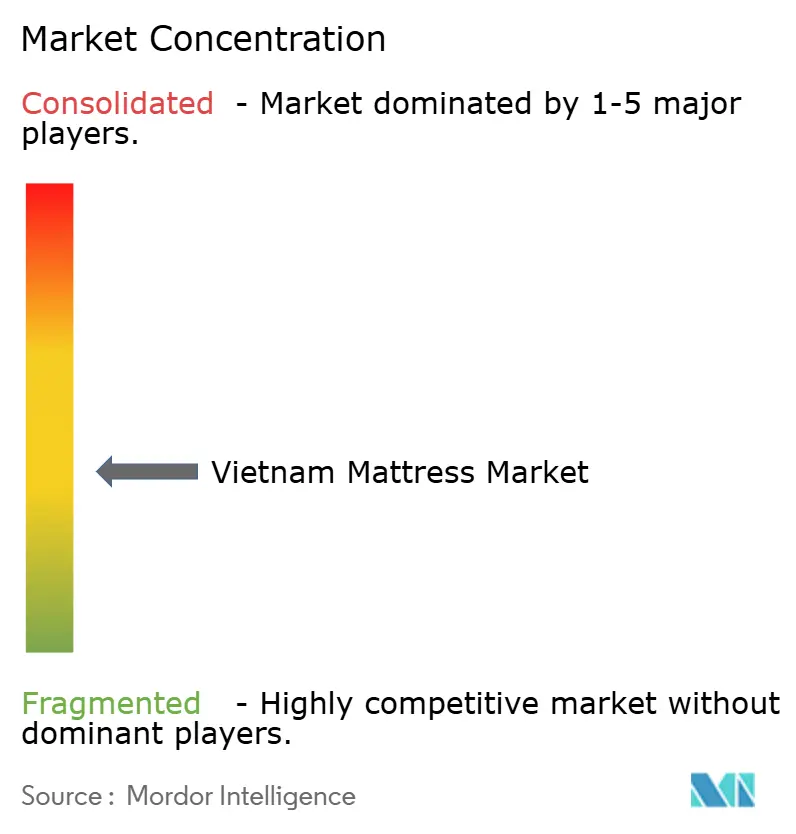
The Vietnam mattress market features moderate fragmentation: global players such as Tempur Sealy, Serta, and Dunlopillo operate alongside domestic names like Vua Nệm, Kymdan, and Everpia. Multinationals capitalize on R&D muscle and supply-chain leverage to launch memory-foam and smart-bed lines locally, while Vietnamese firms exploit cultural proximity and price agility. Pearl Polyurethane Systems’ doubling of foam output underscores the vertical-integration thrust intended to stabilize raw-material costs. Kymdan’s Greenguard certification helps defend premium price points among health-conscious buyers within the Vietnam mattress market.
Vua Nệm carries Tempur and Serta in more than 130 outlets, co-sharing marketing spends and broadening assortment depth. Sustainability is another battleground; firms investing early in take-back logistics and FSC-certified latex earn procurement preference from international hotel chains[3]. Digital disruptors are experimenting with subscription models that swap mattresses every five years for a fixed monthly fee, appealing to mobile millennials. Grey-market and counterfeit competition remain an overhang, prompting branded players to deploy QR-code verification and extended warranties. Overall, scale economics, ESG compliance, and omnichannel excellence are the three pillars now defining competitive edge in the Vietnam mattress market.
M&A activity is inching upward as mid-tier manufacturers confront cost inflation and EPR compliance burdens. Rumors of Vua Nệm’s 2025 IPO fueling a regional acquisition spree reflect a broader consolidation trajectory. International producers may seek joint ventures to secure latex supply and climb Vietnam’s brand ladder quickly. Smaller firms that lack capital for automation or traceability upgrades could exit, further lifting market concentration. While fragmentation persists today, competitive intensity is set to tighten as players jostle for enduring positions in the Vietnam mattress market.
Vietnam Mattress Industry Leaders
-
Vua Nệm
-
Liên Á
-
Dunlopillo Vietnam
-
Kim Cương Mattress
-
KyMDan
- *Disclaimer: Major Players sorted in no particular order
Vietnam Mattress Market Companies Covered in this Report
- AEGONO
- Amando
- Dongsuh Furniture
- Dunlopillo Vietnam
- Everpia Everon
- Hava's
- Kim Cương Mattress
- KingKoil
- Kingsdown
- KyMDan
- Lien A
- Ru9
- Serta Simmons
- Tempur Sealy
- Van Thanh
- Vua Nệm
- Zinus
Market Opportunities and Future Outlook
Hospitality and other contracted projects remain a defined whitespace where suppliers can differentiate on compliance, durability testing, and ESG documentation, particularly as international hotel pipelines expand along Vietnam’s central coast. Procurement requirements also increasingly emphasize consistent specifications and certified materials, creating a clearer basis for premium pricing in commercial tenders. The market also has room to increase penetration of verified low-emission and certified products in premium urban segments, supported by consumer interest in Greenguard and UL-type assurances that brands such as Kymdan already use in their positioning.
On the supply side, technology-enabled manufacturing and value-added design across Vietnam’s broader furniture and furnishing ecosystem support mattress makers that invest in automated lines, standardized performance testing, and faster product iteration, rather than competing only on price. Standard-setting activity provides additional traction: Dow and GoodBed launched a joint laboratory program in February 2025 to create standardized mattress performance benchmarks for pressure relief and durability. These benchmarks can help brands justify premium tiers, support B2B specifications, and reduce quality disputes in omnichannel returns. In parallel, trade and manufacturing bodies continue pushing more advanced production capabilities across clusters, aligning with an opportunity for Vietnamese manufacturers to expand ODM and OBM offerings for both domestic and export-oriented channels.
Recent Industry Developments in Vietnam Mattress Market
- June 2026: Vua Nem opened a new store at 549 Van Xuan, Hoai Duc, Hanoi, extending its specialty sleep retail footprint in the capital region. The added point of presence supports faster delivery and after-sales coverage while reinforcing the chain's omnichannel model built around trials and service-led selling.
- May 2026: Dunlopillo Vietnam introduced the CoolSilk Comfort premium mattress collection, expanding its higher-end assortment positioned around comfort and materials differentiation. The launch raises competitive intensity in premium segments where branded features and verified performance claims influence both retail conversion and hotel-grade specifications.
- January 2025: Pearl Polyurethane Systems doubled annual capacity to 20,000 tons at its Dong Nai plant to supply polyurethane systems used in foam production. Greater domestic availability of upstream inputs helps mattress manufacturers reduce lead-time volatility and improves supply resilience amid fluctuating imported feedstock costs.
Vietnam Mattress Market Report Scope and Research Methodology
Market Definition and Coverage
For this methodology, the market covers revenue from new mattresses sold in Vietnam across home and commercial buyers, counted at the point of sale to the customer. We include key core constructions such as innerspring, foam, latex, and hybrid, across standard and custom sizes.
Scope exclusions: We exclude pillows, toppers, bed linens, bed frames, and repair or refurbishment services.
Segments Covered in This Report
- By Product Type
- Innerspring / Coil
- Foam (including memory foam)
- Latex
- Hybrid
- Other Mattress Types
- By Mattress Size
- Single-size Mattress
- Double-size Mattress
- Queen-size Mattress
- King-size Mattress
- Custom & Specialty Sizes
- By End User
- Residential
- Commercial
- By Distribution Channel
- B2C/Retail
- Mass Merchandisers
- Specialty Mattress Stores (including exclusive brand outlets)
- Online
- Other Distribution Channels
- B2B/Project
- B2C/Retail
- By Geography
- Northern Vietnam
- Central Vietnam
- Southern Vietnam
Data Sources, Market Sizing, and Validation
Desk Research
Desk work started by mapping Vietnam demand drivers that move mattress purchases over time, and then aligning them to measurable public indicators. We relied on sources such as the General Statistics Office of Vietnam for household and housing signals, Vietnam Customs trade statistics for import and export direction, the Ministry of Construction for housing activity context, and the Vietnam National Administration of Tourism for accommodation demand signals that can influence commercial buying.
To keep the model grounded in product realities, we also reviewed sources such as UN Comtrade for cross checks on trade coding patterns, and open patent databases to understand material and construction shifts that may impact pricing ladders. Company annual reports, investor decks, and credible press coverage were used to confirm channel expansion and pricing actions, while a paid subscription for company financials and a shipment level import-export database were used selectively to fill gaps where public data is not granular enough. The desk sources mentioned above are illustrative, and many other references were also used for data collection, validation, and research clarification.
Primary Interviews and Surveys
Primary discussions were used to validate how mattresses are actually sold in Vietnam, especially the split between retail purchases and project sales, and how online discovery converts into final buying. We spoke with manufacturers, brand and channel executives, large format retailers, and commercial buyers from hospitality and real estate, which helped us tighten assumptions on price bands, discounting, and mix shifts across major cities and emerging provinces.
Distribution of primary research fieldwork respondents
| Company type | Respondent position |
|---|---|
| Top tier: 31% | CXOs: 18% |
| Mid tier: 50% | Functional/Unit leaders: 38% |
| Smaller Players: 19% | Managers: 44% |
Market-Sizing & Forecasting
Sizing begins with a top-down build where Vietnam household formation, new housing completions, and replacement cycles are translated into unit demand, which is then priced using typical realized price bands by material type and size. To keep the totals realistic, we also check results with selective bottom-up approximations, such as rolling up a sample of supplier revenue in Vietnam, validating retail throughput with channel interviews, and using a simple ASP times volume sense check by major cities.
A few inputs that matter in this market include the share of foam versus innerspring adoption, the pace of latex positioning in mid to premium ranges, average discount depth during key retail campaigns, hotel room additions that affect commercial orders, and the online to offline conversion pattern that changes channel mix. Where company disclosure is limited, gaps are handled by using range based assumptions that were agreed in interviews and then stress tested against trade movements and visible store footprint changes.
For forecasting, we use scenario analysis supported by short series trend smoothing on key demand indicators, and then adjust the outlook based on what respondents expect for housing, consumer spending, and channel expansion. The final forecast is kept traceable to a small set of inputs so the model can be refreshed without over relying on hard to reproduce datasets.
Data Validation & Update Cycle
Outputs are checked in multiple steps so unusual jumps do not pass through without explanation. We compare model results against independent signals like housing activity direction, trade flows for relevant mattress categories, and channel expansion cues, and then investigate large variances before analyst sign off.
If a key assumption shifts, such as a major pricing reset or a sudden change in project demand, the team re contacts sources to confirm what changed and whether it is temporary or structural. Reports are refreshed annually, with interim updates when material events occur, and a final pre delivery review is completed so clients receive the latest updated view.
Mordor Intelligence's Vietnam Mattress Market Sizing Compared With Other Published Estimates
Published market values for Vietnam mattresses can differ because the underlying counting rules are not always the same, even when the topic name looks identical. Differences typically come from what product set is included, whether retail and project sales are both counted, and how pricing is treated when promotions and mix shifts are common.
Another driver is how the demand pool is built, since some approaches lean heavily on trade data or on a narrow set of listed company revenues without correcting for private sales and channel fragmentation. When B2B project deliveries are treated like normal retail sales, or when online sales are overstated without checking fulfillment and returns, the total can move a lot year to year.
Benchmark comparison
| Source | Market Size | Gaps in Research Methodology |
|---|---|---|
| Mordor Intelligence | USD 359.50 M (2025) | |
| Industry Association A | USD 330.00 M (2025) | Often tracks factory output and member reporting more than full sell through, which can miss imported finished mattresses and under capture smaller retail networks. |
| Trade Journal B | USD 410.00 M (2025) | Tends to apply a higher average selling price progression from premium brands and online listings, with limited adjustment for discounting, project pricing, and size mix. |
The spread in the table largely comes from how each source treats channel mix and realized prices in a promotion heavy market. By separating B2C retail sales from B2B project deliveries and refreshing discount assumptions around major campaign periods, the model stays more repeatable, a method applied by Mordor Intelligence.
Key Questions Answered in the Report
What is the projected value of the Vietnam mattress market in 2031?
The market is forecast to reach USD 523.74 million by 2031, expanding at a 6.47% CAGR during 2026-2031.
Which product type currently leads sales in Vietnam?
Memory-foam mattresses hold the top position with a 33.95% share of 2025 revenue.
Which distribution channel is growing the fastest?
B2C retail, including omnichannel showrooms and e-commerce, is advancing at an 8.03% CAGR through 2031.
Why is Central Vietnam viewed as the fastest-growing region?
Large coastal resort projects and better transport links are driving a 7.52% CAGR for the region’s mattress demand.
How is regulation affecting domestic manufacturers?
Extended Producer Responsibility rules require firms to reclaim and recycle used mattresses, prompting investment in circular-economy logistics that raise short-term costs but enhance long-term competitiveness.