
Market Overview
| Study Period | 2020 - 2031 |
|---|---|
| Forecast Data Period | 2026 - 2031 |
| Base Year Market Size (2025) | USD 3.02 Billion |
| Market Size (2026) | USD 3.42 Billion |
| Market Size (2031) | USD 6.36 Billion |
| Growth Rate (2026 - 2031) | 13.22 % |
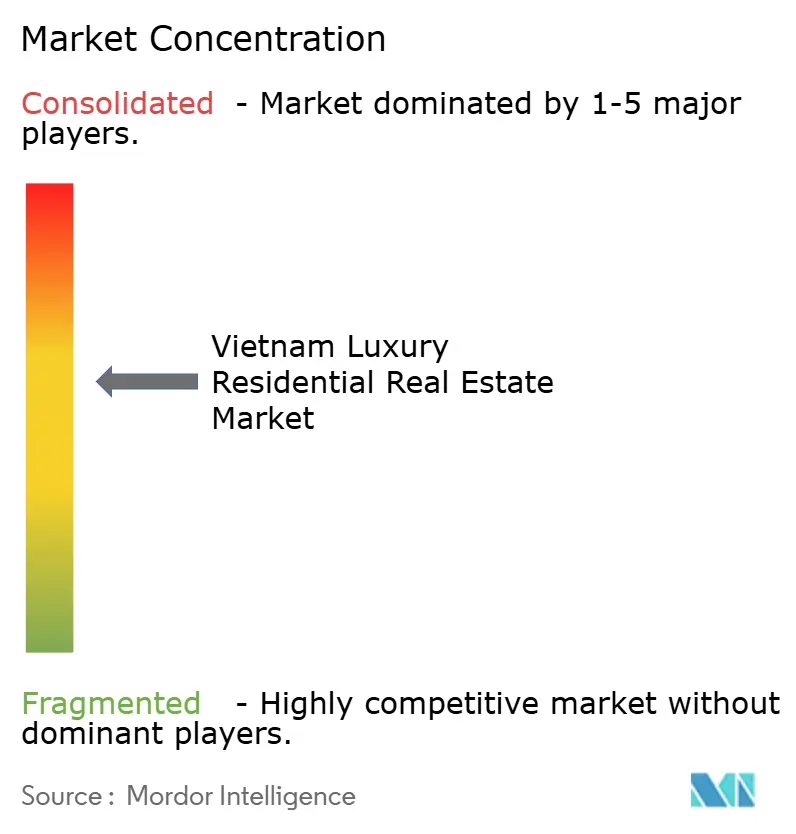
| Market Concentration | Medium |
Major Players *Disclaimer: Major Players sorted in no particular order Image © Mordor Intelligence. Reuse requires attribution under CC BY 4.0. | |
Vietnam Luxury Residential Real Estate Market Analysis by Mordor Intelligence
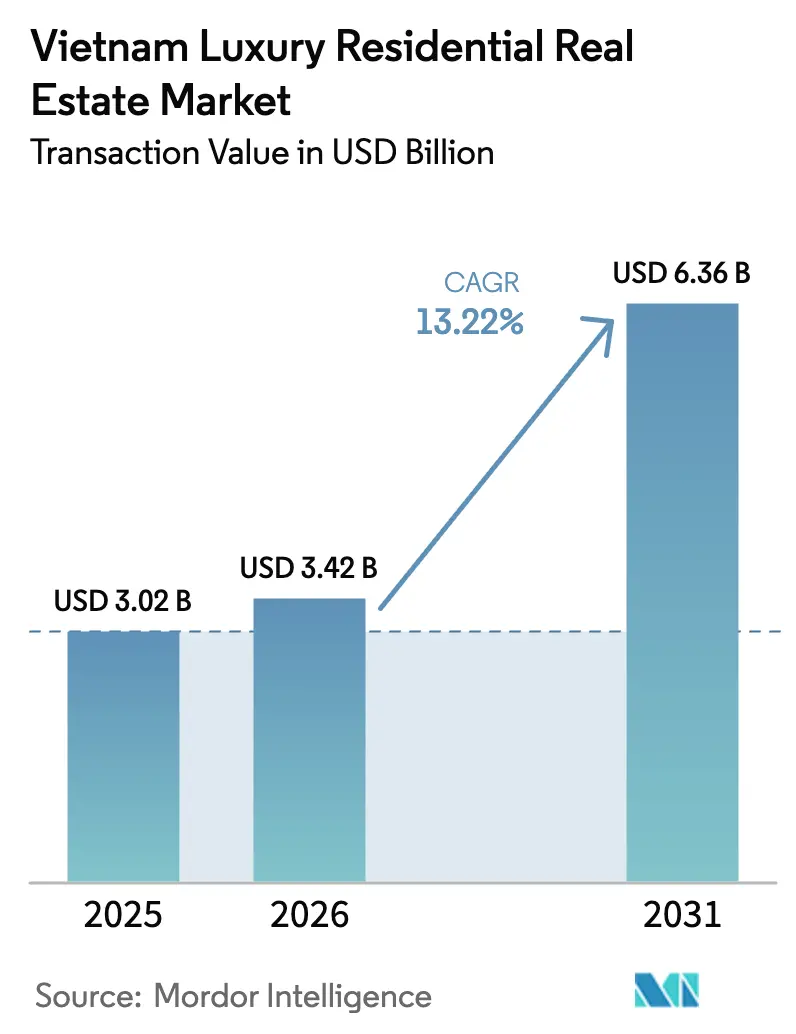
The Vietnam Luxury Residential Real Estate Market size was valued at USD 3.02 billion in 2025 and estimated to grow from USD 3.42 billion in 2026 to reach USD 6.36 billion by 2031, at a CAGR of 13.22% during the forecast period (2026-2031).
Growth is underpinned by a 98% surge in Vietnam’s millionaire population over the past decade, the economy’s 7.09% expansion in 2024, and an 8% GDP growth outlook for 2025[1]. Vietnam luxury residential market capitalizes on Ho Chi Minh City’s wealth concentration, supportive regulatory reforms, and record infrastructure spending that tops USD 10 billion. Apartments and condominiums still dominate but villas are accelerating, while a nascent rental play signals rising yield-driven strategies. Regulatory clarity through the Land Law 2024 and digital-asset legalization from 2026 further widen capital inflows, reinforcing Vietnam luxury residential market resilience.
Key Report Takeaways
- By property type, apartments held 70.35% of Vietnam luxury residential market share in 2025, while villas and landed houses are set to grow at a 13.73% CAGR through 2031.
- By business model, the sales segment accounted for 84.35% of Vietnam luxury residential market share in 2025; the rental segment records the highest projected CAGR at 14.62% over 2026-2031.
- By mode of sale, the secondary segment retained 50.45% of Vietnam luxury residential market share in 2025, yet the primary market is forecast to expand at a 14.02% CAGR to 2031.
- By city, Ho Chi Minh City led with 37.65% of Vietnam luxury residential market share in 2025, while Da Nang is projected to register a 15.02% CAGR over 2026-2031.
Note: Market size and forecast figures in this report are generated using Mordor Intelligence’s proprietary estimation framework, updated with the latest available data and insights as of 2026.
Market Trends and Insights
Drivers Impact Analysis of Vietnam Luxury Residential Real Estate Market*
| Driver | (~) % Impact on CAGR Forecast | Geographic Relevance | Impact Timeline |
|---|---|---|---|
| Aging affluent population & inter-generational wealth transfer | +2.1% | HCMC, Hanoi | Medium term (2-4 years) |
| Elite immigration demand & relaxed visa rules | +1.8% | HCMC, Hanoi, Da Nang | Short term (≤ 2 years) |
| Rapid urbanisation of tier-2 coastal cities | +2.3% | Central coast | Long term (≥ 4 years) |
| Tight land-use quotas in CBD districts | +1.9% | HCMC, Hanoi | Short term (≤ 2 years) |
| Green-building certification adoption | +1.2% | Major cities | Medium term (2-4 years) |
| Boom in tech-sector and crypto millionaires | +2.4% | Key tech hubs | Short term (≤ 2 years) |
| Source: Mordor Intelligence | |||
Aging affluent population drives inter-generational wealth transfer
Vietnam’s 16.1 million seniors in 2025 will exceed 20 million by 2030 as prosperity spreads. Asset transfers from first-generation entrepreneurs to younger heirs fuel continuous upgrading toward multi-generational, amenity-rich homes that blend security with lifestyle. Demand for healthcare-integrated compounds rises, creating fresh opportunities for senior-living focused estates[2].
Elite immigration demand & relaxed long-term visa policies for foreign investors
New 10-year investment visas shorten on-boarding time for foreign millionaires, particularly from East Asia and Europe. Flexible residency drives immediate absorption of serviced penthouses and branded coastal villas, cementing Vietnam luxury residential market as a regional safe-haven.
Rapid urbanisation of tier-2 coastal cities boosts resort-luxury projects
Da Nang and Nha Trang anchor mixed-use resort schemes as airport and expressway upgrades expand catchments. Search inquiries for Da Nang luxury apartments jumped 30% in 2024, while condotel sales rose 45%, underscoring lifestyle-led migration toward secondary hubs.
Tight land-use quotas in CBD districts push vertical luxury towers
Cap limits in HCMC District 1-3 and Hanoi’s Ba Dinh district intensify vertical land economics. Record land auctions above USD 40,000/m² support ultra-luxury towers exceeding 80 stories, embedding concierge retail, private clubs and sky parks to justify premiums in constrained cores.
Restraints Impact Analysis of Vietnam Luxury Residential Real Estate Market*
| Restraint | (~) % Impact on CAGR Forecast | Geographic Relevance | Impact Timeline |
|---|---|---|---|
| Expanding foreign-buyer taxes & ownership caps | −1.6% | National | Medium term (2-4 years) |
| Land & construction cost inflation | −2.1% | Major cities | Short term (≤ 2 years) |
| Stricter anti-money-laundering scrutiny | −1.3% | Gateway cities | Medium term (2-4 years) |
| Climate-risk-driven insurance premium surge | −0.9% | Coastal zones | Long term (≥ 4 years) |
| Source: Mordor Intelligence | |||
Expanding foreign-buyer taxes & ownership ratio caps
Though foreign appetite remains strong, quota ceilings of 30% in condominium blocks and 250 landed homes per ward slow absorption once limits are reached. Proposed surcharge revisions could erode net returns and funnel demand toward quota-available districts.
Land & construction cost inflation pressures pricing
Steel, cement and imported fittings still price 18-22% above pre-pandemic levels. Resulting input spikes lift average HCMC luxury apartment sales to VND 120 million/m² (USD 4,800 per square meter), compelling developers into higher positioning and squeezing attainable demand[3].
*Our forecasts treat driver/restraint impacts as directional, not additive. The impact forecasts reflect baseline growth, mix effects, and variable interactions.
Vietnam Luxury Residential Real Estate Market Segment Analysis
By Property Type:
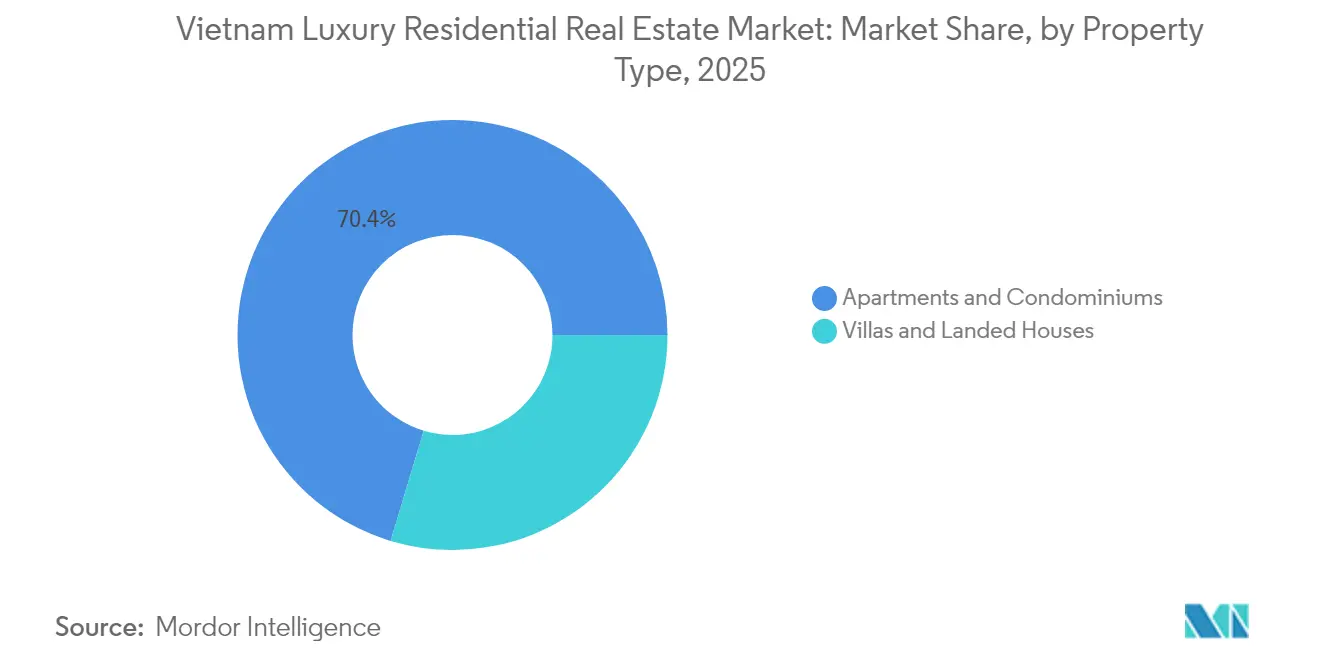
Apartment core with villa upshiftApartments represent 70.35% of Vietnam luxury residential market in 2025, anchored in HCMC and Hanoi CBD stock scarcity. Prime high-rise units trade above USD 14,000/m² and achieve 75% capital appreciation across five years as transit and amenity clustering magnify liquidity. Luxury villas, though smaller in absolute count, record 13.73% CAGR to 2031, lifted by privacy preferences among tech millionaires and returning diaspora. Waterfront villa estates outside HCMC realise 10-35% premiums over in-city counterparts and deliver sturdy holiday rental income streams.
The apartment subsector benefits from developer finance plans, smart home platforms and international hotel branding, sustaining rapid sell-through even at record prices. Conversely, villa supply grows along ring roads and coastal corridors where larger land parcels allow low-density layouts, golf frontage and private berths. Vietnam luxury residential market size for villas is forecast to rise faster than urban towers, yet absolute dominance remains with apartments through 2031.

By Business Model:
Sales foundation, rental emergenceSales retained 84.35% share of Vietnam luxury residential market in 2025 as ownership culture prevails, but professional leasing clusters now expand at 14.62% CAGR on widening expatriate inflows and wealth-management focus. Average gross yields stand at 3.16% in Q1 2025, reaching 3.52% in HCMC. Institutional investors assemble portfolios of branded serviced apartments within prime nodes to secure index-linked income. Vietnam luxury residential market size allocated to rental stock is projected to double by 2031 yet remains a fraction of the sell-to-own stronghold.
Developers respond with leaseback guarantees and co-living floors to attract buy-to-let buyers. Serviced apartment occupancy in HCMC at 85% and rents at USD 42/m² per month underline robust corporate demand pipelines. Should preferential rates for young first-time buyers widen, rental velocity may moderate, but mainstream ownership incentives are not expected to undercut premium leasing in converted Grade A schemes.
By Mode of Sale:
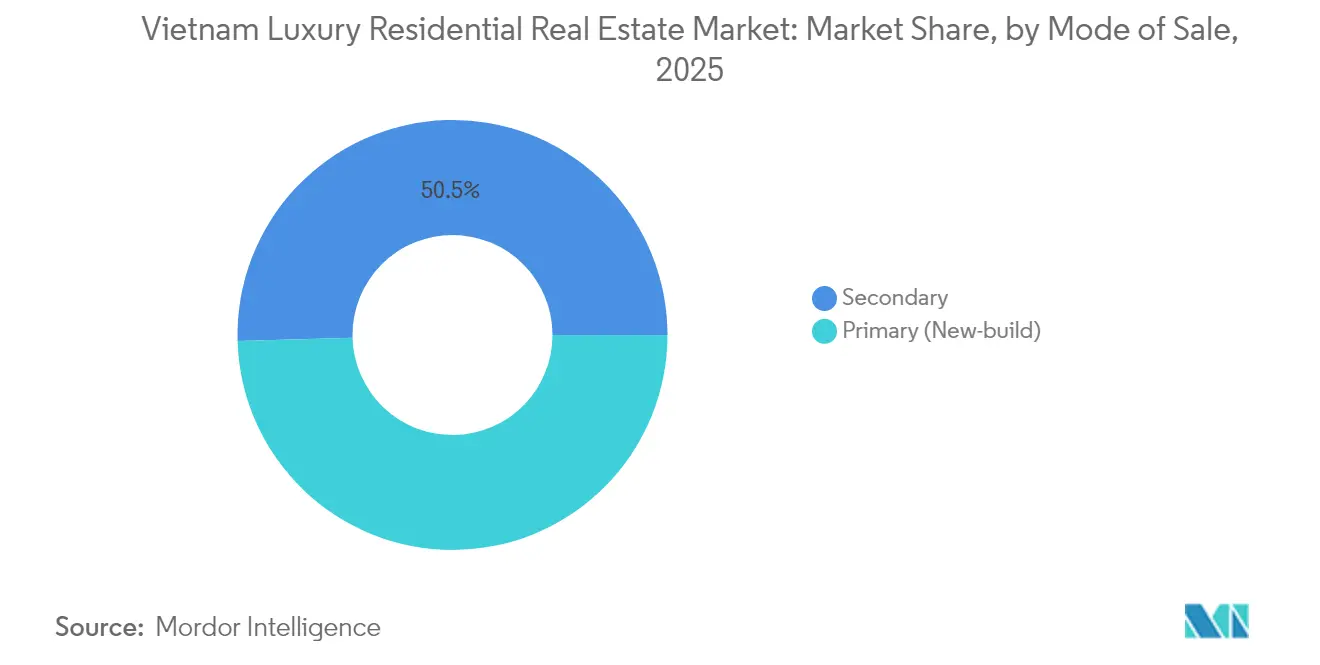
Primary vitality outpaces secondary stockSecondary product commanded 50.45% market share in 2025, valued for immediacy and location certainty. Yet primary launches expand at 14.02% CAGR, lifting Vietnam luxury residential market size for new stock through 2031. Pre-sale absorption exceeds 80% as branded towers and ESG-certified resorts set innovation benchmarks that legacy homes cannot mirror. Primary pricing at VND 120 million/m² (USD 4,800 per square meter) in HCMC outpaces secondary by 47% yet buyers pay for warranties and sophisticated amenity stacks.
Secondary trading remains vibrant in legalised clusters of Thu Duc City where transport completion catalyses capital gains. Upgrades to dated towers prove essential to capture attention of digitally native millionaires who equate technology readiness with prestige. Consequently, owners of older flagships consider value-add refurbishments to narrow the amenity divide.
By City:
HCMC pre-eminence meets Da Nang ascentHo Chi Minh City captured 37.65% Vietnam luxury residential market share in 2025, delivering the deepest project pipeline and hosting 7,200 resident millionaires. Ba Son peninsula and Thu Thiem peninsula pioneer skyline transformations where average primary asking climbs to VND 120 million/m²(USD 4,800 per square meter). Vietnam luxury residential market size allocation to HCMC remains pre-eminent, yet Da Nang targets a 15.02% CAGR on lifestyle magnetism and airport upgrades.
Hanoi retains cultural cachet, with Tay Ho Tay’s lake-view apartments transacting near VND 300 million/m² (USD 12,000 per square meter). Restrictions in Ba Dinh district cement scarcity premiums reaching USD 40,000/m² for bare land. Coastal Nha Trang and Cam Ranh extend demand chains as integrated resorts with private marinas attract jet-set buyers seeking diversified asset plays and leisure homes.
Geography Analysis
Vietnam luxury residential market continues to cluster in the southern metropolis. HCMC’s central land supply contraction funnels demand toward Thu Duc City and riverside corridors, yet buyers still pay for District 1 heritage addresses that regularly set national price records. Strategic infrastructure such as Ring Road 3 and Ben Luc–Long Thanh Expressway braid suburban satellite nodes into one-hour commutes, stimulating gated villa communities along the peri-urban arc. Da Nang’s runway extension and expressway matrix propel flight-time proximity to Hanoi and HCMC within 90 minutes, spurring second-home accumulation and condotel absorption. Tourism-led GDP bounce backs reinforce rental revenue visibility, assuring investors of cash-flow cover despite higher insurance charges in typhoon belts.
In the north, Hanoi’s diplomatic district scarcity incites vertical intensification around West Lake and the Metro Line 2A spine. Embassies and multinationals underwrite executive leasing, though restrictive foreign quota fill-rates impose longer waitlists. Secondary city Hai Phong leverages industrial estate build-out to nurture fresh luxury schemes anchored by international school catchments.
Central coastal provinces witness branded residence debuts where land banks enable low-rise compositions enveloped by wellness centres, golf courses and marinas. Developers incorporate coastal setback and climate-mitigation designs to meet global insurer criteria, ensuring long-run asset viability. Combining improving flight connectivity and aspirational leisure narratives, these locales broaden the footprint of Vietnam luxury residential market beyond its traditional twin poles.
Regulatory Landscape
Vietnam's luxury residential market operates under a legal framework shaped by the Land Law 2024 alongside the Housing Law 2023 and Real Estate Business Law 2023, which took effect from August 1, 2024. These laws streamline procedures and clarify rights and responsibilities across land allocation and real estate transactions. At the same time, foreign ownership in residential property continues to be governed by quota-style limits, commonly referenced as 30% per condominium block and up to 250 landed homes per ward-equivalent area, which can cap absorption in prime buildings once thresholds are reached.
Regulatory execution has increasingly moved toward digitization and tighter market oversight. Government Decree 357/2025/ND-CP (effective January 3, 2026) set standards for construction and management of the housing and real estate market information system and databases, supporting transparency and data-driven supervision. In early 2026, the Government issued Decree 54/2026/ND-CP to amend and supplement regulations in housing and real estate business. The Ministry of Construction also released Consolidated Document 13/VBHN-BXD (March 16, 2026), consolidating rules on social housing management and development, which affects how developers structure compliant project pipelines across segments.
Value Chain Analysis
Vietnam's luxury residential value chain starts with land origination (site clearance, land-use approvals, and land-use right conversion) and runs through project financing, design and permitting, construction, fit-out and FF&E procurement, primary sales via developer channels and agencies, and secondary transactions via brokerage networks. In the premium segment, international-grade design, facade systems, imported fittings, and smart-home packages increase the involvement of specialist consultants and MEP contractors. Branded-residence partnerships and serviced-apartment operators also shape product specifications and post-handover operations.
Execution risk concentrates in compliance readiness and input-cost volatility. The Ministry of Construction's push for market transparency through national housing and real estate databases, anchored by Decree 357/2025/ND-CP, raises the value of clean legal status, standardized project documentation, and verifiable transaction records. On the delivery side, high-end developers are increasingly relying on integrated ecosystems (construction contractors, materials partners, and digital sales platforms such as OneHousing) to stabilize timelines, improve customer acquisition, and protect margins when logistics disruptions and construction material cost swings affect procurement and scheduling.
Competitive Landscape
Vietnam luxury residential market remains moderately concentrated: the top five developers hold an estimated 64-67% cumulative active pipeline, warranting a market concentration score of 6. Vingroup commands scale synergy across retail, hospitality and healthcare ecosystems, enabling bundled lifestyle offerings that embed customer stickiness. Q1 2025 revenue reached USD 3.36 billion on the back of Can Gio sea-encroachment kick-off, Vietnam’s single largest luxury city-making scheme. Masterise Homes partners with Marriott International to deliver branded projects such as LUMIÈRE Riverside, registering 75% capital growth over five years and pioneering triple-glazed façade engineering. CapitaLand Vietnam deploys international capital and design discipline, while Keppel Land optimises exposure via selective divestments like the SGD 98 million sale of Saigon Centre Phase 3.
Domestic challenger SonKim Land captures design-centric niche positioning, earning “Developer of the Decade” accolades. NovaLand resumes selective launches after debt reprofiling, emphasising integrated urban townships along Ho Chi Minh City’s eastward expansion. Heightened compliance scrutiny following Van Thinh Phat’s USD 12 billion scandal reinforces due-diligence-led site acquisitions favouring transparent balance sheets. Developers angle for green-finance lines from multilaterals and ESG-mandated funds by achieving EDGE certification, which unlocks concessional debt and amplifies marketing power among environmental-conscious buyers.
Prop-tech adoption intensifies competitive arms races. Virtual walkthroughs, tokenised fractional sales pilots and smart contract based handovers enhance customer experience and differentiate contenders. Overall, brand trust, land reserve depth and funding agility define winners as Vietnam luxury residential market traverses its next investment cycle.
Vietnam Luxury Residential Real Estate Industry Leaders
-
DAT XANH GROUP
-
Vingroup
-
SonKim Land
-
CapitaLand Vietnam
-
Masterise Homes
- *Disclaimer: Major Players sorted in no particular order
Vietnam Luxury Residential Real Estate Market Companies Covered in this Report
- Vingroup JSC
- SonKim Land Corporation
- Masterise Homes
- NovaLand Group
- CapitaLand Vietnam
- Dat Xanh Group
- Hung Thinh Land
- Phat Dat Real Estate Development Corporation
- Phu My Hung Development Corporation
- Nam Long Investment Corporation
- Filmore Real Estate Development Corporation
- Sun Property Group (Sun Group)
- Keppel Land Vietnam
- Lotte Properties Saigon
- Mapletree Vietnam
- Kusto Home
- Ecopark Corporation JSC
- Gamuda Land Vietnam
- BIM Land
- Sunwah Pearl (Sunwah Group)
Read Analysis of Vietnam Luxury Residential Real Estate Companies
Market Opportunities and Future Outlook
A near-term opportunity centers on the expansion of branded and internationally partnered luxury product in core cities, supported by global capital and standards to differentiate in a more compliance-led market. CapitaLand Development's Maison Privee in Ciputra Township, Hanoi, provides a specific proof point: it launched in partnership with Mitsubishi Estate and Nomura Real Estate as a 490-unit luxury condominium project (reported at about USD 450 million). This structure supports buyer confidence through recognizable partners, clearer governance, and product consistency, particularly where primary launches compete on amenity stacks, building performance, and after-sales service.
Digitization of market infrastructure and construction delivery also creates room for tighter execution across sales and development. Decree 357/2025/ND-CP formalizes housing and real estate database management from 2026, supporting more standardized listings, transaction workflows, and due diligence. At the same time, industry adoption of construction technology is becoming more mainstream, including BIM-related standardization for public investment projects under Decision 2597/QD-TTg. Contractors and developers that industrialize quality control, documentation, and handover processes can better align with tightening scrutiny. Repositioning stalled high-end assets into ultra-luxury formats, as Masterise Homes has done by reviving a previously delayed downtown Ho Chi Minh City project, points to an investable pathway focused on completion, upgrading, and value extraction rather than land accumulation.
Recent Industry Developments in Vietnam Luxury Residential Real Estate Market
- June 2026: Vinhomes announced it would stop expanding its land bank and instead focus on developing its existing portfolio of about 29,500 hectares. The move signals a shift from acquisition-led growth to execution and cash-flow discipline, influencing competitive behavior in premium land bidding and project rollout sequencing.
- May 2026: CapitaLand Development unveiled Maison Privee, a 490-unit luxury residential project in Ciputra Township, Hanoi, in partnership with Mitsubishi Estate and Nomura Real Estate, with the project value reported at about USD 450 million. The launch reinforces the role of cross-border partnerships and branded-grade delivery in Vietnam's luxury condominium pipeline.
- June 2025: Vietnam passed the Digital Technology Industry Law recognizing crypto assets, with the framework taking effect in January 2026. By legitimizing crypto assets in the legal system, the change opened clearer pathways for wealth-origin documentation and transaction structuring for tech-wealth buyers participating in high-end property purchases.
Vietnam Luxury Residential Real Estate Market Report Scope and Research Methodology
Market Definition and Coverage
This market covers the value of luxury residential real estate activity in Vietnam, focused on premium-positioned dwellings that are sold or rented in prime locations and marketed with high-end finishes and amenities.
Scope exclusions: We exclude mid-range, affordable, and social housing units, and we also leave out non-residential property types.
Segments Covered in This Report
- By Property Type
- Apartments & Condominiums
- Villas & Landed Houses
- By Business Model
- Sales
- Rental
- By Mode of Sale
- Primary (New-build)
- Secondary (Existing-home Resale)
- By City
- Ho Chi Minh City
- Hanoi
- Da Nang
- Nha Trang
- Other Cities
Data Sources, Market Sizing, and Validation
Desk Research
For desk research, we first align on what qualifies as luxury residential in Vietnam by reading public releases and the categories used in official housing and construction statistics, and then checking how those definitions map to on-the-ground price levels and launch patterns. Sources used for market context and inputs include public data and publications such as the General Statistics Office of Vietnam, the Ministry of Construction, the State Bank of Vietnam, and Vietnam Customs, which provide macro, credit, and investment signals that affect luxury home demand.
We also review developer announcements, listed company filings and investor presentations, reputable local and international press coverage, and public planning or infrastructure updates that can change premium location attractiveness. To support basic financial and pipeline understanding, paid subscriptions for company financials and intelligence, news and financials, and a global contracts and tenders database were used selectively where public disclosure was thin. The desk sources mentioned above are illustrative and not exhaustive, and other public documents and references were also used to collect data, validate assumptions, and clarify open questions.
Primary Interviews and Surveys
Primary work was used to test pricing bands, absorption pace, and what buyers currently consider luxury, with separate checks for Hanoi, Ho Chi Minh City, and selected resort-linked hubs. We spoke with a mix of developers, broker and agency teams, property services professionals, and informed buyers or investors, so gaps from desk research could be closed and then rechecked before finalizing the model assumptions.
Distribution of primary research fieldwork respondents
| Company type | Respondent position |
|---|---|
| Top tier: 29% | CXOs: 14% |
| Mid tier: 51% | Functional/Unit leaders: 26% |
| Smaller Players: 20% | Managers: 60% |
Market-Sizing & Forecasting
Market sizing starts with a top-down build where housing market activity and investment signals are reconstructed into a luxury demand pool, then filtered using premium pricing thresholds, launch pipelines, and observed transaction momentum in prime districts. Because Vietnam has uneven disclosure across projects, the totals are cross-checked with selective bottom-up approximations, such as sampled project sell-through, average selling price per square meter ranges, and unit delivery schedules from major urban clusters.
Key inputs used to shape the size and outlook include new luxury project launches and handover timing, absorption rates for high-end apartments and villas, price per square meter movements in core districts, mortgage and developer credit conditions, and the share of primary versus secondary transactions where visibility exists. Where project-level data is incomplete, gaps are handled through triangulated ranges anchored to comparable launches, then adjusted using interview feedback on current buyer sentiment and the degree of discounting in transactions.
Forecasts are developed using scenario analysis, where the base case is tied to credit availability, pipeline completion timing, and a realistic pace of price growth rather than a straight-line extrapolation. The final trajectory is stress-tested by varying absorption and pricing assumptions, and then rechecked to ensure the implied volumes remain consistent with observed market liquidity.
Data Validation & Update Cycle
Validation is done through multiple checks so the final output does not depend on a single data series. We compare the modeled market value against independent signals such as project launches, handovers, price benchmarks, and credit trends, and we investigate outliers when the implied results look too high or too low for a given year.
Before sign-off, the model and key assumptions go through a multi-step analyst review, and follow-up calls are triggered when primary feedback conflicts with desk findings or when a large project event changes near-term totals. Reports are refreshed annually, with interim updates when material events occur, and a final pre-delivery pass is completed so clients receive the most current view available at the time of purchase.
Mordor Intelligence's Vietnam Luxury Residential Real Estate Market Sizing Compared With Other Published Estimates
Published market-size numbers for Vietnam luxury residential real estate can differ even when the topic looks similar, because the underlying scope and counting logic are often not the same. Differences usually come from how luxury is defined, whether secondary resales and rentals are included, and how price growth is handled in fast-moving districts.
The main gap comes from whether the estimate blends luxury residential with broader premium real estate activity (including mixed-use components), and Mordor Intelligence keeps the count limited to luxury dwellings and validates the value build using city-level launch pipelines, absorption behavior, and price-per-square-meter bands.
Benchmark comparison
| Source | Market Size | Gaps in Research Methodology |
|---|---|---|
| Mordor Intelligence | USD 3.02 B (2025) | |
| Real Estate Advisory Blog A | USD 3.64 B (2024) | Uses a broader luxury property framing and a different base year, and the link between price points and realized transaction value is not clearly shown for primary versus secondary activity. |
| Industry Commentary Outlet B | USD 3.64 B (2025) | Appears centered on luxury apartments rather than the wider luxury residential set, and the conversion into USD value is not transparent on unit volumes, absorption, or price-mix changes. |
Across the three figures, most of the spread can be explained by scope choices, base-year timing, and whether the value build is anchored to observed launches, deliveries, and sell-through rates. By keeping assumptions tied to repeatable market signals like pricing bands, project pipeline timing, and absorption behavior, the sizing stays easier to audit and update year to year.
Key Questions Answered in the Report
What is the size of Vietnam’s luxury residential market in 2026 and how large will it be by 2031?
The market stands at USD 3.42 billion in 2026 and is projected to reach USD 6.36 billion by 2031.
Which city holds the biggest share of Vietnam’s luxury residential market?
Ho Chi Minh City leads with 37.65% market share, supported by 7,200 resident millionaires and constrained central land.
What is the expected compound annual growth rate for the market?
The overall Vietnam luxury residential market is forecast to expand at a 13.22% CAGR between 2026 and 2031.
Can foreign buyers own luxury property in Vietnam?
Yes; the Land Law 2024 (effective 2025) streamlines procedures while retaining caps of 30% of units in a condominium block and up to 250 landed houses per ward-equivalent area.
What rental yields can investors expect in prime locations?
Average gross yields were 3.52% in Ho Chi Minh City, 2.90% in Hanoi and 3.06% in Da Nang during Q1 2025.
How will digital-asset legalization affect luxury home demand?
Regulation taking effect in 2026 legitimizes crypto-to-property transactions, creating a new pool of tech and crypto millionaires looking to purchase high-end residences.