
Market Overview
| Study Period | 2020 - 2031 |
|---|---|
| Forecast Data Period | 2026 - 2031 |
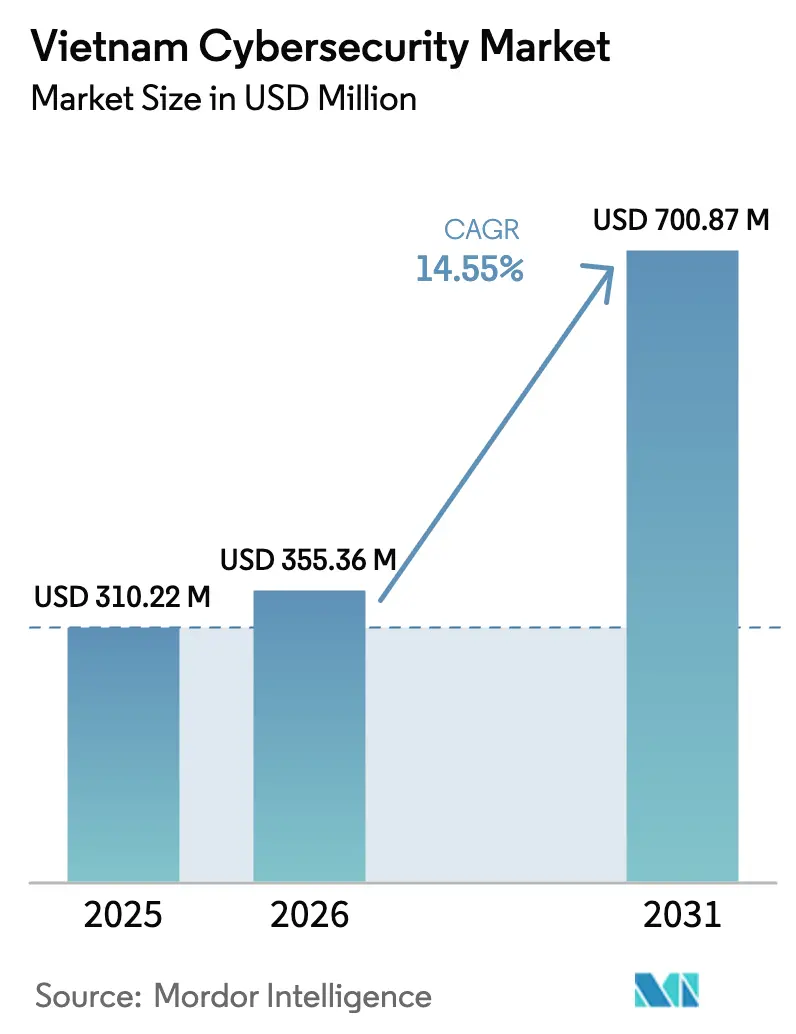
| Base Year Market Size (2025) | USD 310.22 Million |
| Market Size (2026) | USD 355.36 Million |
| Market Size (2031) | USD 700.87 Million |
| Growth Rate (2026 - 2031) | 14.55 % |
| Market Concentration | Medium |
Major Players *Disclaimer: Major Players sorted in no particular order Image © Mordor Intelligence. Reuse requires attribution under CC BY 4.0. | |
Vietnam Cybersecurity Market Analysis by Mordor Intelligence
The Vietnam Cybersecurity Market size is expected to grow from USD 310.22 million in 2025 to USD 355.36 million in 2026 and is forecast to reach USD 700.87 million by 2031 at 14.55% CAGR over 2026-2031. Demand scales rapidly as mandatory data-localization rules under Decree 53/2022 and the Personal Data Protection Decree 13/2023 compel enterprises to strengthen their digital defenses, while a USD 100 million public-sector budget accelerates national cyber-resilience programs. Cloud migration among small and mid-sized enterprises (SMEs), hyperscale data center build-outs by Viettel, AWS, and FPT, and rising biometric mandates in banking further expand the Vietnam cybersecurity market by widening both the threat surface and compliance burden. At the same time, a projected shortage of 700,000 skilled professionals through 2028 inflates service-provider demand and enhances the pricing power of qualified vendors. Fragmented enforcement, SME price sensitivity, and import tariffs on security appliances temper the overall growth trajectory but do not derail it, given the scale of digital-sovereignty investment.
Key Report Takeaways
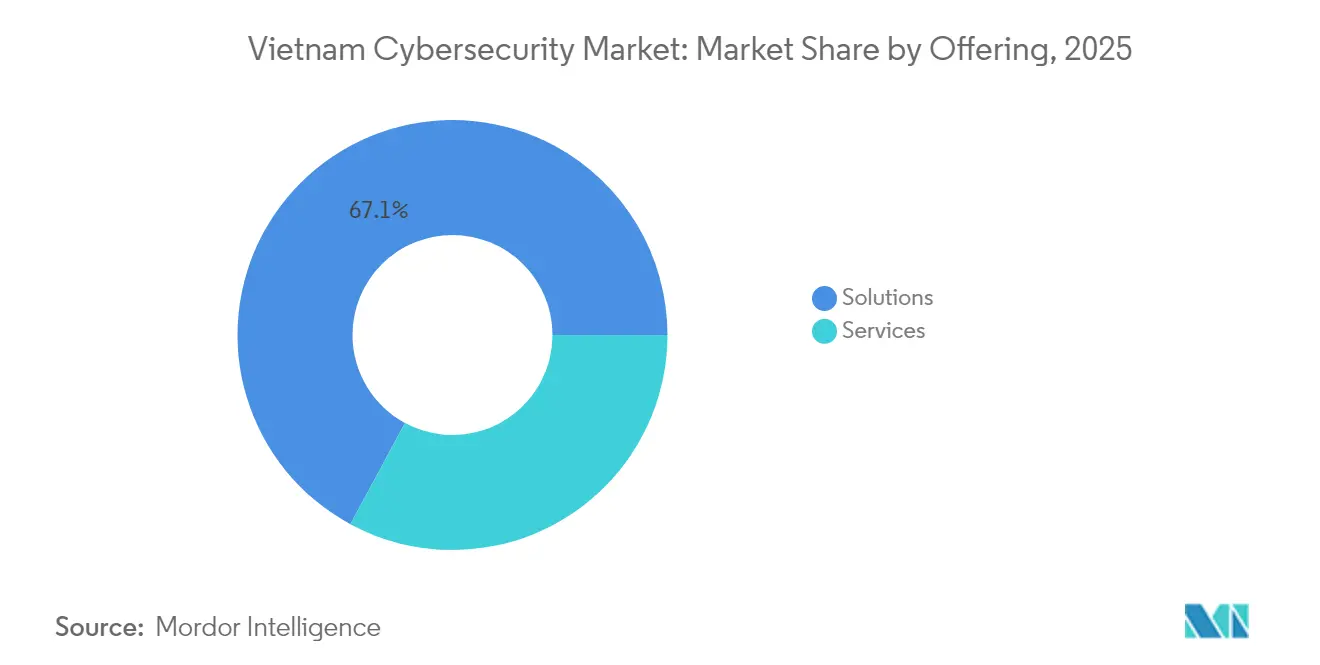
- By offering, Solutions commanded 67.12% of the Vietnam cybersecurity market share in 2025, while Services are projected to advance at a 14.86% CAGR to 2031.
- By deployment mode, Cloud held a 56.02% share of the Vietnam cybersecurity market size in 2025 and is forecasted to expand at a 16.92% CAGR through 2031.
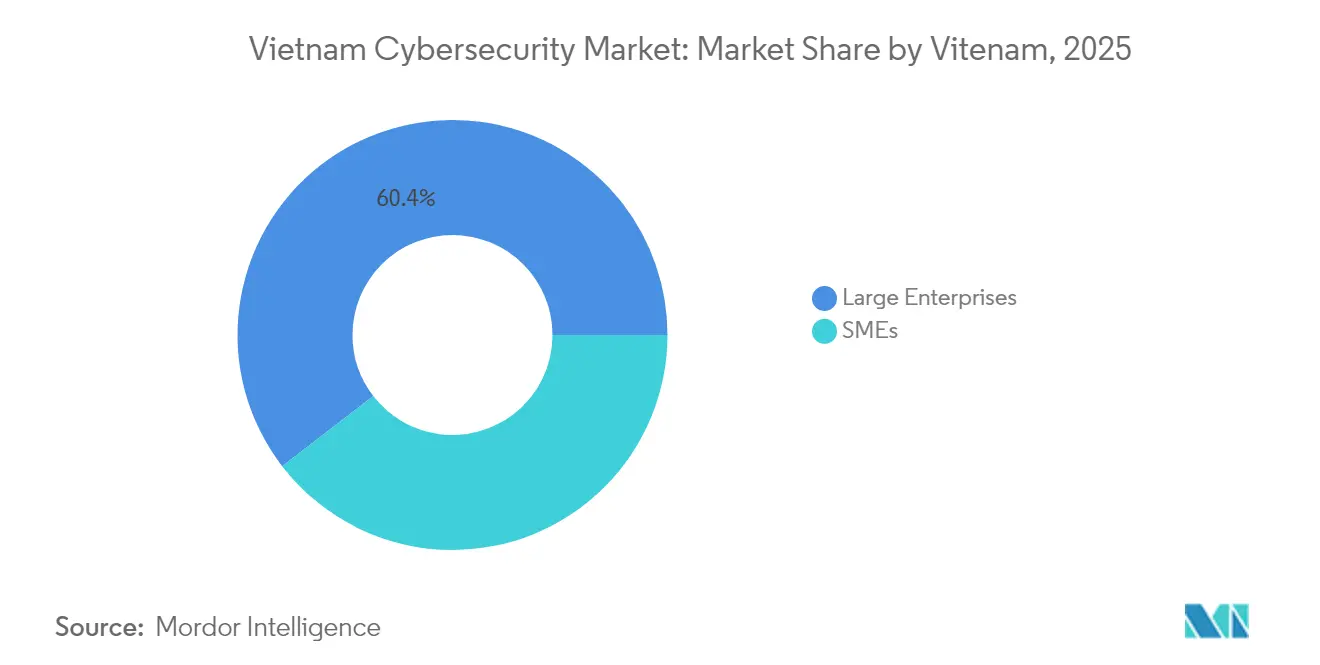
- By organization size, large enterprises accounted for 60.44% of the Vietnam cybersecurity market share in 2025, whereas SMEs are expected to grow at a 17.62% CAGR to 2031.
- By end-user industry, BFSI led with a 27.45% revenue share of the Vietnam cybersecurity market in 2025; healthcare is the fastest-growing vertical, with a 18.75% CAGR through 2031.
Note: Market size and forecast figures in this report are generated using Mordor Intelligence’s proprietary estimation framework, updated with the latest available data and insights as of 2026.
Vietnam Cybersecurity Market Trends and Insights
Drivers Impact Analysis*
| Driver | (~) % Impact on CAGR Forecast | Geographic Relevance | Impact Timeline |
|---|---|---|---|
| Government digital-transformation agenda accelerating security spend | +2.8% | Nationwide, strongest in Hanoi and Ho Chi Minh City | Medium term (2-4 years) |
| Cashless-payment boom raising BFSI attack surface | +2.1% | Urban financial hubs | Short term (≤ 2 years) |
| SME cloud-migration wave post-2023 | +1.9% | Country-wide; industrial zones | Medium term (2-4 years) |
| Mandatory compliance with Cybersecurity Law and Decree 53/2022 | +2.3% | All sectors | Short term (≤ 2 years) |
| Hyperscale datacenter build-outs (Viettel, AWS, FPT) | +1.7% | Ho Chi Minh City, Hanoi corridors | Long term (≥ 4 years) |
| Rising state-sponsored APT attacks on critical infrastructure | +1.4% | National, government and utilities | Long term (≥ 4 years) |
| Source: Mordor Intelligence | |||
Government digital-transformation agenda accelerating security spend
The National Digital Transformation Programme earmarks USD 100 million for cybersecurity and requires every public service to reach level-4 online maturity by 2025.[1]Ministry of Information and Communications, “Digital Transformation Programme Update 2025,” mic.gov.vn Southern Power Corporation’s near-total shift to electronic contracts, 5.6 million executed by December 2024, shows how public-sector adoption forces suppliers to meet the same security standards.[2]EVN Southern Power Corp., “E-Contract Transformation Report,” evn.com.vn Eight “Make in Vietnam” SOC platforms certified in 2023 further localize expertise and funding, ensuring domestic vendors secure a preferential foothold when public agencies procure security technology. Each government deployment creates a signaling effect that nudges private firms to match baseline controls, amplifying market demand.
Cashless-payment boom raising BFSI attack surface
Biometric verification became compulsory for transactions above VND 10 million in July 2024, yet fraud rings manipulated photo-based bypasses to siphon over VND 1,000 billion from multiple banks, underscoring gaps in facial-recognition accuracy. Vietcombank’s AI-enabled anti-fraud engine stopped 40,000 suspicious transfers worth VND 160 billion within one month, demonstrating tangible returns on real-time threat analytics. Consequently, BFSI institutions channel higher budgets toward continuous authentication, behavioral analytics and transaction-monitoring suites, widening the Vietnam cybersecurity market.
SME cloud-migration wave post-2023
VNPT’s OneSME.vn platform onboarded almost 160,000 SMEs and processed VND 600 billion in transactions during 2024. Yet 60% of organizations still lack a clear cloud-security roadmap, allowing personal-data breaches against small firms to climb 50% year-on-year. Hybrid-cloud security architectures that fuse compliance tooling with cost-efficient SaaS thus resonate strongly with resource-constrained enterprises.
Mandatory compliance with Cybersecurity Law and Decree 53/2022
Foreign digital-service providers must localize user data for at least 24 months and establish on-shore offices within 12 months of notification. Personal Data Protection Decree 13/2023 deepens obligations by mandating Data Protection Officers and impact assessments. Multinationals now accelerate investments in localized SOCs, compliance automation and encryption, propelling short-term spending well above organic run-rate growth.
Restraints Impact Analysis*
| Restraint | (~) % Impact on CAGR Forecast | Geographic Relevance | Impact Timeline |
|---|---|---|---|
| Certified-talent shortage (1.5 × gap) | −1.8% | Major cities: acute in Ho Chi Minh City and Hanoi | Long term (≥ 4 years) |
| Price-sensitive SME segment | −1.2% | Rural and secondary cities | Medium term (2-4 years) |
| Fragmented regulatory enforcement | −0.9% | Provincial variance | Short term (≤ 2 years) |
| High import tariffs on security appliances | −0.7% | Nationwide | Medium term (2-4 years) |
| Source: Mordor Intelligence | |||
Certified-talent shortage
Vietnam will need more than 700,000 cybersecurity specialists by 2028, yet 76% of firms already report staffing shortages, inflating salary costs and elongating deployment cycles.Brain drain to overseas employers worsens scarcity, while university curricula lag on hands-on training. The National Cybersecurity Association’s 2025 nCademy platform offers AI-personalized courses, but its near-term impact on workforce volume remains limited. Vendors compensate by bundling remote managed services and low-touch SaaS tools, but project timelines still extend.
Price-sensitive SME segment
Fourteen percent of SMEs run no antivirus software and 48% lack any security monitoring, citing budget rather than technical barriers. Although Security-as-a-Service models reduce upfront outlays, many firms still wait until post-breach before investing, compressing addressable market value despite large customer volume. Providers increasingly offer freemium tiers and government-subsidized packages to seed adoption.
*Our forecasts treat driver/restraint impacts as directional, not additive. The impact forecasts reflect baseline growth, mix effects, and variable interactions.
Segment Analysis
By Offering: Solutions underpin foundations while Services close the skills gap
Solutions held 67.12% of the Vietnam cybersecurity market in 2025, led by network-security equipment and infrastructure protection mandated under Decree 53/2022. Demand for application, cloud, and identity-access security accelerates as enterprises migrate workloads and comply with biometric rules. Network-security refresh cycles align with hyperscale datacenter launches, while endpoint defenses expand alongside remote-work trends.
Services, though smaller, are projected to outpace products at a 14.86% CAGR through 2031 as organizations outsource security operations to bridge workforce shortages. Managed SOC, incident response retainer and compliance consulting anchor this surge. The Vietnam cybersecurity market size for Services is forecast to double by 2031, capturing budgets reallocated from capital purchases to operating expenses. Domestic providers leverage proximity and regulatory fluency, whereas global vendors win complex transformation projects.


By Deployment Mode: Cloud gains ascendancy amid sovereignty-ready datacenters
Cloud deployments captured 56.02% of Vietnam cybersecurity market share in 2025, catalyzed by Viettel’s 140 MW facility and CMC’s USD 250 million campus that satisfy data-localization clauses.Small firms prize SaaS agility, while banks and ministries choose private clouds to retain custody of sensitive data. Demand for cloud-native firewalls, container security and workload-protection platforms scales in parallel.
On-premise estates persist in defense, energy and legacy-system heavy sectors, but even these embrace hybrid designs. Unified policy orchestration across multicloud, edge and premises environments becomes a procurement prerequisite, steering vendor roadmaps toward single-pane management. By 2031 the Vietnam cybersecurity market size for cloud-deployed controls is projected to eclipse on-premise spending by a two-to-one margin.
By Organization Size: SME momentum outpaces large-enterprise incumbency
Large enterprises contributed 60.44% of Vietnam cybersecurity market revenue in 2025, purchasing integrated risk-management suites, advanced SIEM and zero-trust architectures. Banks, telcos and conglomerates negotiate volume contracts that bundle software, appliances and services. Their procurement criteria emphasize interoperability with existing systems and local support.
SMEs, however, register the fastest 17.62% CAGR as cloud adoption democratizes access to enterprise-grade security. VNPT’s OneSME.vn testimonies show transaction volumes near VND 600 billion in 2024, reflecting growing trust in digital channels
By End-User Industry: BFSI retains lead, Healthcare accelerates
BFSI accounted for 27.45% of the Vietnam cybersecurity market size in 2025, absorbing 71% of all reported cyberattacks. Real-time payment networks, digital-only banks, and biometric mandates together necessitate continuous transaction monitoring, fraud analytics, and secure API gateways. Banks invest in layered defense to preserve customer trust and regulatory compliance.
Healthcare is projected to post the highest 18.75% CAGR through 2031, as electronic health records and telemedicine propagate sensitive personal data across distributed devices. Government funding for smart hospitals and IoT medical infrastructure increases the risk of attacks, prompting demand for HIPAA-aligned encryption, medical device segmentation, and identity governance.
Regulatory Landscape
Vietnam’s cybersecurity spending is strongly shaped by the Cybersecurity Law framework and its implementing instruments, alongside data protection and data localization obligations. The Law on Cybersecurity No. 116/2025/QH15 was promulgated on December 10, 2025 and took effect on July 1, 2026, with the Ministry of Public Security designated as the lead agency for unified state management of cybersecurity. In parallel, Decree 53/2022 and Personal Data Protection Decree 13/2023 continue to drive requirements for onshore presence, localized data retention, and expanded governance, including Data Protection Officer responsibilities and impact assessments. These requirements translate into spend on encryption, logging, monitoring, and compliance automation.
Policy execution is being operationalized through an implementation plan signed by the Prime Minister under Decision No. 437/QD-TTg (March 16, 2026). The plan sets near-term coordination milestones for ministries, including reviews and consolidated reporting by mid-2026. The pending decree set referenced in the implementation plan, covering cybercrime and high-tech crime prevention, information system protection, and cybersecurity force regulations, increases demand for audit readiness, incident response processes, and security operations capabilities, especially among regulated sectors such as banking, telecom, and critical infrastructure operators.
Value Chain Analysis
Vietnam’s cybersecurity value chain spans global technology vendors and hyperscalers supplying core platforms (endpoint, network, cloud, IAM, and SIEM), local manufacturers and integrators delivering appliances and turnkey deployments, and a growing services layer that supports design, deployment, and ongoing operations. Distribution and enablement are important midstream functions, with value-added distributors such as VNCS providing Distribution, Service, Development (DSD) support for international stacks (for example Splunk, Akamai, and Invicti). This helps enterprises localize implementations and integrate tooling into existing IT estates.
Downstream, domestic specialists and large IT groups provide SOC build-outs, managed detection and response, assessment, and incident response retainers. Buyer preference for local-language operations and compliance fluency supports this services-led demand. Key players include Viettel Cyber Security, CMC Cyber Security, FPT Information System (security division), and Vietnam National Cyber Security (NCS), alongside niche firms such as VSEC, which focuses on security assessment and testing. Productization within services is also increasing, including NCS developing an NCS SOAR platform for incident response orchestration to support repeatable delivery for resource-constrained customers facing skills gaps.
Competitive Landscape
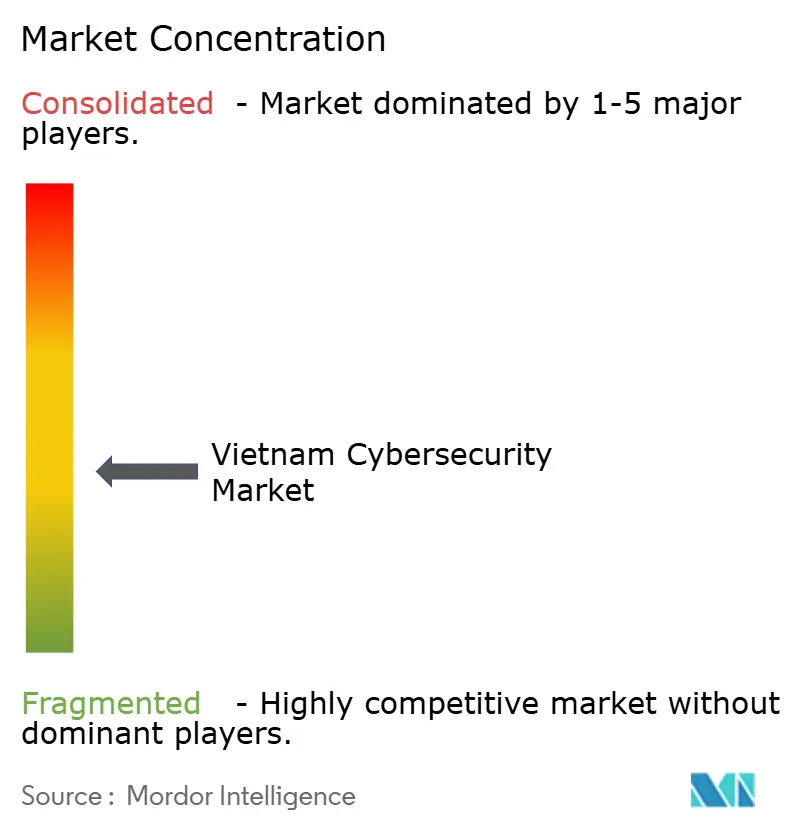
The vendor field remains fragmented, with the top five suppliers collectively controlling less than 35% of the Vietnam cybersecurity market revenue, leaving ample room for challengers. Domestic leaders Viettel Cyber Security, FPT Information System, and CMC Cyber Security combine full-stack offerings with government relationships, often winning regulated-industry contracts. Viettel’s April 2025 spin-out endowed it with 500 specialists and a mandate to penetrate Japan and the Philippines. Meanwhile, its researchers have disclosed more than 400 zero-day vulnerabilities in global software over the past 18 months, thereby elevating brand credibility.
Global majors, including IBM, Cisco, Microsoft, and Palo Alto Networks, are expanding their local footprints through technology transfer, joint labs, and Vietnamese-language threat-intelligence portals. Partnerships such as OPSWAT-Bkav’s multiscanning alliance boost detection accuracy to over 99%, showcasing the value of hybrid global-local engineering. White-space opportunities flourish in cybersecurity insurance, industrial IoT security, and SME-focused MDR, niches now addressed by Viettel Money, VBI, CyStack, and DrayTek.
Talent scarcity shapes competitive strategy: companies differentiate via in-house academies, vendor-neutral certification sponsorships, and automated configuration toolkits that minimize human oversight. Further, regulatory expertise emerges as a sales lever; vendors able to guide clients on Decree 53/2022 audit preparation hold a distinct edge. Over the forecast horizon, incremental consolidation is likely, but large-scale mergers face cultural fit and valuation hurdles, thereby sustaining moderate fragmentation.
Vietnam Cybersecurity Industry Leaders
IBM Vietnam Co., Ltd
HPT Vietnam Corporation
Cisco Systems, Inc
CMC Corporation
Amazon Web Services, Inc
- *Disclaimer: Major Players sorted in no particular order

Market Opportunities and Future Outlook
Compliance-led modernization creates whitespace in governance, risk, and security operations workflows by reducing manual effort for enterprises navigating Decree 53/2022 and Personal Data Protection Decree 13/2023 obligations and the expanded scope of the Cybersecurity Law effective July 1, 2026. The opportunity is reinforced by a concrete budget signal: government guidance that at least 15% of digital transformation and IT investment budgets in state agencies be allocated to cybersecurity protection. This supports demand for security-by-design in e-government platforms, identity controls, encryption, logging, and continuous monitoring.
Capability-building programs and related facilities also create room for vendors that can deliver training-linked SOC, threat intelligence, and cybercrime support services. The Ministry of Public Security broke ground on the Regional Counter Cybercrime Hub for Asia-Pacific at Hoa Lac Hi-Tech Park in Hanoi on July 10, 2026, positioning the site as a center for training, research, and legal assistance. It also expands support for incident response, forensics, and cross-border cooperation needs. In parallel, enterprise appetite for more automated security operations is being reinforced by local system integrators and global partners presenting AI-enabled SOC approaches (for example, IBM Vietnam and FPT IS highlighting AI-powered SOC technologies in a banking forum setting), which aligns with demand for managed services to address Vietnam’s cybersecurity talent constraints.
Recent Industry Developments
- July 2026: Vietnam Regulatory Landscape - The 2025 Cybersecurity Law, mandating stricter service provider obligations like user identity verification and 24-hour breach reporting, is scheduled for implementation. The change reinforces compliance demand and could widen the addressable market for local providers and security service offerings.
- April 2026: HPT signed an MOU with SMOne and ManageEngine to expand the partner ecosystem and IT service management and operations capabilities in Vietnam. The collaboration expands the local MSSP ecosystem and IT services capacity. It strengthens Vietnam’s cybersecurity services pipeline and ecosystem competitiveness.
- March 2026: HPT achieved Titanium Partner status with Dell Technologies on March 18, 2026, covering endpoint security capabilities. The move improves access to Dell security stack capabilities and joint go-to-market activities. It elevates HPT’s product-portfolio credibility and supports potential co-sell opportunities in Vietnam’s enterprise security market.


Research Methodology Framework and Report Scope
Market Definition and Coverage
For this methodology, the market covers spending in Vietnam on cybersecurity software, hardware, and services that prevent, detect, and respond to cyber threats across enterprise and public sector environments.
Scope exclusions: Consumer-grade security purchases for personal devices and informal freelancer activity are excluded when they are not recorded as organized cybersecurity revenue.
Segmentation Overview
- By Offering
- Solutions
- Application Security
- Cloud Security
- Data Security
- Identity and Access Management
- Infrastructure Protection
- Integrated Risk Management
- Network Security Equipment
- Endpoint Security
- Services
- Professional Services
- Managed Services
- Solutions
- By Deployment Mode
- Cloud
- On-Premise
- By End-User Industry
- BFSI
- Healthcare
- IT and Telecom
- Industrial and Defense
- Retail
- Energy and Utilities
- Manufacturing
- Other End-User Industries
- By Organization Size
- SMEs
- Large Enterprises
Data Sources, Market Sizing, and Validation
Desk Research
Desk research set the base structure of the model, mainly by clarifying Vietnam-specific policy triggers, digitization pace, and the size of IT spending pools that cybersecurity typically attaches to. We relied on public sources such as Vietnam government portals and ministry releases tied to cyber safety programs, ITU Global Cybersecurity Index materials, and open publications from international bodies that track digital economy and ICT adoption.
To avoid over-relying on one data series, supporting checks were also pulled from sources such as operator and enterprise annual reports, audited financial statements, investor presentations, reputable Vietnam business press, and open procurement and tender notices when available. In a few places, paid subscriptions were used for company financials and intelligence, news and financials screening, and patent databases to understand where product development and hiring signals were moving. The sources listed here are illustrative, and many additional references were used to collect, validate, and clarify data points during the work.
Primary Interviews and Surveys
Primary interviews and surveys were used to pressure-test adoption levels and pricing logic across key buyer groups such as banks, telecom teams, industrial manufacturers, and public agencies, so the model reflects how cybersecurity is actually bought in Vietnam. We also used these discussions to confirm how budgets split between solutions and services, which deployment patterns are most common (cloud versus on-premise), and what changes after major regulatory deadlines.
Because Vietnam demand can vary by industry and maturity, inputs were validated with a mix of providers, channel-facing experts, and end users, followed by consistency checks across north and south economic hubs and national-level programs.
Distribution of primary research fieldwork respondents
| Company type | Respondent position |
|---|---|
| Top tier: 35% | CXOs: 20% |
| Mid tier: 43% | Functional/Unit leaders: 35% |
| Smaller Players: 22% | Managers: 45% |
Market-Sizing & Forecasting
Sizing starts from a top-down build where Vietnam ICT and digitalization indicators are translated into a cybersecurity demand pool, then filtered by typical security spend ratios that were validated through interviews. Only after the demand pool is constructed do we apply market-specific split factors so totals match how solutions and services are purchased in the country.
A few practical inputs are tracked in the model because they move spending in visible ways, including enterprise cloud migration pace, compliance timelines for personal data protection and data localization, incident and exposure trends that trigger new controls, the managed security share versus in-house delivery, and average pricing movement for core security bundles as capabilities expand. To keep the totals grounded, selective bottom-up checks are used, such as sampled supplier and channel revenue signals, hiring and contract intensity as a proxy for services scale, and a sanity check of implied spend per large enterprise versus peer markets. Where a bottom-up view is incomplete, gaps are handled by scaling from verified coverage rates and applying conservative adjustment factors that are reviewed in the expert loop.
Forecasting is done using scenario analysis supported by a light multivariate regression layer, where the key drivers are projected forward and then reconciled with the forward view shared by local practitioners. The end result stays repeatable, since each step can be traced back to a defined variable and a simple calculation path.
Data Validation & Update Cycle
Validation is done in steps so that outliers do not pass through unnoticed. Model outputs are compared against independent signals like sector turnover references, public program timing, and the implied security spend intensity by industry, and then variances are reviewed by another analyst before sign-off.
If a big change appears, such as a regulatory enforcement shift, a major breach-driven spend surge, or a sharp pricing move in services, we re-contact sources and re-run the affected assumptions before finalizing the view. Reports are refreshed annually, and interim updates are made when a material event changes the demand outlook. Before delivery, a fresh pass is completed so clients receive the latest updated view available at that time.
Mordor Intelligence's Vietnam Cybersecurity Market Estimate Compared With Other Published Estimates
Published numbers for Vietnam cybersecurity often look different because each publisher counts different revenue streams, chooses a different base year, and applies its own view on how fast cloud, compliance, and services adoption will scale. Currency timing also matters, since some figures are reported in local currency first and then converted to USD using a separate reference point.
Consumer antivirus subscriptions and retail device security bundles sit outside Mordor Intelligence's scope, which tends to narrow the total to enterprise and institutional spending that is easier to validate through budgets, contracts, and service delivery patterns. Other estimates can also drift when they mix sector turnover with addressable market, or when they assume aggressive managed security price increases without checking how SMEs actually buy and renew.
Benchmark comparison
| Source | Market Size | Gaps in Research Methodology |
|---|---|---|
| Mordor Intelligence | USD 310.22 M (2025) | |
| Government Trade Brief A | USD 206.53 M (2022) | Uses an older base year and is presented as a national market revenue snapshot, with limited clarity on how services, public programs, and multi-year contracts are recognized. |
| Business Press Compilation B | USD 280.00 M (2024) | Reported as sector turnover, which can include adjacent ICT safety activity and does not always separate enterprise cybersecurity spend from broader information security related revenue. |
The spread across figures is mainly explained by timing and by what gets counted as cybersecurity revenue, especially when sector turnover is used as a proxy for end-user spending. By tying the estimate to clear demand drivers, realistic budget behavior, and repeatable checks on pricing and adoption, the resulting market size stays understandable and easier to reconcile on a client call.


Key Questions Answered in the Report
What is the current size of the Vietnam Cybersecurity Market?
It stands at USD 355.36 million in 2026 and is projected to reach USD 700.87 million by 2031.
Which segment grows fastest in the Vietnam Cybersecurity Market?
Cloud-deployed security leads, expanding at 16.92% CAGR as enterprises migrate workloads to local hyperscale datacenters.
How severe is Vietnam’s cybersecurity talent shortage?
The country faces a deficit of more than 700,000 professionals through 2028, creating implementation bottlenecks and boosting demand for managed services.
Why is the banking sector a prime adopter of cybersecurity solutions?
BFSI experiences 71% of all Vietnamese cyberattacks, compelling banks to embed real-time fraud analytics, biometric authentication and zero-trust architectures.
What regulations most influence market spending?
Decree 53/2022 on data localization and Personal Data Protection Decree 13/2023 collectively drive mandatory investments in localized infrastructure, compliance automation and encryption.
Which regions attract the bulk of cybersecurity investment?
Ho Chi Minh City and Hanoi dominate due to datacenter concentration, skilled workforce and proximity to regulators, although provincial SOCs are expanding reach nationwide.
Page last updated on:


 Your data is secure and never sold or shared.


