
Veterinary Reference Laboratory Market Size and Share
Market Overview
| Study Period | 2020 - 2031 |
|---|---|
| Market Size (2026) | USD 5.97 Billion |
| Market Size (2031) | USD 9.38 Billion |
| Growth Rate (2026 - 2031) | 9.45 % |
| Fastest Growing Market | Asia-Pacific |
| Largest Market | North America |
| Market Concentration | High |
Major Players *Disclaimer: Major Players sorted in no particular order Image © Mordor Intelligence. Reuse requires attribution under CC BY 4.0. | |
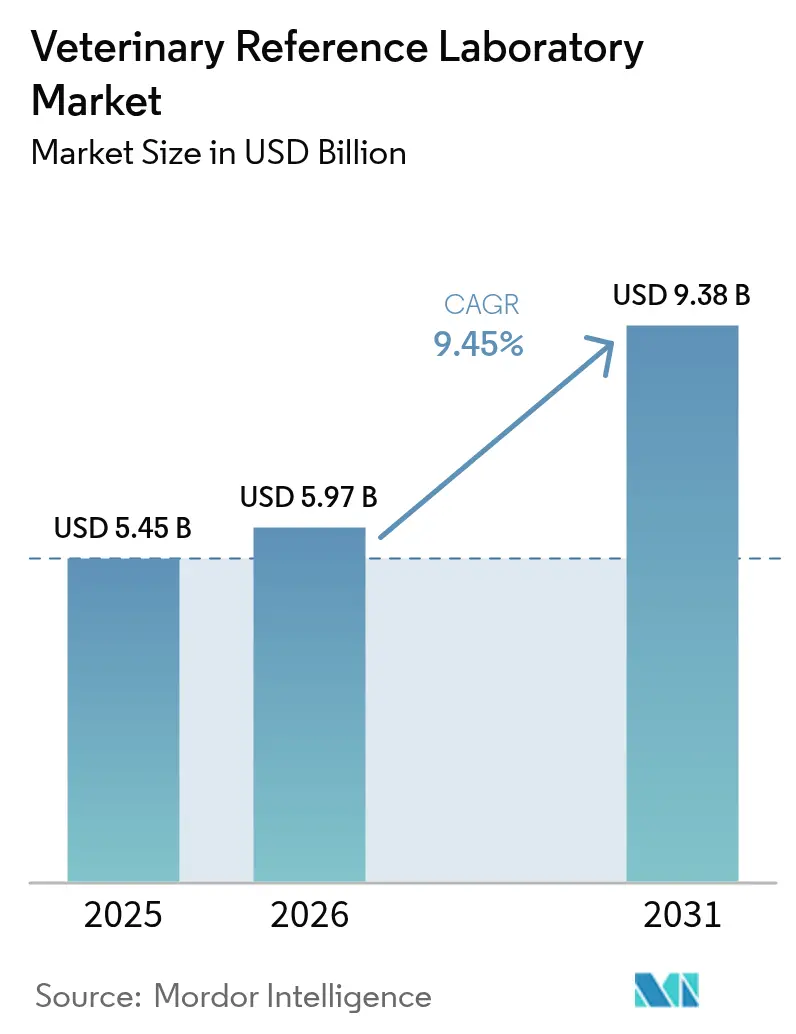
Veterinary Reference Laboratory Market Analysis by Mordor Intelligence
Veterinary Reference Laboratory market size in 2026 is estimated at USD 5.97 billion, growing from 2025 value of USD 5.45 billion with 2031 projections showing USD 9.38 billion, growing at 9.45% CAGR over 2026-2031.
The veterinary reference laboratory market is valued at USD 5.45 billion in 2025 and is projected to reach USD 8.60 billion by 2030, registering a 9.58% CAGR. Strong pet humanization trends, growing pet insurance coverage, and steady technology breakthroughs in immuno- and molecular diagnostics underpin this expansion. The convergence of artificial intelligence, next-generation sequencing, and point-of-care testing enlarges clinical possibilities while compressing diagnostic turnaround times. Infectious disease surveillance mandates following H5N1 outbreaks and antimicrobial stewardship rules sustain recurring testing volumes. Industry participants respond by integrating reference laboratories, imaging, software, and tele-health assets into unified platforms that simplify the clinician workflow and lock in recurring revenue.
Key Report Takeaways
- By animal type, companion animals accounted for 65.05% of the veterinary reference laboratory market share in 2025; livestock applications are projected to grow at a 10.02% CAGR through 2031.
- By service type, immunodiagnostics led with 42.98% revenue share in 2025, while molecular diagnostics is forecast to expand at a 10.48% CAGR to 2031.
- By application, clinical pathology accounted for a 38.22% share of the veterinary reference laboratory market in 2025, and virology is projected to grow at an 11.05% CAGR through 2031.
- By end user, veterinary clinics held 48.05% of the veterinary reference laboratory share in 2025; point-of-care and in-house laboratories are set to grow at a 12.03% CAGR through 2031.
- By geography, North America retained a 38.90% revenue share in 2025, whereas the Asia-Pacific region is expected to post the fastest growth, with a 12.04% CAGR from 2026 to 2031.
Note: Market size and forecast figures in this report are generated using Mordor Intelligence’s proprietary estimation framework, updated with the latest available data and insights as of 2026.
Market Trends and Insights
Drivers Impact Analysis of Veterinary Reference Laboratory Market*
| Driver | (˜) % Impact on CAGR Forecast | Geographic Relevance | Impact Timeline |
|---|---|---|---|
| Rising companion animal population and pet-humanization trend | +2.10% | Global, strongest in North America and Asia-Pacific | Long term (≥ 4 years) |
| Growing uptake of pet insurance and higher veterinary spend | +1.80% | North America and Europe core, expanding to Asia-Pacific | Medium term (2-4 years) |
| Increasing prevalence of zoonotic and chronic animal diseases | +1.40% | Global, intensified in agricultural regions | Short term (≤ 2 years) |
| Technology advances in immuno- and molecular diagnostics | +1.60% | North America and Europe leading, Asia-Pacific following | Medium term (2-4 years) |
| Tele-veterinary logistics platforms boosting sample volumes | +0.90% | Global, pronounced in underserved areas | Short term (≤ 2 years) |
| Antimicrobial-stewardship rules elevating lab testing in food animals | +1.20% | North America and Europe, expanding globally | Medium term (2-4 years) |
| Source: Mordor Intelligence | |||
Growing uptake of pet insurance and higher veterinary spend
Premiums reached USD 4.5 billion in 2024, more than doubling since 2019. Concentrated underwriting among the top ten insurers heightens reimbursement standardization, which in turn lifts acceptance of advanced diagnostics. Veterinary cost inflation of 8.24% reinforces the value proposition of insurance and encourages owners to authorize comprehensive testing without cost anxiety..
Technology advances in immuno- and molecular diagnostics
AI-enabled platforms such as Zoetis Vetscan Imagyst now deliver cytology, hematology, and urine-sediment readings inside the clinic. Next-generation sequencing cancer panels achieve 92.7% detection accuracy and reveal actionable genomic variants for therapeutic planning frontiersin.org. Multiplex PCR assays detect pathogens at 10 copies/µL while matching national reference standards.
Rising companion animal population and pet-humanization trend
U.S. households owned 87.9 million dogs and 73.8 million cats in 2024, and canine patients generated 81% of practice revenue. Owners increasingly demand human-grade diagnostics, evidenced by an 80% accuracy rate of liquid-biopsy cancer monitoring compared with 41% for conventional imaging.
Increasing prevalence of zoonotic and chronic animal diseases
More than 800 U.S. dairy herds experienced H5N1 infection during 2024, and 38 human cases were reported in California, spurring mandatory surveillance across species[1]Source: Centers for Disease Control and Prevention, “Human Cases of Highly Pathogenic Avian Influenza A(H5N1) — California,” cdc.gov. Expanded pathogen range in horses and cattle underscores the One Health imperative.
Restraints Impact Analysis of Veterinary Reference Laboratory Market*
| Restraint | (˜) % Impact on CAGR Forecast | Geographic Relevance | Impact Timeline |
|---|---|---|---|
| High cost of advanced tests & lab automation | -1.30% | Global, with greater impact in emerging markets | Medium term (2-4 years) |
| Shortage of board-certified veterinary pathologists | -0.80% | North America & Europe primarily, expanding globally | Long term (≥ 4 years) |
| Clinic-level PoC diagnostics cannibalising send-out volumes | -0.70% | North America & Europe core, spreading to Asia-Pacific | Short term (≤ 2 years) |
| Data-privacy hurdles for cloud-based LIMS integration | -0.50% | Global, with varying regulatory intensity by region | Medium term (2-4 years) |
| Source: Mordor Intelligence | |||
High cost of advanced tests and lab automation
Fully automated systems carry steep capital requirements that many small clinics cannot absorb. Over 80% of China’s pet hospitals earn under 2.4 million yuan annually, constraining equipment upgrades. Mobile laboratories and cartridge-based analyzers mitigate barriers but still require upfront hardware investment.
Shortage of board-certified veterinary pathologists
Aging specialist cohorts in North America and Europe lengthen turnaround for histopathology and cytology. AI triage solutions and virtual consult platforms extend expertise but cannot fully replace human judgment
*Our forecasts treat driver/restraint impacts as directional, not additive. The impact forecasts reflect baseline growth, mix effects, and variable interactions.
Veterinary Reference Laboratory Market Segment Analysis
By Service Type:
Molecular diagnostics erodes immunodiagnostics leadershipImmunodiagnostics held 42.98% of the veterinary reference laboratory market in 2025 based on entrenched use in routine screening. Molecular diagnostics, however, is forecast to compound at 10.48% through 2031 on the back of superior pathogen specificity, precision medicine, and shrinking run times. Multiplex PCR panels and next-generation sequencing propel this growth trajectory, supported by falling reagent costs and software automation. Immunodiagnostics’ installed base and clinician familiarity sustain its revenue, but competitive pressure steadily diverts high-value oncology and infectious disease testing toward molecular formats.
AI-enhanced cartridge analyzers bring molecular throughput into clinics, shortening result cycles from days to under an hour. Reference laboratories differentiate themselves with whole-genome and liquid biopsy services that inform targeted therapy selection. As test menus broaden, bundled subscription pricing models emerge, anchoring client loyalty and stabilizing cash flows. With these shifts, molecular platforms continue to capture incremental revenue while immunoassay providers add multiplex capability to defend share. Both segments fuel aggregate expansion of the veterinary reference laboratory market.


By Application:
Virology acceleration challenges clinical pathology dominanceClinical pathology accounted for 38.22% of 2025 revenues and remains indispensable for wellness exams and chronic-disease monitoring. Virology’s 11.05% CAGR outpaces every other application due to heightened H5N1 surveillance and mandatory influenza testing in livestock. Rapid antigen and RT-PCR panels, validated against national standards, dominate high-volume screening protocols and facilitate trade compliance. Regulatory emphasis on early detection prompts governments to subsidize virology capacity expansion in dairy, poultry, and equine sectors.
Meanwhile, antimicrobial-stewardship programs elevate bacteriology demand, and AI fecal-analysis systems accelerate parasitology adoption. Toxicology testing grows steadier, driven by rising pet exposure to household chemicals. Other niche applications appear as emerging pathogens and novel therapies require specialized assays. Collectively, diverse testing needs reinforce the growth prospects of the veterinary reference laboratory.
By Animal Type:
Companion animals continue to headline growthCompanion animals represented 65.05% revenue in 2025 and are on track for a 10.74% CAGR through 2031 as owners seek human-equivalent care. Dogs contribute the bulk of samples, although feline-specific innovations, such as bulk-acoustic-wave thyroid assays, gain traction. Enhanced insurance reimbursement and willingness to fund oncology panels solidify companion animals as the mainstay of the veterinary reference laboratory market. In contrast, livestock testing, although smaller, benefits from stringent biosecurity and food safety rules. Cattle surveillance intensifies following dairy-related H5N1 incidents, and multiplex assays targeting porcine respiratory pathogens sustain demand in swine operations. These programs, together, reinforce the veterinary reference laboratory market’s resilience across various animal categories.
Continued growth in companion care cascades into specialized equine sports-medicine panels and exotic-pet diagnostics, diversifying laboratory revenue streams. Livestock providers invest in on-farm sampling logistics and pooled testing to manage cost. Technology transfer between companion and livestock domains accelerates assay innovation and platform scalability.

By End User:
Point-of-care revolution reshapes service deliveryVeterinary clinics retained 48.05% share in 2025 but face stiff competition from fast-growing in-house and mobile laboratories, which post a 12.03% CAGR. Cartridge-based analyzers and cloud-linked microscopes empower clinicians to perform advanced assays without external referrals. Reference laboratories respond by offering specialized panels, guaranteed turnaround times, and integrated teleconsults. Veterinary hospitals leverage scale to deploy high-throughput analyzers, while start-ups design AI-driven interfaces that simplify the interpretation of complex assays.
Universities and research institutes maintain leadership in validation studies and novel assay development, providing a pipeline of technologies that are later commercialized by private laboratories. Telemedicine platforms blur the boundary between clinician and lab, funneling digital images and biometric data into cloud models for instant analytics. This multi-channel ecosystem enhances access, speed, and diagnostic depth, sustaining the broader veterinary reference laboratory market.
Geography Analysis
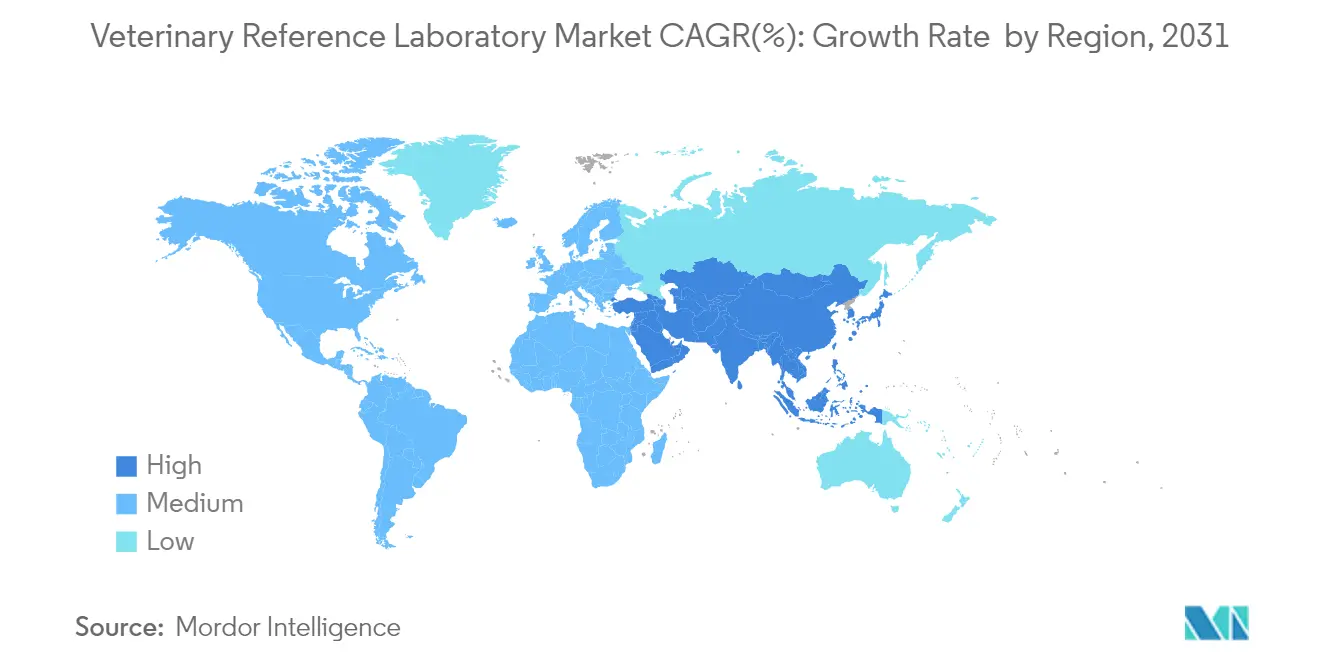
APAC Veterinary Reference Laboratory Market
Asia-Pacific is the fastest-advancing region at a 12.04% CAGR to 2031. China’s pet economy reached 300 billion yuan (USD 41 billion) in 2024 with veterinary care at 28% of spend, though profitability constraints in smaller clinics spur demand for cost-efficient diagnostics. Japanese innovators deploy AI-powered fecal analysis and after-hours tele-health, improving accessibility in an aging-society. Australia attracts multinational investment, as Zoetis expanded vaccine production capacity through a new Melbourne site. Varied regulatory frameworks and uneven infrastructure create a patchwork of opportunities across the region, yet rising household incomes and changing pet-owner behavior support sustained uptake of laboratory services.
North America Veterinary Reference Laboratory Market
North America maintained 38.90% market share in 2025 courtesy of mature practice infrastructure and high pet-care expenditure. FDA Guidance #263, effective June 2024, mandates prescription oversight for antimicrobials, indirectly boosting diagnostic volumes in food animals avma.org. Workforce shortages and declining clinic visits temper momentum, nudging providers toward automation to preserve productivity.
EMEA Veterinary Reference Laboratory Market
Europe demonstrates steady mid-single-digit expansion supported by regulatory harmonization and recent consolidation. Mars Incorporated completed acquisitions of SYNLAB Vet and Cerba Vet, enhancing test menu breadth and geographic reach . Antimicrobial-stewardship campaigns encourage diagnostics-guided therapy, and established veterinary training programs sustain demand for specialized assays. Emerging markets in the Middle East and Africa remain nascent yet promising, evidenced by the Philippines’ PHP 20 million investment in a new veterinary-diagnostic facility pna.gov.ph. Point-of-care platforms offer scalable options for regions lacking extensive laboratory networks, underlining a global convergence toward accessible diagnostics.

Regulatory Landscape
Regulation relevant to veterinary reference laboratories is anchored in official testing and surveillance requirements for notifiable animal diseases. In the United States, 9 CFR 71.22 ties certain official disease testing to USDA APHIS laboratory approval, with requirements around quality systems, use of approved methods, and ongoing oversight, including inspections. In February 2026, USDA APHIS NVSL highlighted work to enhance its laboratory approval portal and a work plan to amend 9 CFR 71.22, reflecting continued modernization of approval and oversight processes for regulated testing.
Accreditation and standards frameworks shape operational expectations globally, even when general reference lab services, such as routine CBCs and many hormone assays, are not directly overseen by USDA. AAVLD accreditation aligns with WOAH (OIE) quality standards for veterinary laboratories, and network participation, such as NAHLN assay deployment, uses multi-stage validation for analytical and diagnostic performance before acceptance. In Europe, EU Regulation 2019/6 on veterinary medicinal products, alongside EMA and national competent authority oversight, reinforces a broader compliance backdrop around antimicrobial stewardship and traceability, which indirectly supports demand for standardized, validated diagnostics that reference laboratories can provide.
Competitive Landscape
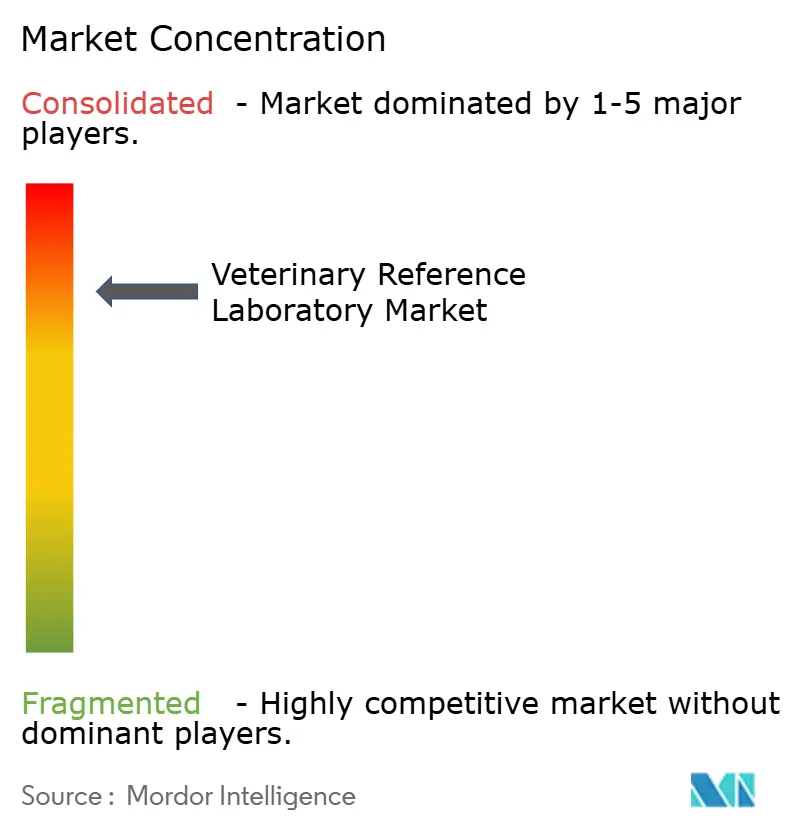
Consolidation marks the competitive tone. Mars Incorporated folded Heska, SYNLAB Vet, and Cerba Vet into its Science & Diagnostics division within twelve months, crafting an end-to-end ecosystem spanning reference labs, imaging, rapid tests, and tele-health. IDEXX sustains innovation leadership, preparing to commercialize the inVue Dx cellular analyzer and multi-cancer screening panel, underpinned by an estimated USD 45 billion total addressable market. Zoetis differentiates itself through AI integration, adding cytology and hematology modules to Vetscan Imagyst, constructing a 32,000-square-foot reference lab in Louisville[2]Source: Zoetis Inc., “Zoetis Opens Largest Diagnostics Reference Laboratory in Louisville,” zoetis.com , and expanding manufacturing capacity in Australia.
Thermo Fisher’s intent to divest parts of its diagnostics unit for USD 4 billion signals potential reshaping of supply dynamics, possibly triggering new partnerships or acquisitions. Regional innovators, such as Japan’s Coo & RIKU, introduce AI-based fecal diagnostics, while U.S. start-ups like Moichor leverage cloud AI to reduce test costs, highlighting the white-space potential in affordable solutions. The strategic focus is shifting toward integrated hardware-software-data bundles that reinforce customer retention through subscription and consumable revenue streams. Competitive pressure, together with pathologist scarcity, accelerates AI adoption and automation, raising the innovation bar across the veterinary reference laboratory market.
Veterinary Reference Laboratory Industry Leaders
IDEXX Laboratories, Inc.
Greencross Vets
Heska Corporation
Zoetis Inc.
Mars Inc.
- *Disclaimer: Major Players sorted in no particular order
Veterinary Reference Laboratory Market Companies Covered in this Report
- IDEXX
- VCA Animal Diagnostic Services (Mars)
- Zoetis Reference Laboratories
- GD Animal Health (Royal GD)
- Heska
- Antech Diagnostics
- SYNLAB Vet
- Veterinary Pathology Group (VPG)
- Laboklin GmbH
- NationWide Laboratories
- Asia Veterinary Diagnostics
- CVS Group plc
- Pathovet (Latin America)
- IDEXX BioAnalytics
- Inovie Vet
- ProtaTek International
- Thermo Fisher Scientific (Vet diagnostic services)
- Neogen
- Virbac Diagnostics
- Boehringer Ingelheim Vetmedica Labs
- Phibro Animal Health Diagnostics

Market Opportunities and Future Outlook
Hybrid models that pair centralized reference-lab capacity with digital reading, consult, and workflow tools are expanding the value per case. Zoetis placing a 32,000-square-foot reference laboratory at the UPS Healthcare Labport in Louisville (opened May 2025) illustrates how locating high-complexity testing near major logistics infrastructure compresses specimen transit time and supports faster turnaround for send-out testing, a key lever for clinics that mix in-house testing with advanced panels that still depend on reference-lab depth.
Genomics and NGS-based infectious disease and parasitology testing are creating gaps where culture-based or singleplex methods are slower or inconclusive. MiDOG Animal Diagnostics expanded whole genome sequencing services in March 2026, including antimicrobial resistance and virulence profiling, and then launched a dedicated NGS-based parasite detection test in July 2026, demonstrating how sequencing-led workflows move into commercial testing for complex, polymicrobial, or low-burden infections. In parallel, virtual reference-lab capabilities are being integrated more tightly into service delivery, and Zoetis' announced agreement in July 2026 to acquire VitalRADS, a cloud-based veterinary teleradiology platform, points to opportunities for reference laboratories and integrated providers to bundle imaging interpretation, AI-assisted decision support, and lab results into a single clinician workflow and subscription-oriented service layer.
Recent Industry Developments in Veterinary Reference Laboratory Market
- July 2026: Zoetis announced an agreement to acquire VitalRADS, a cloud-based veterinary teleradiology platform. The deal adds imaging interpretation and digital workflow into Zoetis diagnostics, strengthening virtual reference lab offerings that complement physical reference-lab networks.
- May 2026: IDEXX expanded its Fecal Dx antigen testing platform with taeniid tapeworm detection, with availability stated for late June 2026 for reference laboratory customers. The addition broadens the menu for routine GI workups and supports higher-throughput parasitology screening in reference-lab workflows.
- June 2024: IDEXX added quantitative pancreatic lipase testing to the Catalyst platform with rapid, in-clinic results. Faster pancreatitis assessment at the point of care shifts some routine testing away from send-out while increasing case finding that can trigger follow-on reference-lab confirmation and expanded panels.


Veterinary Reference Laboratory Market Report Scope and Research Methodology
Market Definition and Coverage
This market covers fee-based diagnostic testing services delivered by veterinary reference laboratories that receive samples from external veterinary clinics, hospitals, and other care points, and then return results with interpretation support. We count service revenues tied to routine and advanced lab testing across companion and production animals.
Scope exclusions: We exclude analyzer and reagent product sales, in-clinic point-of-care testing revenue, farm-gate rapid kits, and purely academic teaching lab activity to avoid double counting.
Segments Covered in This Report
- By Service Type
- Clinical Chemistry
- Hematology
- Immunodiagnostics
- Molecular Diagnostics
- Urinalysis
- Others
- By Application
- Clinical Pathology
- Bacteriology
- Virology
- Parasitology
- Toxicology
- Others
- By Animal Type
- Companion Animals
- Dogs
- Cats
- Horses
- Others
- Livestock Animals
- Cattle
- Swine
- Poultry
- Others
- Companion Animals
- By End User
- Veterinary Hospitals
- Veterinary Clinics
- Research Institutes & Universities
- Point-of-Care / In-house Labs
- By Geography
- North America
- United States
- Canada
- Mexico
- Europe
- Germany
- United Kingdom
- France
- Italy
- Spain
- Russia
- Rest of Europe
- Asia-Pacific
- China
- Japan
- India
- South Korea
- Australia
- Rest of Asia-Pacific
- Middle East & Africa
- GCC
- South Africa
- Rest of Middle East & Africa
- South America
- Brazil
- Argentina
- Rest of South America
- North America
Data Sources, Market Sizing, and Validation
Desk Research
Desk work starts with building a clean demand map for veterinary diagnostic testing that actually flows to reference labs, then checking it against public animal health signals. We typically rely on sources such as the USDA (animal health and livestock statistics), the World Organisation for Animal Health (WOAH) for notifiable disease updates, the World Health Organization for antimicrobial resistance context, and the World Bank for macro indicators that affect veterinary spending.
To keep the model grounded in observed activity, we also review association and regulator materials such as AAHA guidance, AVMA economic and workforce snapshots, and published methods in peer-reviewed veterinary pathology and diagnostics journals. Company annual reports, investor decks, and reputable press coverage are used to understand testing mix shifts (PCR adoption, panel expansion, turnaround expectations) and pricing direction. For company financials, news, patents, and selected import-export signals linked to instruments and reagents, we also use a few paid databases that we subscribe to. The sources listed here are illustrative, and many additional public documents were used for cross-checks and clarification during the work.
Primary Interviews and Surveys
Primary work is used to confirm what portion of diagnostic demand is routed to reference labs, how test menus are priced, and how sample logistics change volumes by region. We speak with lab operators, veterinary clinic and hospital decision-makers, and distribution and logistics-focused stakeholders, then sanity-check trends across APAC, EMEA, and the Americas so that one geography does not overly steer the total.
Distribution of primary research fieldwork respondents
| Company type | Respondent position | Region |
|---|---|---|
| Top tier: 29% | CXOs: 13% | APAC: 42% |
| Mid tier: 57% | Functional/Unit leaders: 41% | EMEA: 37% |
| Smaller Players: 14% | Managers: 46% | Americas: 21% |
Market-Sizing & Forecasting
Sizing starts with a top-down build that reconstructs the reference-lab demand pool using test utilization signals and the share of diagnostics that are typically sent out from clinics and hospitals, which is then converted into revenue using realistic service pricing. To keep the number practical, we corroborate the total with selective bottom-up checks that roll up a sampled set of lab revenues, then extend coverage using channel checks and ASP by test type estimates.
Key inputs include the companion animal and livestock patient base trends, the mix shift toward molecular diagnostics and immunoassays, average tests per visit for common care pathways, sample shipping intensity (which affects send-out behavior), and pricing progression by routine versus specialized panels. Where company disclosure is limited, gaps are handled through conservative ranges, then narrowed using interview feedback on routing shares and throughput utilization. For forecasting, scenario analysis is used because disease outbreaks, preventive screening adoption, and staffing constraints can move volumes quickly, and the scenarios are anchored to expert views on test growth and price changes rather than a single straight-line curve.
Data Validation & Update Cycle
Validation is done by cross-checking outputs against independent signals such as pet care spending direction, notifiable disease reporting intensity, and observable shifts in send-out testing versus in-clinic testing. When the model shows a jump that is not supported by these signals, we revisit routing assumptions, ASP movement, and regional weighting, then re-review the numbers before sign-off.
Reports are refreshed on an annual cycle, and interim updates are triggered when a material event can move testing volumes or pricing, such as major regulatory guidance changes, capacity expansions, or unusually large outbreak waves. Before delivery, the latest public releases and a light round of re-contacts are used so clients receive an updated view that matches current market conditions.
Mordor Intelligence's Veterinary Reference Laboratory Market Sizing Compared With Other Published Estimates
Published market sizes for veterinary reference laboratory services often differ, even when they sound like they cover the same thing, because each source can count a different revenue pool and use different price and volume assumptions. We see the biggest spreads when service boundaries are not spelled out, when the base year differs, and when the model leans too heavily on a single growth storyline.
Send-out testing rates from veterinary clinics, observable shifts in molecular and immunoassay utilization, and region-level disease surveillance signals are the checks that keep Mordor Intelligence tied to service-only reference lab revenues, and adjacent product revenues do not inflate the total.
Benchmark comparison
| Source | Market Size | Gaps in Research Methodology |
|---|---|---|
| Mordor Intelligence | USD 5.97 B (2026) | |
| Trade Journal A | USD 4.60 B (2024) | Uses an earlier base year and can understate the current run-rate if recent menu expansion and price resets are not fully reflected. The scope wording is broad, so some service lines may be treated more conservatively across regions. |
| Industry Platform B | USD 4.76 B (2025) | The approach appears to apply a smoother growth path and may not fully capture faster adoption of higher-value molecular panels in high-throughput reference labs. Limited clarity on exclusions can also cause inconsistent treatment of in-clinic testing or product-linked revenues. |
The table shows that year selection and what gets counted as lab revenue can move the number by a meaningful amount. When scope is held to outsourced reference lab services, and when test mix and routing shares are validated across regions, the final value becomes easier to trace back to real utilization and pricing steps, then update as conditions change.


Key Questions Answered in the Report
What is the current size of the veterinary reference laboratory market?
The market stands at USD 5.97 billion in 2026 and is forecast to reach USD 9.38 billion by 2031.
Which segment will grow fastest through 2031?
Molecular diagnostics leads with a 10.48% CAGR owing to precision medicine adoption and rapid PCR innovations.
Why is Asia-Pacific the key growth region?
Rising pet ownership, expanding middle-class spending, and rapid technology uptake propel a 12.04% CAGR in Asia-Pacific.
How are point-of-care platforms changing diagnostic delivery?
Cartridge analyzers and AI microscopes provide lab-grade results in clinics, driving a 12.03% CAGR for in-house testing.
What impact do zoonotic outbreaks have on the market?
Events like the H5N1 dairy-herd infections boost virology testing demand, elevating the segment to an 11.05% CAGR.
Page last updated on:


 Your data is secure and never sold or shared.


