
Veterinary Parasiticides Market Size and Share
Market Overview
| Study Period | 2020 - 2031 |
|---|---|
| Market Size (2026) | USD 10.74 Billion |
| Market Size (2031) | USD 15.03 Billion |
| Growth Rate (2026 - 2031) | 6.95 % |
| Fastest Growing Market | Asia-Pacific |
| Largest Market | Europe |
| Market Concentration | Medium |
Major Players *Disclaimer: Major Players sorted in no particular order Image © Mordor Intelligence. Reuse requires attribution under CC BY 4.0. | |
Veterinary Parasiticides Market Analysis by Mordor Intelligence
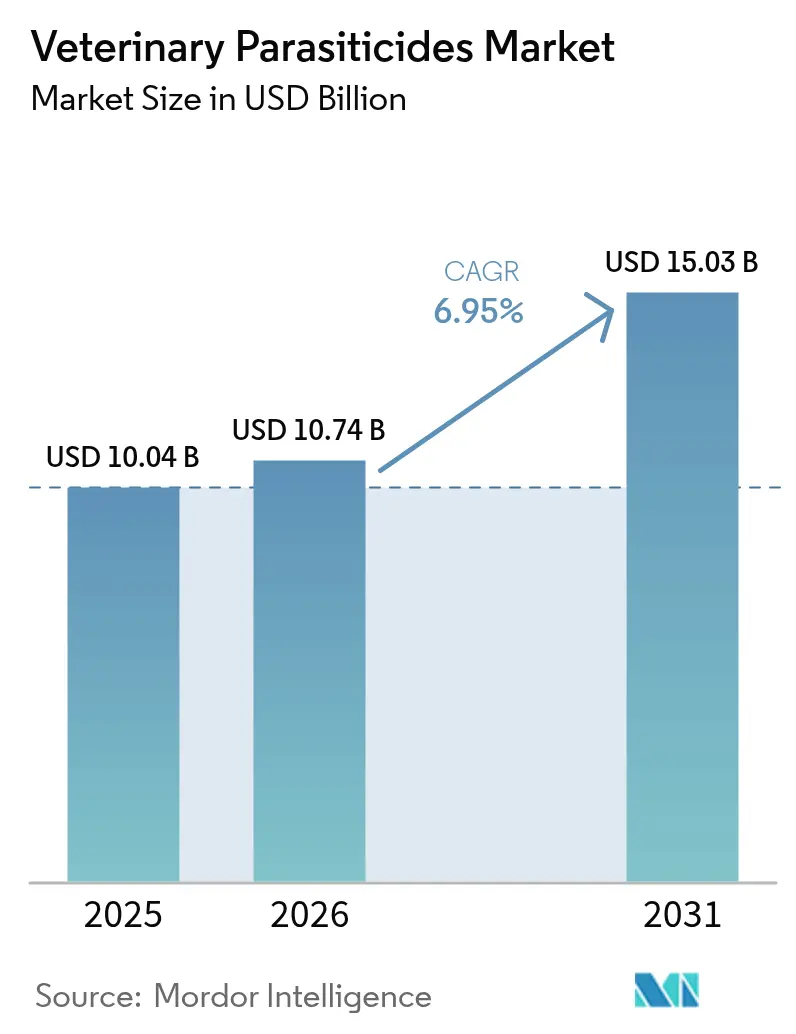
The veterinary parasiticides market size was valued at USD 10.04 billion in 2025 and estimated to grow from USD 10.74 billion in 2026 to reach USD 15.03 billion by 2031, at a CAGR of 6.95% during the forecast period (2026-2031). Robust demand stems from rising pet ownership, climate-driven parasite range expansion, and steady livestock productivity investments. Regulatory approvals for broad-spectrum tablets and long-acting injectables, long-acting treatment protocols, and raise compliance. Digital diagnostics guide precise therapy selection, while emerging generic competition follows the macrocyclic-lactone patent's expiration. Resistance threats and stricter environmental evaluations temper growth but accelerate innovation in novel modes of action, delivery systems, and combination products across the veterinary parasiticides market.
Key Report Takeaways
- By animal type, companion animals led with 57.62% revenue share in 2025; the dogs segment is projected to expand at 10.12% CAGR through 2031.
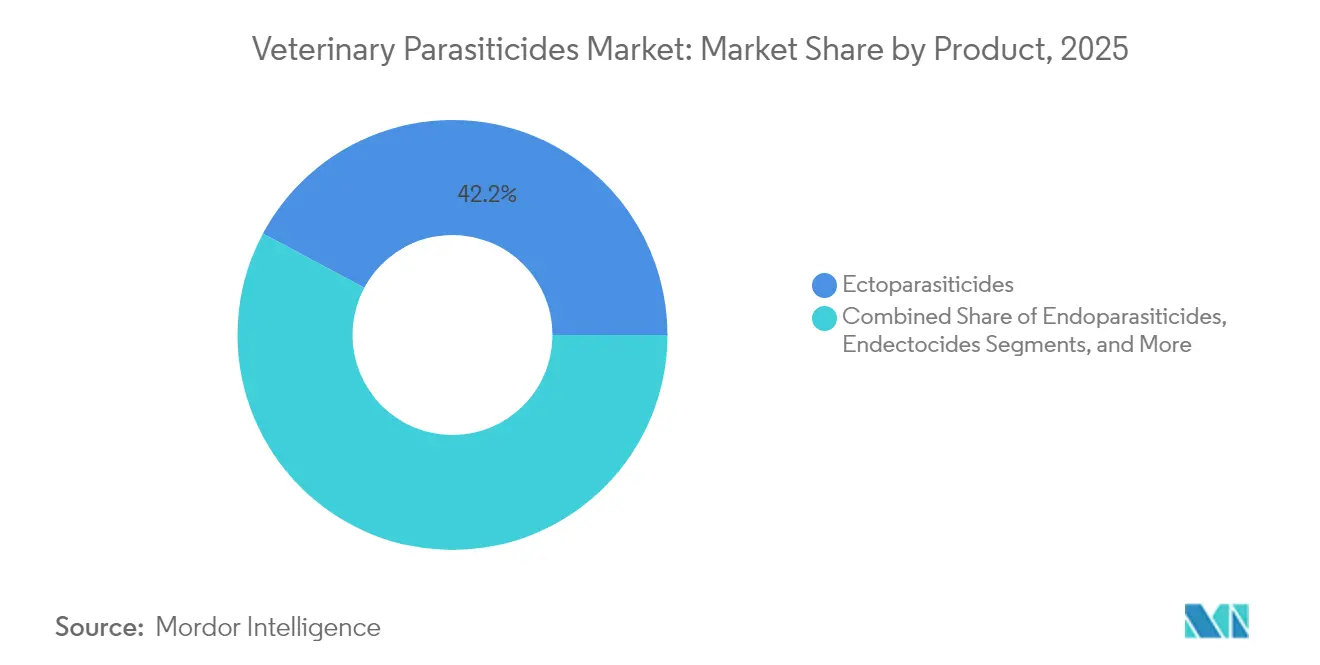
- By product type, ectoparasiticides held 42.18% revenue share in 2025; combination therapies are forecast to grow at 10.78% CAGR to 2031.
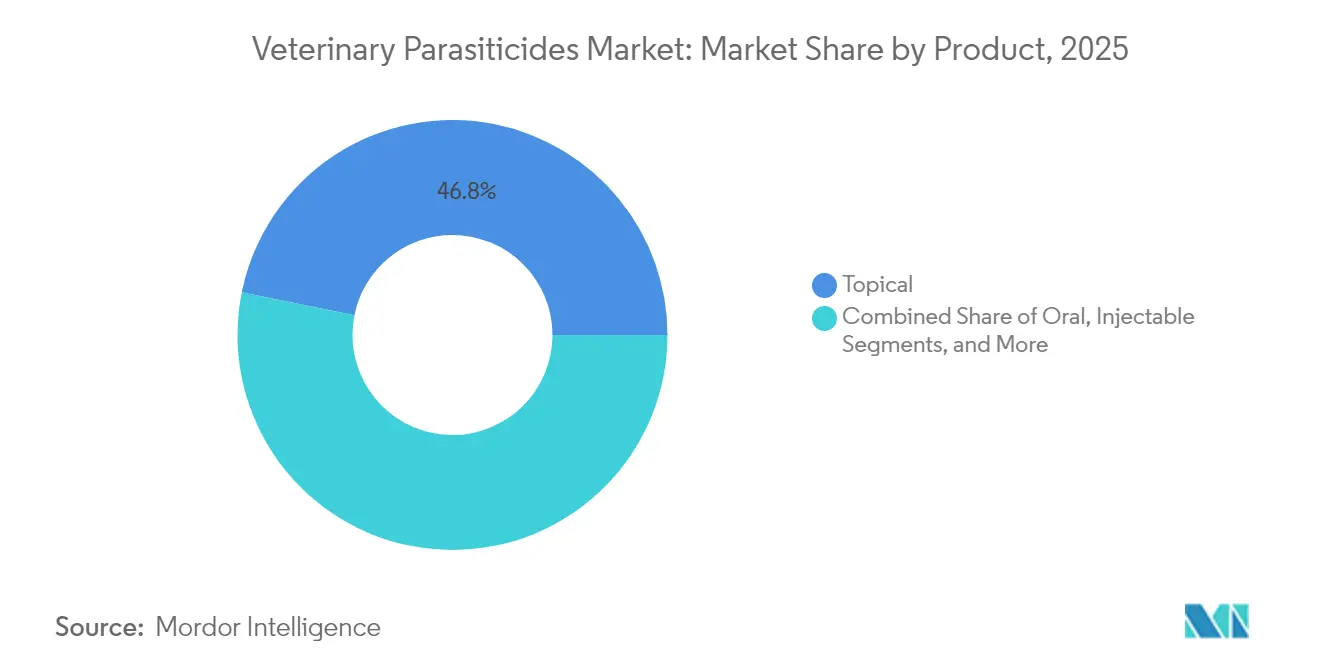
- By mode of administration, topical spot-ons accounted for 46.82% of the veterinary parasiticides market share in 2025, while long-acting injectables are advancing at a 12.18% CAGR through 2031.
- By region, North America commanded 34.62% revenue share in 2025; Asia Pacific is anticipated to register an 8.55% CAGR to 2031.
Note: Market size and forecast figures in this report are generated using Mordor Intelligence’s proprietary estimation framework, updated with the latest available data and insights as of 2026.
Market Trends and Insights
Drivers Impact Analysis of Veterinary Parasiticides Market*
| Driver | (~) % Impact on CAGR Forecast | Geographic Relevance | Impact Timeline |
|---|---|---|---|
| Rising prevalence of food-borne & zoonotic infections | +1.20% | Global; higher in Asia Pacific and Africa | Medium term (2-4 years) |
| Growing companion-animal adoption & humanization | +1.80% | North America and Europe core; expanding to APAC | Long term (≥ 4 years) |
| Increasing animal-health expenditure in emerging economies | +1.50% | Asia Pacific, Latin America, MEA | Long term (≥ 4 years) |
| Macrocyclic-lactone patent expiries unlocking generics | +0.90% | Global | Short term (≤ 2 years) |
| Adoption of long-acting injectable & combo therapies | +1.10% | North America and Europe; spill-over to APAC | Medium term (2-4 years) |
| Climate-change driven expansion of parasite habitats | +0.80% | Global; acute in temperate regions | Long term (≥ 4 years) |
| Source: Mordor Intelligence | |||
Rising Prevalence of Food-Borne & Zoonotic Infections
Zoonotic transmission elevates demand for preventive products as public health agencies integrate One Health priorities. Echinococcus multilocularis spread in North American canids raises human risk, driving mandatory treatment protocols. Climate change amplifies vector survivability, with Leishmania infantum transmission risk forecast to rise 71.6% in Iberia by 2060.[1]Frontiers in Veterinary Science, “Projected Expansion of Leishmania infantum Risk,” frontiersin.orgAuthorities respond with enhanced surveillance and compulsory deworming in high-risk herds. Preventive parasiticides prove more economical than outbreak management, securing long-term uptake in the veterinary parasiticides market.
Growing Companion-Animal Adoption & Humanization
Pet owner’s view pets as family members and prioritize premium preventive care. An Elanco survey found 94% of dog owners favor proactive intestinal worm treatment. The trend boosts combination products that cover internal and external parasites in a single dose. Telemedicine supports tailored regimens, and palatable chewables meet user expectations. Manufacturers improve taste, packaging, and digital engagement, lifting average selling prices across the veterinary parasiticides market.
Increasing Animal-Health Expenditure in Emerging Economies
Rising disposable income and expanding middle classes lift preventive care spending. China’s pet medical sector reached CNY 640 billion (USD 89.6 billion) in 2023, growing 17.43% year on year. Government food-safety programs promote livestock parasite control, while better distribution opens rural markets. Younger demographics in Asia Pacific sustain long-range demand, propelling regional growth in the veterinary parasiticides market.
Macrocyclic-Lactone Patent Expiries Unlocking Generics
Ivermectin’s expiry fostered price-competitive generics; upcoming cliffs for afoxolaner and fluralaner will repeat the pattern. Generic entry typically trims treatment costs by 30-50%, widening access in cost-sensitive regions. Regulators apply VICH harmonization to speed approvals.[2]Federal Register, “VICH Harmonization Activities,” federalregister.gov Innovators pivot to new chemistries and multi-mode products to preserve margins, sharpening product differentiation within the veterinary parasiticides market.
Restraints Impact Analysis of Veterinary Parasiticides Market*
| Restraint | (~) % Impact on CAGR Forecast | Geographic Relevance | Impact Timeline |
|---|---|---|---|
| Stringent Multi-Jurisdictional Regulatory Approvals | -0.80% | Global, with highest impact in EU & North America | Medium term (2-4 years) |
| Escalating Resistance To Existing Active Ingredients | -1.20% | Global, with acute impact in intensive farming regions | Short term (≤ 2 years) |
| High R&D Cost Versus Price Ceilings In Livestock Sector | -0.60% | Global, with higher impact in developing economies | Medium term (2-4 years) |
| Channel Shift To E-Commerce Squeezing Veterinary Markup | -0.40% | North America & Europe core, expanding to APAC | Short term (≤ 2 years) |
| Source: Mordor Intelligence | |||
Stringent Multi-Jurisdictional Regulatory Approvals
Fragmented requirements delay launches by 18-24 months despite FDA-EMA parallel advice initiatives. Environmental risk assessments now examine dung-beetle and aquatic toxicity, raising data burdens.[3]Food and Drug Administration, “Approval of Credelio Quattro,” fda.gov Proposed US labeling rules may increase compliance costs for legacy products. Smaller firms face disproportionate hurdles, which could consolidate power among large players in the veterinary parasiticides industry.
Escalating Resistance to Existing Active Ingredients
Merck Animal Health recorded sub-90% efficacy in 76.5% of pour-on dewormer tests from 600 farms. Multidrug-resistant nematodes compel costly combination protocols and reduce single-agent volumes. Equine guidelines now recommend targeted therapy based on fecal counts extension.uga.edu. R&D budgets shift toward new modes of action and diagnostics that slow resistance, exerting cost pressure across the veterinary parasiticides market.
*Our forecasts treat driver/restraint impacts as directional, not additive. The impact forecasts reflect baseline growth, mix effects, and variable interactions.
Veterinary Parasiticides Market Segment Analysis
By Product Type:
Combination Therapies Lead InnovationEctoparasiticides captured 42.18% of the veterinary parasiticides market share in 2025, thanks to their frontline role against ticks and fleas. Combination tablets are the fastest-growing segment at 10.78% CAGR because they merge internal and external parasite control in one dose. The veterinary parasiticides market benefits from the FDA approval of Credelio Quattro, which protects against six parasites in a single chewable. Endoparasiticides battle mounting resistance, especially in livestock. Endectocides hold a hybrid niche yet face competition from broader-spectrum newcomers. Environmental stewardship drives interest in botanical options, while nanotechnology improves solubility for hard-to-dissolve compounds, widening the innovation funnel for the veterinary parasiticides market.
The shift toward biologicals remains modest due to regulatory complexity and variable field efficacy. Still, formulations that spare dung fauna gain regulatory favor in Europe. Developers explore modes that maintain refugia populations to mitigate resistance escalation. Investment in novel actives rises as generic pressure bites into pricing for aging macrocyclic lactones. The overall trend positions combination therapies as a cornerstone for long-term growth within the veterinary parasiticides market.


By Animal Type:
Companion Animals Drive Premium GrowthCompanion animals delivered 57.62% of 2025 revenue, reflecting the humanization wave and greater veterinary spend per pet. Within this cohort, dogs headline expansion with a 10.12% CAGR as owners seek simplified multi-parasitic coverage. Livestock customers focus on cost-efficient control but now adopt combination dewormers to combat resistance, especially in cattle herds. The veterinary parasiticides market size for canine applications is predicted to rise steadily, given premiumization and increasing adoption rates.
In poultry, FDA-approved SAFE-GUARD AQUASOL addresses backyard flock health and broadens the ruminant-heavy portfolio feedstuffs.com. Swine and sheep operations employ targeted, selective treatment to balance efficacy with stewardship. Cat health progresses at a measured pace due to species-specific safety hurdles, yet increased indoor pet numbers boost demand. Population and diet shifts in Asia Pacific keep food-producing animals a crucial revenue pillar, ensuring balanced growth across the veterinary parasiticides market.
By Mode of Administration:
Injectable Innovation AcceleratesTopical held 46.82% of 2025 revenue due to user familiarity and rapid kill profiles. Long-acting injectables outpaced all other formats with a 12.18% CAGR, spearheaded by ProHeart 12’s year-long coverage that removes monthly compliance gaps. The veterinary parasiticides market size for injectables is projected to expand as microsphere and depot technologies mature and gain regulatory acceptance.
Oral chews command owner preference for ease and palatability, prompting heavy flavoring investment. Environmental scrutiny of topical residues drives reformulation to minimize aquatic toxicity. Transdermal patches and implants progress in R&D pipelines, promising smoother plasma profiles. Oral combo products flex formulation versatility, whereas injectable combos face release-rate synchronization challenges. Together, these dynamics diversify administration choices within the veterinary parasiticides market.
By End User:
Channel Disruption Reshapes DistributionVeterinary clinics remain pivotal, with 53.6% of dog owners buying medications directly from practices in 2024. Yet e-commerce grows as Amazon and Tractor Supply scale online pet pharmacies, compressing price points. Farms prioritize bulk efficacy, buying through cooperatives and wholesaler channels. The veterinary parasiticides industry adapts with hybrid models where practices advise and online partners fulfill, maintaining professional oversight while meeting consumer convenience.
Prescription mandates protect some sales from direct retail competition, though over-the-counter sectors feel pressure. Telehealth platforms integrate diagnostics, enabling physicians to approve refills digitally. Robust demand data help manufacturers refine geographic targeting, yet channel fragmentation complicates sales crediting. Ultimately, multi-channel fluency will underpin future success in the veterinary parasiticides market.
Geography Analysis
North America Veterinary Parasiticides Market
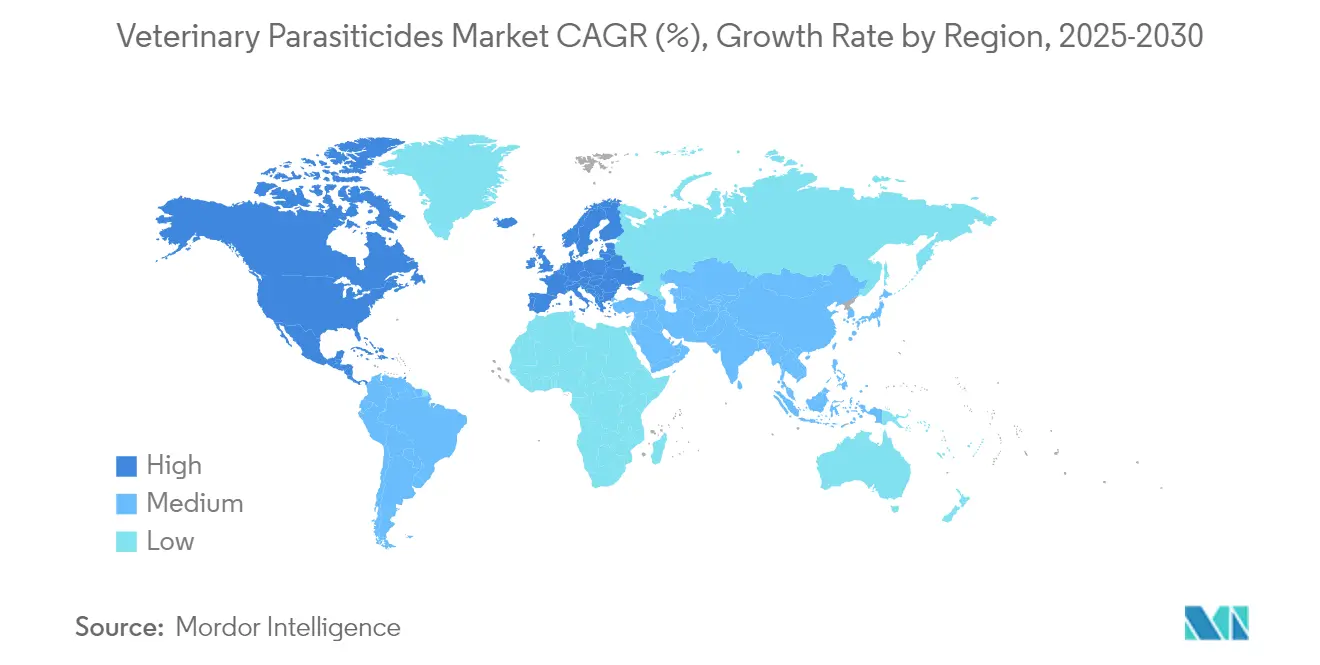
North America generated 34.62% of 2025 revenue owing to high pet ownership, premium care adoption, and supportive regulatory paths. Coordinated FDA–Health Canada reviews streamline new product launches, while climate change lengthens parasite seasons in northern states. E-commerce advances shift purchasing toward online pharmacies, but veterinary practices retain influence through prescription authority. Premium combination tablets and annual injectables anchor revenue resilience in the region’s veterinary parasiticides market.
APAC Veterinary Parasiticides Market
Asia Pacific is the fastest-growing territory with an 8.55% CAGR through 2031. China’s expanding urban pet population, Japan’s aging society preference for companion animals, and India’s vast livestock base jointly drive demand. Governments emphasize food safety, prompting more rigorous parasite-control mandates. Distribution upgrades widen rural access, and pricing tiers broaden the customer base. Regulatory reforms in China shorten time-to-market, further raising momentum for the veterinary parasiticides market.
EMEA and LATAM Veterinary Parasiticides Market
Europe exhibits steady mid-single-digit growth, shaped by strict environmental rules and welfare standards. Sustainability goals spur interest in biologicals and reduced-impact chemistries. Brexit reshapes supply chains, rewarding firms that adapt swiftly to new import checkpoints. Latin America and the Caribbean leverage large cattle populations and competitive beef exports to adopt combination dewormers that safeguard productivity. The Middle East and Africa show nascent but promising uptake as urbanization lifts companion-animal care, although infrastructure deficits temper premium product penetration. Together, these regional currents sustain the global expansion of the veterinary parasiticides market.

Regulatory Landscape
Veterinary parasiticides are governed by multi-jurisdictional veterinary medicine frameworks that increasingly tie product authorization to environmental and resistance-stewardship obligations. In the United States, the FDA Center for Veterinary Medicine (CVM) continues to clear both innovator and generic pathways, including the January 2026 approval of a generic fenbendazole oral suspension (Defendazole, ANADA 200-831) for beef and dairy cattle, which reinforces price-competitive access for food-producing animals.
In Europe, the regulatory bar is tightening on manufacturing controls and post-authorization expectations. The European Commission adopted Regulation (EU) 2025/2154 in October 2025 to set GMP requirements for active substances used in veterinary medicines, while the European Medicines Agency (EMA) is advancing guidance work on how antiparasitic products are described and evaluated, alongside expanding methodologies for environmental risk assessment of ectoparasiticides used in cats and dogs. Policy harmonization is also progressing regionally: the East African Community implemented guidelines (June 2024) to align registration data requirements for veterinary ectoparasiticides across partner states, and the United Kingdom brought into force The Veterinary Medicines (Amendment etc.) Regulations 2024 (May 2024), requiring applicants for generic antiparasitic veterinary medicines to submit available resistance data and relevant reviews.
Competitive Landscape
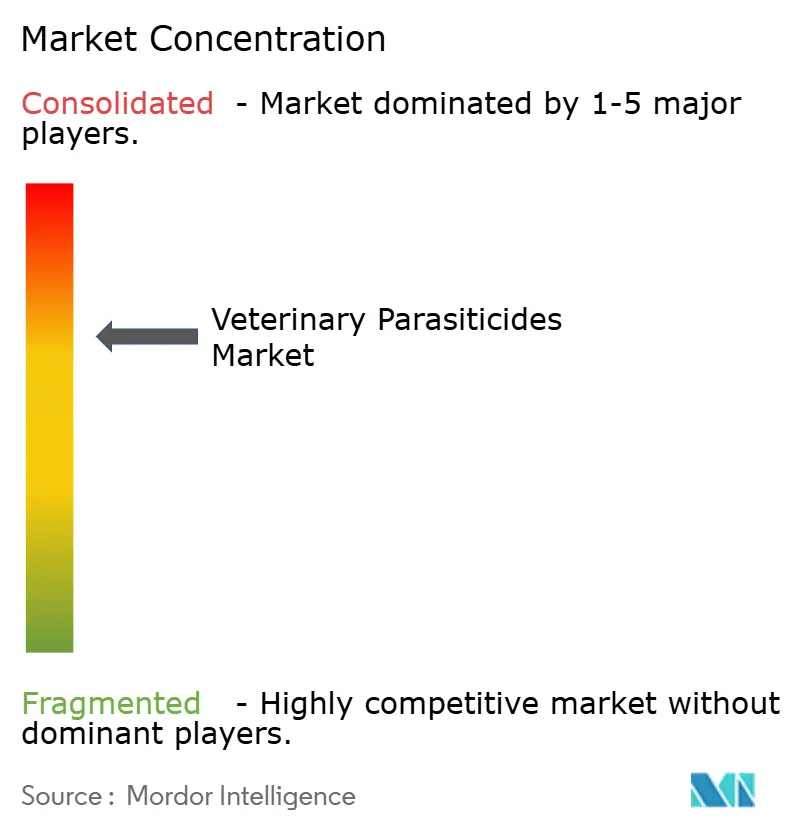
The veterinary parasiticides market is moderately concentrated. Zoetis holds roughly 20% global share, supported by USD 1.6 billion in parasiticide sales and diagnostics integration like Vetscan Imagyst. Elanco follows with a focus on six-in-one Credelio Quattro, anticipating early 2025 rollout. Merck Animal Health expands through acquisitions, recently adding VECOXAN and SENTINEL rights to deepen livestock and companion portfolios.
Innovation priorities include novel chemistries that bypass existing resistance, AI-guided diagnostics that tailor dosing, and long-acting delivery platforms. Indical Bioscience’s automated fecal analysis exemplifies data-driven disruption.
Generics pressure pricing as patents lapse, yet innovators defend margins through convenience-oriented combos and branded loyalty programs. Strategic alliances between pharma and tech firms accelerate connected-care ecosystems, embedding products within broader health-management services across the veterinary parasiticides market.
Veterinary Parasiticides Industry Leaders
Boehringer Ingelheim
Virbac
Zoetis, Inc.
Ceva Sante Animale
Merck & Co. Inc.
- *Disclaimer: Major Players sorted in no particular order
Veterinary Parasiticides Market Companies Covered in this Report
- Zoetis
- Elanco Animal Health Inc.
- Merck & Co., Inc. (Animal Health)
- Boehringer Ingelheim
- Virbac
- Ceva
- Vetoquinol
- Bayer AG (legacy brands)
- Dechra Pharmaceuticals
- Phibro Animal Health
- Norbrook Laboratories Ltd.
- Huvepharma EOOD
- PetIQ, Inc.
- Bimeda Animal Health Ltd.
- Heska
- Neogen
- KRKA d.d.
- Ourofino Saúde Animal
- Kyoritsu Seiyaku
- Animalcare Group plc

Market Opportunities and Future Outlook
White space is building around outbreak-driven and high-consequence parasite control, where accelerated access mechanisms create near-term commercial windows for manufacturers with approved actives and scalable supply. In April 2026, the FDA issued Emergency Use Authorizations for new animal products addressing New World screwworm infestations, including three requests from Boehringer Ingelheim Animal Health USA, Inc. This points to a clear opportunity for ectoparasiticide and endectocide portfolios that can be deployed under emergency pathways.
Product-format opportunities continue to concentrate in broad-spectrum combinations and longer-duration protection that simplify compliance in companion animals and reduce retreatment burden in farms. Recent clinical and field evidence reported in 2026 on multi-active oral combinations (for example, fluralaner, moxidectin, and pyrantel) and 100% efficacy claims in heartworm prevention studies for combination chewables (Credelio Quattro) support continued investment in differentiated, all-in-one monthly regimens that bundle internal and external parasite coverage. On the regulatory-technical side, harmonization and updated effectiveness expectations also create development space for faster multi-market filings: in June 2026, the FDA announced availability of final GFI #96 (VICH GL13) for anthelmintic effectiveness in sheep, which can streamline study design and dossier preparation for ruminant dewormers and combination protocols as resistance surveillance pushes more targeted, evidence-based use.
Recent Industry Developments in Veterinary Parasiticides Market
- July 2026: Zoetis announced an agreement to acquire VitalRADS, expanding its diagnostics footprint alongside core animal health products. The acquisition improves the linkage between diagnostic decision-making and parasiticide selection, supporting data-enabled preventive care workflows in veterinary channels.
- February 2026: Boehringer Ingelheim received FDA Emergency Use Authorization for NexGard Chewables and NexGard COMBO to treat New World screwworm infestations in dogs and cats. Emergency authorization increases demand visibility for fast-acting ectoparasiticides in companion animals and highlights the value of scalable, regulator-ready supply during high-threat pest events.
- April 2025: Zoetis received FDA approval for a new label indication for Simparica Trio to prevent flea tapeworm infections in dogs by killing vector fleas. The label expansion strengthens differentiation within combination oral parasiticides and helps manufacturers compete on breadth of claims and simplified, single-product preventive protocols.


Veterinary Parasiticides Market Report Scope and Research Methodology
Market Definition and Coverage
This market covers veterinary products used to prevent, repel, or treat internal and external parasite infestations in animals, and it is measured in revenue terms across major geographies and care settings.
Scope exclusions: We exclude flea shampoos, plant-based repellents, and products intended only for human use.
Segments Covered in This Report
- By Product Type
- Ectoparasiticides
- Endoparasiticides
- Endectocides
- Combination / Broad-spectrum Products
- Biological & Botanical Parasiticides
- By Animal Type
- Food-Producing Animals
- Cattle
- Poultry
- Swine
- Sheep & Goats
- Companion Animals
- Dogs
- Cats
- Food-Producing Animals
- By Mode of Administration
- Topical
- Oral
- Injectable
- Others
- By End User
- Veterinary Clinics & Hospitals
- Animal Farms & Production Units
- Retail & Online Pharmacies
- By Geography
- North America
- United States
- Canada
- Mexico
- Europe
- Germany
- United Kingdom
- France
- Italy
- Spain
- Rest of Europe
- Asia Pacific
- China
- Japan
- India
- South Korea
- Australia
- Rest of Asia Pacific
- Middle East and Africa
- GCC
- South Africa
- Rest of Middle East and Africa
- South America
- Brazil
- Argentina
- Rest of South America
- North America
Data Sources, Market Sizing, and Validation
Desk Research
Desk research sets the base layer for the model by clarifying product eligibility, animal population context, and the disease burden signals that usually move demand. We referred to public sources such as the World Organisation for Animal Health (WOAH) for animal health context, FAOSTAT for livestock population trends, and USDA and EU public portals for livestock and animal health statistics where available.
We also used peer-reviewed veterinary parasitology journals for adoption and resistance discussions, and official medicines and approvals information from regulators (such as FDA CVM and EMA). To cross-check product mix direction and major launch timings, we reviewed company annual reports and investor presentations. In a few places, paid subscriptions were used for company financials and intelligence, plus patent databases, mainly to sanity check the revenue scale and the technology pipeline cadence. The sources listed here are illustrative only, and additional public and reference materials were used to collect data, validate assumptions, and resolve open questions.
Primary Interviews and Surveys
Primary work was used to pressure test desk assumptions, especially around real world preventive versus treatment use, channel pricing behavior, and how combination products are being adopted. We spoke with veterinarians, animal health distributors, and operational leaders across companion animal and livestock settings. Coverage was set across APAC, EMEA, and the Americas so regional seasonality and parasite risk differences were not averaged out too early.
Distribution of primary research fieldwork respondents
| Company type | Respondent position | Region |
|---|---|---|
| Top tier: 35% | CXOs: 14% | APAC: 41% |
| Mid tier: 51% | Functional/Unit leaders: 37% | EMEA: 34% |
| Smaller Players: 14% | Managers: 49% | Americas: 25% |
Market-Sizing & Forecasting
Our sizing starts with a top-down build that reconstructs demand pools using animal population by species, parasite prevalence signals, and the practical share of animals that are under regular veterinary care and preventive programs. These inputs are translated into annualized treatment cycles. We then corroborate totals with selective bottom-up approximations, such as sampled brand and generic price points multiplied by plausible unit volumes and channel checks. When the two views do not reconcile cleanly, we adjust the totals and document the reason for the change.
Key model inputs include companion animal ownership and clinic visit frequency, livestock population and herd health programs, seasonality and geography driven parasite pressure, shifts toward longer-acting and combination formats, and route-of-administration mix that changes adherence and pricing (oral, topical, and injectable). Where gaps show up, they are handled through conservative interpolation based on comparable countries, and the assumptions are kept tied to observable indicators like population levels, treatment cadence, and public approvals activity. For forecasting, we primarily use scenario analysis, since adoption curves and preventive compliance can shift faster or slower depending on affordability, parasite incidence, and the pace of new product rollouts. The scenarios are then aligned to the consensus view gathered in interviews.
Data Validation & Update Cycle
Validation is done through stepwise triangulation that compares model outputs against independent signals like animal population trends, expected dosing frequency, and realistic price corridors by route and channel. Outliers are investigated before sign-off, and we re-contact sources when a key assumption shifts materially, such as a change in preventive adoption, a major regulatory action, or an unexpected pricing move.
The work is reviewed in more than one analyst pass so calculation logic, scope rules, and conversion assumptions remain consistent across countries and time periods. Reports are refreshed annually, and interim updates are done when a material event changes market direction. Before delivery, we run a final refresh pass so clients receive the most current view available at the time of publication.
Mordor Intelligence's Veterinary Paraciticides Market Size Measured Against Other Published Estimates
Published numbers for veterinary parasiticides do not always line up because authors make different choices on what to count, what year to anchor on, and how to treat pricing through the forecast period. Differences can also come from whether estimates lean more on preventive programs or more on treatment demand, which changes the implied dosing cycles.
Some estimates widen the scope to include adjacent animal parasite prevention items and broader channel mark-ups, which can lift totals quickly. For Mordor Intelligence, only legally approved, commercially packaged veterinary parasiticides are counted, and flea shampoos and plant-based repellents are kept out so totals stay tied to drug-led demand and repeatable dosing cycles.
Benchmark comparison
| Source | Market Size | Gaps in Research Methodology |
|---|---|---|
| Mordor Intelligence | USD 10.74 B (2026) | |
| Global Research Publisher A | USD 13.63 B (2025) | Uses a different base year and a wider inclusion set across channels and end users, which can pull in adjacent prevention items and higher retail mark-ups that are not consistently separated. |
| Industry Publisher B | USD 12.96 B (2025) | Anchors sizing on a different year and applies a broader animal parasiticides definition, which can blend veterinary prescription products with other prevention mixes and alternate pricing progressions. |
The spread in the table is mainly explained by scope and anchoring choices, and then by how pricing and treatment frequency are carried forward in the forecast. By keeping inclusion rules explicit, tying volumes to animal populations and dosing cycles, and then checking totals through interviews and price corridor tests, the model stays traceable and easier to reproduce when assumptions need to be updated.


Key Questions Answered in the Report
What is the current value of the veterinary parasiticides market?
The market is valued at USD 10.74 billion in 2026 and is projected to reach USD 15.03 billion by 2031.
Which region is growing fastest for veterinary parasiticides?
Asia Pacific is the fastest-growing region with an expected 8.55% CAGR to 2031, driven by rising pet ownership and livestock investments.
Why are long-acting injectables gaining popularity?
They offer year-long protection, remove monthly compliance gaps, and have demonstrated 100% efficacy in clinical studies.
How significant is resistance to current parasiticides?
Surveillance shows pour-on dewormers failed to meet 90% efficacy on 76.5% of tested farms, prompting wider use of combination products.
What is driving demand for combination therapies?
Pet owners seek single-dose solutions that cover multiple parasite types, and veterinarians favor simplified protocols that improve adherence.
Which product segment holds the largest share?
Ectoparasiticides accounted for 42.18% revenue share in 2025, reflecting their essential role against vectors like ticks and fleas.
Page last updated on:


 Your data is secure and never sold or shared.


