
Veterinary Infusion Pumps Market Size and Share
Market Overview
| Study Period | 2020 - 2031 |
|---|---|
| Market Size (2026) | USD 368.39 Million |
| Market Size (2031) | USD 494.86 Million |
| Growth Rate (2026 - 2031) | 6.12 % |
| Fastest Growing Market | Asia Pacific |
| Largest Market | North America |
| Market Concentration | Medium |
Major Players *Disclaimer: Major Players sorted in no particular order Image © Mordor Intelligence. Reuse requires attribution under CC BY 4.0. | |
Veterinary Infusion Pumps Market Analysis by Mordor Intelligence
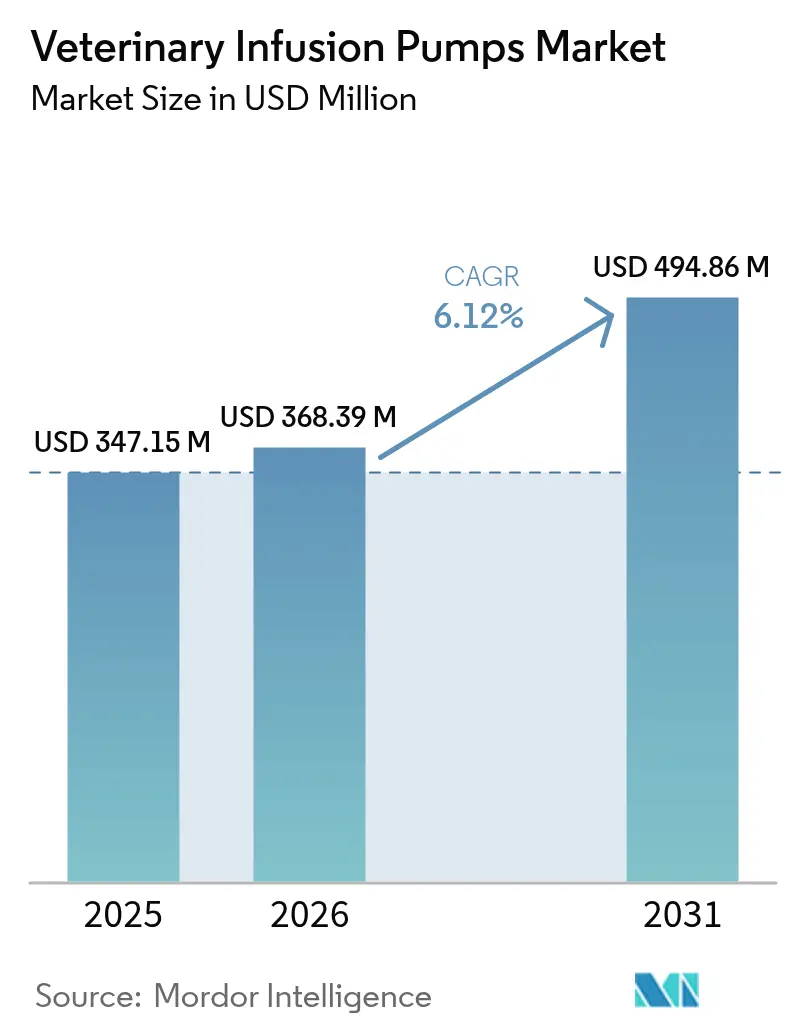
The Veterinary Infusion Pumps market size is expected to grow from USD 347.15 million in 2025 to USD 368.39 million in 2026 and is forecast to reach USD 494.86 million by 2031 at 6.12% CAGR over 2026-2031.
Uptake is propelled by the humanisation of pets, rapid specialty-clinic expansion, and the migration of human-grade smart-pump technology into animal health settings. Growing chronic-disease prevalence in dogs and cats, tighter dosing-accuracy regulations, and AI-enabled devices that auto-adjust flow rates are further accelerating adoption. At the same time, supply-chain localisation, especially for semiconductors and PTFE tubing, is reinforcing manufacturers’ capital outlays, while stringent FDA recall activity is reshaping product-launch timelines. Competitive differentiation now revolves around integrated drug libraries, remote-monitoring connectivity and veterinary-specific user interfaces, features that are fast becoming baseline rather than premium.
Key Report Takeaways
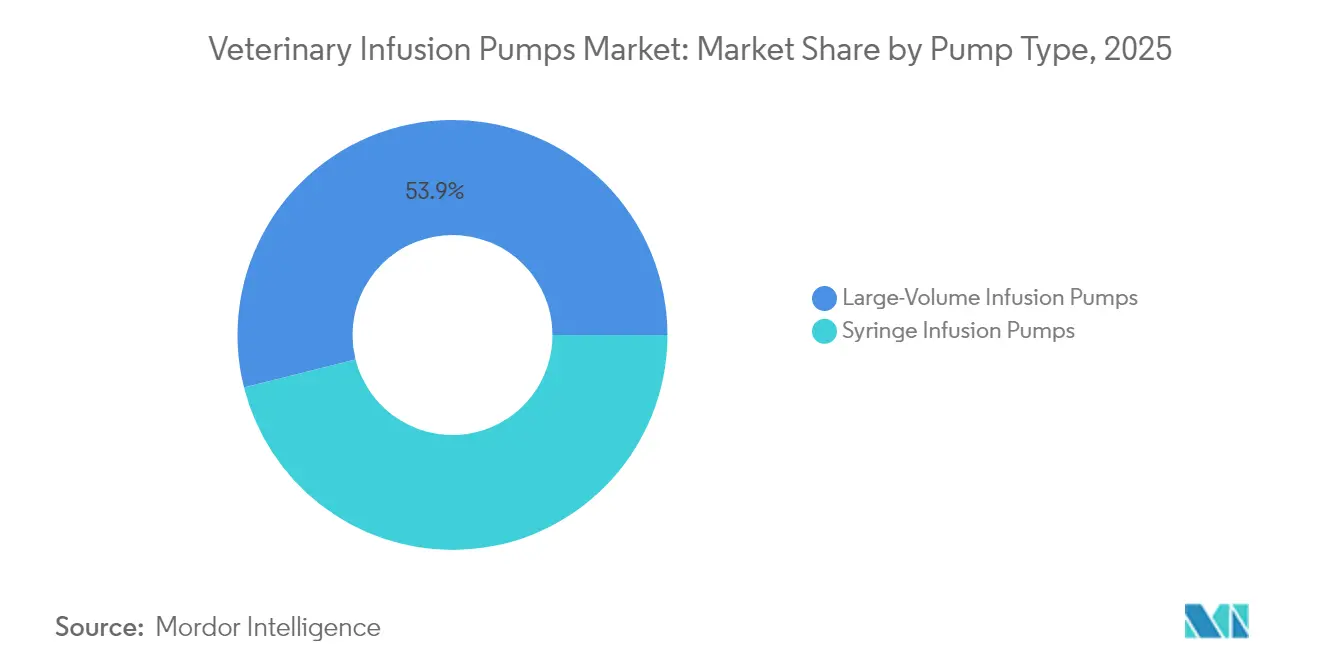
- By pump type, large-volume devices commanded 53.92% of the veterinary infusion pumps market share in 2025, whereas syringe pumps are poised to grow at 8.78% CAGR through 2031.
- By animal type, companion animals led with 56.15% revenue share of the veterinary infusion pumps market in 2025; the same segment is projected to advance at a 9.62% CAGR to 2031.
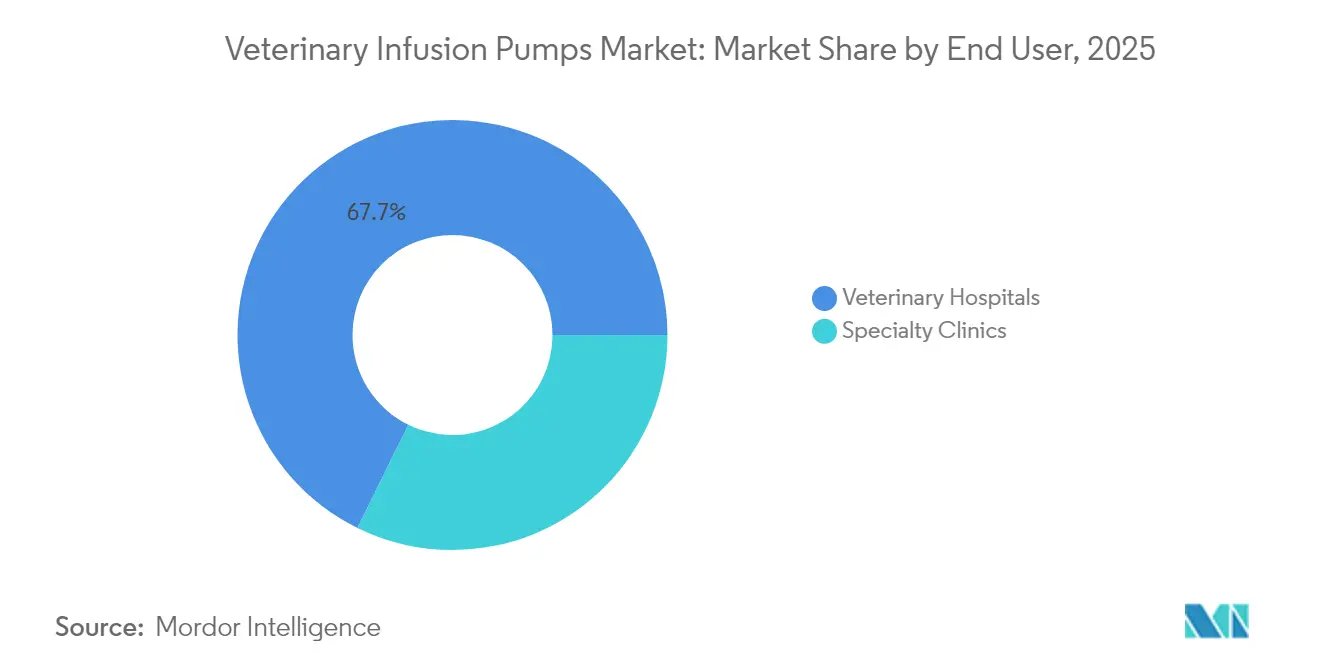
- By end user, veterinary hospitals held 67.72% share of the veterinary infusion pumps market size in 2025, while specialty clinics record the fastest forecast CAGR at 10.62%.
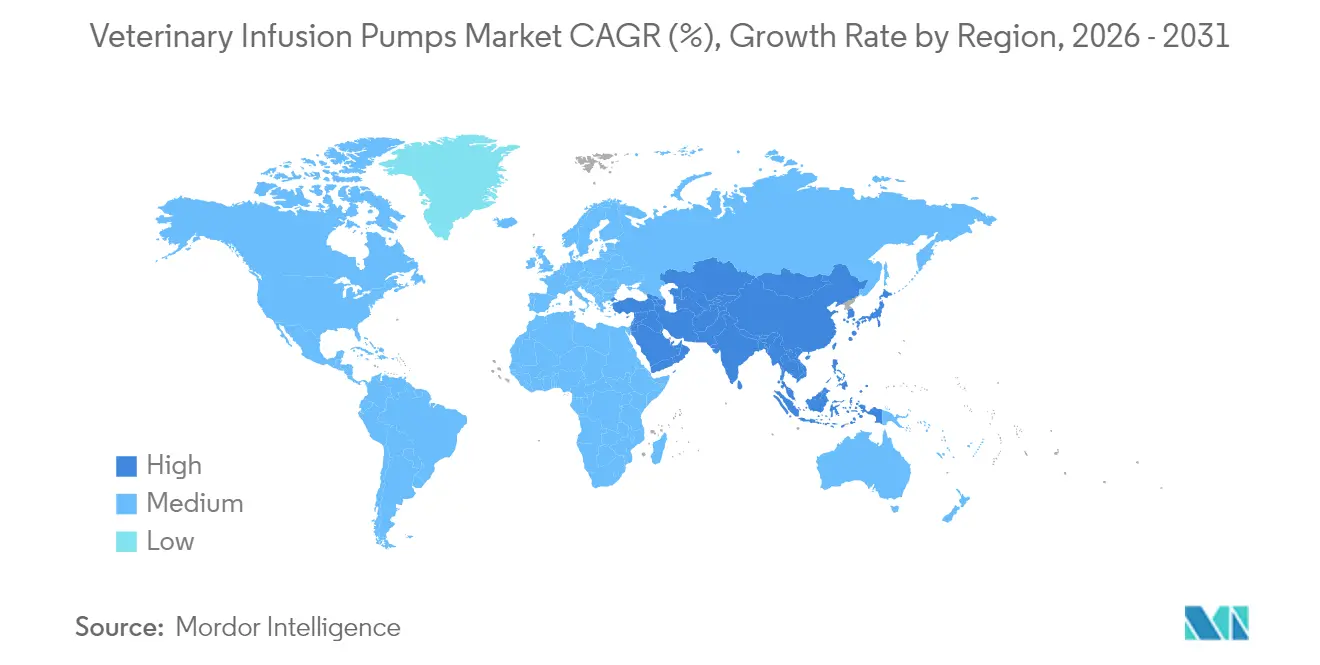
- By geography, North America retained 38.89% share of the veterinary infusion pumps market in 2025; Asia-Pacific is on track for the highest regional CAGR of 13.48% to 2031.
Note: Market size and forecast figures in this report are generated using Mordor Intelligence’s proprietary estimation framework, updated with the latest available data and insights as of 2026.
Market Trends and Insights
Drivers Impact Analysis of Veterinary Infusion Pumps Market*
| Driver | (~) % Impact on CAGR Forecast | Geographic Relevance | Impact Timeline |
|---|---|---|---|
| Rising companion animal ownership & health spend | +1.8% | North America, Europe | Medium term (2-4 years) |
| Increasing incidence of chronic & critical conditions | +1.2% | Global | Long term (≥ 4 years) |
| Technological advances in pump design | +1.5% | North America, Europe, expanding to APAC | Short term (≤ 2 years) |
| Growth of specialty veterinary clinics | +1.1% | North America, Europe | Medium term (2-4 years) |
| Adoption of remote monitoring & telehealth | +0.7% | North America, emerging APAC | Medium term (2-4 years) |
| Shift to minimally invasive, home-based therapy | +0.3% | Developed markets | Long term (≥ 4 years) |
| Source: Mordor Intelligence | |||
Rising Companion Animal Ownership and Health Spending
Pet owners now mirror human-health behaviours, channelling record budgets into sophisticated veterinary care. In North America and Europe, insurers increasingly reimburse infusion-based oncology and renal protocols, softening the cost barrier for advanced devices.[1] Demographic shifts toward smaller households intensify emotional bonds with pets, translating into higher willingness to finance long-term treatments delivered via smart pumps. Drug formulary expansion for animals has increased therapy complexity, anchoring the veterinary infusion pumps market in routine practice. Clinics therefore equip multiple treatment rooms with networked pumps to manage a growing caseload of geriatric pets requiring multi-hour drips.
Increasing Incidence of Chronic and Critical Conditions in Animals
Longer lifespans reveal endocrine, oncologic and gastrointestinal diseases that mandate precise multi-day infusions. FDA conditional approval of PANOQUELL-CA1 for canine pancreatitis reinforces intravenous therapy’s role in emergent care. Similar approvals are spurring device upgrades as dose-error-reduction software becomes a compliance necessity. On the livestock front, intensive farming heightens metabolic disorders, elevating demand for rugged, high-volume pumps capable of simultaneous multi-species dosing, a niche that specialised vendors are capturing.
Technological Advancements in Infusion Pump Design
Next-generation devices integrate AI algorithms that modulate flow rates based on real-time vitals, cutting adverse-event risk. Large manufacturers have ported wireless connectivity, drug libraries and occlusion-sensing from human-care portfolios, shrinking learning curves inside clinics. Regulatory insistence on data logs, now required in FDA submissions, accelerates adoption of cloud-enabled pumps. As firmware updates roll out, service contracts create sticky revenue streams, deepening competitive moats in the veterinary infusion pumps market.[2]
Growth of Specialty Veterinary Clinics
Emergency and critical-care centres are scaling rapidly; each new build typically budgets 8–12 smart pumps for surgery, ICU and oncology suites. UK-based Dick White Referrals’ GBP 15 million expansion typifies this capital-intensive trend, nearly tripling infusion capacity.[3] Consolidators standardise equipment lists across networks, enabling volume discounts that squeeze independents but lift unit shipments for leading OEMs.
Restraints Impact Analysis of Veterinary Infusion Pumps Market*
| Restraint | (~) % Impact on CAGR Forecast | Geographic Relevance | Impact Timeline |
|---|---|---|---|
| High initial and maintenance costs | -1.2% | Global, especially emerging markets | Short term (≤ 2 years) |
| Limited insurance reimbursement | -0.8% | Global | Medium term (2-4 years) |
| Electronic-component supply disruptions | -0.6% | Global, acute in APAC | Short term (≤ 2 years) |
| Heightened regulatory scrutiny | -0.4% | North America, Europe | Medium term (2-4 years) |
| Source: Mordor Intelligence | |||
High Initial and Maintenance Costs
Smart pumps priced at USD 6,000–9,000 place strain on small practices. Annual calibration, software licensing and staff upskilling lift total cost of ownership by 18–22% over five years, slowing penetration in Latin America and Southeast Asia. Vendors are piloting pay-per-infusion models, but uptake remains limited. Capital expenditure requirements for advanced infusion systems create significant barriers for smaller veterinary practices, particularly in emerging markets where practice economics differ substantially from developed regions. The economic pressure intensifies as regulatory compliance requirements drive up manufacturing costs, with FDA Quality Management System Regulation amendments effective February 2026 adding additional compliance burdens that manufacturers will likely pass through to customers.
Lack of Insurance Reimbursement for Veterinary Procedures
With pet-insurance penetration below 5% in most markets, owners shoulder direct costs. Absence of standard reimbursement codes for infusion therapies curbs demand elasticity, particularly in price-sensitive segments. Insurance coverage limitations for advanced veterinary procedures create direct demand constraints for sophisticated medical equipment, as cost-conscious pet owners may opt for less expensive treatment alternatives when facing significant out-of-pocket expenses. The absence of standardized reimbursement protocols for specific infusion therapies reduces predictable revenue streams that typically justify major equipment purchases in human healthcare settings.
*Our forecasts treat driver/restraint impacts as directional, not additive. The impact forecasts reflect baseline growth, mix effects, and variable interactions.
Veterinary Infusion Pumps Market Segment Analysis
By Pump Type:
Syringe Pumps Drive Precision MedicineSyringe devices are projected to log 8.78% CAGR, outpacing large-volume units that held 53.92% share in 2025. Precision dosing for oncology and critical-care boluses is accelerating upgrades, and drug-library integration ensures safe cross-species calculations. Consequently, the veterinary infusion pumps market size for syringe models is set to climb sharply between 2026 and 2031. Large-volume pumps remain indispensable for hydration and total parenteral nutrition, but the innovation spotlight now sits squarely on smart syringe variants embedded with AI-driven flow-control logic.
Flexibility in handling micro-litre flows without compromising accuracy is converting specialist surgeons and internists alike. Meanwhile, refurbished large-volume units are shifting into cost-conscious segments, keeping overall unit volumes stable but constraining premium pricing. Competitive intensity in this slice of the veterinary infusion pumps market remains moderate as firmware ecosystems rather than hardware specs grow to define user preference.

By Animal Type:
Companion Animals Fuel ExpansionCompanion animals generated 56.15% of 2025 revenue and are on course for 9.62% CAGR, making them the clear locomotive of the veterinary infusion pumps market size through 2031. Millennials perceive pets as family, financing prolonged chemo and renal therapies that depend on continuous infusion. Dogs alone account for nearly two-thirds of procedures requiring pumps, with feline oncology close behind.
Public-health drives to reduce antibiotic use in livestock are nudging farms toward precision dosing delivered via automated pumps, though capital constraints temper uptake. Equine sports medicine is surfacing as a niche where high-pressure syringe units fetch premium prices, diversifying revenue. Overall, the veterinary infusion pumps market share remains tilted toward dogs and cats, yet emerging large-herd applications signal a second growth wave.
By End User:
Specialty Clinics Lead Growth TrajectoryVeterinary hospitals held 67.72% share in 2025, yet specialty and emergency clinics will post an 10.62% CAGR to 2031, reflecting case-mix complexity that justifies multi-pump procurement. Corporate chains mandate uniform equipment standards, creating predictable demand spikes each time a new hub opens. Consequently, the veterinary infusion pumps market size for specialty clinics is projected to expand faster than any other end-user group over the forecast horizon.
Teaching hospitals and referral centres embed pumps in anaesthesia, oncology and ICU suites, pushing per-facility installed bases beyond 20 units. Independent practices increasingly lease pumps to preserve cashflow, enabling tier-two OEMs to penetrate via flexible financing. These shifts collectively redeploy market share toward vendors with coordinated service networks and rapid swap-out policies.
Geography Analysis
North America Veterinary Infusion Pumps Market
North America captured 38.89% of 2025 revenue, underpinned by the world’s highest pet-care spend and mature livestock sectors. The United States alone accounts for more than four in every ten pumps sold, driven by widespread insurance adoption and clinical familiarity with human-grade devices. However, growth is tapering to mid-single digits as replacement cycles rather than first-time installs dominate. Canada mirrors these dynamics on a smaller scale, while Mexico is witnessing gradual modernisation of urban clinics.
APAC Veterinary Infusion Pumps Market
Asia-Pacific is the fastest-growing theatre with a 13.48% CAGR through 2031, and it is forecast to eclipse Europe in unit shipments before the decade ends. China’s booming middle class treats pets as status symbols, sparking a surge in high-acuity veterinary hospitals fitted with smart pumps. Japan’s ageing pet population requires chronic-disease infusions, and Australia’s well-developed referral network sustains steady upgrades. India’s dairy sector seeks large-volume pumps for mastitis management, pushing diversified demand across species.
Europe Veterinary Infusion Pumps Market
Europe sits between the two extremes, maintaining solid but unspectacular growth. Stringent EU animal-welfare regulations, especially on antimicrobial stewardship, necessitate precision dosing in cattle and swine, keeping the veterinary infusion pumps market engaged. Germany, France and the United Kingdom lead procurement, while Eastern European clinics are early in the adoption curve and thus represent a latent upswing. Brexit-related customs friction has marginally lengthened delivery times but is prompting distributors to set up continental inventory hubs, enhancing long-term resilience.
Regulatory Landscape
In the United States, the FDA Center for Veterinary Medicine regulates animal medical devices under the Federal Food, Drug, and Cosmetic Act, with emphasis on misbranding and adulteration controls and labeling expectations for legally marketed devices. Veterinary-exclusive devices generally do not use the human device premarket pathways (for example, 510(k) or PMA). As a result, infusion pump manufacturers serving both veterinary and human healthcare depend heavily on post-market quality controls, documentation, and recall readiness, especially as dosing-accuracy expectations tighten in clinical practice.
Outside the United States, market access is increasingly tied to conformity evidence and quality management standards, even where veterinary-device rules are less prescriptive. South Africa's SAHPRA has published veterinary medical device regulatory requirements that emphasize conformity to Essential Principles of Safety and Performance and call for certification aligned with ISO 13485 or ISO 9001. In Europe, veterinary devices often sit alongside human-centric device rules, but the European Commission adopted Implementing Regulation (EU) 2026/977 in May 2026, reinforcing uniform requirements for conformity assessment activities and notified bodies, which raises the compliance bar for manufacturers using notified-body pathways and quality systems.
Value Chain Analysis
The value chain begins with OEM design and manufacturing of veterinary infusion pumps, including large-volume and syringe pumps, with integrated drive systems, sensors and alarms (occlusion, air-in-line), and embedded software (drug libraries, event logs). On the consumables side, it includes veterinary-compatible IV administration sets and tubing, with lead times influenced by component availability, especially semiconductors and specialty polymers such as PTFE tubing. That constraint pushes some suppliers toward localization and dual-sourcing strategies.
Downstream, go-to-market approaches divide between direct sales into large veterinary hospitals, referral centers, and consolidator networks, and distributor-led coverage for independent practices. National distributors such as Patterson Veterinary Supply support product access and bundling (pumps with sets and service), while third-party service and refurbishment specialists such as AIV Vet manage lifecycle needs including maintenance, repair, and redeployment of legacy units. Clinical use standards and training needs reinforce the service layer, with guidelines such as the American Animal Hospital Association (AAHA) 2024 fluid therapy guidance emphasizing pump performance matched to IV set specifications, which in turn supports demand for validated pump-set compatibility, calibration support, and staff education as part of the delivered solution.
Competitive Landscape
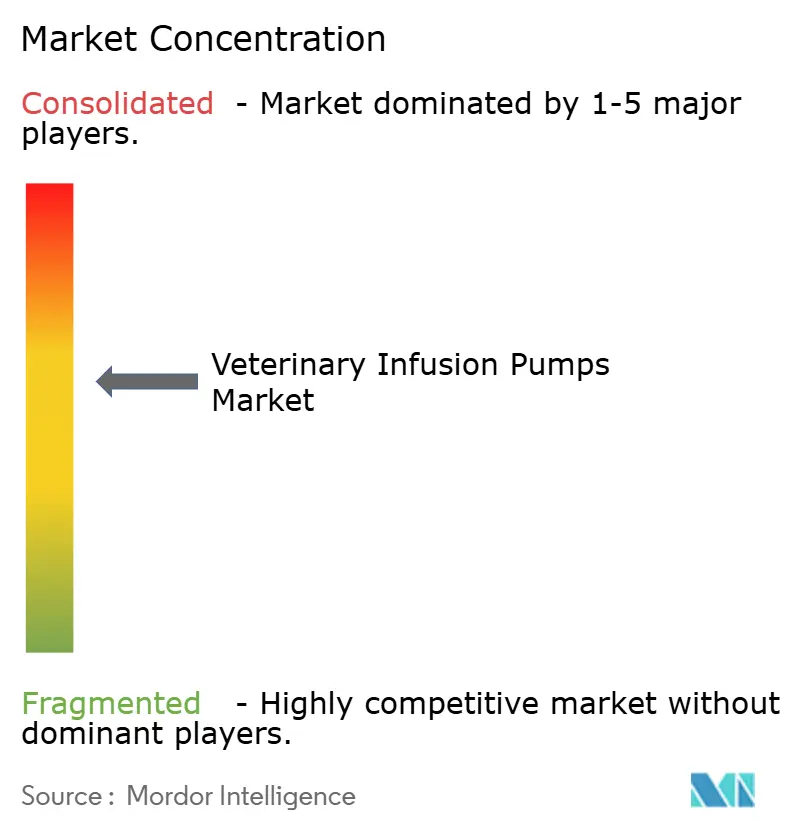
The veterinary infusion pumps market remains moderately consolidated. Human-device giants such as B. Braun and ICU Medical leverage legacy platforms, bundling veterinary consumables to cement client lock-in. Yet repeated FDA recalls have dented confidence, opening channels for niche players like GradyVet that design species-specific cassettes.
Strategic acquisitions define the current chessboard: Patterson Companies’ 2024 purchase of Infusion Concepts instantly boosted its critical-care portfolio in the United Kingdom, signalling broader cross-border consolidation. OEMs are increasingly bundling pumps with cloud analytics, reinforcing aftermarket software revenue. Meanwhile, Asian entrants offer cost-competitive smart pumps, forcing incumbents to defend share through extended warranties and in-clinic training.
Intellectual-property barriers are rising as AI-driven flow-control algorithms become patent protected. Firms with deep software teams gain an edge, while hardware-centric rivals risk commoditisation. The regulatory gauntlet also acts as a moat: companies with ISO-13485-aligned plants can certify revisions faster, translating compliance agility into market agility. Overall, differentiation now hinges on ecosystem breadth rather than standalone hardware specs.
Veterinary Infusion Pumps Industry Leaders
-
Burtons Medical Equipment Ltd
-
Heska Corporation
-
Avante Animal Health
-
Digicare Biomedical
-
B. Braun SE
- *Disclaimer: Major Players sorted in no particular order
Veterinary Infusion Pumps Market Companies Covered in this Report
- B. Braun
- Heska
- Avante Health Solutions
- Burtons Medical Equipment
- Beckton Dickinson
- Eitan Medical Ltd
- Digicare Biomedical Technologies
- Kent Scientific
- Opto Circuits
- Grady Medical Systems Inc.
- Jorgensen Laboratories
- SAI Infusion Technologies
- ICU Medical
- Smiths Group
- Mindray
- Terumo
- QIAGEN
- VetPro Medical
- Norwell Veterinary Hospital Equipment
- Tri-Anim Health Services
Market Opportunities and Future Outlook
One key whitespace is reducing ownership friction for small and mid-sized clinics facing high upfront costs plus recurring calibration and software expenses. Rental, lease-to-own, and service-based models allow distributors and OEMs to bundle pumps with consumables, preventive maintenance, and training, shifting total cost of ownership toward procedure volumes rather than capital budgets. Equipment standardization in specialty and referral centers also creates room for fleet management tools, swap-out programs, and network-ready pump configurations that simplify deployment across multiple rooms.
Another opportunity is tightening the clinical loop between infusion delivery, monitoring, and documentation, as human-grade smart-pump features migrate into veterinary workflows. In June 2026, Bomimed published updated practical guidance emphasizing clinical fit and staff training for pump selection and safe use, which supports demand for education-backed adoption and consistent maintenance discipline. On the regulatory and quality side, the FDA refreshed public-facing explanations in April 2026 reiterating its oversight focus for animal devices (labeling, misbranding, adulteration) while not regulating the practice of veterinary medicine. This keeps manufacturer differentiation centered on verifiable device performance, logs, and compatible consumables rather than introducing new premarket hurdles, and reinforces the role of quality-system maturity (for example, ISO 13485 alignment) in global commercialization.
Recent Industry Developments in Veterinary Infusion Pumps Market
- May 2026: Burtons Medical Equipment Ltd became the exclusive distributor for Mindray Animal Medical's veterinary anesthesia technology in the UK and Ireland, with integration with Mindray monitoring systems. The arrangement strengthens Burtons' ability to package compatible capital equipment across anesthesia, monitoring, and adjacent infusion workflows, which influences standardization decisions in expanding specialty clinics.
- April 2026: FDA published updated public-facing explanations reiterating its oversight focus for animal devices, emphasizing labeling, misbranding, and adulteration, while clarifying that regulation does not extend to the practice of veterinary medicine. Manufacturers should focus on device performance logs and compatible consumables to support safe adoption.
- October 2024: Patterson Companies announced acquisitions to strengthen its animal health distribution footprint, including its UK subsidiary National Veterinary Services Limited acquiring Infusion Concepts Ltd, a provider of infusion, drainage, and critical care products for veterinary professionals. The deal expands distribution leverage over infusion-related product access in the UK and supports broader cross-selling of pumps and consumables through an established veterinary channel.
Veterinary Infusion Pumps Market Report Scope and Research Methodology
Market Definition and Coverage
For this study, the market is defined as the annual revenue generated from newly manufactured veterinary infusion pumps used to deliver fluids, nutrients, or medications to animals in clinical care.
Scope exclusions: We exclude infusion pumps used only for laboratory or rodent research settings.
Segments Covered in This Report
- By Type
- Large-volume Infusion Pumps
- Syringe Infusion Pumps
- By Animal Type
- Companion Animals
- Dogs
- Cats
- Livestock
- Bovine
- Swine
- Poultry
- Other Animal Type
- Companion Animals
- By End User
- Veterinary Hospitals
- Specialty Clinics
- By Geography
- North America
- United States
- Canada
- Mexico
- Europe
- Germany
- United Kingdom
- France
- Italy
- Spain
- Rest of Europe
- Asia-Pacific
- China
- Japan
- India
- Australia
- South Korea
- Rest of Asia-Pacific
- Middle East & Africa
- GCC
- South Africa
- Rest of Middle East & Africa
- South America
- Brazil
- Argentina
- Rest of South America
- North America
Data Sources, Market Sizing, and Validation
Desk Research
Desk research helped us set practical boundaries for what counts as a veterinary infusion pump sale and how demand is formed in routine and critical care. We reviewed public animal health and veterinary care indicators from sources such as the USDA and the US CDC, then paired those trends with macro and trade signals from sources such as the World Bank and UN Comtrade.
To understand supply direction and pricing pressure, we also reviewed annual reports, investor presentations, and reputable press coverage on product updates and distribution expansion. A paid subscription for company financials and news was used for consistency checks, and a paid patent database was used to spot feature and design themes that can shift the pump mix over time. The sources listed here are not exhaustive, and many other public references were reviewed for data collection, validation, and clarification.
Primary Interviews and Surveys
Primary interviews and surveys were used to confirm how veterinary hospitals and specialty clinics select pumps for different care settings and animal types, and how those choices affect unit volumes and typical price bands. We spoke with a mix of manufacturers, distributors, and veterinary providers across APAC, EMEA, and the Americas, so assumptions like replacement cycles, service life, and large-volume versus syringe pump mix could be verified and tightened.
Distribution of primary research fieldwork respondents
| Company type | Respondent position | Region |
|---|---|---|
| Top tier: 30% | CXOs: 19% | APAC: 38% |
| Mid tier: 48% | Functional/Unit leaders: 34% | EMEA: 35% |
| Smaller Players: 22% | Managers: 47% | Americas: 27% |
Market-Sizing & Forecasting
Market sizing used a top-down and bottom-up mix, with the main build tied to clinical demand in veterinary settings. We started by mapping veterinary care activity and the likely share of cases needing controlled infusion, then converted that into pump demand using adoption levels across veterinary hospitals and specialty clinics.
Once the demand pool was set, value was estimated using region-specific price bands and a product mix split between large volume infusion pumps and syringe infusion pumps. To keep totals realistic, we corroborated the outputs with selective bottom-up approximations such as sampled ASP x unit volumes for each pump type, channel feedback on annual placements, and supplier-side revenue checks where coverage existed. When country splits were not directly observable, proxy indicators such as companion animal case intensity, procedure mix, and distribution reach were used, and then confirmed through follow-up calls.
Forecasting relied on scenario analysis so adoption rates, pump mix, and ASP movement could be flexed under conservative and faster uptake cases, then normalized into a single base case. Inputs that mattered most included end user mix (hospital versus specialty clinic), replacement cycles, and the share shift toward syringe pumps in higher-acuity care.
Data Validation & Update Cycle
Validation was done through several steps so totals, shares, and implied unit values stayed consistent across regions, pump types, and end users. We compared model outputs with independent demand signals such as veterinary care utilization trends, reported shifts in equipment purchasing, and any step changes tied to supply constraints or new product releases.
If a variance looked material, assumptions were revisited and sources were re-contacted to clarify whether it was driven by pricing, mix, or adoption timing. Reports refresh annually, with interim updates for material events, and a final pre-delivery review pass is completed so clients receive the latest updated view.
Mordor Intelligence's Veterinary Infusion Pumps Market Size Compared With Other Published Estimates
It is normal to see different market size numbers for veterinary infusion pumps because publishers often include different product baskets, buyer settings, and revenue points. Differences also show up when price progression, currency timing, and refresh cadence do not align to the same base year.
Some estimates add revenues from IV therapy consumables or other adjacent devices, and a few blend veterinary demand with small human care placements that use similar pump hardware. In Mordor Intelligence, the count is limited to newly manufactured veterinary volumetric and syringe infusion pumps sold for clinical use in animals, and pumps meant only for laboratory or rodent research are excluded.
Benchmark comparison
| Source | Market Size | Gaps in Research Methodology |
|---|---|---|
| Mordor Intelligence | USD 368.39 M (2026) | |
| Global Consultancy A | USD 0.56 B (2026) | This figure appears to bundle pump revenue with IV therapy consumables and monitoring-adjacent equipment, which expands the counted basket and raises the implied value for the same year. |
| Trade Journal B | USD 0.29 B (2025) | This estimate likely reflects a narrower clinical purchasing pool and earlier-year pricing, and it may not fully adjust for mix shifts toward syringe pumps in higher-acuity care. |
The table shows that the biggest spread comes from what is counted as part of the market, plus how mix and pricing are carried forward into the base year. By keeping the build tied to pump-only revenue, clear pump type splits, and repeatable adoption inputs, we can trace each step and recheck it as new information becomes available.
Key Questions Answered in the Report
What is the current size of the veterinary infusion pumps market?
The market is worth USD 368.39 million in 2026 and is projected to reach USD 494.86 million by 2031 at a 6.12% CAGR.
Which animal segment dominates demand?
Companion animals account for 56.15% of 2025 revenue and will grow at a 9.62% CAGR, making them both the largest and fastest-expanding segment.
Why are syringe pumps gaining share?
Precision dosing for oncology and critical-care therapies pushes clinics toward smart syringe pumps, which are forecast to post a 8.78% CAGR through 2031.
What restrains adoption in emerging markets?
High upfront costs and limited pet-insurance coverage reduce affordability, while supply-chain shortages lengthen delivery times for advanced models.
Which region offers the strongest growth outlook?
Asia-Pacific leads with a 13.48% CAGR to 2031, fuelled by rising pet ownership in China, Japan and India alongside rapid hospital build-outs.
How will new FDA regulations affect the industry?
Stricter quality-system rules coming in 2026 will lengthen product-development cycles but also elevate entry barriers, favouring companies with strong compliance infrastructure.