
Vertebroplasty and Kyphoplasty Market Size and Share
Market Overview
| Study Period | 2020 - 2031 |
|---|---|
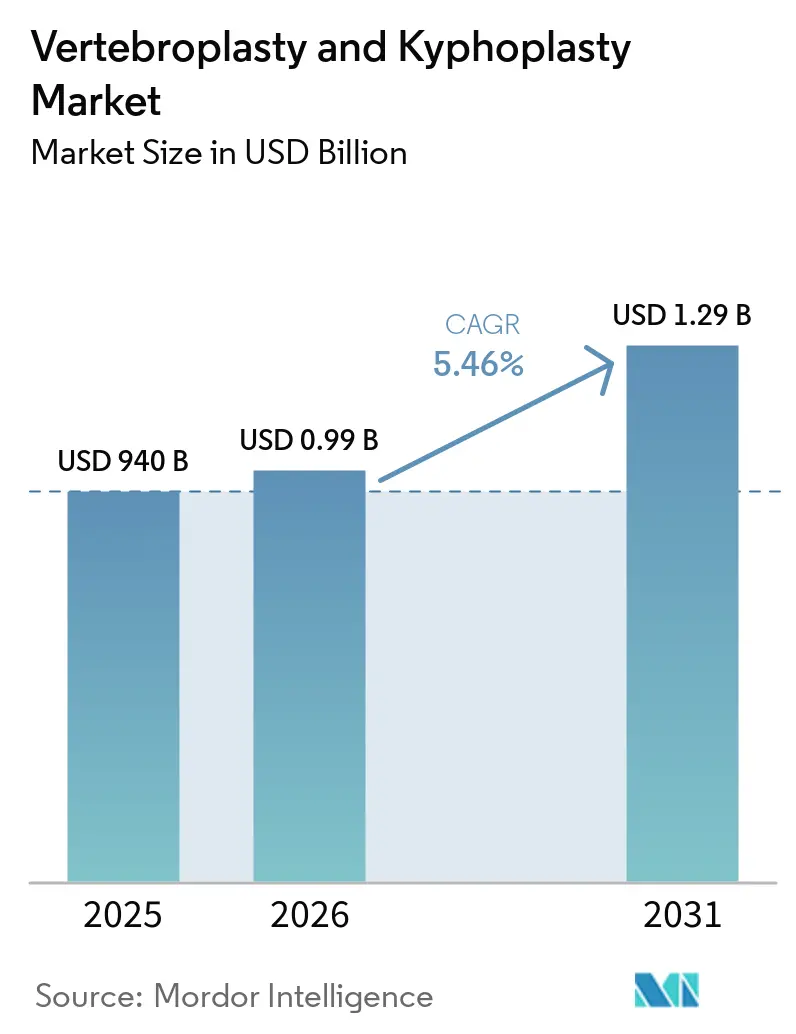
| Market Size (2026) | USD 0.99 Billion |
| Market Size (2031) | USD 1.29 Billion |
| Growth Rate (2026 - 2031) | 5.46 % |
| Fastest Growing Market | Asia Pacific |
| Largest Market | North America |
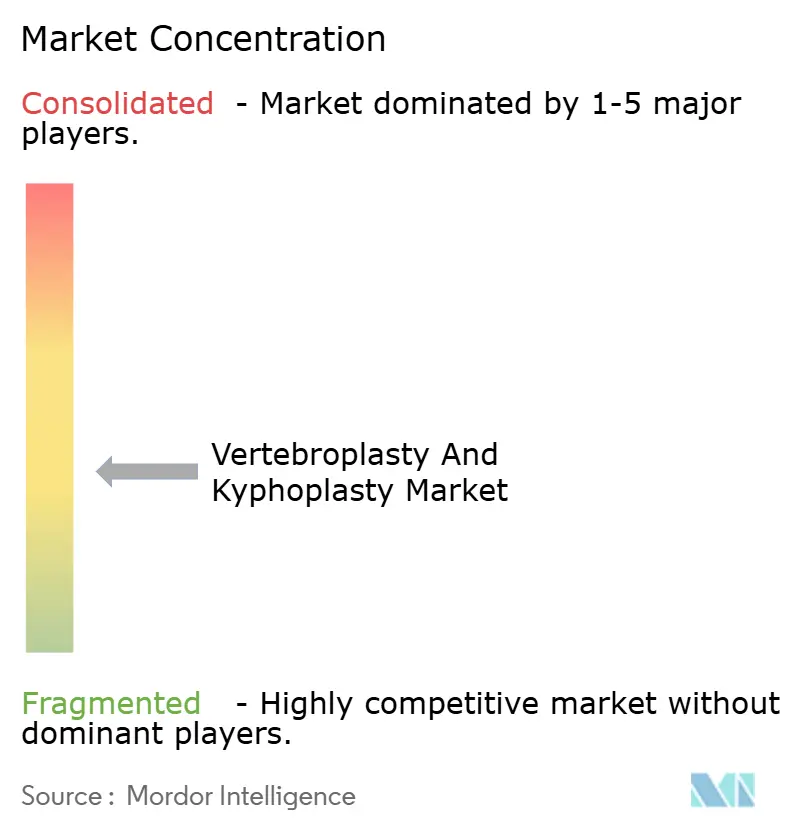
| Market Concentration | Medium |
Major Players *Disclaimer: Major Players sorted in no particular order Image © Mordor Intelligence. Reuse requires attribution under CC BY 4.0. | |
Vertebroplasty and Kyphoplasty Market Analysis by Mordor Intelligence
The Vertebroplasty And Kyphoplasty Market size is projected to expand from USD 940 billion in 2025 and USD 0.99 billion in 2026 to USD 1.29 billion by 2031, registering a CAGR of 5.46% between 2026 and 2031.
This expansion is propelled by rising osteoporotic vertebral compression fractures among aging populations, rapid adoption of minimally invasive day-care spine procedures, and steady introduction of AI-driven navigation systems and bioactive bone cements that improve accuracy while lowering complication risk.
Key Report Takeaways
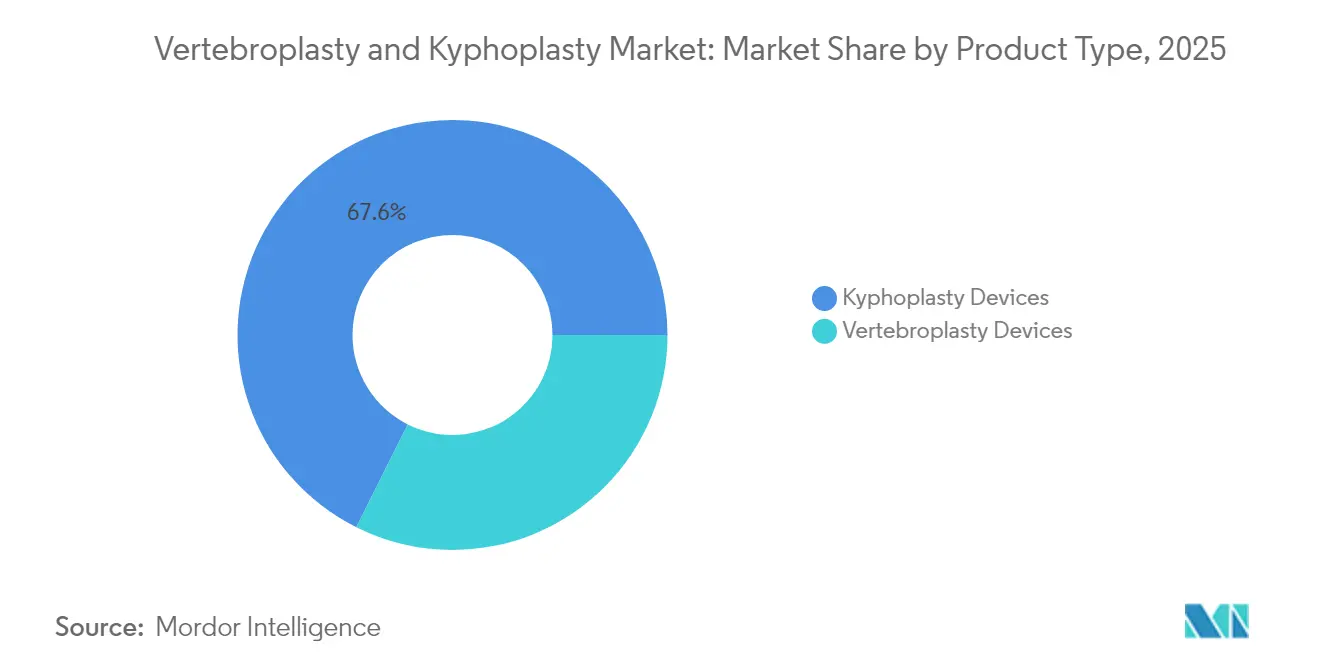
- By product type, kyphoplasty devices commanded 67.62% of the vertebroplasty & kyphoplasty market share in 2025, and the same category is projected to register the fastest 5.57% CAGR through 2031.
- By bone-cement material, polymethylmethacrylate (PMMA) accounted for 71.74% share of the vertebroplasty & kyphoplasty market size in 2025 and is set to grow at a 5.51% CAGR during the forecast window.
- By application, osteoporotic vertebral compression fractures held 58.02% revenue share in 2025, while spinal metastases treatment is forecast to expand at a 5.96% CAGR to 2031.
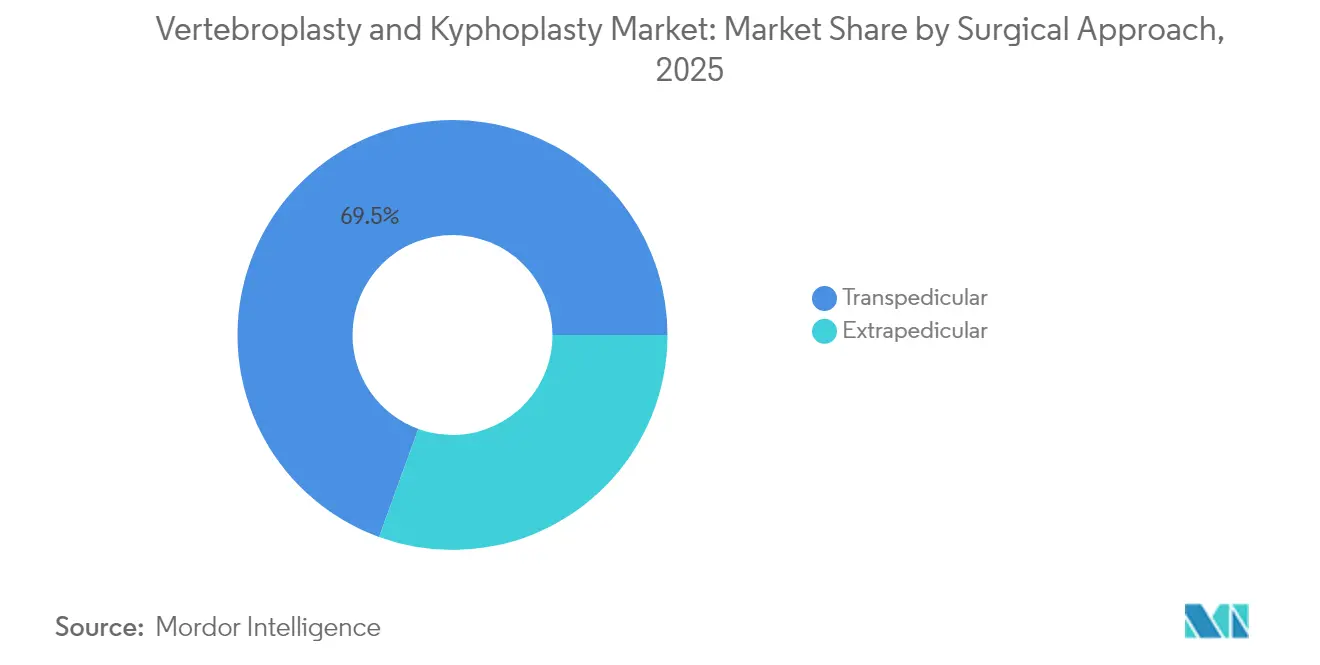
- By surgical approach, the transpedicular technique captured 69.45% of the vertebroplasty and kyphoplasty market share in 2025 and is advancing at a 5.55% CAGR through 2031.
- By end-user, hospitals remained dominant with a 61.32% share in 2025, whereas ASCs are the fastest growing setting, with a 6.12% CAGR over 2026-2031.
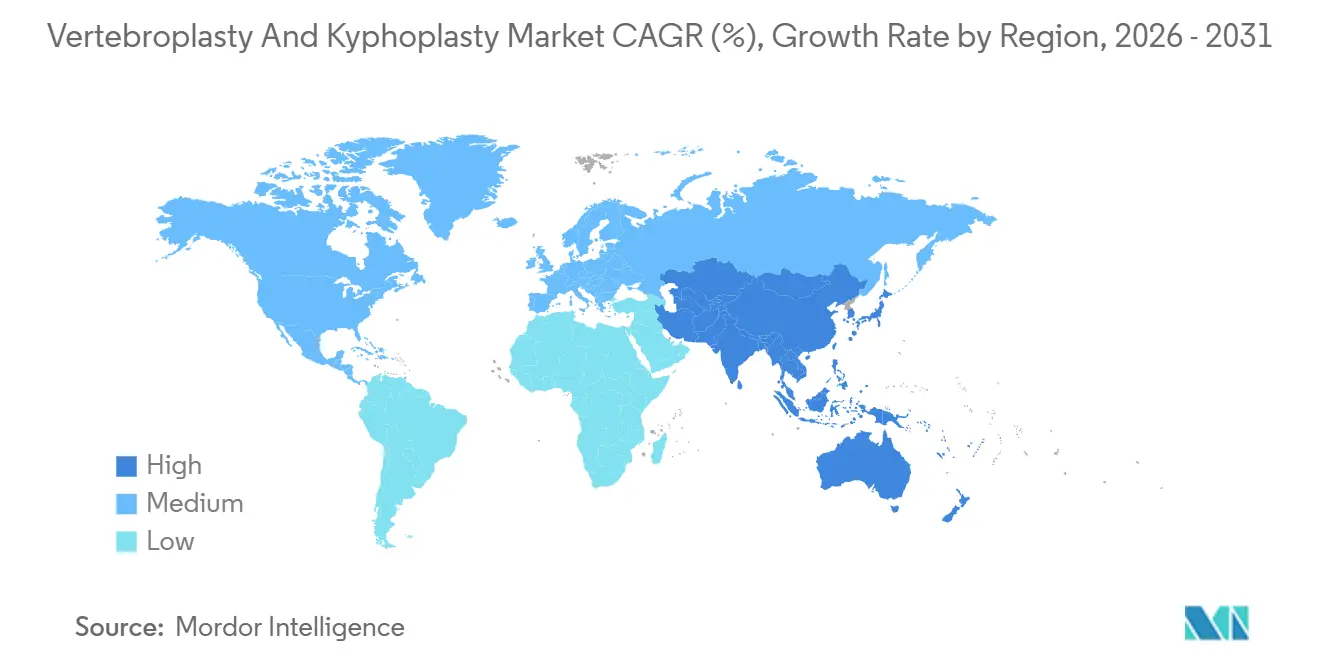
- By geography, North America was the largest regional market in 2025; Asia-Pacific is projected to expand at a 6.56% CAGR through 2031.
Note: Market size and forecast figures in this report are generated using Mordor Intelligence’s proprietary estimation framework, updated with the latest available data and insights as of 2026.
Market Trends and Insights
Drivers Impact Analysis of Vertebroplasty and Kyphoplasty Market*
| Driver | (~) % Impact on CAGR Forecast | Geographic Relevance | Impact Timeline |
|---|---|---|---|
| Growing osteoporosis prevalence | +1.2% | Global, with highest impact in Asia-Pacific and Europe | Long term (≥ 4 years) |
| Expanding geriatric demographic | +1.0% | Global, concentrated in developed economies | Long term (≥ 4 years) |
| Preference for minimally-invasive day-care spine surgeries | +0.8% | North America & EU, expanding to APAC | Medium term (2-4 years) |
| Early-intervention clinical guidelines recommending vertebroplasty/kyphoplasty for acute osteoporotic fractures | +0.6% | Global, led by North America and Europe | Short term (≤ 2 years) |
| AI-driven navigation & robotic alignment in vertebral augmentation | +0.5% | North America, Europe, select APAC markets | Medium term (2-4 years) |
| Bioactive, radiopaque & biodegradable bone-cement innovations | +0.4% | Global, with early adoption in developed markets | Medium term (2-4 years) |
| Source: Mordor Intelligence | |||
Growing Osteoporosis Prevalence
More than 1.4 million vertebral compression fractures occur every year[1], and osteoporosis affects 10-30% of women over 40 in Asia-Pacific, driving steady case growth for vertebral augmentation procedures. Nearly 23% of patients with single osteoporotic fractures develop severe sagittal misalignment after conservative treatment, prompting early surgical intervention. The economic drag is evident, as Brazil spent over BRL 288.9 million on osteoporosis care for the elderly during 2008-2010, underscoring cost pressures that favor definitive procedures that restore mobility.
Expanding Geriatric Demographic
One-fifth of people older than 70 experience osteoporotic vertebral compression fractures, with one-third developing chronic pain that often requires augmentation. Japan’s policy focus on healthy life expectancy elevates demand for rapid fracture repair that permits early ambulation and lowers downstream disability costs. Balloon kyphoplasty can enable standing and walking within hours[2], helping health systems manage the mobility gap in aging societies.
Preference for Minimally Invasive Day-Care Spine Surgeries
Most vertebroplasty and kyphoplasty procedures last about 30 minutes and deliver pain relief to 90% of patients, ideal characteristics for ASC deployment. Studies report that three-quarters of treated patients resume pre-fracture activity levels, while complication rates stay below 1%. Outpatient care reduces facility costs, and Medicare reimburses CPT 22514 at roughly USD 1,200-1,500, creating a clear economic incentive to shift volume from hospitals to ASCs.
Early-Intervention Guidelines Favoring Vertebral Augmentation
Randomized trials show superior pain and mobility outcomes for vertebroplasty over conservative treatment when performed within six weeks of fracture, prompting societies to recommend early intervention. German data illustrate quality-of-life gains, with balloon kyphoplasty patients reaching EQ-5D scores of 0.44 versus 0.25 for non-surgical management. AI-based imaging now detects fractures earlier, shortening the diagnostic-to-treatment cycle and reinforcing guidelines that advocate prompt vertebral augmentation.
Restraints Impact Analysis of Vertebroplasty and Kyphoplasty Market*
| Restraint | (~) % Impact on CAGR Forecast | Geographic Relevance | Impact Timeline |
|---|---|---|---|
| Stringent FDA & EU-MDR approval timelines | -0.8% | Global, most pronounced in North America and Europe | Medium term (2-4 years) |
| Inconsistent reimbursement for vertebral augmentation | -0.6% | Global, varying by healthcare system structure | Short term (≤ 2 years) |
| Procedure-related adverse events | -0.4% | Global, with regional variation in reporting standards | Long term (≥ 4 years) |
| PMMA monomer supply-chain volatility | -0.3% | Global, concentrated in regions dependent on imports | Short term (≤ 2 years) |
| Source: Mordor Intelligence | |||
Stringent FDA & EU-MDR Approval Timelines
Manufacturers now face EU-MDR transition deadlines that extend to 2027-2028 for Class III and certain Class IIb devices, lengthening certification cycles and raising compliance costs. In the US, ongoing post-market surveillance requirements following past cement leakage concerns add data-generation burdens that can slow first-to-market advantage.
Inconsistent Reimbursement for Vertebral Augmentation
Medicare delegates coverage rules to local jurisdictions, creating approval variability for identical clinical scenarios, while private payers often apply narrower indications and deny sacroplasty, complicating provider billing workflows. In China, average hospitalization costs of CNY 35,906 (USD 5,122) for vertebral augmentation can limit access for lower-income patients even as prevalence rises.
*Our forecasts treat driver/restraint impacts as directional, not additive. The impact forecasts reflect baseline growth, mix effects, and variable interactions.
Vertebroplasty and Kyphoplasty Market Segment Analysis
By Product Type:
Kyphoplasty Devices Sustain LeadershipKyphoplasty devices held 67.62% of the vertebroplasty & kyphoplasty market share in 2025 and are projected to rise at a 5.57% CAGR. The approach restores vertebral height before cement injection, cutting leakage risk and delivering visual-analog-scale pain reductions from 7.7 to 2.2. In comparison, vertebroplasty remains essential for acute stabilization but grows more slowly. Stryker’s SpineJack, capable of 1,000 N expansion force, and next-gen unipedicular balloons exemplify how engineering upgrades reinforce clinical preference.
The competitive focus now shifts toward hybrid implants that combine the structural benefits of kyphoplasty with vertebroplasty-style cement flows. Early clinical readouts from autonomous puncture systems suggest that procedural speed and accuracy can improve further, supporting sustained demand for premium device platforms. Emerging players demonstrate that well-targeted design tweaks can still carve out share despite the presence of large incumbents.

By Bone-Cement Material:
PMMA Holds Ground Amid Bioactive OptionsPMMA retained 71.74% of the vertebroplasty & kyphoplasty market share in 2025 and is tracking a 5.51% CAGR. The growth of PMMA-based products reflects their broad familiarity and mechanical reliability. Recent formulations fine-tune polymerization temperature and viscosity to reduce extrusion while preserving strength.
At the same time, bioactive cements are carving a noticeable niche. Strontium-substituted hydroxyapatite promotes osseointegration, and PMMA-CPC hybrids blend load-bearing prowess with controlled resorption. Though starting from a small base, the “Other Materials” category is expected to post a higher CAGR than PMMA, aided by surgeon demand for biologically friendly agents that bond with cancellous bone.
By Application:
Osteoporotic Fractures Dominate; Oncologic Use SurgesOsteoporotic vertebral compression fractures contributed 58.02% of the vertebroplasty & kyphoplasty market share, mirroring their ubiquity in elderly patients. Despite their maturity, procedure counts continue to scale with demographic aging. The vertebroplasty & kyphoplasty market size linked to this segment will expand steadily owing to guideline-driven early intervention.
Metastatic spine disease, with a 5.96% projected CAGR, is gaining traction as improved cancer survival increases skeletal complications. Augmentation provides palliative stability that supports continued systemic therapy, a value recognized by oncologists who now refer patients earlier. This diversification of indications enhances overall procedural volumes beyond purely osteoporotic contexts.
By Surgical Approach:
Transpedicular Route Remains MainstayTranspedicular access delivered 69.45% of the vertebroplasty & kyphoplasty market share in 2025, supported by a 97.7% pain-relief success rate. It benefits from favorable anatomy in lumbar and lower thoracic vertebrae and is preferred by many interventionists for predictable needle trajectories. Extrapedicular methods serve niche needs such as mid-thoracic segments where pedicle dimensions restrict instrumentation. AI-assisted navigation and robotics are improving both routes, yet the familiarity of the transpedicular technique underpins its projected 5.55% CAGR.
By End-User:
Hospitals Dominate; ASCs AccelerateHospitals contributed 61.32% of revenue in 2025, thanks to comprehensive imaging, anesthesia, and perioperative care. Nonetheless, the cost-sensitive environment propels case migration to ASCs, which are forecast to grow at 6.12% CAGR. Strong payer incentives and patient preference for same-day discharge fuel this transition. Hospitals respond by adopting efficiency programs and adding outpatient bays to retain throughput.
Geography Analysis
North America Vertebroplasty and Kyphoplasty Market
North America remains the largest territory, supported by Medicare reimbursement that averages USD 1,200-1,500 per case and clinical familiarity built over two decades of data. The region advances at a 4.97% CAGR as demographic aging continues and AI-assisted navigation gains clinical acceptance.
APAC Vertebroplasty and Kyphoplasty Market
Asia-Pacific, posting the fastest 6.56% CAGR, benefits from high osteoporosis prevalence—52.8% in women and 18.7% in men undergoing spine surgery in China, paired with rising healthcare expenditure. Government campaigns that emphasize active aging and swift fracture repair underpin procedure uptake.
EMEA and South America Vertebroplasty and Kyphoplasty Market
Europe delivers a 5.21% CAGR, buoyed by aging populations and quality-of-life evidence that reinforces adoption, although EU-MDR compliance costs temper rapid product launches. Middle East & Africa and South America trail but still expand above 6% as tertiary centers adopt modern augmentation protocols and local device distributors build channel depth.
Regulatory Landscape
In the United States, vertebral augmentation devices and associated bone cements are regulated by the FDA. Bone cement for vertebroplasty is categorized as a Class II device under 21 CFR 888.3027 (special controls) and is commonly routed through the 510(k) pathway. FDA guidance on clinical-trial considerations for vertebral augmentation devices shapes evidence expectations around safety topics such as cement leakage and other adverse events, which increases the emphasis on post-market surveillance and disciplined risk management across manufacturers’ portfolios.
In Europe, EU MDR 2017/745 has increased compliance burden for vertebral augmentation systems that interface with the spinal column. Many implantable spinal-category products are treated under higher-risk classifications, which drives more rigorous clinical evaluation and deeper notified body engagement. In China, the NMPA directly reviews Class III device registrations for both domestic and imported products, making regulatory planning and local documentation readiness central for market entry and line extensions. Manufacturers also track upcoming quality-system requirements, including China’s medical-device GMP changes scheduled to take effect on November 1, 2026.
Value Chain Analysis
The value chain starts with upstream suppliers of PMMA monomers and specialty additives, including radiopaque and viscosity-modifying agents, alongside metals and polymers used for cannulas, needles, guidewires, balloons, and inflation hardware. These inputs feed into formulation and fill-finish activities for disposable cement kits, as well as precision manufacturing for access and delivery instruments. Quality systems are typically aligned with ISO 13485, with cleanroom assembly practices used for the final products.
Downstream, distribution is driven by large medtech platforms and specialist device companies that bundle consumables with supporting capital systems, including mixing and delivery and imaging workflow integration. Sales typically run through hospital procurement teams and increasingly ambulatory surgical centers. The chain is sensitive to raw-material and logistics volatility, including PMMA supply variability, which pushes manufacturers toward supplier diversification, selective near-shoring, and tighter contracting with OEM/ODM partners to protect lead times for procedure kits.
Competitive Landscape
The vertebroplasty & kyphoplasty market is moderately fragmented. Medtronic, Johnson & Johnson, and VB Spine (following its 2025 acquisition of Stryker’s spine unit) headline the field, yet smaller innovators such as Amber Implants illustrate ongoing disruption potential.
Strategic priorities center on integrated platforms that marry cement, delivery hardware, and imaging. AI-infused navigation suites that shorten learning curves are differentiators, reinforcing commercial leverage in hospital value analysis committees.
Product roadmaps also emphasize next-generation cements with radiopaque additives and bioactivity. Clinical studies remain pivotal; payers increasingly demand peer-reviewed outcomes before widening coverage. Exhibit positioning now integrates carbon-footprint statements as procurement teams add sustainability to their evaluation matrix.
Vertebroplasty and Kyphoplasty Industry Leaders
-
Cardinal Health, Inc.
-
Johnson & Johnson Services, Inc.
-
Medtronic plc
-
Merit Medical Systems, Inc.
-
Stryker Corporation
- *Disclaimer: Major Players sorted in no particular order
Vertebroplasty and Kyphoplasty Market Companies Covered in this Report
- ATEC Spine
- Beckton Dickinson
- BIOPSYBELL S.R.L.
- Cardinal Health
- G21 S.r.l.
- Globus Medical
- IZI Medical Products
- Johnson & Johnson
- Joimax
- Lindare Medical Ltd
- Medtronic
- Merit Medical Systems
- Shanghai Kinetic Medical Limited Co., Ltd.
- Spinal Elements, Inc.
- Spondylos
- Stryker
- Tecres S.p.A.
- Teknimed SA
- Zavation Medical Products, LLC
- Zimmer Biomet
Market Opportunities and Future Outlook
A gap is emerging around cement innovation and workflow simplification that supports outpatient adoption, where procedures are commonly completed in about 30 minutes and fit same-day discharge pathways. FDA clearances for new spinal bone cement offerings continue to refresh competition, and in January 2026 Xelite Biomed received FDA clearance for its SuperM-Fix Spinal Bone Cement (K251896, product code NDN). This strengthens the commercial case for differentiated cement handling, radiopacity, and leakage-mitigation attributes within established vertebral augmentation protocols.
The main technology-led opportunity centers on computer-assisted and robot-navigated targeting approaches. These aim to improve puncture accuracy while reducing cement leakage and intraoperative radiation exposure, aligning with clinician concerns and facility efficiency goals. The direction is consistent with the report’s emphasis on AI-driven navigation systems and next-generation cements, and it also supports uptake in complex pathology and oncology-related fractures, where precise cement distribution and stable fixation are important to maintain mobility and enable continued systemic therapy.
Recent Industry Developments in Vertebroplasty and Kyphoplasty Market
- March 2026: Medtronic and Merit Medical Systems expanded their commercial relationship through a distribution agreement for the FDA-cleared ViaVerte system, while Merit continued supplying Medtronic with Kyphon Xpander inflation syringes. This strengthens Medtronic’s partnered go-to-market model in adjacent minimally invasive spine and pain workflows and helps secure consumable supply continuity that also supports vertebral augmentation procedure throughput.
- October 2025: Johnson and Johnson announced its intent to separate its Orthopaedics business, DePuy Synthes, into a standalone entity within 18 to 24 months. This potential restructuring affects how capital and portfolio priorities are set across spine-adjacent segments and can reshape competitive positioning for vertebral augmentation offerings carried within broader orthopedics channels.
- June 2024: Medtronic partnered with Merit Medical Systems to commercialize the Kyphon KyphoFlex unipedicular balloon catheter for treating vertebral compression fractures in the United States, with Merit handling manufacturing and Medtronic leading sales and distribution. The partnership broadened access to unipedicular kyphoplasty tools and supported bundled selling of balloons, inflation devices, and associated procedure kits through an established spine distribution footprint.
Vertebroplasty and Kyphoplasty Market Report Scope and Research Methodology
Market Definition and Coverage
This market is defined as the revenue generated from products used to perform percutaneous vertebral augmentation, covering vertebroplasty and kyphoplasty procedures for treating painful vertebral compression fractures in routine care settings.
Scope exclusions: We exclude open spinal fusion implants, biologic grafts, vertebral body stents, and non-surgical pain therapies from this sizing.
Segments Covered in This Report
- By Product Type
- Vertebroplasty Devices
- Kyphoplasty Devices
- By Bone-Cement Material
- Polymethylmethacrylate (PMMA)
- Calcium Phosphate Cement (CPC)
- Other Materials
- By Application
- Osteoporotic Vertebral Compression Fractures
- Spinal Metastases
- Other Applications
- By Surgical Approach
- Transpedicular
- Extrapedicular
- By End-User
- Hospitals
- Ambulatory Surgical Centres (ASCs)
- Other End-Users
- By Geography
- North America
- United States
- Canada
- Mexico
- Europe
- Germany
- United Kingdom
- France
- Italy
- Spain
- Rest of Europe
- Asia-Pacific
- China
- India
- Japan
- Australia
- South Korea
- Rest of Asia-Pacific
- Middle East and Africa
- GCC
- South Africa
- Rest of Middle East and Africa
- South America
- Brazil
- Argentina
- Rest of South America
- North America
Data Sources, Market Sizing, and Validation
Desk Research
Desk research was used to build the starting structure of the model and to keep the inputs consistent across countries. We relied on public health statistics and clinical references to size the demand pool for vertebral compression fractures and track how it changes with aging.
Common sources included CDC and CMS releases, OECD health statistics, WHO data tables, and peer reviewed articles in journals such as The Spine Journal and The Journal of Bone and Mineral Research. We also used company annual reports, product brochures, and reputable press coverage to sanity check adoption trends in hospitals and ambulatory centers. Where public numbers were thin, we used paid access to company financials and a patent database to cross-check product activity and estimated revenue direction. These desk sources are illustrative only, and we reviewed many other public and paid references to collect, validate, and clarify inputs.
Primary Interviews and Surveys
Primary work centered on interviews and short surveys with spine surgeons, interventional radiologists, procurement teams, and channel-side experts who see ordering patterns for cement kits, balloons, and related systems. This step was used to confirm procedure mix, typical kit usage per case, timing of the shift to outpatient sites, and country level differences in reimbursement and patient selection. We then reconciled gaps left by public datasets.
Distribution of primary research fieldwork respondents
| Company type | Respondent position | Region |
|---|---|---|
| Top tier: 29% | CXOs: 16% | APAC: 47% |
| Mid tier: 51% | Functional/Unit leaders: 35% | EMEA: 34% |
| Smaller Players: 20% | Managers: 49% | Americas: 19% |
Market-Sizing & Forecasting
The core sizing logic uses a top-down build that reconstructs demand from the treated patient pool, then converts that pool into product revenue using realistic procedure and pricing inputs. We estimated the vertebral compression fracture burden, the share that becomes symptomatic and treated, and the split of vertebroplasty versus kyphoplasty within minimally invasive care. We then applied typical kits and devices used per procedure.
To keep totals grounded, we corroborated the outputs with selective bottom-up checks, including sampled average selling price ranges for cement kits and balloon systems, hospital purchasing checks, and supplier-side revenue direction by region. Key inputs in the model included procedure volumes by setting (hospital versus ambulatory), cement kit consumption per case, balloon usage rates, reimbursement dynamics by country, and the pace of shift to outpatient sites. Forecasting used scenario analysis tied to expert views on adoption, pricing stability, and clinical guideline sentiment, and the final curve was adjusted only when the scenarios and desk signals aligned. Where bottom-up detail was missing for smaller countries, ratios were extended using comparable markets with similar age mix and care setting penetration, then rechecked through interviews.
Data Validation & Update Cycle
Validation is done through multiple checks that look for internal consistency and real-world signals. We compare implied procedures per 100,000 population, kit-to-procedure ratios, and regional growth patterns against independent indicators, and any outliers are investigated before sign-off.
A second analyst reviews model logic and major assumptions. We also re-contact sources when a key input changes materially or when a region shows an unexpected jump. Reports are refreshed annually, with interim updates triggered by material events such as reimbursement changes, major recalls, or sudden procedure slowdowns. Before delivery, a final pass is completed so clients receive the most current view available at that time.
Mordor Intelligence's Vertebroplasty and Kyphoplasty Market Size Measured Against Other Published Estimates
Published market sizes for vertebroplasty and kyphoplasty can differ even when the topic sounds identical, because authors do not always count the same revenue lines, or they apply different timing for prices and volumes. Differences also show up when procedure revenue is mixed with device revenue, or when adjacent vertebral augmentation products are grouped together.
One common gap is scope expansion into broader spine intervention baskets, which can pull in stents or other fracture device lines and lift the total. Some estimates also lean on optimistic procedure growth assumptions without tying them back to reimbursement and site-of-care constraints, and then carry those assumptions forward using a single growth rate. In contrast, Mordor Intelligence limits the count to cement kits, balloons, access needles, inflation pumps, and supporting capital systems used for percutaneous vertebral augmentation, and it excludes open fusion implants, biologic grafts, vertebral body stents, and non-surgical pain therapies.
Benchmark comparison
| Source | Market Size | Gaps in Research Methodology |
|---|---|---|
| Mordor Intelligence | USD 0.99 B (2026) | |
| Global Publisher A | USD 1.38 B (2025) | Uses a broader procedure-revenue framing and longer forecast window, and the inclusion rules around materials and clinical settings are not clearly separated from device revenue, which can inflate the near-term total. |
| Industry Publisher B | USD 0.94 B (2025) | Positions the sizing as a devices view with limited transparency on how capital systems versus disposables are treated, and the pricing progression assumptions are not shown by region, which can change the base-year number. |
The spread across sources mainly comes from what is counted and how procedure intensity and pricing are translated into revenue by geography. By keeping the inputs tied to treated fracture volume, kit usage, and realistic price bands that can be checked in interviews, the market size remains traceable and easier to replicate year over year.
Key Questions Answered in the Report
What is the primary driver behind hospitals' adoption of AI-guided vertebral augmentation systems?
Hospitals are embracing AI-guided navigation because it shortens puncture time, improves cement placement accuracy, and reduces leakage-related complications, leading to better patient outcomes and fewer revisits.
Why are ambulatory surgical centers gaining vertebroplasty and kyphoplasty volume from hospitals?
ASCs combine shorter procedure times with same-day discharge, giving referring physicians a cost-efficient setting while offering patients quicker recovery in a lower-acuity environment.
How do bioactive bone cements reshape surgeon choices?
New formulations enriched with osteoconductive additives encourage bone bonding and lower post-operative inflammation, prompting many spine specialists to shift away from conventional PMMA in eligible cases.
What impact will the EU Medical Device Regulation have on device launches in this field?
Extended conformity assessments and heightened post-market surveillance under EU-MDR are lengthening approval cycles, pushing manufacturers to front-load clinical evidence and risk-management data before release.
How is the competitive landscape changing after Stryker’s spine divestiture?
The sale created a new mid-tier powerhouse, intensifying rivalry for differentiated implants and accelerating partnerships among imaging, navigation, and cement suppliers seeking bundled offerings.
Which clinical indication is seeing the fastest procedural uptake beyond osteoporosis?
Vertebral stabilization for spinal metastases is rising quickly as oncologists incorporate augmentation to control pain and maintain structural integrity during systemic cancer therapy.