
Urinalysis Market Size and Share
Market Overview
| Study Period | 2020 - 2031 |
|---|---|
| Market Size (2026) | USD 4.19 Billion |
| Market Size (2031) | USD 5.68 Billion |
| Growth Rate (2026 - 2031) | 6.26 % |
| Fastest Growing Market | Asia Pacific |
| Largest Market | North America |
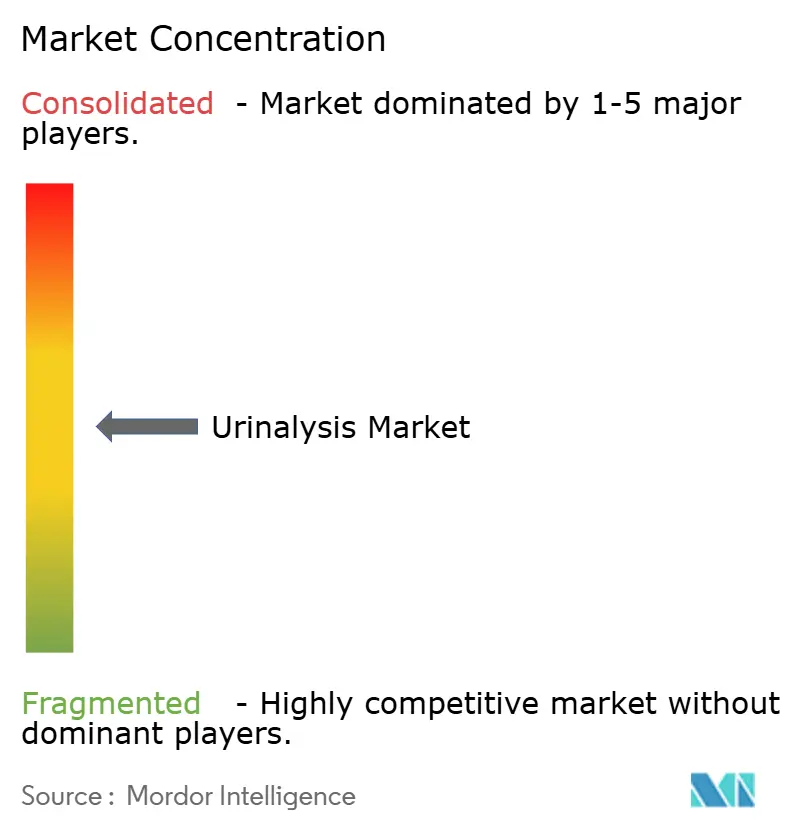
| Market Concentration | Medium |
Major Players *Disclaimer: Major Players sorted in no particular order Image © Mordor Intelligence. Reuse requires attribution under CC BY 4.0. | |
Urinalysis Market Analysis by Mordor Intelligence
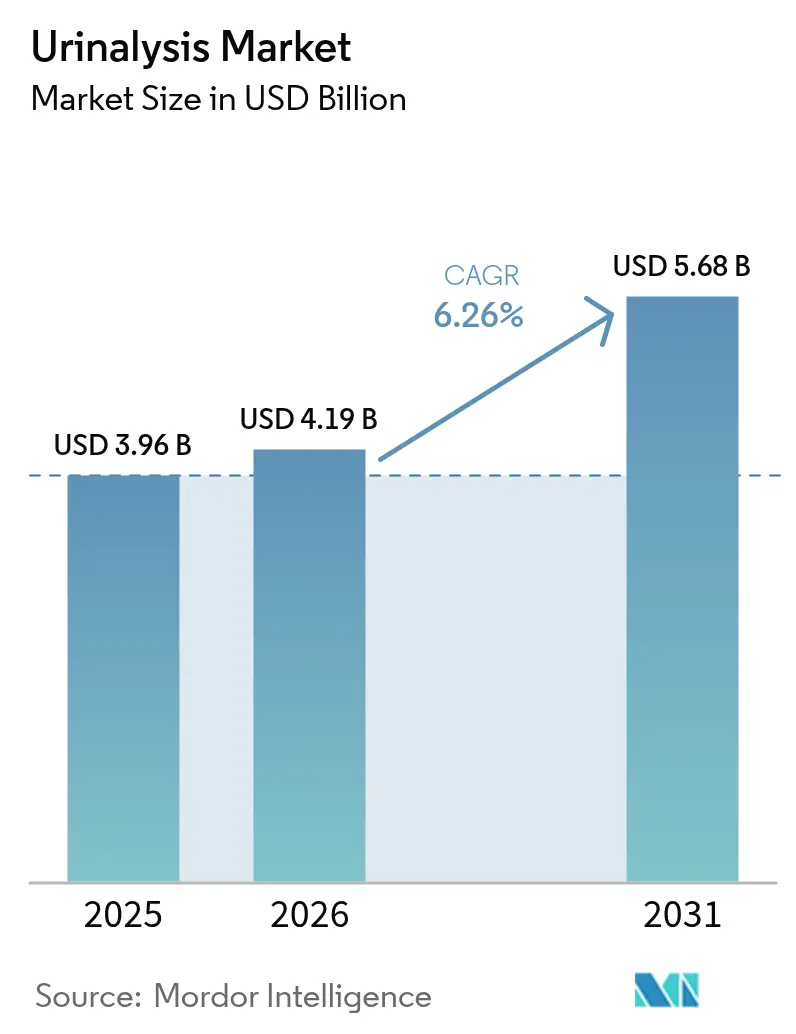
The Urinalysis Market size was valued at USD 3.96 billion in 2025 and is estimated to grow from USD 4.19 billion in 2026 to reach USD 5.68 billion by 2031, at a CAGR of 6.26% during the forecast period (2026-2031).
Clinical demand stems from an expanding chronic-kidney-disease population, broader diabetes screening mandates, and hospital investments in automated, high-throughput analyzers that reduce manual review rates to below 3%. Artificial intelligence modules now interpret urinary sediment images in near real time, adding consistency to a historically subjective test step. Point-of-care systems and connected home devices are growing fastest as payers push services closer to patients and regulatory agencies clarify cybersecurity and data privacy expectations. At the same time, centralized procurement programs in China and DRG-based tariffs in Europe are squeezing consumable margins, prompting suppliers to emphasize reagent–analyzer bundles and cloud analytics that add measurable value.
Key Report Takeaways
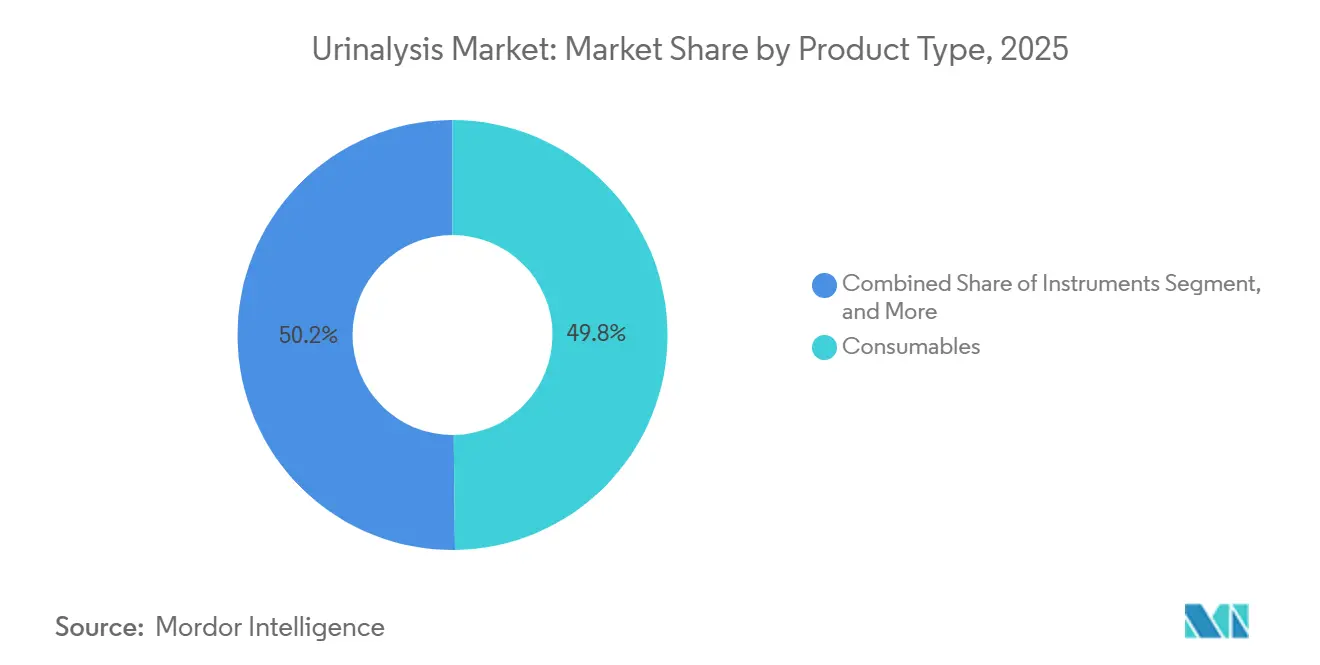
- By product, consumables led with 49.82% of the urinalysis market share in 2025, while point-of-care devices are forecast to advance at a 7.06% CAGR through 2031.
- By test type, biochemical panels accounted for 46.27% of the urinalysis market size in 2025, whereas infectious-disease detection is projected to expand at a 9.63% CAGR to 2031.
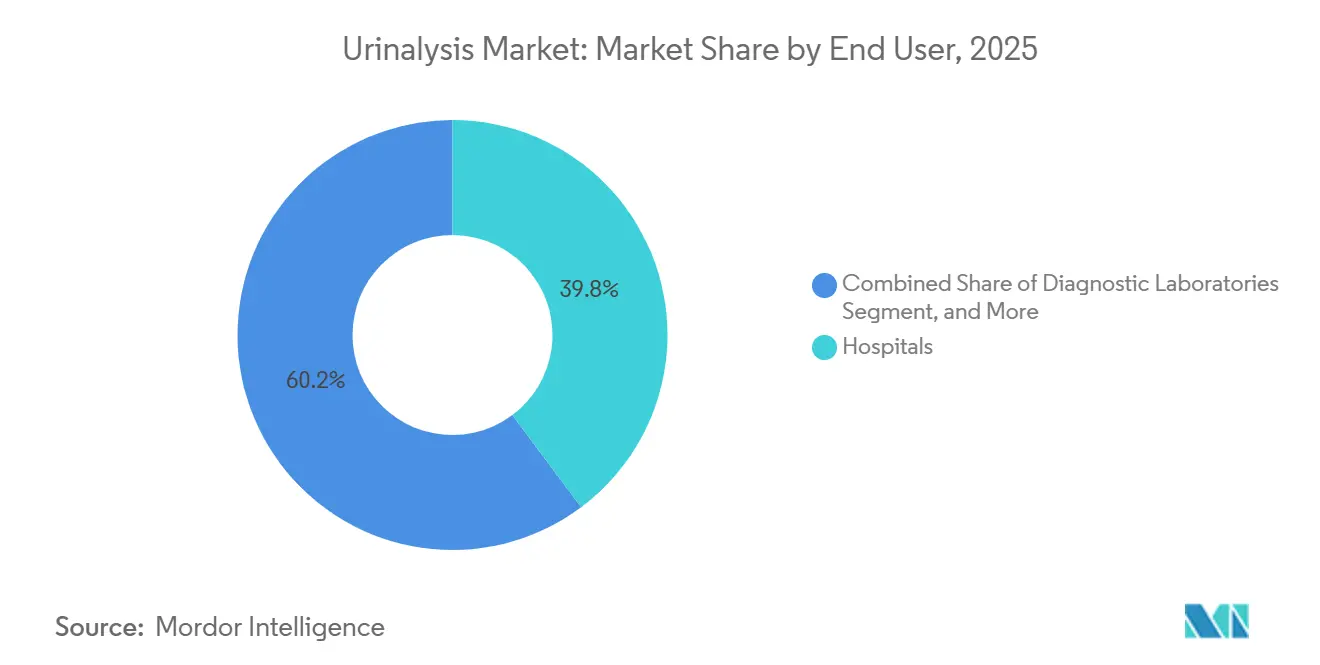
- By end user, hospitals captured 39.79% of the urinalysis market share in 2025, yet home-care settings are poised for an 8.18% CAGR over 2026-2031.
- By geography, North America retained 36.78% of the urinalysis market share in 2025; Asia-Pacific is anticipated to record the fastest regional growth at a 9.28% CAGR through 2031.
Note: Market size and forecast figures in this report are generated using Mordor Intelligence’s proprietary estimation framework, updated with the latest available data and insights as of 2026.
Global Urinalysis Market Trends and Insights
Drivers Impact Analysis*
| Driver | (~) % Impact on CAGR Forecast | Geographic Relevance | Impact Timeline |
|---|---|---|---|
| Rising prevalence of chronic kidney diseases | +1.2% | Global with high incidence in North America, Europe, urban Asia-Pacific | Medium term (2-4 years) |
| Growing diabetic population necessitating routine urine testing | +1.0% | South Asia, Middle East, North America | Long term (≥4 years) |
| Shift toward automated, high-throughput platforms | +0.9% | North America, Europe, tier-1 hospitals in China and India | Short term (≤2 years) |
| Integration of AI-powered image analysis | +0.7% | North America, Europe, Japan; early use in South Korea and Australia | Medium term (2-4 years) |
| Expansion of self-testing and tele-urinalysis kits | +0.6% | North America, Western Europe, affluent urban Asia-Pacific | Medium term (2-4 years) |
| Increasing adoption of urinary oncology biomarkers | +0.5% | North America, Europe, Japan; emerging China and India | Long term (≥4 years) |
| Source: Mordor Intelligence | |||
Rising Prevalence of Chronic Kidney Diseases
Worldwide, an estimated 788 million people live with CKD, and 14% of U.S. adults carried a diagnosis in 2024.[1] Quarterly or semi-annual urine screening for proteinuria and hematuria has therefore become standard for diabetics and hypertensives. Hospitals and diagnostic chains rely on analyzers that process 240–480 samples per hour, reducing labor costs and enabling same-day clinical intervention. Rapid hub-and-spoke expansion in India’s tier-2 and tier-3 cities channels additional volumes to centralized labs. Recurring reagent revenue rises with every mandated follow-up but faces reimbursement caps when public insurers fix per-test fees.
Growing Diabetic Population Necessitating Routine Urine Testing
The International Diabetes Federation counted 537 million adults with diabetes in 2024 and expects the figure to top 640 million by 2030.[2] Urinalysis detects microalbuminuria early in diabetic nephropathy and monitors glycosuria in uncontrolled patients. Public insurers favor preventive testing to avoid late-stage complications, yet India’s Ayushman Bharat program under-reimburses private hospitals, prompting a shift toward lower-cost pharmacy and home testing. Vendors pairing glucose and albumin strips with Bluetooth readers have secured contracts in community health centers across South Asia and the Middle East.
Shift Toward Automated, High-Throughput Platforms
Fully automatic analyzers, such as Siemens Healthineers’ CLINITEK Novus, cleared in Europe in 2025, process 240 specimens per hour and self-validate strip integrity. U.S. laboratories purchase these systems to offset wage inflation and to address a projected 2% growth in technician headcount amid looming retirements. Chinese hospitals prefer domestically made units, buying at an average RMB 53,300 (USD 7,400) and bundling reagents to meet centralized tender rules. Mid-tier facilities still choose semi-automated units ranging from 60 to 240 tests per hour, balancing capital budgets with daily volume.
Integration of AI-Powered Image Analysis for Sediment Examination
IBM and Beckman Coulter have demonstrated convolutional neural networks that identify cells, crystals, and casts with accuracy rivalling expert technicians. Beckman’s DxU Iris Workcell cuts manual review below 3%, improving consistency across shifts.[3] The U.S. FDA’s 2024 software cybersecurity guidance accelerated 510(k) submissions by defining threat-mitigation protocols. Japan’s 2024 reimbursement handbook for software-as-a-medical-device signals Asia-Pacific support, although capital intensity remains a barrier for rural hospitals.
Restraints Impact Analysis*
| Restraint | (~) % Impact on CAGR Forecast | Geographic Relevance | Impact Timeline |
|---|---|---|---|
| Reimbursement gaps across emerging markets | −0.8% | India, Southeast Asia, Sub-Saharan Africa, Latin America | Medium term (2-4 years) |
| Shortage of skilled laboratory technicians | −0.6% | North America, Europe, urban Asia-Pacific | Short term (≤2 years) |
| Data-privacy concerns in at-home devices | −0.4% | Europe, North America, Australia | Short term (≤2 years) |
| Supply-chain vulnerability in reagents | −0.5% | Global with exposure in North America and Europe | Short term (≤2 years) |
| Source: Mordor Intelligence | |||
Reimbursement Gaps Across Emerging Markets
Public insurance programs often reimburse below the cost of reagents, discouraging private investment. Only 13% of private hospitals in a 2025 Maharashtra survey accepted Ayushman Bharat rates, pushing patients toward public facilities or cash payments. WHO noted that low- and middle-income countries spend less than 5% of their health budgets on diagnostics. Suppliers pivot to low-cost strips, but margins remain tight and distribution fragmented.
Shortage of Skilled Laboratory Technicians
The U.S. had 351,200 technologists in 2024, with 44% of staff experiencing burnout. Vacancy rates force hospitals to outsource or delay reporting, harming patient throughput. Automation reduces repetitive tasks yet still needs qualified operators for maintenance. Europe and Japan face similar staffing gaps, complicated by aging workforces and restrictive immigration policies.
*Our forecasts treat driver/restraint impacts as directional, not additive. The impact forecasts reflect baseline growth, mix effects, and variable interactions.
Segment Analysis
By Product: Consumables Anchor Revenue, Point-of-Care Devices Accelerate
Consumables generated 49.82% of urinalysis market revenue in 2025, underscoring the lock-in created by proprietary reagent strips calibrated for specific analyzers. Automated analyzers split into fully automatic workcells serving core laboratories and semi-automatic benchtop units addressing 60–240 daily tests. The urinalysis market for consumables is projected to grow steadily, even as pricing pressure from centralized procurement compresses per-test margins. Hospitals in China paid an average of RMB 53,300 (USD 7,400) for fully automatic analyzers during 2024 tenders, favoring domestic brands that bundled reagents and service contracts.
Point-of-care devices grow at a 7.06% CAGR through 2031 as pharmacies and home-health programs adopt smartphone-linked readers and microfluidic cartridges. Instruments segment revenue benefits from capital purchases of CLINITEK Novus and DxU Iris platforms, which integrate strip analysis with digital microscopy and AI particle recognition. Semi-automated analyzers remain relevant in tier-2 hospitals across India and Latin America, where budgets are tight. Veterinary clinics and companion-animal hospitals are a niche but expanding outlet, adding incremental demand for consumables as pet ownership rises.

By Test Type: Biochemical Dominance Meets Infectious-Disease Surge
Biochemical panels accounted for 46.27% of the urinalysis market share in 2025, driven by glucose, protein, and pH strips ordered for routine diabetes and renal assessment. However, infectious-disease detection is the fastest-growing category, expected to reach a 9.63% CAGR through 2031 as antimicrobial-resistance surveillance mandates rapid pathogen identification. The urinalysis market for infectious-disease applications is growing rapidly as primary-care clinics deploy 30-minute UTI point-of-care kits that reduce empirical antibiotic use.
Sediment analysis still commands meaningful revenue but shifts toward AI-enabled digital microscopy that standardizes findings and reduces technician variability. Pregnancy and fertility tests retain volume but face commoditization, with retail prices under USD 10 per kit. Drug-of-abuse testing received a policy boost when SAMHSA added oral-fluid alongside urine in May 2024 guidelines, yet employers continue to favor multi-panel urine screens for cost and historical comparability.
By End User: Hospitals Lead, Home-Care Settings Gain Momentum
Hospitals accounted for 39.79% of the urinalysis market revenue in 2025, supported by mandatory pre-operative screening and emergency-room triage protocols. Diagnostic laboratories form the next-largest group, processing outsourced samples from physician offices through hub-and-spoke networks. The urinalysis market size in home-care settings is forecast to expand fastest at an 8.18% CAGR through 2031 as connected devices like Withings U-Scan achieve FDA 510(k) clearance and GDPR compliance. Academic and research institutes consume smaller volumes but propel biomarker discovery for oncology.
Veterinary clinics contribute incremental growth, with IDEXX Laboratories booking USD 941 million in diagnostic revenue in Q3 2024. Hospitals invest in CLINITEK Novus workcells to manage morning surges, while reference laboratories compete on test menus and ISO 15189 accreditation to attract physician referrals. Home adoption is restrained by privacy legislation, but vendors that encrypt data and offer cloud dashboards capture early adopters.
Geography Analysis
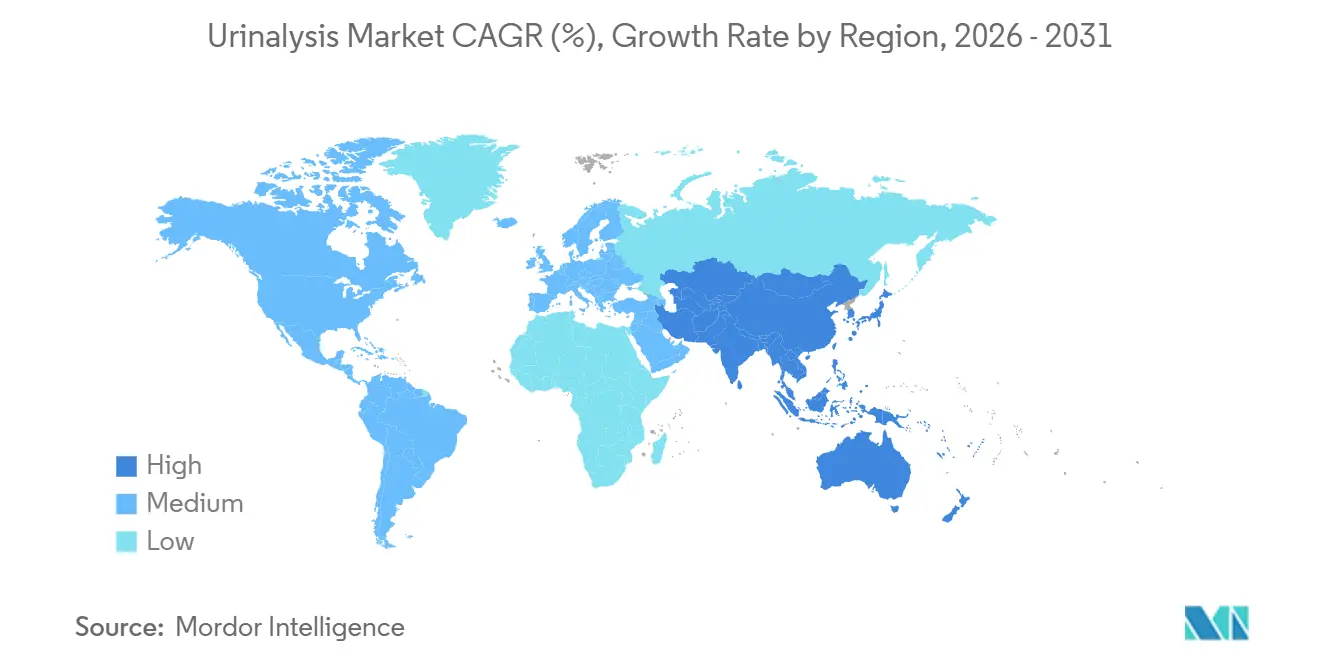
North America accounted for 36.78% of the urinalysis market share in 2025, owing to established reimbursement pathways and early uptake of AI sediment platforms. The FDA’s 2024 cybersecurity guidance clarified 510(k) routes, speeding commercial launches. Workforce shortages drive hospitals to automate, aligning with capital spend on high-throughput analyzers. Canada invests through provincial screening initiatives, whereas Mexico increases private-sector laboratory chains focused on diabetes monitoring. Reimbursement cuts temper revenue, but rising preventive-health volumes partly offset price erosion.
Asia-Pacific is the fastest-growing region, with a 9.28% CAGR projected for 2026-2031. China’s centralized tenders shifted volumes toward domestically produced analyzers from Youlite, Dirui, and Mindray, whose integrated reagent offers secured 73.61% of 2024 contract value. Japan maintains a mature market with 11% of Eiken Chemical’s 2023 revenue from urinalysis strips, and the 2024 MoH guidebook supports software-as-a-medical-device reimbursement. Australia and South Korea are quickly adopting connected home devices due to their robust telemedicine infrastructure.
Europe holds a significant stake thanks to universal coverage and the enforcement of ISO 15189. Germany and the United Kingdom lead automated-analyzer uptake, while GDPR raises compliance hurdles for cloud-connected devices. Eastern European hospitals modernize under EU health-fund grants, yet constrained budgets limit premium analyzer penetration. Latin America and the Middle East & Africa contribute smaller portions but register steady growth as private hospitals expand diagnostics capacity, although currency volatility and fragmented reimbursement pose ongoing risks.
Regulatory Landscape
Urinalysis instruments and reagent test systems sold as IVD medical devices are regulated in the United States under FDA device frameworks that include 21 CFR Part 862 (clinical chemistry and related systems), with categories covering creatinine, urinary protein/albumin, and automated urinalysis systems. Market access commonly requires FDA 510(k) clearance with appropriate labeling and clinical performance evidence, while many routine strip-based tests used outside high-complexity labs also rely on CLIA complexity categorization, including CLIA-waived pathways for certain UTI-related tests.
A key compliance shift for manufacturers is the FDA Quality Management System Regulation (QMSR) update aligning with ISO 13485:2016, effective February 2, 2026, which drives quality-system updates across design controls, manufacturing, and postmarket processes. In Europe, connected and software-enabled urinalysis workflows also intersect with privacy and data-handling expectations under GDPR, and laboratories continue to use ISO 15189 accreditation as a quality anchor for routine urinalysis operations and outsourcing decisions.
Competitive Landscape
Sysmex, Roche, Siemens Healthineers, and Danaher’s Beckman Coulter protect positions through integrated workcells that lock in proprietary reagent sales. Sysmex recorded 8% of FY 2024 revenue from urinalysis and renewed a partnership with Roche to extend reach in North America and Europe. Siemens Healthineers obtained CE Mark for CLINITEK Novus in 2025, strengthening its European hospital bid strategy.
Domestic Chinese makers Youlite, Dirui, and Mindray expand beyond county hospitals by bundling reagents and offering lifecycle service at lower prices, reducing import share from 13.5% in 2021 to 12.0% in 2024. Niche opportunities arise in veterinary and tele-urinalysis software. IDEXX reported 6.6% organic growth in Q3 2024, while IBM introduced a cloud-based AI sediment tool that can be licensed to smaller labs without the capital for full analyzers. Future competition will center on AI accuracy, cybersecurity credentials, and the ability to align with reimbursement reforms.
Urinalysis Industry Leaders
-
Cardinal Health Inc.
-
Sysmex Corporation
-
Beckman Coulter Inc.
-
Arkray Inc.
-
F. Hoffmann-La Roche Ltd
- *Disclaimer: Major Players sorted in no particular order
Market Opportunities and Future Outlook
Workflow automation and digitally enabled urinalysis create whitespace in settings dealing with staffing constraints and rising screening volumes, particularly where high-throughput analyzers can reduce manual review to below 3% and standardize sediment interpretation using AI image analysis. Suppliers that pair instruments with consumables and connectivity (LIS integration, cybersecurity documentation, and audit-ready traceability) can differentiate in hospital and reference-lab tenders that remain price disciplined, including China-style centralized procurement that favors bundled reagent and service offers from domestic and multinational vendors.
Decentralized and at-home testing is an active opportunity area as regulatory clarity improves for device quality systems and connected-device validation, including the FDA QMSR effective February 2026. Several urinalysis-adjacent clearances also signal sustained U.S. throughput demand for urine-based panels, such as FDA 510(k) clearances for multi-drug urine test panels in January 2026 and May 2026. In Europe, the IVDR transition and the May 28, 2026 activation of multiple EUDAMED modules increase the value of strong clinical evidence packages, UDI/device registration readiness, and compliant cloud architectures for tele-urinalysis, which can help vendors scale across health systems with less added manual documentation burden.
Recent Industry Developments
- May 2026: Vivachek Biotech (Hangzhou) Co., Ltd. received FDA 510(k) clearance (K261280) for the BioSieve Multi-Drug Urine Test Panel. The clearance expands the set of regulated, commercially deployable urine-panel options and reinforces how U.S. regulatory pathways shape competitive access for urine-based testing menus.
- October 2025: Sysmex Indonesia launched the UF-1500 fully automated urine particle analyzer. The launch supports broader deployment of automated urine sediment and particle analysis in routine workflows, aligning with laboratory efforts to reduce hands-on time and manage technician shortages.
- January 2024: Vivoo launched a digital UTI test that integrates with telemedicine apps. This product move advanced consumer-facing urinalysis toward connected care pathways, linking home testing to remote clinical decision-making and follow-up.
Research Methodology Framework and Report Scope
Market Definition and Coverage
For this study, the urinalysis market covers the value of instruments and consumables used to assess urine through physical, chemical, and microscopic examination for screening, diagnosis support, and monitoring across care settings.
Scope exclusions: Veterinary urinalysis and standalone drug-of-abuse cup tests are excluded to keep the demand pool tied to routine clinical urinalysis workflows.
Segmentation Overview
- By Product
- Consumables (Reagents & Strips)
- Instruments
- Automated Analyzers
- Semi-Automated Analyzers
- Point-of-Care Devices
- By Test Type
- Biochemical Urinalysis
- Sediment Analysis
- Pregnancy & Fertility Testing
- Drug-of-Abuse Testing
- Infectious Disease Detection
- By End User
- Hospitals
- Diagnostic Laboratories
- Home-Care Settings
- Academic & Research Institutes
- Veterinary Clinics
- By Geography
- North America
- United States
- Canada
- Mexico
- Europe
- Germany
- United Kingdom
- France
- Italy
- Spain
- Rest of Europe
- Asia-Pacific
- China
- Japan
- India
- Australia
- South Korea
- Rest of Asia-Pacific
- Middle East & Africa
- GCC
- South Africa
- Rest of Middle East & Africa
- South America
- Brazil
- Argentina
- Rest of South America
- North America
Data Sources, Market Sizing, and Validation
Desk Research
Desk work starts with mapping the real demand pool, which is grounded in how often urine testing is ordered and how it is performed in labs and care sites. We refer to public health and utilization signals from the US CDC, the World Health Organization, the US FDA device clearances and recalls database, the OECD health statistics, and the World Bank health indicators to understand disease burden and testing context.
To convert that context into a usable model, we also review company annual reports, investor presentations, product brochures, clinical guideline publications, and medical journals that describe testing pathways and adoption of automation in routine urinalysis. Where needed, paid subscriptions are used for company financials and intelligence, and for patent databases to support product mapping and innovation tracking. The sources listed above are illustrative, and additional public documents and datasets were also reviewed for data collection, validation, and clarification.
Primary Interviews and Surveys
Primary inputs come from interviews and surveys with diagnostic laboratory stakeholders, hospital procurement and lab managers, distributors, and selected clinicians who rely on urinalysis in day-to-day practice. Coverage is balanced across major regions so assumptions on test mix, automation penetration, and price movement can be checked and adjusted, and then rechecked when desk signals do not match.
Distribution of primary research fieldwork respondents
| Company type | Respondent position | Region |
|---|---|---|
| Top tier: 30% | CXOs: 14% | APAC: 48% |
| Mid tier: 48% | Functional/Unit leaders: 36% | EMEA: 34% |
| Smaller Players: 22% | Managers: 50% | Americas: 18% |
Market-Sizing & Forecasting
Sizing is built using a top-down approach where disease screening demand and routine testing behavior are translated into annual test volumes, and then converted into value using an instrument-to-installed-base link and recurring consumables pull-through. To keep the model practical, results are corroborated through selective bottom-up checks, such as sampling analyzer shipments and placements through channel checks, and testing whether the implied consumables spend per site looks realistic.
Key inputs that shape the model include the share of urinalysis performed in hospitals versus independent labs, the split between manual and automated workflows, average strip and reagent usage per test, replacement cycles for analyzers, and observed pricing and currency movement used for consistent USD conversion. Forecasts are developed using scenario analysis supported by expert consensus, since adoption of automation and point-of-care usage can change speed depending on budgets, staffing, and guideline adherence. When bottom-up visibility is limited in smaller countries, proxies are used from similar health system profiles and then reconciled to regional testing intensity to avoid overstatement.
Data Validation & Update Cycle
Outputs are validated by checking consistency across multiple signals, including implied tests per capita, instrument installed base plausibility, and consumables-to-instrument revenue balance, and then drilling into any unusual jumps by country or end user. A second analyst reviews assumptions, calculations, and year-to-year movements before sign-off, and callbacks are triggered when interview feedback conflicts with desk indicators.
The report is refreshed annually, and interim updates are made when material events affect pricing, regulatory status, or ordering patterns. Before delivery, a final pass is done to ensure the latest public releases and market events are reflected in the model and commentary.
Mordor Intelligence's Urinalysis Market Size Compared With Other Published Estimates
Published estimates for urinalysis can look far apart even when they describe similar testing needs, because scope and pricing logic are not always aligned. Differences usually come from what is counted as urinalysis, how home-use kits are treated, and how quickly pricing and exchange rates are refreshed.
Some sources widen the scope into adjacent consumer applications like fertility and pregnancy testing, which increases the headline value in years where at-home products grow quickly. In Mordor Intelligence, the number is restricted to instruments and consumables used for urinalysis in clinical and point-of-care workflows, with veterinary urinalysis and standalone drug-of-abuse cups kept out, and this choice explains much of the spread.
Benchmark comparison
| Source | Market Size | Gaps in Research Methodology |
|---|---|---|
| Mordor Intelligence | USD 4.19 B (2026) | |
| Global Consultancy A | USD 4.89 B (2025) | Uses a broader application scope that includes fertility and pregnancy related home testing kits, and applies a higher growth arc that amplifies consumer channels in the base year. |
| Industry Research Publisher B | USD 4.70 B (2025) | Anchors the model to a nearer-term base year and includes a wider set of at-home testing kits, with less separation between routine clinical urinalysis and consumer self-testing spend. |
The table shows that the main variance comes from adjacent home-use categories and the year chosen for the stated market value, which can shift totals even before forecasting starts. By tying revenue to repeatable inputs like testing intensity, automation mix, and consumables pull-through, we keep the estimate traceable to clear drivers and easier to replicate over time.
Key Questions Answered in the Report
How large will the urinalysis market be by 2031?
It is projected to reach USD 5.68 billion, growing at a 6.26% CAGR over 2026-2031.
Which product category dominates spending today?
Consumables account for 49.82% of 2025 revenue thanks to recurring reagent purchases tied to installed analyzers.
What is the fastest-growing test type?
Infectious-disease detection leads with a projected 9.63% CAGR as antimicrobial-resistance surveillance expands.
Why is Asia-Pacific the growth hotspot?
Hospital capacity additions in India and China, plus domestic analyzer manufacturing, drive a 9.28% regional CAGR.
How are vendors addressing technician shortages?
Suppliers roll out fully automatic analyzers with AI sediment imaging that lower manual review below 3% and ease staffing burdens.