
Upstream Bioprocessing Market Size and Share
Market Overview
| Study Period | 2020 - 2031 |
|---|---|
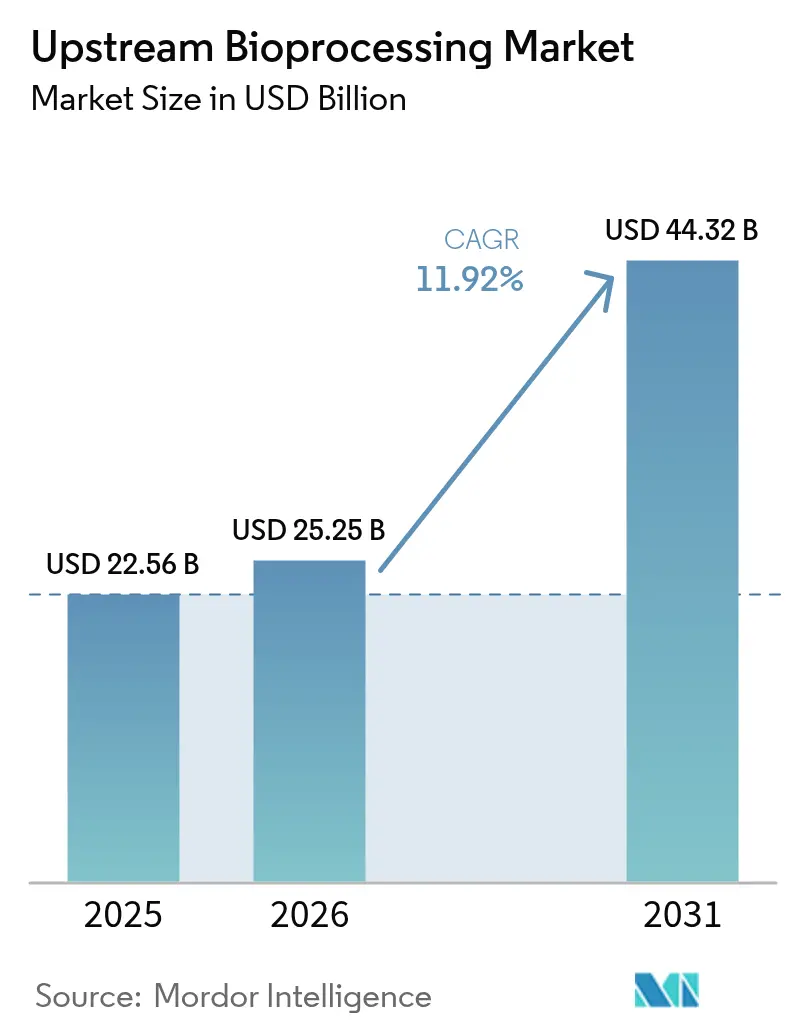
| Market Size (2026) | USD 25.25 Billion |
| Market Size (2031) | USD 44.32 Billion |
| Growth Rate (2026 - 2031) | 11.92 % |
| Fastest Growing Market | Asia Pacific |
| Largest Market | North America |
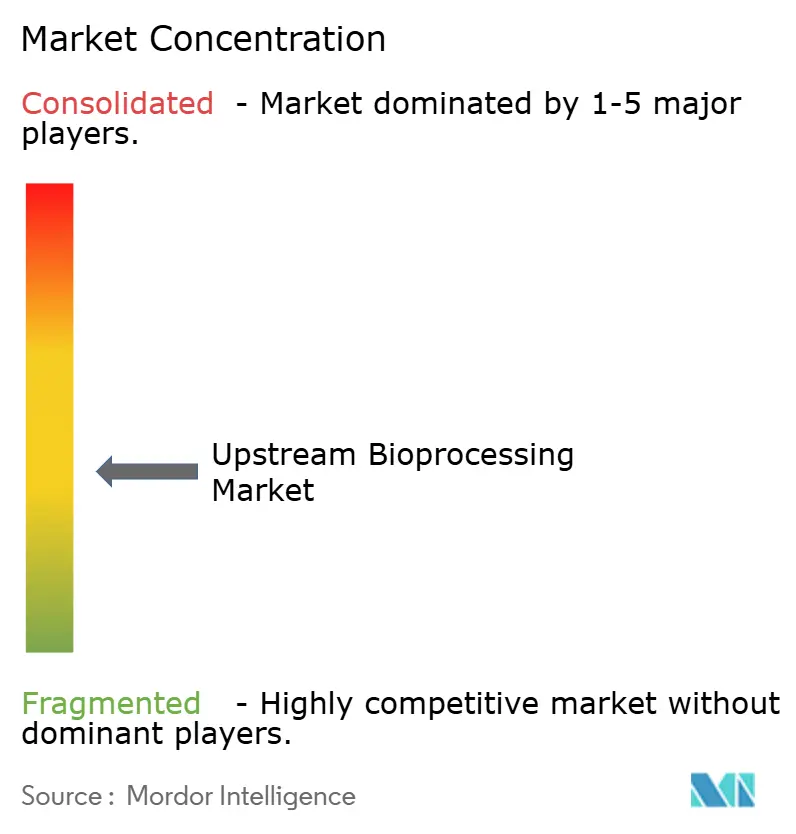
| Market Concentration | Medium |
Major Players *Disclaimer: Major Players sorted in no particular order Image © Mordor Intelligence. Reuse requires attribution under CC BY 4.0. | |
Upstream Bioprocessing Market Analysis by Mordor Intelligence
The upstream bioprocessing market size in 2026 is estimated at USD 25.25 billion, growing from 2025 value of USD 22.56 billion with 2031 projections showing USD 44.32 billion, growing at 11.92% CAGR over 2026-2031. Growth accelerates as manufacturers adopt flexible single-use platforms, high-intensity perfusion bioreactors and AI-enabled process controls that compress scale-up timelines while meeting stringent regulatory standards [1]Thermo Fisher Scientific, “Annual Report 2025,” thermofisher.com. Intensifying demand for cell and gene therapies, biosimilars and recombinant vaccines keeps capacity additions above the historical trend, and drives supplier investments in vertically integrated component supply chains. North America retains the largest regional footprint thanks to mature biopharmaceutical clusters and FDA guidance that expedites continuous manufacturing approval [2]U.S. Food and Drug Administration, “Framework for Advanced Manufacturing,” fda.gov , yet Asia-Pacific delivers the fastest output expansion as government incentives and lower operating costs catalyze new greenfield plants. Technology convergence between single-use hardware and advanced analytics reduces total cost of ownership, supporting broader uptake by small and mid-sized sponsors. Meanwhile, consolidation among leading vendors tightens control over critical filtration, media and sensor technologies, raising competitive barriers for late entrants.
Key Report Takeaways
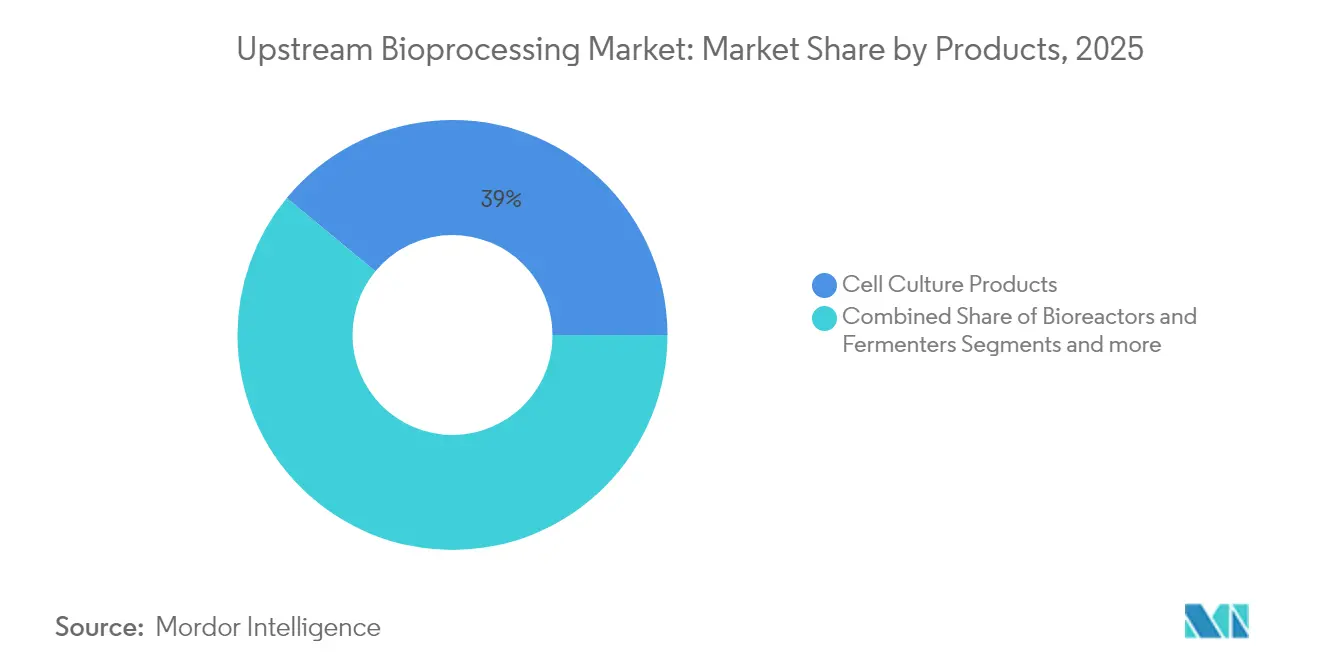
- By product, cell culture solutions held 39.01% of upstream bioprocessing market share in 2025 and bioreactors and fermenters are forecast to expand at a 12.52% CAGR through 2031.
- By usage type, single-use systems accounted for 62.55% of the upstream bioprocessing market size in 2025 while multi-use equipment records the highest projected CAGR at 12.66% to 2031.
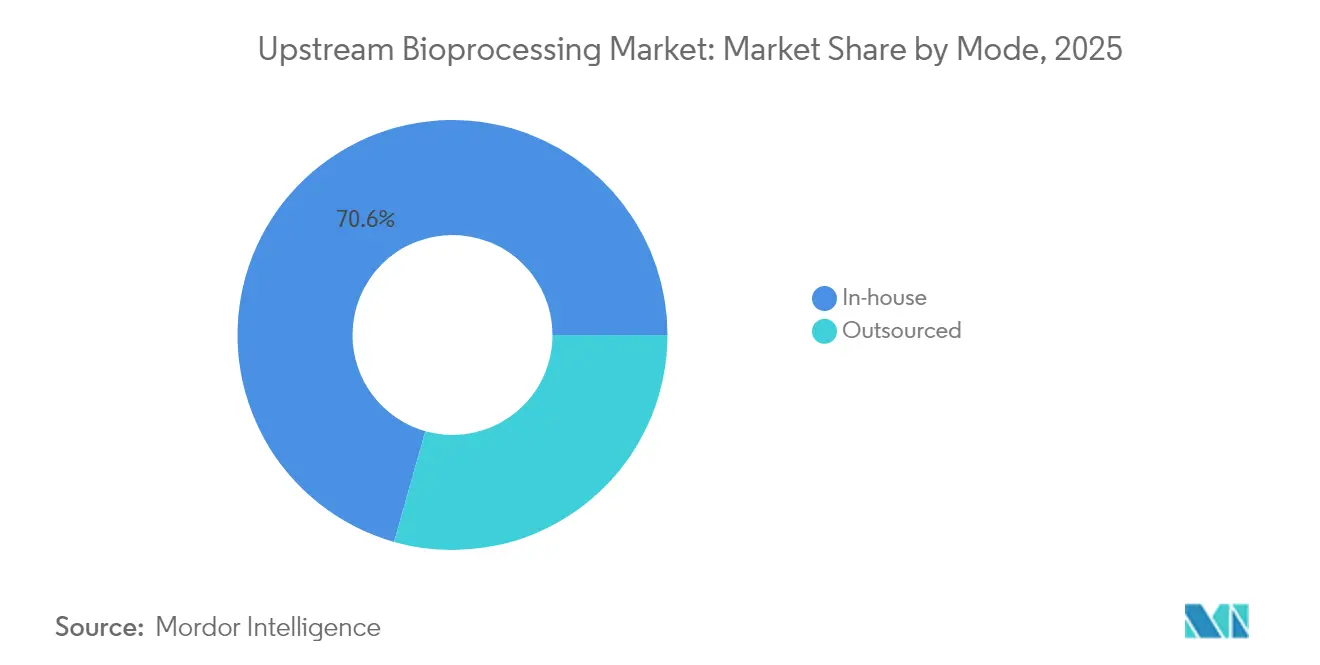
- By mode, in-house manufacturing commanded 70.62% share of the upstream bioprocessing market size in 2025, whereas outsourcing is expected to advance at a 12.61% CAGR during 2026-2031.
- By end user, contract development and manufacturing organizations captured 12.74% CAGR, the fastest of all segments, between 2026 and 2031.
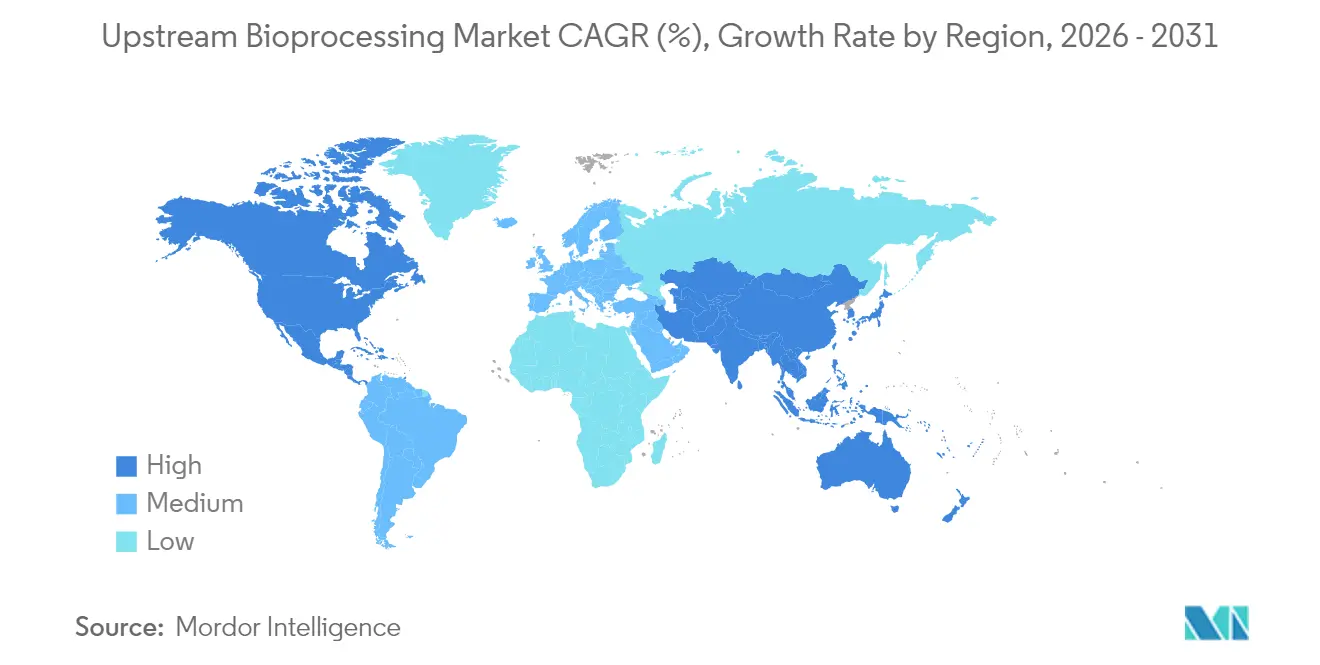
- By geography, North America generated 40.78% market revenue while Asia-Pacific captured 12.8% CAGR, the fastest of all segments, between 2026 and 2031.
Note: Market size and forecast figures in this report are generated using Mordor Intelligence’s proprietary estimation framework, updated with the latest available data and insights as of 2026.
Global Upstream Bioprocessing Market Trends and Insights
Drivers Impact Analysis*
| Driver | (~) % Impact on CAGR Forecast | Geographic Relevance | Impact Timeline |
|---|---|---|---|
| Rising adoption of single-use upstream bioprocessing | +2.1% | Global, with North America and Europe leading | Medium term (2-4 years) |
| Commercial success and rising demand for biotherapeutics | +1.8% | Global, concentrated in developed markets | Long term (≥ 4 years) |
| Emergence of high-intensity perfusion bioreactors | +1.2% | North America and Europe, expanding to APAC | Medium term (2-4 years) |
| Government push for domestic biomanufacturing capacity | +0.9% | US, Canada, UK, India and China | Long term (≥ 4 years) |
| Integration of continuous manufacturing workflows | +0.7% | North America and Europe, pilot projects in APAC | Long term (≥ 4 years) |
| AI-driven optimisation of cell-culture parameters | +0.6% | Global, early adoption in tech-forward plants | Medium term (2-4 years) |
| Source: Mordor Intelligence | |||
Rising Adoption of Single-Use Upstream Bioprocessing
Single-use technologies remove the cleaning validation burden linked to stainless-steel systems and let facilities pivot between molecule classes with minimal downtime. Production flexibility improves asset utilisation, yet 2024 resin shortages exposed supply bottlenecks that prompted hybrid facilities combining disposable and reusable assets. Vendor vertical integration and polymer diversification programs will ease pressure, but lead times of 18-24 months suggest continued tightness that rewards suppliers holding strategic inventory positions.
Commercial Success & Rising Demand for Biotherapeutics
Accelerated approvals for novel biologics and breakthrough designations shorten clinical-to-commercial transition windows, amplifying upstream capacity requirements. Emerging biotechs increasingly outsource to CDMOs because the capex burden of purpose-built plants is hard to justify for molecules with unproven market trajectories. Volume bifurcation is visible: blockbuster monoclonal antibodies demand scale efficiencies while niche advanced therapies need bespoke small-batch environments.
Emergence of High-Intensity Perfusion Bioreactors
Perfusion platforms sustain cell densities up to ten-fold higher than fed-batch reactors, slashing facility footprints and cutting cost of goods sold by as much as 60% for large-volume products. Implementation challenges include continuous media exchange, cell retention device fouling and sophisticated monitoring requirements. Early movers that have mastered perfusion report first-mover advantages in productivity metrics and faster lot release cycles.
Government Push for Domestic Biomanufacturing Capacity
National security agendas fund domestic vaccine and biologics infrastructure. The US committed USD 2 billion to expand local production suites and workforce programs, mirrored by similar initiatives in Canada, the UK, India and China. Contracts often stipulate local sourcing of critical consumables, advantaging vendors with regional manufacturing footprints.
Restraints Impact Analysis*
| Restraint | (~) % Impact on CAGR Forecast | Geographic Relevance | Impact Timeline |
|---|---|---|---|
| Operational challenges including shear stress and scalability | -1.4% | Global, affecting high-shear processes | Short term (≤ 2 years) |
| Supply-chain volatility for single-use plastics | -0.8% | Global, acute in regions relying on Asian suppliers | Short term (≤ 2 years) |
| Skilled labour shortages in bioprocess engineering | -0.6% | North America and Europe, emerging in APAC | Medium term (2-4 years) |
| Quality variability in novel cell lines | -0.4% | Global, concentrated in advanced therapy hubs | Medium term (2-4 years) |
| Source: Mordor Intelligence | |||
Operational Challenges Including Shear Stress and Scalability
Scale-up often alters hydrodynamic conditions that harm shear-sensitive cell lines, reducing viability and changing glycosylation profiles. Advanced impeller geometries and computational fluid dynamics modelling reduce turbulence, but they raise capital costs and extend qualification timelines. Perfusion configurations partly alleviate scale limitations, although they introduce extra filtration and control complexity.
Supply-Chain Volatility for Single-Use Plastics
Concentrated resin supply left many biotech firms with lead-time extensions during 2024, inflating consumable prices and delaying campaign starts. Diversification into regional polymer plants and recycled-content programs are underway, yet 18-24 months are needed before new capacity reaches commercial volumes, meaning near-term exposure persists for buyers without long-term supply contracts.
*Our forecasts treat driver/restraint impacts as directional, not additive. The impact forecasts reflect baseline growth, mix effects, and variable interactions.
Segment Analysis
By Product: Cell Culture Dominance Drives Innovation
Cell culture media, sera and growth factors held 39.01% upstream bioprocessing market share in 2025, reflecting their pivotal role in productivity optimisation. Media formulation advances, such as chemically defined feeds, stabilise metabolites and curb lot variability. Supplements tailored to CHO or HEK lines command premium pricing, supporting solid segment margins. The bioreactors and fermenters sub-segment expands at 12.52% CAGR as single-use formats and perfusion designs enable higher titres in smaller footprints. Adoption of modular control software lets operators refine agitation, gas-transfer and temperature profiles, enhancing reproducibility. Filters, probes and ancillary accessories rise in tandem because intensified processes mandate closed fluid paths and high-resolution monitoring to avoid contamination.
Stainless-steel vessels still dominate high-volume monoclonal antibody production where depreciation is spread across multi-decade asset lives, but new builds favour single-use or hybrid operations that shorten tech-transfer cycles and minimise downtime . Perfusion units recorded double-digit adoption growth during 2024-2025 as firms chased facility densification goals. Integrated depth-filtration skids streamline harvest clarification inside disposable flow-paths, aligning with quality-by-design objectives and cutting change-over labor hours.


By Usage Type: Single-Use Systems Reshape Manufacturing
Single-use assemblies secured 62.55% upstream bioprocessing market share in 2025 due to their ability to eliminate cross-contamination risk and accelerate campaign changeovers. Disposable flow-paths suit multi-product CDMO suites and early-stage programs where batch sizes are small and timelines compressed. Large-volume biologics retain multi-use infrastructure for economic reasons, so the multi-use category grows at 12.66% CAGR through 2031 as manufacturers retrofit existing plants with advanced sensing and automation. Hybrid facilities that mix steel bioreactors with single-use seed trains balance flexibility and operating cost constraints.
Environmental sustainability debates influence equipment strategy. Users deploying high-throughput monoclonal antibody lines adopt multi-use skid technologies that lower polymer waste generation, whereas viral-vector producers prefer disposable containment to prevent cross-viral contamination. Vendor innovation now targets recycling initiatives and lower-weight films to mitigate ecological concerns without compromising sterility or leachables profiles.
By Mode: Outsourcing Accelerates Amid Capacity Constraints
In-house lines retained 70.62% upstream bioprocessing market size in 2025, anchored by large pharma’s need for process sovereignty and intellectual-property protection. However, outsourced manufacturing logs the highest 12.61% CAGR as CDMOs scale multi-tenant campuses that pool analytical labs, viral-vector suites, and high-speed perfusion reactors. CDMO capacity utilisation climbed to 85-90% during 2024, granting providers pricing power and selection control over project pipelines. Sponsors, therefore, pursue hybrid supply chains—retaining flagship biologics internally while outsourcing surge demand or specialised cell therapy steps.
In-house operators intensify existing assets through high-density fed-batch retrofits and perfusion conversions to justify capital tied up in legacy stainless-steel plants. Workforce development is critical: shortages in bioprocess engineers and automation specialists elevate recruitment costs and prolong validation schedules. Collaborative training initiatives with academic institutions alleviate skill gaps but require sustained funding.
By End User: CDMOs Emerge as Growth Catalysts
Biopharmaceutical innovators consumed 59.76% of upstream bioprocessing equipment in 2025, yet CDMOs deliver the fastest 12.74% CAGR on the back of venture-backed biotech outsourcing patterns. Niche service providers specialise in autologous cell therapy, mRNA vaccines and viral-vector supply, capturing premium pricing for expertise and rapid turnaround. Academic and research institutes buy scaled-down bioreactors to train graduates and conduct early-stage process development, fostering a skilled workforce pipeline. Government laboratories remain a small but strategic purchaser cohort, prioritising biosafety and supply-chain resilience over throughput metrics.
CDMOs seeking differentiation add integrated analytical and regulatory consultancy offerings, positioning themselves as one-stop partners from pre-clinical through commercial launch. Client stickiness rises with each incremental service layer, locking in multi-year contracts and supporting steady revenue visibility amid volatile funding cycles in the biotech sector.
Geography Analysis
North America held 40.78% upstream bioprocessing market share in 2025 as dense biopharma clusters, venture capital availability and FDA regulatory clarity foster rapid technology uptake. Federal investments totaling USD 2 billion support new fill-finish suites, single-use bag manufacturing and localised supply chains. Canada’s pandemic-preparedness grants fund modular vaccine facilities, while Mexico attracts near-shoring biologics projects seeking lower operating costs without sacrificing US market proximity. Continuous-processing guidance from the FDA accelerates adoption of end-to-end manufacturing trains, giving domestic sites an efficiency edge.
Asia-Pacific’s 12.8% CAGR through 2031 marks the highest regional pace. China subsidises domestic perfusion bioreactor development and upstream consumable plants to lessen foreign reliance. India leverages its biosimilar leadership to win multi-national tech-transfer mandates, focusing on cost-per-gram optimisation. Japan and South Korea channel R&D funds into viral-vector and iPSC therapy platforms that need highly controlled small-volume bioreactors. Regional supply-chain diversification programs encourage local resin production, reducing exposure to overseas shipping delays and tariff risks.
Europe maintains moderate growth anchored by Germany, the United Kingdom and Switzerland. EU sustainability goals motivate adoption of continuous operations and low-energy facility designs, and the European Medicines Agency provides harmonised guidance for advanced therapy medicinal products. France, Italy and Spain house specialised contract manufacturers serving niche biologic segments. European suppliers position themselves as partners in digital transformation, integrating PAT sensors and AI analytics with disposable hardware to deliver incremental productivity gains.

Regulatory Landscape
Upstream bioprocessing equipment and consumables are qualified under biologics GMP expectations and increasingly referenced in international quality frameworks, tightening requirements around sterility assurance, contamination control, data integrity, and process validation for single-use and intensified operations. In the United States, the FDA published the Final Rule for the Medical Device Quality System Regulation (QMSR) in February 2024, incorporating ISO 13485:2016 by reference, which increases the importance of ISO-aligned quality management for suppliers of sensors, single-use assemblies, and other device-like components used across biomanufacturing workflows.
In Europe, the Medical Device Regulation (EU) 2017/745 (MDR) continues to shape documentation and conformity expectations for relevant equipment categories. Targeted EU actions in 2025-2026 focused on refining implementation and standards alignment. In June 2026, Commission Implementing Decision (EU) 2026/1231 updated references to harmonised standards affecting biological evaluation and related compliance pathways, while ISO standardization activity for advanced modalities continued in 2026 with projects such as ISO/DIS 23565 (equipment systems for cellular therapeutic products) and ISO/CD 20399-4 (certificates of analysis and origin for ancillary materials), reinforcing upstream traceability and documentation needs for cell and gene therapy manufacturing.
Competitive Landscape
The upstream bioprocessing market shows moderate consolidation as Thermo Fisher Scientific, Danaher Corporation and Sartorius AG leverage vertical integration to command filtration membranes, single-use bags, sensors and media formulations. Differentiation hinges on full-workflow portfolios rather than price competition, creating switching costs for clients embedded in proprietary automation architectures. Mid-tier players concentrate on specialised gaps such as perfusion cell-retention devices, AI-driven control software and custom media.
Thermo Fisher’s USD 4.1 billion purchase of Solventum’s purification unit in 2024 illustrated the imperative to secure critical downstream assets in order to offer truly end-to-end platforms. Sartorius expanded its Marlborough innovation centre, adding GMP suites to provide process-development through early-stage manufacturing services that embed its hardware into client pipelines. Danaher’s Cytiva division invested heavily in digital twins and process analytical technology, underscoring the shift toward data-driven manufacturing. White-space opportunities persist in emerging markets where cost-optimised single-use systems can displace legacy stainless-steel imports, and in advanced therapy niches where bespoke bioreactors and closed-cartridge harvest devices remain underserved.
Supply-chain resilience has become a strategic differentiator. Vendors with multiple resin and film factories across continents secure priority status in RFP evaluations. Companies that cross-license filtration media or co-develop sensors with analytics firms increase platform stickiness, ensuring multi-year consumable pull-through.
Upstream Bioprocessing Industry Leaders
Thermo Fisher Scientific Inc.
Corning, Inc
Merck KGaA
Sartorius AG
Danaher Corporation (Cytvia)
- *Disclaimer: Major Players sorted in no particular order

Market Opportunities and Future Outlook
Investment and capacity signals point to whitespace in high-productivity, flexible upstream platforms that shorten development cycles and support multi-modal portfolios. In 2026, major biomanufacturing announcements and milestones such as UCBs plan for a USD 2 billion biologics facility in Georgia, and WuXi Biologics completing a first GMP production campaign at its MFG17 drug substance facility in Shanghai (using single-use bioreactors and supporting fed-batch and perfusion approaches), reinforce demand for scalable single-use hardware, perfusion-ready consumables, and integrated process controls across both in-house and CDMO settings.
Opportunities also cluster around regionalization and modernization of drug substance networks, particularly where supply-chain resilience and local-for-local manufacturing programs are active. Evoniks July 2026 announcement of a USD 100 million modernization program at its Tippecanoe, Indiana site, including large-scale reactor upgrades, and Cytovances addition of perfusion capabilities to upstream process development in July 2026, suggest ongoing purchasing needs for intensified bioreactors, media/feed optimization, advanced sensors, and automation software that support faster tech transfer and consistent performance. Supplier differentiation increasingly depends on validated single-use supply security (films, resins, bags), documentation readiness for ancillary materials, and service layers that help sponsors execute perfusion and continuous upstream workflows without extending qualification timelines.
Recent Industry Developments
- March 2026: Sartorius launched a genetically engineered CHO host cell line designed using proteomic profiling and targeted genome editing, reporting up to three-fold higher productivity and culture durations up to 28 days. The release supports intensified upstream strategies such as perfusion and extended fed-batch by pairing cell line engineering with tighter process control requirements. It also raises the competitive bar for media, analytics, and bioreactor platforms that need to support higher cell densities and longer runs.
- December 2025: Thermo Fisher Scientific expanded its Asia biopharma ecosystem support by opening a new Bioprocess Design Center in Hyderabad, India, and expanding bioprocess design center capacity in Incheon, Korea, and Singapore. This increases regional process development and scale-up throughput for single-use and intensified upstream workflows, helping shorten tech-transfer timelines for local and multinational sponsors. The move also backs supply-chain localization strategies as Asia-Pacific manufacturing footprints expand.
- June 2024: Thermo Fisher Scientific introduced biobased solutions intended to reduce the climate impact of therapy manufacturing, including offerings relevant to bioprocess workflows. The development reflects increasing environmental considerations in single-use-heavy upstream operations, where material choices and waste profiles influence procurement decisions. It also encourages suppliers to differentiate through lower-impact consumables without compromising sterility and leachables performance.


Research Methodology Framework and Report Scope
Market Definition and Coverage
This market is defined as the tools, consumables, and related services used to grow and manage cells up to the point where the culture is ready for harvest in biomanufacturing. It covers upstream unit operations that help create the biological material used later for purification and finishing.
Scope exclusions: We exclude downstream purification and fill-finish activities, and we also exclude final drug distribution and clinical care delivery.
Segmentation Overview
- By Product
- Cell Culture Products
- Media
- Sera & Reagents
- Supplements & Growth Factors
- Bioreactors and Fermenters
- Stainless-steel Bioreactors
- Single-use Bioreactors
- Perfusion Bioreactors
- Filters
- Bioreactor Accessories
- Other Products
- Cell Culture Products
- By Usage Type
- Single-use
- Multi-use
- By Mode
- In-house
- Outsourced
- By End User
- Biopharmaceutical Companies
- Contract Manufacturing Organisations (CMOs/CDMOs)
- Academic & Research Institutes
- Others
- By Geography
- North America
- United States
- Canada
- Mexico
- Europe
- Germany
- United Kingdom
- France
- Italy
- Spain
- Rest of Europe
- Asia-Pacific
- China
- Japan
- India
- Australia
- South Korea
- Rest of Asia-Pacific
- Middle East and Africa
- GCC
- South Africa
- Rest of Middle East and Africa
- South America
- Brazil
- Argentina
- Rest of South America
- North America
Data Sources, Market Sizing, and Validation
Desk Research
Desk work starts with building a clean map of upstream process needs and how they translate into product demand and service spend. We reviewed public sources such as the US FDA databases and guidance, the EMA website, the WHO pipeline and manufacturing-related publications, and OECD health and innovation indicators to anchor definitions and adoption context.
To keep assumptions realistic, the model was further supported using company annual reports, earnings call transcripts, and investor presentations, alongside peer reviewed articles on cell culture, fermentation, and perfusion trends. In parallel, we used patent databases to track activity around single-use bioreactors, sensors, and media optimization, and we also checked import and export statistics where relevant for bioprocess inputs. The sources listed here are illustrative only, and many other public references were used for cross-checking and clarification during the study.
Primary Interviews and Surveys
Primary calls and structured questionnaires were used to confirm what is actually being purchased for upstream steps, how pricing is moving, and which products are being substituted (for example, single-use versus multi-use). We spoke with manufacturers, service providers, and end users across the Americas, EMEA, and APAC so that regional demand drivers and outsourcing patterns could be checked before finalizing assumptions.
Distribution of primary research fieldwork respondents
| Company type | Respondent position | Region |
|---|---|---|
| Top tier: 38% | CXOs: 16% | APAC: 43% |
| Mid tier: 46% | Functional/Unit leaders: 33% | EMEA: 35% |
| Smaller Players: 16% | Managers: 51% | Americas: 22% |
Market-Sizing & Forecasting
Market sizing was built using top-down logic that reconstructs demand from biomanufacturing activity indicators and upstream intensity, and then converts that demand pool into spend using category-level pricing. Once the first totals were formed, they were checked against selective bottom-up approximations such as sampled supplier revenue splits, channel feedback on volumes, and unit-level volume times ASP for common upstream items, which helped us adjust outliers.
Inputs used in the model include biologics and vaccine manufacturing expansion signals, single-use system penetration in upstream operations, typical batch and perfusion run rates, media and buffer consumption patterns per run, and replacement cycles for filters, sensors, and accessories. Where public data was thin, gaps were handled by using conservative ranges confirmed in interviews and then stress-tested across regions and end-use mixes. For forecasting, scenario analysis was applied around capacity additions, outsourcing share shifts, and price progression, and the final trajectory was kept aligned with what practitioners expect to be achievable over the forecast window.
Data Validation & Update Cycle
Validation is done through multiple checks so one single data point does not drive the result. We compare the model outputs with independent signals such as installed bioreactor capacity direction, biologics manufacturing announcements, and reported growth patterns for upstream consumables, and then anomalies are reviewed and corrected before sign-off.
Each report goes through analyst review steps where assumptions are rechecked, calculations are audited, and any large variances trigger follow-up with selected respondents. The dataset is refreshed annually, and interim updates are made when material events occur, followed by a final pre-release pass so the view stays current at the time of delivery.
Mordor Intelligence's Upstream Bioprocessing Market Size Compared With Other Published Estimates
Published market values for upstream bioprocessing can look different even when they appear to cover the same topic, because the scope boundary and the timing of the data used are not always aligned. Differences also show up when firms apply different pricing assumptions for consumables versus equipment, or when they treat services and outsourcing spend in different ways.
A refresh-led issue is common here because upstream pricing has moved unevenly across media, single-use assemblies, and hardware, and the currency timing used for converting regional revenues can shift the headline number. The consistency checks used to update ASP ladders and to revalidate demand signals right before finalizing the dataset are a key reason the 2026 value lands at USD 25.25 B in the Mordor Intelligence model, while other publications may reflect an earlier pricing environment or a broader revenue bundle.
Benchmark comparison
| Source | Market Size | Gaps in Research Methodology |
|---|---|---|
| Mordor Intelligence | USD 25.25 B (2026) | |
| Global Consultancy A | USD 26.55 B (2024) | Uses a different base year and growth window, and the earlier-year pricing and currency conversion timing can understate later ASP resets for consumables and single-use assemblies. |
| Industry Publisher B | USD 26.60 B (2024) | Defines the base year as 2024 and runs a long-dated projection, which can amplify assumptions on adoption and price escalation without the same near-term validation checks against updated manufacturing activity indicators. |
The table shows that year selection and refresh cadence are doing much of the work behind the spread, not only growth expectations. By tying the estimate to a clear upstream boundary and rechecking price and demand inputs at the end of the build, the output stays traceable to practical signals that can be reviewed and repeated.


Key Questions Answered in the Report
How fast is global upstream bioprocessing capacity growing?
Installed capacity expands at a 11.92% CAGR through 2031 as more firms adopt flexible single-use and perfusion technologies.
Which region will add the most new upstream suites through 2031?
Asia-Pacific posts the highest 12.8% growth as China, India and South Korea subsidise domestic biomanufacturing.
Why are single-use systems preferred for early-stage programs?
Disposable assemblies remove cleaning validation steps, cut changeover time and support rapid multi-product scheduling.
What drives CDMOs share gains in biologics production?
Emerging biotech firms outsource to CDMOs to avoid capex and to access specialised expertise in cell and gene therapy.
Which technology offers the greatest productivity uplift?
High-intensity perfusion bioreactors lift cell densities 5-10 fold, reducing facility footprints and cost of goods sold.
How are suppliers mitigating resin shortages?
Vendors invest in regional polymer plants and diversify material sourcing, though new capacity takes up to two years to come on-line.
Page last updated on:


 Your data is secure and never sold or shared.


