
Market Overview
| Study Period | 2021 - 2031 |
|---|---|
| Forecast Data Period | 2026 - 2031 |
| Historical Data Period | 2021 - 2024 |
| Market Size (2026) | USD 123.48 Billion |
| Market Size (2031) | USD 140.32 Billion |
| Growth Rate (2026 - 2031) | 2.59 % |
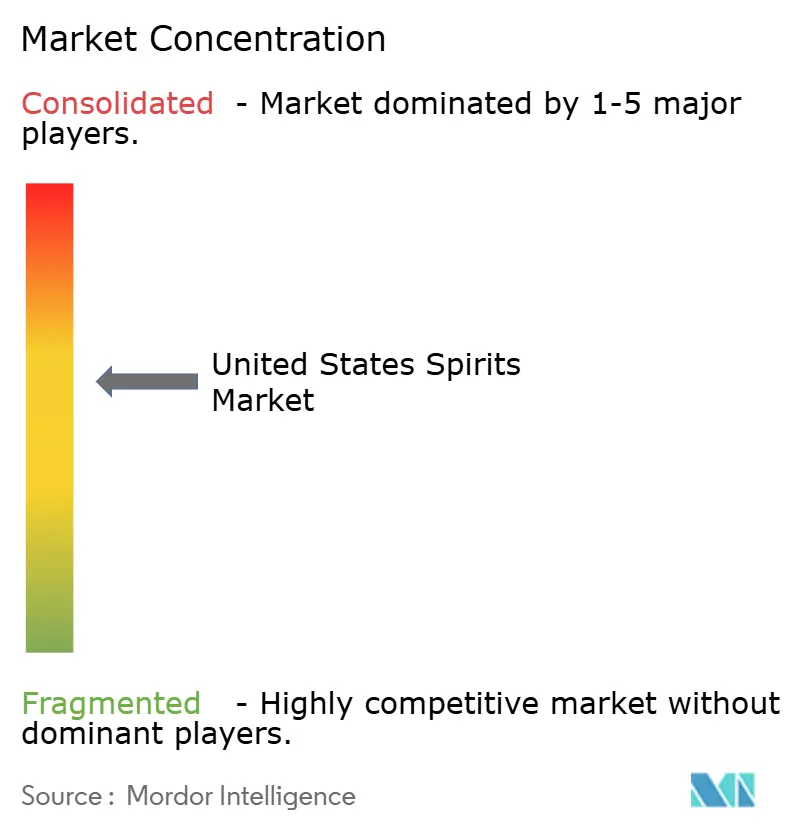
| Market Concentration | Medium |
Major Players *Disclaimer: Major Players sorted in no particular order Image © Mordor Intelligence. Reuse requires attribution under CC BY 4.0. | |
United States Spirits Market Analysis by Mordor Intelligence
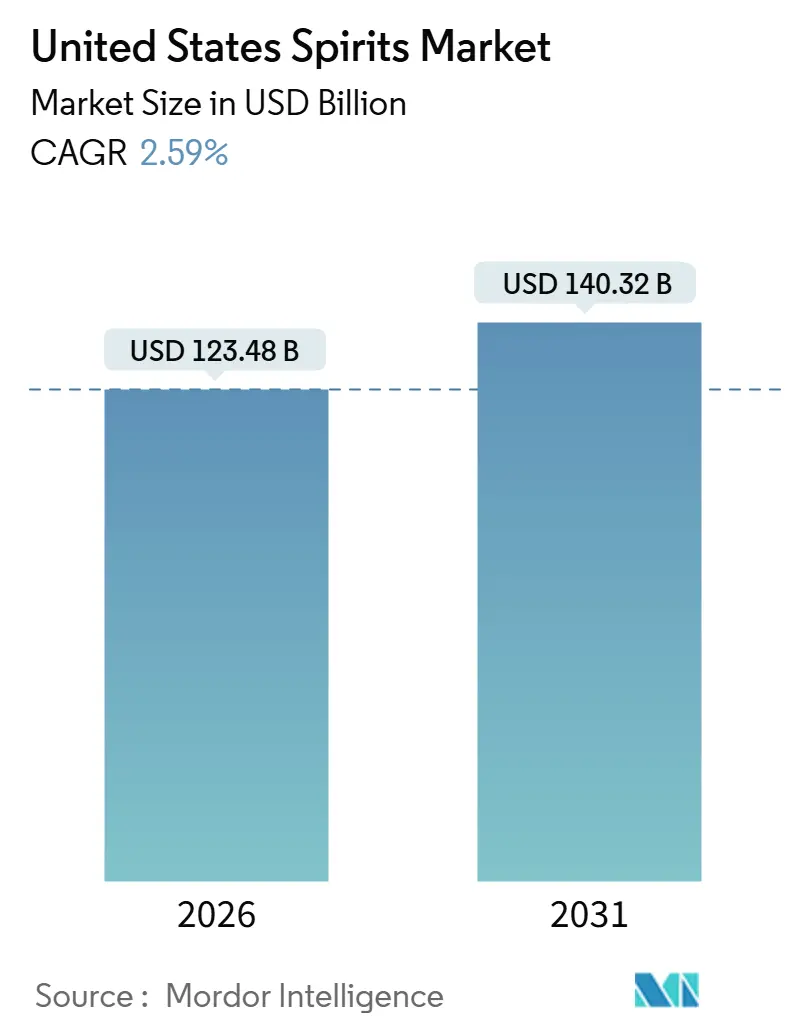
The United States spirits market size reached USD 123.48 billion in 2026 and is forecast to climb to USD 140.32 billion by 2031, advancing at a 2.59% CAGR during the period. Premiumization is driving value growth as consumers reduce their drinking frequency yet willingly pay more for super-premium and ultra-premium tiers, allowing supplier revenue to rise even as total case volumes soften. Craft authenticity, once the growth engine, now competes with broader quality cues such as age statements, provenance, and sustainability claims that resonate with urban, high-income buyers. Federal excise incentives under the Craft Beverage Modernization Act continue to support small producers, but declining craft case sales indicate that tax relief alone cannot fully offset distribution frictions and shelf crowding. Channel diversification introduces another layer of change, as direct-to-consumer (DTC) shipping in 18 states opens up options for niche labels, but leaves producers in restrictive states bound to the traditional three-tier system.
Key Report Takeaways
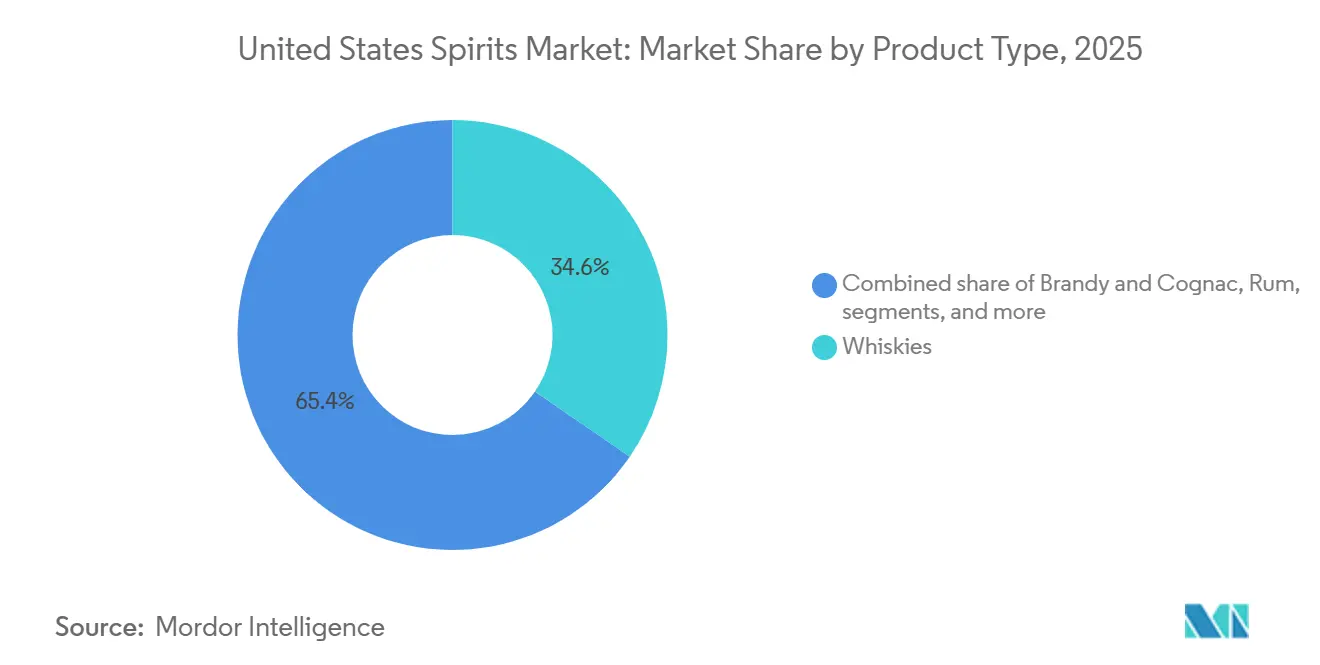
- By product type, whiskies led with 34.58% of the United States spirits market share in 2025, while white spirits are projected to post the quickest 3.03% CAGR through 2031.
- By end user, men commanded 74.61% share of the United States spirits market in 2025, and women represent the fastest-growing cohort at a 3.46% CAGR through 2031.
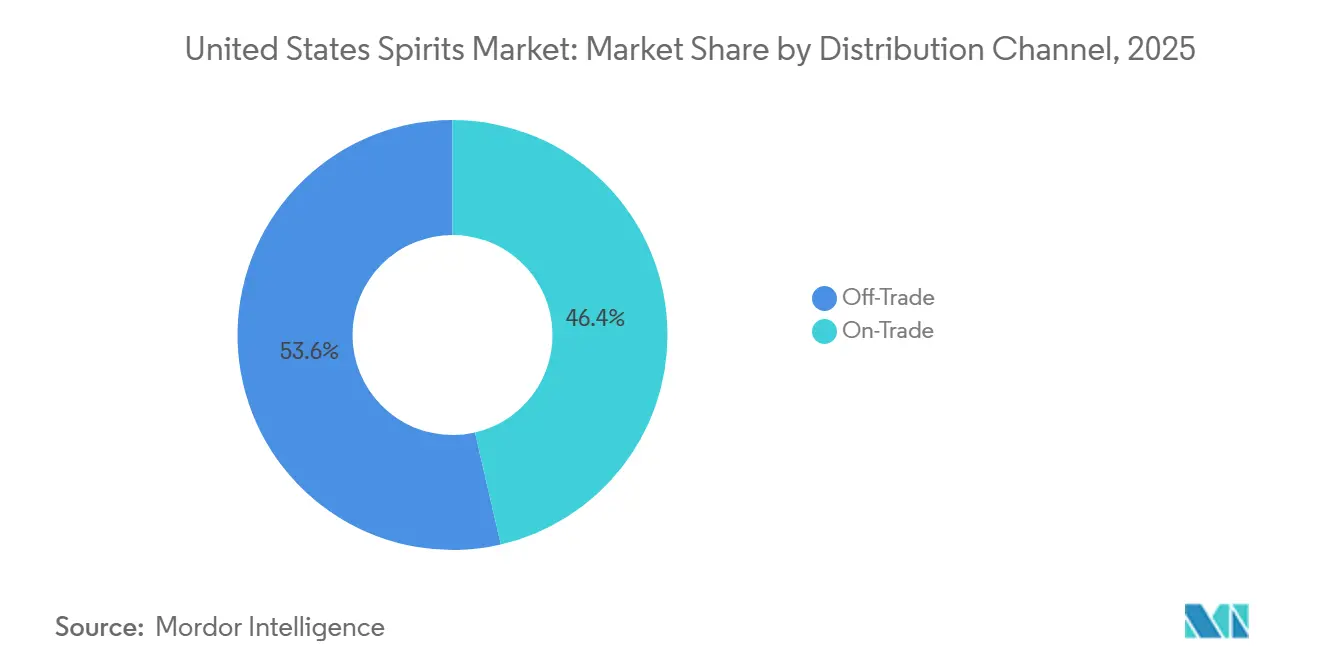
- By distribution channel, the off-trade segment held a 53.61% share of the United States spirits market in 2025; the on-trade channel is expected to expand at a 2.86% CAGR through 2031.
- By geography, the South captured a 34.59% share of the United States spirits market in 2025, whereas the West is forecast to grow the fastest at 3.87% through 2031.
Note: Market size and forecast figures in this report are generated using Mordor Intelligence’s proprietary estimation framework, updated with the latest available data and insights as of January 2026.
United States Spirits Market Trends and Insights
Drivers Impact Analysis*
| Driver | (~) % Impact on CAGR Forecast | Geographic Relevance | Impact Timeline |
|---|---|---|---|
| Growing tourism and hospitality sector | +0.80% | South, West, Northeast | Medium term (2-4 years) |
| Consumers' inclination towards craft spirits | +0.60% | National, with concentration in West and Northeast | Medium term (2-4 years) |
| Surge in demand for premium alcoholic products | +0.50% | National | Long term (≥ 4 years) |
| Product differentiation in terms of raw material and alcohol content | +0.40% | National | Medium term (2-4 years) |
| Sustainability and ethical sourcing | +0.30% | West, Northeast | Long term (≥ 4 years) |
| Strategic expansion by pubs and bars | +0.30% | South, West | Short term (≤ 2 years) |
| Source: Mordor Intelligence | |||
Growing tourism and hospitality sector
Tourism-driven spirits consumption is on the rise as both international arrivals and domestic leisure travel recover from pandemic-related lows. According to the U.S. Travel Association, domestic leisure travel spending in 2024 surpassed pre-2020 levels, with Nevada and Florida capturing a particularly large share of hospitality revenue[1]. Distillery tourism, especially in Kentucky, Tennessee, and California, generates additional income through tasting-room sales, which avoid traditional distribution markups. In California, craft distilleries welcomed over 1 million visitors in 2024, with average tasting-room purchases of USD 75 per visitor, a margin structure that allows smaller producers to thrive despite challenges in competing on wholesale pricing, according to the American Craft Spirits Association[2]. Hotels and resorts are increasingly curating spirits menus that highlight local products, a trend that boosts regional brands and creates geographic advantages around production hubs. This effect is most pronounced in the West and South, where tourism infrastructure and favorable tasting-room regulations converge.
Consumers inclination towards craft spirits
The U.S. craft distillery sector reached 2,282 producers in 2024, yet case sales dropped to 12.7 million from earlier peaks, signaling that growth in production has outpaced consumer demand, according to the American Craft Spirits Association. This imbalance is largely driven by oversupply in crowded categories, such as vodka and gin, where differentiation at retail is challenging. Leading craft brands are shifting focus to grain-to-glass narratives that showcase local sourcing, heritage mash bills, and transparent production methods. The Craft Beverage Modernization Act provides a cost advantage through reduced federal excise taxes for producers with annual production of less than 100,000 proof gallons, but distribution remains the key bottleneck. Craft spirits thrive in states with strong locavore cultures, such as Oregon, Colorado, and New York, where retailers prioritize regional brands on their shelves. Ultimately, the sector’s long-term success will depend on whether distillers can scale distribution without compromising the artisanal positioning that justifies premium pricing.
Surge in demand for premium alcoholic products
The United States spirits market is witnessing a notable shift toward premiumization, as consumers increasingly favor high-quality products despite economic challenges. According to Diageo's interim report for FY 2025, the premium and super-premium categories have grown significantly, now accounting for nearly 35% of the market value, compared to 26% a decade ago. This trend is particularly pronounced among consumers aged 18-34, with 54% actively choosing premium spirits. Even during economic downturns, consumers demonstrate a clear preference for premium products by reducing consumption frequency rather than compromising on quality. This behavior underscores the importance of brands effectively communicating their superior quality and authentic brand narratives to capture market share. The shift toward premium offerings, despite declining overall volumes, highlights a structural change in the spirits industry, transitioning from a volume-driven approach to a value-focused consumption model. Additionally, this trend aligns with broader consumer preferences for premiumization across other beverage categories, further reinforcing the long-term potential for growth in the premium spirits segment.
Product diffrentiation in terms of raw material and alcohol content
Distillers are exploring heritage grains, alternative aging vessels, and unique botanicals to stand out in crowded categories. Bourbon producers are offering single-barrel and cask-strength expressions that command prices exceeding USD 100, while gin makers are highlighting regional botanicals, such as California citrus or Pacific Northwest juniper, to convey a sense of terroir. Lower-ABV spirits, typically 20–30% alcohol by volume, are gaining popularity among health-conscious consumers seeking moderation without full abstinence. In 2024, Pernod Ricard’s Absolut Vodka introduced a 20% ABV line designed for occasions where standard-strength spirits may be perceived as too strong. Flavored whiskeys and spiced rums continue to draw entry-level consumers, though premiumization is steering innovation toward subtle, complex flavor profiles rather than overt sweetness. Compliance with Alcohol and Tobacco Tax and Trade Bureau (TTB) labeling standards ensures ingredient claims are verifiable, which discourages exaggerated marketing but can pose challenges for smaller producers lacking regulatory expertise.
Restraints Impact Analysis*
| Restraint | (~) % Impact on CAGR Forecast | Geographic Relevance | Impact Timeline |
|---|---|---|---|
| Stringent government regulations | -0.30% | National, with particular impact in Control States | Long term (≥ 4 years) |
| Rising consumer inclination towards other alcoholic beverages | -0.20% | National | Medium term (2-4 years) |
| Health issues over excessive consumption | -0.10% | National | Long term (≥ 4 years) |
| Supply chain disruptions | -0.10% | National, with heightened impact in import-dependent categories | Short term (≤ 2 years) |
| Source: Mordor Intelligence | |||
Stringent government regulations
The three-tier distribution system, required in most states, creates structural inefficiencies that limit market access for emerging brands. Producers must sell through wholesalers, who then supply retailers, with each tier taking a margin and controlling inventory flow. Direct-to-consumer shipping, legal in 18 states as of 2025, provides an alternative, but inconsistent regulations across jurisdictions complicate compliance, according to the Distilled Spirits Council[3]. The Alcohol and Tobacco Tax and Trade Bureau’s Certificate of Label Approval process mandates detailed ingredient disclosure and formula approval, ensuring product safety but delaying launches by 6–8 weeks. State-level taxes on spirits vary significantly: Washington imposes combined excise and sales taxes exceeding 35%, while Missouri applies minimal levies. These disparities distort pricing and competitive dynamics, placing producers in high-tax states at a disadvantage. Regulatory oversight from the TTB and state alcohol control boards will continue to create friction, especially as health advocacy groups push for stricter labeling and advertising rules.
Rising consumer inclination towards other alcoholic beverages
Rising health consciousness regarding alcohol consumption is significantly influencing consumer behavior and market dynamics. The US Surgeon General's Advisory on Alcohol and Cancer Risk identifies alcohol as a major preventable cause of cancer, resulting in approximately 100,000 cancer cases and 20,000 deaths annually in the US[4]. The advisory emphasizes that cancer risk increases even with minimal alcohol consumption, fundamentally challenging long-held beliefs about the benefits of moderate drinking. According to the National Institute on Alcohol Abuse and Alcoholism, alcohol contributes to approximately 178,000 deaths annually and is linked to more than 200 distinct health conditions. With less than half of Americans currently understanding the connection between alcohol and cancer, intensifying public health awareness campaigns about these risks are accelerating consumer shifts toward lower-alcohol and non-alcoholic alternatives, potentially constraining growth in traditional spirits markets.
*Our forecasts treat driver/restraint impacts as directional, not additive. The impact forecasts reflect baseline growth, mix effects, and variable interactions.
Segment Analysis
By Product Type: Whiskies Lead Despite Supply Challenges
Whiskies accounted for 34.58% of the market in 2025, fueled by bourbon’s cultural cachet and the premiumization of Scotch and Irish imports. White spirits are projected to grow at a rate of 3.03% annually from 2026 to 2031, the fastest among categories, as vodka and gin drive the ready-to-drink cocktail market and appeal to consumers seeking lower-calorie options. Tequila and mezcal are seeing strong demand, supported by celebrity endorsements and the premiumization of reposado and añejo expressions. Rum faces headwinds due to declining traditional dark rum consumption, though spiced and flavored variants continue to attract younger drinkers. Brandy and cognac remain niche, concentrated in high-income segments and Asian-American communities where cognac carries cultural significance. Liqueurs remain stable, primarily serving as cocktail modifiers rather than standalone beverages.
Regulatory frameworks reinforce market dynamics. The Alcohol and Tobacco Tax and Trade Bureau (TTB) mandates that bourbon be produced in the United States and aged in new charred oak barrels, creating a protective moat for domestic producers. Tequila’s Denomination of Origin restricts production to select Mexican states, limiting supply flexibility and contributing to price volatility. The growth of white spirits is further driven by innovation in ready-to-drink formats, with Diageo, Pernod Ricard, and Bacardi launching canned vodka sodas and gin tonics to capture convenience-focused occasions. Whiskey’s market dominance reflects decades of brand equity and established distribution infrastructure, though its slower growth signals category maturation. Across the industry, traditional product boundaries are blurring as hybrid offerings, such as whiskey-based RTDs and flavored vodkas, fragment segmentation and redefine consumer choices.

By End User: Female Consumers Reshape Market Dynamics
Male consumers accounted for 74.61% of spirits demand in 2025, reflecting historical marketing and cultural associations that have positioned spirits as a masculine category. Female consumption, however, is growing at an annual rate of 3.46% through 2031, outpacing the overall market as brands develop products and messaging tailored to women. Flavored vodkas, botanical gins, and lower-ABV spirits resonate with female consumers who prioritize taste and moderation over alcohol strength. Ready-to-drink cocktails, especially those emphasizing convenience and portion control, are capturing share among women who view spirits as occasional indulgences rather than habitual purchases. The gender gap is narrowing most rapidly in urban areas and among younger cohorts, where traditional consumption norms are undergoing a shift.
Brands are adapting accordingly. Pernod Ricard’s Absolut Vodka and Diageo’s Tanqueray Gin have launched campaigns featuring female brand ambassadors and highlighting the versatility of cocktails, marking a strategic pivot from the spirit-forward messaging that has historically been aimed at men. End-user segmentation is increasingly nuanced, with non-binary and gender-fluid identities prompting some brands to adopt gender-neutral positioning. Male consumption remains concentrated in whiskey, rum, and tequila, while female preferences skew toward vodka, gin, and liqueurs. The 3.46% growth rate among female consumers indicates that closing the gender gap will be a multi-decade endeavor, dependent on sustained marketing efforts and product innovation aligned with female preferences.
By Distribution Channel: Experiential Retail Drives On-Trade Growth
Off-trade channels captured 53.61% of the market in 2025, reflecting the convenience and cost advantages of purchasing spirits for home consumption. On-trade channels are projected to grow at a rate of 2.86% annually from 2026 to 2031, as experiential dining and craft cocktail culture recover from pandemic disruptions. Specialty liquor stores within the off-trade segment provide curated selections and knowledgeable staff, serving as discovery points for premium and craft brands. Other off-trade outlets, including supermarkets and convenience stores, focus on high-velocity mainstream brands, limiting shelf space for emerging producers. Direct-to-consumer shipping, legal in 18 states, is expanding off-trade access for distillers who can bypass wholesaler margins, though regulatory complexity constrains widespread adoption.
Full-service restaurant beverage sales grew faster than food in 2024, according to the National Restaurant Association, signaling a recovery in on-premise spirits consumption[5]. Craft cocktail bars and upscale restaurants function as brand-building venues, with bartender recommendations driving trial and subsequent off-premise purchases. While on-trade channels support premium positioning through higher per-serving prices, volume is constrained by dining frequency. Off-trade growth is fueled by at-home entertaining and the proliferation of ready-to-drink cocktails that replicate bar-quality experiences. Distribution channel segmentation is evolving as e-commerce and direct-to-consumer models challenge the three-tier system’s dominance, though regulatory barriers remain significant in most states.
Geography Analysis
The South accounted for 34.59% of the U.S. spirits market in 2025, primarily driven by the large populations of Texas and Florida, as well as permissive alcohol regulations that facilitate broad retail availability. The West is projected to grow at 3.87% annually from 2026 to 2031, the fastest regional rate, driven by California’s distillery tourism infrastructure, Nevada’s hospitality sector, and the Pacific Northwest’s craft spirits culture. In California, 1 million distillery visitors in 2024 generated tasting-room revenues that support smaller producers, who are unable to compete on wholesale pricing, according to the American Craft Spirits Association. Nevada’s casino and resort sector is rebounding with international tourism, yielding some of the highest per-capita spirits consumption in the nation. Texas benefits from population growth and favorable tax policies, while Florida’s tourism economy and retiree population sustain steady demand.
The Northeast and Midwest exhibit slower growth, constrained by mature markets and restrictive distribution frameworks in states like Pennsylvania and Ohio, where state-controlled liquor stores limit retail competition. New York’s craft distillery scene is vibrant, yet complex licensing and distribution rules hinder scaling beyond local markets. In the Midwest, consumption is concentrated in urban centers such as Chicago and Minneapolis, with rural areas showing lower per-capita demand. Strict pricing and promotion rules enforced by state alcohol control boards in the Northeast reduce competitive intensity, limiting innovation compared to less-regulated regions.
Western growth is further supported by demographic trends, including migration from higher-cost Northeastern and Midwestern states to Western metros with expanding tech and service sectors. The region’s younger population aligns with premiumization and craft spirits trends, while environmental consciousness drives demand for sustainably produced brands. The South’s market dominance is structural, rooted in population size and cultural norms that favor spirits over wine. The Midwest and Northeast face headwinds from aging populations and economic stagnation in legacy industrial cities, though growth persists in college towns and revitalized urban cores. Overall, geographic performance is increasingly determined by local regulatory environments, distribution infrastructure, and demographic composition rather than regional identity alone.
Regulatory Landscape
The United States spirits market is governed by the Federal Alcohol Administration (FAA) Act, with the Alcohol and Tobacco Tax and Trade Bureau (TTB) overseeing federal permitting, formulas, labeling, and advertising compliance. The Certificate of Label Approval (COLA) workflow can extend new-product timelines, and a federal packaging update took effect on January 10, 2025 (TTB T.D. TTB-200). The update added 15 new authorized standards of fill for distilled spirits containers and removed the prior distinction between cans and other container types, expanding compliant pack-size options for off-trade and convenience-led occasions.
Beyond federal compliance, state alcohol control boards shape route-to-market economics through the three-tier distribution framework, state-by-state tax differentials, and varying direct-to-consumer (DTC) shipping rules (legal in 18 states as of 2025 per DISCUS). Trade policy remains a material regulatory variable for suppliers with import and export exposure. In 2026, DISCUS submitted testimony to the Office of the USTR in the Section 301 investigations (USTR-2026-0067/0068), seeking to prevent retaliatory tariffs from sweeping in distilled spirits and disrupting category pricing and cross-border supply flows.
Value Chain Analysis
The U.S. spirits value chain starts with agricultural inputs (grains, agave for tequila/mezcal imports, botanicals, and molasses), moves through processing and aging materials (notably new charred oak barrels for bourbon), and includes packaging components such as glass, closures, and labels. Downstream activities cover distillation, maturation, blending, bottling, and compliance workstreams like formulas and COLAs administered by the TTB.
Brand owners span global suppliers (Diageo, Bacardi, Suntory, Sazerac, Pernod Ricard) and a large craft base. The American Craft Spirits Association reported 2,282 craft producers in 2024, with 12.7 million 9L cases and USD 7.6 billion in sales, which points to a sizable long tail with constrained scale economics. Go-to-market remains centered on the three-tier system, where producers and importers sell to wholesalers, who then supply retailers and on-trade accounts, concentrating leverage in distribution. The top two distributors (Southern Glazer's and RNDC) are estimated to control about 53% of the market, and the top 10 about 81.5%, so wholesaler access, portfolio priority, and in-market execution become key bottlenecks for smaller brands. Trade frictions also show up at the importer/exporter interface, with DISCUS flagging export pressure in 2025 (including a 9% decline in Q2 2025 versus Q2 2024). This supports the need for resilient sourcing, diversified channel strategies (including DTC where permitted), and disciplined inventory allocation across high-velocity off-trade and premium-led on-trade placements.
Competitive Landscape
The U.S. spirits market exhibits moderate consolidation, with Diageo, Bacardi, Suntory, Sazerac, and Pernod Ricard dominating, alongside a fragmented segment comprising craft distillers and regional brands. These major players leverage decades of established distribution networks and strong relationships with wholesalers to secure shelf space and on-premise placements. Their strategies increasingly emphasize premiumization, with many divesting mainstream brands to focus on super-premium and ultra-premium tiers that deliver higher margins. Diageo’s fiscal 2025 results highlighted portfolio optimization toward premium and above segments, a strategy mirrored by Pernod Ricard and Bacardi.
White-space opportunities exist in ready-to-drink cocktails, low-ABV spirits, and sustainably produced brands, where consumer demand outpaces incumbent innovation. Emerging disruptors include celebrity-backed tequila brands and craft distillers utilizing direct-to-consumer models that bypass traditional distribution channels. Technology adoption is reshaping competitive dynamics. Suppliers are deploying data analytics to optimize pricing, promotions, and inventory allocation, with Diageo’s use of artificial intelligence for demand forecasting and personalized marketing creating a capability gap smaller producers cannot easily replicate.
Patent filings for novel distillation and aging techniques are rare, as trade secrets provide stronger protection than public disclosure. The Alcohol and Tobacco Tax and Trade Bureau’s formula approval process creates a regulatory moat favoring established players with compliance expertise, while also ensuring product safety and label accuracy. Competitive intensity is highest in the standard-tier segment, where price competition compresses margins, whereas premium tiers offer room for differentiation. The market’s fragmented tail of craft distillers faces consolidation pressure as distribution challenges and capital constraints drive exits or acquisitions.
United States Spirits Industry Leaders
-
Diageo plc
-
Bacardi Limited
-
Suntory Holdings Limited
-
Sazerac Company Inc.
-
Pernod Ricard SA
- *Disclaimer: Major Players sorted in no particular order
Market Opportunities and Future Outlook
Capacity and network upgrades are creating whitespace for suppliers that can improve service levels while supporting premium mix and compliance-heavy innovation. In April 2026, the market saw the opening of a USD 415 million manufacturing and warehousing facility in Montgomery, Alabama by Diageo, featuring electric boilers and automated guided vehicles. This development reflects a shift toward more agile, regionalized production and logistics footprints, which can shorten replenishment cycles and support differentiated pack and portfolio strategies across off-trade and on-trade. In June 2026, Willett started whiskey production at its new Springfield, Kentucky facility following a USD 93 million build.
Route-to-market and the regulatory structure also define where suppliers can act first. With DTC shipping allowed in 18 states as of 2025, niche and premium brands have an additional path to reach consumers where state rules permit, particularly when traditional wholesaler prioritization is constrained by shelf crowding. On the product side, whitespace concentrates in premium-led differentiation (age statements, provenance, sustainability claims) and in adjacent formats for spirits occasions, while spirit-based RTDs are excluded from this report scope. That constraint pushes suppliers to focus on core-spirit innovation that can pass TTB labeling and standards requirements, including the federal standard for American Single Malt that became effective on January 19, 2025. Policy advocacy on trade access and tariffs continues to shape cross-border economics and influences portfolio choices for both domestic producers and importers.
Recent Industry Developments
- July 2026: Sazerac expanded its distribution partnership with Reyes Beverage Group to include Colorado, extending a multistate route-to-market relationship. The expansion reflects ongoing realignment in US wholesaling following distributor asset deals and increases the weight of distributor footprint for brand execution across control and license states.
- April 2026: Diageo opened a USD 415 million manufacturing and warehousing facility in Montgomery, Alabama (Diageo Montgomery), featuring technology such as electric boilers and automated guided vehicles. The facility highlights a shift toward more agile, regionalized production and logistics footprints that shorten replenishment cycles and enable differentiated pack and portfolio strategies across off-trade and on-trade.
- May 2025: Maker's Mark launched Star Hill Farm Whisky, its first non-bourbon wheat whisky in more than 70 years, made with estate-grown wheat and certified under the University of Kentucky's Estate Whiskey program. The release reinforces premium differentiation through provenance and controlled sourcing, while extending the brand's whiskey credentials beyond bourbon.
Research Methodology Framework and Report Scope
Market Definition and Coverage
For this report, the market is the annual value of distilled spirits sold within the United States across on-trade and off-trade channels, covering standard bottled spirits categories that are bought for consumption by adults.
Scope exclusions: We exclude beer, wine, hard seltzer, alcohol-free spirit alternatives, and spirit-based RTD cocktails because their alcohol thresholds, tax treatment, and price structures differ from core spirits.
Segmentation Overview
- By Product Type
- Brandy and Cognac
- Liqueur
- Rum
- Tequila and Mezcal
- Whiskies
- White Spirits
- Other Spirit Types
- By End User
- Men
- Women
- By Distribution Channel
- On-Trade
- Off-Trade
- Specialty/Liquor Stores
- Others Off Trade Channels
- By Region
- Northeast
- Midwest
- South
- West
Data Sources, Market Sizing, and Validation
Desk Research
Desk work started with public, auditable data that anchors the demand pool and pricing context for spirits in the United States. Sources reviewed included releases from the Alcohol and Tobacco Tax and Trade Bureau, label information, US Census Bureau and Bureau of Economic Analysis series for consumption and income, and US International Trade Commission trade statistics to understand import and export direction.
We also leaned on association publications such as the Distilled Spirits Council of the United States, along with company 10-Ks, investor presentations, earnings call transcripts, and reputed press coverage to map category shifts and channel momentum. Where coverage was fragmented, paid subscriptions for company financials and news intelligence, as well as patent databases and an import-export shipment-level database, were used mainly to validate player activity and pricing moves rather than directly sizing totals. The sources listed are illustrative only, and many additional public references were used to collect data, cross-check it, and clarify gaps.
Primary Interviews and Surveys
Primary calls and surveys were completed with a mix of distillers, brand owners, distributors, on-trade buyers, and retail category managers so the assumptions could be pressure-tested from more than one angle. Since this is a single-country market, outreach was spread across major consumption states and control-state environments, then the discussion was widened to cover price tier shifts, promo intensity, and how depletions compare with shipments behavior.
Distribution of primary research fieldwork respondents
| Company type | Respondent position |
|---|---|
| Top tier: 31% | CXOs: 17% |
| Mid tier: 47% | Functional/Unit leaders: 34% |
| Smaller Players: 22% | Managers: 49% |
Market-Sizing & Forecasting
Sizing begins with a top-down build where production and trade data are used to reconstruct the available spirits pool, which is then translated into value using category-wise price bands and channel mix. To keep the outcome realistic, selective bottom-up approximations were used as checks, including sampled price per 9-liter case equivalents, supplier roll-ups where public disclosures exist, and channel checks on the on-trade versus off-trade split.
Key inputs that shaped the model included supplier sales and volume signals (9-liter cases), category mix shifts (for example, tequila and American whiskey momentum), premiumization indicators in retail and bar menus, on-premise traffic normalization, and the pattern of distributor inventory resets that can temporarily distort shipments. Forecasts were generated using scenario analysis, where the base case demand is tied to macro indicators and category-level momentum, then adjusted based on what interviewees expect for pricing, promotions, and on-trade recovery. When a data gap appeared for smaller brands, it was handled through category share proxies and conservative price band mapping, and totals were rechecked after the adjustment.
Data Validation & Update Cycle
Outputs are validated through cross-checks that compare the model against independent signals, including association supplier sales, trade and customs directionality, and visible price movement in major channels. If an assumption creates an unusual jump in value or volume, it is flagged, reviewed, and corrected after a second analyst pass, and follow-up expert calls are triggered when the variance cannot be explained by seasonality or one-time stocking.
The report is refreshed on an annual cycle, and interim updates are done when material events change pricing or availability, such as tax changes, major category disruptions, or sharp shifts in on-trade demand. Before delivery, a fresh sweep is done to make sure inputs, conversions, and key assumptions reflect the latest available year of data.
Mordor Intelligence's United States Spirits Market Size Versus Other Published Estimates
Published market sizes for US spirits can look far apart, even when the topic label sounds similar, because the counting level is not always the same. The main splits usually come from whether figures reflect supplier sales versus consumer spending, whether RTD cocktails are treated as spirits, and how pricing is updated as premium mix changes.
A practical gap driver is the refresh cadence and how price per case is rolled forward, since using an older price deck or a different timing for currency and tax handling changes the final value quickly. By rebuilding category ASPs from recent channel signals and then re-validating the result against supplier sales and volume markers during updates, Mordor Intelligence keeps the value series aligned to the latest consumption and pricing reality instead of letting outdated price assumptions drift.
Benchmark comparison
| Source | Market Size | Gaps in Research Methodology |
|---|---|---|
| Mordor Intelligence | USD 123.48 B (2026) | |
| Industry Association A | USD 37.20 B (2024) | This figure reflects supplier sales revenue and is closer to producer level receipts, so it is not comparable to consumer-spend style market value. It can also treat certain RTD and category definitions differently, which compresses the total versus a retail value view. |
| Global Publisher B | USD 76.16 B (2024) | The estimate uses a different base year and forecast window, and its scope can vary by whether on-trade is fully captured and how price tiers are progressed across years. Variance also comes from how distributor inventory swings are handled when translating volumes into value. |
Overall, the spread is mostly explained by the measurement point in the value chain and by how quickly pricing and mix assumptions are refreshed. When buyers match the scope to their decision need, the differences become easier to reconcile and the numbers can be interpreted consistently across years.
Key Questions Answered in the Report
What is the current value of the United States spirits market?
The United States spirits market size reached USD 123.48 billion in 2026.
Which product type leads sales in the United States spirits space?
Whiskies hold the top position with 34.58% market share in 2025.
Which region is growing the fastest for spirits in the United States?
The West is forecast to expand at a 3.87% CAGR between 2026 and 2031.
How are on-trade channels performing after the pandemic?
On-trade sales are recovering, posting a projected 2.86% CAGR through 2031 as experiential drinking gains momentum.
What is the main growth driver influencing premium spirits?
Premiumization, fueled by Millennials and Gen Z willingness to pay for quality, remains the leading driver.
Which regulatory hurdle most delays product launches?
TTB’s Certificate of Label Approval extends new-product timelines by 6–8 weeks.