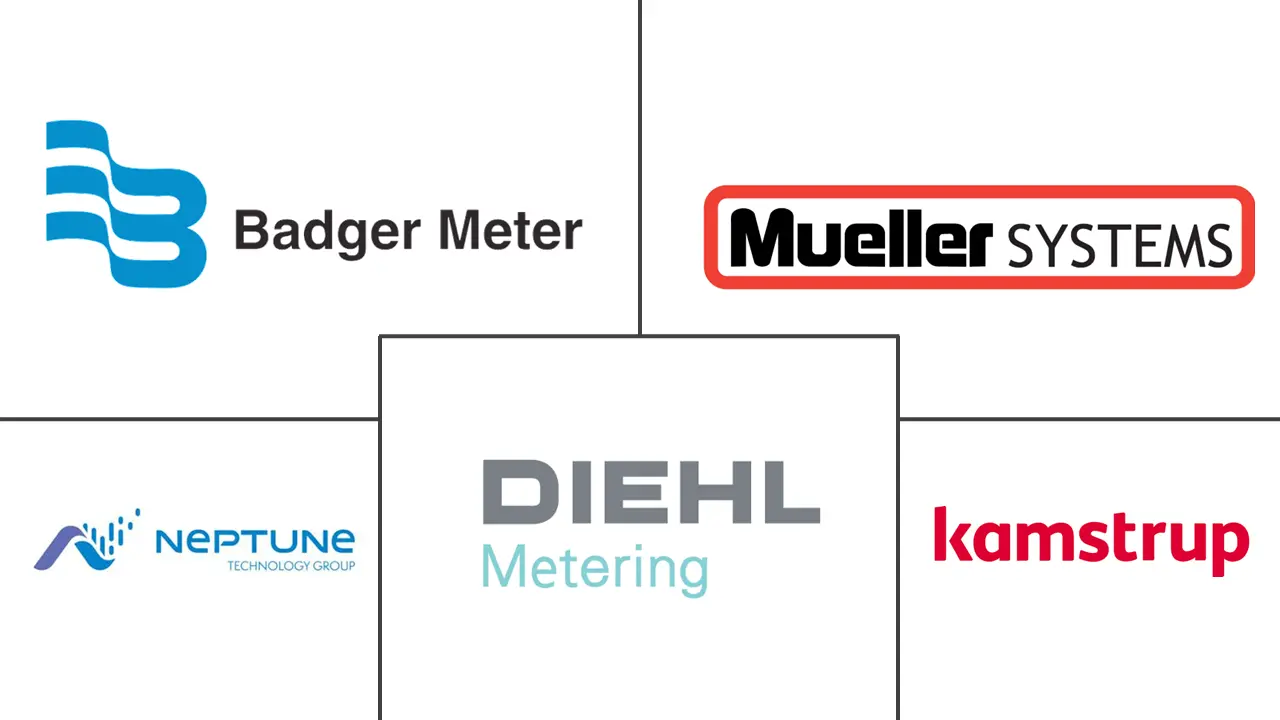
Top 5 United States Smart Meter Companies


Badger Meter Inc.
Mueller Systems LLC
Diehl Metering US
Kamstrup
Neptune Technology Group Inc.
Source: Mordor Intelligence
United States Smart Meter Companies Matrix by Mordor Intelligence
Our comprehensive proprietary performance metrics of key United States Smart Meter players beyond traditional revenue and ranking measures
The MI Matrix can rank firms differently because it rewards visible delivery capability, not just overall revenue scale. In this space, utility buyers often prioritize proven deployment playbooks, local support coverage, and the ability to keep networks secure and stable during storms. Several indicators tend to predict outcomes: recent US contract wins, manufacturing or assembly moves closer to utilities, security certifications for connected endpoints, and credible software that reduces billing exceptions. Utilities also commonly weigh RF mesh for dense territories and cellular IoT for wide rural footprints where towers already exist. Time based rates increase the value of reliable hourly reads, which raises the bar for data management and validation. This MI Matrix by Mordor Intelligence is more useful for supplier and competitor evaluation than revenue tables alone because it ties scores to real delivery signals and in scope execution.
MI Competitive Matrix for United States Smart Meter
The MI Matrix benchmarks top United States Smart Meter Companies on dual axes of Impact and Execution Scale.
Analysis of United States Smart Meter Companies and Quadrants in the MI Competitive Matrix
Comprehensive positioning breakdown
Badger Meter Inc.
Record 2024 results show Badger Meter, a leading vendor, can fund faster product refresh and deeper service offerings. ORION Cellular also earned a rigorous connected device certification in March 2025, which supports stricter utility security reviews. If state regulators push harder on leak reduction, its end-to-end water visibility can win larger rollouts. A key risk is cellular cost inflation, which can shift total program economics.
Itron Inc.
Scale and execution discipline show up in how consistently Itron supports multi-year deployments. Its 2024 Form 10-K describes an integrated portfolio spanning endpoints, networks, and software used by utilities. A Vermont electric cooperative launched an AMI project with Itron support, signaling ongoing US cooperative momentum. If co-ops continue to access federal funding, Itron is positioned to capture second-wave replacements. The operational risk is delivery bottlenecks when multiple large utilities overlap schedules.
Sensus USA Inc. (Xylem Inc.)
Portfolio focus can be a hidden advantage when a parent company chooses to double down on North America. Xylem announced in October 2025 it would sell metering assets outside North America while retaining its North American smart metering business under the Sensus name. That clarity can reassure utilities about roadmap continuity and spares support. If procurement teams tighten cyber and reliability requirements, keeping engineering attention local can help. The risk is transition distraction during the carve-out, which can slow response times for large rollouts.
Landis+Gyr AG
When a utility commits to long-horizon managed services rather than just buying devices, Landis+Gyr can benefit as a major supplier. Landis+Gyr signed a March 2023 agreement with WEC Energy Group to expand AMI coverage and extend managed services through 2038, subject to approvals. That kind of contract supports recurring operations investment and network reliability improvements. If more utilities tie AMI to electrification and demand response goals, its multi-commodity approach fits. The risk is regulatory delay, which can push large deployments out by years.
Aclara Technologies LLC
Edge intelligence is shifting from a pilot feature to a core requirement in new meter generations. Aclara partnered with Utilidata in March 2024 to embed distributed AI in a smart meter, aiming to improve grid operations and DER handling. This approach can strengthen the case for AMI 2.0 when utilities need faster local decisions and better power quality signals. If states expand time-based rates, higher-resolution meter compute becomes more valuable. The biggest operational risk is proving consistent performance at scale under diverse feeder conditions.


Frequently Asked Questions
How should a utility choose between RF mesh and cellular IoT for smart meters?
RF mesh often fits dense service areas where utilities can build a stable local network. Cellular IoT can fit wide territories where tower coverage reduces utility owned network work.
What are the top security checks utilities apply to connected meters and endpoints?
Utilities typically require clear encryption, patching practices, and evidence of secure device behavior under real network conditions. They also look for vendor readiness to support audits and incident response.
What usually drives an "AMI 2.0" refresh decision?
Common triggers include aging meters, new time based rates, and the need for higher resolution grid visibility. Utilities also refresh when data systems cannot handle growing exception volumes.
What should water utilities prioritize when upgrading to smart water meters?
Battery life, measurement accuracy over time, and leak detection usefulness tend to drive real savings. Utilities also evaluate how quickly the system turns alerts into field action.
How do utilities evaluate meter data management software vendors?
They focus on scalability, data validation quality, and integration with billing and customer systems. Proven migration delivery matters as much as software features.
What is a practical way to reduce vendor lock in risk in AMI programs?
Utilities can require open interfaces and test multi vendor interoperability early. They can also separate meter procurement from head end and data platform contracts when feasible.


Methodology
Research approach and analytical framework
Used company filings, investor materials, and official press rooms as primary inputs, plus selected named journalism. Public and private firms were assessed using observable signals such as facilities, certifications, and deployment disclosures. When in scope financial detail was not disclosed, scores relied on triangulated proxies from contracts, product releases, and operating footprint.
US utility coverage, local service teams, and proof of deployments across electric, gas, and water programs.
Utility trust for safety, billing accuracy, and outage visibility, plus acceptance by regulators and procurement teams.
Relative installed position across US smart electricity, gas, and water meter programs and closely tied network platforms.
US aligned production, deployment capacity, managed services, and ability to execute multi year rollouts.
New meters, security, edge compute, and meter data tooling launched since 2023 for US AMI needs.
Financial strength that supports warranty coverage, spares, and sustained R&D tied to US utility programs.