
| Study Period | 2020 - 2031 |
| Forecast Data Period | 2026 - 2031 |
| Base Year Market Size (2025) | USD 2.83 Billion |
| Market Size (2026) | USD 3.12 Billion |
| Market Size (2031) | USD 5.13 Billion |
| CAGR (2026 - 2031) | 10.42% |
| Market Concentration | Low |
Major Players *Disclaimer: Major Players sorted in no particular order |
US Optical Sensors Market Analysis by Mordor Intelligence
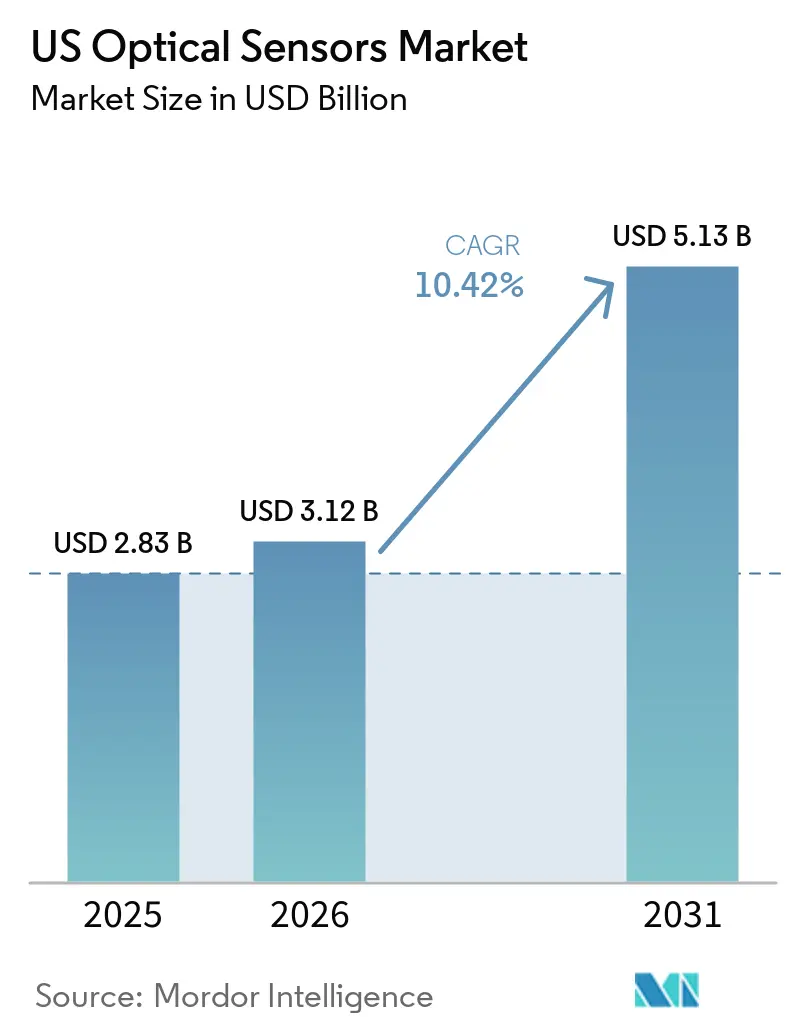
The US Optical Sensors Market size is expected to grow from USD 2.83 billion in 2025 to USD 3.12 billion in 2026 and is forecast to reach USD 5.13 billion by 2031 at 10.42% CAGR over 2026-2031.
According to the Consumer Technology Association (CTA), based on the projected retail sales for 2021, consumer electronics retail sales in the United States reached USD 442 billion. Smartphones were the products accounting for the largest retail revenue within the consumer electronics sector, comprising USD 79 billion in revenue in 2020.
The smartphone household penetration stands at 74% in the United States, which indicates a high potential for household penetration in the country. The United States market is primarily driven by the latest product innovations in the market.
Optical sensors are typically embedded in smartphones, smart wearable, and smartwatches for ambient light and other purposes. Internet of Things (IoT), wearable technology, and health and fitness technology have transformed the United States market and have been primary drivers for increasing the demand for optical sensors.
Smart TVs are also expected to witness high growth in the United States, owing to high multi-functionality. According to comscore, In 2020, Samsung remained the most popular smart TV brand among US households, with a steady share of 32%, followed by Alcatel/TCL and Vizio with 14% and 13% market share, respectively. It is expected that smart TVs will be a part of all households in the United States, which is expected to further increase further, thereby fueling the growth of the market.
The adoption of autonomous vehicles equipped with optical sensors is increasing in the United States. Companies such as Waymo, which operate in the country, are expanding their operations to promote the use of driverless cars. Several states, including California, are broadening testing regulations to support the development of driverless cars, which is expected to boost optical sensor sales.
US Optical Sensors Market Trends and Insights
Photoelectric Sensor is Expected to Register a Significant Growth
These sensors have been recognized for their robust use in the industrial automation marketplace, owing to their high precision in detecting objects. These sensors have found a rising integration into a wide range of automated machinery, mainly for non–contact detections and measurements, including counting, monitoring, conveyor mechanisms, transport systems, machine tools, and across assembly lines.
According to Control Global Magazine, some of the leading automation vendors in the region include Emerson, Rockwell, ABB, Fortive, Schneider Electric, Siemens, etc. Emerson had a sales revenue of USD 5.27 Billion in the year 2020, followed by Rockwell Automation with a sales revenue of USD 3.72 Billion in 2020.
With a greater inclination toward employing robotics and automation through Industry 4.0, there is a pressing need for precision in operations. Thus, driving the need for photoelectric sensors. The packaging, material handling, and automotive industries have emphasized the need for photoelectric sensors, owing to their collaboration of IIoT with Big Data and the reliance on data from smart sensors.
This rising trend in sectors, ranging from packaging (the growth of automated warehouses) to manufacturing, and pharmaceuticals to food and beverages, is set to augment the growth of the market over the forecast period.
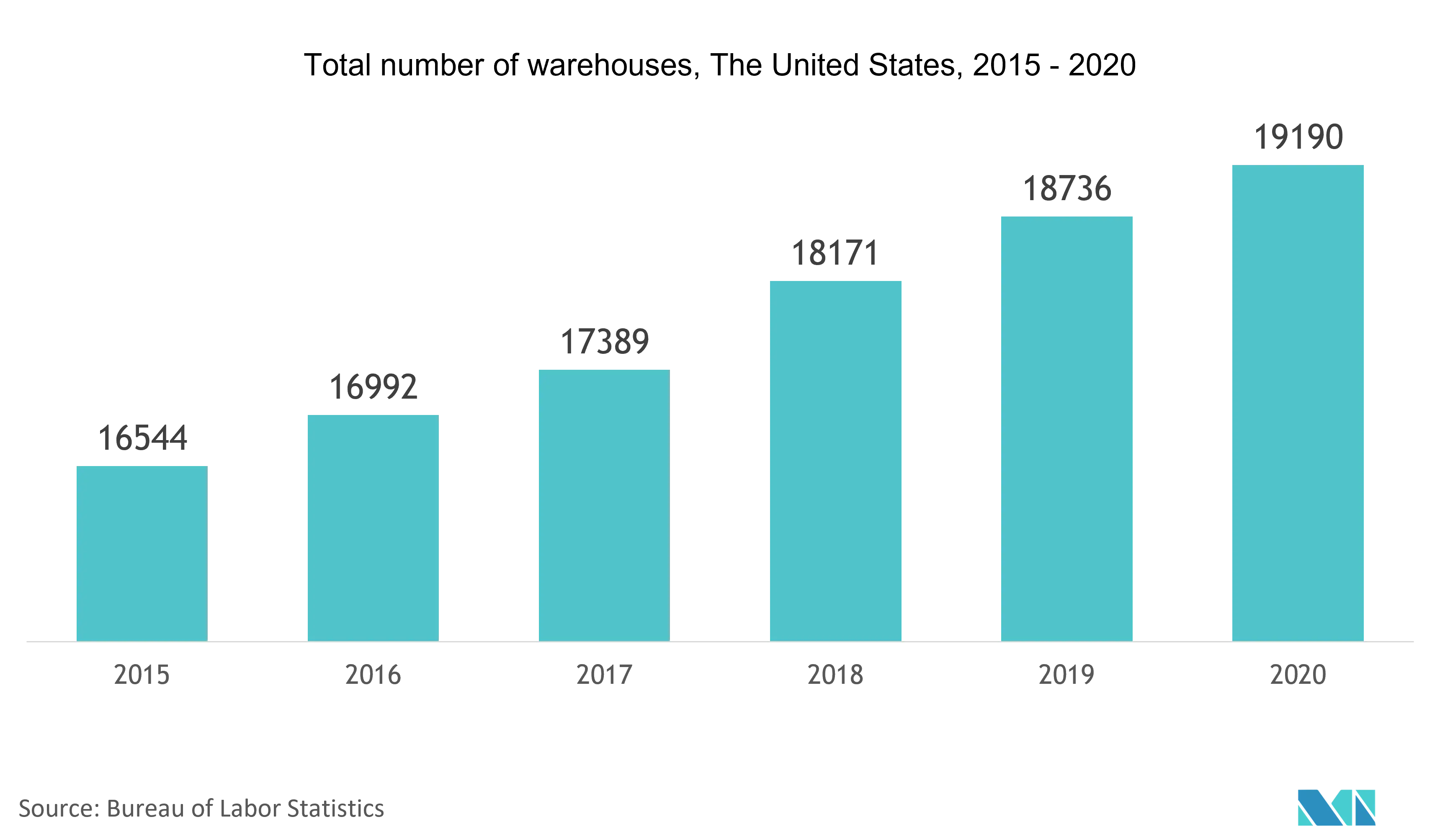
According to the Bureau of Labor Statistics, the number of warehouses in the United States has been growing at an increasing rate every year, reaching 19,190 in 2020. Forbes survey with 48 respondents also showed that one-third of respondents plan to invest in conveyors or automatic sortation facilities in the next 12 months.
Usage of optical sensors in Industrial and Automotive applications are expected to drive the growth of the market
Optical sensors are increasingly used in driver assistance systems for lane-keeping assistants, parking assistants, and emergency brake assistant systems. The sensors, based on LEDs and infrared lasers, are one of the primary technologies for advanced driver assistance systems to reduce the burden on the driver gradually.
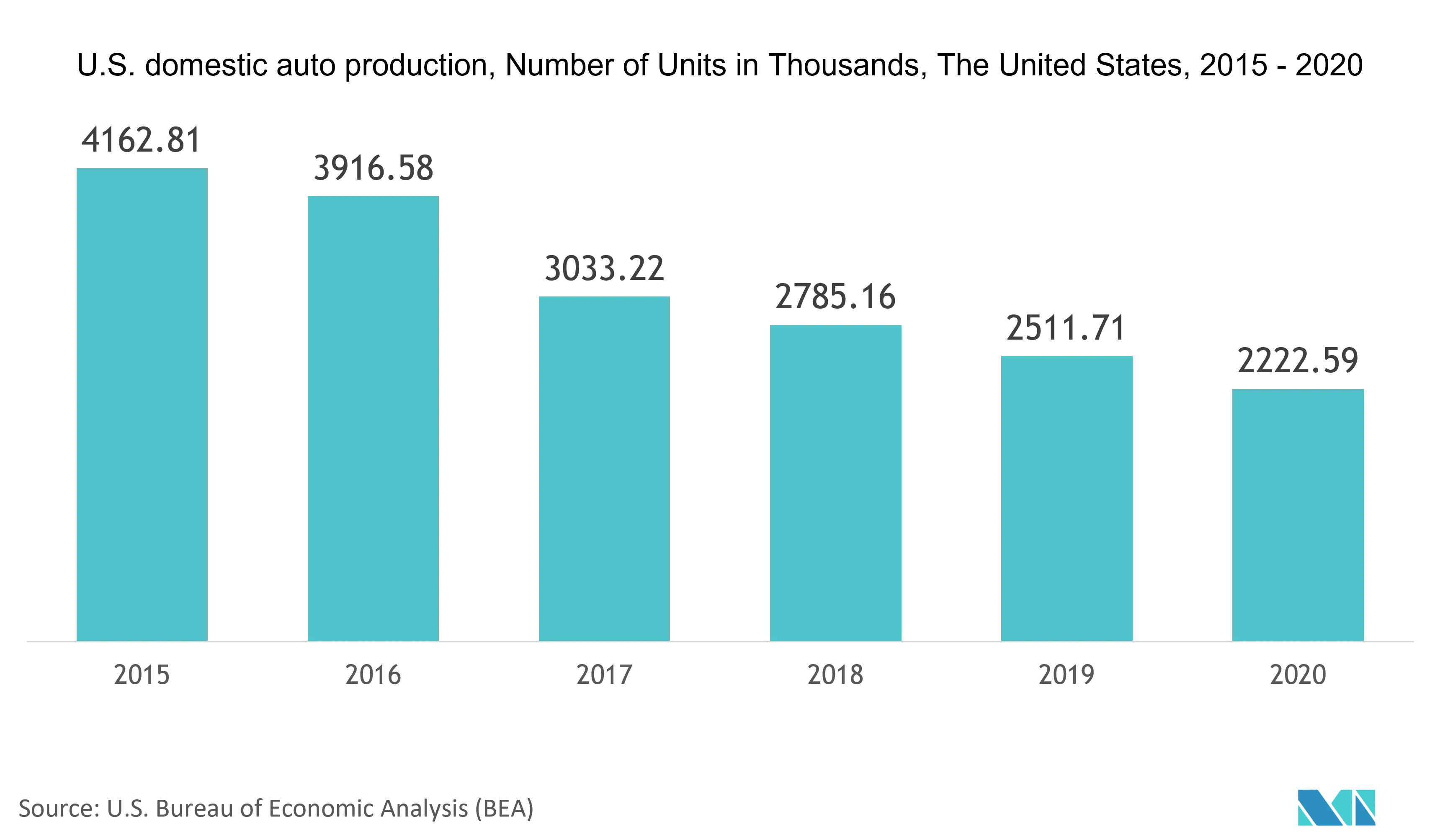
According to the U.S. Bureau of Economic Analysis (BEA), approximately 2.2 million automobiles were produced in the United States in 2020, a significant decline attributed to the COVID-19 pandemic. However, this figure is anticipated to increase over the forecast period, potentially driving market growth. According to the Organization Internationale des Constructeurs d'Automobiles (OICA), nearly 13.4 million motor vehicles were produced in North America in 2020.
Infrared laser-based sensors are increasingly being integrated into a broad range of automated machinery, primarily for non-contact detection applications, including monitoring conveyor systems, transport systems, and assembly lines. The use of optical sensors in the automotive industry is growing considerably, particularly the adoption of image sensors driven by technological advancements. Image sensor adoption in the automotive industry is expected to grow rapidly due to the sector's extensive imaging applications.
In January 2020, ams AG, a global supplier of sensor solutions, launched the CMOS Global Shutter Sensor (CGSS) Near-Infrared (NIR) image sensor, the CGSS130, which supports 3D optical sensing applications such as face recognition and payment authentication. The CGSS130 sensor offers high quantum efficiency in the NIR, reaching up to 40% at 940 nm and 50% at 850 nm. The stacked BSI process used to manufacture the sensors provides a compact footprint of 3.8 mm × 4.2 mm.
The sensor captures monochrome images using an adequate pixel array of 1080H × 1280V at a maximum frame rate of 120 frames/s. Additionally, it delivers a high-dynamic-range (HDR) mode exceeding 100dB. The CGSS130 is 4 times more sensitive to NIR wavelengths and can reliably detect reflections from very low-power IR emitters in 3D sensing systems. The sensor supports 3D sensing technologies, including Active Stereo Vision, Time-of-Flight, and Structured Light.
Competitive Landscape
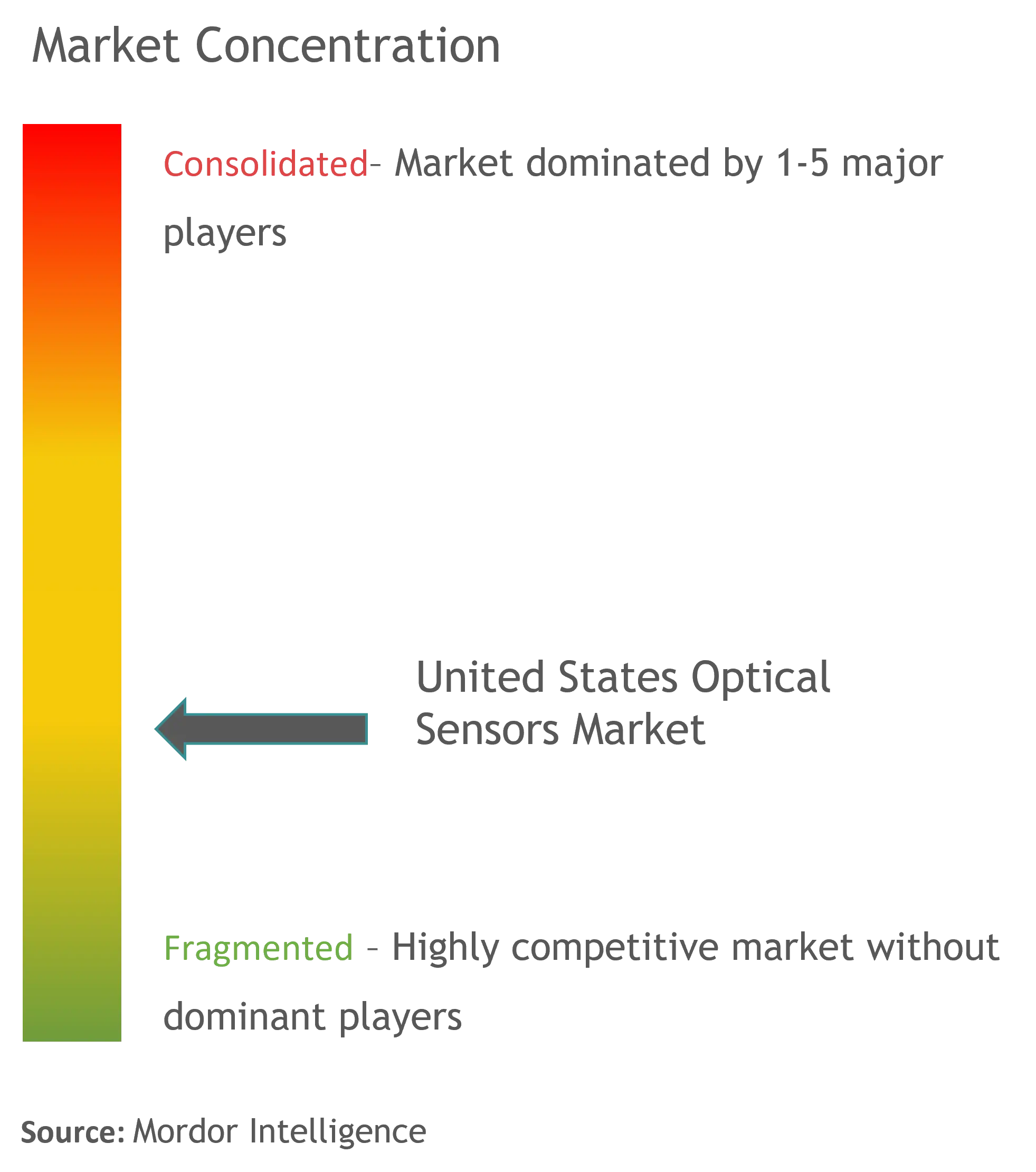
The United States Optical Sensors Market is fragmented with few major players, which are various established international brands, domestic brands, as well as new entrants that form a competitive landscape. Some of the major players are increasingly seeking market expansion through various strategic mergers and acquisitions, innovation, increasing investments in research and development.
- February 2021: Mouser Electronics stocked a broad selection of environmental sensors from Sensirion, a supplier of sensors for the medical and automotive industries. The selection included the SPS30 particulate matter sensor, which is an optical sensor that combines laser scattering with Sensirion's contamination-resistant technology. The sensor enables accurate measurements for HVAC equipment, air conditioners, and Internet of Things (IoT) devices.
- January 2021: Honeywell announced the introduction of an Optical Caliper Measurement Sensor designed to optimize Lithium-Ion Battery (LIB) production. The sensor provides an effective solution for measuring the true thickness of electrode material during coating as well as at the pressing station during LIB manufacturing. The Optical Caliper Measurement Sensor can detect variations in coatings as small as 1 micron (0.0393701 thousandths of an inch) in areas as small as 0.5 mm x 0.5 mm (0.019685 inches x 0.019685 in).
US Optical Sensors Industry Leaders
-
Mouser Electronics Inc.
-
Sick AG
-
Rockwell Automation
-
Honeywell Inc.
-
Eaton Corporation
- *Disclaimer: Major Players sorted in no particular order
Recent Industry Developments
- June 2021: Mouser Electronics announced a distribution agreement with Marktech Optoelectronics to offer customers Marktech Optoelectronics' range of emitters and photodiodes for applications, including night vision, safety equipment, fiber optics, and currency validation. The near-IR emitters offer exceptional optical/mechanical axis alignment, making them a suitable choice for high-precision applications, including bar code readers, fiber optics, and optical switches, and optical sensors.
- November 2020: Trumpf and Sick partnered to develop the 'first' industrial quantum sensor for industrial use. Sick will be responsible for application development and sales of the product, while, Trumpf subsidiary Q.ANT takes on production of the measurement technology. The quantum sensor is expected to enable highly accurate measurements and provide insights that will lead to completely new industrial applications.
US Optical Sensors Market Report Scope
Optical sensors are used in various commercial and research applications, such as quality and process control, medico technologies, metrology, imaging, and remote sensing. R&D in the field is driven by the expectation that optical sensors will have significant advantages over the conventional sensor types in terms of their properties
Optical sensors are commonly used as sensing elements to process electronic signals. Some of the different types of optical sensors include light sensors, photoelectric sensors, image sensors, infrared detectors, motion sensors, and position sensors.
Technology
| Hyperspectral imaging |
| Near IR Spectroscopy |
| Photo-Acoustic Tomography |
| Optical Coherence Tomography |
Sensor Type
| Fiber Optic Sensors | |
| Image Sensors | |
| Position Sensors | |
| Ambient light and proximity sensors | Cadmium Sulfide |
| Silicon | |
| InGaAs Sensors | |
| Extended InGaAs Sensors | |
| Infrared Sensors | |
| Other Sensors |
Applications
| Commercial | |
| Consumer Electronics | |
| Medical | |
| Automotive | |
| Industrial | |
| Aerospace & Defence | |
| Optocouplers | 4-pin Optocouplers |
| 6-pin Optocouplers | |
| High speed optocouplers | |
| IGBT gate driver optocouplers | |
| Isolation Amplifier Optocouplers | |
| Others |
| Technology | Hyperspectral imaging | |
| Near IR Spectroscopy | ||
| Photo-Acoustic Tomography | ||
| Optical Coherence Tomography | ||
| Sensor Type | Fiber Optic Sensors | |
| Image Sensors | ||
| Position Sensors | ||
| Ambient light and proximity sensors | Cadmium Sulfide | |
| Silicon | ||
| InGaAs Sensors | ||
| Extended InGaAs Sensors | ||
| Infrared Sensors | ||
| Other Sensors | ||
| Applications | Commercial | |
| Consumer Electronics | ||
| Medical | ||
| Automotive | ||
| Industrial | ||
| Aerospace & Defence | ||
| Optocouplers | 4-pin Optocouplers | |
| 6-pin Optocouplers | ||
| High speed optocouplers | ||
| IGBT gate driver optocouplers | ||
| Isolation Amplifier Optocouplers | ||
| Others | ||
Key Questions Answered in the Report
How big is the US Optical Sensors Market?
The US Optical Sensors Market size is expected to reach USD 3.12 billion in 2026 and grow at a CAGR of 10.42% to reach USD 5.13 billion by 2031.
What is the current US Optical Sensors Market size?
In 2026, the US Optical Sensors Market size is expected to reach USD 3.12 billion.
Who are the key players in US Optical Sensors Market?
Mouser Electronics Inc., Sick AG, Rockwell Automation, Honeywell Inc. and Eaton Corporation are the major companies operating in the US Optical Sensors Market.
What years does this US Optical Sensors Market cover, and what was the market size in 2025?
In 2025, the US Optical Sensors Market size was estimated at USD 2.79 billion. The report covers the US Optical Sensors Market historical market size for years: 2020, 2021, 2022, 2023 and 2024. The report also forecasts the US Optical Sensors Market size for years: 2025, 2026, 2027, 2028, 2029, 2030 and 2031.
US Optical Sensors Market Report
Statistics for the 2026 US Optical Sensors market share, size and revenue growth rate, created by Mordor Intelligence™ Industry Reports. US Optical Sensors analysis includes a market forecast outlook for 2026 to 2031 and historical overview. Get a sample of this industry analysis as a free report PDF download.