
Market Overview
| Study Period | 2021 - 2031 |
|---|---|
| Forecast Data Period | 2026 - 2031 |
| Base Year Market Size (2025) | USD 2.10 Billion |
| Market Size (2026) | USD 2.22 Billion |
| Market Size (2031) | USD 2.9 Billion |
| Growth Rate (2026 - 2031) | 5.54 % |
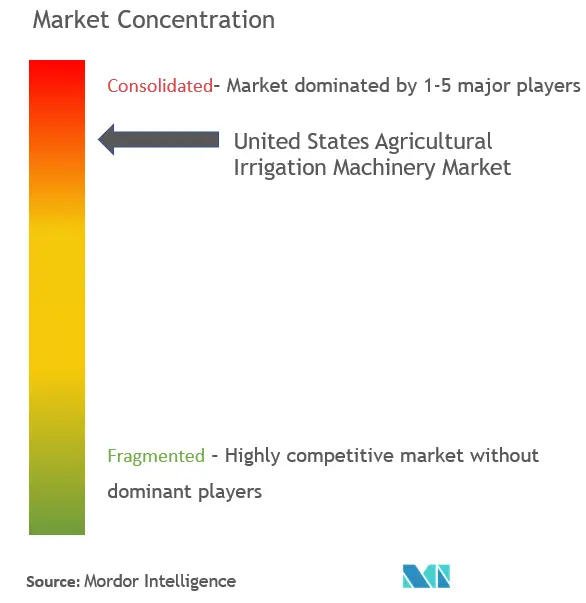
| Market Concentration | High |
Major Players *Disclaimer: Major Players sorted in no particular order Image © Mordor Intelligence. Reuse requires attribution under CC BY 4.0. | |
United States Agricultural Irrigation Machinery Market Analysis by Mordor Intelligence
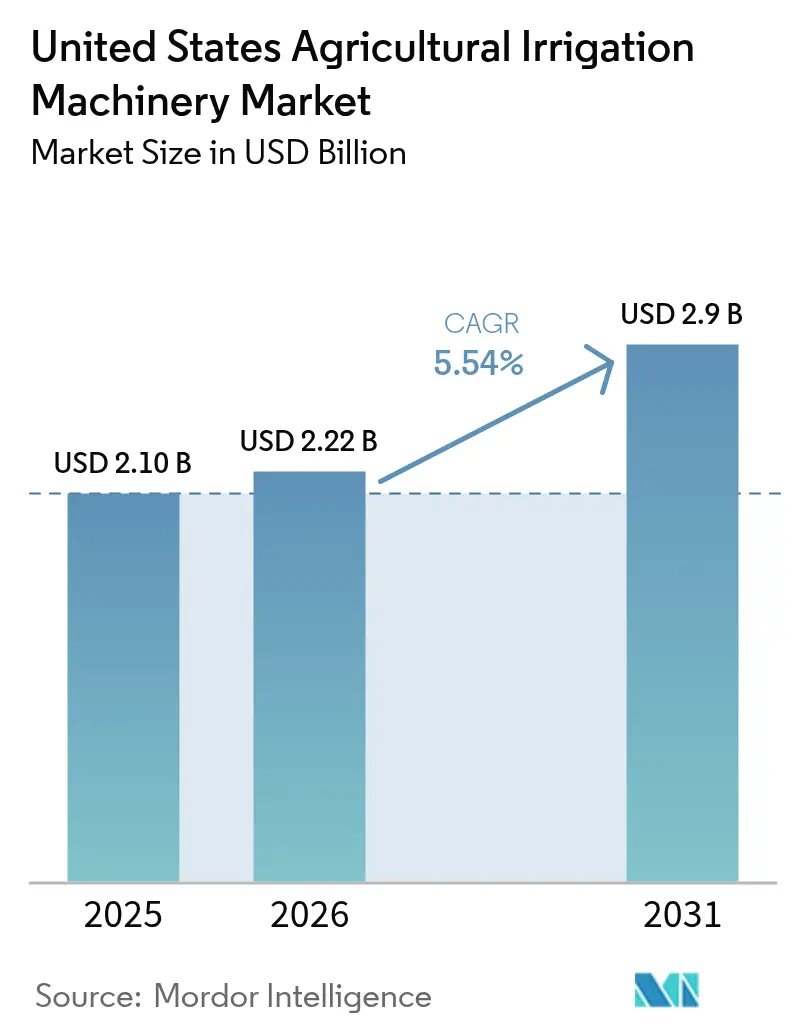
The United States agricultural irrigation machinery market size is expected to grow from USD 2.10 billion in 2025 to USD 2.22 billion in 2026 and is forecast to reach USD 2.90 billion by 2031 at 5.54% CAGR over 2026-2031. Producers are substituting aging flood layouts with sensor-enabled pivots and pressure-compensating drip lines in response to conservation incentives, water-scarcity mandates, and escalating energy expenses, while tax credits for on-farm solar further shrink lifetime operating costs. Pivot irrigation still dominates installed acreage, yet the high-efficiency drip segment is advancing more than twice as fast as pivots as specialty tree-nut and berry operations demand precise water delivery. At the same time, broadband build-outs and cloud-based analytics are expanding the addressable base for variable-rate scheduling, reinforcing the technology shift and deepening competitive differentiation among platform-centric suppliers.
Key Report Takeaways
- By irrigation type, pivot irrigation led with a 43.35% of the United States agricultural irrigation machinery market share in 2025, while drip irrigation is forecast to expand at an 11.02% CAGR to 2031.
- By application, crop-based uses accounted for 70.25% of the United States agricultural irrigation machinery market, and are advancing at a 8.72% CAGR through 2031.
Note: Market size and forecast figures in this report are generated using Mordor Intelligence’s proprietary estimation framework, updated with the latest available data and insights as of 2026.
United States Agricultural Irrigation Machinery Market Trends and Insights
Drivers Impact Analysis*
| Driver | (~) % Impact on CAGR Forecast | Geographic Relevance | Impact Timeline |
|---|---|---|---|
| Federal cost-share programs accelerating pivot system upgrades | +1.20% | National, greatest uptake in Great Plains and Mountain West | Medium term (2-4 years) |
| Rising water-use efficiency mandates in water-stressed states | +1.40% | California, Arizona, Nebraska, Kansas, and Texas | Long term (≥ 4 years) |
| Rapid adoption of sensor-based variable-rate irrigation (VRI) controls | +1.10% | Midwest corn belt, and Pacific Northwest | Medium term (2-4 years) |
| Increasing acreage of specialty fruit and nut crops requiring drip systems | +0.90% | California Central Valley, Pacific Northwest, and Southeast | Long term (≥ 4 years) |
| On-farm solar-powered pump incentives lowering operating costs | +0.70% | Remote high-plains and desert regions | Short term (≤ 2 years) |
| Emergence of autonomous irrigation robots for labor-constrained farms | +0.50% | California, Arizona, Washington, pilot sites in Florida | Long term (≥ 4 years) |
| Source: Mordor Intelligence | |||
Federal Cost-Share Programs Accelerating Pivot System Upgrades
In fiscal 2024, the Environmental Quality Incentives Program disbursed a significant amount to support hardware expenditures for growers that replaced flood systems or retrofitted older pivots, compressing typical payback periods from eight years to fewer than four. State-level zero-interest loans in Nebraska, Kansas, and Colorado complement the federal benefit and financed a rise in High Plains installations over the past year. The incentive mix has broadened adoption among 500- to 1,000-acre operations that previously lacked the balance-sheet strength to self-fund USD 120,000 pivots. Dealer order logs show an uptick in variable-rate nozzle packages, reflecting producers’ intent to maximize program eligibility and water savings simultaneously. However, the initiative remains subject to annual appropriations, and any Farm Bill cuts after 2026 could pause upgrades, particularly for smaller growers lacking commercial credit lines. Suppliers are therefore accelerating shipments ahead of possible funding uncertainty, while lobbying coalitions seek to maintain cost-share ceilings through 2030. The thrust of these incentives underscores why the United States agricultural irrigation systems market continues to outpace broader farm machinery spending.
Rising Water-Use Efficiency Mandates in Water-Stressed States
California’s Sustainable Groundwater Management Act compels critically overdrafted basins to achieve sustainability by 2040, effectively forcing a 20%–30% cut in agricultural withdrawals across the San Joaquin Valley [1]. Arizona, Nebraska, and Kansas have introduced metering and volumetric caps that penalize inefficient flood practices, nudging growers toward drip and micro-sprinkler layouts that slash evaporation. Field trials conducted by the Agricultural Research Service show drip reducing losses by up to 25% compared with overhead sprinklers in almonds and pistachios [2]. Compliance deadlines extend through 2030, anchoring a durable pipeline of retrofit demand for both subsurface emitters and variable-rate pivots able to document efficiency gains. Nevertheless, uneven enforcement and drought-year exemptions create uncertainty, prompting some operators to stage equipment purchases to align with local milestones. Technology vendors are responding with monitoring dashboards that convert sensor data into compliance reports, simultaneously meeting regulatory reporting needs and driving stickiness for their subscription platforms within the United States agricultural irrigation systems market.
Rapid Adoption of Sensor-Based Variable-Rate Irrigation (VRI) Controls
Across 1,200 Midwest corn and soybean fields, real-time soil-moisture telemetry cut applied water by an average of 18% in the 2024 season. Valmont’s FieldNET Advisor and Lindsay’s FieldNET suite manage a large network of connected pivots and integrate weather forecasts with evapotranspiration models to adjust rates zone by zone. The economics hinge on robust connectivity, as 14% of cropland still lacks reliable cellular or satellite coverage, limiting return on investment for growers in unserved counties. The Infrastructure Investment and Jobs Act allocates USD 65 billion for rural broadband, but carrier rollouts may not reach many counties before 2027. Consequently, uptake remains clustered around regions with 4G or Starlink coverage, nudging suppliers to bundle satellite plans into lease packages. Even so, case studies from Iowa and Washington show variable-rate systems recouping costs within three seasons when savings are coupled with fertilizer micro-dosing, reinforcing momentum within the United States agricultural irrigation systems market.
Increasing Acreage of Specialty Fruit and Nut Crops Requiring Drip Systems
Almond plantings in California climbed 5.3% from 2021 to 2024, while pistachios expanded 12.9% in the same window [3]. These perennials demand root-zone consistency to maximize kernel fill, prompting widespread adoption of subsurface drip lines that stabilize soil moisture and accommodate fertigation. Blueberry and strawberry enterprises across the Southeast and Pacific Northwest mirror this trajectory as drip-irrigated berry acreage has been increasing annually since 2022. Global buyers increasingly request water-footprint certifications, bolstering adoption among export-oriented farms that wish to preserve market access. Despite upfront costs of USD 2,500–USD 4,000 per acre, many growers justify the investment via yield gains of 12%–18%, reduced disease pressure, and higher pack-out quality. Maintenance hurdles, clogging, algae, and mineral deposits, persist but are being mitigated by inline filtration and pressure-compensating emitters from Netafim and Rivulis. Collectively, these dynamics are expanding the addressable base and pushing the United States agricultural irrigation systems market deeper into specialty-crop regions.
Market Restraints*
| Restraint | (~) % Impact on CAGR Forecast | Geographic Relevance | Impact Timeline |
|---|---|---|---|
| High upfront CAPEX for large-area center pivots | –0.8% | Nationwide, sharpest in Midwest corn–soybean belt | Medium term (2-4 years) |
| Chronic rural broadband gaps limiting precision-irrigation ROI | –0.6% | Great Plains, Mountain West, and Southeast | Long term (≥ 4 years) |
| Volatility in agricultural commodity prices squeezing farm capital budgets | –0.7% | Nationwide, greater where revenue relies on row crops | Short term (≤ 2 years) |
| Increasing scrutiny of groundwater withdrawals in Ogallala Aquifer states | –0.4% | Kansas, Nebraska, Texas, and Oklahoma | Long term (≥ 4 years) |
| Source: Mordor Intelligence | |||
High Upfront CAPEX for Large-Area Center Pivots
A modern quarter-mile variable-rate pivot costs USD 90,000–USD 200,000, absorbing 15%–25% of a 1,000-acre corn–soybean farm’s yearly gross [4]. When commodity prices sag, payback horizons can stretch beyond 10 years, discouraging purchases despite potential water savings. Federal cost-share programs ease barriers, but application queues run 18–24 months in high-demand districts, compelling growers either to self-finance at commercial rates or to delay. Leasing options provided by Valmont and Lindsay reduce upfront cash requirements but involve an interest rate of 6%–8% over a seven-year term. Dealers note that used equipment shortages raise sticker prices, further inflating capital hurdles. Delays ripple through the broader United States agricultural irrigation systems market, slowing replacement cycles and dampening volume growth even as technology advances.
Chronic Rural Broadband Gaps Limiting Precision-Irrigation ROI
Roughly 14% of cropland still lacks stable cellular or satellite coverage, stalling real-time telemetry adoption that can save 15%–20% water. Connectivity blind spots force farmers back to time-based or manual scheduling, capping efficiency and eroding pivot ROI. Federal broadband funding promises relief, but low-density regions may remain underserved if carriers deem returns insufficient. Interim satellite plans, such as Starlink, incur higher annual costs per unit, which can offset some fuel savings and exert pressure on already narrow profit margins. Until the coverage map fills in, geographic unevenness will persist, segmenting the United States agricultural irrigation systems market into connected and disconnected sub-regions with divergent capital-spending profiles.
*Our forecasts treat driver/restraint impacts as directional, not additive. The impact forecasts reflect baseline growth, mix effects, and variable interactions.
Segment Analysis
By Irrigation Type: Drip Systems Gain on Pivot Dominance
Pivot irrigation commanded a 43.35% of the United States agricultural irrigation machinery market share in 2025, followed by sprinkler setups, while drip captured a smaller but fast-rising fraction of total acreage. Drip’s expansion aligns with specialty-crop growth, rising water-use mandates, and technology that maintains uniform flow on undulating terrain. Rivulis, and The Toro Company have rolled out pressure-compensating emitters and inline filtration that extend service life and curb clogging. Pivots remain cost-effective on large, flat tracts, especially when outfitted with GPS steering and variable-rate nozzles that help narrow the efficiency gap with drip. Sprinkler big-guns are steadily displaced, and flood or furrow options continue to decline as they are ineligible for federal subsidies.
Drip is projected to log the fastest 11.02% CAGR through 2031, making it the prime engine of incremental revenue within the United States agricultural irrigation systems market size. Pivot systems will still advance, as row-crop producers adopt sensor-guided modules to comply with groundwater caps, while sprinkler rigs will stagnate and flood usage will retreat further. The relative pace underscores how conservation policy and crop-mix shifts steer capital spending across irrigation modalities, reshaping competitive focus among leading suppliers.

By Application: Specialty Crops Drive Fastest Expansion
Food Crop-based uses accounted for 70.25% of 2025 sales, and are advancing at a 8.72% CAGR through 2031, led by row crops such as corn, soybeans, wheat, and cotton. Specialty fruit and nut crops delivered a smaller absolute sum but registered the fastest growth, propelled by rising almond, pistachio, and berry acreage in California, the Pacific Northwest, and the Southeast. Non-food crop applications, including turf, landscaping, and nurseries, account for the remainder and provide steadier cash flow as municipal budgets insulate them from commodity swings.
Specialty fruit and nut crops are forecast to grow at the fastest pace among all uses, reflecting export-driven demand and stringent water-footprint certification standards. Row-crop segments will expand at a more moderate rate as aquifer scrutiny and price volatility temper growth. Non-crop categories are estimated to maintain steady momentum, supported by municipal conservation programs and rising penetration of micro-sprinklers in commercial landscapes. Taken together, these trends reaffirm that specialty acreage will continue to anchor the strongest growth within the United States agricultural irrigation machinery market over the next several years.
Geography Analysis
The Great Plains and Mountain West account for the bulk of mechanized acreage, with Nebraska, Kansas, and Colorado concentrating more than half of national pivot installations, yet drip’s penetration is rising in California’s Central Valley and the Pacific Northwest, where strict groundwater regimes prevail. These populous installations form the revenue backbone of the United States agricultural irrigation systems market.
California leads drip spending as Sustainable Groundwater Management Act deadlines draw near; almond, pistachio, and vineyard operators accelerated subsurface networks in 2025. Pacific Northwest berry operations add incremental volume, while the Southeast’s peanut and vegetable belts adopt low-flow tape to reduce disease. In contrast, Midwestern uptake hinges on broadband rollouts; states such as Iowa and Illinois with better 4G coverage have demonstrated higher variable-rate pivot adoption than neighbors still reliant on manual scheduling.
The Ogallala Aquifer overlay introduces regional risk. Kansas and Texas see moderated pivot orders amid pumping-cap debates, while Nebraska leverages zero-interest loans to sustain an upgrade cycle. Remote high-plains counties from eastern Colorado into New Mexico are early adopters of solar-powered pumps owing to high diesel cost and vast grid distances, tilting local growth toward hybrid energy packages. Broadly, the interplay of water policy, connectivity, and energy economics shapes a multi-speed the United States agricultural irrigation machinery market across states.
Regulatory Landscape
Federal and state conservation and water-allocation rules affect both irrigation equipment specifications and the economics of upgrades. At the federal level, USDA NRCS Conservation Practice Standards (including Code 449, Irrigation Water Management) function as a technical rulebook for which projects qualify for financial assistance, which in turn shapes controller features, monitoring, and documentation requirements for program eligibility. Separately, irrigation ditch construction and maintenance can fall under exemptions from certain Clean Water Act Section 404 permitting requirements, based on joint guidance involving the U.S. Army Corps of Engineers and the EPA. This can influence timelines and costs for some on-farm conveyance and drainage activities tied to irrigation projects.
Trade and tariff actions also affect delivered costs for irrigation machinery and key inputs. In June 2026, a U.S. proclamation adjusted Section 232 tariff treatment for certain agricultural machinery (HTSUS 8432 and 8433) and related industrial equipment, lowering the duty rate from 25% to 15% effective June 8, 2026, while CBP issued implementation guidance for the amended framework covering metal derivatives used across machinery supply chains. At the same time, USTR ran an exclusion request process for a broad set of manufacturing machinery subheadings across Chapters 84 and 85, with a filing window that closed March 31, 2025, which remains a compliance pathway that importers and OEMs track alongside domestic steel and component costs.
Competitive Landscape
The top five players, Valmont Industries, Inc., Lindsay Corporation, The Toro Company, Nelson Irrigation, and Orbia (Netafim USA), captured a significant share of sales in 2025, signposting a concentrated structure within the United States agricultural irrigation machinery market. Valmont Industries, Inc. leads the market through its telemetry subscriptions with hardware. Lindsay Corporation follows and differentiates its position with an advanced portfolio.
The Toro Company's 2024 acquisition of select Rivulis Irrigation Ltd. drip assets has strengthened its position in specialty-crop kits. Netafim USA continues to hold technical leadership in pressure-compensating emitters, while Nelson Irrigation focuses on advancing low-pressure Rotator nozzles for semi-arid pivots. Leading players leverage extensive dealer networks, proprietary agronomic data, and substantial R&D budgets to sustain high entry barriers.
White-space opportunities are emerging around fertigation control and autonomous maintenance. Cropx Inc. and Agri-Inject, Inc. link soil-nutrient sensors with injection pumps to deliver variable-rate chemicals, while Deere & Company’s integration with Lindsay’s FieldNET offers a closed loop across planting, spraying, and irrigation. The resulting arms race accelerates technology diffusion but also cements platform stickiness, reinforcing concentration within the United States agricultural irrigation systems market.
United States Agricultural Irrigation Machinery Industry Leaders
-
Valmont Industries, Inc.
-
Lindsay Corporation
-
The Toro Company
-
Nelson Irrigation
-
Orbia (Netafim USA)
- *Disclaimer: Major Players sorted in no particular order
Market Opportunities and Future Outlook
Program-funded modernization continues to create near-term whitespace for suppliers that can link hardware upgrades to measurable water savings and auditable reporting. USDA NRCS announced USD 65 million for fiscal 2026 Conservation Innovation Grants, and irrigation water management technologies were listed as a priority for 2026 on-farm trials. This supports demand for sensor packages, variable-rate controls, and software that converts field telemetry into management and compliance-ready outputs. For OEMs and platform vendors, it also matches the market shift from stand-alone pivots and drip kits toward bundled offerings that combine equipment, connected controls, and decision support, particularly as water-use caps and groundwater scrutiny push growers to document performance.
Specialty-crop irrigation intensification supports spend on premium drip and micro systems, filtration, and fertigation-ready layouts, while row-crop operations in the Great Plains and Mountain West keep upgrading pivots with low-pressure packages and VRI to reduce pumping costs and align with local water rules. Connectivity-enabled service and retrofit revenue is another opportunity area. With persistent rural broadband gaps, vendors that bundle satellite connectivity, remote diagnostics, and dealer-enabled support into leases or subscriptions can expand adoption beyond the most connected counties. On the supply side, tariff and exclusion-process shifts, including the June 2026 machinery duty adjustment, create openings for pricing, sourcing, and localization strategies that reduce delivered-cost volatility for growers comparing replacement cycles across pivot and drip alternatives.
Recent Industry Developments
- July 2026: Lindsay Corporation reported fiscal 2026 third-quarter results and cited tempered North American irrigation equipment demand amid margin pressure and high input costs. The update points to a more cautious replacement cycle for large pivot systems and increases the role of aftermarket, controls, and service-led revenue across irrigation portfolios.
- June 2026: The Toro Company launched the RXC irrigation controller and Oasis irrigation management software aimed at simplifying control and management for irrigation users. The controller-software pairing reinforces the industry's move toward integrated, connected irrigation platforms and adds competitive pressure around ease-of-use, monitoring, and digital workflow integration.
- November 2025: Komet Irrigation introduced the Komet Precision Wave (KPW) pivot sprinkler designed to improve water distribution uniformity and irrigation efficiency. Higher-uniformity sprinkler and nozzle innovations support retrofit demand on existing pivot fleets, especially where growers pursue measurable water savings to align with conservation program requirements.
Research Methodology Framework and Report Scope
Market Definition and Coverage
This market covers the value of agricultural irrigation machinery sold and used in the United States for applying water to crops, including systems and equipment used at farm level to deliver, control, and distribute irrigation water.
Scope exclusions: It does not count general farm pumps and motors sold for non-irrigation uses, municipal water infrastructure, or routine repair labor that is not tied to machinery sales.
Segmentation Overview
- Irrigation Type
- Sprinkler Irrigation
- Drip Irrigation
- Pivot Irrigation
- Other Irrigation Types
- Application
- Food Crops
- Row Crops
- Specialty Fruit and Nut Crops
- Non-food Crops
- Food Crops
Data Sources, Market Sizing, and Validation
Desk Research
Desk work starts by building a demand backdrop for irrigated farming and equipment replacement needs in the United States. We review public statistics and technical notes from sources such as USDA (NASS and ERS), USGS water-use publications, Bureau of Reclamation program updates, and EPA water-efficiency and conservation guidance, since these help explain where irrigation is practiced and what constraints farmers face.
We then use supporting information like company annual reports and investor decks, importer and exporter summaries, and reputable farm and equipment news to map product availability and pricing direction. When needed, subscribed datasets are used for company financials and news screening, shipment-level import and export checks, and patent lookups to understand technology change. The desk sources listed here are illustrative only, and many other public and paid references were also used to gather, cross-check, and clarify data.
Primary Interviews and Surveys
Primary work is used to pressure-test desk assumptions with people who see orders and usage patterns directly in US irrigated agriculture, such as dealers, distributors, large farms, irrigation contractors, and select component suppliers. Since this is a single-country market, interviews were spread across key irrigated belts and crop mixes. Feedback was used to validate price bands, replacement cycles, and adoption of efficiency-driven upgrades.
Distribution of primary research fieldwork respondents
| Company type | Respondent position |
|---|---|
| Top tier: 35% | CXOs: 17% |
| Mid tier: 47% | Functional/Unit leaders: 27% |
| Smaller Players: 18% | Managers: 56% |
Market-Sizing & Forecasting
The model starts with a top-down build where irrigated acreage and crop mix are translated into an addressable equipment pool, then adjusted by adoption rates for major irrigation formats and typical replacement timing. To keep totals grounded, we corroborate them with selective bottom-up checks, such as dealer channel splits, sampled average selling prices times units, and supplier-side sense checks for high-volume equipment categories.
Key inputs used in the sizing include irrigated area and water-stress signals, farm income and capex intent, share shifts across sprinkler, drip, and pivot systems, observed pricing movement for kits and assemblies, and program-driven demand tied to conservation incentives. When information is thin in a category, we use ranges agreed in calls and anchor them to the closest observable proxy, such as installed base behavior in the same crop belt.
Forecasts are built using scenario analysis, where macro inputs and agriculture indicators are combined with expert views on how fast efficiency requirements and drought exposure are changing buying behavior. The scenarios are then narrowed to a single base case after we check consistency with historical sales direction and near-term order sentiment.
Data Validation & Update Cycle
Outputs are checked through multiple passes so the math and assumptions stay consistent across years and product groupings. We compare results against independent signals such as irrigated acreage movement, reported equipment pricing direction, and demand comments from the channel, then investigate variances before final sign-off.
The report is refreshed annually, and interim updates are made when major events materially change demand drivers or price assumptions. Before delivery, a final review pass is completed so the published view reflects the latest available data and any newly validated expert feedback.
Mordor Intelligence's United States of America Agricultural Irrigation Machinery Market Size Compared Against Other Published Estimates
It is common to see different market sizes published for the same topic, even when the market name looks identical. The gaps usually come from how each study draws the product boundary, which year and pricing basis it uses, and how much primary validation was done on adoption and replacement behavior.
By tracking irrigated acreage signals, checking dealer-led pricing bands, and refreshing scope rules yearly, Mordor Intelligence treats US agricultural irrigation machinery as farm-use irrigation equipment sales. This can exclude adjacent water-handling items that some estimates bundle into a larger total.
Benchmark comparison
| Source | Market Size | Gaps in Research Methodology |
|---|---|---|
| Mordor Intelligence | USD 2.10 B (2025) | |
| Industry Publisher A | USD 4.80 B (2026) | The total appears to be broader, likely bundling additional water-handling equipment and services alongside irrigation machinery, and it is shown for a different year which can inflate comparisons when prices are rising. |
| Research Brief B | USD 0.84 B (2028) | This value is presented as incremental growth (added value over a period) rather than the full market size, so it is not directly comparable to an annual total market number. |
The spread in the table mainly comes from scope boundaries and how the number is labeled, either as a full-year market size or as period growth. When the counted products, year basis, and pricing approach are aligned, the market view becomes easier to reproduce and to use for planning decisions.
Key Questions Answered in the Report
What is the current value of the United States agricultural irrigation machinery market?
The United States agricultural irrigation machinery market size stands at USD 2.22 billion in 2026 and is projected to reach USD 2.90 billion by 2031.
Which irrigation type is growing the fastest?
Drip irrigation leads with an 11.02% CAGR to 2031, powered by specialty fruit and nut expansion and stringent water-use mandates.
Why are specialty crops important for future demand?
Almond, pistachio, and berry acreage is climbing, and these crops require precise subsurface drip that drives premium equipment sales and service revenue.
How do federal incentives influence equipment payback periods?
Cost-share programs reimburse up to 75% of pivot hardware outlays, shrinking typical payback from eight to fewer than four years for mid-sized farms.