
Market Overview
| Study Period | 2021 - 2031 |
|---|---|
| Forecast Data Period | 2026 - 2031 |
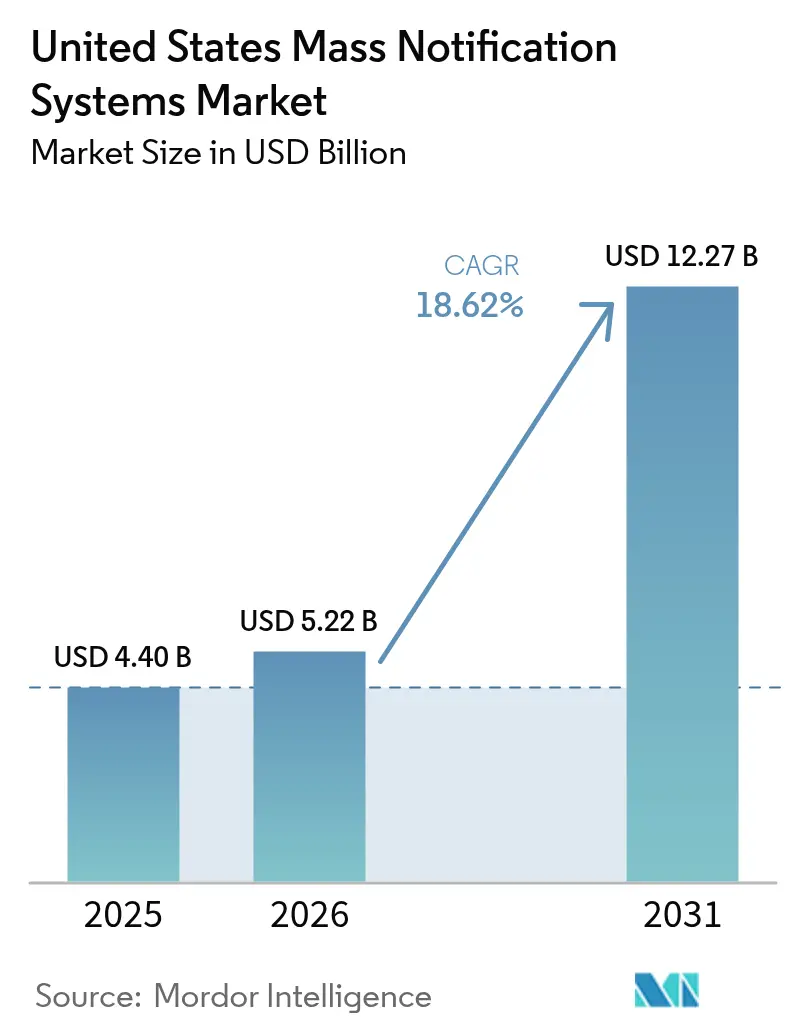
| Base Year Market Size (2025) | USD 4.40 Billion |
| Market Size (2026) | USD 5.22 Billion |
| Market Size (2031) | USD 12.27 Billion |
| Growth Rate (2026 - 2031) | 18.62 % |
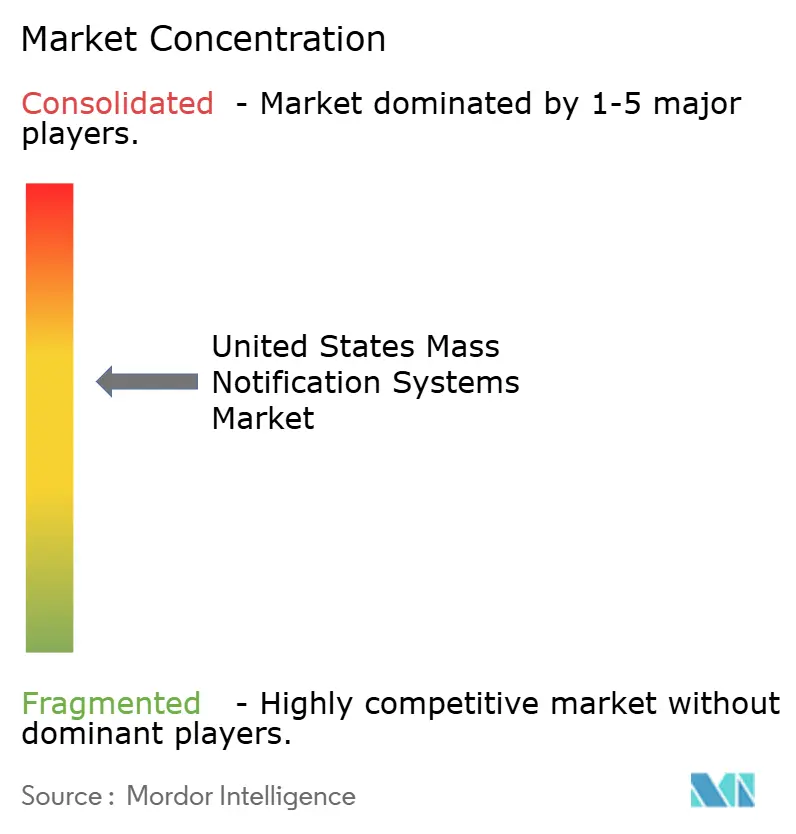
| Market Concentration | Medium |
Major Players *Disclaimer: Major Players sorted in no particular order Image © Mordor Intelligence. Reuse requires attribution under CC BY 4.0. | |
United States Mass Notification Systems Market Analysis by Mordor Intelligence
United States mass notification systems market size in 2026 is estimated at USD 5.22 billion, growing from 2025 value of USD 4.40 billion with 2031 projections showing USD 12.27 billion, growing at 18.62% CAGR over 2026-2031. Momentum reflects simultaneous federal mandates, rapid cloud adoption, and heightened risk awareness among both public-sector and private-sector operators. Compliance deadlines tied to FEMA’s Integrated Public Alert and Warning System Open Platform 3.0 (IPAWS-Open 3.0) and the Department of Education’s Clery Act oversight have pulled forward procurement cycles, while hybrid-work policies accelerate demand for cloud-native, mobile-first alerts. Investments in 5G and artificial-intelligence-enabled incident response strengthen product differentiation, yet interoperability gaps between Project 25 (P25) radio networks and new cellular services temper near-term scalability. Competitive dynamics remain moderately fragmented; Everbridge’s 2024 take-private transaction and BlackBerry AtHoc’s FedRAMP High authorization underscore an active MandA environment and federal customer focus.
Key Report Takeaways
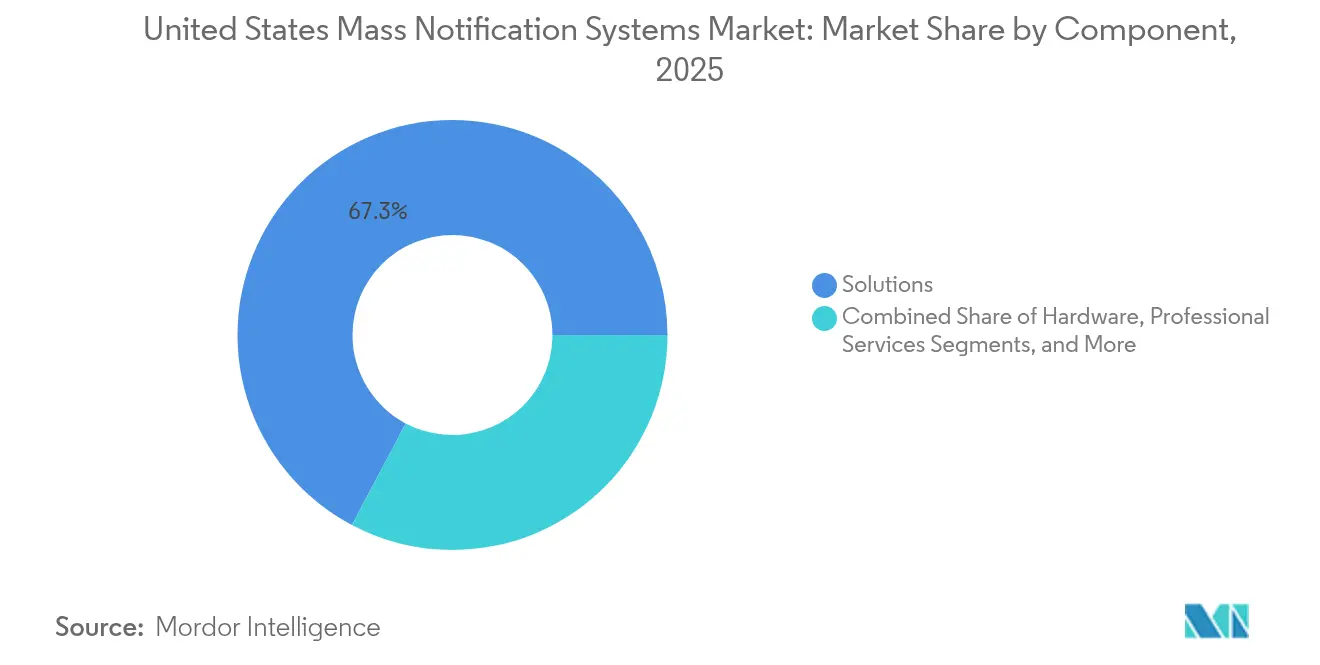
- By component, solutions held 67.25% of the United States mass notification systems market share in 2025, whereas services are set to grow at a 18.95% CAGR to 2031.
- By deployment model, cloud captured 71.80% revenue share in 2025, while hybrid is projected to expand at a 20.05% CAGR through 2031.
- By application, distributed recipient and personal alerting accounted for 45.90% of the United States mass notification systems market size in 2025; in-building systems post the highest 20.24% CAGR outlook.
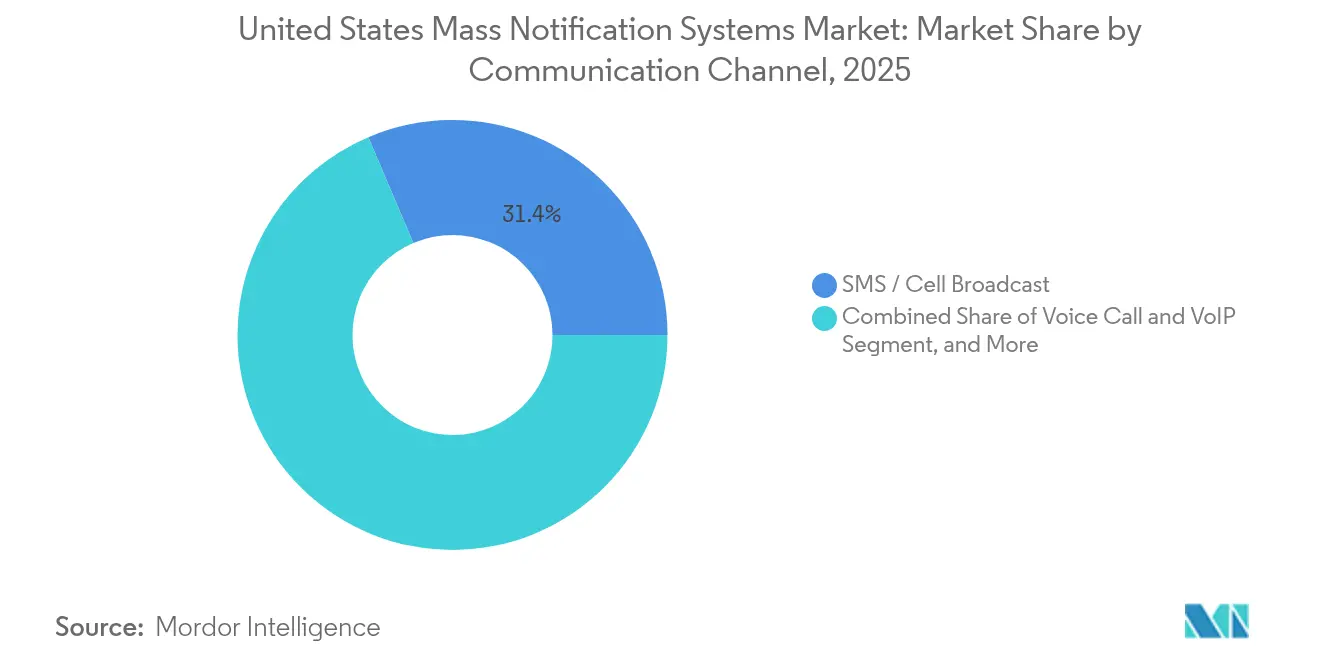
- By communication channel, SMS and text led with 31.40% share in 2025, contrasted with mobile-app push notifications advancing at 20.93% CAGR.
- By end-user vertical, government and public-safety agencies commanded 41.20% share in 2025; healthcare and life sciences represent the fastest-growing segment with a 21.08% CAGR through 2031.
Note: Market size and forecast figures in this report are generated using Mordor Intelligence’s proprietary estimation framework, updated with the latest available data and insights as of 2026.
United States Mass Notification Systems Market Trends and Insights
Drivers Impact Analysis*
| Driver | (~) % Impact on CAGR Forecast | Geographic Relevance | Impact Timeline |
|---|---|---|---|
| Federal expansion of IPAWS-Open 3.0 accelerating agency deployments | +4.20% | Nationwide; strongest among federal and state emergency-management bodies | Short term (≤ 2 years) |
| Clery-Act-driven campus-safety mandates | +2.80% | Nationwide; concentrated in states with large public-university systems | Medium term (2-4 years) |
| AI and ML integration enhancing emergency response | +3.50% | Urban centers and critical-infrastructure corridors | Long term (≥ 4 years) |
| Convergence of multiple federal safety mandates | +2.10% | Nationwide; all federal agencies and contractors | Medium term (2-4 years) |
| Cloud-native platforms enabling hybrid-work use cases | +1.90% | Major metropolitan areas with distributed workforces | Short term (≤ 2 years) |
| Next Generation 911 infrastructure modernization | +2.40% | State and local public-safety answering points (PSAPs) nationwide | Medium term (2-4 years) |
| Source: Mordor Intelligence | |||
Federal Expansion of IPAWS-Open 3.0 Accelerating Agency Deployments
IPAWS-Open 3.0 authorizations surpassed 1,800 alerting authorities in 2024, compelling upgrades across federal, state, local, tribal, and territorial jurisdictions. The FCC’s December 2024 rule requiring IP-based Emergency Alert System transmissions intensified compliance timelines, catalyzing rapid contract awards for BlackBerry AtHoc-compatible solutions [1]. Concurrently, a USD 136 million Corporation for Public Broadcasting grant accelerates infrastructure modernization for underserved rural and tribal broadcasters.
Clery-Act-Driven Campus Safety Mandates Fueling Higher-Ed Spend
The Department of Education can now levy USD 35,000 per violation for deficient campus alerts, compelling universities to adopt integrated platforms that bundle incident management with mass communication. Vanderbilt University’s AlertVU upgrade illustrates the shift toward centralized command systems. Recent studies indicate more than 80% of higher-education safety professionals find these platforms effective in shaping real-time behavior.
AI and ML to Revolutionize Security and Emergency Response
DHS Science and Technology Directorate pilots show wildfire-response times improving when AI analyzes satellite imagery and atmospheric data. Colorado’s statewide wildfire-risk mapping leverages similar models, while NTIA notes AI-driven 911 call-triage cuts volume by 30% and lifts efficiency by up to 10%. January 2025 FCC approval of multilingual WEA templates in 13 languages positions AI translation as a pivotal accessibility tool.
Convergence of Federal Safety Mandates on Next-Generation Notification Systems
New cyber-incident reporting rules require critical-infrastructure owners to alert CISA within 72 hours, pushing demand for automated, multi-channel notification workflows. TSA’s FY 2024-2028 Capital Investment Plan likewise prioritizes cybersecurity and automated screening in transportation nodes, reinforcing interoperability requirements. EMPG funding of USD 355.1 million targets climate-resilient alert capabilities, further standardizing platform adoption.
Restraints Impact Analysis*
| Restraint | (~) % Impact on CAGR Forecast | Geographic Relevance | Impact Timeline |
|---|---|---|---|
| Interoperability gaps between legacy P25 radio and 5G networks | −2.7% | Rural and tribal jurisdictions nationwide | Medium term (2-4 years) |
| Budget shortfalls in rural municipalities | −1.8% | Small counties and townships across rural America | Long term (≥ 4 years) |
| Expanding data-privacy and breach-notification compliance burden | −1.3% | States with newly strengthened privacy statutes | Medium term (2-4 years) |
| Public alert-fatigue after past false-alarm incidents | −1.0% | Regions with high exposure to frequent test alerts | Short term (≤ 2 years) |
| Source: Mordor Intelligence | |||
Interoperability Gaps with Legacy P25 and 5G Networks
CISA’s LMR/LTE best-practices guide underscores persistent technical hurdles in patching P25 talk groups to broadband channels. Santa Fe County’s USD 8.1 million P25 overhaul—backed by just USD 425,000 in state aid—illustrates the fiscal weight of radio upgrades. The FCC’s 2025 NG911 reliability docket may further widen the gap if existing radio networks cannot meet new standards.
Budget Shortfalls in Rural Municipalities
Declining fee revenue and competing priorities constrain rural 911 centers, with counties increasingly diverting general funds to maintain basic service levels. A USD 2.2 billion NG911 requirement in New York alone exemplifies the scale of modernization costs that exceed local capacities. Hazard-mitigation plans highlight the administrative burden of multiyear grant compliance, often outstripping the staffing resources of small jurisdictions.
*Our forecasts treat driver/restraint impacts as directional, not additive. The impact forecasts reflect baseline growth, mix effects, and variable interactions.
Segment Analysis
By Component: Services Growth Outpaces Solutions Dominance
The solutions segment accounted for 67.25% of the United States mass notification systems market in 2025, underscoring entrenched spending on core alerting platforms. Services revenue, however, is rising at a 18.95% CAGR as organizations rely on managed integrations to meet IPAWS-Open 3.0 and FedRAMP benchmarks. Professional-services providers benefit from growing demand for AI-enabled analytics configuration and 24/7 system monitoring.
Hardware margins are tightening as cloud architectures reduce on-premises footprint, yet specialized devices such as Alertus Beacons remain indispensable in hospitals and campuses requiring audible and visual redundancy. Subscription licensing aligns vendors and buyers to continuous-update roadmaps, while training services emerge to unlock machine-learning-based threat detection. As a result, services are positioned to capture a growing share of the United States mass notification systems market size, particularly among mid-tier municipalities lacking in-house expertise.

By Deployment: Hybrid Models Bridge Cloud–Premises Divide
Cloud delivery dominated 71.80% of the United States mass notification systems market in 2025, but hybrid models—expanding at 20.05% CAGR—offer the preferred compromise between scalability and data-sovereignty requirements. Federal agencies with classified workloads demand on-premises storage paired with cloud distribution layers, a configuration reinforced by the FedRAMP High framework now supporting BlackBerry AtHoc deployments.
Healthcare providers adopt hybrid to safeguard electronic health information under HIPAA while retaining rapid alert dissemination to mobile caregivers. NG911 migration likewise pulls state PSAPs toward public-cloud resilience. As 5G expands, hybrid architectures are poised to capture a larger portion of the United States mass notification systems market share among enterprises integrating legacy P25 radios with broadband push-to-talk applications.
By Application: In-Building Systems Gain Momentum
Distributed recipient and personal alerting retained 45.90% share of the United States mass notification systems market size in 2025, reflecting the ubiquity of SMS, email, and push communications. In-building notification, however, is charting a 20.24% CAGR as stricter life-safety codes demand targeted alerts that minimize patient and student disruption.
Elevator communication standards requiring video and two-way voice coverage now cover 75% of U.S. jurisdictions, driving retrofits of cab systems. Hospitals deploy real-time location wearables for staff duress calls, while colleges embrace alert beacons to broadcast room-level instructions during severe-weather incidents.
By Communication Channel: Mobile Apps Transform Alert Delivery
SMS held 31.40% of 2025 revenue, prized for network reliability under congestion. Mobile-app push notifications are growing at 20.93% CAGR as organizations favor rich media, read-receipt tracking, and two-way chat. FCC multilingual templates enhance SMS reach but delayed rollouts push adopters toward app-based instant translation.
Voice and VoIP channels remain critical when human confirmation is needed during evacuations. Public-address sirens persist for wide-area coverage, with cloud-controlled systems enabling remote activation. IoT device alerts, leveraging smart-building sensors, represent an emerging avenue expected to deepen recipient engagement.
By End-User Vertical: Healthcare Emerges as Growth Leader
Government and public-safety bodies generated 41.20% of 2025 revenue, reflecting statutory duties to warn populations. Healthcare and life sciences are on track for a 21.08% CAGR as patient-centric facilities deploy silent, room-specific alerts that protect privacy while ensuring rapid incident response.
Education maintains robust budgets under Clery Act scrutiny, with more than 350 colleges subscribing to InformaCast for integrated voice, text, and digital-signage alerts. Energy, utilities, and transport operators embed mass-notification within SCADA, airport, and rail workflows to safeguard critical infrastructure amid rising cyber threats.
Geography Analysis
Federal agencies have largely harmonized requirements, and BlackBerry AtHoc now supports 80% of federal employees following its 2025 FedRAMP High clearance. State and municipal adoption is patchy; well-funded metros such as Los Angeles International Airport (LAWA) deploy multi-channel systems with stakeholder segmentation . Rural and tribal areas remain dependent on FEMA and CPB grants to modernize broadcast relay towers, underscoring an uneven security baseline.
Natural-hazard profiles shape regional spending. Southeast states emphasize hurricane-resilient outdoor sirens, while western jurisdictions prioritize wildfire and earthquake alerts. Hawaii’s post-2018 false-alert reforms now include periodic test messages to combat alert fatigue and rebuild public trust. Coastal emergency-management offices additionally coordinate with the Pacific Tsunami Warning Center, integrating local siren activations with global seismic data.
Higher-education concentration in the Northeast accelerates Clery Act–led deployments, while the Southwest’s rapid population growth fuels municipal demand for scalable cloud solutions. Academic medical centers act as innovation hubs, piloting AI-triage extensions that later trickle to community hospitals. Consequently, regional disparities in funding, hazard exposure, and institutional density collectively steer adoption trajectories across the United States mass notification systems market.
Regulatory Landscape
The United States regulatory environment for mass notification is centered on FEMA-administered IPAWS, with interoperability requirements focused on the Common Alerting Protocol (CAP) for exchanging alerts across EAS and WEA pathways. Statutory direction for IPAWS modernization under 6 U.S.C. 321o, supported by FEMA planning such as the IPAWS Strategic Plan (FY 2022-2026), keeps IPAWS connectivity and CAP-compliant message origination a core compliance gate for public warning use cases.
FCC rulemaking continues to shape downstream technical and content requirements for Emergency Alert System and Wireless Emergency Alerts, including device and provider obligations codified under 47 CFR Part 10 for WEA. Recent actions include FCC 24-83 (August 2024), which adopted a Missing and Endangered Person (MEP) event code for EAS and permitted its use via WEA, and the FCC Public Safety and Homeland Security Bureau order (DA 25-12, January 2025) requiring participating commercial mobile service providers to implement multilingual WEA templates. That expands accessibility requirements that vendors must accommodate across templates, testing, and message workflow design.
Value Chain Analysis
The value chain starts with standards setting and national infrastructure enablement, led by FEMA IPAWS (and its Memorandum of Agreement process for alerting authorities) and FCC rules for WEA/EAS distribution. Message origination and workflow design sit upstream of delivery, with FEMA tools such as the Message Design Dashboard (MDD) version 2.0 (launched April 2025) supporting alerting authorities as they draft specific alert types, including missing-person and all-clear notifications.
Midstream, mass notification platform vendors provide CAP-capable origination, operator consoles, integration services, and managed monitoring to connect public-sector and enterprise endpoints to IPAWS and to internal channels (SMS, email, apps, desktop, PA/sirens, and IoT). Downstream delivery depends on carriers and broadcasters for WEA/EAS distribution and on local infrastructure owners for in-building hardware, outdoor warning systems, and radio interoperability. Funding and procurement mechanics are a defining part of the chain, with federal appropriations and programs such as FY 2025 IPAWS funding of USD 54.2 million (operations and support) and the Next Generation Warning System Grant Program (USD 40 million in FY 2025) accelerating upgrades, while FEMA’s May 2026 Federal Register notice on extending IPAWS MOA applications highlights the administrative step still required for jurisdictions to connect to the national alerting architecture.
Competitive Landscape
The United States mass notification systems market remains moderately fragmented. Everbridge’s USD 1.8 billion buyout by Thoma Bravo positions the platform for product-suite rationalization and cross-portfolio expansion [3]. BlackBerry AtHoc’s April 2025 FedRAMP High authorization differentiates its offering for classified federal use cases, potentially locking in long-term subscription annuities.
Motorola Solutions consolidates complementary capabilities, adding RapidDeploy and Theatro for USD 414 million to fuse cloud-based CAD and in-store communications with its P25 backbone, supporting 6% year-on-year revenue growth in Q1-2025. Smaller innovators such as Regroup gain share via feature depth and vertical templates, evidenced by SourceForge user-satisfaction accolades.
Strategic differentiation increasingly rests on AI-powered analytics, multilingual capabilities, and proven compliance automation. Patent activity around IoT-based emergency-location information signals future competition over sensor-native alert delivery [4]. Overall, the breadth of public-sector requirements and rapid technology cycles ensure no single vendor eclipses the market, preserving space for niche specialists alongside large integrated-platform providers.
United States Mass Notification Systems Industry Leaders
-
Everbridge, Inc.
-
Motorola Solutions, Inc.
-
Intrado Life & Safety (West Corp.)
-
OnSolve, LLC
-
Honeywell International Inc.
- *Disclaimer: Major Players sorted in no particular order
Market Opportunities and Future Outlook
Near-term opportunity is concentrated in accelerating formal IPAWS onboarding and modernization across smaller jurisdictions and specific facilities that still rely on fragmented point solutions, especially since IPAWS had more than 2,000 active alerting authorities as of May 2026 while gaps persist in rural and resource-constrained areas. FEMA’s continued administration of the IPAWS MOA process, reinforced by the May 2026 Federal Register action to extend MOA applications, keeps integration, testing, and compliance services in focus for vendors that can package CAP-first origination, governance workflows, and training for public warning operators.
Federal and critical-infrastructure procurement continues to prioritize platforms that align to government cloud requirements and operational resilience, supporting vendors with FedRAMP-ready architectures and repeatable deployment playbooks. This is reflected in 2026 contracting activity, including a June 2026 ATF award for an Everbridge-hosted FedRAMP SaaS mass notification system and July 2026 VA solicitations for emergency management mass notification and integrated overhead speaker systems. County-level platform replacement cycles also indicate ongoing demand for integrated emergency management plus communications, supported by Genasys securing a multi-year Ada County, Idaho contract in May 2026 for Genasys Protect.
Recent Industry Developments
- July 2026: AT&T announced it will offer Everbridge 360 to enterprise and public sector customers alongside AT&T wireless connectivity. Bundling critical event management software with connectivity simplifies procurement and deployment for distributed workforces and multi-site operators. The move broadens Everbridge distribution through a major carrier channel and reinforces mobile-first alert delivery as a mainstream buying pattern.
- June 2026: Motorola Solutions expanded Assist AI agents for 911 workflows, including an Interpreter Agent for real-time language translation and capabilities such as live audio streaming to field units. These additions raise the functionality baseline for NG911-adjacent operations that increasingly connect incident handling, dispatch, and outbound notifications. This update strengthens Motorola Solutions positioning where agencies want AI-enabled triage and multilingual support integrated into mission-critical communications stacks.
- December 2025: Everbridge introduced Emergency Event Management (EEM) with ServiceNow and Ekatra to support critical-infrastructure organizations responding to storms and wildfires. The joint solution connects IT and operations workflows with emergency communications, reducing manual handoffs during fast-moving incidents. This collaboration reflects enterprise demand for tighter integration between mass notification, incident management, and operational systems of record.
Research Methodology Framework and Report Scope
Market Definition and Coverage
This market covers the value of mass notification systems used in the United States to send urgent and time-sensitive alerts to groups of recipients through multiple channels, including software, related services, and supporting hardware that enables delivery and administration.
Scope exclusions: We exclude general marketing messaging tools, non-alert internal chat tools, and public warning activities that are not supported by a dedicated mass notification platform.
Segmentation Overview
- By Component
- Hardware
- Software
- Professional Services
- Managed Services
- By Deployment
- On-Premise
- Cloud
- Hybrid
- By Application
- In-Building
- Wide-Area Outdoor
- Distributed Recipient / Personal Alerting
- By Communication Channel
- SMS / Cell Broadcast
- Voice Call and VoIP
- Email and Desktop Pop-Ups
- Public Address and Siren Systems
- Social Media and Web Feed
- IoT and Connected Device Notifications
- By End-User Vertical
- Government and Public Safety
- Education (K-12 and Higher-Ed)
- Healthcare Facilities
- Energy and Utilities
- Transportation and Logistics
- Industrial and Manufacturing
- Commercial and Corporate Enterprises
Data Sources, Market Sizing, and Validation
Desk Research
Desk research built the base structure of the model and helped us pin down demand signals that can be checked year over year. We referred to public safety and emergency communications material from sources such as FEMA (including IPAWS program references), FCC releases, and NIST publications that outline alerting and interoperability expectations.
To ground adoption by user groups, we also used sources such as U.S. Department of Education safety guidance, OSHA workplace safety information, and relevant government procurement portals where alerting and emergency communications systems are commonly tendered. Company annual reports, investor presentations, reputable press, and a paid subscription for company financials, news, and patent lookups were used to clarify product positioning, merger activity, and the pace of feature changes. These sources are illustrative and not exhaustive, and many other public and paid references were also used for data collection, validation, and research clarification.
Primary Interviews and Surveys
Primary interviews and short surveys were used to confirm what customers actually buy as a mass notification system and how pricing typically moves across cloud and on-premise deployments. We spoke with solution users in public safety, education, healthcare, transportation, and enterprise security teams, then validated assumptions with channel partners and service providers that support implementation and ongoing management across the United States.
Distribution of primary research fieldwork respondents
| Company type | Respondent position |
|---|---|
| Top tier: 34% | CXOs: 14% |
| Mid tier: 52% | Functional/Unit leaders: 42% |
| Smaller Players: 14% | Managers: 44% |
Market-Sizing & Forecasting
Our sizing starts with a top-down build where the reachable demand pool is reconstructed from U.S. end user adoption patterns, alerting compliance needs, and budget behavior in security and emergency communications. Those totals are then checked with selective bottom-up approximations, such as sampled subscription pricing times estimated active seats, service attach rates for implementation, and channel feedback on typical deal sizes, which helps adjust the model when one input looks overstated.
Key inputs used to keep the model market-specific include the split of cloud versus on-premise deployments, average contract duration and renewal behavior, usage intensity by end user type (for example, education campuses versus municipal agencies), the mix of in-building versus wide-area and distributed recipient use cases, and the role of multi-channel delivery (SMS, voice, email, desktop, and siren or PA integrations) in pricing. For forecasting, we primarily use scenario analysis supported by a light regression check on drivers like severe weather frequency, public safety modernization funding signals, and the rate of cloud migration discussed by interviewees. Where company disclosures are limited, gaps are handled through bounded ranges that are tightened after follow-up calls with practitioners and buyers.
Data Validation & Update Cycle
Model outputs are validated through cross-checks against independent signals, including procurement activity patterns, pricing ranges shared by implementers, and observed shifts in deployment preferences. When a variance appears, the assumptions are revisited, and additional outreach is triggered to confirm whether the change is real or a data artifact.
Before sign-off, the full workbook goes through multi-step analyst review, including formula checks, unit consistency checks, and year-to-year logic tests so unexpected jumps are explained. Reports are refreshed annually, and interim updates are made when material events occur, such as policy changes or notable contract wins that shift expected adoption. Right before delivery, an analyst performs a final pass to ensure the latest public information is reflected in the market view.
Mordor Intelligence's United States Mass Notification Systems Market Size Versus Other Published Estimates
Published values for this market can look far apart because the scope line is not always drawn in the same place, and the inputs that drive recurring revenue are handled differently across studies. Differences in whether hardware, services, and multi-channel delivery are included, along with how cloud subscriptions are annualized, tend to create most of the spread.
A second driver is the choice of time frame and the way pricing is escalated. Some estimates apply aggressive ASP growth without matching it to renewal behavior and procurement constraints in U.S. public sector and campus buyers. The table below reflects those practical differences, and the widest gap is usually tied to whether wide-area alerting and related services are counted together or treated as adjacent spending lines.
Benchmark comparison
| Source | Market Size | Gaps in Research Methodology |
|---|---|---|
| Mordor Intelligence | USD 4.40 B (2025) | |
| Trade Journal A | USD 3.45 B (2024) | Uses an earlier base year and appears to lean on a narrower subscription view, which can undercount implementation services and supporting hardware that are commonly bundled in U.S. deployments. |
| Regional Consultancy B | USD 2.80 B (2026) | Likely applies a more restrictive inclusion set and a conservative annualization of contracts, which can reduce totals when multi-channel delivery add-ons and wide-area deployments are not fully captured. |
Looking across the three figures, the biggest differences come from how fully the solution stack is counted and how contract values are translated into annual market value, and then those choices flow into forecasts. By keeping implementation services and supporting hardware in-scope only when they are tied to mass notification deployments, and by re-checking cloud annualization assumptions during annual refresh cycles, the estimate stays traceable to repeatable steps applied by Mordor Intelligence.
Key Questions Answered in the Report
What is the current value of the United States mass notification systems market?
The market is valued at USD 5.22 billion in 2026.
How fast is the United States mass notification systems market expected to grow?
A CAGR of 18.62% is projected between 2026 and 2031.
Which deployment model is expanding most rapidly?
Hybrid architectures are forecast to grow at a 20.05% CAGR as agencies blend cloud scalability with on-premises control.
Which end-user vertical shows the highest growth potential?
Healthcare and life sciences lead with a 21.08% CAGR through 2031 due to patient-centric safety requirements.