
Market Overview
| Study Period | 2020 - 2031 |
|---|---|
| Forecast Data Period | 2026 - 2031 |
| Base Year Market Size (2025) | USD 62.91 Billion |
| Market Size (2026) | USD 71.14 Billion |
| Market Size (2031) | USD 119.92 Billion |
| Growth Rate (2026 - 2031) | 11.01 % |
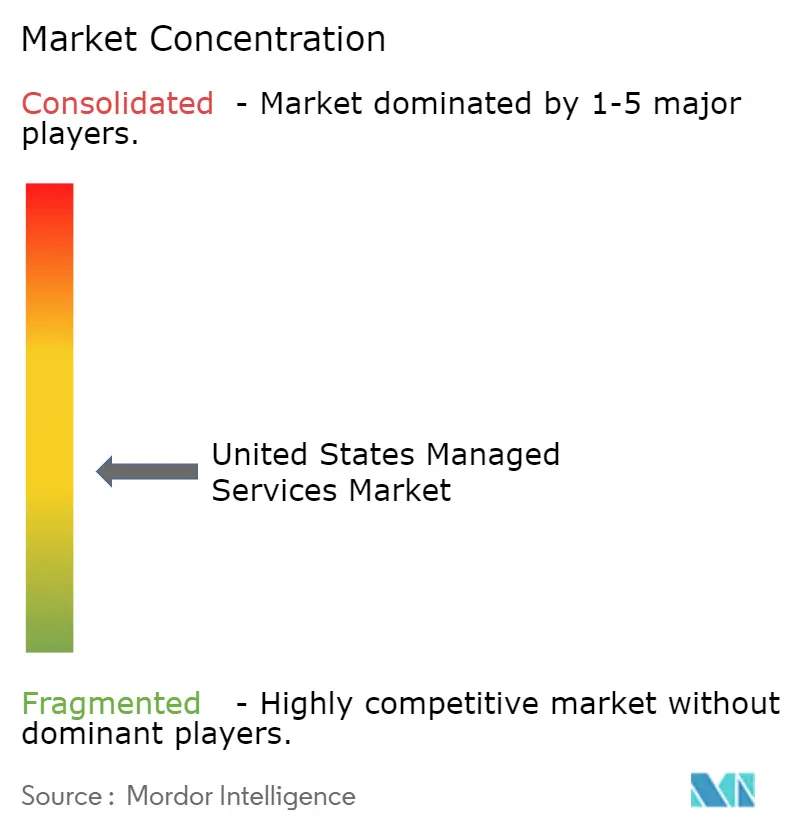
| Market Concentration | Medium |
Major Players *Disclaimer: Major Players sorted in no particular order Image © Mordor Intelligence. Reuse requires attribution under CC BY 4.0. | |
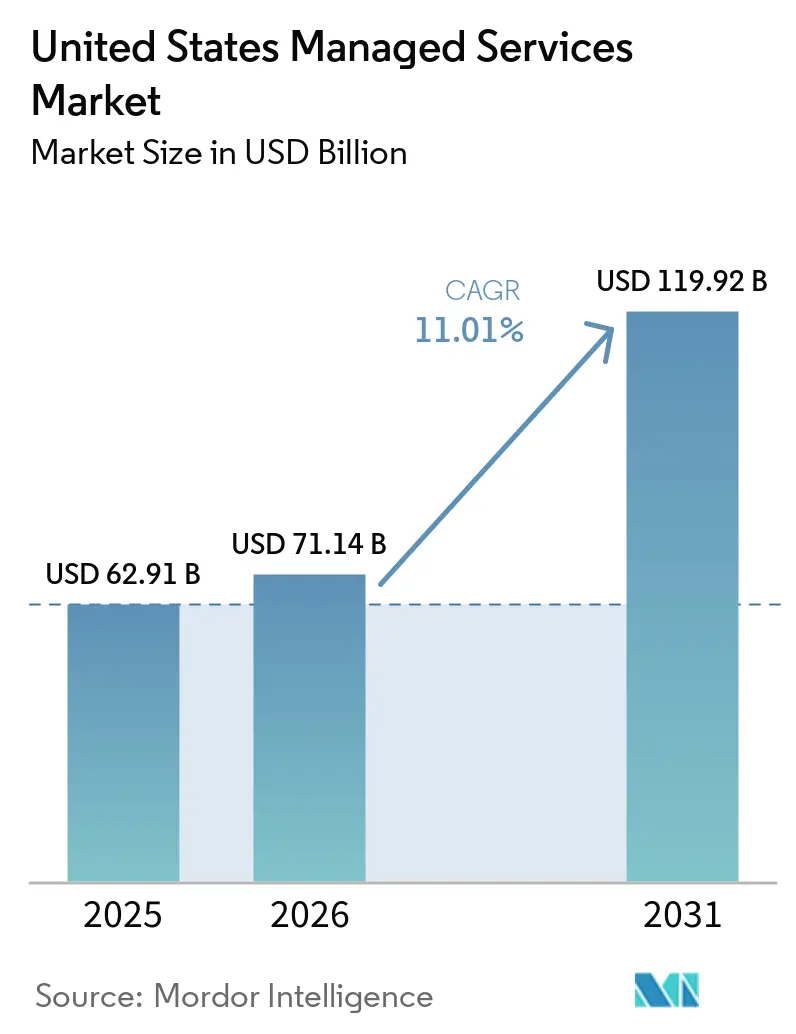
United States Managed Services Market Analysis by Mordor Intelligence
The United States managed services market size is projected to expand from USD 62.91 billion in 2025 and USD 71.14 billion in 2026 to USD 119.92 billion by 2031, registering a CAGR of 11.01% between 2026 to 2031. The expansion rests less on budget growth than on a structural shift toward outsourcing cloud, security, and compliance functions. Mandatory 24/7 monitoring for cyber-insurance renewal, rapid hybrid-cloud sprawl, and Securities and Exchange Commission (SEC) disclosure rules that demand continuous control over third-party risks combine to move spending from capital budgets to operating budgets. Enterprises also view managed services as the fastest path to remedying the skills gap in cloud security architecture, a role that commands an annual compensation of USD 165,000 in major metros. Small and medium enterprises (SMEs) amplify demand because committed-use cloud discounts introduced in 2024 give them cost parity with depreciated on-premise hardware, erasing the rationale for self-hosting.
Key Report Takeaways
- By deployment, cloud-based services held 63.41% of the United States managed services market share in 2025 and are projected to expand at an 11.49% CAGR through 2031.
- By service type, managed data center services led with a 24.68% share in 2025, and managed security services are forecast to advance at a 12.13% CAGR to 2031.
- By enterprise size, SMEs accounted for 57.93% of 2025 spending and are also set to maintain the fastest growth at an 11.46% CAGR through 2031.
- By end-user vertical, BFSI contributed 24.74% of the United States managed services market share in 2025, and healthcare is projected to record the fastest growth at a 12.24% CAGR through 2031.
Note: Market size and forecast figures in this report are generated using Mordor Intelligence’s proprietary estimation framework, updated with the latest available data and insights as of January 2026.
United States Managed Services Market Trends and Insights
Drivers Impact Analysis*
| Driver | (~) % Impact on CAGR Forecast | Geographic Relevance | Impact Timeline |
|---|---|---|---|
| Growing Enterprise Shift Toward Hybrid-Cloud Management | +2.4% | National, with concentration in technology hubs (San Francisco, Seattle, Austin) and financial centers (New York, Charlotte) | Medium term (2-4 years) |
| Surge in Multi-Cloud Complexity Driving Demand for Centralized MSPs | +2.1% | National, particularly acute in retail and healthcare verticals managing AWS, Azure, and Google Cloud simultaneously | Short term (≤ 2 years) |
| Rapid Escalation of Cyber-Insurance Prerequisites | +1.9% | National, with higher impact in regulated industries (BFSI, healthcare, energy) subject to state-level data breach notification laws | Short term (≤ 2 years) |
| SME Preference for OPEX-Based IT | +1.7% | National, with early adoption in service-oriented sectors (professional services, media, SaaS providers) | Medium term (2-4 years) |
| Edge-Computing Rollouts in U.S. Manufacturing Hubs | +1.3% | Regional, concentrated in Midwest manufacturing belt (Michigan, Ohio, Indiana) and Southeast automotive corridors (Alabama, Tennessee, South Carolina) | Long term (≥ 4 years) |
| AI-Ops Automation Boosting MSP Margins | +1.6% | National, with fastest adoption among large MSPs serving Fortune 1000 accounts | Medium term (2-4 years) |
| Source: Mordor Intelligence | |||
Growing Enterprise Shift Toward Hybrid-Cloud Management
U.S. enterprises run hybrid architectures that blend on-premise data centers, multiple public clouds, and edge locations, yet fewer than one-third possess in-house expertise to optimize costs and security. Configuration drift rises 40-60% in such estates, creating vulnerabilities that managed service providers (MSPs) monetize by offering unified policy enforcement and automated workload placement. Banks lead adoption because OCC guidance requires resilience testing across all critical third-party dependencies. MSPs that consolidate monitoring and failover orchestration, therefore, win multiyear contracts that bundle infrastructure with security services.
Surge in Multi-Cloud Complexity Driving Demand for Centralized MSPs
The average enterprise now operates 3.2 public cloud platforms, up from 2.1 in 2022. Fragmented identity and access management increase the attack surface; Verizon attributed 34% of 2024 cloud breaches to misconfigured permissions.[1] Centralized MSPs deploy cloud security posture management tools that scan AWS, Azure, and Google Cloud for deviations from the Center for Internet Security Benchmarks. Retailers and healthcare providers feel pressure because customer-facing apps are shifting to the cloud while payment and EHR systems still reside on-premises. Outsourcing becomes rational when specialist salaries in each hyperscaler’s proprietary stack top USD 180,000, well above SME budgets.
Rapid Escalation of Cyber-Insurance Prerequisites
Ransomware claims of USD 8.2 billion in 2023 pushed insurers to make continuous security operations center (SOC) monitoring a prerequisite for coverage. The Coalition reported that policyholders using managed detection and response services experienced 58% fewer successful ransomware attacks.[2] Quarterly audits and tabletop exercises facilitated by third-party MSPs have turned what was once episodic consulting into recurring revenue. Premium hikes in BFSI and healthcare accelerate demand because managed security spending offsets reduced premiums, yielding a net cost benefit to buyers.
SME Preference for OPEX-Based IT
SMEs favor month-to-month cloud contracts that convert capital investment into predictable operating expenses. Federal Reserve rate increases during 2022-2023 raised borrowing costs, making hardware financing unattractive. MSPs responded with self-service onboarding portals and packaged SLAs priced per user per month, allowing companies with fewer than 250 employees to access enterprise-grade capabilities. The United States managed services market penetration is therefore now higher among SMEs than among firms with 10,000+ employees, contradicting historical patterns.
Restraints Impact Analysis*
| Restraint | (~) % Impact on CAGR Forecast | Geographic Relevance | Impact Timeline |
|---|---|---|---|
| Skills Shortage Inflates U.S. MSP Labor Costs | -1.8% | National, with acute impact in high-cost metros (San Francisco, New York, Boston, Seattle) where cybersecurity talent commands 30-40% wage premiums | Short term (≤ 2 years) |
| Vendor Lock-In Fears Among Regulated Industries | -0.9% | National, concentrated in BFSI and healthcare sectors subject to OCC, FDIC, and HHS vendor management guidelines | Medium term (2-4 years) |
| Rising Compliance Burden From SEC Cybersecurity Rules | -1.1% | National, affecting all public companies and their MSP vendors under SEC's December 2023 incident disclosure requirements | Short term (≤ 2 years) |
| Data-Sovereignty Pushback on Offshore NOC Models | -0.7% | National, with highest impact on defense contractors and critical infrastructure operators subject to CISA reporting mandates | Long term (≥ 4 years) |
| Source: Mordor Intelligence | |||
Skills Shortage Inflates U.S. MSP Labor Costs
CyberSeek recorded 450,000 unfilled cybersecurity roles in 2025.[3] Median compensation for cloud security architects climbed 22% since 2023, compressing margins for labor-intensive service lines such as managed network operations. Providers must either invest in AI-Ops to improve engineer-to-device ratios or accept lower profitability. Large MSPs with proprietary automation gain cost advantages, while smaller firms face consolidation pressure.
Rising Compliance Burden From SEC Cybersecurity Rules
SEC rules effective in December 2023 require public issuers to report material incidents within 4 business days, shifting liability to MSPs that manage detection and response. Providers now purchase errors and omissions policies with cyber riders, raising operating expenses by up to 5%. Contract negotiations increasingly require indemnification clauses that smaller MSPs cannot support, pushing Fortune 1000 accounts toward providers with USD 100 million in liability coverage.
*Our forecasts treat driver/restraint impacts as directional, not additive. The impact forecasts reflect baseline growth, mix effects, and variable interactions.
Segment Analysis
By Deployment: Cloud Consolidation Drives Long-Term Gains
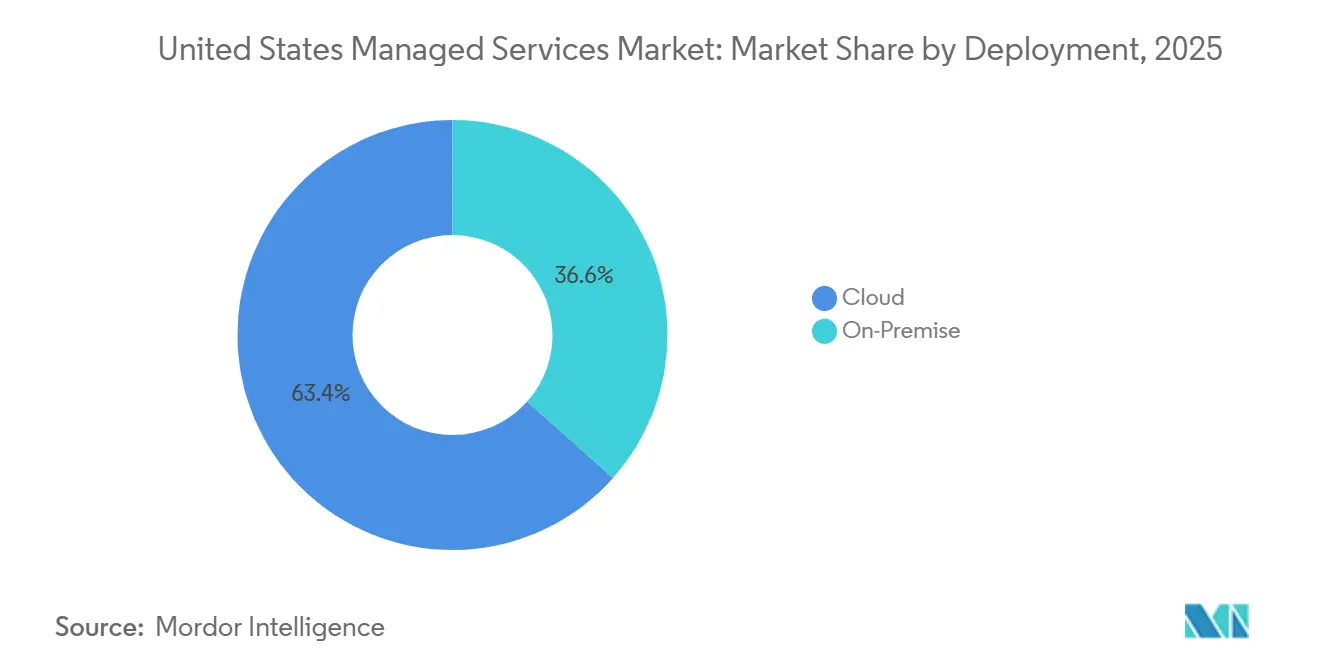
Cloud-based services commanded 63.41% of the United States managed services market share in 2025 and are projected to grow at an 11.49% CAGR through 2031. Committed-use discounts from hyperscalers reduced multiyear cloud costs to parity with depreciated on-premises hardware, erasing capital-expenditure advantages. The United States managed services market for cloud deployments is therefore positioned to surpass USD 75 billion by 2031, while on-premises growth remains muted at single-digit rates. On-premises solutions persist in defense contracting, high-frequency trading, and medical imaging, yet even these verticals are adopting hybrid models, shifting latency-tolerant workloads to public cloud while retaining data-sovereignty-sensitive applications in local environments.
Performance differentials reinforce the cloud trend. Azure-based managed services detect ransomware on average 14 hours faster than on-premises equivalents. CFOs increasingly quantify the opportunity cost of delayed detection, concluding that migration savings outweigh sunk hardware costs. As threat telemetry pooled across thousands of tenants improves machine-learning models, the cloud advantage compounds, locking more enterprises into consumption-based contracts.
By Service Type: Managed Security Extends Lead Over Infrastructure
Managed security services are projected to grow at a 12.13% CAGR through 2031, outpacing the broader United States managed services market. Breach costs averaging USD 4.54 million motivate boards to treat continuous monitoring as business continuity rather than discretionary spend. Managed data center services held a 24.68% share in 2025 but face pricing pressure as hyperscalers automate provisioning. The United States managed services market for security offerings is forecast to eclipse USD 40 billion by 2031, while data center services are forecast to plateau near current levels.
Ransomware-as-a-service lowered barriers to attack, with 68% of incidents in 2024 deleting backups, up from 42% in 2022. A yearly fee of USD 150,000 for 24/7 managed detection compares favorably to potential breach losses, driving uptake among mid-market firms. Compliance catalysts, regulatory requirements such as SEC disclosure rules, and insurer audits are playing a significant role in firmly integrating security outsourcing into the operational budgets of organizations.
By Enterprise Size: SMEs Propel Volume Growth
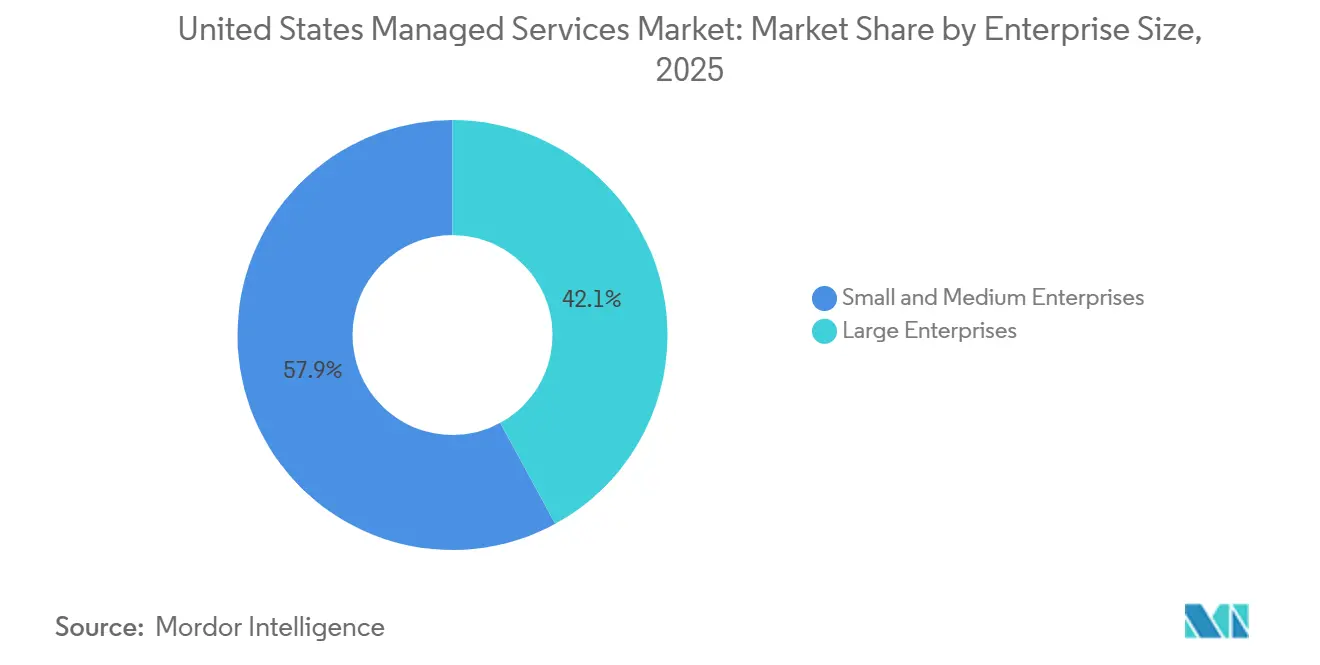
SMEs accounted for 57.93% of the market in 2025 and are expected to grow at an 11.46% CAGR, reshaping provider go-to-market strategies. The United States managed services market size attributable to SMEs is projected to exceed USD 70 billion by 2031 as founders prioritize rapid deployment over custom architectures. Online provisioning portals, fixed-price bundles, and monthly billing align with SME cash-flow cycles, fostering faster adoption than among global enterprises that navigate longer procurement cycles.
Large enterprises still outsource commodity tasks such as endpoint management and help desk support, but retain strategic cloud architecture in-house. As AI-Ops reduces support tickets through predictive remediation, providers reallocate engineering talent to advisory roles, expanding wallet share within both SME and large enterprise accounts. The resulting scale economies allow MSPs to lower per-user pricing, further widening the SME adoption gap.
By End-User Vertical: Healthcare Leads Growth, BFSI Guards Scale
Healthcare is projected to advance at a 12.24% CAGR, the fastest among verticals, fueled by EHR cloud migrations and stringent HIPAA penalties totaling USD 140 million in 2024. The United States managed services market linked to healthcare could exceed USD 18 billion by 2031 as providers adopt packaged HIPAA-compliant security and data analytics services. Specialized MSPs command 25-30% price premiums by bundling encryption key management, audit logging, and incident response tailored to protected health information.
BFSI retained a 24.74% share in 2025, the largest vertical slice, owing to OCC mandates requiring banks to demonstrate ongoing oversight of critical vendors. Zero-trust network architectures and operational-resilience testing drive multiyear contracts that bundle infrastructure, application management, and security under unified SLAs. Retail, IT-telecom, and media segments maintain steady adoption for omnichannel inventory, network operations, and digital rights management. IoT rollouts in manufacturing and energy sectors add incremental demand for edge-computing managed services, although their share remains smaller than in heavily regulated industries.
Geography Analysis
Per-capita spending on managed services is concentrated in technology hubs such as San Francisco, Seattle, and Austin, where venture-backed startups and SaaS vendors favor outsourcing IT to accelerate product releases. Financial centers in New York, Charlotte, and Chicago are driving demand for managed security as banks align with OCC resilience guidance and SEC disclosure requirements. Manufacturing corridors in the Midwest and Southeast adopt edge-computing managed services to support IoT sensor networks that require real-time analytics at plant sites. In the IoT managed services market, IIoT solutions capture real-time data from equipment sensors to provide reports on the machines' cycle times, downtime, and other parameters.
Labor cost differentials influence provider location strategy. Network operations centers in Omaha, Raleigh, and Salt Lake City operate with 25-35% lower wages than those in coastal metros, yet they access graduates from state universities, enabling providers to price commodity services competitively. High-value cloud architecture and threat-hunting roles remain in primary markets to leverage deeper talent pools. However, data-sovereignty constraints under the Cyber Incident Reporting for Critical Infrastructure Act of 2022 push defense contractors to demand on-shore monitoring, limiting the appeal of offshore centers.
Regulatory patchwork adds regional complexity. California’s Consumer Privacy Act and New York’s SHIELD Act impose stricter breach-notification requirements than federal statutes, forcing MSPs to maintain state-specific compliance frameworks. Smaller providers struggle with the legal overhead, driving consolidation toward national MSPs with dedicated regulatory teams. As additional states introduce privacy bills, regional compliance expertise becomes a differentiator in the United States managed services market.
Regulatory Landscape
The United States managed services market operates in a compliance-led environment shaped by cybersecurity disclosure, critical-infrastructure reporting, privacy statutes, and communications modernization actions, all of which influence how MSPs deliver monitoring, incident response, and managed connectivity. SEC cybersecurity incident disclosure rules effective December 2023, which require material incidents to be reported within four business days, continue to raise expectations for continuous detection and third-party risk governance across public issuers and their MSPs. At the state level, privacy and breach-notification regimes such as the California Consumer Privacy Act and New York SHIELD Act add state-by-state process and documentation requirements for national providers.
In 2026, federal actions added new anchors relevant to managed services involving networks, IoT, and AI-enabled operations. The FCC named the ioXt Alliance as Lead Administrator of the Cyber Trust Mark IoT labeling program (April 2026), and NIST published NIST IR 8259 Revision 1 on foundational cybersecurity activities for IoT product manufacturers (April 2026), both of which raise baseline security expectations that MSPs increasingly operationalize for connected-device estates. The FCC also advanced network modernization initiatives in March 2026 through a Report and Order reducing barriers to the transition to IP-based infrastructure, and an NPRM on reforming legacy intercarrier compensation frameworks. In parallel, the White House published AI governance legislative recommendations (March 2026), and an Executive Order on Promoting Advanced Artificial Intelligence Innovation and Security was published in the Federal Register (June 2026), reinforcing the need for providers to embed AI governance, security controls, and documentation into managed service delivery.
Value Chain Analysis
The value chain in the United States managed services market starts with upstream technology and connectivity inputs, including hyperscalers, network and security OEMs, endpoint and IoT device ecosystems, and telecom operators. It then moves into MSP service design and packaging, covering service catalogs, SLAs, automation or AIOps, security operations, FinOps, and compliance playbooks. Delivery is handled through on-shore NOCs or SOCs, field services, and customer success functions that manage recurring operations and renewals. Channel and alliance ecosystems support distribution and expansion, with OEM programs and platform ecosystems such as cloud marketplaces, ITSM suites, and security tooling shaping bundling, pricing, and attach rates across managed security, network, and workplace services.
Integration partners and platform vendors increasingly sit within the delivery layer as MSPs industrialize service operations around standardized workflows and API-driven toolchains. Tech Mahindra partnering with ServiceNow (April 2025) to integrate its netOps.now platform with ServiceNow TMT suites is one example, aimed at unifying operations and automating network rollouts for broadband communication service providers. Rimini Street partnering with T-Systems North America (March 2025) combined software support, managed services, and hosting to support cost reduction and stability. On the connectivity side, Inseego and OneSource partnered (August 2025) on a managed 5G fixed wireless access solution, showing how device and connectivity providers work with MSPs to package lifecycle management into a single managed offer for enterprise buyers.
Competitive Landscape
Top-tier integrators Accenture, IBM, Kyndryl, and Cognizant combine infrastructure, applications, and security into transformational contracts spanning 5 or more years. Together with other global providers, the top 10 vendors captured roughly 45% of 2025 revenue, indicating moderate concentration. Hyperscaler-affiliated MSP programs from Microsoft Azure, Amazon Web Services, and Google Cloud bundle infrastructure consumption with managed services discounts, commoditizing tier-1 support, and deepening client lock-in through proprietary automation.
Specialized MSPs flourish by targeting regulated niches. Providers that package HIPAA-compliant EHR hosting, OCC-aligned operational resilience testing, or FedRAMP-authorized cloud management win contracts that global firms cannot cost-effectively address. Patent activity underscores the shift toward automation. AIOps filings rose 340% between 2023 and 2025, and large incumbents now embed predictive analytics to shrink incident response times. AI-driven remediation lowers labor intensity, allowing niche players to compete on price while protecting margins.
Competitive dynamics increasingly revolve around intellectual-property assets and liability capacity. Providers with proprietary data sets train more accurate anomaly-detection models, widening performance gaps. At the same time, Fortune 1000 buyers demand USD 100 million liability coverage to offset potential SEC fines, favoring vendors with strong balance sheets. The outcome is a bifurcated United States managed services market in which tier-1 integrators and well-capitalized specialists expand share, while small, generalist MSPs consolidate or exit.
United States Managed Services Industry Leaders
-
Accenture plc
-
AT&T Inc.
-
Cisco Systems Inc.
-
Fujitsu Limited
-
IBM Corporation
- *Disclaimer: Major Players sorted in no particular order
Market Opportunities and Future Outlook
Demand is shifting toward managed services that can operationalize security, resilience, and AI-enabled operations under faster incident timelines and more formal vendor oversight, creating room for providers that package governance with measurable run-state outcomes. A concrete proof point is the March 2026 release of the White House 2026 National Cyber Strategy, which highlighted zero-trust architecture and AI-enabled cyber defense. That emphasis aligns with buyer requirements that increasingly bundle managed detection and response, identity controls, and compliance reporting into core outsourcing scopes rather than add-on projects.
Federal and regulated-sector contract vehicles are also an opportunity area where long-duration awards improve spend visibility for managed communications, cloud operations, and secure workplace services. WidePoint being named the single awardee of DHS Cellular Wireless Managed Services (CWMS) 3.0 (June 2026, approximately USD 3.1 billion over 10 years) points to the scale of managed mobility and secure connectivity operations being externalized by agencies. On the supply side, capability build is accelerating through targeted M&A and operating-model shifts, including Cognizant entering a definitive agreement to acquire Astreya (April 2026) to deepen AI-first IT managed services. This supports the broader market shift toward AIOps, automated remediation, and standardized delivery approaches that can address the U.S. skills gap and sustain 24/7 monitoring requirements at scale.
Recent Industry Developments
- July 2026: Cisco and Lumen announced a fully managed network experience in which Lumen provides day-to-day management for Cisco-powered networking solutions. The move tightens the carrier-plus-OEM delivery model for enterprise managed network services and simplifies lifecycle operations by aligning hardware, software, and managed operations under a unified offer.
- February 2026: AT&T announced a collaboration with AWS to migrate workloads to AWS Outposts and implement Amazon Q Developer. The announcement reinforces the hybrid-cloud operations theme in managed services by combining on-premises cloud infrastructure with automation and developer tooling that can be wrapped into ongoing managed operations for enterprise customers.
- October 2025: Microsoft expanded its Azure Expert MSP program with AI-based workload optimization that shifts compute to lower-cost regions during off-peak periods. The update strengthens hyperscaler-partner influence on managed services packaging and pricing, while pushing MSP differentiation toward governance, security, and multi-cloud operations beyond tier-1 cloud support.
Research Methodology Framework and Report Scope
Market Definition and Coverage
For this report, the United States managed services market is defined as recurring revenue earned by third-party providers for running, monitoring, and optimizing a customer's IT environment (infrastructure, networks, security, and collaboration workloads) under ongoing contracts.
Scope exclusions: We exclude one-off consulting projects, break-fix support, cloud license resale margins, and any services delivered outside the United States.
Segmentation Overview
- By Deployment
- On-Premise
- Cloud
- By Service Type
- Managed Data Center
- Managed Security
- Managed Communications
- Managed Network
- Other Service Types
- By Enterprise Size
- Small and Medium Enterprises
- Large Enterprises
- By End-User Vertical
- Banking, financial services and insurance (BFSI)
- IT and Telecom
- Healthcare
- Entertainment and Media
- Retail
- Other End-User Verticals
Data Sources, Market Sizing, and Validation
Desk Research
Desk research was used to define the addressable demand pool and the pricing context before the model was built. We referenced public sources such as the US Bureau of Economic Analysis (IT and cloud spend context), the US Bureau of Labor Statistics (IT employment and wage inflation signals), the National Institute of Standards and Technology (security and controls references), and the Federal Communications Commission (broadband and connectivity indicators that influence managed network demand).
To keep the scope aligned with what is actually purchased, we also reviewed company filings, investor presentations, contract announcements, and reputable technology press coverage on outsourcing cycles and contract terms. Where needed, paid subscriptions were used for company financials and intelligence, news and financials screening, and patent databases to confirm service direction and investment emphasis. The desk sources listed here are illustrative only, and we also used other public materials for collection, validation, and clarification.
Primary Interviews and Surveys
Primary discussions were conducted with managed service providers, channel partners, and enterprise buyers to check how contract structures are set up, how services get attached, and how pricing typically behaves in US deals. We also used these interviews to clarify what is counted as managed services revenue versus adjacent IT services, and to sanity-check assumptions across major US demand hubs and regulated industries.
Distribution of primary research fieldwork respondents
| Company type | Respondent position |
|---|---|
| Top tier: 35% | CXOs: 13% |
| Mid tier: 44% | Functional/Unit leaders: 28% |
| Smaller Players: 21% | Managers: 59% |
Market-Sizing & Forecasting
Sizing starts with a top-down build that reconstructs managed services revenue from US IT services demand pools, and then filters that pool by managed share using contract and workload coverage patterns. This approach keeps the model tied to what customers pay each year before any forecasting assumptions are applied.
Next, the totals are corroborated using selective bottom-up approximations, including sampled provider revenue splits, channel checks on managed network and security bundles, and a simple ASP x client count logic where service catalogs are consistent enough for that method to work. When a company or subcategory has limited disclosure, we handle gaps using peer benchmarks and conservative ranges, then refine those points through interview feedback.
Forecasts are produced using scenario analysis supported by a light multivariate regression check. This is used because the market responds to a small set of drivers that tend to move together. Inputs include cloud and hybrid adoption pace, cybersecurity managed-service attach rates, average contract duration and renewal timing, labor cost inflation affecting delivery pricing, and the mix shift between managed data center, managed network, and managed security. Assumptions are refined until the resulting trends align with the procurement and renewal cycles practitioners describe.
Data Validation & Update Cycle
Validation is done in layers so the final number does not depend on a single data series. We compare outputs against independent signals such as outsourcing demand commentary, broad IT spend direction, and observed pricing moves, and we then review outliers before an estimate is finalized.
Before sign-off, another analyst reviews the model steps, input logic, and calculations. We re-contact sources when a key variable changes or when the spread between indicators looks unusual. Reports are refreshed annually, with interim updates when material events occur, and a final pre-delivery pass is completed so clients receive the most current view.
Mordor Intelligence's United States Managed Services Market Size Compared Against Other Published Estimates
Published market sizes for managed services often differ because each publisher draws the boundary in a slightly different way, and updates pricing and contract assumptions on a different schedule. Differences also show up when sources mix deal value style measures with revenue measures, or when adjacent IT services are included in the same total.
The spread typically comes from refresh cadence and timing choices, including whether the latest contract repricing and wage pressure flow into the current-year ASPs, and whether currency timing and multi-year contract recognition are treated consistently. For that reason, we keep the United States managed services model on a strict annual update cycle with interim checks for major pricing resets in Mordor Intelligence.
Benchmark comparison
| Source | Market Size | Gaps in Research Methodology |
|---|---|---|
| Mordor Intelligence | USD 62.91 B (2025) | |
| Industry Publisher A | USD 84.03 B (2024) | Often presented as a broad managed services total that can fold in adjacent IT outsourcing work and blended contract value assumptions, which can inflate the number versus a recurring revenue-only view. |
| Market Advisory B | USD 88.00 B (2024) | Common gaps include limited clarity on exclusions (such as one-off projects and resale margins) and less transparent handling of ASP progression across renewals, which can push totals higher in fast repricing years. |
The table shows that most of the gap is explained by timing and what gets counted as recurring managed services revenue versus neighboring IT services. By keeping inclusions tight, applying repeatable ASP logic across renewals, and re-checking assumptions when pricing shifts, the final figure stays traceable to clear purchase behavior and can be recalculated when inputs change.
Key Questions Answered in the Report
How large is the United States managed services market in 2026?
The market is valued at USD 71.14 billion in 2026 and is forecast to reach USD 119.92 billion by 2031.
Which service type is growing fastest in managed services?
Managed security services are expanding at a 12.13% CAGR through 2031 as enterprises respond to ransomware and compliance mandates.
Why are SMEs adopting managed services more quickly than large enterprises?
SMEs prefer operating-expense contracts, face higher borrowing costs for hardware, and can onboard through self-service portals that simplify procurement.
What regulation is driving demand for continuous security monitoring?
The SEC’s 2023 cybersecurity disclosure rule requires public companies to report material incidents within four business days, pushing firms toward 24/7 managed detection.
Which vertical shows the highest growth rate?
Healthcare leads, advancing at a 12.24% CAGR, propelled by EHR cloud migration and strict HIPAA enforcement.
How does cloud deployment compare with on-premise in market share?
Cloud-based managed services held 63.41% share in 2025 and continue to grow faster than on-premises alternatives, supported by hyperscaler discounts and superior threat detection.