
Market Overview
| Study Period | 2020 - 2031 |
|---|---|
| Forecast Data Period | 2026 - 2031 |
| Base Year Market Size (2025) | USD 525.08 Billion |
| Market Size (2026) | USD 561.18 Billion |
| Market Size (2031) | USD 792.36 Billion |
| Growth Rate (2026 - 2031) | 7.14 % |
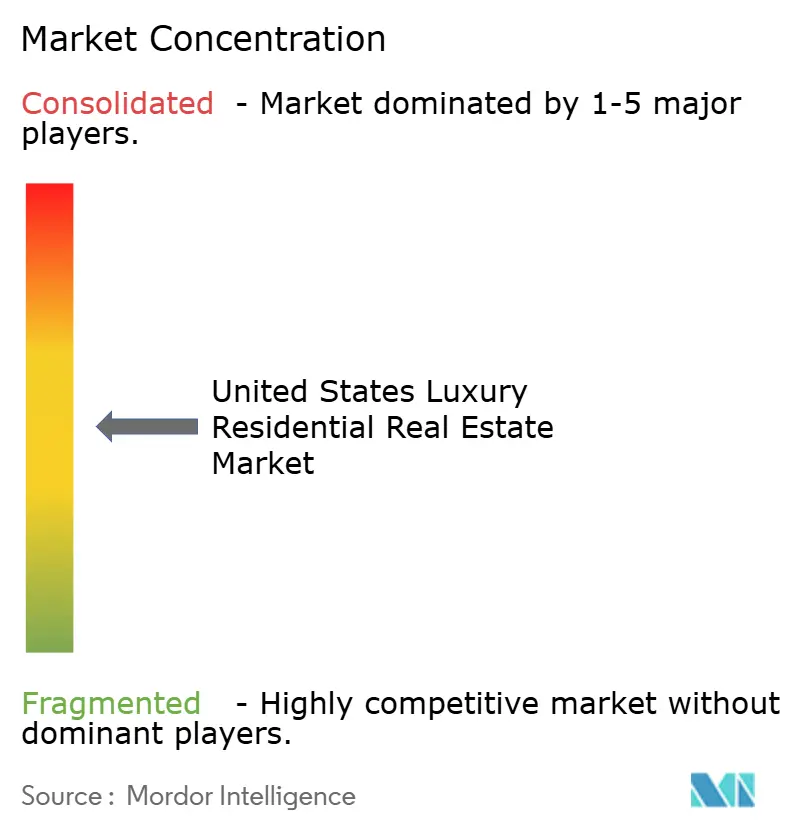
| Market Concentration | Medium |
Major Players *Disclaimer: Major Players sorted in no particular order Image © Mordor Intelligence. Reuse requires attribution under CC BY 4.0. | |
United States Luxury Residential Real Estate Market Analysis by Mordor Intelligence
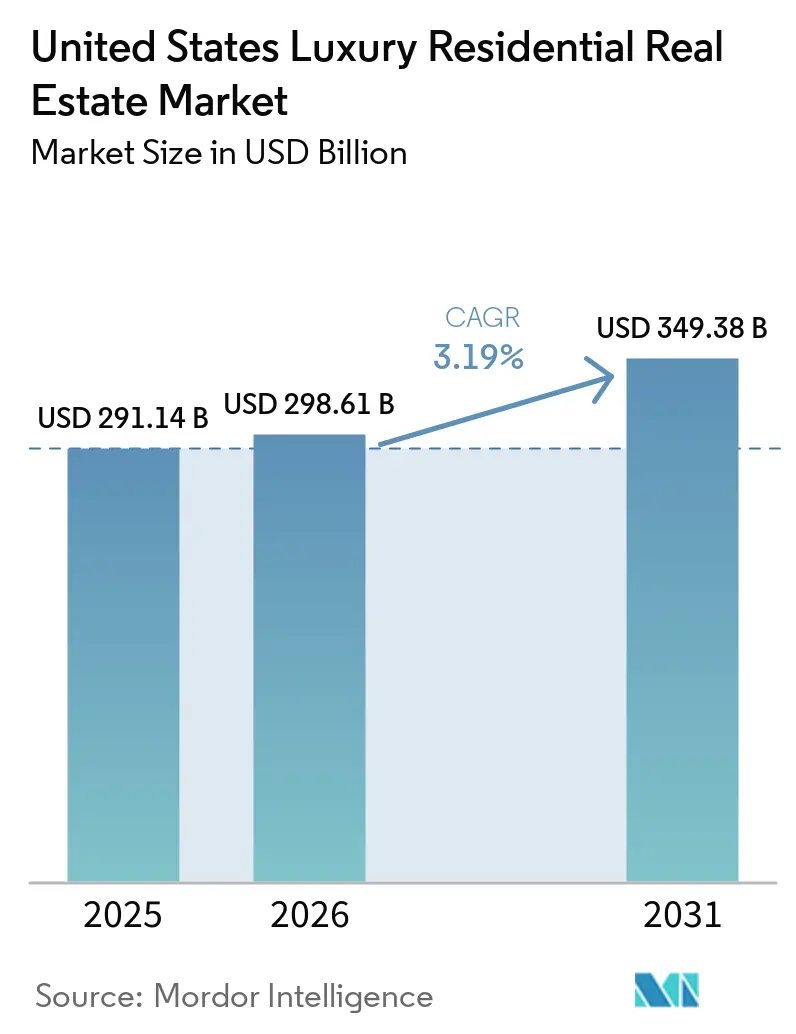
The United States Luxury Residential Real Estate Market size is expected to grow from USD 525.08 billion in 2025 to USD 561.18 billion in 2026 and is forecast to reach USD 792.36 billion by 2031 at 7.14% CAGR over 2026-2031.
Buyers in this tier are shaped by ultra-low luxury resale inventory in prime ZIP codes and a steady pipeline of green-certified new product that signals quality and long-run asset protection. The segment continues to diverge from entry-level housing because a deep cash-buyer pool remains active as a hedge against equity market swings and rate sensitivity. Policy shifts and capital market innovations are also relevant, including EB-5 investor-visa set-asides and the liquidity boost following the approval of spot Bitcoin ETFs in 2024. At the same time, beneficial-owner transparency requirements set by FinCEN are expected to restrain anonymous LLC purchases in several high-priced transaction categories beginning in 2026.[1]
Key Report Takeaways
- By business model, sales accounted for 62.98% of the United States luxury residential real estate market share in 2025, while the rental segment is forecast to grow at a 9.12% CAGR through 2031.
- By property type, apartments and condominiums accounted for 75.63% of the United States luxury residential real estate market size in 2025, while villas and landed houses are forecast to grow at a 6.62% CAGR through 2031.
- By mode of sale, secondary sales (existing home resales) accounted for 83.37% of the United States luxury residential real estate market share in 2025, while primary sales (new-build homes) are forecast to grow at a 6.27% CAGR through 2031.
- By region, the West accounted for 50.57% of the United States luxury residential real estate market share in 2025, while the Southwest is forecast to grow at a 7.44% CAGR through 2031.
Note: Market size and forecast figures in this report are generated using Mordor Intelligence’s proprietary estimation framework, updated with the latest available data and insights as of January 2026.
United States Luxury Residential Real Estate Market Trends and Insights
Drivers Impact Analysis*
| Drivers | (~) % Impact on CAGR Forecast | Geographic Relevance | Impact Timeline |
|---|---|---|---|
| Ultra-low existing-home inventory in prime ZIP codes | +0.8% | West (California coastal markets), Northeast (Hamptons, Manhattan), Southeast (Miami, Naples) | Medium term (2-4 years) |
| Resilient cash-buyer segment hedging against equity & rate volatility | +0.7% | National, with spillover intensity in Florida, Texas, and Arizona | Short term (≤ 2 years) |
| Surge in green-certified luxury builds | +0.6% | Global, with early gains in California (LEED), Massachusetts, Colorado, and Washington state | Long term (≥ 4 years) |
| EB-5 investor-visa quota expansion unlocking fresh foreign capital (2025 rule change) | +0.5% | APAC core, spillover to Southeast (Florida), West (California), Northeast (New York) | Medium term (2-4 years) |
| Approval of spot Bitcoin ETFs unleashing crypto-investor liquidity into trophy homes | +0.4% | West (California, tech hubs), Southeast (Miami), select Southwest (Austin) | Short term (≤ 2 years) |
| Source: Mordor Intelligence | |||
Ultra-Low Existing-Home Inventory in Prime ZIP Codes
Ultra-low existing-home inventory in prime U.S. luxury ZIP codes is driven by a persistent lock-in effect from sub-4% mortgage rates held by existing owners, discouraging resale. Wealth preservation behavior among high-net-worth households favors holding trophy assets amid market volatility. Zoning restrictions, slow permitting, and community opposition constrain new supply in elite neighborhoods. Additionally, intergenerational wealth transfers, foreign capital inflows, and cash-heavy buyers reduce turnover, while premium lifestyle migration to tax-advantaged states intensifies demand, further compressing available inventory in top-tier luxury markets.
Resilient Cash-Buyer Segment Hedging Against Equity and Rate Volatility
Resilient cash-buyer segment is driven by elevated equity-market volatility, prolonged high interest rates, and growing demand for capital preservation. High-net-worth individuals increasingly deploy cash to avoid financing costs, execution delays, and credit-market uncertainty while securing negotiating leverage and price discounts. Wealth migration, strong stock-market gains over prior cycles, and rising allocations toward hard assets further support cash purchases, positioning luxury homes as inflation-resilient stores of value and portfolio diversification tools amid macroeconomic uncertainty.
Surge in Green-certified Luxury Builds (LEED, WELL)
Ultra-low luxury resale inventory continues to define the United States luxury residential real estate market, steering demand to new-builds and supporting pricing in core ZIP codes. Even with a 2026 national inventory uptick forecast, ultra-prime areas remain structurally tight, which benefits developers with ready-to-build entitlements. Cash buyers are particularly active as they are less sensitive to rate swings, which helps stabilize contract activity during periods of broader market volatility. In practice, this has reinforced absorption for branded and amenitized towers in technology and finance employment hubs. The net effect is steady transaction throughput at the high end despite mixed signals in mass-market housing.
EB-5 Processing Bottlenecks and Carryover Visas
While EB-5 set-asides are a tailwind, ongoing administrative bottlenecks have slowed the conversion of interest into completed investments. FY2024 ended with nearly 2,900 carryover visas unused, reflecting a gap between program design and on-the-ground execution. For developers relying on EB-5-linked presales or financing, longer processing timelines can impact project phasing. The constraint is time-bound and solvable, but it affects near-term capital availability and staging decisions. As processing efficiency improves, the medium-term drag is likely to ease, unlocking deferred demand.[2]
Restraints Impact Analysis*
| Restraints | (~) % Impact on CAGR Forecast | Geographic Relevance | Impact Timeline |
|---|---|---|---|
| Construction-input inflation squeezing developer margins | -0.7% | National, with acute pressure in the West (California), the Northeast (New York) | Short term (≤ 2 years) |
| Climate-risk-driven insurance-premium spikes & carrier withdrawals in coastal/wildfire zones | -0.6% | Southeast (Florida), West (California, wildfire zones), Southwest (Texas coastal) | Medium term (2-4 years) |
| FinCEN's nationwide beneficial-owner disclosure rule dampening anonymous LLC purchases | -0.4% | National, with concentrated impact in Florida, New York, California | Short term (≤ 2 years) |
| Proposed federal luxury-home transfer tax (2–5%) creating price uncertainty for USD 5 million-plus deals | -0.3% | National, if enacted; precedent set by state/local levies (New Jersey, Los Angeles, Rhode Island) | Long term (≥ 4 years) |
| Source: Mordor Intelligence | |||
Construction-input Inflation Squeezing Developer Margins
U.S. residential construction costs remain elevated despite post-2022 moderation, with renewed pressure in 2025 driven by steel, lumber, gypsum inflation, and higher tariffs. Margin compression is prompting project delays, while scale luxury builders protect profitability through pricing power. Developers are increasingly adopting modular construction to shorten timelines and reduce material waste, despite higher upfront capital requirements.
Climate-risk-driven Insurance-premium Spikes & Carrier Withdrawals in Coastal/Wildfire Zones
U.S. homeowners insurance stress has intensified, with non-renewals in Florida and California exceeding 3% in 2024 as major insurers reduced exposure amid rising construction costs and climate risk. California’s FAIR Plan exposure surged to USD 650 billion by mid-2025. Luxury homes face higher non-renewal risk, constraining liquidity, while escalating disaster losses and insurance inflation drive underinsurance despite selective self-insurance by ultra-wealthy buyers.
*Our forecasts treat driver/restraint impacts as directional, not additive. The impact forecasts reflect baseline growth, mix effects, and variable interactions.
Segment Analysis
By Property Type: Apartments and Condominiums define the center of gravity
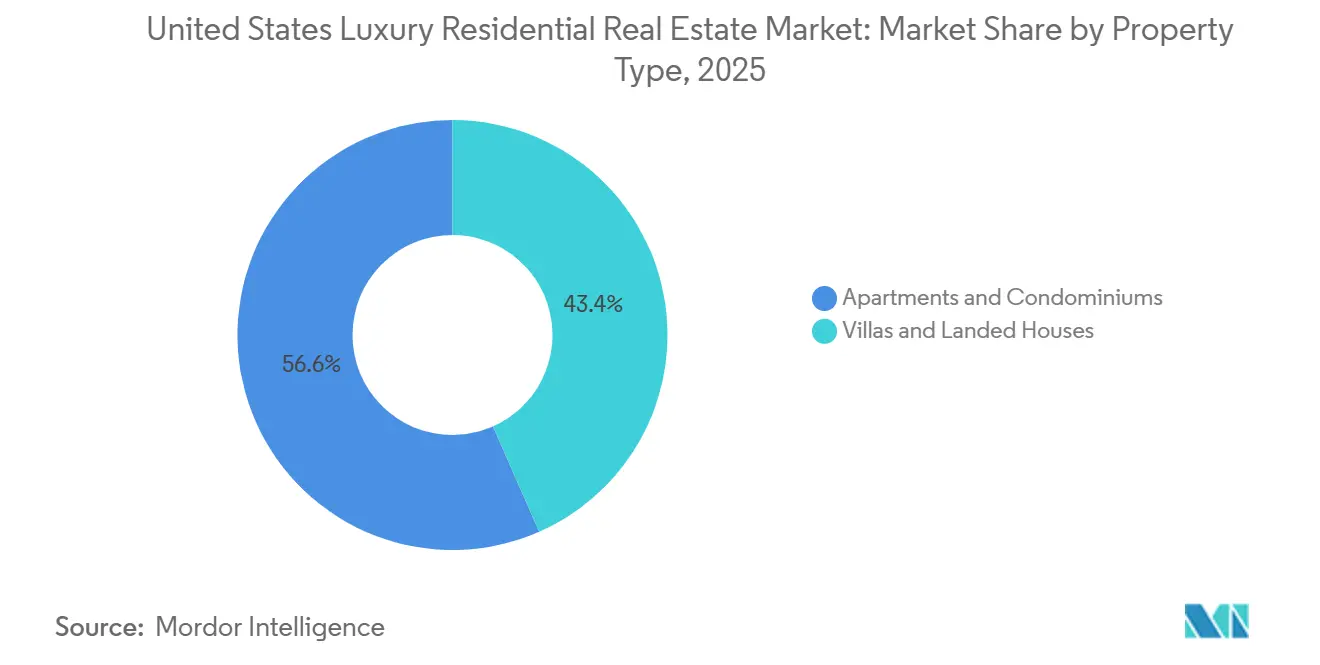
The apartments and condominiums segment accounted for 75.63% of the market share in 2025. The villas and landed houses segment is projected to grow at a 6.62% CAGR during 2026–2031. Sales retain primacy in gateway and resort markets favored by global wealth, while high-end rentals benefit from flexibility demand among executives and relocating families.
The United States luxury residential real estate industry is also seeing rental offerings integrate ESG-forward designs and hospitality-grade services. Operators are layering co-working spaces, wellness amenities, and concierge services to attract tenants who value experience parity with ownership properties. Asset managers and developers continue to rebalance exposure as capital costs shift and as valuations normalize from post-pandemic peaks. Sales channels remain strong in the ultraluxury tier, supported by cash buyers and international interest where policy and tax profiles are favourable. Over the forecast horizon, both channels should contribute meaningfully to the United States luxury residential real estate market as consumer preferences diversify.[3]

By Mode of Sale: Secondary listings lead while new-builds quicken
The secondary (existing home resales) segment accounted for 83.37% of the market share in 2025. The primary (new-build) segment is projected to grow at a 6.27% CAGR during 2026–2031. Longer marketing timelines in late 2025 show normalization from the post-2021 surge, which improves buyer optionality and deal diligence at the top end. Developers with strong presale strategies and brand affiliations remain well-positioned to benefit from tight resale conditions. The United States luxury residential real estate market size for new-builds is supported by projects that combine climate resilience, hospitality services, and curated amenities.
The United States luxury residential real estate industry will continue to balance resale depth with targeted ground-up deliveries in high-demand corridors. In metros where urban rezoning and master-planned communities unlock scale, primary supply can grow without overshooting demand. Where legacy neighborhoods dominate, renovations and conversions will shape a portion of inventory turnover while preserving character assets. The interplay of these pathways supports steady absorption and price discipline into the forecast period. Market participants will use pricing, staging, and capital partnerships to align offerings with evolving household portfolios.
By Business Model: Sales dominate while rentals gain favor
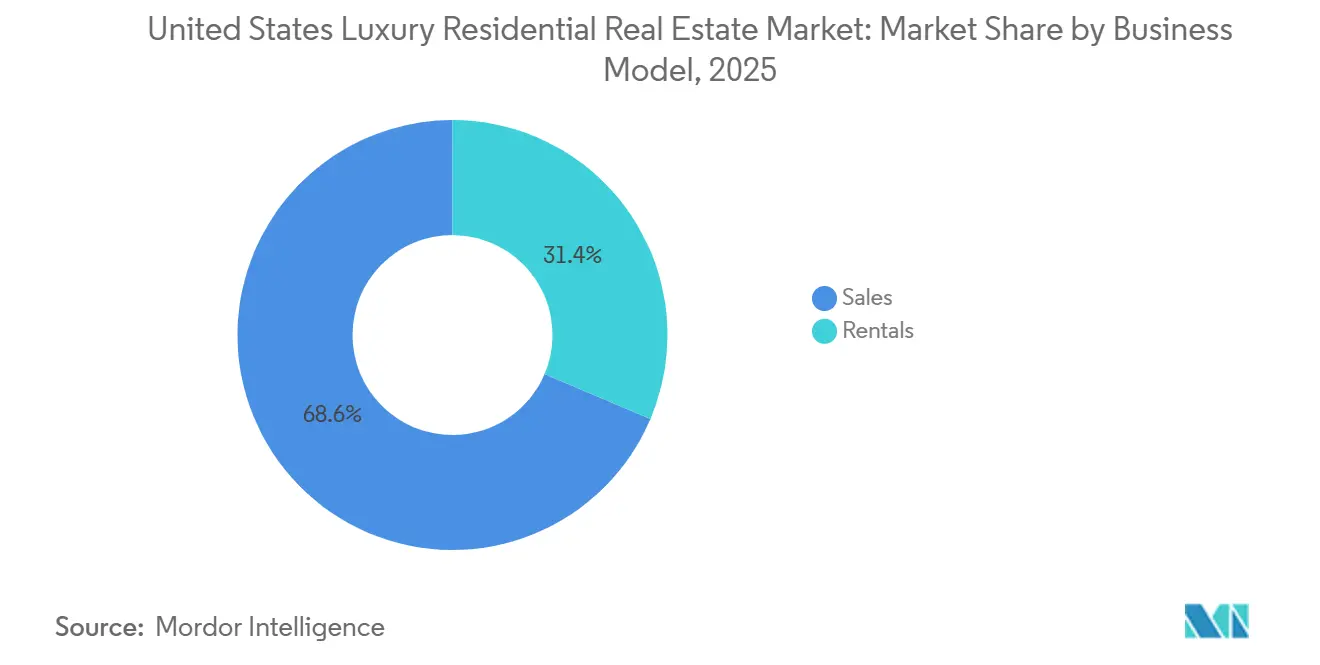
Sales accounted for the largest revenue slice at 62.98% in 2025, while Rentals are forecast to expand at a 9.12% CAGR through 2031, signaling a durable two-track model for the sector. Sales retain primacy in gateway and resort markets favored by global wealth, while high-end rentals benefit from flexibility demand among executives and relocating families. The United States luxury residential real estate market size attached to Rentals is indirectly supported by institutional platforms that professionalize management and amenity delivery, which improves tenant retention. Notable portfolio moves include partnerships that scale single-family rental operations and sharpen asset-light strategies across cycles. In urban cores, luxury lease-up periods remain healthy when projects are tied to employment clusters and transit.
Geography Analysis
The West held 50.57% of the United States luxury residential real estate market share in 2025, while the Southwest is projected to be the fastest-growing region at a 7.44% CAGR through 2031. California’s technology corridors and coastal enclaves continue to anchor luxury demand, supported by branded residences and trophy projects that attract global buyers. Timed openings near major corporate campuses enhance absorption, especially where premium amenities and sustainability features are standard. Arizona’s large-scale master plans and Nevada’s entertainment-led urban cores add breadth to the West’s pipeline. Transaction pacing reflects a normalization from the 2021 to 2022 rush, yet cash-ready buyers sustain clearance for scarce high-quality listings.
The Southeast benefits from a favorable tax profile, influx of corporate relocations, and year-round lifestyle, all of which draw primary and second-home buyers to Florida’s coastal metros. Miami’s luxury ecosystem continues to benefit from international capital, hospitality brands, and finance and technology migration, lifting presales for branded towers and high-end waterfront homes. Brokerage network expansions into Northeast Florida further broaden reach in growth corridors anchored by significant urban redevelopment. South Florida remains a focal point for penthouse launches and hospitality-branded residences that extend services and cachet to owners. Across major Southeastern metros, new luxury offerings balance design, amenities, and location to meet rising expectations from global buyers.
The Northeast retains a deep base of legacy luxury neighborhoods in Manhattan and coastal Connecticut, while Boston’s biotech economy sustains high-end condo demand. Trophy developments in New York City continue to set benchmarks for design and height, appealing to global collectors of iconic addresses. In the Mid-Atlantic, Virginia’s master-planned communities are seeing new institutional and multinational developer partnerships that broaden high-end rental and for-sale supply. The Midwest remains selective, with demand strongest in central business districts and lakefront corridors where new-build efficiency and amenities meet lifestyle expectations. Overall, the United States luxury residential real estate market remains diversified by geography, with each region leveraging distinct demand drivers and development models.
Regulatory Landscape
Regulation affecting luxury residential transactions and development in the United States is tightening around transparency, valuation governance, and fair-housing compliance, while parts of the 2026 federal agenda also focus on faster project approvals for housing supply. On valuation and lending controls, the CFPB and partner agencies finalized the Automated Valuation Models (AVMs) rule in June 2024 under Dodd-Frank quality-control requirements. Federal agencies also finalized interagency guidance in July 2024 on Reconsiderations of Value (ROV), which increases compliance expectations for lenders and appraisal processes used in high-value and jumbo lending.
On supply-side approvals and program administration, March 2026 federal action included an executive order directing agencies to remove regulatory barriers to home construction by reviewing permitting and environmental requirements. HUD issued an interim final rule in June 2026 removing Environmental Clearance Officer review and comment requirements for assessments tied to projects over 200 lots or dwelling units. In June 2026, HUD also announced policy changes to its FHA Single Family mortgage insurance program, and in May 2026 it issued Fair Housing Act-related enforcement guidance. These updates shape operating requirements for developers, property managers, lenders, and brokers, even in segments where luxury buyers are less dependent on FHA financing.
Value Chain Analysis
The luxury residential value chain in the United States begins with land sourcing and entitlement (zoning, community review, environmental clearance), then moves through architecture and engineering, general contracting and specialty trades, and procurement and installation of premium components (custom millwork, high-end appliances, glazing, HVAC, and smart-home systems). Downstream, luxury inventory is marketed and distributed through brokerages and developer sales teams, with transaction execution supported by mortgage providers (including jumbo), title and escrow, attorneys, inspection and appraisal services, and post-close services such as property management, concierge operations, and renovation contractors for secondary-market upgrades.
Recent frictions in the chain are linked to long-lead imported finishes and higher, more volatile construction inputs, which has pushed builders and custom-home teams toward earlier procurement, off-site warehousing, and contract structures that share cost risk with buyers, including more cost-plus and escalation clauses. Tariff and materials uncertainty has also increased substitution efforts toward domestic products where specifications allow, shifting bottleneck risk toward permitting speed and schedule coordination across specialty trades for green-certified, high-amenity builds in prime ZIP codes.
Competitive Landscape
Competitive intensity is rising as scale players consolidate brokerage networks and developers streamline capital structures for asset-light growth. In January 2026, Compass completed a USD 1.7 billion all-stock acquisition of Anywhere Real Estate, bringing Century 21, Coldwell Banker, and Sotheby’s International Realty under a combined platform of 340,000 agents with USD 225 million to USD 255 million in expected annual cost synergies. The transaction expands luxury reach and suburban coverage and creates broader lead-generation and cross-referral capabilities in top-tier ZIP codes. Luxury buyers and sellers benefit from improved data, marketing reach, and multi-brand matching across the same corporate umbrella. This consolidation theme supports the operational backbone of the United States luxury residential real estate market in 2026.
Developers are also refining portfolios through targeted acquisitions and divestitures to enhance focus and liquidity. In November 2025, Kennedy Wilson closed on the acquisition of Toll Brothers Apartment Living’s platform for USD 347 million, adding USD 5 billion in assets under management and an 18-property GP interest footprint along with a 29-site development pipeline, which strengthens institutional capabilities in luxury multifamily. In February 2025, Lennar expanded into five states through the acquisition of Rausch Coleman Homes’ homebuilding operations, while separately spinning off land assets to Millrose Properties as part of an asset-light strategy. These moves show how operators are balancing development risk with scalable management platforms and capital-efficient structures. Together, these shifts underpin a resilient base for the United States luxury residential real estate market through the forecast window.
Product differentiation at the top end continues to hinge on hospitality partnerships, climate resilience, and experiential amenities. High-visibility launches and penthouse offerings signal continued appetite for nine-figure and eight-figure trophy homes in coastal destinations with strong global connectivity. Select developers are also channeling large capital programs into data center adjacencies and mixed-use hubs that bring employment and infrastructure benefits to surrounding luxury neighborhoods. Brokerage brands are expanding internationally and deepening footprints in high-growth U.S. metros, helping to match global buyers with differentiated U.S. listings across formats and price tiers. The result is a competitive field where brand strength, capital agility, and ESG-aligned design set the pace in the United States luxury residential real estate market.
United States Luxury Residential Real Estate Industry Leaders
-
Toll Brothers City Living
-
Lennar Corp (CalAtlantic Luxury)
-
Howard Hughes Corp
-
Extell Development
-
Related Group
- *Disclaimer: Major Players sorted in no particular order
Market Opportunities and Future Outlook
White space is emerging where new-build supply addresses buyer friction tied to ultra-low resale inventory in prime ZIP codes, especially through green-certified and resilience-forward product designed to limit long-run operating costs and improve insurability. Climate-risk-driven insurance stress is pulling design and underwriting discussions earlier in the purchase cycle, which creates an opening for developers and renovators to deliver hardened envelopes, upgraded mechanicals, and disaster-readiness packages in coastal and wildfire-exposed luxury corridors.
Platform-scale brokerage and operating models are another opportunity as the market places more emphasis on data, marketing reach, and cross-referral in high-value geographies. A clear proof point is the January 2026 consolidation of Compass and Anywhere Real Estate, which brought major brokerage brands under one platform and strengthened distribution for trophy listings and new development sales programs. On the development side, high pre-sold rates in large-format luxury towers and continued launches of luxury communities by national builders support demand for curated, amenitized product, while procurement-led differentiation, including securing long-lead finishes and controlling timelines, is increasingly becoming a practical advantage for delivering primary inventory.
Recent Industry Developments
- July 2026: Toll Brothers announced multiple luxury community milestones, including the grand opening of Vista Ventana in La Mirada, California. The launch expands Toll Brothers footprint in Southern California luxury townhome-style product and supports primary-market supply in a high-cost, inventory-constrained corridor. It also signals that builders are still prioritizing smaller, premium communities where absorption can be managed tightly.
- June 2026: Howard Hughes opened The Park Ward Village residential tower in Honolulu, Hawaii, delivering 546 homes with a 97% pre-sold rate. The high pre-commitment level underscores the role of master-planned and mixed-use ecosystems in de-risking luxury delivery and supporting price discovery before completion. It also reinforces demand for design-driven, amenitized vertical living in select urban nodes.
- November 2025: Kennedy Wilson closed its USD 347 million acquisition of Toll Brothers Apartment Living, adding a scaled multifamily platform and a large development pipeline. The transaction strengthens institutional capabilities across luxury rentals and for-sale adjacent residential operations, improving access to projects, operating expertise, and capital partnerships. It also reflects ongoing consolidation among sponsors to manage development risk and expand national reach.
Research Methodology Framework and Report Scope
Market Definition and Coverage
This market covers the total value of luxury residential property transactions in the United States, counted at the closing value for sales and the contract value for rentals, focused on high-end homes in the top end of local price bands.
Scope exclusions: We exclude commercial mixed-use towers, fractional ownership structures, timeshares, and hotel-style serviced apartments.
Segmentation Overview
- By Business Model
- Sales
- Rentals
Data Sources, Market Sizing, and Validation
Desk Research
Desk research helped us set the market boundary and build a clean data spine before speaking with industry participants. We used public sources such as the US Census Bureau (building permits and completions), Bureau of Labor Statistics (CPI and employment series linked to housing services), and Federal Reserve releases tied to interest rates, mortgage conditions, and household balance sheets.
To anchor transaction and pricing behavior, we also reviewed National Association of Realtors releases, Federal Housing Finance Agency (FHFA) home price index updates for directional price movements, and US Department of Housing and Urban Development (HUD) publications that describe housing conditions and supply programs. County recorder and assessor style disclosure summaries and local government housing dashboards were referenced where available, and reputable press was used to track luxury inventory narratives and shifts in buyer sentiment. Company filings, investor presentations, and a paid subscription for company financials and news were used selectively to sanity check exposure to luxury transactions and market timing commentary. The sources named here are illustrative, and many other public materials were also used for data collection, validation, and clarification.
Primary Interviews and Surveys
Primary interviews and surveys were used to close the gaps that public datasets cannot answer cleanly, especially around how metros define luxury and how pricing responds when inventory is thin. We spoke with a mix of brokerages, developers, appraisers, and related service firms, and we balanced inputs across major coastal markets and interior luxury hubs so local seasonality and financing sensitivity were not overstated.
Distribution of primary research fieldwork respondents
| Company type | Respondent position |
|---|---|
| Top tier: 39% | CXOs: 15% |
| Mid tier: 46% | Functional/Unit leaders: 30% |
| Smaller Players: 15% | Managers: 55% |
Market-Sizing & Forecasting
The sizing work starts with a top-down build where national housing transaction value is reconstructed from sales activity and price signals, then narrowed to the luxury share using metro-level luxury thresholds and the observed concentration of high-ticket deals. To keep the model realistic, the totals are corroborated with selective bottom-up checks, such as sampled luxury deal counts in key metros multiplied by typical closing values, then paired with channel checks on new-build versus resale mix.
Inputs that materially move the model include luxury listing inventory and absorption, mortgage rate direction and jumbo loan availability, cash-buyer share, new luxury permits and completions, and metro price growth at the high end (which affects ASP progression). For forecasting, we use scenario analysis supported by a simple multivariate regression layer, where rate paths, inventory normalization, and high-end price growth are stress tested and then aligned to what interviewees expect for buyer sentiment and supply pipelines. Where data is thin for smaller metros, we use proxy indicators like high-end price indices and building activity and then scale conservatively to avoid overstating the luxury pool.
Data Validation & Update Cycle
Validation is handled through several passes so the final number is not driven by a single dataset. We compare outputs against independent signals like reported luxury sales share in key metros, permit and completion trends for premium builds, and movements in high-end median prices. If variance is large, we review the underlying assumptions and re-check the source series.
Before sign-off, the model is reviewed by another analyst for logic consistency, unit alignment, and year-on-year movement, and follow-up calls are made when a key variable shifts faster than expected. Reports are refreshed annually, and interim updates are made when material events occur, such as major rate changes or sharp inventory resets. Right before delivery, we run a final update pass so clients receive the latest consistent view.
Mordor Intelligence's United States Luxury Residential Real Estate Market Size Compared With Other Published Estimates
It is normal to see different market sizes for luxury housing because authors choose different luxury cutoffs, count sales versus rentals differently, and sometimes mix asking prices with closed transaction values. Timing also affects results, since housing values swing with seasonality and interest rates, so a change in the capture window can move the total.
When the price series is refreshed and the currency timing is held to one consistent year, and then ASP progression is checked against realized closing values in key luxury metros, the resulting total stays anchored to transactions rather than headline listings, a discipline applied by Mordor Intelligence.
Benchmark comparison
| Source | Market Size | Gaps in Research Methodology |
|---|---|---|
| Mordor Intelligence | USD 291.14 B (2025) | |
| Trade Journal A | USD 289.38 B (2024) | Uses a prior-year snapshot and does not clearly state whether values are based on closed prices or a blend of list and sale prices, which can shift the implied luxury ASP when markets change quickly. |
| Global Consultancy B | USD 313.54 B (2026) | Starts from a forward year and may apply a higher luxury-share uplift from price-tier assumptions, and the definition of luxury appears broader, which can pull in adjacent upper-premium homes. |
Overall, the spread is mainly explained by year selection and how luxury thresholds and pricing are applied across metro areas. By keeping the scope tied to closed transaction value and then checking the assumptions with market participants, the number stays traceable to clear inputs and can be repeated when new releases arrive.
Key Questions Answered in the Report
What is the size and expected growth of the United States luxury residential real estate market by 2031?
The market has a 2026 market size of USD 561.18 billion and is projected to reach USD 792.36 billion by 2031 at a 7.14% CAGR.
Which property type leads and which is growing fastest in U.S. luxury housing?
Apartments and condominiums led with 75.63% share in 2025, while villas and landed houses are the fastest growing at a projected 6.62% CAGR through 2031.
How are sales and rentals performing in high-end U.S. housing?
Sales accounted for 62.98% of 2025 activity, while Rentals are projected to grow at a 9.12% CAGR through 2031 as institutional platforms scale premium offerings.
Which sales channel is stronger today in U.S. luxury housing, and how will new-builds trend?
Secondary listings held a 83.37% share in 2025, while Primary new-builds are projected to grow at a 6.27% CAGR due to tight resale supply.
Which U.S. region currently leads and which is forecast to grow fastest in luxury housing?
The West led with 50.57% share in 2025, and the Southwest is projected to be the fastest-growing region at a 7.44% CAGR through 2031.
What regulatory and capital-market shifts are affecting luxury real estate buyers in the U.S.?
EB-5 set-asides are unlocking foreign capital, spot Bitcoin ETFs have added liquidity for some buyers, and FinCEN’s beneficial-owner rule is curbing anonymous LLC purchases.