
Market Overview
| Study Period | 2021 - 2031 |
|---|---|
| Forecast Data Period | 2026 - 2031 |
| Base Year Market Size (2025) | USD 490.86 Billion |
| Market Size (2026) | USD 525.32 Billion |
| Market Size (2031) | USD 737.42 Billion |
| Growth Rate (2026 - 2031) | 7.02 % |
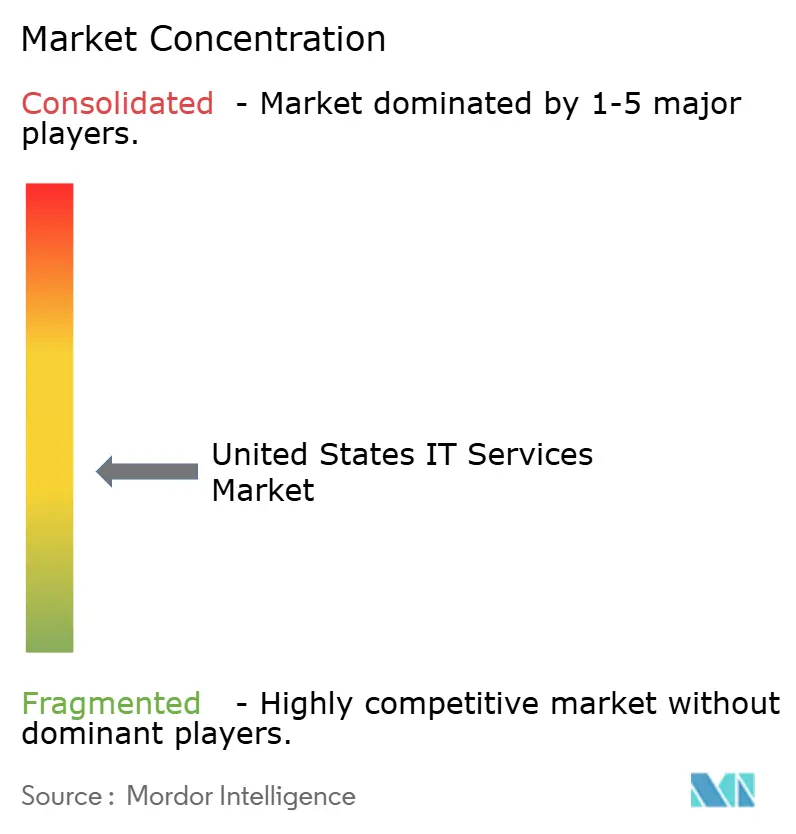
| Market Concentration | Medium |
Major Players *Disclaimer: Major Players sorted in no particular order Image © Mordor Intelligence. Reuse requires attribution under CC BY 4.0. | |
United States IT Services Market Analysis by Mordor Intelligence
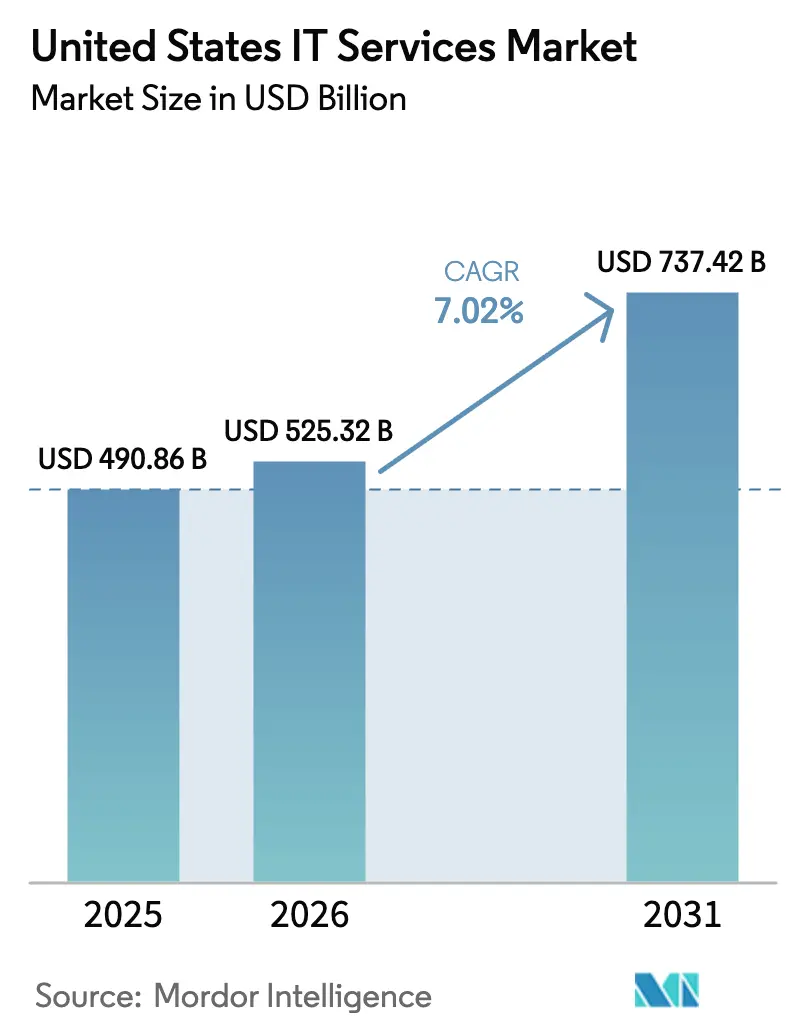
The United States IT Services market size was valued at USD 490.86 billion in 2025 and is estimated to grow from USD 525.32 billion in 2026 to reach USD 737.42 billion by 2031, at a CAGR of 7.02% during the forecast period (2026-2031). The growth outlook reflects a decisive pivot from labor-arbitrage contracts to outcome-linked engagements, a shift driven by federal zero-trust mandates, generative-AI pilots, and healthcare interoperability deadlines. Enterprises now prize integration depth and measurable business impact over simple cost take-outs, reshaping vendor selection criteria toward FedRAMP-authorized cloud platforms, identity-fabric expertise, and edge-compute orchestration capabilities. Spending momentum is amplified by the Technology Modernization Fund’s 42% lift in fiscal-2026 appropriations, Fortune 1000 experimentation with large-language-model toolchains, and a nationwide 5G-plus-edge rollout that demands low-latency integration skills. Competitive dynamics remain fluid as outcome-based pricing transfers delivery risk to service providers, while offshore wage inflation and California privacy compliance squeeze margins.
Key Report Takeaways
- By service type, Managed Services led with 27.46% share in 2025, whereas Cybersecurity Services is forecast to expand at an 8.42% CAGR through 2031.
- By deployment model, Onshore Delivery retained 54.63% share in 2025, while Nearshore Delivery is projected to post an 8.87% CAGR over 2026-2031.
- By engagement model, Managed Services and outcome-based contracts commanded 41.21% share in 2025 and are expected to accelerate at a 12.96% CAGR to 2031.
- By organization size, Large Enterprises accounted for 60.84% of 2025 spend, yet Small and Medium Enterprises are poised to grow at an 8.63% CAGR through 2031.
- By end-user industry, Banking, Financial Services and Insurance captured 18.78% share in 2025, whereas Healthcare and Life Sciences is projected to expand at a 9.02% CAGR during 2026-2031.
Note: Market size and forecast figures in this report are generated using Mordor Intelligence’s proprietary estimation framework, updated with the latest available data and insights as of 2026.
Market Trends and Insights
Drivers Impact Analysis of United States IT Services Market*
| Driver | (~) % Impact on CAGR Forecast | Geographic Relevance | Impact Timeline |
|---|---|---|---|
| Federal Incentives Accelerating Cloud Migration in United States Public Sector | +1.2% | National, concentrated in Washington DC metro, Northern Virginia | Medium term (2-4 years) |
| Large-Scale Adoption of Generative AI among Fortune 1000 | +1.5% | National, with early concentration in technology hubs, San Francisco Bay Area, Seattle, New York | Short term (≤ 2 years) |
| 5G and Edge Roll-out Driving Network Integration Demand | +0.9% | National, with manufacturing belt (Midwest) and logistics corridors showing accelerated adoption | Medium term (2-4 years) |
| Zero-Trust Cybersecurity Mandates Boosting Security Services | +1.3% | National, federal agencies and defense contractors in DC, Virginia, Maryland leading | Short term (≤ 2 years) |
| Healthcare Interoperability Rules Fueling EHR Integration Services | +0.8% | National, concentrated in major health systems across Northeast, California, Texas | Medium term (2-4 years) |
| PE-Backed ERP Modernization Wave in Mid-Market Firms | +0.7% | National, with concentration in industrial Midwest and Southeast manufacturing clusters | Long term (≥ 4 years) |
| Source: Mordor Intelligence | |||
Federal Incentives Accelerating Cloud Migration in United States Public Sector
Federal agencies drew USD 1.05 billion from the Technology Modernization Fund in 2026, a steep rise that channels capital toward legacy-system retirement and FedRAMP cloud deployments, lifting demand for tier-1 integrators that can re-platform mainframe workloads at scale. Agencies have already migrated 67% of eligible systems, but the remaining estate involves data-sovereignty wrappers and custom middleware, widening the execution moat for vendors with cleared talent. The USD 9 billion Joint Warfighting Cloud Capability contract imposes a 35% small-business subcontracting quota, fragmenting delivery and raising program-management complexity. State and local governments, racing to obligate Infrastructure Investment and Jobs Act grants before 2027 expiry, compressed sourcing cycles in 2025, advantaging suppliers with catalog-based solutions. An acute talent deficit23,000 unfilled cyber and cloud positionshas pushed cleared hourly rates above USD 185 in the National Capital Region, inflating project budgets.
Large-Scale Adoption of Generative AI among Fortune 1000
Production deployments of generative-AI use cases climbed from 412 to 1,847 between January 2025 and January 2026, yet nearly two-thirds serve internal productivity workflows, not revenue generation. Data-quality shortcomings remain the chief barrier; 71% of chief data officers confess to lacking unified customer-master records, inflating preprocessing costs. Financial-services leaders are monetizing first, as illustrated by JPMorgan Chase’s contract-intelligence assistant that trims 360,000 review hours a year. Regulatory clouds persist, with the Federal Trade Commission probing 18 AI-driven pricing algorithms in 2025, stalling consumer-sector rollouts.[1] Integration specialists now package retrieval-augmented generation pipelines, bias detection, and audit trails, earning premium fees as they translate experimental pilots into compliant, scalable solutions.
5G and Edge Roll-out Driving Network Integration Demand
United States carriers lit up 2,100 5G standalone cores in 2025, enabling network slicing that guarantees bandwidth for industrial IoT, yet fewer than 9% of factories have knit edge nodes into production systems. Automakers already show what is possible; BMW’s Spartanburg plant processes 2.3 terabytes of sensor data daily, detecting paint defects within 140 milliseconds. Amazon’s 487 edge sites shave 63% off image-processing costs versus cloud inference, proof that latency gains drive tangible savings. Kubernetes adoption on the edge jumped 89% in 2025, but the skill gap forces enterprises to outsource cluster lifecycle management. Telecom-IT convergence is accelerating, typified by AT&T and Accenture’s network-as-code platform, which shrinks slice provisioning time from weeks to hours.
Zero-Trust Cybersecurity Mandates Boosting Security Services
The Cybersecurity and Infrastructure Security Agency’s March 2025 update introduced a five-stage maturity model, compelling quarterly progress reporting and sustained demand for assessments, architectures, and rollouts. Identity and access management leads the charge; federal customers pushed MFA coverage on privileged accounts from 54% to 91% in 12 months, yet micro-segmentation remains below 40% maturity. Private-sector players follow suit, with 68% of Fortune 500 adopting zero-trust roadmaps, a move rewarded by 18% cyber-insurance premium cuts. Although average ransomware demands fell to USD 1.4 million in 2025, attackers pivoted to data-exfiltration extortion, exposing gaps in data loss prevention. Service providers now bundle managed detection and response with risk-quantification dashboards that translate technical posture into financial exposure.
Restraints Impact Analysis of United States IT Services Market*
| Restraint | (~) % Impact on CAGR Forecast | Geographic Relevance | Impact Timeline |
|---|---|---|---|
| Scarcity of Senior Cloud and Security Talent | -0.6% | National, acute in technology hubs, San Francisco, Seattle, New York, Austin | Short term (≤ 2 years) |
| Margin Pressure from Outcome-Based Pricing Models | -0.5% | National, affecting all major service providers | Medium term (2-4 years) |
| Compliance Complexity under CCPA and CPRA Litigation | -0.3% | California-based enterprises with national operations | Medium term (2-4 years) |
| Offshore Wage Inflation Eroding Cost Advantages | -0.4% | Global delivery centers in India, Philippines, Eastern Europe impacting United States clients | Long term (≥ 4 years) |
| Source: Mordor Intelligence | |||
Scarcity of Senior Cloud and Security Talent
United States employers faced 377,500 open information-security roles in 2025, a 22% uptick that pushed median cloud-architect salaries to USD 168,000. Demand for elite certifications far outstrips supply; only 47,000 professionals hold AWS Solutions Architect-Professional credentials, yet job postings climbed to 112,000.[2] Zero-trust deployments require identity-fabric specialists who draw 28% wage premiums, intensifying churn. Vendors ramped apprenticeship programsCognizant alone enrolled 8,200 graduates in a 16-week bootcampbut 34% quit within 18 months as hyperscalers poached trained talent. Offshore arbitrage is narrowing, senior Java engineers in Bengaluru now draw USD 52,000, eroding the cost delta that once underpinned traditional support models.
Margin Pressure from Outcome-Based Pricing Models
Outcome-linked contracts represented 29% of 2025 signings, but 41% missed initial milestones, triggering penalties that trimmed vendor margins. Accenture disclosed that fixed-price projects delivered operating margins 340 basis points below time-and-materials work, despite making up 38% of revenue. Private-equity sponsors poured USD 1.2 trillion into deals requiring go-live guarantees, shifting execution risk to service partners. Senior architects capable of navigating ambiguous scopes command 40-60% salary premiums, raising blended delivery costs. Vendors are piloting modular fee structures with upside-sharing clauses, yet many mid-tier firms lack the contract-lifecycle systems needed to monitor granular business outcomes in real time.
*Our forecasts treat driver/restraint impacts as directional, not additive. The impact forecasts reflect baseline growth, mix effects, and variable interactions.
United States IT Services Market Segment Analysis
By Service Type:
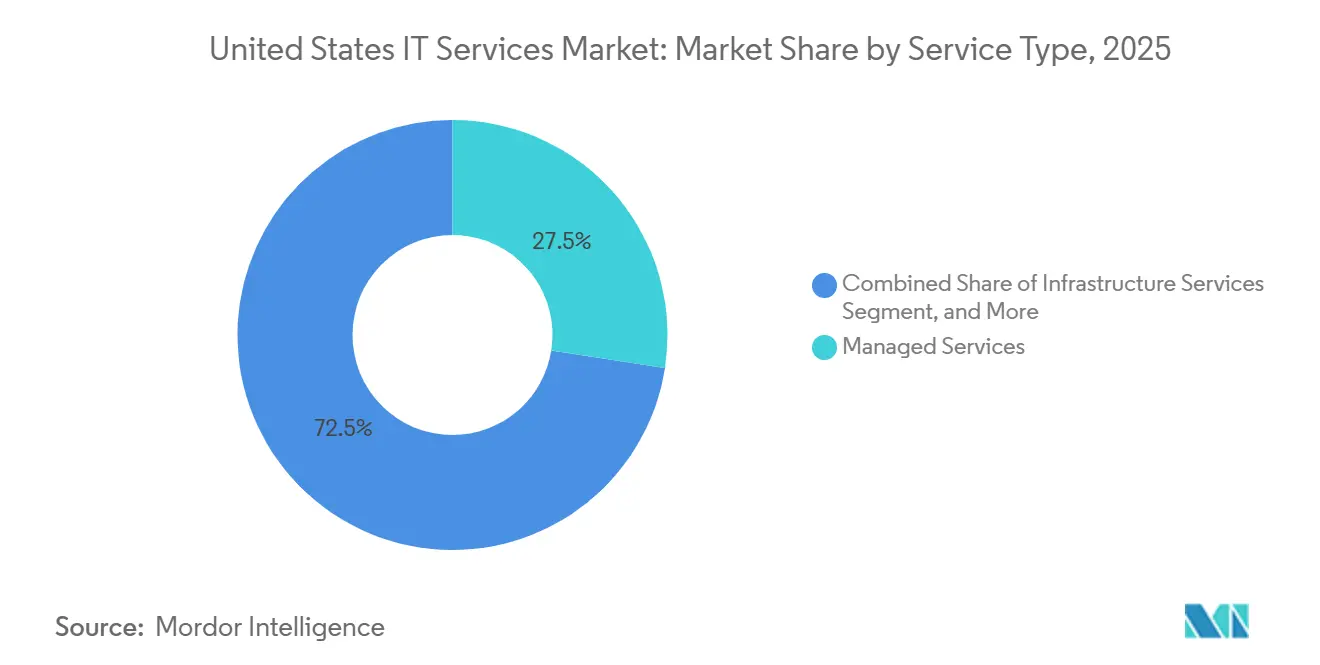
Managed Models Dominate Outcome-Driven SpendManaged Services secured 27.46% of 2025 revenue, reflecting enterprise appetite for predictable operating expenses, while Cybersecurity Services is expected to deliver an 8.42% CAGR through 2031. The United States IT Services market share is consolidating around providers that layer breach warranties often capped at USD 5 million to managed detection and response offerings, aligning economic incentives with risk reduction. Application Development and Maintenance still drives the largest absolute spend, although growth slackens as low-code platforms let business users spin up departmental apps, trimming demand for bespoke Java and.NET builds. Cloud and Platform Services expanded 11.3% in 2025 as the average enterprise juggled 4.7 cloud platforms, intensifying demand for FinOps governance and multi-cloud orchestration. Infrastructure Services face commoditization, compelling vendors to bundle advisory, migration, and managed-ops layers. IT Outsourcing and Business Process Outsourcing increasingly converge, illustrated by Genpact’s 2025 acquisition of an RPA vendor that now stitches invoice-to-cash automation across IT and finance workstreams. Digital-transformation consulting remains in high demand, yet 57% of emerging-tech pilots stall at proof-of-concept, underscoring data-governance gaps.
Tailwinds extend as clients pursue outcome guarantees. Managed-security providers now price access to specialized SOC analysts and proprietary AI-driven threat-intel feeds within multiyear subscriptions, converting capital spend into OPEX. Conversely, legacy infrastructure deals replicate cloud’s pay-as-you-grow model, tying vendor remuneration to workload migration velocity and post-move cost savings. Application modernization is shifting from waterfall to agile pods that integrate DevSecOps from day zero, further tightening feedback loops between business stakeholders and delivery teams. The United States IT Services market continues to reward vendors that meld vertical-domain expertise with automation platforms that shrink test cycles and cut technical debt.

By Deployment Model:
Nearshore Capacity Erodes Onshore DominanceOnshore Delivery retained 54.63% share in 2025, anchored in regulated industries that prize co-location for compliance and collaboration, yet Nearshore Delivery is forecast to expand at an 8.87% CAGR. Mexico’s exports hit USD 9.2 billion, aided by USMCA protections and 41% labor discounts, prompting 187 United States enterprises to establish captive centers in Monterrey and Guadalajara. Canada’s cultural fit and robust IP laws lure financial-services clients, with Toronto engineers charging 22% less than Bay Area peers. The United States IT Services market size linked to nearshore centers is widening as clients compress sprint cycles by exploiting the same-time-zone overlap.
Offshore Delivery remains large but margin headwinds rise as Indian and Philippine wages climb and attrition nears 20%. Manila and Cebu pitch cybersecurity centers staffed by 23,000 SOC analysts, yet geopolitical tension nudges risk-averse clients toward the Americas. Eastern Europe wins compliance-sensitive work under GDPR, but 8.2% 2025 wage inflation and regional instability moderate its cost appeal. Providers now hedge delivery by architecting globally distributed agile pods, blending onshore product owners, nearshore scrum masters, and offshore developers to balance cost, speed, and talent depth.
By Engagement Model:
Outcome-Based Structures Drive Risk-Reward RealignmentOutcome-linked Managed Services captured 41.21% share in 2025 and are projected to grow 12.96% annually through 2031. Private-equity sponsors make outcome clauses table stakes, compelling integrators to underwrite ERP go-live dates and commit to measurable cost reductions. Infosys’s USD 340 million SAP S/4HANA deal, with 30% fees contingent on order-to-cash improvements, typifies the model. Net Promoter Scores hover 47 for outcome deals versus 31 for T&M contracts, signaling higher client satisfaction and stickier relationships.
Traditional project-based and fixed-price work persists where scope is predictable, such as data-center consolidations, but staff-augmentation demand migrates toward niche expertise including quantum-computing and blockchain. Hybrid contracts emerge, coupling base fees with upside-sharing triggers, yet only vendors equipped with real-time KPI dashboards can reconcile delivery progress against business outcomes. The United States IT Services market continues to innovate contract frameworks that reward value creation rather than labor volume.
By Organization Size:
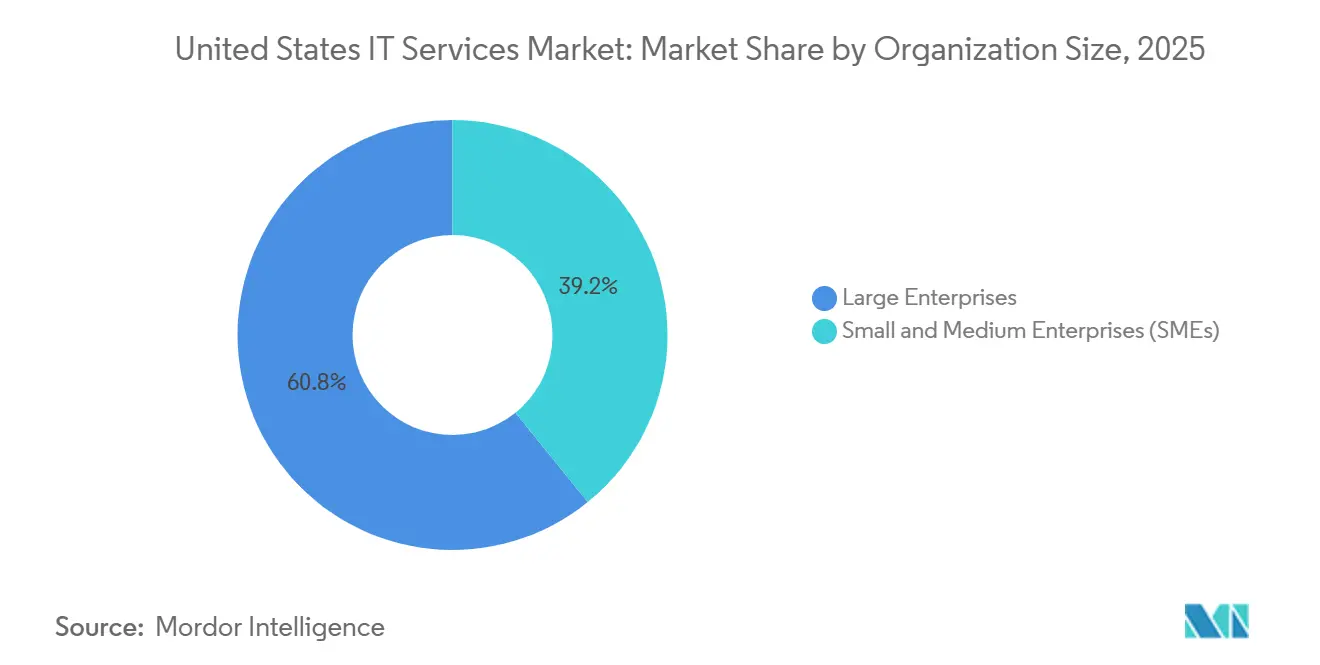
SMEs Accelerate Cloud-First ModernizationLarge Enterprises commanded 60.84% of spend in 2025, as Fortune 500 firms juggled 847 applications on average, many on legacy stacks. Yet SMEs are projected to expand at an 8.63% CAGR, buoyed by cloud-native SaaS models that erase hefty upfront licenses. Community banks under USD 10 billion in assets migrated to cloud cores, slashing maintenance that once ate 22% of IT budgets. Managed-service providers court this cohort with USD 150-per-user bundles covering cybersecurity, backup, and help desk, aligning with operating-expense constraints.
Meanwhile, large organizations bankroll multimillion-dollar compliance projects, such as pharmaceutical validation services and zero-trust programs, sustaining demand for tier-1 integrators. The bifurcation yields a two-tier ecosystem, hyperscale vendors chase USD 50-million plus engagements, while regional specialists package templated solutions for cost-conscious SMEs. The United States IT Services market share held by SME-oriented providers is set to rise as subscription pricing democratizes access to sophisticated digital capabilities.
By End-User Industry:
Interoperability Spurs Healthcare UpsideBanking, Financial Services, and Insurance held an 18.78% share in 2025, underpinned by AML upgrades and stress-testing infrastructure, yet Healthcare and Life Sciences are expected to clock a 9.02% CAGR. The January 2025 TEFCA go-live mandates standardized APIs, opening a USD 6.8 billion integration addressable market. Epic and Cerner clients averaged USD 14.3 million each on third-party services to meet FHIR and consent-management requirements.
Automotive and discrete manufacturers harness edge analytics to cut unplanned downtime, spending heavily on network integration and digital twins. Public-sector demand climbed on the back of TMF and state grants, though protracted procurement cycles stretch delivery timelines. Retail, telecom, and logistics verticals lean on omnichannel platforms, 5G core integration, and inventory optimization. Collectively, these shifts reinforce cross-industry demand for talent capable of fusing domain knowledge with cloud, AI, and cybersecurity toolchains, sustaining the growth trajectory of the United States IT Services market.
Geography Analysis
Spending remains geographically concentrated; the Northeast corridor, California, and Texas contributed 61% of 2025 outlays. Washington DC and its Northern Virginia halo captured 9.4% of federal IT allocations, leveraging a pool of 340,000 cleared professionals who deliver classified cloud and zero-trust projects impervious to offshore competition.
California’s USD 94 billion market rides Silicon Valley’s AI surge and Hollywood’s move to cloud-rendered production workflows, though CPRA compliance drains USD 2.7 million a year from mid-market budgets, crowding out innovation. Texas markets itself as a nearshore alternative, hosting 240 captive centers with 67,000 engineers across Austin, Dallas, and Houston.
The Midwest manufacturing belt allocated USD 18.3 billion in 2025 to finance edge-compute rollouts that power predictive maintenance in automotive plants. Detroit’s automakers poured USD 4.1 billion into software-defined vehicles, driving integrator demand for over-the-air update frameworks. The Southeast chalked up 8.9% growth, with Atlanta logistics hubs and Charlotte banking centers investing in warehouse management systems and fraud defense analytics. Rural America lags; only 3.2% of 2025 IT-services spending occurred in counties that house 14% of the population due to limited fiber and a shortfall of digital skills.[3] The USD 42.5 billion broadband program will narrow this gap post-2026, but for now providers deploy hybrid models, keeping heavy compute in metro data centers while installing edge nodes to service latency-sensitive rural use cases.
Regulatory Landscape
United States IT services engagements are shaped by federal cybersecurity and identity standards, and by Commerce-led ICT supply-chain controls that affect how enterprises source, deploy, and manage connected software and cloud services. NIST publications used widely in federal procurement and security baselining have continued to set the terms for this cycle, including the Digital Identity Guidelines (SP 800-63-4, August 2025) and the National Checklist Program guidance (SP 800-70r5, May 2026). As a result, demand remains concentrated around MFA, identity proofing, configuration compliance, and continuous monitoring.
Policy attention has also broadened around AI governance and security. In June 2026, a federal Executive Order on promoting advanced AI innovation and security added requirements such as classified benchmarking for covered frontier AI models, while NIST continued updating machine-readable security and automation content (for example, SCAP 1.4 in June 2026). These changes increase the compliance burden for providers delivering AI, cloud modernization, and managed security programs, particularly for federal agencies and contractors operating under tighter oversight and reporting expectations.
Value Chain Analysis
The value chain runs from technology and platform inputs (hyperscalers, enterprise software publishers, and cybersecurity tool vendors) to solution design and integration (consulting, platform engineering, application modernization, data/AI implementation), and then to recurring operations (managed services, managed security, and IT outsourcing). Demand is primarily initiated by enterprise and government buyers through RFPs and multi-year frameworks, while delivery is carried out through blended onshore, nearshore, and offshore pods, with specialized subcontractors supporting cleared work, niche security controls, and domain-specific implementation.
In 2026, partner ecosystems around hyperscalers and foundation-model platforms have become a key route for capability expansion and differentiation, particularly where alliances link implementation assets to specific cloud AI stacks. Examples include CGI signing a Strategic Collaboration Agreement with AWS for the U.S. public sector (April 2026), IBM announcing a Google Cloud Practice to help scale AI into production (June 2026), DXC forming a global alliance with Anthropic (June 2026), and Cognizant expanding its Google Cloud partnership around Gemini Enterprise deployments (July 2026). On the delivery side, constraints in infrastructure build-outs have emerged as a practical bottleneck for AI-ready environments, with shortages extending beyond chips into power, networking, and cooling components and lengthening lead times for critical data center and network upgrades, which can affect timelines and scope across migration, platform, and managed-operations contracts.
Competitive Landscape
The top five vendorsAccenture, IBM, Cognizant, Tata Consultancy Services, and Microsoftheld about a major share in 2025, leaving room for niche consultancies and regional integrators. Platform ecosystems loom large; IBM’s USD 24.1 billion hybrid-cloud haul proves that owning the underlying stack amplifies services pull-through. Accenture’s USD 620 million cybersecurity buy and USD 3 billion AI investment underline the arms race for domain expertise and proprietary IP. Smaller players such as Slalom and Perficient grew 18% by pairing cloud-native chops with regional intimacy, winning mid-market contracts that tier-1s overlook.
Technology adoption separates winners from laggards. Vendors using proprietary AI coding assistants reduced development cycles 23%, enabling aggressive fixed-price bids. Patent filings reinforce the shift, Infosys logged 340 AI patents in 2025, while Cognizant concentrated blockchain IP on pharma provenance.
Wage inflation narrows offshore advantage, spurring automation investments that shield margins from rising labor costs. Outcome-based pricing spreads risk but elevates customer loyalty, reshaping how vendors staff, govern, and monetize projects across the United States IT Services market.
United States IT Services Industry Leaders
-
Accenture plc
-
IBM Corporation
-
Cognizant Technology Solutions Corp.
-
Tata Consultancy Services Ltd.
-
Microsoft Corporation
- *Disclaimer: Major Players sorted in no particular order
United States IT Services Market Companies Covered in this Report
- Accenture plc
- IBM Corporation
- Cognizant Technology Solutions Corp.
- Tata Consultancy Services Ltd.
- Microsoft Corporation
- Infosys Ltd.
- Wipro Ltd.
- Deloitte Consulting LLP
- Capgemini SE
- HCL Technologies Ltd.
- CGI Inc.
- DXC Technology Co.
- Booz Allen Hamilton Inc.
- Leidos Holdings Inc.
- Slalom LLC
- EPAM Systems Inc.
- NTT DATA Services
- Kyndryl Holdings Inc.
- LTI Mindtree Ltd.
- Tech Mahindra Ltd.
- Perficient Inc.
- ThoughtWorks Inc.
- Persistent Systems Ltd.
Market Opportunities and Future Outlook
Federal modernization and oversight actions create whitespace for providers that can package compliant, auditable delivery for cloud, zero-trust, and AI programs. The White House memorandum M-26-10 (March 2026) elevated agency CIO review and approval for IT services contracts and emphasized supply-chain transparency and procurement consolidation, which increases the upside for vendors that can standardize controls, document provenance, and operationalize governance across multi-provider environments. NSPM-11 (June 2026) also pushed federal procurement process updates to accelerate onboarding of advanced AI models, while establishing an AI for National Security Curriculum, reinforcing demand for model onboarding, security validation, and operational readiness services.
Private-sector AI infrastructure build-outs are flowing into downstream services demand for data center integration, network modernization, platform engineering, and managed operations tied to large compute campuses. 2026 investments include Meta expanding its Hyperion data center in Richland Parish, Louisiana to 5 GW (announced July 2026), and Amazon outlining multi-billion-dollar U.S. data center investments, including USD 25 billion in Mississippi and USD 12 billion in Northwest Louisiana. These programs support demand for low-latency connectivity, secure hybrid architectures, and lifecycle services that connect facility build-outs to enterprise application modernization and AI toolchain deployment, while also underscoring how power and cooling availability can shape sequencing and delivery models.
Recent Industry Developments in United States IT Services Market
- July 2026: Cognizant expanded its partnership with Google Cloud around Gemini Enterprise and Google Workspace, positioning reusable agents and implementation accelerators for enterprise deployments. The expansion supports Cognizant's AI-first managed services and platform engineering offerings for clients standardizing on Google Cloud AI toolchains.
- June 2026: Cognizant completed its acquisition of Astreya, adding an AI-first IT managed services provider focused on infrastructure and workplace operations. The combination broadens Cognizant's ability to run and modernize hybrid environments while supporting scaled AI infrastructure and operations programs.
- November 2025: Cognizant announced plans to acquire 3Cloud to deepen Microsoft Azure services and enterprise AI transformation capabilities. The transaction is intended to enhance Cognizant's cloud engineering capacity and support larger modernization programs where Azure platform integration and data foundations are central.
United States IT Services Market Report Scope and Research Methodology
Market Definition and Coverage
For this study, the United States IT services market is defined as revenues earned from providing outsourced and project-based IT work to organizations, including planning, building, running, and improving IT environments and applications across industries.
Scope exclusions: We exclude pure hardware product sales, packaged software license-only revenue (without a services component), and telecom connectivity services.
Segments Covered in This Report
- By Service Type
- IT Consulting and Implementation
- Application Development and Maintenance (ADM)
- Infrastructure Services
- Managed Services
- IT Outsourcing (ITO)
- Business Process Outsourcing (BPO)
- Cloud and Platform Services
- Cybersecurity Services
- Digital Transformation and Emerging Tech (AI, IoT, Blockchain)
- By Deployment Model
- Onshore Delivery
- Nearshore Delivery
- Offshore Delivery
- By Engagement Model
- Project-based / Fixed Price
- Staff Augmentation / Time-and-Material
- Managed Services / Outcome-based
- By Organization Size
- Large Enterprises
- Small and Medium Enterprises (SMEs)
- By End-User Industry
- Banking, Financial Services and Insurance (BFSI)
- Manufacturing
- Government and Public Sector
- Healthcare and Life Sciences
- Retail and Consumer Goods
- Telecom and Media
- Transportation and Logistics
- Energy and Utilities
- Other End-User Industries
Data Sources, Market Sizing, and Validation
Desk Research
Desk research was used to set the market boundary, map the service value chain, and establish a consistent set of demand and supply signals in US dollars. We referenced public sources such as the US Bureau of Labor Statistics (IT occupation wages and employment), the US Census Bureau service-industry revenue series, and Bureau of Economic Analysis data tied to the information sector and digital activity.
To keep assumptions grounded, we also reviewed open materials such as SEC filings, annual reports, and investor presentations from service providers, along with association and standards references (such as NIST and ISO publications) that help interpret delivery models and compliance-driven buying. Where needed, a paid subscription focused on company financials and news was used to normalize revenue disclosures and remove obvious one-time impacts. This list is not exhaustive, and many other public and subscription sources were also used for data collection, validation, and clarification during the work.
Primary Interviews and Surveys
Primary work was run to test how services are being bought and priced, and to confirm what should count as IT services versus adjacent tech spending. We spoke with delivery leaders, procurement-side IT decision makers, and channel partners across major US end-user industries so gaps from desk research could be filled, and assumptions could be re-checked before finalizing outputs.
Distribution of primary research fieldwork respondents
| Company type | Respondent position |
|---|---|
| Top tier: 37% | CXOs: 14% |
| Mid tier: 42% | Functional/Unit leaders: 27% |
| Smaller Players: 21% | Managers: 59% |
Market-Sizing & Forecasting
Sizing was built using a top-down approach where national services activity, IT spending direction, and industry demand signals are reconstructed into an IT services revenue pool, then filtered by what is actually delivered as services in the United States. To avoid over-counting, the totals were cross-checked with selective bottom-up approximations such as sampled provider revenue roll-ups by service line, channel checks on deal mix, and a reasonableness test using average billable rates multiplied by delivery headcount ranges.
Key inputs used in the model include the share of work delivered as managed services versus project work, utilization trends for delivery staff, blended hourly rates by skill mix, cloud migration intensity (which changes the run versus build split), and public sector modernization activity that creates steadier multi-year demand. Where data gaps existed, especially around smaller providers and subcontracted delivery, we used ranges from interviews and applied conservative capture factors so the model stayed realistic.
Forecasts were produced using scenario analysis supported by short-run smoothing on the most stable drivers, followed by expert checks on expected rate movements and mix shift. Because price and mix can change faster than volumes in IT services, the forward view was anchored on expected ASP progression, utilization normalization, and the pace of enterprise tech refresh cycles, which were then translated into revenue growth by year.
Data Validation & Update Cycle
Outputs were validated through triangulation across independent signals, including public services revenue direction, labor indicators, and large-provider disclosure trends, then compared against what interviewees reported as typical growth and pricing in current bids. When variance looked unusual, we re-opened the driver stack, checked currency timing and deflators, and re-contacted sources if the change could not be explained by mix or seasonality.
Before sign-off, the model and write-up go through multi-step analyst review so assumptions, calculations, and scope boundaries match what is described in the report. Reports are refreshed annually, and interim updates are triggered when a material event changes demand or pricing expectations. Right before delivery, a final pass is completed so clients receive the latest updated view available at that time.
Mordor Intelligence's United States IT Services Market Estimate Compared With Other Published Estimates
Published market numbers for US IT services can look far apart, even when they are trying to talk about the same thing, because each publisher locks in its scope and pricing logic differently. Differences usually show up around what gets counted as IT services, how multi-year contracts are treated, and whether the value is expressed in a clean current-year dollar basis.
A refresh-led check is important in this market because blended rates, utilization, and the project-to-managed mix can shift within a year, which changes revenue even if delivery volumes move slowly. When those drivers are updated more frequently and tied to current-dollar timing and validation call-backs, the estimate is less exposed to stale ASP assumptions, which is a modeling choice applied by Mordor Intelligence.
Benchmark comparison
| Source | Market Size | Gaps in Research Methodology |
|---|---|---|
| Mordor Intelligence | USD 490.86 B (2025) | |
| Global Consultancy A | USD 520.00 B (2025) | Often broadens the boundary to include adjacent tech-enabled business services and some software-led delivery bundled into consulting revenue, which can lift totals when service line mapping is not separated cleanly. |
| Industry Association B | USD 455.00 B (2024) | Typically reflects member-reported run-rate and may anchor to an earlier year without fully re-stating values to current-dollar timing, which can understate the effect of rate increases and mix shift into higher value managed services. |
The spread across the three figures is mainly explained by boundary choices and timing, rather than a disagreement that demand exists. In our view, keeping pricing updates, contract treatment, and cross-checks consistent year to year makes the result easier to trace back to a few repeatable drivers, and it also makes planning discussions more practical.
Key Questions Answered in the Report
How large will the United States IT Services market become by 2031?
It is projected to reach USD 737.42 billion by 2031, representing a 7.02% CAGR over 2026-2031.
Which service line is growing fastest among U.S. buyers?
Cybersecurity Services leads with an expected 8.42% CAGR through 2031, driven by zero-trust mandates and rising ransomware risk.
Why are nearshore delivery centers attracting more U.S. clients?
Time-zone alignment, USMCA trade benefits, and labor rates roughly 40% below onshore equivalents are propelling an 8.87% CAGR in nearshore engagements.
What is prompting the shift to outcome-based contracts?
Private-equity sponsors and large enterprises increasingly insist on performance guarantees, causing outcome-linked deals to represent 29% of new signings in 2025.
Which vertical will post the strongest growth through 2031?
Healthcare and Life Sciences is expected to expand at a 9.02% CAGR as TEFCA interoperability rules push hospitals to modernize electronic-health-record integrations.
How severe is the talent shortage for cloud and security skills?
The U.S. faced 377,500 unfilled information-security roles in 2025, raising median cloud-architect salaries to USD 168,000 and compressing vendor margins.