
Market Overview
| Study Period | 2020 - 2031 |
|---|---|
| Forecast Data Period | 2026 - 2031 |
| Base Year Market Size (2025) | USD 14.55 Billion |
| Market Size (2026) | USD 15.45 Billion |
| Market Size (2031) | USD 20.86 Billion |
| Growth Rate (2026 - 2031) | 6.18 % |
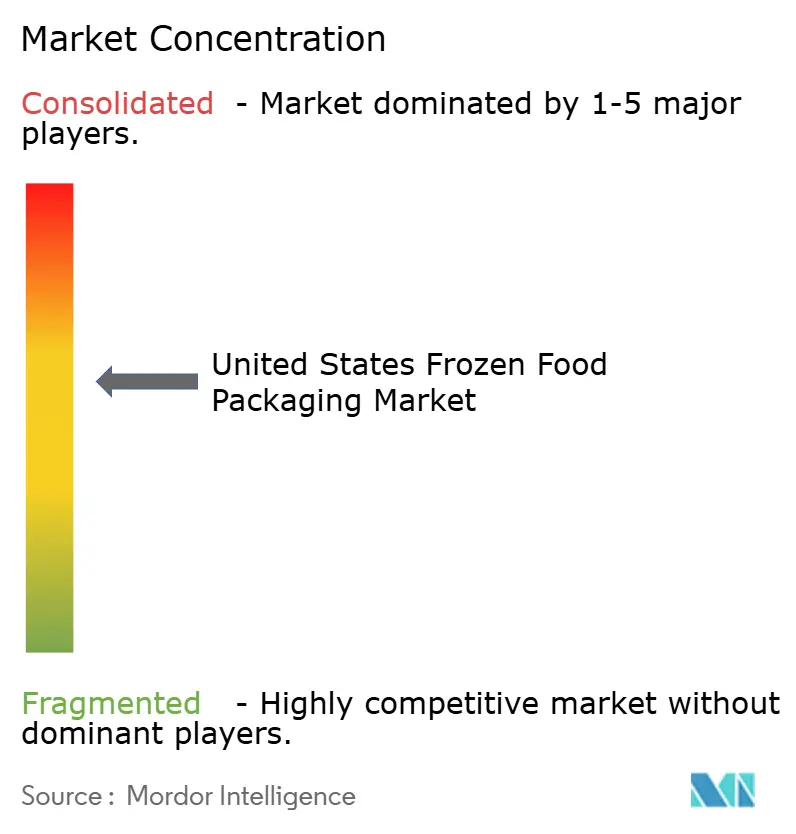
| Market Concentration | Medium |
Major Players *Disclaimer: Major Players sorted in no particular order Image © Mordor Intelligence. Reuse requires attribution under CC BY 4.0. | |
United States Frozen Food Packaging Market Analysis by Mordor Intelligence
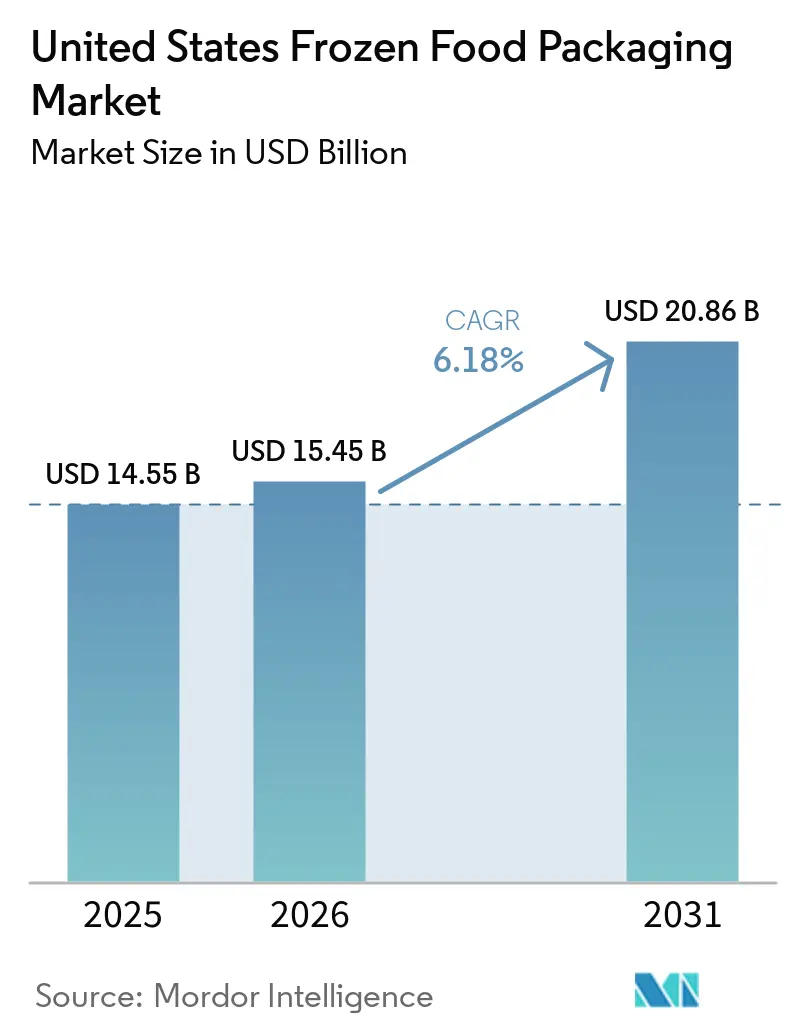
The United States frozen food packaging market size is expected to grow from USD 14.55 billion in 2025 to USD 15.45 billion in 2026 and is forecast to reach USD 20.86 billion by 2031 at 6.18% CAGR over 2026-2031. Robust growth stems from structural changes in consumer lifestyles, direct-to-consumer (D2C) delivery models, and retailer sustainability mandates. Demand for convenient heat-and-eat formats has spurred rapid adoption of dual-ovenable crystalline polyethylene terephthalate (CPET) trays, even though CPET commands a 35% price premium over polypropylene. At the same time, phase-change shipper inserts and vacuum-insulated panels enable D2C brands to reduce last-mile shipping costs by up to 18% while maintaining contents at a temperature below 10 °F for 48 hours. Converters are also chasing a USD 340 million substrate niche created by plant-based entrées that require ultra-low oxygen transmission rates to curb lipid oxidation. Automation of horizontal form-fill-seal (FFS) lines, capable of filling 180 pouches per minute, is reducing per-unit labor expense by 22%, freeing capital for investments in mono-material polyethylene (PE) films that meet Association of Plastic Recyclers design protocols.
Key Report Takeaways
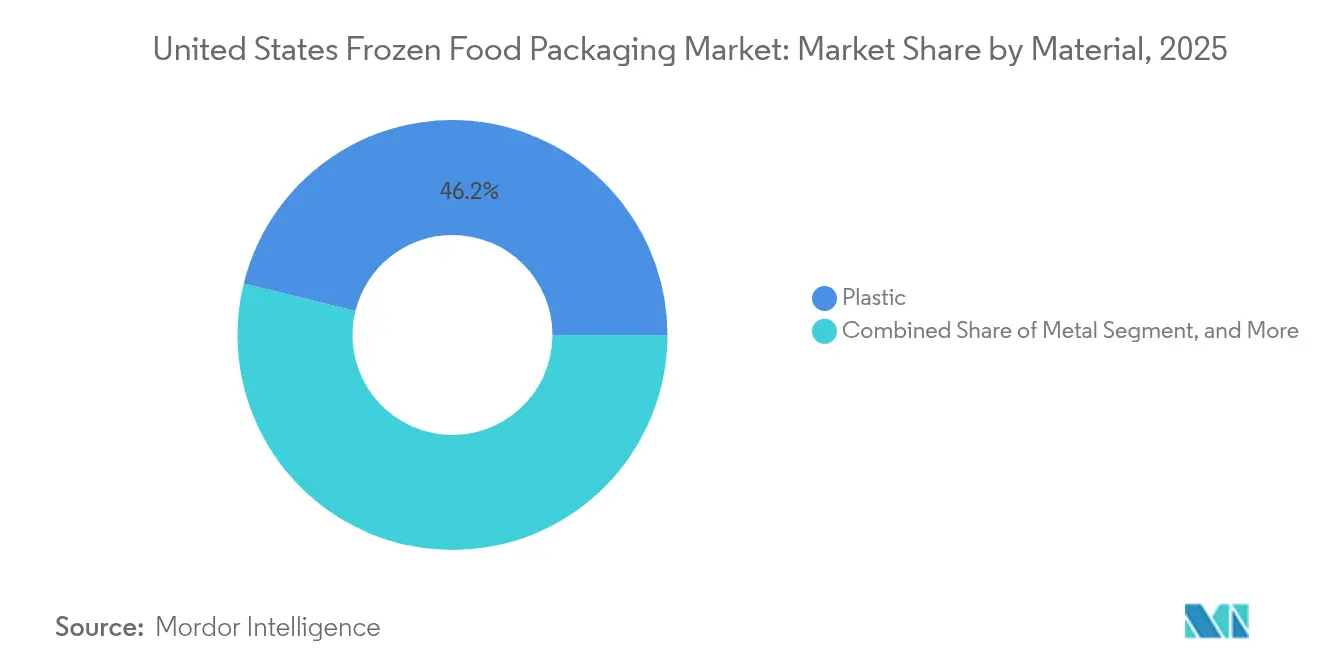
- By material, plastic captured 46.15% of the United States frozen food packaging market share in 2025, while paper and paperboard are projected to be the fastest-growing option at a 7.35% CAGR through 2031.
- By packaging format, flexible designs led with a 54.10% share of the United States frozen food packaging market in 2025 and are expected to expand at a 6.9% CAGR over the forecast period.
- By packaging product, bags and pouches accounted for 31.25% of the United States frozen food packaging market share in 2025, yet trays are poised for the quickest rise, advancing at a 7.22% CAGR.
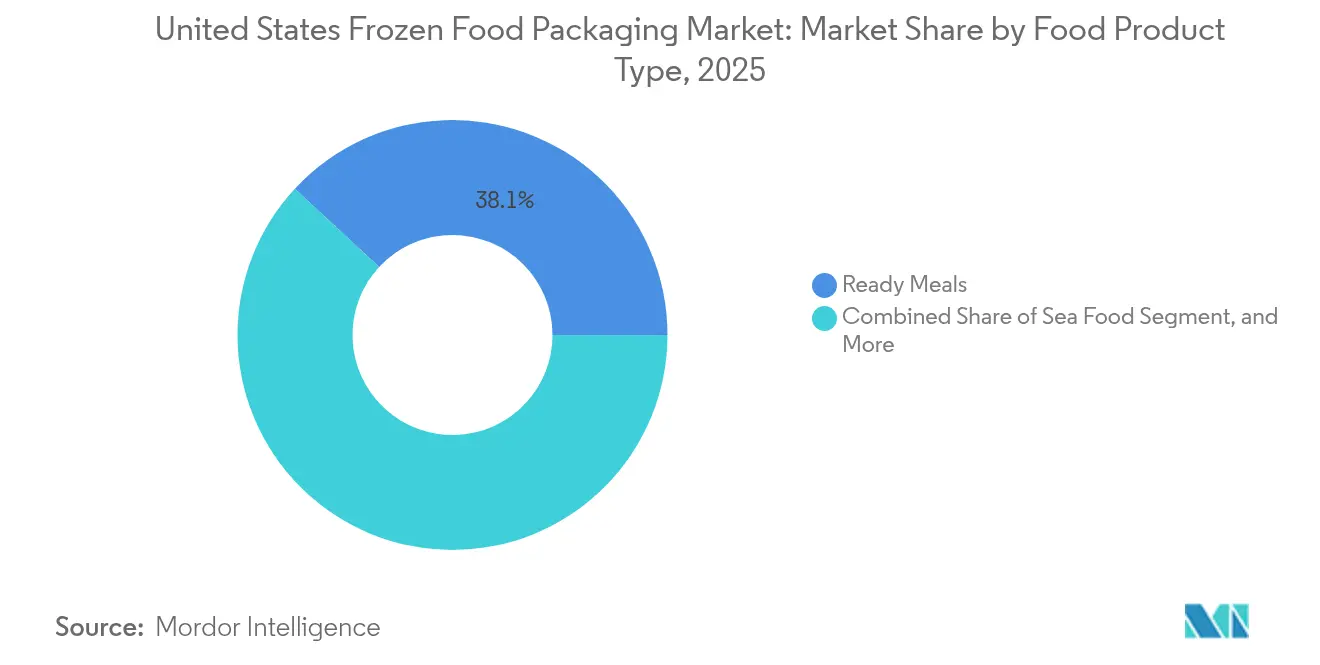
- By food product type, ready meals represented 38.10% of the United States frozen food packaging market share in 2025, whereas seafood packaging is forecast to grow the fastest with a 7.75% CAGR.
- By packaging technology, vacuum packaging dominated the United States frozen food packaging market with a 38.85% share in 2025, but intelligent and active packaging is expected to experience the highest growth, increasing at an 8.45% CAGR through 2031.
Note: Market size and forecast figures in this report are generated using Mordor Intelligence’s proprietary estimation framework, updated with the latest available data and insights as of 2026.
United States Frozen Food Packaging Market Trends and Insights
Drivers Impact Analysis*
| Driver | (~) % Impact on CAGR Forecast | Geographic Relevance | Impact Timeline |
|---|---|---|---|
| Rising Consumer Demand for Convenient Heat-and-Eat Formats | +1.2% | United States urban metros and suburban clusters | Medium term (2-4 years) |
| Growth of Direct-to-Consumer Frozen Meal Subscriptions | +0.9% | Northeast corridor and West Coast | Short term (≤2 years) |
| Surge in Plant-Based Frozen Entrées Requiring Specialized Films | +0.8% | California, New York, Illinois | Medium term (2-4 years) |
| Retailer Private-Label Expansion Driving High-Volume Flexible Packaging | +1.1% | Walmart, Costco, Target distribution networks | Long term (≥4 years) |
| Intelligent Time-Temperature Indicator Labels for Cold-Chain Integrity | +0.6% | National logistics hubs | Long term (≥4 years) |
| Automation of Pouch and Bag Form-Fill-Seal Lines Reducing Cost per Unit | +1.0% | Midwest and Southeast manufacturing clusters | Medium term (2-4 years) |
| Source: Mordor Intelligence | |||
Rising Consumer Demand for Convenient Heat-and-Eat Formats
Microwaveable and oven-ready meals accounted for 62% of new frozen product launches in 2024, up from 48% two years prior.[1]Food Marketing Institute, “2024 Power of Frozen Report: Consumer Trends and Preferences,” Fmi.org Dual-ovenable CPET trays endure 425 °F for 40 minutes, supporting premium positioning and faster shelf turns. Single-serve packs under 12 ounces grew 19% in unit volume in 2024, three times faster than family-size alternatives, reinforcing the need for packaging formats that stack vertically and minimize freezer cube waste. Retailers report that heat-and-eat SKUs cycle 1.7 times faster than conventional entrées, incentivizing shelf re-allocation to tray-based lines. Converters able to supply CPET and coated-paperboard hybrids enjoy pricing power despite the substrate’s 35% cost premium.
Growth of Direct-to-Consumer Frozen Meal Subscriptions
D2C frozen meal sales climbed to USD 2.8 billion in 2024, a 23% jump from 2023.[2]Specialty Food Association, “State of the Specialty Food Industry 2024,” Specialtyfood.com These services bypass store freezers, requiring insulated shippers that maintain temperatures between −10 °F and 10 °F for 48 hours. Korrvu suspension pouches from Sealed Air reduce breakage rates to below 2%, enhancing brand reputation and minimizing returns. Right-sizing initiatives shave USD 1.20-1.80 off excess freight per order, which is critical when D2C gross margins hover near 12-15%. USDA regulations further require tamper-evident seals and freeze-by dating, adding complexity that only converters with digital printing and quality control systems can manage efficiently.
Surge in Plant-Based Frozen Entrées Requiring Specialized Films
Plant-based frozen foods generated USD 1.9 billion in retail revenue in 2024, representing a 17% year-over-year increase.[3]Nielsen Company, “Plant-Based Frozen Foods Market Analysis 2024,” Nielsen.com Oxygen-sensitive pea-protein and mycoprotein matrices force packaging films to achieve OTR values below 0.5 cc/m²-day. Amcor’s AmPrima Encore mono-PE structure meets this spec while remaining store-drop-off recyclable, unlocking incremental shelf space at mass merchandisers. Transparent anti-fog windows, leveraging bio-based surfactants, maintain clarity for 24 months and add only USD 0.03-0.05 per pack, yet blind tests show an 11% sales lift. These demands create a USD 340 million substrate opportunity for converters with barrier-film expertise.
Retailer Private-Label Expansion Driving High-Volume Flexible Packaging
Private labels captured 22.4% of U.S. frozen food revenue in 2024, representing a 340-basis-point increase since 2022. Globally, meat, poultry, and seafood retained 39.78% of 2025 volume, underscoring the flexible frozen food packaging market reliance on high-protein staples that require oxygen-scavenging and anti-fog films for color stability. Walmart’s Great Value, Costco’s Kirkland Signature, and Target’s Good and Gather added more than 1,200 combined frozen SKUs during 2024, gravitating toward light-weight pouches that cut freight costs by 40%. Pactiv Evergreen disclosed that private-label volume now stands at 34%, nine points higher than 18 months ago. Lead-time pressure has tightened to four weeks, elevating the value of converters with digital presses that print nutrition panels and promotional codes in a single pass. Shelf-price parity between private label and national brands also narrows the historical gap in packaging quality, compelling suppliers to improve print fidelity and barrier performance simultaneously.
Restraints Impact Analysis*
| Restraint | (~) % Impact on CAGR Forecast | Geographic Relevance | Impact Timeline |
|---|---|---|---|
| PFAS and Single-Use Plastics Regulatory Crackdowns | -0.7% | Maine, California, New York, Washington | Medium term (2-4 years) |
| Volatile Resin Prices Compressing Converter Margins | -0.5% | Nationwide | Short term (≤2 years) |
| Limited Curbside Recyclability of Multi-Layer Films | -0.4% | Rural and mid-tier municipalities | Long term (≥4 years) |
| Capital-Intensive Shift Toward Recyclable Mono-Material Structures | -0.6% | Extrusion hubs in Midwest and Southeast | Medium term (2-4 years) |
| Source: Mordor Intelligence | |||
PFAS and Single-Use Plastics Regulatory Crackdowns
California’s AB 1200 bans PFAS in food packaging by 2028, while Maine’s LD 1541 imposes a similar prohibition by 2030. Converters relying on fluorinated grease barriers must reformulate or exit a USD 680 million microwaveable-tray niche. FDA’s voluntary phase-out of long-chain PFAS, announced in 2024, accelerates compliance deadlines. Bio-based alternatives derived from algae and chitosan currently lag CPET-grade grease resistance by 15-20%, adding USD 0.08-0.12 per tray. Smaller regional converters have begun to exit the category, citing USD 2-4 million in reformulation costs per product line.
Volatile Resin Prices Compressing Converter Margins
Polyethylene prices declined 14% through late 2024, then rebounded 9% in Q1 2025 as crude oil prices climbed above USD 80 per barrel. Polypropylene swings were steeper, which complicated budget forecasting and delayed automation upgrades. Fixed-price customer contracts hinder immediate cost pass-through, resulting in a 200-300 basis point reduction in converter margins during price surges. Even converters with hedging strategies recorded USD 18-25 million in unrecovered resin expense in 2024. The uncertainty is dampening capital outlays for mono-material PE extrusion lines, which carry USD 8-12 million in retooling costs per plant.
*Our forecasts treat driver/restraint impacts as directional, not additive. The impact forecasts reflect baseline growth, mix effects, and variable interactions.
Segment Analysis
By Material: Fiber Substrates Gain Traction Amid Recyclability Push
Paper and paperboard are projected to advance at a 7.35% CAGR to 2031, outpacing all other substrates, as Walmart and Target incorporate curbside-recyclable requirements into their 2025 supplier contracts. Graphic Packaging logged a 16% year-over-year rise in frozen-food paperboard shipments during 2024, underscoring volume momentum. Amcor’s AmFiber paper tray, launched in late 2024, withstands freezer conditions and microwave reheating without a polyethylene laminate, helping brands secure retailer sustainability credits. Plastic maintained a 46.15% share of the United States frozen food packaging market in 2025, yet its growth has moderated. The United States frozen food packaging market size for plastic is expected to inch forward at a mid-single-digit rate as PFAS bans and mono-material demands accelerate capital spending. Metal cans remain relegated to frozen juice concentrates and institutional vegetables, while glass is nearly absent due to weight and breakage risks.
Plastic’s dominance persists because mono-PE pouches achieve sub-1 cc/m²-day oxygen transmission rates at half the weight of coated board, favoring applications such as frozen fruits and single-serve entrées. Nevertheless, fiber trays now qualify for municipality curbside programs in 72% of U.S. ZIP codes, improving end-of-life economics for retailers. Converters must juggle a wider substrate slate, often stocking six platforms versus three a decade ago, which raises working-capital burdens but also permits tailored solutions that match product viscosity, headspace, and reheat method.


By Packaging Format: Automation Favors Flexible Structures
Flexible structures held a 54.10% share in 2025, driven by high-speed horizontal FFS lines that reduce labor costs by 22%. These lines fill 180 pouches per minute for vegetables and 100 for chunky entrée fillings, driving a 6.9% CAGR for flexibles through 2031. Sealed Air’s recyclable PE pouch won Association of Plastic Recyclers recognition in 2024 and unlocked distribution at Walmart by enabling How2Recycle labeling. Rigid packaging format retained a 45.90% share, supported by the oven-ready performance required in premium entrées.
While rigid formats expand at a slower rate, innovations such as Sabert’s pulp-based post-consumer recycled (PCR) polypropylene tray reduce carbon footprint by 28%, softening sustainability concerns. Flexible pouches improve pallet cube efficiency by 18% and shrink blast-freezer energy use by 11%. Yet they require outer corrugated cases for pallet stability, adding USD 0.06-0.09 per unit. Trays self-stack, cutting secondary-packaging costs but sacrificing shipping density. The divergence means that high-velocity value lines lean toward pouches, whereas premium SKUs priced above USD 6.50 per unit continue to favor ridged CPET or PCR-PP trays, which communicate quality through their heft.
By Packaging Product: Trays Accelerate on Dual-Ovenable Appeal
Trays are on course for a 7.22% CAGR as consumers gravitate toward ‘oven-to-table’ convenience. CPET withstands 425 °F, enabling crust development and browning unattainable in microwave-only formats. Genpak’s 2025 snap-fit lid combines CPET bases with recyclable paperboard tops, meeting retailer scorecards while maintaining shelf strength. Bags and pouches retained a 31.25% volume share in 2025, dominating the category, although stand-up pouches with reclose zippers are siphoning market share within the broader bag category.
Polypropylene trays offer a 35% cost savings over CPET but cap reheat temperatures at 375°F, confining usage to microwave-only entrées. Brands transitioning frozen vegetables from trays to pillow bags posted a 9% gross margin gain in 2024, indicating that commoditized items will continue to favor low-cost, flexible formats. Cans, which account for just 12% of the volume, face a structural decline as consumer preference tilts toward refrigerated, not-from-concentrate beverages. The ‘other’ grouping, comprising lidding films, overwraps, and shrink bands, grew 19% in 2024 as D2C channels demanded tamper-evident and intelligent labels.
By Food Product Type: Seafood Outpaces in Premium Pricing
Seafood packaging is set to climb at an 7.75% CAGR through 2031. Vacuum-skin technology extends shelf life to 24 months, maintaining protein color and supporting retail prices of USD 12-18 per pound. Sealed Air’s Grip and Tear film enables one-handed opening, reducing product returns associated with difficult packaging. Ready meals dominated the market, accounting for 38.10% of the 2025 volume, as single-serve portions under 12 ounces expanded by 19%, while family packs lagged.
Meat packaging growth is modest as plant-based analogs siphon market share; frozen beef patty sales dropped 4% in 2024, while plant-based burgers climbed 11%. Fruits and vegetables, although high in tonnage, face razor-thin margins that cap packaging budgets at USD 0.22 per pound. The ‘other’ category, including frozen appetizers, desserts, and specialty bakery goods, grew 7% driven by premium ice cream pints and artisan pizza crusts, but remains fragmented across small SKU volumes, keeping packaging runs short and favoring digital print.
By Packaging Technology: Intelligence Adds Real-Time Assurance
Intelligent and active systems are forecast to rise at an 8.45% CAGR, the swiftest among technology classes. Brands embed oxygen scavengers and time-temperature indicators (TTIs) that shift color when cumulative exposure exceeds safety thresholds. Whole Foods has mandated TTIs on frozen seafood priced above USD 15 per pound, a policy covering 68% of its SKU roster. Vacuum packaging maintained a 38.85% share in 2025 and remains the mainstay for premium meats and seafood.
Cryovac’s Darfresh skin-pack reduces headspace by 22%, enabling 14% more units per pallet and trimming distribution cost. Modified atmosphere packaging (MAP) is gaining acceptance for organic vegetables, where nitrogen flushing helps preserve vitamin C and prevent surface browning. Active packaging extends the shelf life of frozen bread by 40%, allowing retailers to order larger quantities without incurring spoilage risk. The United States frozen food packaging market size for intelligent solutions is thus poised to compound faster than any other technology tranche, although cost premiums of USD 0.08-0.12 per pack limit adoption among value lines.
Geography Analysis
California, Texas, Florida, New York, and Illinois accounted for 47% of frozen food consumption in 2025, demonstrating the geographic concentration that defines the United States frozen food packaging market. The Northeast posted the highest per-capita frozen meal intake at 62 pounds per person, benefiting from superior cold-chain infrastructure and dense urban populations. By contrast, the Midwest dominates frozen vegetable processing, with Iowa, Minnesota, and Wisconsin accounting for 34% of national FFS capacity, which serves institutional buyers such as schools and hospitals.
Sun Belt states are experiencing population-led channel expansion. Arizona, Nevada, and North Carolina each experienced growth in retail frozen-food square footage between 8% and 11% in 2024, significantly outpacing the 3% U.S. average. Coastal metros generate 71% of D2C orders, reflecting higher household incomes and household time constraints. However, regulatory patchwork complicates supply chains: Washington’s HB 1799 imposes a 25% PCR content minimum by 2031, whereas Maine and California have already legislated PFAS bans that take effect before 2030.
Rural regions in the Mountain West and Great Plains rely on older blast-freezer assets that consume 20% more energy per pallet, raising landed packaging costs. Ethnic food demand is surging in Texas and California, where immigrant populations exceed 25%. These cuisines often require steam-venting films and grease-resistant coatings, which raises per-unit packaging spend by up to 20% but delivers incremental shelf-price premiums that justify the added cost. The United States frozen food packaging market, therefore, exhibits strong regional disparities that reward converters capable of flexing their production footprints and substrate offerings.
Regulatory Landscape
Frozen food packaging in the United States is governed primarily through federal food-contact and food-labeling requirements. The FDA regulates packaging materials as food contact substances under 21 CFR Parts 174-178, and authorizations are tied to specific conditions of use, including frozen storage (Condition of Use G), which pushes converters to qualify resins, adhesives, inks, and barrier layers for low-temperature performance and migration limits rather than relying on broad food-contact claims.
For frozen meat and poultry, USDA-FSIS labeling rules add packaging-specific compliance obligations, including required handling statements such as "Keep Frozen" on the principal display panel and date/marking expectations under 9 CFR Part 317. In parallel, state-level restrictions are reshaping material choices for grease-resistant and coated structures, with California AB 1200 banning PFAS in food packaging by 2028 and Maine LD 1541 setting a similar prohibition by 2030, accelerating reformulation away from fluorinated barriers and tightening supplier qualification across multi-state distribution.
Value Chain Analysis
The value chain starts with upstream feedstocks and substrates, notably polyethylene and polypropylene resins, specialty barrier polymers (such as EVOH used in some high-barrier structures), and paperboard used for cartons and emerging fiber-based trays. Packaging converters then transform these inputs into flexible bags and pouches, lidding films, cartons, and rigid trays (including CPET and PCR-PP), with performance requirements centered on moisture and oxygen barriers to prevent freezer burn and oxidation across long frozen shelf lives and reheating methods.
Downstream, frozen food processors and co-packers specify sealing performance, print and compliance needs (FDA food-contact clearance and, where relevant, USDA-FSIS labeling), and increasingly retailer-driven sustainability attributes, then route finished goods through distributors, cold-chain logistics providers, and retail and foodservice channels. D2C meal subscriptions add a parallel packaging layer via insulated shippers, inserts, and tamper-evident features, while procurement scale at retailers such as Walmart, Costco, and Target amplifies lead-time and quality demands, rewarding converters with high-speed form-fill-seal automation and validated mono-material or fiber-forward designs aligned to recyclability protocols.
Competitive Landscape
The top five converters, Amcor, Pactiv Evergreen, Sealed Air, Graphic Packaging, and Smurfit Kappa, controlled roughly 42-48% of 2024 revenue, indicating moderate market concentration. Minimum economic plant scale exceeds USD 40 million in annual sales, deterring new entrants. Amcor’s AmPrima and AmFiber lines, Sealed Air’s Cryovac recyclable pouches, and Pactiv Evergreen’s EverGreen fiber trays all debuted in 2024, signaling an innovation race to meet retailer recyclability targets. Smaller players, such as Printpack and Genpak, compete on lead time, leveraging digital print to reduce order-to-delivery windows to four weeks—half the industry average.
Circular-resin partnerships are emerging as differentiation levers. Novolex signed a supply deal with Eastman for chemically recycled PE totaling 8 million pounds annually, while LyondellBasell is co-developing PCR-rich mono-PE films with multiple converters. Patent activity underscores the intensifying trend of R&D investment; Amcor filed 14 frozen-food packaging patents in 2024, while Sealed Air secured nine covering vacuum-skin innovations. Automation is another frontier: plants that installed vision inspection and robotic case packing posted 31% throughput increases and 14% labor savings, widening performance gaps that pressure laggards to invest or exit.
Regulatory compliance is fast becoming a moat. Converters earning recognition from the Association of Plastic Recyclers for mono-PE structures gain priority placement at Walmart and Target, driving 8-12% volume increases. Those delaying conversion face a risk to their shelf space as retailer contracts now include recyclability clauses. Active packaging suppliers remain fragmented, creating a white space for mid-tier brands seeking cost-effective TTIs. Overall, the competitive dynamics of the United States frozen food packaging market favor scale, sustainability alignment, and digital agility.
United States Frozen Food Packaging Industry Leaders
Amcor Plc
Sealed Air Corporation
Smurfit WestRock
Crown Holdings Inc.
Ball Corporation
- *Disclaimer: Major Players sorted in no particular order

Market Opportunities and Future Outlook
Regulatory and retailer scorecards are creating targeted whitespace for reformulated barriers and verified food-contact compliance across both plastics and fiber. PFAS phase-outs at the state level (for example, California AB 1200) are forcing microwaveable trays and coated paperboard structures to move to alternative grease and moisture barriers, while FDA food-contact requirements under 21 CFR Parts 174-178 keep migration testing and documentation central, particularly as brand owners and retailers scrutinize recycled-content claims and end-of-life labeling.
Capacity additions and sustainability-led format shifts are broadening the addressable opportunity for converters serving ready meals, private label, and high-barrier plant-based SKUs. Conagra Brands announced a USD 220 million, five-year expansion in March 2026 at its Fayetteville, Arkansas facility to increase frozen chicken output for brands such as Healthy Choice and Banquet, a tangible demand-side catalyst that pulls through higher volumes of bags, pouches, trays, cartons, and case-ready secondary packaging. On the materials side, brands and retailers are actively trialing recycle-ready mono-PE films and fiber-based trays (such as Amcor initiatives across AmPrima/AmFiber and broader fiber collaborations), while intelligent/active features like time-temperature indicators and connected labels are being adopted in higher-value segments to reduce returns and protect cold-chain integrity in both retail and D2C distribution.
Recent Industry Developments
- April 2026: Amcor advanced its collaboration with Metsä Group and G. Mondini to develop fiber-based packaging solutions, demonstrating the concept on G. Mondini tray equipment at Interpack. The move reinforces the shift toward fiber-forward formats for frozen foods where retailer sustainability scorecards and state chemical restrictions are tightening acceptable material options.
- November 2025: Amcor announced an expansion of its North America printing, lamination, and converting capabilities for the protein market, with equipment installation continuing through the first half of 2026. This adds converting headroom for high-volume frozen applications that require strong seal integrity, high barrier performance, and faster changeovers for private-label and D2C-driven SKU proliferation.
- March 2024: SEE (Sealed Air) introduced a compostable protein packaging tray at IPPE 2024, extending its tray portfolio alongside established Cryovac flexible and vacuum solutions. The launch signals ongoing substitution efforts away from legacy tray materials and supports processors seeking packaging changes that align with retailer sustainability requirements while maintaining cold-chain performance.


Research Methodology Framework and Report Scope
Market Definition and Coverage
This market measures the value of packaging used to store, protect, and distribute frozen foods within the United States, including common formats and materials used at industrial scale for retail and foodservice supply.
Scope exclusions: It excludes the value of frozen food itself and also excludes general-purpose packaging that is not designed or sold for frozen applications.
Segmentation Overview
- By Material
- Plastic
- Paper and Paperboard
- Metal
- Glass
- By Packaging Format
- Flexible
- Rigid
- By Packaging Product
- Bags and Pouches
- Trays
- Cans
- Other Packaging Products
- By Food Product Type
- Ready Meals
- Fruits and Vegetables
- Meat
- Sea Food
- Other Food Product Types
- By Packaging Technology
- Modified Atmosphere Packaging (MAP)
- Vacuum Packaging
- Intelligent / Active Packaging
- Other Packaging Technologies
Data Sources, Market Sizing, and Validation
Desk Research
Desk work was used to set the boundaries and build the first version of the demand picture for frozen-food pack formats used in the United States. We relied on public sources such as the US Census Bureau manufacturing and trade series, Bureau of Labor Statistics price indexes, USDA and FDA publications on frozen foods and cold chain practices, and EPA updates that affect packaging materials and waste rules.
To make the desk inputs usable in a market model, the data was translated into packaging-relevant signals like output trends, import and export direction, and price movement for key materials. Company filings, investor presentations, association websites, and reputed press were then used to confirm capacity additions, material substitution, and technology adoption. Where public reporting was thin, a paid subscription covering company financials and a separate paid patent database were used to cross-check product focus and investment themes. The desk sources listed here are illustrative only, and many other public references were also used for data collection, validation, and clarification.
Primary Interviews and Surveys
Primary interviews and surveys were used to test the desk assumptions and convert broad signals into market variables that can be priced and forecast. We spoke with packaging converters, material suppliers, distributors, and frozen-food packers to validate what is actually shipped into frozen applications, what mix is flexible versus rigid, and how technology choices such as modified atmosphere packaging (MAP) and vacuum are being adopted across end uses in the United States.
Distribution of primary research fieldwork respondents
| Company type | Respondent position |
|---|---|
| Top tier: 39% | CXOs: 14% |
| Mid tier: 41% | Functional/Unit leaders: 36% |
| Smaller Players: 20% | Managers: 50% |
Market-Sizing & Forecasting
Sizing starts with a top-down build where US frozen-food production and consumption signals are translated into packaging demand pools, and then filtered through format and material usage patterns that are typical for frozen shelf-life and barrier needs. The totals are corroborated using selective bottom-up approximations, such as sampled supplier revenues tied to frozen applications, channel checks on shipped mix, and observed ASP ranges by format and material, which are then used to adjust outliers.
For this market, the model is most sensitive to variables such as frozen food volumes by major category, flexible versus rigid share shifts, resin and paperboard price movement, downgauging and recycled-content trends, and the adoption rate of packaging technologies like modified atmosphere packaging and vacuum packaging. When a bottom-up datapoint was missing for a niche format, the gap was handled using proxied ASPs and penetration assumptions validated in interviews, followed by a reasonableness check against total packaging spend. Forecasts were built using scenario analysis, where drivers like material cost direction, freezer-aisle demand trends, and technology adoption were varied and then aligned to what primary respondents described as the most likely case.
Data Validation & Update Cycle
Outputs are validated through triangulation across at least three lenses, namely demand signals from frozen foods, supply-side packaging capacity and product mix, and pricing movement in key materials. When variance is seen, the assumptions are re-tested, and follow-up calls are triggered to confirm whether the difference comes from scope, pricing, or timing.
Before sign-off, the model goes through multi-step analyst reviews, including anomaly checks at segment level and year-over-year movement checks against independent indicators like production, trade, and price indexes. Reports are refreshed annually, and interim updates are made when material events occur that can move volumes or pricing. Right before delivery, a fresh pass is done so clients receive the latest updated view.
Mordor Intelligence's United States Frozen Food Packaging Market Size Compared Against Other Published Estimates
Published market sizes for US frozen food packaging can look far apart because different studies define what counts as frozen-specific packaging, and they also vary the year chosen as the base. Differences also come from how each study prices the market, since some use broad packaging averages while others separate flexible, rigid, and technology-linked packs.
The table shows a visible spread, and Mordor Intelligence builds the value from packaging used for frozen foods inside the United States across formats, materials, and packaging technologies, rather than mixing in adjacent chilled-only packaging or using a global-to-US split.
Benchmark comparison
| Source | Market Size | Gaps in Research Methodology |
|---|---|---|
| Mordor Intelligence | USD 14.55 B (2025) | |
| Global Consultancy A | USD 7.90 B (2023) | Uses an earlier base year and a narrower value build that can undercount higher-value formats and technology-linked packs when pricing is averaged across broad packaging types. |
| Trade Journal B | USD 48.03 B (2024) | Global total is reported rather than United States only, so the figure reflects multi-region demand and cannot be directly compared without a clear US-only split and scope alignment. |
Taken together, the comparison mainly points to two drivers, which are geography coverage and what is treated as frozen-specific packaging versus broader food packaging. By keeping the scope tied to observable US frozen-food demand signals and by checking pricing and mix through interviews, the final number stays traceable to clear inputs that can be repeated in the next update.


Key Questions Answered in the Report
What is the projected value of United States frozen food packaging by 2031?
The market is forecast to reach USD 20.86 billion by 2031.
Which packaging format is growing fastest in U.S. frozen foods?
Dual-ovenable trays are expanding at a 7.22% CAGR through 2031.
How do PFAS regulations affect frozen food packaging suppliers?
Bans in California and Maine force reformulation of grease-resistant coatings, raising costs and driving R&D into bio-based barriers.
Why are plant-based frozen entrées reshaping packaging demand?
They require films with ultra-low oxygen transmission rates, spurring a USD 340 million barrier-substrate niche.
Which U.S. regions dominate D2C frozen meal shipments?
Coastal metros in the Northeast and West Coast generate roughly 71% of D2C orders.
How is automation impacting converter cost structures?
High-speed FFS lines cut labor expense by roughly 22% and increase throughput by about 31%.
Page last updated on:


 Your data is secure and never sold or shared.


