
Market Overview
| Study Period | 2020 - 2031 |
|---|---|
| Forecast Data Period | 2026 - 2031 |
| Historical Data Period | 2020 - 2024 |
| Growth Rate | 5.87 % |
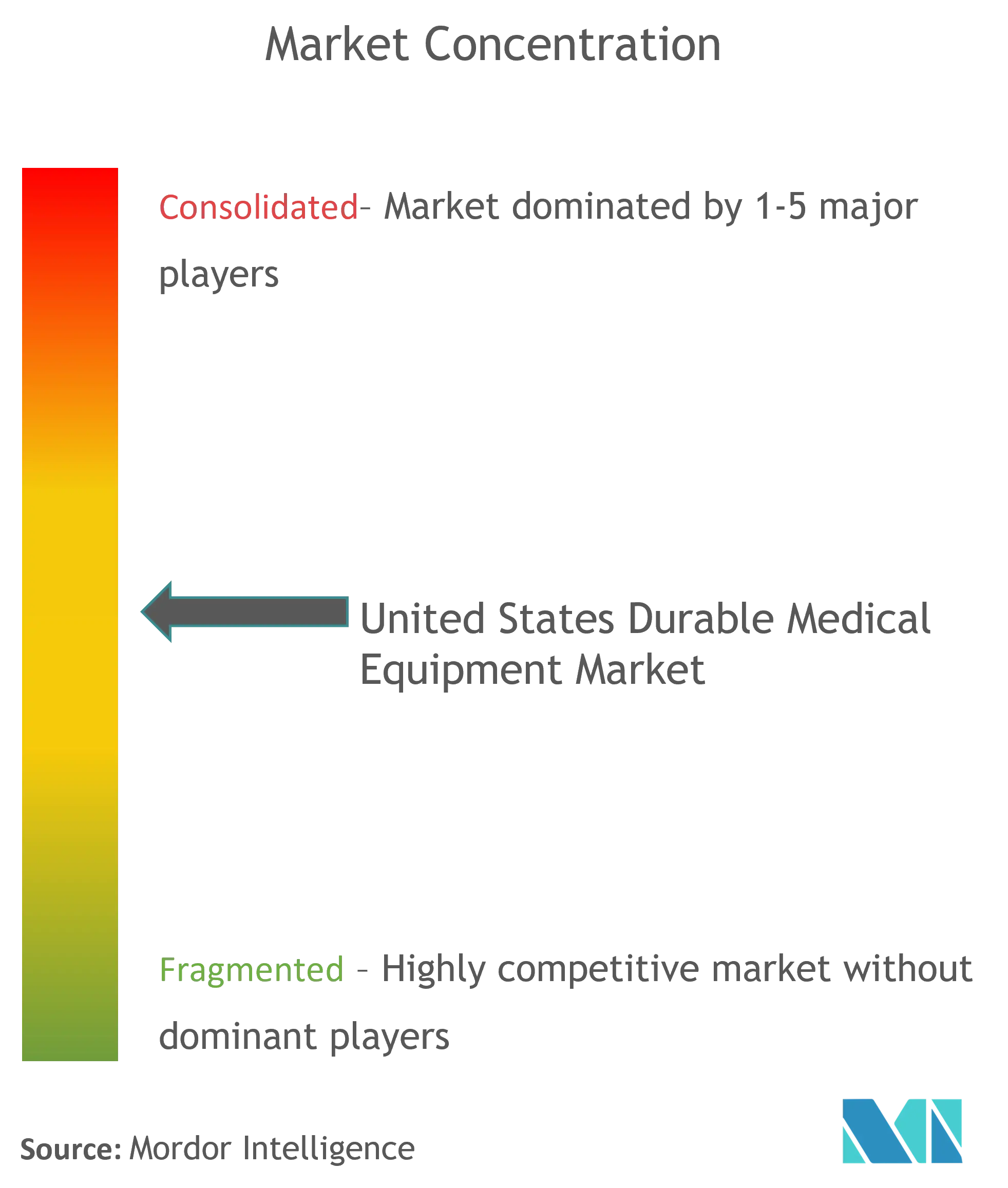
| Market Concentration | Medium |
Major Players *Disclaimer: Major Players sorted in no particular order Image © Mordor Intelligence. Reuse requires attribution under CC BY 4.0. | |

United States Durable Medical Equipment Market Analysis by Mordor Intelligence
The United States Durable Medical Equipment Market size is expected to register a CAGR of 5.87% during the forecast period.
As a result of the COVID-19 public health emergency, there is a higher demand for durable medical equipment to extend health care capacity in local hospitals and health care systems through temporary expansion sites, as well as to ensure adequate and effective patient monitoring. Manufacturers from a range of industries that aren't normally linked with medical device production are seeking resources to produce and sell these products to the healthcare community to satisfy this demand. For instance, according to the Office of the Assistant Secretary for Preparedness and Response, since the COVID-19 pandemic began, the United States government's investments in key domestic manufacturing capabilities have significantly improved the United States posture, both in terms of quantities of Personal Protective Equipment (PPE) and Durable Medical Equipment (DME) stored in domestic industrial manufacturing capacities and in having reviewed nearly 13,500 applications for medical product approval, clearance, or authorization between March 2020 and September 2021. This has led to increased adoption of DMEs during the pandemic, driving market growth.
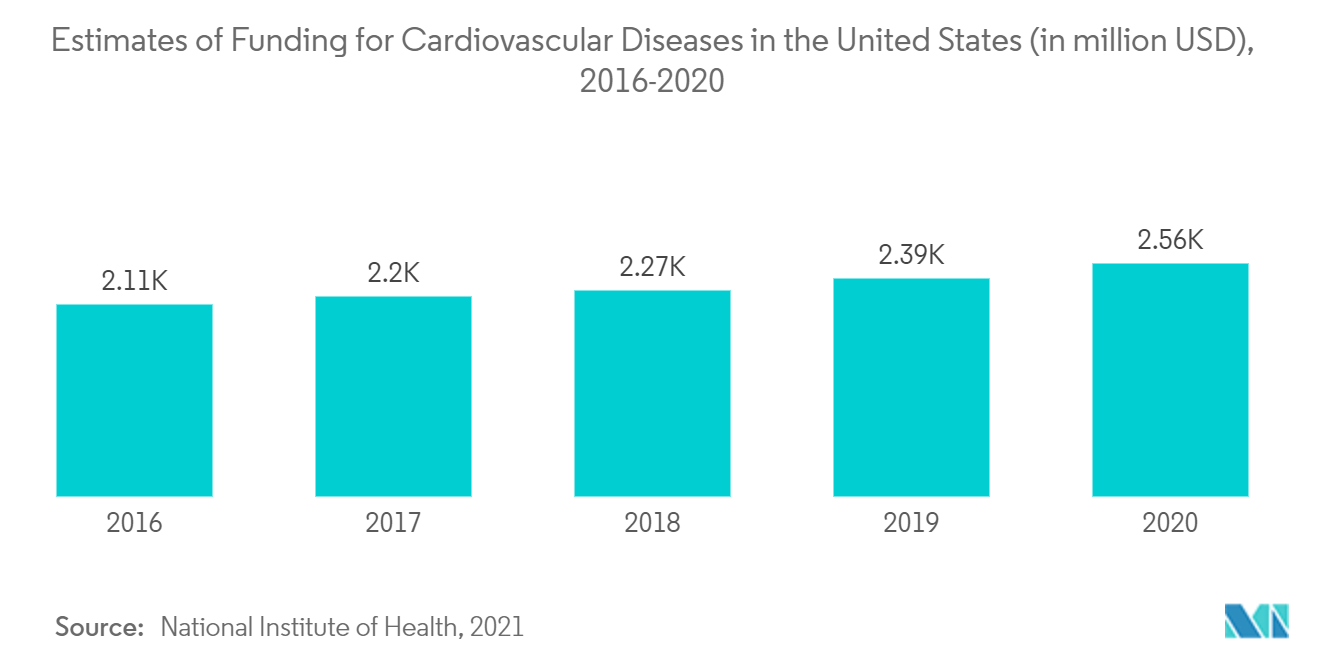
Further, the increasing focus on home care settings for the management of medical conditions and illnesses in patient populations, the rise in prevalence of cardiovascular and diabetes diseases, and the rising awareness about elevating patients' comfort are the key factors driving the market for durable medical equipment (DME) in the United States. For instance, according to the Center for Disease Control and Prevention (CDC) data updated in February 2021, about 659,000 people in the United States die from heart disease each year, accounting for 1 in every 4 deaths. In addition, more than 34 million Americans have diabetes, which is nearly 11% of the United States population, according to the Centers for Disease Control and Prevention (CDC), 2020. Such a high prevalence of diabetes and cardiovascular diseases will lead to increased adoption of monitoring and therapeutic devices, thereby driving market growth in the United States.
In addition, rising initiatives such as the formation of alliances among patients, prescribers, and suppliers in the durable medical equipment industry will lead to increased adoption of durable medical equipment, driving the market's growth. For instance, in September 2021, DMEscripts LLC, an independent e-prescribe firm devoted to improving the patient, prescriber, and provider experience by removing inefficiencies and lowering paperwork, was founded by industry leaders in the United States. DMEscripts intends to significantly enhance the present order-to-delivery process by enabling and speeding up the general deployment of a DME electronic ordering application. Moreover, in March 2021, Vanderbilt University Medical Center launched durable medical equipment (DME) company, Carefluent Connect, LLC, at Vanderbilt Health One Hundred Oaks. Furthermore, the company is planning to open a combined warehouse and second retail location in nearby Mount Juliet, Tennessee in the near future. Such an increase in the commercial availability of DMEs will further drive the market growth in the United States over the coming years. Therefore, owing to the abovementioned factors, the market is expected to grow over the forecast period.
However, stringent regulatory requirements related to medical supplies and higher costs are expected to hamper the market's growth.
Note: Market size and forecast figures in this report are generated using Mordor Intelligence’s proprietary estimation framework, updated with the latest available data and insights as of 2026.
United States Durable Medical Equipment Market Trends and Insights
The Vital Sign Monitor Segment is Expected to Hold a Major Share During the Forecast Period.
By device type, the vital sign monitor segment is expected to hold a major share in the market and is expected to do the same over the forecast period.
The vital signs of hospitalized patients are evaluated to assess the patient's clinical state at an early stage and to detect clinical deterioration. Blood pressure (BP), heart rate (HR), respiratory rate (RR), oxygen saturation (SpO 2), and core temperature are among the vital indicators that are typically monitored. Consistent vital sign monitoring is necessary for the early diagnosis of clinical deterioration in hospitalized patients. It is mostly monitored by healthcare professionals, who measure and document all patients' key vital signs two or three times each day to check their status. Owing to the large number of patients admitted to hospitals due to several illnesses as a result of the recent COVID-19 pandemic, vital sign monitors have become a necessary tool to manage patients within healthcare settings. Thus, the companies are engaged in numerous product launches and approvals of these products, resulting in the segment's growth. For instance, the United States Food and Drug Administration authorized Phillips wearable biosensor "Philips Biosensor BX100," a novel method for vital sign measures to better treat verified and suspected COVID-19 patients in hospitals, in May 2020.
Furthermore, in March 2020, Hillrom, an American corporation, undertook initiatives to provide critical care devices to consumers and caregivers in order to satisfy the ongoing COVID-19 patient demands. The company increased the production of its devices, with the goal of more than doubling capacity in areas such as respiratory health, particularly Life2000, a non-invasive ventilator; ICU and med-surg unit smart beds; and patient monitoring and diagnostics, including the company's Connex and Spot Vital Signs monitors, among others.
Therefore, owing to the abovementioned factors, this segment is expected to drive the segment growth over the forecast period.
Regulatory Landscape
In the United States, durable medical equipment is shaped by a dual framework of FDA medical-device oversight for manufacturers and CMS Medicare policy for coverage, coding, and supplier compliance. On February 2, 2026, the FDA Quality Management System Regulation (QMSR) took effect, incorporating ISO 13485:2016 and changing quality system expectations for device makers that supply DME-relevant monitoring and therapeutic products.
On the reimbursement and supplier side, CMS updates the DMEPOS Fee Schedule and compliance controls on a recurring basis. CMS implemented the CY 2026 DMEPOS Fee Schedule update with a 2.0% update factor for items not adjusted using competitive bidding information, and issued an April 2026 quarterly update that added new HCPCS codes effective April 1, 2026 and deleted select codes effective March 31, 2026. CMS also continues to use prior authorization and enrollment tools to address program integrity, including a Federal Register notice on February 27, 2026 announcing a 6-month nationwide moratorium on enrollment of certain DMEPOS supplier types, and a December 2, 2025 final policy (CMS-1828-F) establishing an exemption pathway from prior authorization for suppliers demonstrating billing compliance.
Competitive Landscape
The United States durable equipment market is highly competitive owing to the large number of prominent players in the market. The factors such as rising launch of new products in the market, growth in funding for various diseases, surge in acquisitions, collaborations and partnerships among key players are expected to drive this market. Some of the key market players include Masimo, Koninklijke Philips NV, Becton, Dickinson and Company, Medtronic PLC, Pride Mobility, Nihon Kohden Corporation, and Invacare Corporation, among others.
United States Durable Medical Equipment Industry Leaders
-
Masimo
-
Medtronic PLC
-
Pride Mobility
-
Nihon Kohden Corporation
-
Koninklijke Philips NV
- *Disclaimer: Major Players sorted in no particular order
Market Opportunities and Future Outlook
The tightening and formalization of Medicare controls creates room for suppliers that can operationalize compliance at scale, particularly around DMEPOS prior authorization, required lists, and supplier enrollment actions, including the February 2026 nationwide moratorium for certain supplier types. CMS also continues to refine pricing and coding mechanics through the CY 2026 DMEPOS Fee Schedule update and quarterly HCPCS code changes, including April 2026 additions and deletions. This supports demand for revenue-cycle tooling, documentation workflows (face-to-face and written order requirements), and product configurations aligned with reimbursable coding.
Operationally, domestic capacity and distribution investments provide an enabling backdrop for DME categories that rely on resilient supply and fulfillment, including monitoring and therapeutic equipment used across hospital-to-home pathways. In July 2026, Boston Scientific announced a USD 138 million investment in a 500,000-square-foot Plainfield, Indiana facility combining light manufacturing and global medical-device distribution, and Otsuka ICU Medical LLC announced a USD 500 million expansion of IV solutions manufacturing in Austin, Texas, including a new 500,000-square-foot facility. While not all output is DME, these moves reinforce broader US medical-device logistics and manufacturing expansion that DME suppliers and OEMs can use for lead-time reduction and continuity planning alongside Medicare policy changes, including Competitive Bidding Program updates finalized by CMS in 2025.
Recent Industry Developments
- April 2026: VGM and Trace Medical announced an exclusive agreement effective April 1, 2026 to expand VGM member access to Trace Medical respiratory rentals, dialysis rentals, and biomedical services nationwide. The program strengthens rental and service infrastructure that supports oxygen therapy and other home-based durable equipment categories. It also concentrates service access through a national network, influencing how smaller providers source rentals and maintenance.
- December 2025: Owlet announced a new DME partnership with 1 Natural Way to expand insurance-supported access to the BabySat infant pulse oximeter. This brings a consumer-facing monitoring device deeper into the traditional DME channel, with fulfillment and payer workflows managed through an established supplier. The partnership highlights continued convergence between remote monitoring products and reimbursed home medical equipment distribution.
- June 2025: Inogen introduced the Voxi 5 stationary oxygen concentrator, positioning it as an affordable durable oxygen therapy option. The launch broadens choice within home oxygen equipment, a core DME category used in chronic respiratory care and post-acute settings. New stationary platforms can also shift provider purchasing decisions when paired with service models and payer coverage requirements.
Research Methodology Framework and Report Scope
Market Definition and Coverage
For this study, the market covers revenue generated from durable medical equipment used repeatedly for medical needs in the United States, across home and facility settings. It includes products such as personal mobility devices, medical furniture and bathroom safety equipment, and monitoring and therapeutic devices.
Scope exclusions: We exclude routine disposable medical supplies (for example, bandages, face masks, and rubber gloves) and other short life consumables that are not treated as durable equipment in common reimbursement definitions.
Segmentation Overview
- By Device Type
- Personal Mobility Devices
- Wheelchair
- Crutch and Cane
- Walker
- Medical Furniture and Bathroom Safety Devices
- Medical Bed and Mattress
- Commode and Toilet
- Other Medical Furniture and Bathroom Safety Devices
- Monitoring and Therapeutic Devices
- Blood Glucose Monitor
- Oxygen Equipment Oxygen Equipment
- Vital Sign Monitor
- Infusion Pump
- Other Monitoring and Therapeutic Devices
- Personal Mobility Devices
- By End User
- Hospital/Clinic
- Ambulatory Surgical Center
- Other End Users
Data Sources, Market Sizing, and Validation
Desk Research
Desk research starts with public signals that show how the DME demand pool is moving in the United States, and then we map those signals to the product categories covered in the report. Sources we leaned on include CMS and Medicare fee schedule and utilization documentation, CDC health statistics (especially chronic disease and aging related indicators), and FDA databases for recalls and product safety actions, since these can shift replacement cycles.
To keep the model grounded, we also review broad healthcare expenditure series (including DME spending projections), peer reviewed articles on home care adoption and adherence, and trade association publications that explain coverage rules and delivery patterns. Company annual reports, investor presentations, and earnings commentary are used to check category level momentum and pricing direction, while a paid subscription focused on company financials and a separate paid patent database are used selectively to fill gaps and confirm innovation intensity. These desk sources are not exhaustive, and many other public documents and datasets were referenced to cross check figures and clarify assumptions.
Primary Interviews and Surveys
Primary work was used to turn the public signals into realistic, usable assumptions on pricing, channel mix, and utilization patterns, with a focus on decision making across home medical equipment providers and care settings in the United States. We spoke with a mix of manufacturer side contacts, distributors, provider organizations, and clinical stakeholders so the model reflects what is reimbursed, what is actually delivered, and where adoption is changing across the market.
Distribution of primary research fieldwork respondents
| Company type | Respondent position |
|---|---|
| Top tier: 33% | CXOs: 12% |
| Mid tier: 49% | Functional/Unit leaders: 30% |
| Smaller Players: 18% | Managers: 58% |
Market-Sizing & Forecasting
Sizing begins with a top down build that reconstructs demand using U.S. coverage and care delivery realities, and then we translate it into value by applying category level pricing and utilization assumptions. Inputs used in the model include the age 65 plus population trend, prevalence signals tied to chronic respiratory and mobility limiting conditions, Medicare reimbursement signals (purchase versus rental logic where relevant), and observed replacement or upgrade behavior for major device groups.
The totals are then corroborated using selective bottom up approximations, such as roll ups from sampled supplier and provider revenue splits, sampled unit volumes multiplied by average selling prices, and channel checks on where equipment is typically fulfilled (home delivery versus facility procurement). When a bottom up view is incomplete for smaller local providers, we estimate the missing share through calibrated ratios that were validated in interviews and aligned to the broader demand indicators.
For forecasting, we use scenario analysis supported by a simple multivariate relationship between demand drivers and category spend, and then assumptions are adjusted based on what primary respondents expect for reimbursement tightening, home care expansion, and product mix shifts. Where the data points disagree, we keep assumptions conservative and traceable to one or two measurable signals, so updates can be repeated consistently in the next refresh.
Data Validation & Update Cycle
Validation is done in layers so the final numbers do not rely on a single dataset or one interview view. We compare outputs against independent metrics like national DME spend signals, reimbursement direction, and category level growth cues from filings, and then unusual spikes are reviewed to confirm they are not caused by timing mismatches or category overlap.
Before sign off, the model goes through a second analyst review that checks arithmetic consistency, unit economics, and whether assumptions match what respondents described in terms of purchasing versus rental patterns. Reports are refreshed annually, and interim updates are made when material events happen, such as major reimbursement changes or unusually large recall waves. Right before delivery, we run a fresh pass on the latest public updates so clients receive an up to date view.
Mordor Intelligence's United States Durable Medical Equipment Market Sizing Compared With Other Published Estimates
Published market values for U.S. durable medical equipment can look far apart because the scope line is drawn differently, and because some sources lean on spending led totals while others build product sales values. Differences also come from how rental revenue is treated, what is counted as durable versus consumable, and how quickly pricing and reimbursement assumptions are refreshed.
The main gap comes from mixing national DME expenditure series with product market revenue, where Mordor Intelligence counts only durable equipment categories aligned to device type coverage and excludes routine disposable supplies even if they are used in care delivery.
Benchmark comparison
| Source | Market Size | Gaps in Research Methodology |
|---|---|---|
| Mordor Intelligence | USD 78.00 B (2024) | |
| Trade Journal A | USD 78.00 B (2024) | Uses health care expenditure tracking for DME, which can reflect payer accounting and timing effects rather than product category revenue mapping, and it typically does not show how device type boundaries are handled. |
| Industry Publisher B | USD 62.70 B (2023) | Anchors on an earlier base year and may apply a broad product basket with limited visibility into rental versus purchase treatment, which can shift totals when reimbursement and pricing move quickly. |
The table shows that the spread is mainly explained by what is being measured and when it is being measured, rather than by arithmetic alone. By keeping the scope tied to durable categories and checking assumptions against reimbursement and utilization signals, we keep the estimate traceable to clear inputs that can be rechecked each year.
Key Questions Answered in the Report
What is the current United States Durable Medical Equipment Market size?
The United States Durable Medical Equipment Market is projected to register a CAGR of 5.87% during the forecast period (2026-2031)
Who are the key players in United States Durable Medical Equipment Market?
Masimo, Medtronic PLC, Pride Mobility, Nihon Kohden Corporation and Koninklijke Philips NV are the major companies operating in the United States Durable Medical Equipment Market.
What years does this United States Durable Medical Equipment Market cover?
The report covers the United States Durable Medical Equipment Market historical market size for years: 2019, 2020, 2021, 2022, 2023 and 2024. The report also forecasts the United States Durable Medical Equipment Market size for years: 2026, 2027, 2028, 2029, 2030 and 2031.