
Market Overview
| Study Period | 2020 - 2031 |
|---|---|
| Forecast Data Period | 2026 - 2031 |
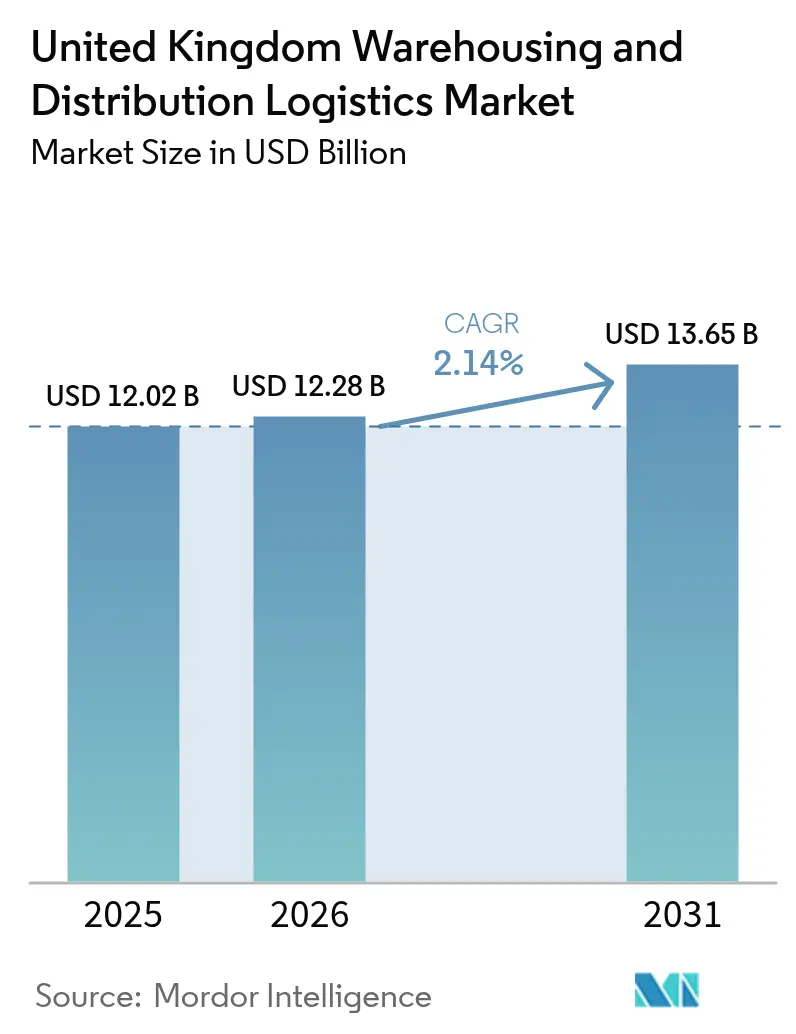
| Base Year Market Size (2025) | USD 12.02 Billion |
| Market Size (2026) | USD 12.28 Billion |
| Market Size (2031) | USD 13.65 Billion |
| Growth Rate (2026 - 2031) | 2.14 % |
| Market Concentration | Low |
Major Players *Disclaimer: Major Players sorted in no particular order Image © Mordor Intelligence. Reuse requires attribution under CC BY 4.0. | |
United Kingdom Warehousing And Distribution Logistics Market Analysis by Mordor Intelligence
The United Kingdom Warehousing And Distribution Logistics Market size was valued at USD 12.02 billion in 2025 and estimated to grow from USD 12.28 billion in 2026 to reach USD 13.65 billion by 2031, at a CAGR of 2.14% during the forecast period (2026-2031).
Expanding e-commerce volumes, post-Brexit inventory realignments, and sustained investment in automation collectively underpin the market’s steady trajectory. Increasing demand for omnichannel fulfillment hubs near dense population centers, rising temperature-controlled storage requirements for grocery and pharmaceuticals, and government freeport incentives are reinforcing development pipelines. At the same time, land scarcity around major conurbations and labor shortages are exerting upward pressure on rents and wages, prompting faster adoption of robotics and energy-efficient designs. Consolidation among large operators allows scaling of capital-intensive technology, while mid-sized providers focus on niche services such as renewable-energy component storage to remain competitive within the United Kingdom warehousing & distribution logistics market.
Key Report Takeaways
- General Warehousing & Storage held 57.35% of the United Kingdom warehousing & distribution logistics market share in 2025, whereas Refrigerated Warehousing & Storage is advancing at a 5.22% CAGR through 2031.
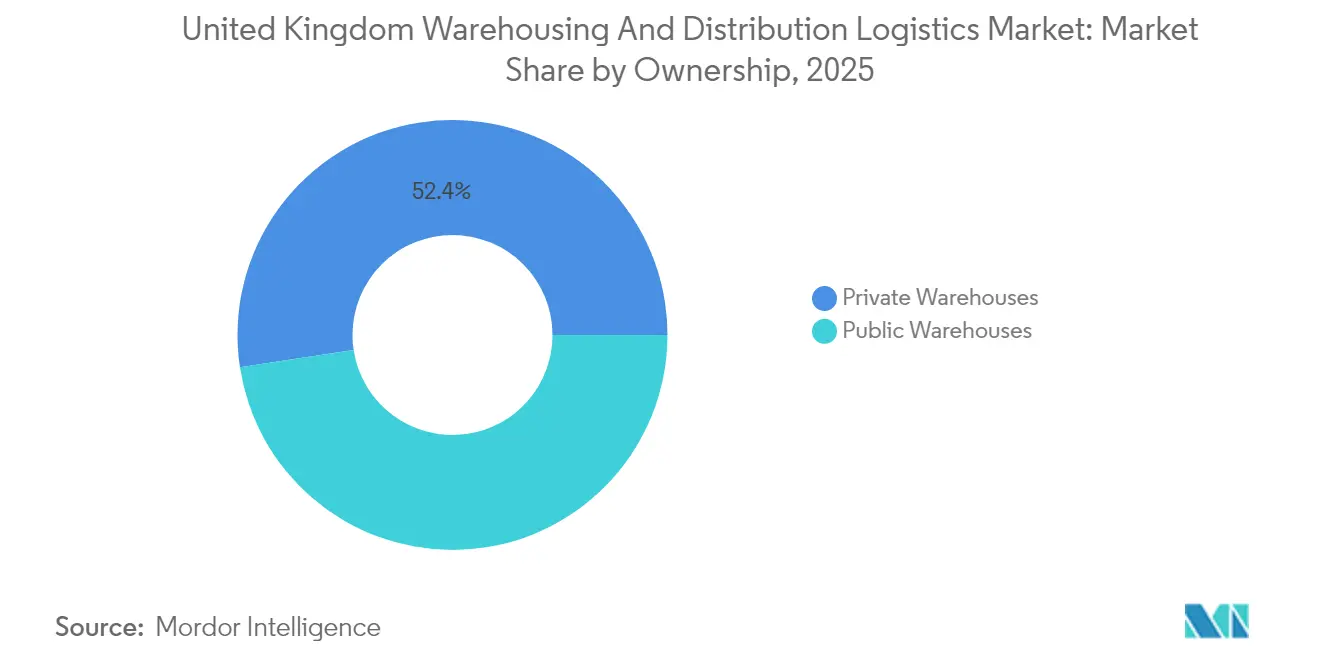
- Private Warehouses commanded 52.40% of the United Kingdom warehousing & distribution logistics market size in 2025 and will post the fastest 4.05% CAGR to 2031.
- By end-user industry, e-commerce & retail captured 23.60% revenue share in 2025, while pharma & healthcare will expand at a 4.84% CAGR during the same horizon.
- England led with 73.45% regional share in 2025; Scotland is poised for a 3.96% CAGR, the strongest within the geography segmentation.
Note: Market size and forecast figures in this report are generated using Mordor Intelligence’s proprietary estimation framework, updated with the latest available data and insights as of 2026.
United Kingdom Warehousing And Distribution Logistics Market Trends and Insights
Drivers Impact Analysis*
| Driver | (~) % Impact on CAGR Forecast | Geographic Relevance | Impact Timeline |
|---|---|---|---|
| E-commerce fulfillment space surge | +1.2% | England core, Scotland emerging | Medium term (2-4 years) |
| Cold-chain growth for grocery & pharma | +0.8% | National, London-Birmingham corridor | Long term (≥ 4 years) |
| Automation & robotics efficiency gains | +0.7% | England, Scotland industrial zones | Medium term (2-4 years) |
| Government freeport & industrial-park incentives | +0.5% | 12 designated freeport zones | Short term (≤ 2 years) |
| Re-/near-shoring of inventory post-Brexit | +0.6% | England ports, Scotland manufacturing | Long term (≥ 4 years) |
| ESG-driven brown-field redevelopment | +0.4% | Urban England, Wales industrial areas | Long term (≥ 4 years) |
| Source: Mordor Intelligence | |||
E-commerce Fulfillment Space Surge
Escalating online retail penetration has shifted network planning toward facilities located within 50 miles of the largest urban catchments. Operators prioritize multi-story hubs and micro-fulfillment annexes that compress last-mile delivery times while supporting returns processing. Amazon’s multi-year program of green-field and brown-field developments exemplifies the scale of investment, and large grocery chains now dedicate dedicated space to online picking alongside store replenishment. Extended Producer Responsibility rules for packaging, effective in 2025, add data compliance layers but simultaneously drive operational streamlining. Resulting capacity constraints in the Golden Triangle underpin premium rent growth and sustain double-digit pre-leasing rates across the United Kingdom warehousing and distribution logistics market[1].
Cold-Chain Growth for Grocery and Pharma
Demand for temperature-controlled facilities now outpaces ambient capacity expansion as grocery home-delivery volumes converge with pharmaceutical buffer-stock strategies. Dual-use specifications capable of +4 °C chilled to -20 °C frozen enable operators to flex between sectors and smooth asset utilization. Strategic corridors linking London, Birmingham, and the eastern ports attract multi-tenant build-to-suit projects, while nationwide distribution requires satellite cross-dock nodes closer to consumers. Adoption of natural refrigerants aligns buildings with future sustainability regulation and generates operating-cost benefits once electricity-intensive systems are powered by on-site solar arrays. This specialist capability therefore commands a rental premium of 20-25% but continues to secure long-term commitments from brand-name occupiers, enhancing revenue visibility across the United Kingdom warehousing & distribution logistics market.
Automation and Robotics Efficiency Gains
Rising wage bills and the chronic 76% vacancy rate for warehouse operatives accelerate investment in goods-to-person robotics, autonomous mobile robots, and AI-enabled inventory orchestration. Ocado’s grid-based robotic system delivered over 30 million picks during 2024, demonstrating a pathway to 99.9% accuracy and sub-five-minute order cycles. Return on investment horizons have contracted to two-three years where throughput tops 150,000 picks per week, and early adopters report 25-50% productivity uplifts. As new facilities break ground, developers increasingly grade electrical capacity to support high-density automation from day one, embedding modular mezzanines and fiber backbones that future-proof buildings. These technology deployments are becoming a primary means of mitigating labor-market friction within the United Kingdom warehousing & distribution logistics market.
Government Freeport and Industrial-Park Incentives
Twelve freeports now offer streamlined customs processes, capital-allowance uplifts, and business-rate holidays, lowering entry thresholds for international traders. Forth Green Freeport couples renewable-energy benefits with automotive supply-chain clustering, reducing turnaround times for component flows into northern assembly plants. Complementary investment zones add research-and-development reliefs that attract value-added logistics operations such as light manufacturing and product customization. Although compliance procedures remain intricate, early participants unlock logistics cycle-time savings and total landed-cost efficiencies. The incentive framework effectively offsets short-term border frictions following Brexit and channels new FDI into the United Kingdom warehousing and distribution logistics market.
Restraints Impact Analysis*
| Restraint | (~) % Impact on CAGR Forecast | Geographic Relevance | Impact Timeline |
|---|---|---|---|
| Urban land scarcity & rent inflation | -0.9% | London, Birmingham, Manchester cores | Short term (≤ 2 years) |
| Warehouse-labor shortages & wage spikes | -0.6% | National, acute in Southeast England | Medium term (2-4 years) |
| Grid-capacity limits for EV / automation | -0.4% | Industrial England, Scotland renewables | Medium term (2-4 years) |
| Planning-permission delays (NIMBY) | -0.3% | Urban England, suburban expansion zones | Short term (≤ 2 years) |
| Source: Mordor Intelligence | |||
Urban Land Scarcity and Rent Inflation
Vacancy across prime logistics sub-markets remains below 2%, propelling rents upward by 8% annually as occupiers compete for scarce plots inside the M25 and along the M1 corridor. Developers increasingly pursue multi-story designs or repurpose obsolete big-box retail to unlock urban footprints. However, higher land outlays translate into elevated breakeven rent thresholds that smaller retailers struggle to absorb, driving polarization toward scale players. Local authorities attempt to balance employment opportunities against community concerns but retain stringent design codes to mitigate traffic and visual impact, slowing start-to-completion cycles within the United Kingdom warehousing and distribution logistics market.
Warehouse-Labor Shortages and Wage Spikes
Logistics UK surveys indicate that 76% of operators faced critical staffing gaps during 2024, even after median hourly wages rose 9% year on year. Housing affordability in the Southeast deepens recruitment difficulties, prompting employers to bus workers from peripheral towns or invest in on-site amenities. Skills shortages extend to maintenance engineers and data analysts needed for robotics upkeep and WMS optimization. Apprenticeship and reskilling programs are expanding but yield benefits only over multi-year horizons, placing near-term upward pressure on total cost to serve.
*Our forecasts treat driver/restraint impacts as directional, not additive. The impact forecasts reflect baseline growth, mix effects, and variable interactions.
Segment Analysis
By Warehouse Type: Refrigerated Capacity Outpaces General Storage
Refrigerated Warehousing & Storage generated a 5.22% CAGR to 2031, comfortably ahead of the 2.14% overall growth registered by the United Kingdom warehousing & distribution logistics market size. Although General Warehousing & Storage retained 57.35% share in 2025, vacancy for high-spec cold units is virtually nonexistent, reflecting structural shifts in grocery home delivery and pharmaceutical integrity regulations. Capital intensity is higher refrigerated builds cost 40-60% more than ambient equivalents but operators pass through expenses via multi-year indexed contracts that insulate returns.
Energy-efficient chillers, IoT temperature monitoring, and modular racking improve space utilization and compliance, enabling providers to blend chilled and frozen zones on demand. Meanwhile, general warehousing leans on automation to defend margins, integrating shuttle systems and high-density pallets that reduce per-unit handling costs. Dual-certified facilities capable of toggling between cold and ambient regimes further blur segment boundaries, optimizing uptake across seasonal peaks within the United Kingdom warehousing & distribution logistics market.


By Ownership: Private Facilities Tighten Hold
Private Warehouses controlled 52.40% of the United Kingdom warehousing & distribution logistics market share in 2025 and are on course for a 4.05% CAGR, mirroring corporates’ desire for end-to-end visibility and integration. In-house management accelerates deployment of robotics and tailored WMS, supporting omnichannel flows and SKU proliferation. Public warehouses remain vital for SMEs and importers requiring flexible volume commitments, but commoditization places downward pressure on service margins.
M&A activity underscores the strategic value of private capacity; GXO’s USD 1.3 billion Wincanton transaction consolidates expertise across automotive, retail, and defense. Lease-purchase structuring, whereby occupiers take title at maturity, gains popularity as a hedge against long-term rent inflation. Conversely, REIT-owned public stock struggles to fund deep retrofits without extended lease terms, creating a bifurcated asset base inside the United Kingdom warehousing & distribution logistics market.
By End-User Industry: Healthcare Leads Premium Expansion
E-commerce & retail sustained 23.60% of 2025 demand, yet the pharma & healthcare vertical emerges as the fastest-growing at 4.84% CAGR, reflecting stricter Good Distribution Practice audits and nearshoring of vaccine and biologics manufacturing. Temperature and humidity monitoring are critical, pushing the adoption of validated digital twins and blockchain traceability. Food & beverage volumes remain high but margin pressure spurs co-location with grocery distribution to maximize cross-docking.
Automotive warehousing adapts to electric-vehicle component flows that require lithium-battery handling protocols and proximity to gigafactories. Manufacturing & engineering goods maintain steady requirements for heavy-lift capacity and secure yards. Growing renewable-energy investment adds demand for oversized turbine parts and grid-scale battery units, expanding the “Others” category. This diversification underpins stable baseline demand across the United Kingdom warehousing & distribution logistics market size.
Geography Analysis
England accounted for 73.45% of all occupied space in 2025, anchored by the “Golden Triangle” linking the M1, M6, and M42 that enables next-day delivery to 90% of UK households. Extended lead times for building permits and rail-freight network delays limit immediate capacity relief, so speculative projects secure pre-lets months before completion. London’s low vacancy pushes occupiers to Greater Essex and Kent, where supply pipelines are rising but compete with residential land uses. The cancellation of the northern HS2 leg in 2024 removed a catalyst for high-speed freight, raising concern about future inter-modal fluidity.
Scotland delivers the fastest 3.96% CAGR to 2031, stimulated by Forth Green Freeport incentives and abundant renewable-energy generation that lowers carbon intensity for cold-chain operators. Mossend International Railfreight Park enhances continental connectivity, reducing reliance on southern ports. Grant support for battery-storage and wind-turbine assembly drives specialized warehouse requirements that command premiums in the Central Belt. Wales concentrates activity around Milford Haven and Cardiff, where automotive and aerospace links draw inbound components and export flows, though labor supply remains tight.
Northern Ireland occupies a strategic interface between UK and EU regulatory zones, offering dual-market access that attracts value-added logistics services such as product customization and reverse logistics. However, customs protocols still create administrative overhead, dampening speculative development appetite. Cross-border projects with the Republic of Ireland share resources to mitigate scale limitations, gradually bolstering resilience across the wider United Kingdom warehousing & distribution logistics market.
Regulatory Landscape
Warehouse and distribution operations in the United Kingdom are shaped by border, safety, and trade compliance requirements. Customs warehousing is administered by HM Revenue and Customs (HMRC), where operators must be authorised to run a customs warehouse, hold an EORI number, and maintain robust, computerised inventory records aligned to customs procedures for goods held under duty suspension. The Health and Safety Executive (HSE) is the primary enforcement body for warehousing safety, and operators are required to manage material-handling risks, racking integrity, and vehicle-pedestrian segregation as part of day-to-day compliance.
Trade and border policy updates continue to affect documentation and operating processes for importers, freight forwarders, and warehouse operators managing bonded or temporary storage flows. The Department for Transport (DfT) frames freight policy through national freight initiatives such as the Future of Freight plan, while businesses operating within the United Kingdom freeport framework can use established special procedures (including customs warehousing and inward processing) alongside site-specific incentives, supporting duty deferral and value-added activity within designated zones.
Value Chain Analysis
The United Kingdom warehousing and distribution logistics value chain starts with inbound flows from ports, airports, and Channel crossings into inland storage and fulfilment nodes, then moves through picking and packing and value-added services (kitting, labeling, returns and refurbishment), before outbound trunking to parcel networks and retail replenishment. Upstream enablers include developers and REITs delivering modern sheds, automation and WMS providers supporting high-throughput operations, and energy and grid connections that determine feasible levels of electrification and robotics density. Downstream, parcel carriers and retail transport fleets convert warehouse throughput into last-mile delivery and store replenishment.
Network design increasingly links large regional distribution centres in the Golden Triangle with intermodal rail-linked hubs and urban micro-fulfilment sites to balance cost, service time, and labor availability. Major projects reflect the chain shift toward rail-integrated distribution, including the Northampton Gateway strategic rail freight interchange opened in March 2026 (a rail-connected logistics hub with container storage) and the Secretary of State approval of Prologis DIRFT IV as a Nationally Significant Infrastructure Project in January 2026, supporting additional inland capacity over a multi-year buildout. Cost inflation in transport inputs, including diesel price volatility highlighted in 2026 market updates, feeds back into warehouse location and modal choices, reinforcing rail-enabled hubs and higher throughput automation in labor-constrained regions.
Competitive Landscape
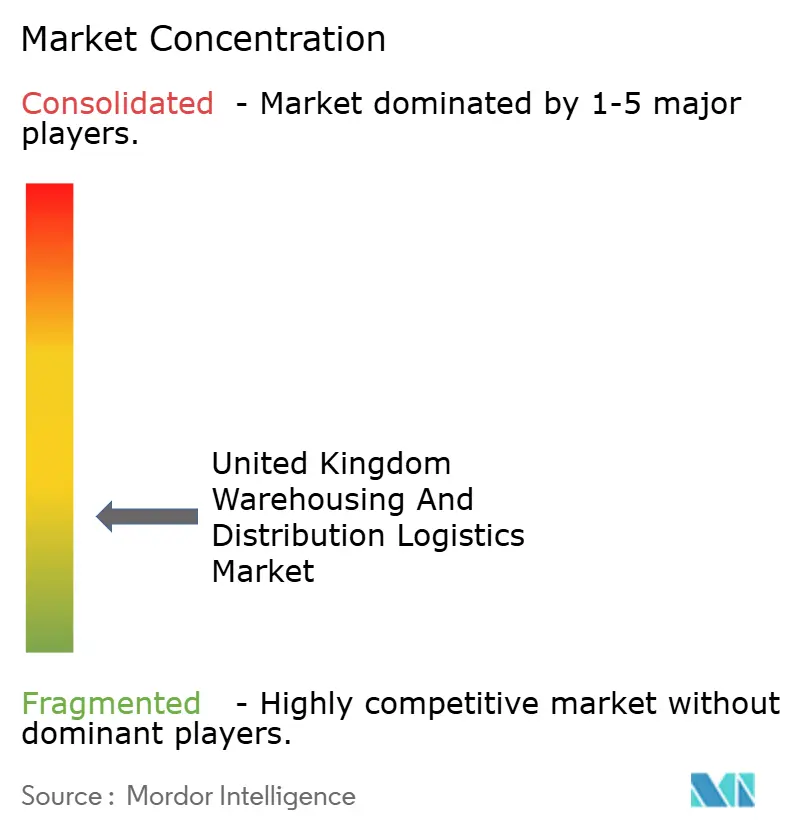
The market exhibits moderate concentration, signaling ample room for specialist and regional players. GXO’s absorption of Wincanton enriches its sector breadth and unlocks GBP 45 million (57.28 million) in annual synergies around automation procurement and network optimization. DHL, Kuehne + Nagel, and CEVA leverage global procurement strength to roll out standardized WMS platforms and sustainability features such as LED retrofits and electric shunter fleets.
Technology is the main competitive differentiator. Ocado licenses its proprietary robotic grid to third-party grocers as a service, while Amazon extends its European “multi-node” inventory algorithm to UK sellers, compressing delivery promise windows without ballooning stock levels. Mid-tier operators respond by partnering with software specialists to deploy plug-and-play autonomous mobile robots on a subscription basis. ESG credentials increasingly tip bidding contests; Prologis and SEGRO both market on-site solar generation and biodiversity offsets to secure blue-chip tenants.
Disruption risk persists as parcel networks integrate lockers and micro-depots that bypass central warehousing for fast-moving SKUs. At the same time, institutional investors pile into prime sheds seeking defensive yields, lifting acquisition multiples to record highs. This influx encourages sale-and-leaseback transactions that recycle capital back into automation, thereby reinforcing competitive moats across the United Kingdom warehousing & distribution logistics market[3].
United Kingdom Warehousing And Distribution Logistics Industry Leaders
-
DHL Supply Chain
-
Kuehne + Nagel
-
GXO Logistics
-
CEVA Logistics
-
DSV
- *Disclaimer: Major Players sorted in no particular order
Market Opportunities and Future Outlook
Demand-side whitespace is concentrated in high-spec capacity that reduces cost-to-serve under tight labor and land conditions, including automated shared-user fulfilment, validated healthcare distribution, and modern temperature-controlled space for grocery and pharma integrity requirements. A concrete example is DHL Supply Chain announcing automation-led UK capacity additions around Derby, with plans for a flagship healthcare logistics site at Infinity Park Derby tied to a broader GBP 550 million UK automation investment, and a shared-user ecommerce fulfilment hub in Derby with George at Asda as an anchor customer. These moves support opportunities for multi-tenant operators and technology providers focused on fast deployment of robotics, WMS, and compliant quality systems.
On the supply and infrastructure side, rail-linked logistics space and border-efficient inventory models are opening new development and operating lanes. Strategic Rail Freight Interchange momentum is evidenced by Maritime Transport and SEGRO opening the Northampton Gateway SRFI at SEGRO Logistics Park Northampton in March 2026, and work starting in July 2026 to modernise Barking Eurohub into an international rail freight facility supporting cross-Channel services. In parallel, government trade and border initiatives, including preparation work for a UK-EU SPS agreement with an indicated mid-2027 start, create a pathway for warehouses that specialise in agrifood handling, inspection readiness, and documentation control, alongside freeport-enabled customs warehousing models that defer duties and support value-added processing within designated zones.
Recent Industry Developments
- July 2026: DHL Supply Chain and Leidos formed a strategic alliance focused on bidding for the UK Ministry of Defence Future Defence Support Services (FDSS) program. The tie-up strengthens scale, technology, and systems-integration capability for defense logistics and can influence contracting dynamics for defense logistics and large, multi-year warehousing and distribution scopes in the United Kingdom.
- June 2026: GXO Logistics extended its transport partnership with Co-op for five years, covering operations linked to Avonmouth, Andover, and Lea Green. The renewal secures multi-site grocery distribution volumes and reinforces the role of long-duration contracts in underwriting fleet and warehouse productivity investments.
- April 2026: Kuehne+Nagel began rolling out its cloud-native KN SwiftLOG warehouse management system globally, integrated with Blue Yonder technology and agentic AI. The platform shift supports standardized execution and faster deployment of advanced warehouse orchestration, raising the digital baseline for contract logistics operations serving UK networks.
Research Methodology Framework and Report Scope
Market Definition and Coverage
For this study, we size the value of third-party warehousing and distribution logistics services delivered within the United Kingdom. The scope covers paid activities tied to storing, handling, and moving goods through distribution operations.
Scope exclusions: We exclude own-account logistics done fully in-house by shippers and any stand-alone long-haul freight services that are not part of warehousing-led distribution work.
Segmentation Overview
- By Warehouse Type (Value)
- General Warehousing and Storage
- Refrigerated Warehousing and Storage
- By Ownership (Value)
- Private Warehouses
- Public Warehouses
- By End-User Industry (Value)
- E-commerce and Retail
- Food and Beverage
- Pharma and Healthcare
- Automotive
- Manufacturing and Engineering Goods
- Others
- By Region
- England
- Scotland
- Wales
- Northern Ireland
Data Sources, Market Sizing, and Validation
Desk Research
Desk research starts with building a clear fact base on the UK storage and distribution footprint, the macro trade environment, and demand signals from large end-user sectors. We rely on public, non-paywalled sources such as the UK Department for Transport statistics, Office for National Statistics (ONS) series, HM Revenue and Customs (HMRC) trade data, and Bank of England inflation and rate indicators to keep inputs consistent over time.
Next, we cross-check the service side using sources such as Companies House filings, annual reports and investor decks, industry association releases (for warehousing and road haulage), and reputable press coverage on capacity additions, automation, and labor availability. Where it helps link revenue to activity, we also use paid subscriptions focused on company financials, freight and supply chain rates, and shipment-level trade signals. The examples listed above are indicative only, because many other sources were used to collect, verify, and clarify the data points and assumptions.
Primary Interviews and Surveys
Primary work is used to validate how pricing moves, what utilization levels providers report, and what customers actually bundle into a warehousing and distribution contract. We speak with operators, facility managers, transport and distribution planners, and end-user logistics heads across key UK regions, and then we re-check any outlier inputs through follow-up calls so the model is not dependent on a single viewpoint.
Distribution of primary research fieldwork respondents
| Company type | Respondent position |
|---|---|
| Top tier: 38% | CXOs: 12% |
| Mid tier: 41% | Functional/Unit leaders: 39% |
| Smaller Players: 21% | Managers: 49% |
Market-Sizing & Forecasting
Our sizing starts with a top-down reconstruction of the served logistics spend in the UK that is linked to warehousing-led distribution, and then the totals are pressure-tested through selective bottom-up checks. In practice, the top-down layer is anchored on activity and demand pools, such as goods movement intensity, trade and inventory trends, and sector-level throughput expectations. We then convert these pools into a service value view using realistic pricing and utilization assumptions.
To keep the model traceable, we use a small set of inputs that can be explained and verified, including warehouse capacity additions and take-up signals, labor and energy cost trends that influence operating rates, inflation-driven price resets in contracts, and end-user volume shifts in retail, food and beverage, and manufacturing. Bottom-up checks are applied using sampled revenue disclosures, service-mix splits, and an ASP times volume logic for common warehouse operations. When private financials are thin, we handle gaps using peer averages.
For forecasting, we use scenario analysis supported by a light multivariate regression layer. Forward paths for inflation, industrial output, retail sales, and trade volumes are translated into expected pricing and throughput changes. Before finalizing, we adjust assumptions only when primary feedback repeatedly points to a different utilization or repricing pattern than what the historical data implies.
Data Validation & Update Cycle
Validation is done through multiple checks that compare the model output against independent signals, such as trade movement, logistics hiring, and warehouse capacity indicators, so the result stays realistic. Outliers are flagged, recalculated, and reviewed by another analyst, and we also re-contact interviewees when a variable shifts sharply or conflicts with observed market behavior.
The report is refreshed annually, and interim updates are made when material events change cost structures or demand patterns in a visible way. Right before delivery, a final review pass is completed so clients receive an updated view aligned to the latest available data.
Mordor Intelligence's United Kingdom Warehousing and Distribution Logistics Market Size Compared With Other Published Estimates
Published market values for UK warehousing and distribution logistics can look far apart because each publisher draws the market box differently and uses different pricing and demand assumptions. Differences also show up when updates are done at different times, since costs and contract rates can move quickly in this service-heavy space.
Some estimates roll in broader logistics services like full 3PL bundles or transport-led freight revenue. In Mordor Intelligence, the value is counted only for warehousing and distribution logistics activity delivered in the United Kingdom, with adjacent transport services excluded unless they are part of the warehousing-led distribution work that customers pay for.
Benchmark comparison
| Source | Market Size | Gaps in Research Methodology |
|---|---|---|
| Mordor Intelligence | USD 12.28 B (2026) | |
| Industry Publisher A | USD 38.20 B (2022) | Uses a wider warehousing plus logistics view and is anchored to an earlier year, so price inflation, contract resets, and later capacity changes are not reflected the same way. |
| Industry Summary B | USD 212.50 B (2024) | Appears to include a much broader logistics revenue pool, likely mixing transport and other outsourced services, and also reports a wide valuation band that is not tied to a clearly repeatable activity-to-revenue build. |
The spread in the table is mainly explained by what gets counted as part of distribution logistics and how pricing is carried into the base year. By keeping the model tied to observable throughput and cost drivers, and then checking it with operator feedback, we arrive at a practical number that is easier to track and update over time.
Key Questions Answered in the Report
How large is the United Kingdom warehousing & distribution logistics market in 2026?
The sector is valued at USD 12.28 billion in 2026, and it is forecast to grow at a 2.14% CAGR to 2031.
Which warehouse type is expanding fastest?
Refrigerated Warehousing and Storage is growing at 5.22% CAGR thanks to grocery home delivery and pharmaceutical demand.
Why are private warehouses gaining share?
Corporations seek tighter supply-chain control and faster automation rollouts, giving Private Warehouses 52.40% share in 2025 and a projected 4.05% CAGR.
Which region offers the highest growth potential?
Scotland leads with a 3.96% CAGR through 2031, supported by the Forth Green Freeport and renewable-energy investments.
What is the key technology trend shaping competitiveness?
Robotics and AI-driven automation deliver 25-50% productivity gains and are shortening return-on-investment periods to under three years.
How is sustainability influencing warehouse development?
Developers retrofit brown-field sites with rooftop solar, LED lighting, and low-carbon refrigerants to meet tenant ESG targets and secure long leases.