
Market Overview
| Study Period | 2020 - 2031 |
|---|---|
| Forecast Data Period | 2026 - 2031 |
| Base Year Market Size (2025) | USD 29.10 Billion |
| Market Size (2026) | USD 30.39 Billion |
| Market Size (2031) | USD 36.54 Billion |
| Growth Rate (2026 - 2031) | 3.75 % |
| Market Concentration | Medium |
Major Players *Disclaimer: Major Players sorted in no particular order Image © Mordor Intelligence. Reuse requires attribution under CC BY 4.0. | |

United Kingdom Third Party Logistics (3PL) Market Analysis by Mordor Intelligence
The United Kingdom third-party logistics market size was estimated to grow from USD 29.10 billion in 2025 to USD 30.39 billion in 2026 and reach USD 36.54 billion by 2031, at a CAGR of 3.75% during the forecast period (2026-2031).
Shippers are shifting toward micro-fulfillment, bonded-warehouse, and predictive-maintenance models that compress lead times and raise service complexity, steering capital toward refrigeration retrofits, customs-linked inventory controls, and same-day spare-parts networks. Digital visibility platforms are penetrating the United Kingdom third-party logistics market as SME users demand API connectivity that orchestrates multi-carrier contracts without owning rolling stock, bolstered by lower capital costs on ESG-linked loans dedicated to green warehousing upgrades. Mode-shift incentives for rail and coastal feeder corridors are beginning to alter modal splits, even as road haulage retains dominance due to entrenched route density and limited intermodal hubs. Meanwhile, lithium-battery fire risks, driver shortages, and cyber-ransom incidents are squeezing margins and accelerating the tilt toward asset-light orchestration models that transfer operational risk to underlying carriers.
Key Report Takeaways
- By service, domestic transportation management held 41.90% of the United Kingdom third party logistics (3PL) market share in 2025, while value-added warehousing and distribution is advancing at a 4.79% CAGR through 2031.
- By end user, retail and E-commerce commanded 28.15% of the United Kingdom third party logistics (3PL) market size in 2025 and is the quickest-growing end-user segment at 5.40% CAGR.
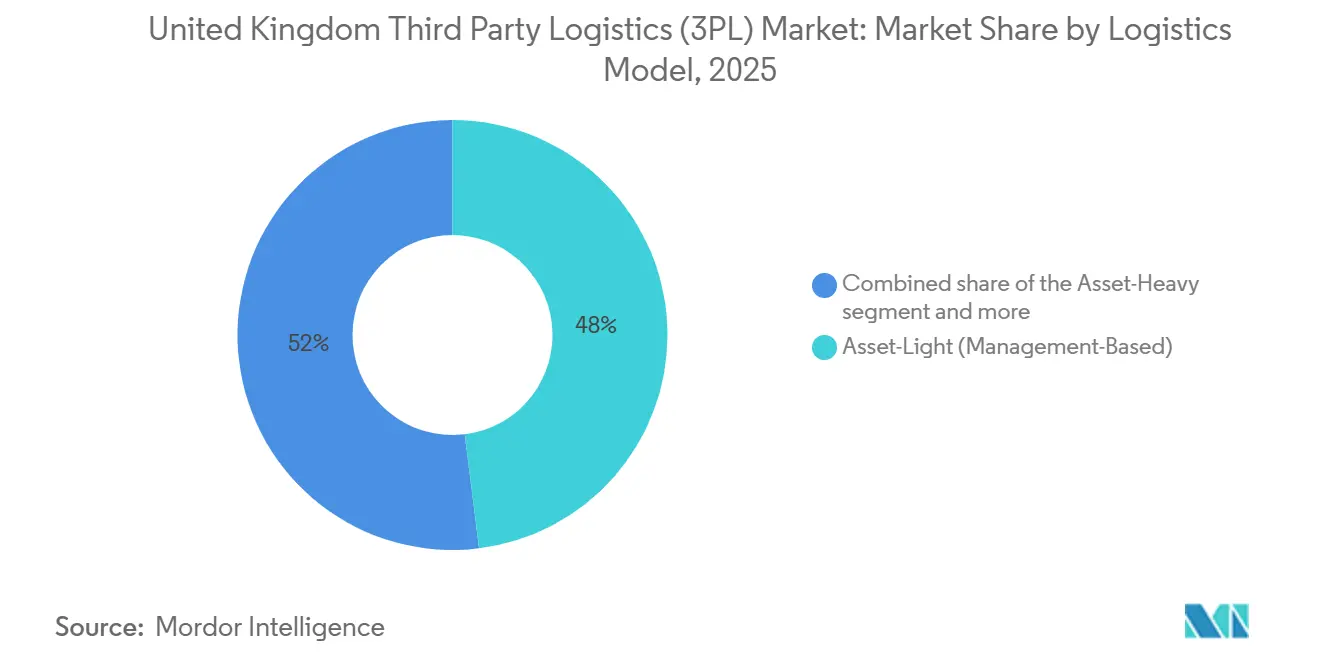
- By logistics model, asset-light models captured 48.03% of the market in 2025, while hybrid configurations are expanding at a 5.58% CAGR.
- By region, England retained a 69.26% share in 2025, yet Scotland is the fastest-growing geography, with a 4.65% CAGR.
Note: Market size and forecast figures in this report are generated using Mordor Intelligence’s proprietary estimation framework, updated with the latest available data and insights as of 2026.
United Kingdom Third Party Logistics (3PL) Market Trends and Insights
Drivers Impact Analysis*
| Driver | (~) % Impact on CAGR Forecast | Geographic Relevance | Impact Timeline |
|---|---|---|---|
| Instant-grocery omni-temperature delivery | +0.9% | England urban cores, Scotland cities | Short term (≤ 2 years) |
| UK Freeports bonded-warehouse demand | +0.7% | Teesside, Liverpool, Thames, Inverness | Medium term (2-4 years) |
| SME digitisation and API 3PL visibility | +0.6% | National, early adoption in Southeast England | Short term (≤ 2 years) |
| OEM predictive-maintenance spare-parts flows | +0.5% | Midlands manufacturing belt, Scotland industrial zones | Medium term (2-4 years) |
| ESG-linked financing lowering cost of capital for green logistics facilities | +0.5% | England logistics parks, Scotland renewable-energy hubs | Long term (≥ 4 years) |
| Government mode-shift subsidies lifting rail & coastal feeder freight volumes | +0.4% | National, concentrated in England-Scotland corridors | Long term (≥ 4 years) |
| Source: Mordor Intelligence | |||
Rapid Expansion of Instant-Grocery and Omni-Temperature Delivery Nodes
Instant-commerce specialists are rolling out micro-fulfillment hubs that combine ambient, chilled, and frozen storage to hit 15-minute delivery windows, a configuration that traditional distribution centers rarely match. Getir’s former network of 100 dark stores illustrated both the capital intensity and data-science sophistication required to forecast SKU-level demand inside dense catchments. Ocado’s robotic cube systems add high-throughput efficiency, enabling 3PLs to offer turnkey micro-fulfillment packages rather than bare pallet space[1]“Freeports,” UK Government, UKGOV.UK. Landlords are converting under-utilized retail and light-industrial sites into temperature-controlled hubs that command premium rents, while Food Standards Agency compliance pushes 3PLs with existing cold-chain certification to the front of contract tenders. The result is rising demand for urban real-estate parcels within 3 km of major high-street nodes, reinforcing the pricing power of operators that already hold chilled capacity. Collectively, these factors are injecting new growth momentum into the United Kingdom third-party logistics market.
UK Freeports Catalyzing Bonded-Warehouse and Customs-Linked 3PL Contracts
Eight designated Freeports offer duty deferral and tax relief, spawning a new class of bonded warehouses that bundle customs brokerage, kitting, and re-export processing inside secure perimeters. Teesside Freeport alone targets GBP 1 billion (USD 1.34 billion) of private inflows by 2030 and up to 18,000 jobs, much of it logistics-adjacent. Operators able to integrate HMRC audit trails with real-time inventory systems win shorter dwell times and lower working-capital outlays for shippers. Thames Freeport leverages London Gateway’s deep-sea berths to funnel inward processing traffic that re-exports finished goods without full customs duty, fostering demand for ISO 9001-certified 3PLs. These developments embed additional resilience into the United Kingdom third-party logistics market as firms redesign networks around duty-optimized nodes.
SME Digitization Wave Accelerating Adoption of API-Integrated 3PL Platforms
Small and medium-sized exporters are adopting cloud TMS and open-API visibility tools that unlock multi-carrier orchestration without heavy IT investment. Digital platforms from incumbents and start-ups alike deliver track-and-trace data, automated invoicing, and exception alerts, narrowing the capability gap between multinationals and SMEs. Lower switching costs intensify competition among providers, pressuring rates but widening addressable volumes for data-driven services. Financiers are factoring platform maturity into ESG-linked loan pricing, granting lower margins to 3PLs that demonstrate emissions tracking and paperless documentation. The proliferation of tech-enabled contracts ensures that digital capabilities remain a decisive differentiator inside the United Kingdom third-party logistics market[2]“Rapid Grocery Delivery UK Market Consolidation,” Financial Times, FINANCIALTIMES.COM.
OEM Predictive-Maintenance Programs Boosting Same-Day Spare-Parts Logistics
Aerospace and automotive manufacturers now stream sensor data to forecast component failures, requiring 3PLs to pre-position spares within a four-hour radius of production lines. Rolls-Royce’s TotalCare service exemplifies how real-time engine analytics trigger rapid-response logistics that command double-digit price premiums over standard B2B distribution. DHL Supply Chain operates sector-specific spare-parts hubs, blending airside capabilities with road milk-runs that feed just-in-time plants. Compliance with AS9120 and ISO 9001 creates further barriers to entry, consolidating volumes among credentialed operators. Predictive-maintenance flows, therefore, represent one of the most lucrative niches within the United Kingdom third-party logistics market.
Restraints Impact Analysis*
| Restraint | (~) % Impact on CAGR Forecast | Geographic Relevance | Impact Timeline |
|---|---|---|---|
| Escalating warehouse-insurance premiums driven by lithium-battery fire risk | -0.5% | England e-commerce hubs, Scotland distribution centers | Short term (≤ 2 years) |
| Urban planning constraints limiting new Grade-A shed development near consumption hubs | -0.4% | England Greater London, Manchester, Birmingham | Medium term (2-4 years) |
| Rising cyber-ransom incidents targeting transport-management and WMS platforms | -0.3% | National, concentrated in digitally advanced operators | Short term (≤ 2 years) |
| Fuel-price volatility outpacing surcharge recovery windows for contract hauliers | -0.3% | National, acute for long-haul road operators | Short term (≤ 2 years) |
| Source: Mordor Intelligence | |||
Escalating Warehouse-Insurance Premiums Driven by Lithium-Battery Fire Risk
Premiums at facilities storing battery-powered goods climbed more than 25% during 2024-2025 as underwriters flagged thermal-runaway incidents exceeding 1,000 °C, with several high-severity fires recorded by the Association of British Insurers. FM Global now demands denser sprinklers, isolation vaults, and heat-sensor arrays, adding up to 20% to construction budgets. 3PLs serving electronics and e-mobility sectors are ring-fencing battery inventory into specialized cells, but retrofits inflate cost-per-pallet and erode contract margins unless surcharges are passed through. Shippers that cannot tolerate higher rates are reconsidering self-distribution or relocating stock to less regulated jurisdictions. This cost inflation tempers some of the expansion momentum, otherwise fueling the United Kingdom third-party logistics market.
Urban Planning Constraints Limiting New Grade-A Shed Development Near Consumption Hubs
Local authorities in London, Manchester, and Birmingham often prioritize housing over logistics zoning, constraining land supply inside critical last-mile radiuses. Grade-A warehouses with 12 m clear heights and BREEAM Excellent ratings now attract rents near GBP 20 per sq ft (USD 26) yet require lengthy planning approvals that face resident opposition to HGV traffic. Some operators are investing in vertical warehouses that stack floors, although build costs surpass GBP 100 per sq ft (USD 129). Others relocate to the M25 periphery, trading proximity for space, which extends delivery lead times and elevates carbon emissions. These limitations slow warehouse supply growth and cap near-term capacity in the United Kingdom third-party logistics market[3]“The London Plan,” Greater London Authority, LONDON.GOV.UK.
*Our forecasts treat driver/restraint impacts as directional, not additive. The impact forecasts reflect baseline growth, mix effects, and variable interactions.
Segment Analysis
By Service: Warehousing Complexity Drives Premium Growth
Value-Added Warehousing and Distribution is advancing at 4.79% CAGR, outpacing transportation categories, even though Domestic Transportation Management held the largest share of 41.90% of the United Kingdom third party logistics (3PL) market share in 2025. Retailers and manufacturers outsource kitting, returns processing, and omnichannel order orchestration, rewarding providers that couple robotics with AI inventory tools. Automated shuttle systems and multi-temperature chambers underpin contracts extending three to five years, anchoring sticky revenue streams. Meanwhile, International Transportation Management faces lingering Brexit documentation overheads that reduce cross-border efficiency and limit price recovery[4]“Rail Freight Statistics,” Office of Rail and Road, ORR.GOV.UK.
Rail, air, and coastal feeder services still form minor slices of the United Kingdom third-party logistics market size but receive tailwinds from government incentives that subsidize intermodal loads. Electrified rail corridors between Scotland and England cut carbon footprints 76% versus road and help shippers hit scope-3 targets. Airfreight remains a necessity for temperature-controlled pharmaceuticals and semiconductors through Heathrow and East Midlands cargo hubs, while short-sea operators such as Samskip capture flows weakened by driver shortages on long-haul trucking lanes.


By End User: Retail Dominance Extends Across Growth Metrics
Retail and E-commerce contributed 28.15% of the United Kingdom third party logistics (3PL) market size in 2025, as online sales are estimated to rise to 32% of total retail by 2027. Instant-commerce and social-commerce models add SKU variety and peak demand volatility, intensifying outsourcing demand for scalable 3PL capacity. Reverse-logistics volumes, especially in fashion, exceed 30% of outbound orders, pushing providers to develop returns grading and recommerce programs that monetize backflows.
Manufacturing clients, particularly automotive and aerospace, depend on predictive-maintenance spares programs; however, nearshoring dampens total ton-kilometers, trimming the United Kingdom's third-party logistics industry exposure to lengthy global inbound lanes. Life Sciences and Healthcare remain a niche with GDP-compliant cold-chain requirements, and Technology and Electronics face insurance headwinds from battery fire volatility. Food and Beverages relies on omni-temperature consolidation, while Energy and Utilities growth revolves around heavy-lift renewable components that require specialized rigging know-how.

By Logistics Model: Hybrid Approaches Balance Flexibility and Control
Asset-Light configurations still held 48.03% share in 2025, reflecting the United Kingdom third-party logistics market reliance on subcontracted carrier networks accessible via digital freight platforms. Yet, Hybrid models are registering the fastest 5.58% CAGR as operators hedge spot-market exposure by owning key assets such as automated mega-sheds and regional truck fleets. GXO’s GBP 965 million (USD 1,301.89 million) Wincanton takeover underscores the logic of blending management dashboards with owned capacity that assures peak-season throughput.
Pure Asset-Heavy players face mounting diesel price shock, driver wage inflation, and looming electrification costs, which are mitigated only partially by EV infrastructure grants. Consequently, capital is migrating toward selective asset plays, urban cross-docks, bonded sheds, and temperature-controlled nodes integrated within broader brokered-capacity ecosystems, cementing Hybrid relevance across the United Kingdom third-party logistics market.
Geography Analysis
Scotland leads growth at 4.65% CAGR, underpinned by offshore wind projects that demand heavy-lift port handling, turbine blade marshaling yards, and rail-connected consolidation centers. The Port of Grangemouth’s GBP 3 million (USD 4.04 million) rail upgrade tightens intermodal links to English consumption zones, slashing road dependence and shrinking emissions. Glasgow and Edinburgh act as distribution pivots feeding Highlands and Islands catchments, whose low-density routes command premium rates. Inverness and Cromarty Firth Freeport introduces bonded-warehouse incentives that amplify customs-linked opportunities for local 3PLs.
England retained a dominant 69.26% share of the United Kingdom's third-party logistics market in 2025, due to Felixstowe and London Gateway ports, yet intra-regional contrast is stark. Greater London suffers acute Grade-A land scarcity within the M25, driving rents above GBP 20 per sq ft and prompting vertical warehouse investment. The Midlands manufactures automotive and aerospace assemblies, anchoring predictive-maintenance spare-parts corridors that hinge on East Midlands Airport’s express cargo uplift. Northern powerhouses Manchester and Liverpool capture e-commerce fulfillment growth as instant-grocery brands expand chilled micro-hubs in dense urban cores.
Wales and Northern Ireland remain smaller contributors but hold strategic importance. Holyhead Ro-Ro flows bind the Welsh corridor to Irish markets, though post-Brexit border checks add clearance complexity that favors customs-savvy 3PLs. Northern Ireland’s dual-regulatory Windsor Framework injects compliance hurdles yet opens premium pricing for firms that can navigate parallel EU and United Kingdom rules, particularly in pharma cold-chain and aerospace supply.
Regulatory Landscape
The United Kingdom 3PL market operates within a policy and compliance mix covering freight decarbonization, border controls, and port planning oversight. The Department for Transport (DfT) continues to steer freight policy through the Freight Council, with meeting minutes in February 2026 citing workstreams on skills alignment, decarbonization pathways, and the development of a new Freight Plan linked to broader industrial and infrastructure frameworks.
Trade and border compliance also shape day-to-day execution, including HMRC tariff administration and ongoing customs amendments. In 2026, multiple statutory instruments updated tariff and customs provisions (including the Customs (Tariff and Miscellaneous Amendments) regulations). DfT also updated the framework for nationally significant port projects through the new National Policy Statement for Ports, laid in Parliament in July 2026, which influences how port and port-centric logistics proposals are assessed and progressed.
Value Chain Analysis
The United Kingdom 3PL value chain runs from freight generation (retail, e-commerce, manufacturing, life sciences) to inbound and cross-border gateways (ports and airports), inland linehaul, and warehousing and fulfillment nodes, before reaching final-mile delivery and returns. Port-to-inland connectivity and rail-linked logistics parks remain central to flow efficiency, including initiatives such as DP World’s London Gateway expansion plans that include a second rail terminal (announced in 2025) and the Strategic Rail Freight Interchange at SEGRO Logistics Park Northampton connected to the West Coast Mainline.
Service delivery is increasingly built around large, multi-user distribution and sector-specialist facilities that link transport execution with value-added warehouse processes (pick-pack, kitting, compliance handling, and temperature control). In 2026, capacity and capability announcements in Derby reflect this shift, including CEVA Logistics opening a 508,000 sq ft e-commerce distribution center and DHL Supply Chain announcing a 194,000 sq ft automated healthcare facility at Infinity Park Derby. At the contract layer, long-duration shipper partnerships, such as GXO and Co-op extending transport operations across multiple sites to support deliveries to over 1,000 stores, reinforce 3PLs as integrated operators rather than transactional carriers.
Competitive Landscape
Moderate consolidation defines the United Kingdom third-party logistics market as landmark mergers reshape share contours. GXO’s proposed Wincanton acquisition drew Phase 2 CMA scrutiny, illustrating regulator vigilance where combined assets could limit retail and consumer-goods choice. MSC subsidiary Medlog’s buyout of Maritime Transport integrates landside haulage with ocean capacity, challenging Maersk and CMA CGM’s door-to-door propositions.
Technology remains the chief competitive arena. Incumbents invest in API layers, AI demand forecasts, and warehouse robotics that lift pick rates fivefold, as Wincanton did with its VersaTile system in Northampton. Start-ups supply plug-and-play TMS modules empowering SMEs to stitch together carrier portfolios with real-time visibility, compressing onboarding cycles from weeks to hours. Cold-chain operators differentiate through GDP accreditation, while hazardous-goods specialists build lithium-battery fire compartments that satisfy insurer guidelines.
Margin pressure from driver wage inflation, insurance spikes, and fuel volatility accelerates the pivot toward asset-light orchestration, but providers retaining selective assets, electric HGV fleets, bonded sheds, and micro-fulfillment nodes protect service integrity during capacity squeezes. Compliance credentials such as ISO 9001, GDP, and AS9120 increasingly separate bid winners from also-rans, reinforcing the professionalization of the United Kingdom third-party logistics market.
United Kingdom Third Party Logistics (3PL) Industry Leaders
GXO Logistics
FedEx
DHL Group
United Parcel Service of America, Inc. (UPS)
Kuehne+Nagel
- *Disclaimer: Major Players sorted in no particular order


Market Opportunities and Future Outlook
Port-centric and multimodal logistics investment stands out as an opportunity area as the policy framework and planning pipeline for UK port development refresh. In February 2026, Thurrock Council granted outline planning consent for Forth Ports Tilbury3, a 58-hectare expansion positioned as a rail- and road-connected multimodal logistics hub. In July 2026, the Department for Transport laid the new National Policy Statement for Ports in Parliament, providing updated decision-making guidance for port development proposals. Together, these actions expand the addressable footprint for 3PLs that can integrate drayage, rail shuttles, container freight station services, and adjacent warehousing for import-heavy consumer and industrial supply chains.
A second opportunity track centers on capacity build-out and modernization around strategic sites and regulated supply chains, supported by industrial strategy and operator-led investment. The Modern Industrial Strategy 2025 includes funding mechanisms such as the Strategic Sites Accelerator (reported as GBP 600 million) and a national Supply Chain Centre, targeting constraints that commonly slow logistics projects such as land readiness, permitting, and infrastructure enablement. On the infrastructure side, Associated British Ports has been highlighted as committing GBP 200 million across its UK network, and ABP and Stena Line marked the start of marine works for the GBP 200 million Immingham Eastern RoRo Terminal. This creates new lanes for automotive, short-sea, and unitized freight where 3PLs can add value through bonded storage, sequencing, and time-definite domestic distribution.
Recent Industry Developments
- June 2026: GXO Logistics and Co-op extended their transport partnership with a new five-year agreement covering multiple UK transport operations and supporting deliveries to over 1,000 stores. The renewal strengthens GXOs position in high-frequency grocery distribution and underpins capacity continuity at key nodes such as Avonmouth, Andover, and Lea Green.
- November 2025: Kuehne + Nagel secured a warehousing and logistics agreement with Changan, providing dedicated space at East Midlands Gateway. The deal adds automotive-oriented contract logistics volume and reinforces the role of rail- and motorway-connected logistics parks as preferred locations for inbound, storage, and outbound distribution.
- September 2024: MSC subsidiary Medlog completed its purchase of Maritime Transport, expanding integrated port-to-door capability through control of a major UK inland haulier. The transaction tightened ocean-to-inland coordination for containerized flows and increased competitive pressure on standalone trucking and drayage providers serving major ports.


Research Methodology Framework and Report Scope
Market Definition and Coverage
For this report, the market counts revenues earned in the United Kingdom by third-party providers for outsourced logistics services that cover transportation management and warehousing and distribution work, including value-added handling tied to these services.
Scope exclusions: Excludes in-house logistics operations run directly by shippers for their own networks, even when the activity looks similar to contracted 3PL work.
Segmentation Overview
- By Service
- Domestic Transportation Management (DTM)
- Roadways
- Railways
- Airways
- Waterways
- International Transportation Management (ITM)
- Roadways
- Railways
- Airways
- Waterways
- Value-Added Warehousing and Distribution (VAWD)
- Domestic Transportation Management (DTM)
- By End User
- Automotive
- Energy and Utilities
- Manufacturing
- Life Sciences and Healthcare
- Technology and Electronics
- E-commerce
- Consumer Goods and FMCG
- Food and Beverages
- Others
- By Logistics Model
- Asset-Light (Management-Based)
- Asset-Heavy (Own Fleet and Warehouses)
- Hybrid
- By UK Region
- England
- Scotland
- Wales
- Northern Ireland
Data Sources, Market Sizing, and Validation
Desk Research
Desk research was used to build a stable fact base on UK freight activity, warehousing demand, and service pricing directions, so the model started from observable signals. Public sources such as Department for Transport releases, Office for National Statistics time series, HM Revenue and Customs trade statistics, and Bank of England macro and inflation indicators were checked to anchor volume and pricing assumptions. We also used other official or public datasets where relevant, including Companies House filings for basic company details, UK government procurement and tender portals for contract signals, and port or airport statistics published by operators and authorities.
To keep the numbers grounded in real business reporting, we reviewed annual reports, management commentary, and investor presentations of logistics service providers and large shippers that discuss outsourcing needs. Select paid subscriptions were used for company financials and intelligence, news and financials, and shipment-level import and export checks where they were helpful for sanity testing international flow assumptions. The desk sources listed here are illustrative only, and many other public documents and datasets were also used for data collection, validation, and research clarification.
Primary Interviews and Surveys
Primary work focused on validating what is actually outsourced in the UK and how revenue is booked across domestic transport management, international transport management, and value-added warehousing and distribution. We spoke with a mix of 3PL operators and freight and warehouse managers on the buyer side, plus functional leaders responsible for network planning, contracts, and operations. This input helped confirm assumptions on utilization, pricing resets, and mix shifts. Because this is a country market, the interviews were also used to sense-check where activity concentrates across the UK, without forcing a separate geography split into the core sizing.
Distribution of primary research fieldwork respondents
| Company type | Respondent position | Region |
|---|---|---|
| Top tier: 29% | CXOs: 17% | |
| Mid tier: 53% | Functional/Unit leaders: 41% | |
| Smaller Players: 18% | Managers: 42% |
Market-Sizing & Forecasting
Market sizing is built using a top-down and bottom-up logic, with the main structure starting from UK logistics demand pools that can be traced to transport activity and warehousing throughput. In practice, national indicators and sector demand are translated into outsourced serviceable spend by applying outsourcing penetration levels and service mix splits that were validated in primary conversations. The totals are then corroborated using selective bottom-up checks, where sampled provider revenues, service line splits, and implied average selling price patterns are rolled up to see if they reconcile with the demand-based view.
A few market fingerprints were kept in the model because they move the UK 3PL revenue line in a visible way. These include domestic road freight intensity and parcel activity (as a proxy for distributive trade), warehouse space take-up and occupancy pressure, fuel and labor cost pass-through timing in contracts, trade-linked forwarding activity for international transport management, and sector mix shifts in manufacturing and healthcare. Where data was not clean enough to roll up by provider, we handled gaps by using ranges for revenue mix and utilization, then narrowed them after re-contacting industry respondents.
Forecasts were produced using scenario analysis supported by trend smoothing. The main drivers were stepped forward under a base case and then stress tested for macro swings and contract repricing cadence. Because UK logistics pricing and volumes do not always move together, the model separates volume effects from price effects before they are recombined into revenue growth.
Data Validation & Update Cycle
Validation is done by cross-checking the calculated market value against independent signals, such as national freight activity trends, warehousing utilization commentary, and trade flow direction, and then reviewing for mismatches. When a segment output looks too high or too low versus these signals, we re-check input assumptions and revisit interview notes until the variance is explainable. A second analyst review is performed to confirm that calculations, currency handling, and growth logic stay consistent across years.
Reports are refreshed annually, and interim updates are made when a material event changes pricing, capacity, or demand expectations in a meaningful way. Before delivery, we do a final pass to ensure the latest public releases and any major market changes are reflected in the narrative and numbers.
Mordor Intelligence's United Kingdom Third Party Logistics 3pl Market Size Measured Against Other Published Estimates
Published market sizes for UK 3PL do not always match because each publisher draws the line differently on what counts as outsourced logistics revenue, and then uses different price and volume assumptions to move the forecast. Differences also show up when one estimate focuses on contract logistics only, while another blends in broader freight forwarding, last mile, or in-house activity.
In-house logistics operations run by retailers and manufacturers sit outside Mordor Intelligence's scope, which can pull the value below estimates that mix outsourced and captive fleets and warehouses into a single number. Other gaps typically come from how domestic versus international transport management is treated, whether value-added warehousing is counted only when billed by a 3PL, and how fast contract repricing is assumed to flow through during fuel and wage changes. Currency conversion timing and refresh cadence can also widen the spread, especially when inflation shifts quickly across a year.
Benchmark comparison
| Source | Market Size | Gaps in Research Methodology |
|---|---|---|
| Mordor Intelligence | USD 29.10 B (2025) | |
| Industry Data Provider A | USD 28.10 B (2026) | Often reported in local currency and converted using an average annual rate, which can compress the USD total, and it may emphasize contract logistics revenue while undercounting international transport management billed separately. |
| Trade Journal B | USD 39.00 B (2024) | Uses a broader logistics services frame that can blend captive operations and adjacent delivery activity into the same pool, and it may apply aggressive price growth assumptions without explicitly separating volume from price effects. |
Overall, the spread is mainly explained by what is treated as outsourced revenue versus a wider logistics economy number, and then by how pricing escalation is carried into the forecast. By keeping inputs tied to observable UK freight, warehousing, and trade signals, and then pressure testing them through repeat interviews, the final figure stays traceable to repeatable steps.


Key Questions Answered in the Report
How large will UK 3PL spending be by 2031?
The United Kingdom third-party logistics market size is forecast to reach USD 36.54 billion by 2031.
Which end-user vertical grows fastest for UK 3PLs?
Retail & E-commerce shows the highest 5.40% CAGR through 2031, reflecting sustained online penetration.
Why are hybrid logistics models gaining traction?
Hybrid 3PLs blend management expertise with selective asset ownership, delivering capacity assurance during peaks while retaining capital efficiency.
What is driving 3PL growth in Scotland?
Logistics tied to offshore wind components and improved rail links are propelling Scotland’s 4.65% CAGR.
How do lithium-battery risks affect warehouse costs?
Insurance premiums on facilities storing battery goods have risen more than 25%, compelling 3PLs to install costly fire-suppression upgrades.
Which recent merger could reshape UK 3PL competition?
GXO’s proposed GBP 965 million (USD 1,301.89 million) acquisition of Wincanton remains under CMA review and could consolidate service capacity across retail and consumer goods logistics.
Page last updated on:


 Your data is secure and never sold or shared.


