
United Kingdom Self-Monitoring Blood Glucose Market Size and Share
Market Overview
| Study Period | 2021 - 2032 |
|---|---|
| Forecast Data Period | 2027 - 2032 |
| Historical Data Period | 2021 - 2025 |
| Base Year Market Size (2026) | USD 300.24 Million |
| Market Size (2027) | USD 314.68 Million |
| Market Size (2032) | USD 398 Million |
| Growth Rate (2027 - 2032) | 4.81 % |
Major Players *Disclaimer: Major Players sorted in no particular order Image © Mordor Intelligence. Reuse requires attribution under CC BY 4.0. | |
United Kingdom Self-Monitoring Blood Glucose Market Analysis by Mordor Intelligence
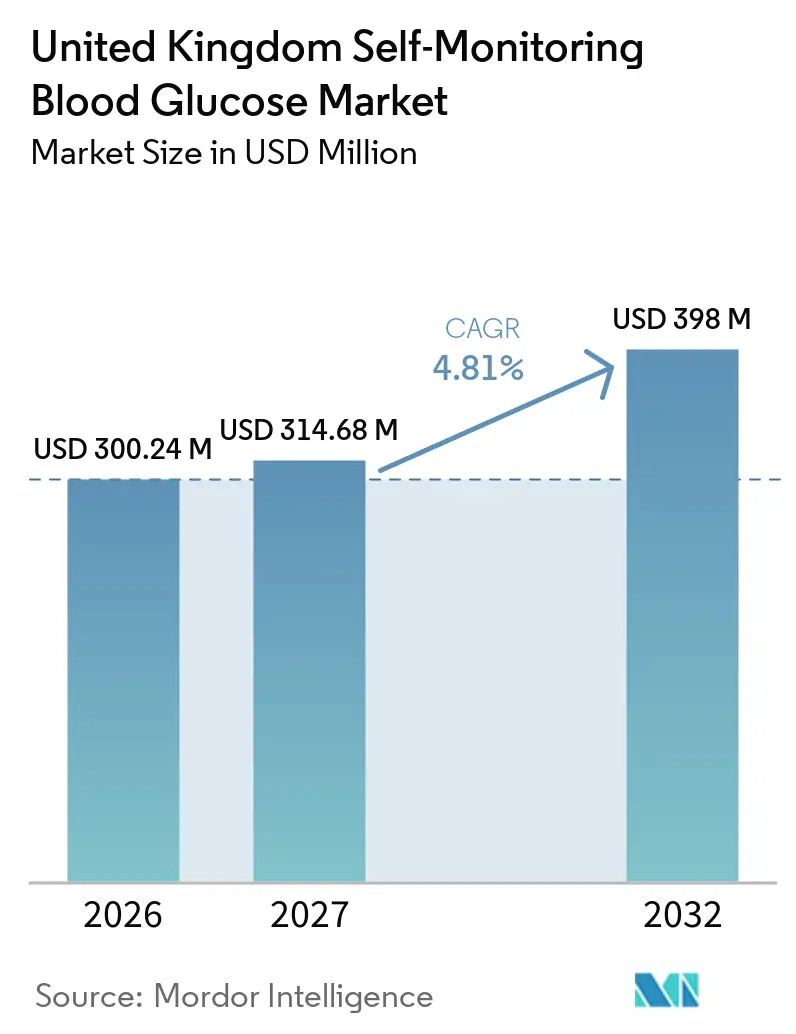
The United Kingdom Self-Monitoring Blood Glucose Market size is projected to expand from USD 300.24 million in 2026 and USD 314.68 million in 2027 to USD 398 million by 2032, registering a CAGR of 4.81% between 2027 and 2032.
The COVID-19 pandemic showed that diabetes needs a lot more attention if we don't want the infection to cause problems that aren't necessary or fair. According to Diabetes UK, in adults with diabetes, there were certain factors that increased the risk of serious illness, like being older, having a high HbA1c, or having a history of diabetes-related complications, along with BMI and ethnicity. According to the 2021 article "Assessment of the effect of the COVID-19 pandemic on UK HbA1c testing: implications for diabetes management and diagnosis," there was evidence that people with prediabetes, obesity, and other causes of dysglycemia were also more likely to have worse outcomes after getting SARS-CoV-2.
Self-monitoring of blood glucose enables patients to track their glucose levels regularly and make informed decisions regarding diet, physical activity, and medication adherence. It provides actionable feedback that helps individuals adjust health behaviors when required. In patients with diabetes, sustained high blood glucose levels can result in long-term complications, including kidney disease, nerve damage, and vision impairment. Regular and timely monitoring helps patients identify and manage abnormal glucose levels, reducing the risk of diabetes-related complications.
Advanced technologies, such as digital health applications that record and summarize blood glucose readings along with insulin doses, meals, snacks, and physical activity, support more effective self-management of diabetes. These solutions can ease the overall disease burden and enhance the quality of care. The integration of self-monitoring blood glucose devices with insulin dose calculators, automated insulin titration software, and remote coaching services further supports patients with poorly controlled diabetes and improves clinical outcomes. In the United Kingdom, the growing focus on personalized diabetes management and digital healthcare solutions is increasing the adoption of self-monitoring blood glucose devices. The availability of connected monitoring solutions is also expected to support the growth of the United Kingdom self-monitoring blood glucose market in the coming years.
Note: Market numbers in this report are based on Mordor Intelligence's proprietary estimation framework, which combines nine months of actuals with Q4 projections for base year 2026.
United Kingdom Self-Monitoring Blood Glucose Market Trends and Insights
Rising Diabetes Prevalence in the United Kingdom
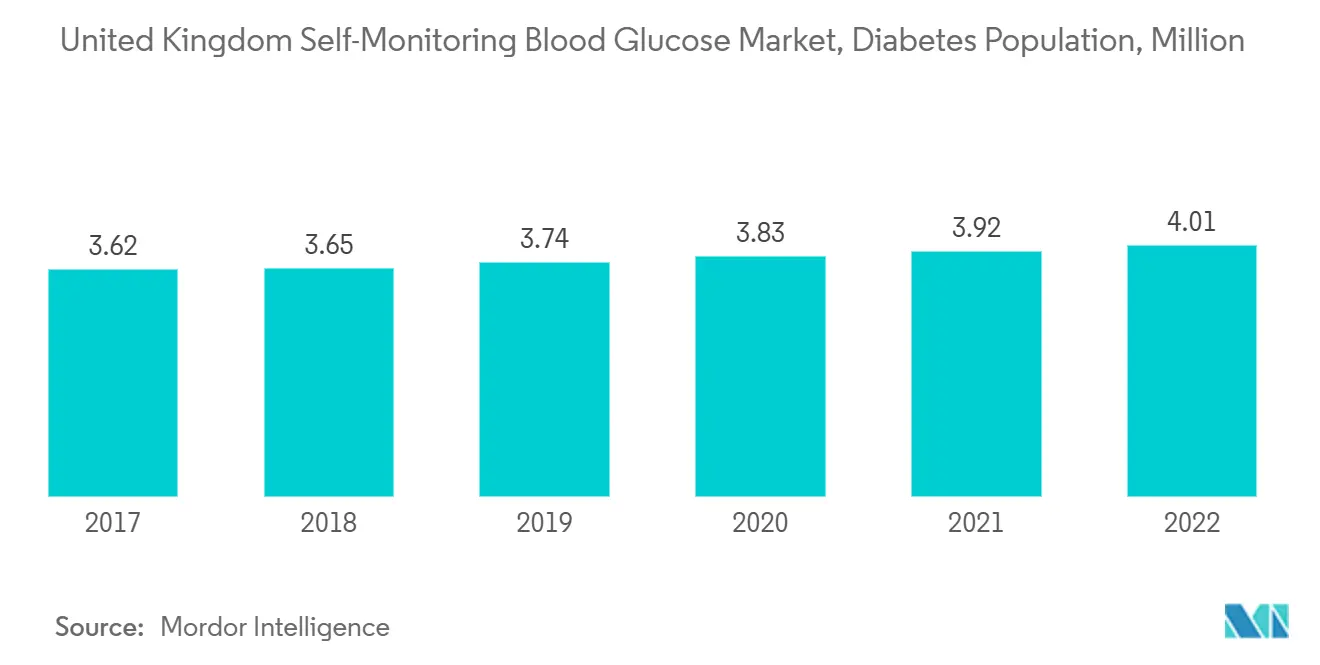
According to a survey of 10,000 patients by Diabetes UK, there are currently around 4.9 million people living with diabetes in the UK. More than 60% of diabetics say that this is partly because they don't have access to healthcare, which can prevent serious illness and early death from diabetes-related heart problems. In the poorest parts of the country, this number goes up to 71%.
People with diabetes can live healthy lives, but if the condition is not managed well, high blood sugar levels, high blood pressure, and high cholesterol can cause problems with the vascular system that can lead to serious complications. To lower the risk of complications, people with diabetes must always take care of their condition on their own with help from doctors and nurses. This includes measuring blood sugar, checking their feet, and keeping an eye on their blood pressure. Research shows that these regular checks are linked to better health outcomes, such as fewer deaths, less time in the hospital, and fewer amputations and emergency room visits.
The National Health Service (NHS) in England is one of four National Health Service systems in the United Kingdom. It is paid for by the government.By investing in the technology, the NHS can give patients advice on treatment and care, as well as teach them how to eat and exercise in healthy ways.This remote support complements patients' appointments, whether through video consultations or via telephone. People living with diabetes can access websites such as Digibete and MyType1Diabetes for a wide range of awareness, education, training, and support resources. The Healthier You NHS Diabetes Prevention Programme, also known as the Healthier You program, identifies people at risk of developing type 2 diabetes and refers them to a nine-month, evidence-based lifestyle change program. It is a joint service of NHS England and Diabetes UK.
Therefore, it is anticipated that the studied market will witness growth over the analysis period due to rising prevalence and increasing awareness through government initiatives.
The Glucometer Devices Segment is expected to witness the highest CAGR over the forecast period
The glucometers segment is expected to account for the highest CAGR of about 6.3% in the market over the forecast period, owing to the increasing adoption of glucometers in home care settings, growing preference for home-based self-monitoring, and recent product launches of advanced glucometers.
Glucometers are simple, portable, and easy-to-use devices that are used to check blood sugar at the point-of-care.A drop of blood from the finger of the patient is dropped onto a paper test strip, which is impregnated with a glucose-specific enzyme that reacts with the glucose in the blood. The strip is put into the blood glucose meter, and the level of glucose in the blood is read by either reflectance photometry or electrochemical technology.These monitors are also used to monitor blood glucose levels in clinical settings. In general, portable glucose devices have improved in precision and accuracy with each generation.
Self-monitoring is a commitment that many diabetic patients follow to manage their condition. The blood glucose levels help the patients and doctors modify their diet, lifestyle, insulin therapy, and medications that can help their blood sugar come back to normal. With newer innovations in medical technology, glucometers these days have highly sensitive strips and sensors that can detect every component of blood accurately, close to lab results.
The National Service Framework (NSF) program is improving services by setting national standards to drive up service quality and tackle variations in care. The Association of British HealthTech Industries (ABHI) made a section for diabetes. This is the first forum of its kind that allows diabetes technology companies to work together. The ABHI group is for any health technology company with an interest in diabetes care, from CGM and insulin pumps to apps. Such advantages have helped spur the adoption of these products in the United Kingdom market.
Competitive Landscape
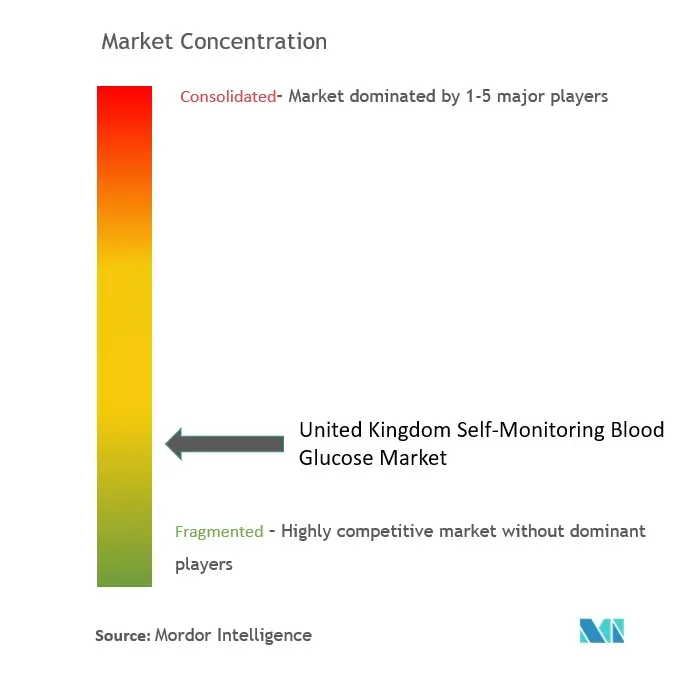
The United Kingdom self-monitoring blood glucose market is moderately fragmented, with a few significant and other generic players. Manufacturers like Abbott, LifeScan, F. Hoffmann-La Roche AG, and Ascensia occupy a major share.
United Kingdom Self-Monitoring Blood Glucose Industry Leaders
-
Abbott Diabetes Care
-
Ascensia Diabetes Care
-
Sinocare Inc.
-
Roche Diabetes Care
-
LifeScan, Inc.
- *Disclaimer: Major Players sorted in no particular order
Recent Industry Developments
- 2023: LifeScan announced that the peer-reviewed Journal of Diabetes Science and Technology published Improved Glycemic Control Using a Bluetooth Connected Blood Glucose Meter and a Mobile Diabetes App: Real-World Evidence From Over 144,000 People With Diabetes, detailing results from a retrospective analysis of real-world data from over 144,000 people with diabetes-one of the largest combined blood glucose meter and mobile diabetes app datasets ever published.
- 2022: Roche launched its new point-of-care blood glucose monitor designed for hospital professionals with a companion device shaped like a touchscreen smartphone that will run its own apps. The hand-held COBAS Pulse includes an automated glucose test strip reader as well as a camera and touchscreen for logging other diagnostic results. It's designed to be used with patients of all ages, including neonates and people in intensive care.
United Kingdom Self-Monitoring Blood Glucose Market Report Scope
Diabetic patients can measure their own blood sugar levels using a glucometer, test strips, and lancets by self-monitoring their blood glucose. Based on the readings, patients can adjust or check the effect of their treatment. The United Kingdom self-monitoring blood glucose market is segmented into components (glucometer devices, test strips, and lancets). The report offers the value (in USD million) and volume (in million units) for the above segments.
| Glucometer Devices |
| Test Strips |
| Lancets |
| Component | Glucometer Devices |
| Test Strips | |
| Lancets |
Key Questions Answered in the Report
How big is the United Kingdom Self-Monitoring Blood Glucose Market?
The United Kingdom Self-Monitoring Blood Glucose Market size is expected to reach USD 314.68 million in 2027 and grow at a CAGR of 4.81% to reach USD 398.00 million by 2032.
What is the current United Kingdom Self-Monitoring Blood Glucose Market size?
In 2026, the United Kingdom Self-Monitoring Blood Glucose Market size is expected to reach USD 300.24 million.
Who are the key players in United Kingdom Self-Monitoring Blood Glucose Market?
Abbott Diabetes Care, Ascensia Diabetes Care, Sinocare Inc., Roche Diabetes Care and LifeScan, Inc. are the major companies operating in the United Kingdom Self-Monitoring Blood Glucose Market.
What years does this United Kingdom Self-Monitoring Blood Glucose Market cover, and what was the market size in 2025?
In 2025, the United Kingdom Self-Monitoring Blood Glucose Market size was estimated at USD 286.46 million. The report covers the United Kingdom Self-Monitoring Blood Glucose Market historical market size for years: 2021, 2022, 2023, 2024, and 2025. The report also forecasts the United Kingdom Self-Monitoring Blood Glucose Market size for years: 2027, 2028, 2029, 2030, 2031, and 2032.