
Market Overview
| Study Period | 2020 - 2031 |
|---|---|
| Forecast Data Period | 2026 - 2031 |
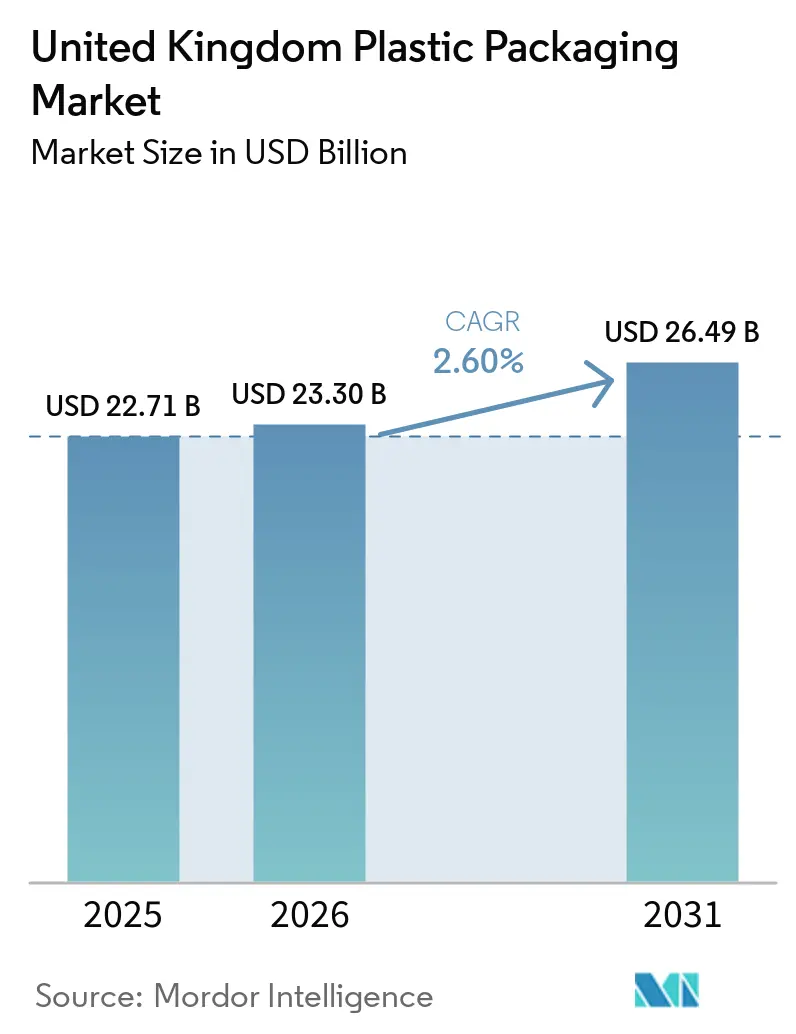
| Base Year Market Size (2025) | USD 22.71 Billion |
| Market Size (2026) | USD 23.30 Billion |
| Market Size (2031) | USD 26.49 Billion |
| Growth Rate (2026 - 2031) | 2.60 % |
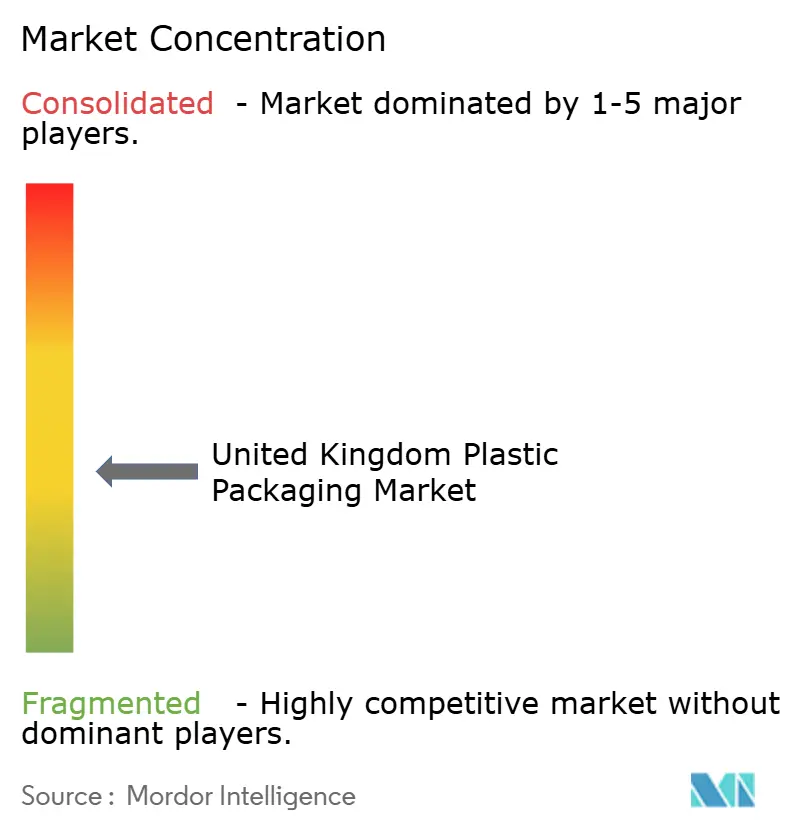
| Market Concentration | Medium |
Major Players *Disclaimer: Major Players sorted in no particular order Image © Mordor Intelligence. Reuse requires attribution under CC BY 4.0. | |
United Kingdom Plastic Packaging Market Analysis by Mordor Intelligence
The United Kingdom plastic packaging market size in 2026 is estimated at USD 23.3 billion, growing from 2025 value of USD 22.71 billion with 2031 projections showing USD 26.49 billion, growing at 2.6% CAGR over 2026-2031. The shift from volume to value is reshaping pricing power as sustainability premiums and regulatory compliance costs are embedded into contracts. Chemical recycling pilots, mono-material barrier films, and refillable delivery systems are redefining design rules while acting as early indicators for global circular-economy standards. Flexible formats advance at the expense of rigid options, driven by e-commerce logistics and lightweight convenience requirements. Material substitution decisions increasingly weigh feedstock volatility, tax incentives, and consumer perception of recycled content.
Key Report Takeaways
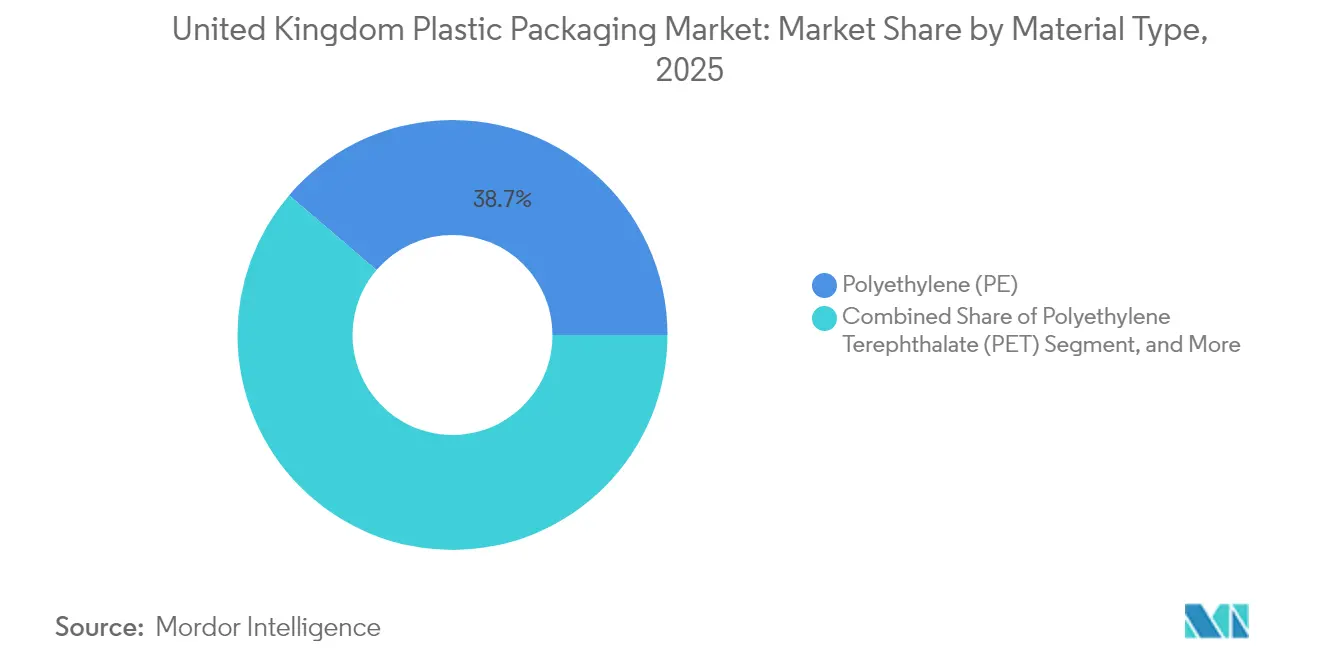
- By material type, polyethylene held 38.74% of the United Kingdom plastic packaging market share in 2025, while polyethylene terephthalate is forecast to post the fastest 3.41% CAGR through 2031.
- By packaging type, flexible solutions commanded 55.32% revenue in 2025, and the same segment is set to expand at a 3.71% CAGR to 2031.
- By product form, pouches and sachets contributed 31.05% of the United Kingdom plastic packaging market size in 2025, whereas films and wraps are projected to rise at a 4.04% CAGR between 2026 and 2031.
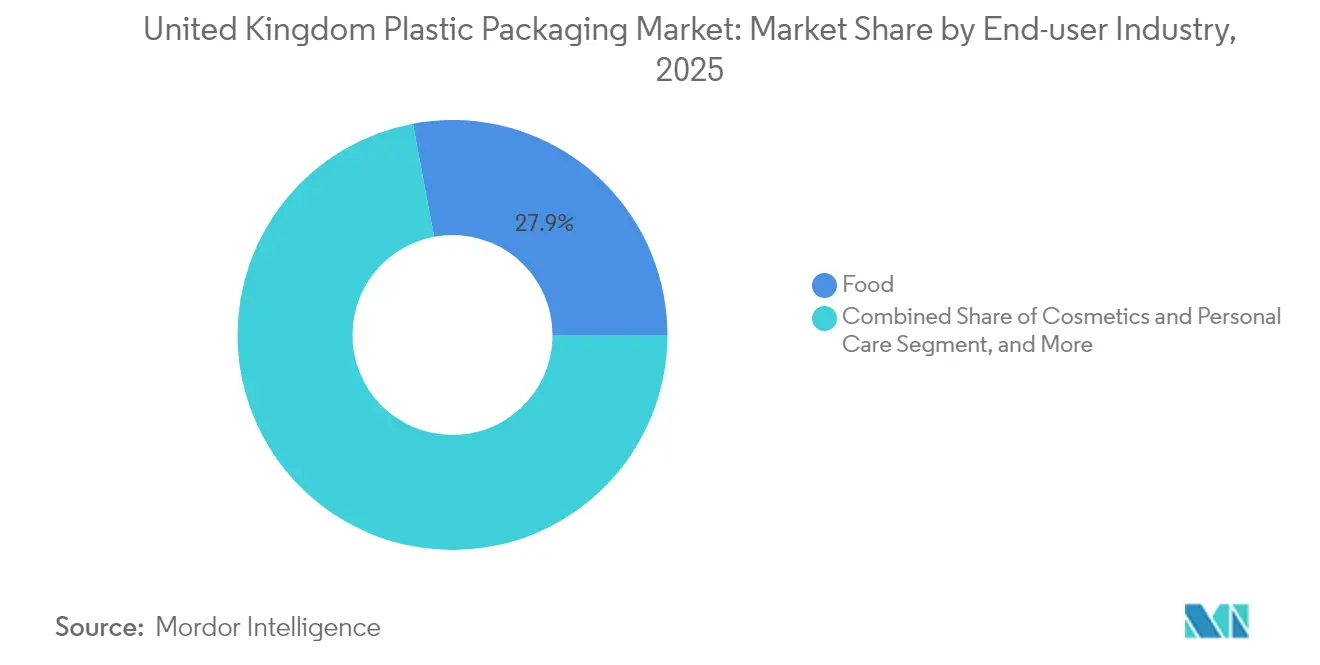
- By end-user industry, food applications secured a 27.95% share in 2025, but cosmetics and personal care are heading for the highest 4.88% CAGR to 2031.
- By manufacturing process, extrusion led with 27.86% revenue share in 2025, yet thermoforming is anticipated to deliver a 4.81% CAGR through 2031.
Note: Market size and forecast figures in this report are generated using Mordor Intelligence’s proprietary estimation framework, updated with the latest available data and insights as of 2026.
United Kingdom Plastic Packaging Market Trends and Insights
Drivers Impact Analysis*
| Driver | (~) % Impact on CAGR Forecast | Geographic Relevance | Impact Timeline |
|---|---|---|---|
| Lightweight convenience formats | +0.8% | United Kingdom-wide, urban centers | Medium term (2-4 years) |
| E-commerce protective packaging | +0.6% | Nationwide, highest in London and Manchester | Short term (≤2 years) |
| Recycled-content plastics under 30% tax | +0.4% | Nationwide, regulation driven | Long term (≥4 years) |
| Chemical recycling capacity scale-up | +0.3% | North England and Scotland clusters | Long term (≥4 years) |
| United Kingdom Plastics Packaging Tax effect | +0.5% | Nationwide, mandatory compliance | Medium term (2-4 years) |
| Mono-material high-barrier films | +0.2% | Nationwide, municipal collection dependent | Long term (≥4 years) |
| Source: Mordor Intelligence | |||
Rising Demand for Lightweight Convenience Formats
Urban consumers prioritize portability and portion control, encouraging 15-20% material reductions versus legacy rigid packs. Single-dose formats extend from snacks to pharmaceuticals, lowering contamination risk while boosting adherence. Coveris introduced its MonoFlexBP resealable tray line in September 2025, merging easy-open functionality with curbside recyclability. Aging populations and busier lifestyles sustain demand for formats that trade bulk economics for usability, supporting steady margin expansion for converters that optimize downgauging.
Growth in E-commerce Protective Packaging
Online order volumes are subject packs to high compression, puncture, and drop forces across multiple shipping cycles. Engineered films and void-fill systems balance strength with dimensional-weight savings, cutting freight costs and damage claims. TekniPlex Healthcare’s March 2025 capacity boost targets temperature-controlled and tamper-evident pharma shipments, underscoring channel-specific needs. Logistics-optimized designs translate directly into customer satisfaction metrics and repeat-purchase propensity.
Uptake of Recycled-Content Plastics Under 30% Tax
The GBP 200 per tonne levy on packs containing under 30% recycled content compels vertical integration and feedstock contracts to guarantee supply. HMRC guidance validates mass-balance chemical recycling within the threshold, broadening compliance options.[1]United Kingdom Government, “Single-use plastic wet wipes ban,” gov.uk The framework anchors a two-tier pricing landscape that rewards investment in recycled resin and penalizes virgin dependency, positioning first movers for cross-border advantage as similar mandates proliferate in Europe.
Chemical Recycling Capacity Scale-Up
Pyrolysis and gasification plants progress from pilot to commercial scale, processing contaminated and mixed residual streams unsuited to mechanical recycling. Dow and Mura Technology’s partnership exemplifies regional build-out that will shorten feedstock haulage distances and support closed-loop food-grade output. Economic viability improves as carbon-pricing schemes elevate landfill and incineration costs, narrowing the gap with virgin polymer pricing.
Restraints Impact Analysis*
| Restraint | (~) % Impact on CAGR Forecast | Geographic Relevance | Impact Timeline |
|---|---|---|---|
| Volatile resin prices linked to energy costs | −0.7% | Nationwide, manufacturing hubs most exposed | Short term (≤2 years) |
| Single-use plastics regulations | −0.4% | Nationwide, foodservice and retail hot spots | Medium term (2-4 years) |
| Retailer refill/re-use pilots | −0.3% | Urban retail centers | Long term (≥4 years) |
| Micro-plastics backlash | −0.2% | Consumer goods sectors nationwide | Medium term (2-4 years) |
| Source: Mordor Intelligence | |||
Volatile Resin Prices Linked to Energy Costs
Ethylene and propylene production accounts for roughly 60-70% of cracker operating costs, so swings in natural-gas inputs distort converter margins. The British Plastics Federation recorded pronounced PE and PP price turbulence in July 2025, forcing buyers to adopt hedging tools and shorter contracts that raise administrative burden. Importers face dual exposure to euro and U.S.-dollar swings against sterling, complicating cost forecasting and inventory strategies.
Single-Use Plastics Regulations
Targeted bans, such as the April 2024 wet-wipe prohibition, compel rapid redesign or material substitution, often with higher unit costs and performance trade-offs. Compliance audits demand new traceability systems and supplier certifications that raise overhead. In foodservice, bans on specific cutlery and plates mandate compostable or paper alternatives that may lack durability, potentially elevating food-waste rates and undermining sustainability narratives.
*Our forecasts treat driver/restraint impacts as directional, not additive. The impact forecasts reflect baseline growth, mix effects, and variable interactions.
Segment Analysis
By Material Type: Polyethylene Dominance, PET Innovation
Polyethylene, spanning LDPE, LLDPE, and HDPE grades, retained 38.74 of % United Kingdom plastic packaging market share in 2025 because of processing ease and cost-performance balance in films. Polyethylene terephthalate is on course for a 3.41% CAGR with beverage lightweighting and ready-meal trays fueling demand. Converters value PET’s clarity and gas barrier, paying the premium for thinner walls and hotter-fill tolerance. Mechanical recycling rates favor clear PET, catalyzing brand commitments to food-grade rPET integration. Polypropylene’s colored variants lag recycling advances, limiting volume growth. Polystyrene use wanes under disposability scrutiny, while engineered resins and emerging biopolymers occupy specialized niches where functional gains justify higher costs.
Recycled-content mandates push polyolefin advancements such as odor-removal additives and compatibilizers that elevate post-consumer blend quality. Innovia Films debuted a PVC-free coater in April 2025 to eliminate halogen concerns while protecting oxygen-sensitive foods. Long term, material portfolios will reflect a disciplined trade-off between regulatory risk, circularity credentials, and application-specific performance needs within the United Kingdom plastic packaging market.


By Packaging Type: Flexible Formats Consolidate Leadership
Flexible solutions delivered 55.32% revenue in 2025 and are projected to achieve a 3.71% CAGR to 2031. A single auto-form seal pouch can cut material use by up to 70% versus comparable rigid plastic packaging, reducing freight emissions and waste-handling charges. Coveris’s August 2025 MonoFlex Thermoform pack for tortillas extends mono-material flexibles into categories once dominated by rigid trays.
Rigid containers remain relevant for carbonated beverages, fragrances, and heavy-duty chemicals requiring stand-up stability and tamper resistance, yet landfill levies and Extended Producer Responsibility fees constrain growth. As multilayer film recycling technologies mature, flexible adoption is expected to permeate cosmetics and household cleaners, accelerating the United Kingdom plastic packaging market transition toward leaner supply chains.
By Product Form: Pouches Lead, Films Accelerate
Pouches and sachets accounted for 31.05% of the United Kingdom plastic packaging market size in 2025, thanks to portion control trends, easy-tear functionality, and improved high-speed filling compatibility. High-growth films and wraps, projected at a 4.04% CAGR, address the rise of omnichannel retail by protecting mixed SKUs during courier transit. Automated pallet-wrap systems combine stretch and shrink films to stabilize loads while optimizing cube utilization.
Bottles and jars continue to serve premium spirits and skin-care serums, where shelf presence and re-closability support brand equity. Rigid trays cater to ready meals that demand oven or microwave endurance, but film-sealed paperboard hybrids are beginning to erode share. DS Smith’s TailorTemp launch in January 2025 fuses thermal insulation with lightweight board to challenge EPS boxes in cold-chain routes.
By End-User Industry: Food Stability, Cosmetics Upswing
Food applications delivered 27.95% revenue in 2025, underpinned by stringent hygiene regulations and extended life requirements. Mono-material barrier films that withstand high-pressure processing or retort sterilization are being fast-tracked to satisfy supermarkets’ recyclability targets without compromising safety. Cosmetics and personal care, rising at a 4.88% CAGR, champion airless pumps, refill pods, and recycled PET jars that reinforce eco-premium positioning.
Meadow’s Daisy Top refill cap, recognized in September 2024, trims primary-pack tonnage by up to 70% and boosts repeat purchase frequency via convenient replenishment. Pharmaceuticals prioritize tamper-evidence and anti-counterfeit embossing, enabling suppliers to command higher margins for specialty features. Industrial bulk liners focus on puncture strength and static dissipative properties, but face slow growth as commodity cycles plateau.
By Manufacturing Process: Extrusion Scale, Thermoforming Precision
Extrusion generated a 27.86% share in 2025 on the back of high-output blown-film lines servicing food and e-commerce applications. Process tweaks, including inter-layer bubble cooling, let converters push thinner gauges without sacrificing toughness. Thermoforming is predicted to clock a 4.81% CAGR through 2031 as portion-controlled ready meals, medical drapes, and shell-and-lid combos demand tight tolerances and stackable profiles.
Broanmain Plastics installed automated robotic demolding in March 2025 to offset labor shortages and elevate repeatability. Injection molding supports caps and closures integrating tethered features mandated by EU directives, while blow molding innovations deliver 25% weight cuts in HDPE milk bottles via optimized parison programming. Emerging rotational molding niches include reusable bulk-dispense cartridges for refill stations, reflecting wider system redesign efforts across the United Kingdom plastic packaging market.
Geography Analysis
London and the South East channel premium cosmetic and specialty-food volumes, reinforcing demand for high-clarity rPET and decorated stand-up pouches. Northern England and Scotland, anchored by petrochemical clusters, favor industrial and food processing packs and host multiple announced chemical-recycling builds, granting converters localized feedstock advantages. Scotland’s Circular Economy Act imposes aggressive recycled-content thresholds ahead of national timetables, incentivizing early supplier alignment. Wales is piloting reuse-inclusive deposit return schemes, hinting at design divergence that multiregional brand owners must anticipate.
The Department for Environment, Food and Rural Affairs confirmed a United Kingdom-wide deposit return scheme go-live date of October 2027, giving bottle producers a firm horizon for tethered-closure and label-adhesive modifications. Simpler Recycling rules, effective March 2026, harmonize household material segregation, unlocking broader mechanical-recycling yield for mono-material flexibles. Local authorities still vary in sorting technology investment, dictating nuanced pack-format decisions. Northern Ireland’s alignment reduces cross-border complexity but requires vigilance against differing post-Brexit customs enforcement.
Regional development funds are channeling grants into polymer de-inking, odor-removal, and composite delamination projects, accelerating technology diffusion outside traditional manufacturing bases. Converters clustered in the Midlands benefit from motorway proximity but remain exposed to natural-gas volatility concentrated in large-scale industrial estates. As recycled-content pipelines stabilize, proximity to depolymerization units may outstrip historical proximity to end-use markets in strategic weightings for future plant siting across the United Kingdom plastic packaging market.
Regulatory Landscape
United Kingdom plastic packaging regulation is tightening through parallel cost-and-compliance regimes led by HMRC and the packaging EPR administrator and regulators. The Plastic Packaging Tax applies to plastic packaging components with less than 30% recycled plastic, with the rate rising to GBP 228.82 per tonne from 1 April 2026, reinforcing the commercial premium on verified PCR content and mass-balance approaches where permitted.
Extended Producer Responsibility obligations under the Producer Responsibility Obligations (Packaging and Packaging Waste) Regulations 2024, as amended by the Producer Responsibility Obligations (Packaging and Packaging Waste) (Amendment) Regulations 2025 (in force 1 January 2026), shift net household packaging waste-management costs to producers and require detailed packaging-data reporting. Waste disposal fees began from October 2025 for obligated businesses (including thresholds such as GBP 1 million annual turnover and more than 25 tonnes of packaging handled), and the regulators (Environment Agency, SEPA, NRW, and NIEA) issued updated technical interpretations (Version 8) on 25 February 2026, increasing the need for auditable material, weight, and nation-of-sale traceability.
Value Chain Analysis
The United Kingdom plastic packaging value chain runs from polymer and additive supply (dominated by PE, PP, and PET used broadly across films, rigid containers, and thermoformed formats) through converters (extrusion, thermoforming, injection and blow molding), pack designers and prepress, and then to brand owners and retailers across food, beverage, healthcare, and personal care. Downstream, collection, sorting, reprocessing, and PRN/PERN compliance markets influence resin availability and pricing, with pEPR and the Plastic Packaging Tax increasingly shaping procurement specifications toward traceable recycled content and design-for-recycling.
Compliance and end-of-life infrastructure are now binding constraints within the chain. The pEPR framework (2024 Regulations, with 2025 amendments effective 1 January 2026) moves producers from reporting to paying waste-management fees and sets up fee modulation from 2026/27. It also introduces operational requirements, including separate kerbside collection of plastic films and flexible packaging across the UK by 31 March 2027. Limited specialist recycling for flexibles keeps a large share routed to energy recovery or landfill, which raises the strategic value of long-term PCR feedstock contracts, recycling partnerships, and mono-material structures that can flow through existing sort and reprocessing pathways.
Competitive Landscape
The market is moderately fragmented, yet consolidation is quickening as sustainability investments stretch balance sheets. Amcor’s 2025 merger with Berry Global positions the combined entity to leverage in-house chemical-recycling offtake and negotiate multi-year feedstock agreements, lowering input cost risk. Constantia Flexibles’ May 2025 coffee-pack partnership on recyclable barrier films illustrates how collaborative R and D accelerates niche solutions.[3]Constantia Flexibles, “Recyclable coffee packs partnership,” constantiaflexibles.com Smaller converters gravitate to bespoke runs, rapid lead times, and localized service to defend share against integrated multinationals.
Strategic moves center on vertical integration, with converters procuring stakes in recycling plants to lock in PCR resin and satisfy 30% thresholds. Others double down on design-for-recycling advisory, embedding themselves in early brand development stages. White-space innovations include refill-ready rigid shells paired with flexible liners and paper-based hybrids designed for curbside sort lines. The competitive narrative is moving from price per unit toward verified environmental performance, certified traceability, and consumer experience differentiation within the United Kingdom plastic packaging market.
United Kingdom Plastic Packaging Industry Leaders
Amcor PLC
Sealed Air Corporation
Polystar Plastics Ltd
Coveris Holdings SA
Constantia Flexibles GmbH
- *Disclaimer: Major Players sorted in no particular order

Market Opportunities and Future Outlook
Regulation-linked compliance demands are creating near-term whitespace in traceability, data management, and pack redesign services, alongside pull for compliant recycled-content and recyclable structures. The Plastic Packaging Tax rate increase to GBP 228.82 per tonne from 1 April 2026 for packaging below 30% recycled content, together with pEPR obligations and recycling targets (including 57% for plastics in 2026), is pushing brand owners and converters to secure PCR supply, qualify materials, and document chain-of-custody through recognized standards and regulator guidance.
Opportunities are expanding around (i) mono-material high-barrier films and thermoformable structures that align with collection and sorting upgrades and upcoming fee modulation, (ii) lightweighting technologies that reduce both material use and EPR fee exposure, and (iii) circular pilots spanning chemical recycling and alternative barrier layers. Market evidence of this shift includes PackUK activity around stabilizing packaging-data submissions, including a 1 September 2026 resubmission deadline for 2025 packaging data to finalize liabilities. Public reporting of early pEPR trends also indicates movement away from hard-to-recycle packaging, supporting demand for scalable, recyclable formats and compliance-ready documentation across the United Kingdom plastic packaging market.
Recent Industry Developments
- July 2026: Amcor partnered with UK startup Kelpi to test seaweed-based barrier coatings for fiber-based packaging as part of expanding its AmFiber solutions. The collaboration targets performance barriers without conventional plastic coatings, supporting brand-owner trials that align with recyclability and material-reduction pressures in the UK.
- June 2026: Coveris announced the acquisition of German film manufacturer GEFO Folienbetrieb GmbH to expand cast polypropylene (CPP) film production capacity. The move adds scale in mono-material film structures used in recyclable flexible packaging, strengthening supply for UK-focused customers seeking redesign options under tax and EPR cost pressures.
- September 2024: Meadow highlighted its Daisy Top refill cap, designed to reduce primary-pack tonnage through a refill format. Refill-enabling components support retailer and brand reuse pilots, creating an adjacent pathway for plastic packaging demand to shift toward durable closures and repeat-use systems.


Research Methodology Framework and Report Scope
Market Definition and Coverage
In this methodology, the market covers plastic packaging consumed in the United Kingdom across common packaging formats used for protecting, transporting, and selling goods, and it is sized in value terms (USD) across the supply chain that serves these uses.
Scope exclusions: This scope excludes paper, glass, and metal packaging, and it also excludes packaging machinery and packaging services.
Segmentation Overview
- By Material Type
- Polyethylene (PE)
- Polypropylene (PP)
- Polyethylene Terephthalate (PET)
- Polystyrene and EPS
- Other Material Types
- By Packaging Type
- Flexible Plastic Packaging
- Rigid Plastic Packaging
- By Product Form
- Bottles and Jars
- Trays and Containers
- Pouches and Sachets
- Bags and Sacks
- Films and Wraps
- Other Product Forms
- By End-User Industry
- Food
- Beverage
- Pharmaceuticals and Healthcare
- Cosmetics and Personal Care
- Industrial
- Other End-user Industries
- By Manufacturing Process
- Extrusion
- Injection Molding
- Blow Molding
- Thermoforming
- Other Manufacturing Processes
Data Sources, Market Sizing, and Validation
Desk Research
Desk research is used to anchor the model to repeatable reference points, and then our assumptions are stress tested before interviews begin. We mainly pull baseline indicators from public sources such as the UK Office for National Statistics (manufacturing output, producer prices, and household spend signals), HM Revenue and Customs trade statistics (imports and exports of plastics and plastic articles), and UK Parliament and DEFRA publications on packaging waste, EPR, and recycling targets.
We also review sources such as PlasticsEurope data for polymer context, and UN Comtrade series when a cross check is needed on trade direction and units. Company annual reports, UK plant announcements, investor presentations, and credible press coverage help validate capacity changes, closures, and shifts in packaging mix across end markets. For price and shipment context where public data is thin, a paid subscription is used for company financials and news screening, and a separate paid subscription is used when shipment level import and export lines are needed. These desk research sources are illustrative rather than exhaustive, and many other public references are used for data collection, validation, and clarification during the study.
Primary Interviews and Surveys
Primary work focuses on checking what the numbers mean in the real market, especially where public series lag or bundle multiple product groups. We speak with packaging converters, resin and film suppliers, brand owners, and distribution side participants, and then we validate splits by end use, packaging format, and recent pricing direction across the United Kingdom.
To keep the model grounded, assumptions on application mix, typical gauge or weight ranges, recycled content adoption, and pass through timing for polymer and energy costs are tested with multiple respondent types before finalizing the forecast.
Distribution of primary research fieldwork respondents
| Company type | Respondent position |
|---|---|
| Top tier: 30% | CXOs: 13% |
| Mid tier: 53% | Functional/Unit leaders: 42% |
| Smaller Players: 17% | Managers: 45% |
Market-Sizing & Forecasting
Sizing starts from a top-down rebuild of the United Kingdom packaging demand pool, where manufacturing and trade signals are translated into plastic packaging consumption and then valued using representative price levels. That structure is then corroborated with selective bottom-up approximations, such as rolling up sampled supplier revenues, using channel checks on format level volumes, and applying average selling price ranges to estimated tonnes for key formats before totals are adjusted.
A few practical inputs guide the model, including polymer and recycled resin price direction, packaging mix shifts between rigid and flexible formats, UK food and beverage output trends, healthcare and personal care packaging demand signals, and policy linked indicators such as EPR cost pressure and recycling rate targets. When a variable is missing at a granular level, gaps are handled using proxy series (for example, closely related plastics trade headings or producer price indices), and then validated through interviews.
For forecasting, scenario analysis is used so the outlook reflects different paths for resin prices, recycled content uptake, and regulation driven redesign, and then the base case is aligned to the consensus heard from primary respondents. The final numbers are expressed in USD, with currency conversion timing kept consistent across the historical and forecast window.
Data Validation & Update Cycle
Validation is done in layers so that outliers do not slip into the final output. Model totals are compared against independent signals such as plastics production indicators, packaging waste and recycling statistics, and trade flow direction, and then large variances are rechecked back to the assumption that caused them.
A second analyst review is performed for unit consistency, price logic, and year on year movements, followed by a final pass that looks for breaks created by regulation dates or sudden price shocks. Reports are refreshed annually, and when a material event occurs, such as a major policy update or a large capacity change, the key assumptions are revisited and updated. Before delivery, a fresh check is completed so clients receive the most current view available at the time.
Mordor Intelligence's United Kingdom Plastic Packaging Market Size Measured Against Other Published Estimates
Published market values for UK plastic packaging can look far apart because the underlying scope and valuation point are not always aligned, and because price assumptions move quickly in this space. Differences also show up when one estimate leans more on trade value, while another leans more on consumption volumes and then applies a broad price.
Packaging machinery, filling lines, and contract packaging services sit outside Mordor Intelligence's scope, which explains part of the spread when other publications blend packaging materials with adjacent packaging industry revenues. Gaps also come from how recycled content premiums are treated, whether importer margins are counted, how GBP to USD conversion is timed, and how frequently assumptions are refreshed when resin and energy costs change within a year.
Benchmark comparison
| Source | Market Size | Gaps in Research Methodology |
|---|---|---|
| Mordor Intelligence | USD 23.30 B (2026) | |
| Industry Research Publisher A | USD 15.51 B (2025) | Uses a different base year and often applies broader average pricing across materials and formats, which can compress value in years where resin and energy pass through is uneven. |
| Trade Analytics Publisher B | USD 5.70 B (2035) | Leans on wholesale price framing and a long dated forecast endpoint, which can omit converter margin layers and can understate value when format mix shifts toward higher value applications. |
The table shows that year selection and the valuation layer being counted are the biggest drivers of the gap. By keeping the scope tied to plastic packaging materials and by checking totals against multiple demand and price signals, the estimate remains traceable to clear inputs that a reader can revisit and replicate.


Key Questions Answered in the Report
What is the 2026 value of the United Kingdom plastic packaging market?
The United Kingdom plastic packaging market size is USD 23.3 billion in 2026.
How fast is the market projected to grow?
It is expected to rise at a 2.6% CAGR, reaching USD 26.49 billion by 2031.
Which packaging type is expanding the quickest?
Flexible formats lead growth with a projected 3.71% CAGR through 2031, fueled by e-commerce logistics demand.
Which material commands the largest market share?
Polyethylene holds 38.74% of 2025 revenue due to versatility across films and rigid containers.
How does the Plastics Packaging Tax influence material choice?
The GBP 200 (USD 270.14) per tonne levy for packs under 30% recycled content financially favors recycled resin and accelerates design shifts toward mono-material solutions.
Page last updated on:


 Your data is secure and never sold or shared.


