
United Kingdom Mining Equipment Market Size and Share
Market Overview
| Study Period | 2019 - 2031 |
|---|---|
| Forecast Data Period | 2026 - 2031 |
| Base Year Market Size (2025) | USD 0.89 Billion |
| Market Size (2026) | USD 0.92 Billion |
| Market Size (2031) | USD 1.11 Billion |
| Growth Rate (2026 - 2031) | 3.78 % |
| Market Concentration | Medium |
Major Players *Disclaimer: Major Players sorted in no particular order Image © Mordor Intelligence. Reuse requires attribution under CC BY 4.0. | |
United Kingdom Mining Equipment Market Analysis by Mordor Intelligence
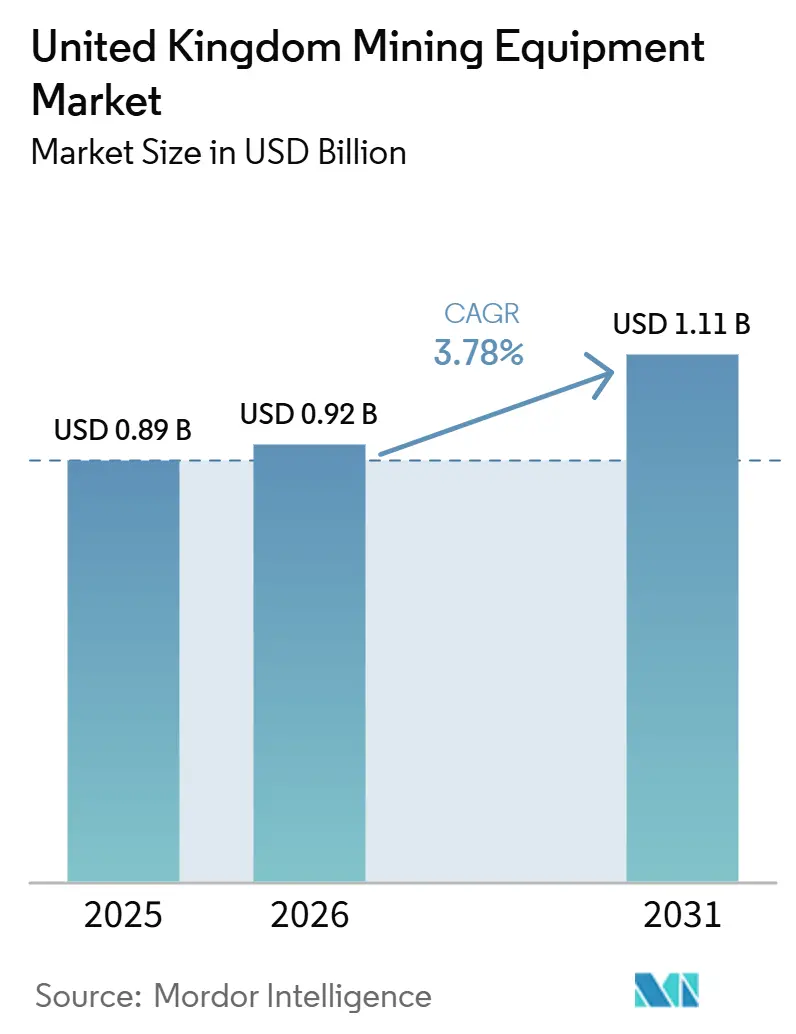
The United Kingdom mining equipment market size was valued at USD 0.89 billion in 2025 and is estimated to grow from USD 0.92 billion in 2026 to reach USD 1.11 billion by 2031, growing at a CAGR of 3.78% over 2026-2031. As a major power station shuts down and a ban on new coal-mining licenses approaches, demand for thermal-coal equipment has significantly declined. In contrast, sectors such as lithium, tin, tungsten, and infrastructure aggregates are seeing increased capital investment. Government incentives under the UK Critical Minerals Strategy, along with co-investments from the National Wealth Fund, are driving growth in underground-equipment orders in regions such as Cornwall and County Durham [1]“Critical Minerals Strategy,”, UK Government, gov.uk. Additionally, a major infrastructure project has moved substantial volumes of aggregates, supporting the utilization of surface equipment across England. Operators are upgrading their fleets, replacing older models to meet stricter emission standards, and testing battery-electric and hybrid units. This transition aims to reduce exposure to potential carbon taxes and shift procurement toward high-efficiency loaders, trucks, and mobile crushers. Although a few leading aggregate producers dominate most national output, the market for drills, haulage, and processing equipment remains highly competitive. Global original-equipment manufacturers and local dealers continue to compete, maintaining disciplined pricing but resulting in tight margins.
Key Report Takeaways
- By equipment type, surface mining equipment led with 45.27% revenue share in 2025, whereas loaders are projected to register the highest 6.46% CAGR through 2031.
- By automation level, manual machines accounted for 68.28% of the United Kingdom mining equipment market share in 2025, while fully autonomous systems are poised to expand at a 7.43% CAGR between 2026 and 2031.
- By powertrain, internal-combustion units held 76.58% revenue share in 2025, and battery-electric vehicles are expected to grow at a 7.78% CAGR over the forecast period.
- By power output, the 500-1,000 HP class captured 49.42% of the United Kingdom mining equipment market share in 2025, yet equipment rated above 1,000 HP is forecast to post the fastest 6.37% CAGR to 2031.
- By application, metal mining accounted for 46.75% of the United Kingdom mining equipment market in 2025, whereas mineral mining demand is anticipated to rise at a 6.43% CAGR to 2031.
- By geography, England dominated the United Kingdom mining equipment market with a 68.74% share in 2025, while Scotland posted the highest 6.54% CAGR to 2031.
Note: Market size and forecast figures in this report are generated using Mordor Intelligence’s proprietary estimation framework, updated with the latest available data and insights as of January 2026.
United Kingdom Mining Equipment Market Trends and Insights
Drivers Impact Analysis*
| Driver | (~) % Impact on CAGR Forecast | Geographic Relevance | Impact Timeline |
|---|---|---|---|
| Battery-Critical Metal Demand | +1.2% | England, Scotland, Wales | Medium term (2-4 years) |
| UK Critical Minerals Incentives | +0.8% | National, with early gains in Cornwall, Yorkshire | Long term (≥ 4 years) |
| Stage V Fleet Upgrades | +0.6% | National | Short term (≤ 2 years) |
| Autonomous Haulage Uptake | +0.5% | England, Scotland | Medium term (2-4 years) |
| Legacy-Mine Repurposing | +0.4% | Northern England, Wales, Scotland | Long term (≥ 4 years) |
| HS2/Offshore-Wind Aggregates Surge | +0.3% | England | Short term (≤ 2 years |
| Source: Mordor Intelligence | |||
Growing Demand for Battery-Critical Metals
The national goal of significantly increasing lithium production has revived deep-shaft and geothermal projects once considered uneconomic. Cornish Lithium’s recent financing and South Crofty’s allocation are driving investment in high-specification drilling rigs, submersible pumps, and mineral processors. Tungsten West’s planned Hemerdon restart, supported by favorable APT prices, will require heavy-duty loaders and large-capacity trucks to handle substantial resource volumes, boosting demand for wear-protected crushers. Equipment designs are evolving: lithium-brine circuits now require corrosion-resistant pumps, while tungsten’s high hardness necessitates more energy-intensive crushing systems. Additionally, the lack of domestic refining capacity, which has led to significant copper scrap exports, presents opportunities for growth in smelting and electrowinning lines if supportive policies are introduced [2]“Critical Raw Materials Prospective Areas,”, British Geological Survey, bgs.ac.uk.
Government Incentives under the UK Critical Minerals Strategy
With a significant grant pool and matched equity from the National Wealth Fund, exploration-to-development timelines are shrinking. Tamar Minerals and Northern Lithium have ramped up their drilling campaigns, hastening the acquisition of diamond-core rigs and geophysical sensors. Anglo American and Mitsubishi are committing substantial investments to the Woodsmith polyhalite mine, ensuring steady demand for construction shovels and shaft-sinking machines even before the first ore is extracted. Original Equipment Manufacturers (OEMs) are setting up localized parts depots; for instance, Sandvik expanded its Retec partnership, significantly reducing lead times for critical components. Yet, despite this progress, planning approval remains a bottleneck. Forest Wood Quarry secured consent only after extensive studies, highlighting the challenges that can still delay equipment deliveries.
Fleet Replacement to Meet Stringent Stage V Emission Norms
UK operators are being compelled to either retire or retrofit older equipment due to Stage V emission limits, which set stringent standards for particulate matter and NOx emissions. A surge in purchasing is evident, with Lomond Plant placing a significant order for JCBs and Fox Group acquiring a fleet of Stage V-compliant Sandvik crushers. However, the financial strain is palpable: retrofit kits, costing a substantial percentage of an equipment's residual value, are tightening profit margins for smaller quarries and pushing the market towards consolidation. In a strategic move, many buyers are bypassing traditional upgrades and opting for hybrid or fully electric models. Notable choices include Volvo’s EC230 Electric and Komatsu’s PC210LCE-11, which not only sidestep future compliance challenges but also promise significant fuel savings[3]“EC230 Electric Performance Data,”, Volvo Construction Equipment, volvoce.com.
Rising Adoption of Autonomous Haulage Systems
Labor shortages and the push for continuous production are accelerating the transition of autonomous trucks from pilot programs to early commercial use. During trials in Devon, Sibelco’s Bell B40E, equipped with Xtonomy software, achieved a significant reduction in cost per tonne. The consortium of Develon, Gravis, and Holcim is planning to implement automated excavation tailored to quarries. They anticipate a quick return on investment for high-throughput pits. While capital investments—including private 5G networks, LiDAR, and edge servers—can be substantial, the introduction of modular retrofit packages is making adoption more accessible.
Restraints Impact Analysis*
| Restraint | (~) % Impact on CAGR Forecast | Geographic Relevance | Impact Timeline |
|---|---|---|---|
| Permitting and ESG Scrutiny | -0.7% | National, particularly scenic areas in Cornwall, Lake District | Long term (≥ 4 years) |
| Commodity Volatility | -0.5% | National | Short term (≤ 2 years) |
| Automation Skill Shortage | -0.4% | England, Scotland | Medium term (2-4 years) |
| Post-Brexit Confidence Gap | -0.3% | National, with higher impact in Northern England, Wales | Medium term (2-4 years) |
| Source: Mordor Intelligence | |||
Strict Environmental Permitting and ESG Scrutiny
Environmental Agency applications now mandate comprehensive ecological, noise, and traffic studies. These requirements can significantly extend the application process and lead to substantial consultant fees per site. Additionally, charges from the Mining Remediation Authority further increase costs. Institutional lenders require detailed plans before disbursing funds that address emissions and biodiversity. Moreover, staffing backlogs at regulatory bodies delay approvals, even for proposals that meet all compliance standards. This delay compresses the timeframe for suppliers to transport machinery, especially before weather conditions restrict site operations.
Commodity-Price Volatility Curbing CAPEX Cycles
APT prices fluctuated within a specific range, while lithium carbonate prices also experienced significant variation. Such price volatility extends payback periods, prompting operators to either stagger their equipment purchases or negotiate production-linked payment terms with OEMs. This, in turn, has a cooling effect on annual unit sales.
*Our forecasts treat driver/restraint impacts as directional, not additive. The impact forecasts reflect baseline growth, mix effects, and variable interactions.
Segment Analysis
By Equipment Type: Surface Mining Dominates Infrastructure Demand
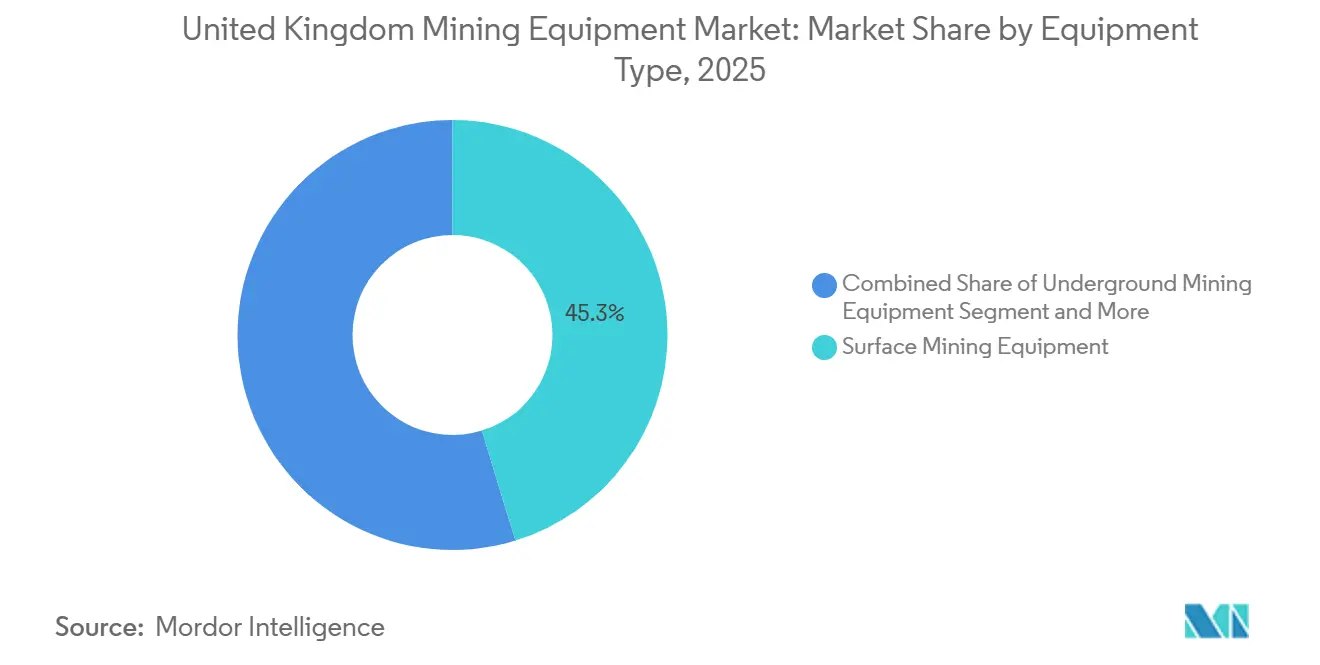
Surface units accounted for 45.27% of the United Kingdom mining equipment market share in 2025. The national aggregate output reflects significant production levels. Mobile crushers and screens are increasingly replacing static installations. This trend is particularly noticeable on major infrastructure worksites, where relocatable plants help reduce haulage runs. Underground machinery remains a niche but valuable segment, especially in connection with lithium and tin shafts in Cornwall. Drills and breakers are experiencing shorter replacement cycles as owners prioritize fuel-efficiency improvements required for compliance with environmental standards.
Loaders are forecast to grow at a 6.46% CAGR, accelerating overall United Kingdom mining equipment market growth. Lomond Plant's recent fleet renewal, featuring multiple JCB units, underscores the industry's scale. In quarries, high-powered loaders are the norm, whereas metal pits, like Hemerdon, are now seeing the entry of even more powerful loaders. Features like payload monitoring, tire-pressure systems, and factory-fitted autonomy kits are becoming standard, contributing to higher average selling prices.


By Automation Level: Manual Operations Face Transformation Pressure
Manual units retained 68.28% market share in 2025, yet fully autonomous machines will post the fastest 7.43% CAGR, improving the overall trajectory of the United Kingdom mining equipment market. At Sibelco, Bell's B40E demonstration significantly reduced haul costs, setting a benchmark for other pits in Devon and Yorkshire. For mid-tier quarries without the budget for full autonomy, semi-autonomous upgrades like Caterpillar's Grade with Assist serve as a practical alternative.
While the initial costs for connectivity and LiDAR pose challenges, sites with high throughput often see rapid returns on investment, making the adoption worthwhile. However, the absence of UK-specific autonomous regulations means operators lean on ISO 17757, hindering broader adoption until liability concerns are addressed.
By Powertrain Type: Electric Transition Accelerates Despite ICE Dominance
Internal-combustion engines supplied 76.58% of 2025 revenue, but battery-electric fleets are on a 7.78% CAGR run to 2031, aided by Komatsu’s ammonia-cracking project with AFC Energy. In urban quarries, Volvo's EC230 Electric demonstrates significantly lower energy costs per operating hour. Meanwhile, hybrids like the Tesab 700ie utilize braking energy, avoiding substantial investments in charging infrastructure, making them a preferred option in areas where grid upgrades are expensive.
With compliance requirements encouraging owners to adopt cleaner power solutions, the addition of retrofit particulate filters, which can enhance residual value, is influencing the shift towards newer Stage V or electric equipment. Scotland's Aggregates Tax is further driving the demand for fuel-efficient machinery. Even a modest efficiency improvement on a large excavator can result in considerable annual savings.
By Power Output: 500-1,000 HP Dominates While Above-1,000 HP Leads Growth
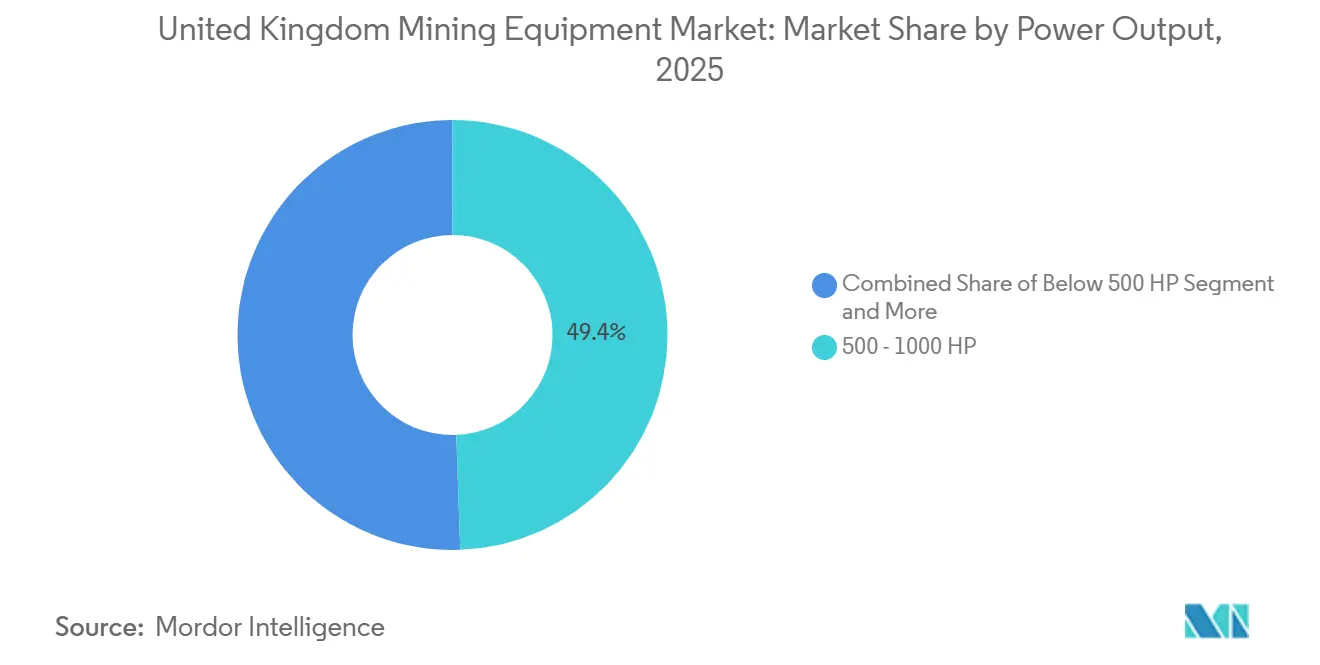
The 500-1,000 HP bracket secured 49.42% of the United Kingdom mining equipment market share in 2025. Mid-sized loaders and excavators with moderate cycle times and bucket capacities strike a balance between productivity and fuel economy, making them ideal for aggregate quarries. This demand remains robust, as these machines can handle overburden stripping, selective extraction, and stockpile management, all with a single fleet. This versatility eliminates the idle time smaller classes face when matched to specific tasks. Furthermore, operators appreciate these machines' compatibility with factory-installed Stage V engines, sidestepping a hefty retrofit cost on excavators.
Equipment rated above 1,000 HP is forecast to expand at a 6.37% CAGR through 2031, outpacing the overall United Kingdom mining equipment market size as metal pits like Hemerdon restart and deploy 100-t trucks and 15-m³ loaders. High-power assets have streamlined their fleet by replacing smaller units with a single larger machine. This change reduces the operator count and simplifies maintenance, though it comes with a significant price increase. OEMs are enhancing these flagship machines with features like payload monitoring, tire-pressure systems, and autonomous-ready drive-by-wire kits. While these upgrades raise the average selling price, they also promise a notable reduction in cost per tonne. Smaller models continue to play a crucial role in urban recycling and tight-space extractions. However, their sales are slowing due to the abundance of mini-excavators and compact loaders in the rental market. Additionally, taxation policies are encouraging buyers to opt for high-efficiency engines, as even a modest reduction in fuel consumption can lead to substantial annual savings.
By Application: Critical Minerals Drive Metal-Mining Growth
Metal mining accounted for 46.75% of the United Kingdom mining equipment market in 2025, anchored by projects for tungsten, lithium, and tin valued at more than GBP 1 billion combined. The specification of high-power loaders, corrosion-resistant pumps, and core drills in these projects drives high-dollar content per machine.
Mineral-mining equipment demand grows at a 6.43% CAGR on the back of HS2, offshore wind, and recycled-aggregate expansion. Mobile crusher sales are expected to increase significantly, driven by the establishment of a new Forest Wood recycling plant designed to process a substantial amount of waste. Across the nation, aggregate recycling accounts for a significant portion of total supply, requiring extensive equipment due to the complexities of contamination handling.
Geography Analysis
England continues to dominate the United Kingdom mining equipment market, with a 68.74% share in 2025. Large-scale infrastructure sustains high-volume surface-equipment demand, such as HS2’s 10 million-tonne aggregate program and offshore wind-foundation rollouts under the Clean Power 2030 plan. The Midlands, Yorkshire, and Cornwall form a triangle of activity where replacement cycles overlap with niche lithium exploration, generating parallel orders for heavy crushers and narrow-vein miners. The proximity of the supply chain to the Port of Felixstowe and other logistics hubs simplifies equipment import, refurbishment, and spare parts distribution, lowering downtime.
Scotland holds the fastest projected growth at a 6.54% CAGR as critical-mineral exploration and mine-water geothermal schemes move from pilot to commercial scale. The Coal Authority calculates that a single 6-MW mine-water heat system can offset CO₂, attracting municipal funding and equipment tenders for submersible pumps, heat exchangers, and monitoring instrumentation. Rugged terrain, harsher weather, and remote locations drive higher cold-start reliability and telematics specifications, favoring OEMs with proven Nordic or Canadian field experience.
Wales leverages its industrial mining heritage to repurpose shafts for rare-earth and geothermal projects. Planning authorities increasingly require zero-tailpipe equipment for underground use, driving demand for battery loaders. Northern Ireland’s quarry clusters supply domestic and Irish infrastructure, supporting a steady replacement rhythm for articulated dump trucks and mobile screens. Together, these trends illustrate the geographic heterogeneity underpinning future UK mining equipment market allocations.
Competitive Landscape
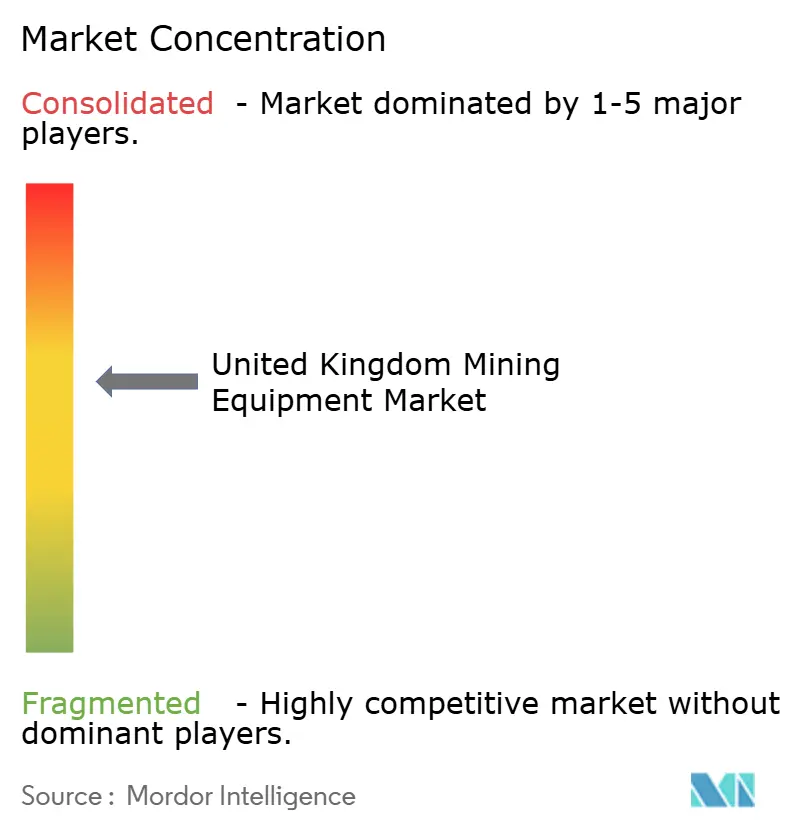
The competitive arena is moderately concentrated: five global OEMs command the lion’s share yet face niche rivalry from domestic and Asian challengers. Caterpillar, Komatsu, and Sandvik maintain broad portfolios, established dealerships, and financing arms, securing framework agreements with tier-one miners. Sandvik and Epiroc capitalize on battery-electric offerings for underground deployments, each announcing record multi-million-dollar orders through 2025 that illustrate accelerating fleet turnover toward electrification.
JCB amplifies local relevance through its hydrogen-engine prototype program, which aligns with government hydrogen-strategy grants and enhances political goodwill. The company’s robust rental and service network shortens lead times for mid-power equipment, blunting price competition from low-cost Asian entrants. SANY and XCMG, meanwhile, extend European footprints via joint ventures with global miners, leveraging attractive lease terms to penetrate price-sensitive fleets.
Sensor and software suppliers like Luminar and Ouster ride the automation wave, embedding lidar packages into OEM ecosystems and earning recurring revenue from analytics subscriptions. These partnerships underscore a shift from hardware-only offerings toward lifecycle service models that bundle autonomy, electrification, and predictive maintenance. Over the horizon, competitive advantage will hinge on demonstrable emission cuts, data-driven productivity gains, and the ability to customize for the diverse operating environments that typify the UK mining equipment market.
United Kingdom Mining Equipment Industry Leaders
Caterpillar Inc.
Komatsu Ltd.
Sandvik AB
Epiroc AB
Liebherr Group
- *Disclaimer: Major Players sorted in no particular order

Recent Industry Developments
- September 2025: Retec Equipment and Sandvik have expanded their collaboration to include aftermarket services, aiming to enhance support and service offerings across the UK and Ireland. This partnership extension is expected to strengthen their market presence and improve customer satisfaction in these regions.
- July 2025: Scot JCB delivered 130 Stage V-compliant machines to Lomond Plant, marking a significant fleet update in anticipation of stricter emission regulations. This order highlights Lomond Plant's proactive approach to aligning with upcoming environmental standards, ensuring compliance and operational efficiency as emission enforcement becomes more stringent.


United Kingdom Mining Equipment Market Report Scope
The United Kingdom mining equipment market report is segmented by equipment type (surface mining equipment, underground mining equipment, mineral processing equipment, drills & breakers, crushing, pulverizing & screening equipment, loaders, and mining trucks), automation level (manual equipment, semi-autonomous equipment, and fully autonomous equipment), powertrain type (internal-combustion engine vehicles, battery-electric vehicles, and hybrid vehicles), power output (below 500 hp, 500-1,000 hp, and above 1,000 hp), application (metal mining, mineral mining, and coal mining), and geography (England, Scotland, Wales, and Northern Ireland). The market forecasts are provided in terms of value (USD).
| Surface Mining Equipment |
| Underground Mining Equipment |
| Mineral Processing Equipment |
| Drills and Breakers |
| Crushing, Pulverizing and Screening Equipment |
| Loaders |
| Mining Trucks |
| Manual Equipment |
| Semi-Autonomous Equipment |
| Fully Autonomous Equipment |
| Internal-Combustion Engine Vehicles |
| Battery-Electric Vehicles |
| Hybrid Vehicles |
| Below 500 HP |
| 500 - 1,000 HP |
| Above 1,000 HP |
| Metal Mining |
| Mineral Mining |
| Coal Mining |
| England |
| Scotland |
| Wales |
| Northern Ireland |
| By Equipment Type | Surface Mining Equipment |
| Underground Mining Equipment | |
| Mineral Processing Equipment | |
| Drills and Breakers | |
| Crushing, Pulverizing and Screening Equipment | |
| Loaders | |
| Mining Trucks | |
| By Automation Level | Manual Equipment |
| Semi-Autonomous Equipment | |
| Fully Autonomous Equipment | |
| By Powertrain Type | Internal-Combustion Engine Vehicles |
| Battery-Electric Vehicles | |
| Hybrid Vehicles | |
| By Power Output | Below 500 HP |
| 500 - 1,000 HP | |
| Above 1,000 HP | |
| By Application | Metal Mining |
| Mineral Mining | |
| Coal Mining | |
| By Geography | England |
| Scotland | |
| Wales | |
| Northern Ireland |


Key Questions Answered in the Report
What is the forecast value of the UK mining equipment market by 2031?
USD 1.11 billion based on a projected 3.78% CAGR between 2026 and 2031.
Which power-output bracket currently dominates equipment demand?
The 500-1,000 HP class leads with 49.42% of United Kingdom mining equipment market share in 2025.
How quickly are battery-electric machines expected to grow?
Battery-electric variants record a 7.78% CAGR, the fastest among powertrains.
Why are Stage V regulations significant for equipment buyers?
They mandate particulate- and NOx-reduction technology, triggering near-term fleet replacement and raising demand for compliant machines.
How are OEMs addressing zero-emission requirements for heavy-duty applications?
Approaches include battery-electric haulage, hydrogen-combustion engines, and HVO-compatible diesel platforms backed by government energy cost relief.
Page last updated on:


 Your data is secure and never sold or shared.


