
Market Overview
| Study Period | 2020 - 2031 |
|---|---|
| Forecast Data Period | 2026 - 2031 |
| Base Year Market Size (2025) | USD 112.5 Billion |
| Market Size (2026) | USD 120.11 Billion |
| Market Size (2031) | USD 166.56 Billion |
| Growth Rate (2026 - 2031) | 6.76% CAGR |
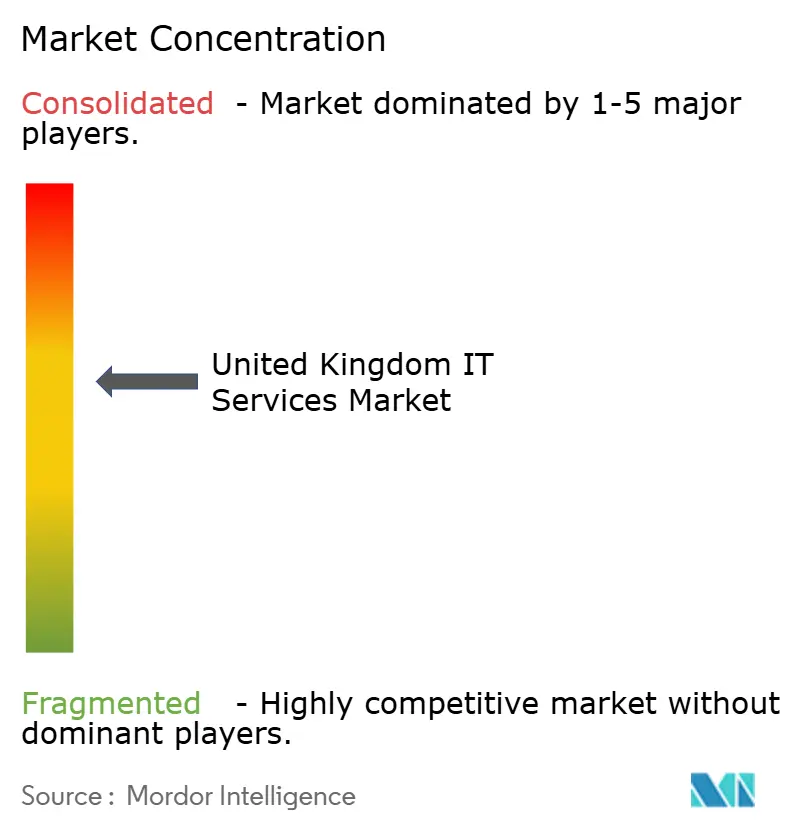
| Market Concentration | Medium |
Major Players *Disclaimer: Major Players sorted in no particular order Image © Mordor Intelligence. Reuse requires attribution under CC BY 4.0. | |
United Kingdom IT Services Market Analysis by Mordor Intelligence
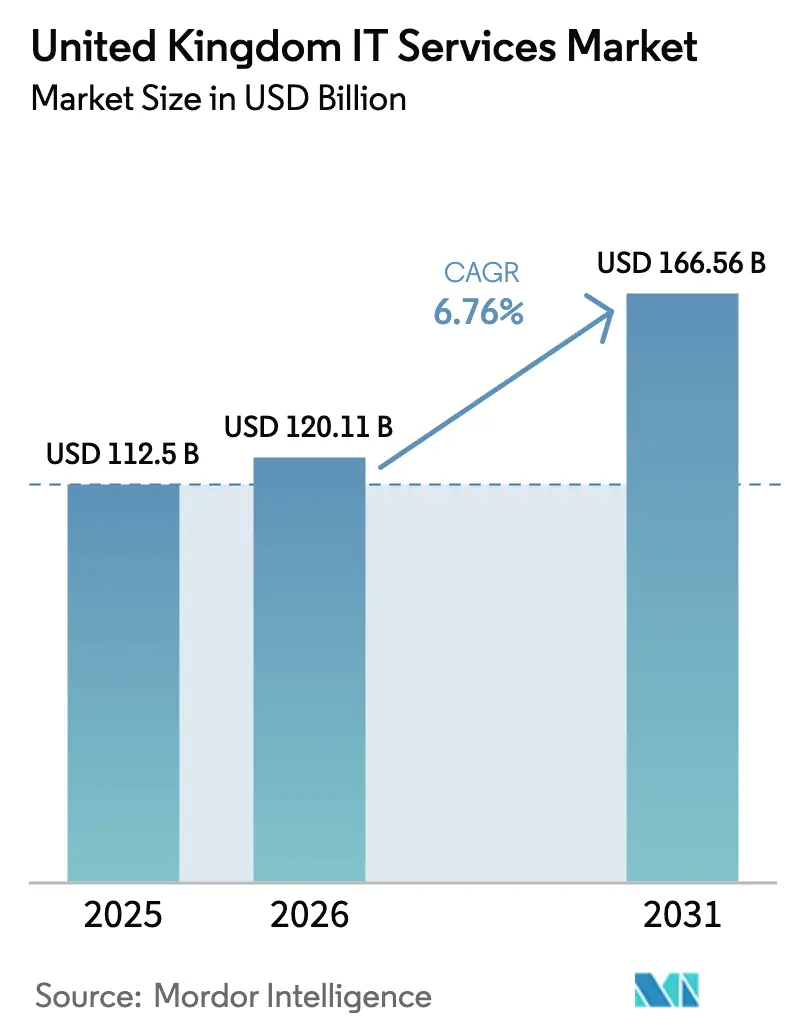
The UK IT services market size was valued at USD 112.5 billion in 2025 and estimated to grow from USD 120.11 billion in 2026 to reach USD 166.56 billion by 2031, at a CAGR of 6.76% during the forecast period (2026-2031). This trajectory underscores the resilience of the UK IT services market, powered by accelerating digital transformation in both public and private sectors, sustained public investment in AI infrastructure, and expanding compliance mandates in cybersecurity. Public-sector cloud frameworks, record generative-AI contract bookings, and growing regional tech hubs continue to stimulate demand, while wage inflation and macro-economic caution remain moderating influences. Global consulting firms are reinforcing their AI credentials to secure large multi-year deals, whereas mid-tier providers are targeting specialized niches such as managed security and Industry 4.0 integration. Nearshore delivery adoption is rising in response to tight local talent supply, yet the UK IT services market still favors on-premises proximity for high-regulation verticals such as finance and government.
Key Report Takeaways
- By service type, cloud and platform services captured 28.15% of the UK IT services market share in 2025; managed security services are projected to expand at a 9.38% CAGR through 2031.
- By enterprise size, large enterprises held a 64.25% share of the UK IT services market in 2025, while the SME segment is projected to grow at a 8.98% CAGR to 2031.
- By deployment model, onshore delivery accounted for 46.55% of the UK IT services market size in 2025, and nearshore delivery is advancing at a 9.51% CAGR through 2031.
- By end-user vertical, financial services led with 20.35% revenue share in 2025; healthcare and life sciences are forecast to expand at a 9.44% CAGR to 2031.
Note: Market size and forecast figures in this report are generated using Mordor Intelligence’s proprietary estimation framework, updated with the latest available data and insights as of 2026.
United Kingdom IT Services Market Trends and Insights
Drivers Impact Analysis*
| Driver | (~) % Impact on CAGR Forecast | Geographic Relevance | Impact Timeline |
|---|---|---|---|
| AI-led Digital Transformation Wave | +2.1% | Global, with concentration in the London-Oxford-Cambridge triangle | Medium term (2-4 years) |
| Cloud-first Government Procurement Policies | +1.8% | National, with early gains in the Central Government departments | Short term (≤ 2 years) |
| Acute Cyber-threat Environment | +1.5% | Global, with particular focus on Financial Services and Critical Infrastructure | Short term (≤ 2 years) |
| Convergence of OT-IT in UK Manufacturing | +0.9% | National, concentrated in the West Midlands and Northern England | Medium term (2-4 years) |
| Rise of Green-IT Mandates (Sustainability Targets) | +0.6% | National, driven by government procurement requirements | Long term (≥ 4 years) |
| Brexit-Driven Regulatory Complexity | +0.4% | National, with spillover effects to EU operations | Medium term (2-4 years) |
| Source: Mordor Intelligence | |||
AI-led Digital Transformation Wave
The United Kingdom now ranks as the world’s third-largest AI economy and is targeting annual productivity gains of 1.5% through AI deployment. [1]Department for Science, Innovation and Technology, “Prime Minister sets out blueprint to turbocharge AI,” GOV.UK Despite enthusiasm, only 16% of manufacturers report adequate AI knowledge, opening consultative opportunities for service providers. Public investment of USD 4 billion and USD 14 billion in private commitments form a durable pipeline for AI-centric engagements. Accenture alone secured USD 1.4 billion in generative-AI bookings during Q2 FY25, signaling robust enterprise appetite. Government-designated AI Growth Zones—beginning with Culham, Oxfordshire—will require extensive systems integration and cloud capacity. Together, these factors generate a sustained uplift in the UK IT services market.
Cloud-first Government Procurement Policies
The cloud-first mandate, highlighted by G-Cloud 14’s catalog of 46,000 services from 4,000 suppliers, is reshaping public-sector procurement. Framework savings of USD 2.3 billion since 2012 validate economic benefits and stimulate SME participation. The forthcoming USD 16 billion Technology Services 4 competition represents the largest single opportunity for vendors. Cloud uptake extends into strategic partnerships under the Digital and Technologies Sector Plan, blurring lines between procurement and innovation. Private-sector spillovers are visible as regulated industries replicate public-sector standards, reinforcing double-digit growth in platform services across the UK IT services market.
Acute Cyber-threat Environment
The Cyber Security and Resilience Bill expands oversight to 900-1,100 managed service providers and recognizes data centers as critical national infrastructure. With 58% of large financial firms reporting third-party attacks in 2024, cybersecurity spending is shifting from discretionary to mandatory. Industry growth of 13.2% suggests sustained demand amid imminent consolidation, as larger firms acquire niche specialists to satisfy regulatory scope. Alignment with EU-level rules such as DORA fosters continuous investment, propelling managed security services to become the fastest-growing category in the UK IT services market.
Convergence of OT-IT in UK Manufacturing
Valued at USD 9.5 billion in 2023, the domestic Industry 4.0 segment is forecast to hit USD 30.6 billion by 2030, demanding integration of operational and information technologies. The Made Smarter Programme’s USD 53 million fund speeds adoption, yet capability gaps drive manufacturers toward external partners for cloud migration and data analytics. West Midlands’ 5G coverage above 80% positions the region as a digitization hub demanding specialized services. Environmental compliance, including carbon border adjustment mechanisms, introduces sustainability analytics into OT-IT engagements. Such multi-disciplinary needs keep the UK IT services market on a steep growth curve.
Restraints Impact Analysis*
| Restraint | (~) % Impact on CAGR Forecast | Geographic Relevance | Impact Timeline |
|---|---|---|---|
| High Wage Inflation in Tech Talent Pool | -1.2% | National, with acute pressure in London and Southeast England | Short term (≤ 2 years) |
| Near-term Macroeconomic Slowdown | -0.8% | National, with regional variations in impact severity | Short term (≤ 2 years) |
| Data-Sovereignty Concerns with Offshore Delivery | -0.5% | National, affecting cross-border service delivery models | Medium term (2-4 years) |
| Fragmented SME Adoption Outside London | -0.3% | Regional, concentrated in Northern England, Wales, and Scotland | Long term (≥ 4 years) |
| Source: Mordor Intelligence | |||
High Wage Inflation in Tech Talent Pool
Tech salaries escalated 7-10% in 2024, with 76% of employers citing acute skill shortages. [2]Tech Nomads, “Salary Trends in the UK 2024,” technomads.io The April 2025 National Insurance hike from 13.8% to 15% inflate employer costs. Post-Brexit workforce attrition of 300,000 EU professionals leaves 600,000 vacancies that cost the economy USD 63 billion annually. Firms offset gaps by expanding nearshore and automation strategies, yet elevated labor costs compress margins and temper growth in the UK IT services market.
Near-term Macroeconomic Slowdown
Inflation uncertainty delays procurement decisions, as illustrated by Computacenter’s observation of elongated sales cycles. GenAI enthusiasm depresses other ICT transformation projects, causing real-terms contraction in 2023. Central government spending defends baseline demand, but private-sector caution prompts prioritization of ROI-proven initiatives. While AI’s measurable productivity gains help justify investments, macro sentiment remains a short-term drag on the UK IT services market.
*Our forecasts treat driver/restraint impacts as directional, not additive. The impact forecasts reflect baseline growth, mix effects, and variable interactions.
Segment Analysis
By Service Type: Cloud Dominance Drives Security Surge
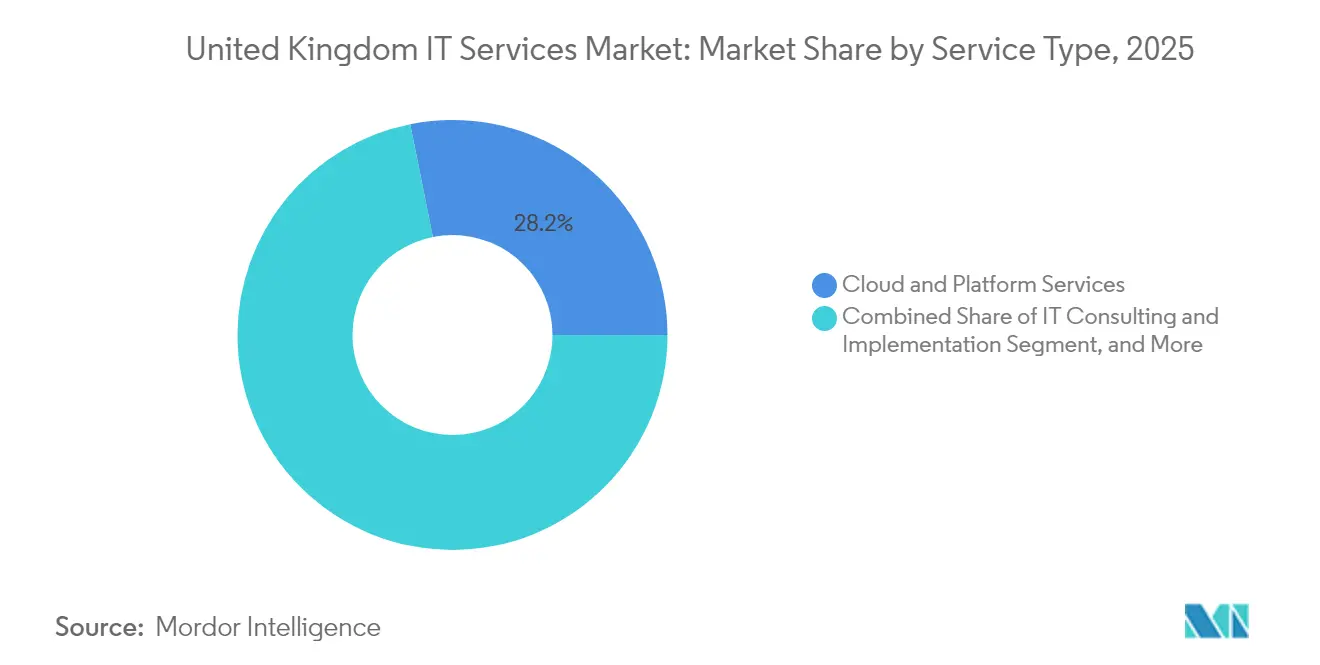
Cloud and platform services represented 28.15% of the UK IT services market share in 2025, a leadership position supported by G-Cloud 14’s widened catalog and ongoing migration of legacy estates to the public cloud. The UK IT services market size for this segment is projected to compound steadily on the back of the USD 16 billion Technology Services 4 framework. Simultaneously, managed security services are forecast to post a 9.38% CAGR to 2031, reflecting mandatory compliance under the Cyber Security and Resilience Bill. IT consulting remains resilient thanks to enterprise AI programs, while IT outsourcing and BPO experience balanced growth amid automation.
Cross-pollination between cloud migration and security hardening underpins provider revenue expansion. As agencies replace on-premise systems, bundled managed-security contracts accompany platform deals, magnifying wallet share. NHS tenders worth USD 1.4 billion illustrate how sector-specific frameworks pull along ecosystem suppliers. The UK IT services market, therefore, rewards vendors that combine hyperscale know-how with zero-trust architectures.


By End-User Enterprise Size: SME Acceleration Challenges Large-Enterprise Dominance
Large enterprises controlled 64.25% of the UK IT services market size in 2025, leveraging substantial budgets for multi-cloud rollouts, generative-AI pilots, and regulatory modernization. Despite dominance, their growth rate moderates as transformation roadmaps mature. In contrast, the SME cohort is projected to expand at a 8.98% CAGR to 2031, propelled by the SME Digital Adoption Taskforce’s 10-step action plan. UK IT services market share among SMEs remains modest, yet the economic value potential—USD 78.1 billion in AI-enabled productivity gains—creates a fertile addressable base.
Service models must adjust to shorter sales cycles and outcome-based pricing preferred by smaller firms. Regional AI innovation hubs, tax credits, and cloud marketplaces lower entry barriers, allowing providers to develop repeatable packages. Accordingly, the UK IT services market is witnessing a rise in subscription-oriented solutions tailored to micro-enterprises outside London.
By Deployment Model: Nearshore Momentum Challenges Onshore Preference
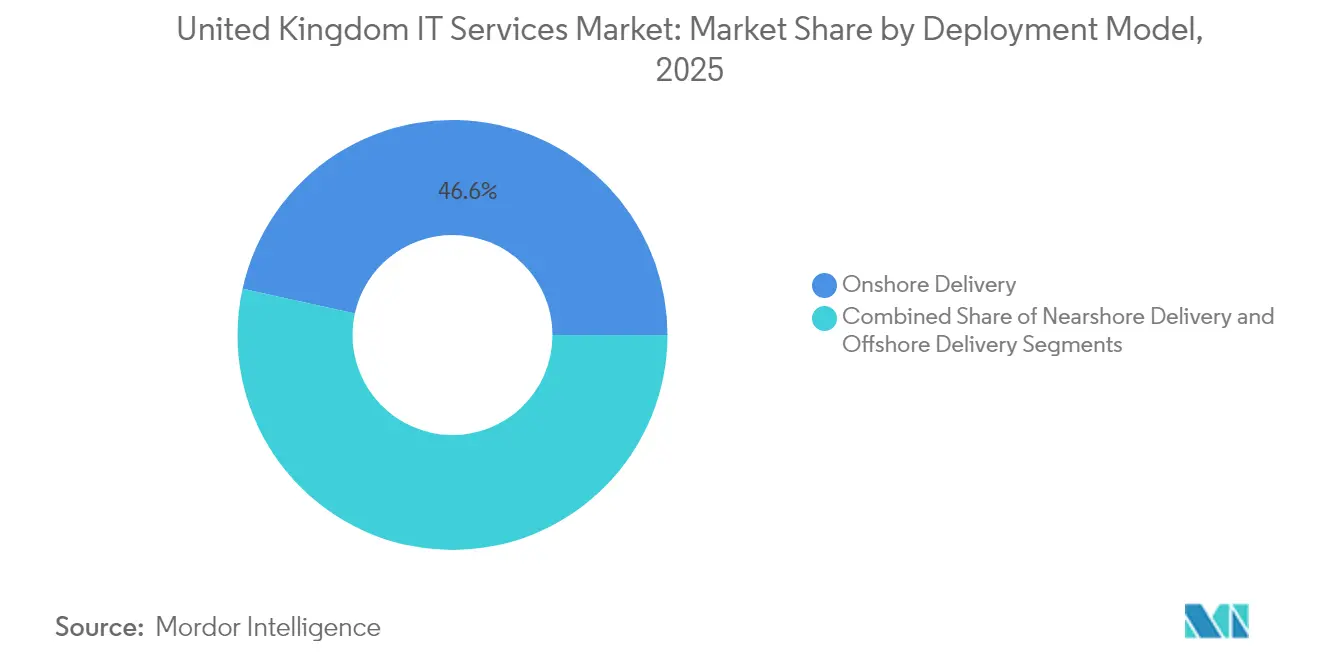
Onshore delivery captured 46.55% of the UK IT services market share in 2025 as clients prioritized data residency and close collaboration. However, wage inflation and talent scarcity push enterprises toward nearshore centers in Eastern Europe, projected to clock a 9.51% CAGR by 2031. The UK IT services market size for nearshore engagements will rise as hybrid models blend local consulting with overseas agile squads. Offshore delivery remains relevant for commodity tasks, but heightened compliance obligations cap its velocity.
Providers refine governance structures to coordinate cross-border delivery without breaching UK GDPR. Adoption of generative-AI coding assistants accelerates productivity, yet firms must navigate regulatory clarity on AI accountability, reinforcing demand for UK-based oversight.
By End-User Vertical: Healthcare Surge Challenges Financial-Services Leadership
Financial services held 20.35% of the UK IT services market size in 2025, anchored by strict regulatory imperatives and cyber-resilience mandates. Operational resilience and DORA compliance keep spending elevated, but growth is leveling off as core modernization programs mature. Healthcare and life sciences are predicted to grow 9.44% CAGR through 2031, buoyed by NHS England’s USD 1.4 billion digital framework expansion. The UK IT services market share for healthcare is set to climb as electronic-patient-record upgrades and AI-driven diagnostics roll out nationwide.
Manufacturing continues steady uptake thanks to Industry 4.0 incentives, while government agencies sustain cloud-migration momentum through large procurement vehicles. Retail, telecom, and energy verticals focus on customer experience and smart-grid projects, creating balanced opportunity lanes across the UK IT services market.
Geography Analysis
Regional clustering defines growth dynamics within the UK IT services market. London commands the highest digital sector GVA at USD 9,083 per capita, reflecting the concentration of venture funding and headquarters functions. The “golden triangle” of London, Oxford, and Cambridge attracts a disproportionate share of AI investment, risking divergence from levelling-up goals.
Government intervention via AI Growth Zones aims to seed large-scale data-center campuses outside traditional hubs, beginning with Culham, Oxfordshire. Simultaneously, tax reliefs and digital-skills funds target devolved administrations to correct labor imbalances that leave 10 million workers without essential digital capabilities.
Regional opportunities manifest in targeted cloud and managed-services packages for SMEs reluctant to adopt AI. Economic-impact studies suggest potential uplifts of USD 4.6 billion for West Yorkshire, USD 2.8 billion for Liverpool City Region, and USD 2.4 billion for Cardiff through AI integration. Such figures demonstrate geographically distributed upside for the UK IT services market when infrastructure and skills converge.
Regulatory Landscape
UK IT services delivery is shaped by expanding cyber, data, and operational-resilience obligations across public sector and regulated industries. The Cyber Security and Resilience (Network and Information Systems) Bill (introduced 12 November 2025) widens the scope of the existing NIS framework to more digital infrastructure and creates a designation regime for critical suppliers, raising compliance requirements for managed service providers and their supply chains.
In 2026, oversight sharpened around systemic technology dependencies and AI governance. The Critical Third Parties (Designation) Regulations 2026 came into force on 13 July 2026, designating Amazon Web Services EMEA SARL, Google Cloud EMEA Limited, Microsoft Ireland Operations Limited, and Oracle Corporation UK Limited as critical third parties to the financial sector, tightening expectations for resilience, incident management, and assurance across major cloud ecosystems. Alongside this, the UK Digital Standards Strategy (2026 to 2030), published 17 June 2026, reinforces the government push for leadership in AI and cybersecurity standards, and the UK digital verification services trust framework (1.0) published 3 March 2026 sets a certification model for trustworthy digital verification services under the Data (Use and Access) Act 2025.
Value Chain Analysis
The UK IT services value chain begins with core technology inputs such as hyperscale cloud, enterprise software, cybersecurity tooling, networks, and data platforms. Service creation then happens across global SIs, MSPs, and specialist boutiques, spanning consulting, migration, application services, and security operations. Delivery is commonly supported by onshore client-facing teams and nearshore or offshore engineering, and the work ultimately reaches end users in BFSI, government, healthcare, manufacturing, and SMEs through direct contracting and public sector procurement frameworks.
Public procurement and digital infrastructure policy also route downstream demand across the chain. DSIT research counted 12,867 active managed service providers as of March 2025 (with 37% serving logistics and supply chain), which points to fragmentation and a long tail of subcontractors behind prime contractors. Large government migrations further reshape upstream platform choices and partner ecosystems, including HMRC's March 2026 award of a GBP 473 million contract to Amazon Web Services to migrate and host services previously managed by Fujitsu, shifting spend toward hyperscaler marketplaces and cloud-native operations partners. Connectivity targets (standalone 5G in all populated areas by 2030 and 99% gigabit-capable broadband coverage by 2032) reinforce demand for network, edge, and managed infrastructure services, while planning reforms and telecom supply-chain priorities influence deployment timelines and supplier selection.
Competitive Landscape
Competition within the UK IT services market is intense but moderately fragmented. Accenture illustrates first-mover advantage in AI, leading with USD 1.4 billion in generative-AI bookings during Q2 FY25. [4]Accenture Plc, “8-K Material Event,” last10k.com By comparison, Indian majors TCS and Infosys trail significantly in project volume. M&A activity remains brisk: IBM’s acquisition of Advanced Computer Software Group’s modernization assets adds hybrid-cloud capability and exemplifies ecosystem consolidation.
White-space segments such as SME digital enablement and regional sustainability consulting entice emerging specialists. Meanwhile, compliance-driven niches in cybersecurity and AI assurance generate demand for boutique expertise capable of navigating the evolving regulatory landscape. Large framework wins, including NHS England’s USD 440 million cloud-service contract awarded to Softcat, underscore the importance of outcome-based and consumption pricing.
Providers differentiating on cloud-native delivery, AI accelerators, and zero-trust architectures will improve wallet share. The UK IT services market, therefore, favors firms capable of combining global scale with sector-specific depth, while mid-market players carve value in specialized domains.
United Kingdom IT Services Industry Leaders
Accenture plc
IBM UK Ltd.
Capgemini SE
Tata Consultancy Services (TCS) UK
Cognizant Technology Solutions UK
- *Disclaimer: Major Players sorted in no particular order

Market Opportunities and Future Outlook
Public sector modernization programs are generating a pipeline for multi-year digital engineering, cloud migration, and service-management work. The roadmap for modern digital government 2025-2030 (launched January 2026) signals continued demand for product-centric delivery, legacy replacement, and cross-department platforms, and the Cloud Challenge Book 2026 (published July 2026) invites scalable industry solutions aimed at public sector legacy and infrastructure constraints. Procurement modernization also creates services opportunities around catalog onboarding, assurance, and managed operations as government moves toward more standardized, repeatable digital components.
Compliance-led and infrastructure-led workstreams provide additional whitespace for UK IT services suppliers. DSIT's Government Cyber Action Plan (January 2026) sets up a Government Cyber Unit, supporting demand for managed detection and response, third-party risk management, and security assurance across public bodies and critical suppliers. In telecom and connectivity, DSIT's Statement of Strategic Priorities was designated in April 2026, and DSIT agreed 2026-2027 growth goals with Ofcom in June 2026, supporting activity around fixed network modernization and AI innovation in telecoms, alongside targets for standalone 5G and gigabit broadband coverage. These initiatives also raise demand for data governance, operational-resilience testing, and cloud risk management as UK oversight expands to systemic cloud and digital infrastructure dependencies.
Recent Industry Developments
- July 2026: Accenture launched Accenture Edge with Google Cloud to deliver scalable agentic AI solutions aimed at mid-market companies. The offering packages transformation and managed services around AI agents, expanding addressable demand beyond large-enterprise programs. It also increases competitive pressure on mid-tier UK providers that have been differentiating through verticalized, outcome-based managed offerings.
- June 2026: Capgemini signed a multi-year contract with HM Revenue & Customs to deliver contact centre as a service using NICE CXone, working with partners including NICE and Route 101. The award reinforces the shift of UK central government customer-contact platforms toward cloud-native consumption models. It also creates downstream work in integration, security, and service management across adjacent HMRC transformation portfolios.
- March 2026: HMRC awarded a GBP 473 million contract to Amazon Web Services to migrate and host services previously managed by Fujitsu. This program accelerates the transition away from legacy datacenter operations toward hyperscaler-centric architectures in a major UK department. The scale of the migration drives demand for cloud engineering, application modernization, security assurance, and operational tooling across prime and subcontractor ecosystems.


Research Methodology Framework and Report Scope
Market Definition and Coverage
For this report, the United Kingdom IT services market is defined as the value of contracted services that plan, build, run, and improve IT environments for public and private sector users, delivered by external service providers and billed as service revenue.
Scope exclusions: We exclude packaged software license-only revenue, pure telecom connectivity, and resale-only hardware revenues where no material service delivery is bundled.
Segmentation Overview
- By Service Type
- IT Consulting and Implementation
- IT Outsourcing (ITO)
- Business Process Outsourcing (BPO)
- Managed Security Services
- Cloud and Platform Services
- By End-User Enterprise Size
- Small and Medium Enterprises (SMEs)
- Large Enterprises
- By Deployment Model
- Onshore Delivery
- Nearshore Delivery
- Offshore Delivery
- By End-user Vertical
- BFSI
- Manufacturing
- Government and Public Sector
- Healthcare and Life-Sciences
- Retail and Consumer Goods
- Telecom and Media
- Logistics and Transport
- Energy and Utilities
- Other End-user Verticals
Data Sources, Market Sizing, and Validation
Desk Research
Desk work started with public UK datasets that anchor demand conditions and business activity, such as Office for National Statistics series, Department for Science, Innovation and Technology releases, and Bank of England macro indicators. We also used guidance and statistics from HM Revenue and Customs where trade or spending patterns helped explain delivery footprints, along with public procurement publications that signal government digital-services demand.
To keep the model grounded in real supplier behavior, we reviewed company annual reports, financial statements, and investor presentations, and then validated themes using reputable press and association updates (such as tech and digital economy groups). For private-company context and deal signals, we used paid subscriptions focused on company financials and intelligence, news and financials, and selective contracts and tenders screening. The desk sources listed here are illustrative, and additional references were used for data collection, cross-checks, and clarification.
Primary Interviews and Surveys
Primary work focused on interviews and structured questionnaires with UK-facing IT service providers, delivery leaders, channel partners, and enterprise and public sector buyers who manage technology budgets. Input from these sessions was used to confirm which revenue lines are consistently counted as IT services, how pricing moves with labor costs and cloud consumption, and which verticals are seeing faster deal cycles. This then helped close gaps left by public datasets.
Distribution of primary research fieldwork respondents
| Company type | Respondent position | Region |
|---|---|---|
| Top tier: 34% | CXOs: 14% | |
| Mid tier: 51% | Functional/Unit leaders: 26% | |
| Smaller Players: 15% | Managers: 60% |
Market-Sizing & Forecasting
Sizing was built using a top-down and bottom-up approach, where national spending capacity and IT services intensity were first reconstructed from UK macro and digital-economy signals, and then stress-tested using supplier-side revenue structure checks. In practical terms, we mapped demand pools by large enterprise and SME adoption, plus public sector program activity, and then translated that into service revenue using realistic price and utilization assumptions.
Key inputs included public sector digital procurement momentum, hiring and wage pressure for IT roles, cloud migration pace that shifts work from project to managed services, cybersecurity compliance needs that raise service attach rates, and nearshore versus onshore delivery mix that changes blended billing rates. For forecasts, scenario analysis was used so that baseline growth reflects consensus expectations from interviews on budget cycles, deal duration, and pricing resets. Sensitivity cases were also run for inflation and GBP to USD movements. Where supplier coverage was thinner in niche service lines, we applied gap-filling rules based on comparable contract structures and checked that implied revenue per employee stayed within realistic ranges.
Data Validation & Update Cycle
Outputs were validated through multiple checks that compare modeled totals with independent demand signals, followed by analyst reviews that look for unusual jumps by year, service line, or buyer cohort. When variances appeared, assumptions were revisited, and where needed, respondents were re-contacted to confirm whether the change came from pricing shifts, delivery mix, or one-time contract effects.
The dataset is refreshed on an annual cadence, and interim updates are triggered when material events occur, such as policy-led spending changes, sharp currency swings, or major shifts in labor cost trends. Before publication delivery, a final pass is completed to ensure the latest public releases and interview learnings are reflected in the numbers clients see.
Mordor Intelligence's United Kingdom Itservices Market Sizing Compared With Other Published Estimates
Published market values for UK IT services can look far apart because the timing of currency conversion, the way billing-rate inflation is carried forward, and the treatment of project versus managed services are not handled the same way. Some sources also publish a single number without explaining whether it reflects supplier revenue, buyer spending, or a blend of both.
The biggest swings usually come from refresh cadence and price logic, since services pricing can move quickly with wage inflation and cloud-related delivery changes, and then USD value changes again when the GBP rate is updated. Using a consistent FX timing, a clearly stated services-only boundary, and re-checks against recent contract pricing and utilization feedback are what keep the model current, a refresh discipline applied by Mordor Intelligence.
Benchmark comparison
| Source | Market Size | Gaps in Research Methodology |
|---|---|---|
| Mordor Intelligence | USD 112.5 B (2025) | |
| Industry Association A | USD 130.0 B (2025) | Often reflects a broader digital-technology services view, where adjacent spend (such as bundled software-related services and wider outsourcing lines) can be included, and FX conversion timing is not always stated. |
| Global Consultancy B | USD 105.0 B (2025) | May apply a more conservative billing-rate progression and slower managed-services mix shift, and the estimate can be anchored to older deal benchmarks if the refresh cycle is less frequent. |
Across these benchmarks, the spread is best explained by what gets counted as IT services revenue, plus how quickly pricing and FX assumptions are refreshed when costs and delivery models change. Our approach keeps the total traceable to a defined service boundary, a stated currency timing, and repeatable checks against demand and supplier-side signals.


Key Questions Answered in the Report
What is the projected value of the UK IT services market in 2031?
The market is expected to reach USD 166.56 billion by 2031, reflecting a 6.76% CAGR.
Which service category is growing fastest?
Managed security services are projected to expand at a 9.38% CAGR through 2031 as compliance mandates tighten.
How will nearshore delivery models evolve post-Brexit?
Nearshore engagements to Eastern Europe are forecast to rise at a 9.51% CAGR as firms offset domestic talent shortages while maintaining time-zone alignment.
Where do SMEs stand on digital adoption?
Although SMEs currently lag, government programs aim to unlock USD 78.1 billion in productivity gains by 2035 through accelerated AI and cloud uptake.
Which region outside London shows the highest growth potential?
West Yorkshire could generate USD 4.6 billion in economic uplift from AI adoption, supported by emerging AI innovation hubs and regional skills funds.
What factors most influence vendor selection today?
Clients increasingly prioritize demonstrated AI capability, strong cyber-security credentials, and the ability to deliver hybrid onshore-nearshore models compliant with UK GDPR.
Page last updated on:


