
Market Overview
| Study Period | 2020 - 2031 |
|---|---|
| Forecast Data Period | 2026 - 2031 |
| Historical Data Period | 2020 - 2024 |
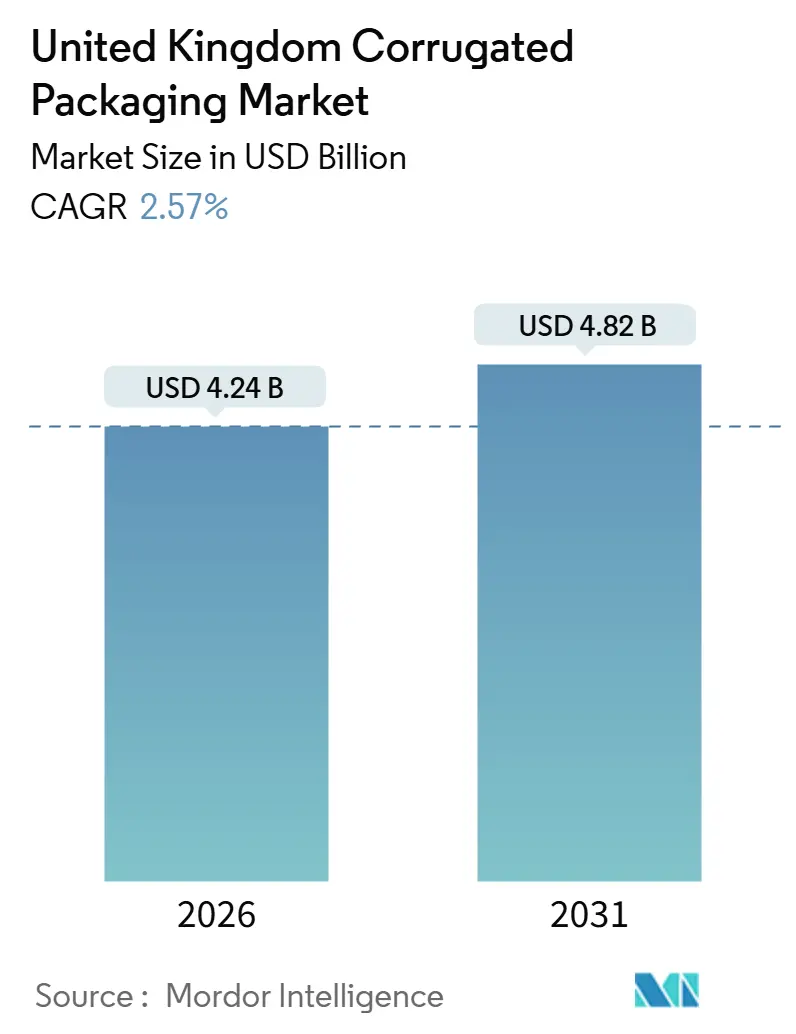
| Market Size (2026) | USD 4.24 Billion |
| Market Size (2031) | USD 4.82 Billion |
| Growth Rate (2026 - 2031) | 2.57 % |
| Market Concentration | Low |
Major Players *Disclaimer: Major Players sorted in no particular order Image © Mordor Intelligence. Reuse requires attribution under CC BY 4.0. | |
United Kingdom Corrugated Packaging Market Analysis by Mordor Intelligence
The United Kingdom corrugated packaging market size stands at USD 4.24 billion in 2026 and is expected to reach USD 4.82 billion by 2031, reflecting a 2.57% CAGR over the forecast period. This moderate pace signals a mature landscape where e-commerce parcel growth and plastic-reduction policies outweigh margin pressure from volatile recovered-fiber prices and elevated electricity tariffs. The Plastic Packaging Tax, now GBP 210.82 (USD 267.7) per tonne, continues to redirect capital toward corrugated lines, while Extended Producer Responsibility fees of GBP 196 (USD 248.9) per tonne for paper and card motivate converters to lightweight board grades, curb logistics emissions and stretch pulp yields. Old corrugated container prices remain unpredictable, and fourth-quarter 2024 electricity costs averaged 25.97 pence (USD 0.33) per kilowatt-hour, squeezing corrugator margins. Nevertheless, sustained demand from food, beverage and direct-to-consumer brands supports steady volume gains, and investments in digital inkjet equipment accelerate short-run graphics for personalized packs.
Key Report Takeaways
- By product type, slotted boxes led with 42.43% revenue share in 2025, whereas trays, folders and sheets are forecast to expand at a 3.66% CAGR through 2031.
- By board type, single-wall constructions captured 38.32% of the United Kingdom corrugated packaging market share in 2025, while triple-wall formats are projected to grow at a 4.32% CAGR.
- By flute profile, C-flute retained 32.54% share in 2025 and F-flute is set to climb at a 4.65% CAGR to 2031.
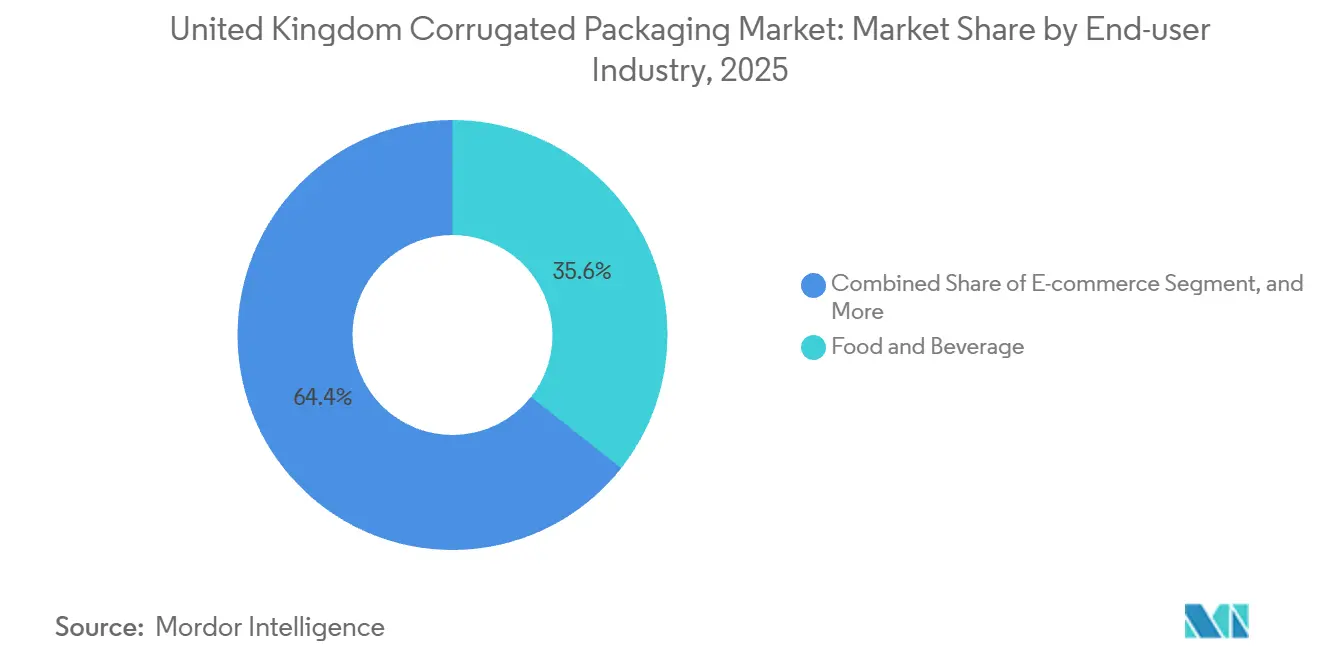
- By end-user industry, food and beverage accounted for 35.63% of the United Kingdom corrugated packaging market size in 2025, whereas e-commerce is advancing at a 4.73% CAGR.
- By print technology, flexography held 28.54% share in 2025, yet digital printing is climbing at a 3.54% CAGR.
Note: Market size and forecast figures in this report are generated using Mordor Intelligence’s proprietary estimation framework, updated with the latest available data and insights as of January 2026.
United Kingdom Corrugated Packaging Market Trends and Insights
Drivers Impact Analysis*
| Driver | (~) % Impact on CAGR Forecast | Geographic Relevance | Impact Timeline |
|---|---|---|---|
| Surge in e-commerce parcel volumes | +0.6% | National, concentrated in London, Manchester, Birmingham hubs | Short term (≤ 2 years) |
| Preference for recyclable fiber-based packs | +0.5% | National, strongest in England under Simpler Recycling mandates | Medium term (2-4 years) |
| Lightweighting initiatives | +0.3% | National, led by food and beverage chains targeting Scope 3 cuts | Medium term (2-4 years) |
| Rising demand from processed food brands | +0.4% | National, clustered in East Midlands and Yorkshire | Long term (≥ 4 years) |
| Expansion of shelf-ready formats | +0.2% | National, led by leading supermarket groups | Medium term (2-4 years) |
| Plastic Packaging Tax impact | +0.3% | National, affecting producers above 10 tonnes annual throughput | Short term (≤ 2 years) |
| Source: Mordor Intelligence | |||
Surge in E-Commerce Parcel Volumes
Online retail penetration touched 27.8% of total U.K. sales in 2024, stimulating demand for lightweight B- and F-flute mailers that withstand automated sortation forces while minimizing dimensional-weight charges.[1]About Amazon, “Ships in Own Container program,” aboutamazon.com Brand participation in “Ships in Own Container” programs expands the addressable pool for frustration-free slotted boxes, supporting incremental adoption of digital printing for variable data and QR codes.
Preference for Recyclable Fiber-Based Packaging
The Separation of Waste Regulations 2024 mandates dedicated paper and card collection for most businesses by March 2025, lifting bale purity and boosting recovered-fiber prices by roughly 8-12%.[2]UK Statutory Instruments 2024 No. 666, “The Separation of Waste Regulations 2024,” legislation.gov.uk Extended Producer Responsibility fees establish a cost gradient that favors mono-material designs, encouraging brands to substitute plastic trays with corrugated equivalents.
Lightweighting Initiatives
Converters lowered average basis weight by 6-9% from 2021 to 2025 using high-performance liners and micro-flute profiles, cutting shipment carbon footprints by 0.15-0.22 kg of CO₂e while maintaining burst strength above 1,100 kPa.[3]European Federation of Corrugated Board Manufacturers, “Lifecycle Assessment Data,” fefco.org Upgrades at Board24 increased run speed and reduced waste, proving that productivity and sustainability gains can coincide.
Rising Demand from Processed Food Brands
Extended Producer Responsibility costs of GBP 1.1 billion (USD 1.40 billion) in 2025 pushed food manufacturers to rationalize packaging formats and switch to shelf-ready corrugated trays that shorten shelf-stocking time by 15-20%. Major retailers target 100% recyclable own-brand packaging, reinforcing corrugated’s volume base.
Restraints Impact Analysis*
| Restraint | (~) % Impact on CAGR Forecast | Geographic Relevance | Impact Timeline |
|---|---|---|---|
| Volatility in recovered paper prices | -0.4% | National, acute where imported fiber is prominent | Short term (≤ 2 years) |
| Substitution threat from flexible plastics | -0.3% | National, notably in cosmetics, electronics and pharma blister packs | Medium term (2-4 years) |
| Urban curbside collection limits | -0.2% | England, especially London, Essex, Cambridgeshire | Medium term (2-4 years) |
| Energy-price fluctuations | -0.2% | National, burdening energy-intensive corrugators | Short term (≤ 2 years) |
| Source: Mordor Intelligence | |||
Volatility in Recovered Paper Prices and Supply
Household paper collection fell 3.3% year on year to 1.894 million t in 2023, compressing raw-material availability even as recycling rates reached 74.3%. Packaging Recovery Note prices dropped below GBP 5 per tonne in early 2025, undermining the incentive for local authorities to segregate OCC and forcing converters to hedge pulp inputs.
Substitution Threat from Flexible Plastics
Moisture-sensitive cosmetics and electronics accessories still favor polyethylene pouches that meet tight barrier and drop-test demands at a lower weight. A 120-g corrugated mailer costs roughly GBP 0.025 (USD 0.032) in board alone, versus GBP 0.01 (USD 0.013) Plastic Packaging Tax-inclusive outlay for a 50-g flexible pouch, maintaining a cost gap that corrugated cannot yet erase.
*Our forecasts treat driver/restraint impacts as directional, not additive. The impact forecasts reflect baseline growth, mix effects, and variable interactions.
Segment Analysis
By Product Type: Slotted Boxes Anchor Volume, Shelf-Ready Trays Capture Growth
Slotted boxes represented 42.43% of market share in 2025, reflecting their compatibility with high-speed erecting lines and broad use across food, beverage, and industrial shipping. The United Kingdom corrugated packaging market size attached to trays, folders and sheets is projected to expand at a 3.66% CAGR, fueled by retailer mandates for shelf-ready presentation that trims in-store labor and boosts on-shelf visibility. Tesco and Sainsbury’s specifications for perforated tear strips and reinforced corner posts reinforce material upgrades, and Amazon’s ship-in-own-container standard pushes primary packs to double as shipping cases. Additional demand stems from gift and promotional formats that employ litho-laminated graphics to differentiate products in crowded e-commerce storefronts.
Brand owners chasing smaller pack counts for single-person households generate thousands of SKUs, making trays and folders ideal for short-run digital printing. The United Kingdom corrugated packaging market share enjoyed by telescope and multi-piece boxes remains modest, yet heavy-machinery exporters rely on these adjustable depth designs for delicate equipment valued at more than GBP 50,000 (USD 63,500) per shipment. Over the forecast horizon, publishers forecast micro-flute mailers to proliferate, yet slotted boxes retain scale where automated case erectors handle more than 60 cases per minute.


By Board Type: Single-Wall Dominates, Triple-Wall Gains in Heavy-Duty Logistics
Single-wall board captured 38.32% of the United Kingdom corrugated packaging market share in 2025, balancing weight, cost, and stacking performance. In contrast, triple-wall constructions are gaining at a 4.32% CAGR as automotive, aerospace, and machinery shippers shift away from timber crates. CorrBoard and VPK Packaging’s new capacity expands access to BB and BC double-wall flutes that meet edge-crush thresholds above 10 kN per meter. Double-wall variants remain relevant for household appliances, but lightweighting is pushing many applications toward optimized single-wall grades with high-performance liners.
Industrial shippers prefer triple-wall for export cargo that can face vibration, humidity, and puncture hazards during ocean transit. The United Kingdom corrugated packaging market's triple-wall volume remains smaller than single-wall volumes, yet its higher unit revenue and stable margins drive converter interest. Investments in automated palletization at CorrBoard reinforce the medium-term outlook for heavy-duty board.
By Flute Profile: C-Flute Leads, F-Flute Surges on E-Commerce Tailwinds
C-flute retained a 32.54% share in 2025 because upstream packing lines, pallets, and racking in grocery and beverage networks are optimized for its 4 mm thickness. Meanwhile, F-flute, at 1.5 mm, is growing 4.65% annually, allowing retailers to load more parcels per trailer and to cut dimensional-weight fees. The United Kingdom corrugated packaging market for F-flute boards will benefit from integrated digital printing systems that deliver high-resolution graphics without pre-coating.
B-flute will continue in beverage multipacks that require grip strength and edge crush resilience. Hybrid BC and EB combinations fill heavy-duty niches but require longer corrugator changeovers that limit volume share. As carriers enforce cubic efficiency, smaller flutes will gain traction, supported by print-on-demand economics that lower minimum order quantities.
By End-User Industry: Food and Beverage Anchors Demand, E-Commerce Accelerates
Food and beverage brands accounted for 35.63% of the market in 2025, relying on recyclable secondary packs for ambient, chilled, and multichannel distribution. E-commerce shipments are set to rise 4.73% annually as rapid grocery delivery and direct-to-consumer models multiply parcel counts. Pharmaceutical cold-chain logistics now tests fiber-based alternatives, such as DS Smith’s TailorTemp solution, which maintains 2-8 °C for 36 h.
Industrial and electronics segments remain partial to triple-wall and ESD-safe inserts, respectively, reflecting higher performance thresholds. The United Kingdom corrugated packaging industry increasingly serves personal-care products in shelf-ready trays that allow store staff to replenish in under half a minute.
By Print Technology: Flexography Dominates, Digital Gains on Short-Run Economics
Flexography held 28.54% of the revenue share in 2025, excelling at runs above 5,000 linear m, where plate costs amortize efficiently. The United Kingdom corrugated packaging market size linked to digital printing will climb at a 3.54% CAGR, supported by HP PageWide presses integrated with inline die-cutters to deliver variable data at speeds above 150 m min⁻¹.
Lithography remains confined to premium gift packs and point-of-sale displays that require photographic detail, while thermal transfer retains a foothold for compliance coding. As SKU proliferation accelerates, the flexo-to-digital crossover point continues to drop, prompting converters to hybridize workflows.
Geography Analysis
England generated roughly 85% of the market share in 2025, thanks to a dense population, extensive fulfillment hubs, and a strong food-processing base in the East Midlands and Yorkshire. London and the South East accounted for one-third of national parcel traffic, driving adoption of F-flute mailers and digital print for direct-to-consumer brands.
The North West’s automotive and aerospace corridors bolster triple-wall intake to protect high-value engines and assemblies. Scotland, Wales, and Northern Ireland collectively hold 15% of volume; Scotland’s capacity is concentrated in Saica Pack’s network, while Wales benefits from Shotton mill’s linerboard supply, avoiding costly fiber imports. Northern Ireland remains export-oriented but faces Brexit-related customs friction.
Collection quality diverges regionally: Essex and Cambridgeshire send more than 40% of residual waste to landfill, lowering recovered fiber availability, whereas English cities subject to Simpler Recycling mandates improve bale grades, raising gate prices 8-12%. Scotland and Wales lag by a year in adopting parallel collection schemes, delaying uniform EPR enforcement. Rising energy-cost volatility weighs on plants lacking onsite renewables, although installations like Saica Pack’s solar-equipped Hartlepool warehouse signal incremental mitigation.

Regulatory Landscape
The United Kingdom corrugated packaging market operates under the UK packaging Producer Responsibility framework administered by the Environment Agency, alongside devolved regulators (Natural Resources Wales, NIEA, and SEPA). The Producer Responsibility Obligations (Packaging and Packaging Waste) (Amendment) Regulations 2025 came into force on 1 January 2026, expanding reporting categories to include paper, board, and fibre-based composite material and setting a 2026 recycling target of 77% for this category.
From 2026, enforcement has tightened through regulator monitoring activity and updates to interpretive guidance, including Version 8 of the pEPR Agreed Positions and Technical Interpretations published in February 2026. Producers need to align packaging data submissions and recyclability assessment inputs with the official guidance for the 2026 reporting year, which raises documentation expectations and audit readiness across corrugated specifications, materials declarations, and evidence trails.
Value Chain Analysis
The value chain starts with recovered fiber collection and virgin pulp inputs that feed domestic and imported containerboard. That base moves into corrugation and conversion into formats such as slotted boxes, trays, and die-cut mailers. Integrated groups manage mills, corrugators, and box plants, while independents rely more on third-party containerboard and differentiate through faster turnaround, specialized converting, and print capability. Supply then goes to food and beverage customers, retail-ready programs, and parcel-shipper networks that support e-commerce fulfillment.
Recent changes in capacity and footprint are reshaping upstream supply options and shifting risk. Smurfit Westrock confirmed the closure of its SSK paper mill in Birmingham, with production scheduled to cease on 27 July 2026, removing about 200,000 tonnes per year of domestic fluting and liner supply for the UK and Irish markets and increasing the need for diversified sourcing for non-integrated converters. On the compliance layer, EPR data reporting and waste disposal fee obligations effective from 1 January 2026 require brands and converters to embed recyclability documentation and material accuracy into procurement and pack design workflows.
Competitive Landscape
The market is fragmented, with players including Mondi, Smurfit Kappa, WestRock, International Paper, and others. The 2025 International Paper acquisition of DS Smith created a 6.5 billion m² output platform with mill-to-box integration. Mondi’s April 2025 purchase of Schumacher Packaging enlarged its Central European linerboard footprint, positioning the firm to guarantee supply into the United Kingdom corrugated packaging market.
Eren’s 2024 acquisition of Onboard Corrugated and its GBP 150 million (USD 190.5 million) Shotton mill revamp underscores interest from non-EU investors seeking barrier-free access to U.K. customers. Independents such as Board24, GWP Group, and CorrBoard compete on rapid turnaround, bespoke die-cutting, and renewable-energy attributes, yet remain exposed to OCC price swings.
Digital inkjet adoption serves as a differentiator. Board24’s 19% improvement in run speed and 0.54% reduction in waste in 2025 reduce scope 3 emissions for brand owners. CorrBoard’s GBP 1.7 million (USD 2.16 million) palletization upgrade streamlines the handling of high-girth triple-wall sheets. Kite Packaging and Rigid Containers focus on quick-ship online ordering models that resonate with small and mid-sized enterprises shipping via parcel carriers.
United Kingdom Corrugated Packaging Industry Leaders
Smurfit WestRock
Mondi Group
International Paper Company
Saica Group S.L.
GWP Group Limited
- *Disclaimer: Major Players sorted in no particular order


Market Opportunities and Future Outlook
Implementation of EPR from 1 January 2026 creates a clear compliance-led whitespace for corrugated design and data services. Producers must submit packaging data under expanded material categories and operate against a 77% 2026 recycling target for paper, board, and fibre-based composite material. Converters that can supply auditable specifications, clearer recyclability evidence, and simpler mono-material pack designs help brand owners manage tighter regulator oversight, including the 2026 monitoring approach published by the Environment Agency and counterpart regulators.
Operational resilience and capacity localization also present an opportunity. Eren Holding reaching the completion phase of the Shotton Mill redevelopment in Wales, including integrated containerboard and corrugating units with stated 110,000 tpa corrugated box capacity, points to continued moves toward domestic supply integration. Alongside this, commissioning plans such as CBS Packaging Group expanding a Walsall, West Midlands facility show sustained converter investment. Logistics-focused upgrades further support differentiation tied to service levels for e-commerce and retail-ready demand, including Saica Pack bringing a GBP 10 million Hartlepool warehouse to fully operational status in April 2026 with 9,000-pallet capacity.
Recent Industry Developments
- June 2026: Smurfit WestRock confirmed the closure of its SSK paper mill in Birmingham, with production scheduled to cease on 27 July 2026. The site supplied around 200,000 tonnes per year of fluting and liner to the UK and Irish markets, shifting containerboard sourcing dynamics for converters. The move tightens the supply landscape for non-integrated players and increases the value of long-term procurement and mill-to-box integration.
- April 2026: Saica Pack made its GBP 10 million warehouse in Hartlepool, UK, fully operational, lifting storage capacity to about 9,000 pallets. The added logistics buffer supports faster fulfillment, SKU breadth, and service reliability for corrugated packaging customers. It also improves network flexibility during periods of fiber and energy cost volatility.
- August 2025: Board24 completed corrugator upgrades at its Preston and Coalville sites, increasing run speed by 19% and cutting downtime by 254 hours per year. The changes raise throughput capacity and improve lead times for short-run and bespoke corrugated formats. Higher productivity also supports lightweighting and waste reduction initiatives by lowering scrap generated per unit output.


Research Methodology Framework and Report Scope
Market Definition and Coverage
For this report, the market covers the value of corrugated packaging used in the United Kingdom, counted as corrugated board formats that are converted into shippable and protective packaging for commercial end users.
Scope exclusions: Non-corrugated paper packaging such as folding cartons, molded fiber trays, and flexible paper packs are excluded from this market sizing.
Segmentation Overview
- By Product Type
- Slotted Box
- Telescope/Multi-Piece Boxes
- Trays, Folder and Sheets
- Other Product Types
- By Board Type
- Single Wall
- Double Wall
- Triple Wall
- By Flute Profile
- A Flute
- B Flute
- C Flute
- E Flute
- F Flute
- Other Flute Profile
- By End-user Industry
- Food
- Beverages
- Pharmaceuticals
- Personal Care and Household
- Industrial
- E-commerce
- Electrical and Electronics
- Other End-user Industries
- By Print Technology
- Flexography
- Digital
- Lithography
- Other Print Technology
Data Sources, Market Sizing, and Validation
Desk Research
Desk research was used to set the outer limits of demand and supply in the UK, and to compile time series that can be checked year to year. We reviewed official and public sources such as UK Office for National Statistics production and manufacturing releases, HMRC trade and tariff statistics, Eurostat packaging and waste indicators, and guidance notes tied to UK packaging waste rules and EPR timelines. For corrugated specific signals, we also used open publications from industry bodies such as paper and board associations, plus academic articles that describe corrugated board performance and recycling rates.
In parallel with public material, we checked company annual reports, investor presentations, and press releases on capacity changes, plus reputable business news, to spot expansions, shutdowns, and pricing commentary. Where useful, a paid subscription covering company financials and news was referenced to standardize revenue moves and corporate activity across suppliers and converters, and a patent database was used to track packaging design and print innovation direction. These desk sources are illustrative, and we used additional public and paid references to collect inputs, validate assumptions, and clarify open questions.
Primary Interviews and Surveys
Primary interviews and short surveys focused on packaging converters, corrugated board producers, distributors, and large buyers in end-user sectors such as food, industrial goods, and e-commerce fulfillment. The goal was to confirm product mix shifts (for example, board grade and flute preferences), map common patterns in pricing movement, and clarify what buyers include when they report corrugated packaging spend. Since this is a single-country market, we balanced coverage across major UK production and consumption hubs so the assumptions are not driven by one corridor or one end-user type.
Distribution of primary research fieldwork respondents
| Company type | Respondent position |
|---|---|
| Top tier: 38% | CXOs: 16% |
| Mid tier: 46% | Functional/Unit leaders: 26% |
| Smaller Players: 16% | Managers: 58% |
Market-Sizing & Forecasting
Our model starts with a top-down build where UK corrugated packaging value is reconstructed from end-use demand pools and packaging intensity, then translated into annual spend using price progression inputs. To keep the output realistic, we also ran selective bottom-up checks using sampled converter output, channel feedback on box volumes, and typical price bands by board type, and then we adjusted totals when the two views did not align.
Several market fingerprints were used as inputs, and they were refreshed during validation. These include shifts in board type mix (single wall vs double and triple wall), flute profile preferences tied to weight and protection needs, the share of e-commerce and parcel shipping in box demand, print technology adoption that can shift unit pricing, and the timing of recycled fiber and energy cost swings that move selling prices. Where gaps existed for smaller product formats or niche end uses, we used ratios from the interview benchmarks and then stress-tested the outcome against the overall UK packaging activity trend.
For forecasting, we used scenario analysis so price and volume can be moved separately when conditions change, and then the resulting path was reviewed with primary respondents for a realistic base case. Main forecast drivers were end-user output expectations, e-commerce shipment momentum, substitution pressure away from plastics, and expected cost pass-through behavior in corrugated pricing.
Data Validation & Update Cycle
Validation was done through triangulation across desk indicators, primary feedback, and internal consistency checks in the model. We compared implied volumes and pricing against independent signals such as manufacturing output movement, trade and recycled paper availability cues, and reported capacity changes, then reviewed anomalies by a second analyst before sign-off.
If large variances emerged by product type or end user, we re-contacted respondents to confirm what caused the gap, and we re-checked the underlying ratios and unit assumptions. The report is refreshed annually, with interim updates when material events occur (for example, major capacity additions, sharp energy price moves, or policy-linked cost impacts). Before delivery, a final pass ensures the newest public releases and company updates are reflected in the latest view.
Mordor Intelligence's United Kingdom Corrugated Packaging Market Size Compared Against Other Published Estimates
Published market sizes for UK corrugated packaging often look different because each publisher draws the market boundary in its own way, and then uses different price and volume trackers to convert activity into value. Timing also matters, since corrugated pricing can move quickly, so the year and currency treatment can swing the reported number.
Folding carton and other non-corrugated paper packs sit outside Mordor Intelligence's scope, which is one reason our 2026 value can look lower than estimates that group wider paper packaging together or use broader industry turnover totals.
Benchmark comparison
| Source | Market Size | Gaps in Research Methodology |
|---|---|---|
| Mordor Intelligence | USD 4.24 B (2026) | |
| Trade Publisher A | USD 12.40 B (2025) | Uses a broader cardboard box and paper packaging grouping and mixes global report assumptions into the UK cut, so the value is not limited to corrugated packaging demand in end use sectors. |
| Industry Platform B | USD 19.06 B (2024) | Appears to apply a wider corrugated plus adjacent packaging scope and a higher growth and price curve, with limited visibility on how UK-only volumes and ASPs are validated year by year. |
Overall, the spread is mainly explained by scope width and how pricing is carried through the time series. By keeping the market tied to corrugated formats used within the UK, and by checking key inputs like end user demand mix and price movement with interviews, the resulting number stays traceable to clear, repeatable steps.


Key Questions Answered in the Report
How large is United Kingdom corrugated packaging demand in 2026?
Consumption is valued at USD 4.24 billion and is projected to climb to USD 4.82 billion by 2031 at a 2.57% CAGR.
Which product type delivers the most revenue?
Slotted boxes account for 42.43% of 2025 revenue and remain the mainstay for food, beverage and e-commerce shipping.
What drives rapid uptake of F-flute board?
Thinner 1.5 mm caliper cuts dimensional-weight fees, fits automated sortation and supports high-resolution digital graphics.
How are Extended Producer Responsibility fees affecting packaging choices?
Fees of GBP 196 (USD 248.9) per tonne for paper and card push brand owners toward lightweight mono-material corrugated packs to lower compliance costs.
Why is digital printing gaining ground on flexography?
Plate-free HP PageWide and similar presses cut setup waste by 40%, making short runs of 500-1,000 units economical for personalized, multi-SKU campaigns.
Which regions show the fastest e-commerce parcel growth?
London, the South East and major Midlands hubs generate the highest parcel volumes, reinforcing demand for micro-flute mailers and shelf-ready trays.
Page last updated on:


 Your data is secure and never sold or shared.


