
Market Overview
| Study Period | 2020 - 2031 |
|---|---|
| Forecast Data Period | 2026 - 2031 |
| Base Year Market Size (2025) | USD 21.16 Billion |
| Market Size (2026) | USD 21.83 Billion |
| Market Size (2031) | USD 25.51 Billion |
| Growth Rate (2026 - 2031) | 3.17 % |
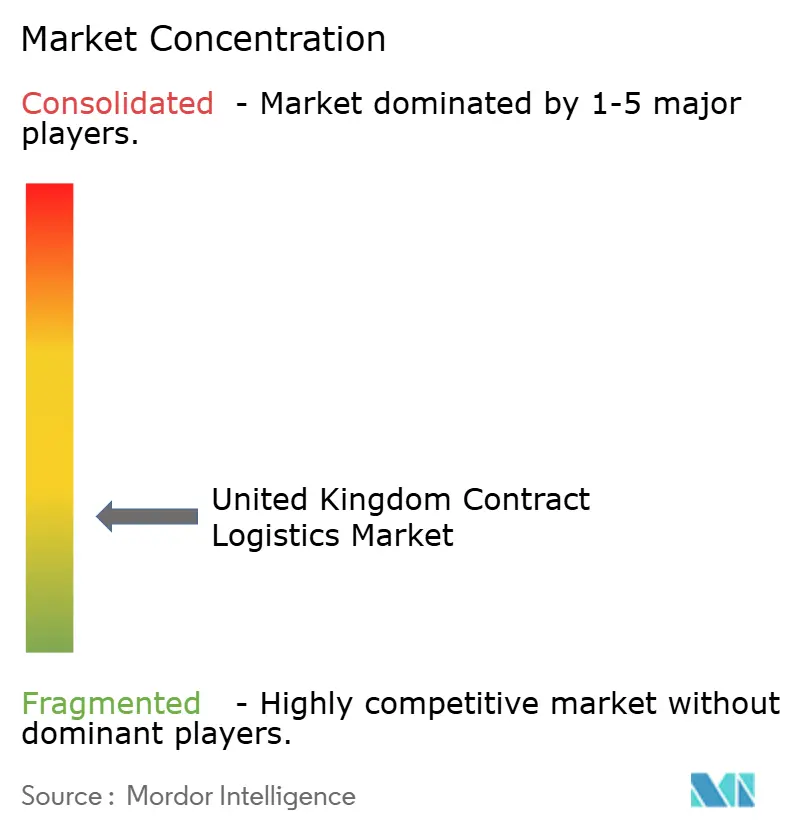
| Market Concentration | Low |
Major Players *Disclaimer: Major Players sorted in no particular order Image © Mordor Intelligence. Reuse requires attribution under CC BY 4.0. | |
United Kingdom Contract Logistics Market Analysis by Mordor Intelligence
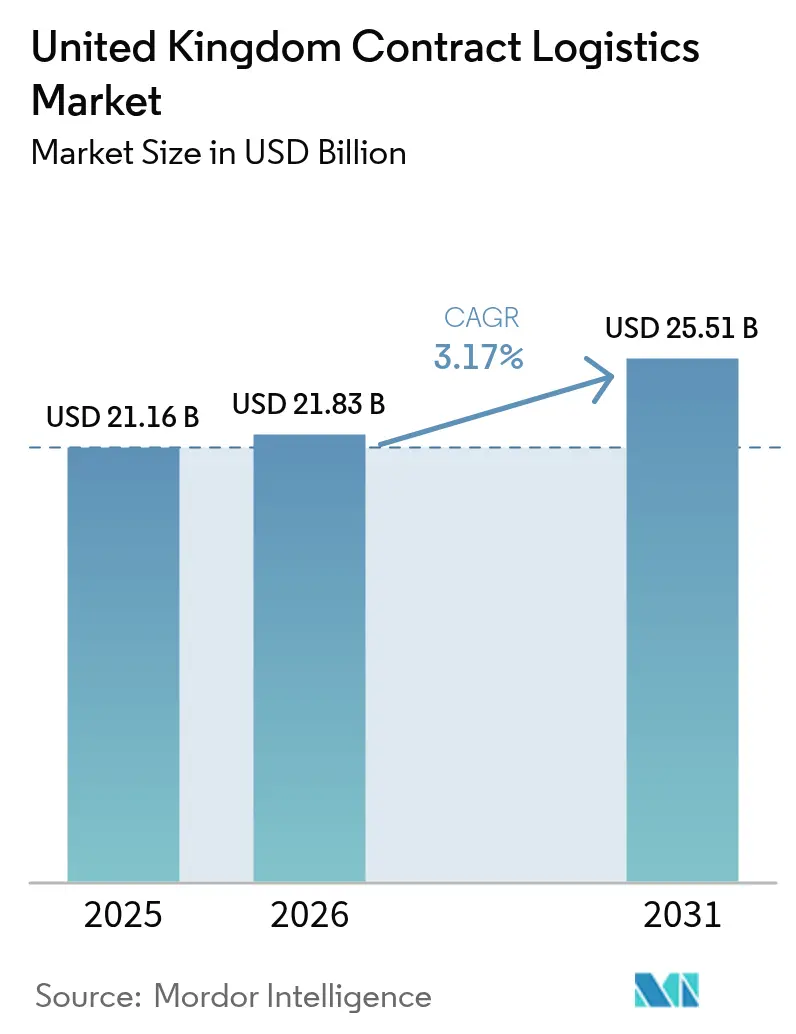
The United Kingdom Contract Logistics Market size market size in 2026 is estimated at USD 21.83 billion, growing from 2025 value of USD 21.16 billion with 2031 projections showing USD 25.51 billion, growing at 3.17% CAGR over 2026-2031.
Persistent e-commerce demand, infrastructure modernization programs, and new customs requirements after Brexit underpin this growth trajectory. Transportation services retain a commanding position because retailers and manufacturers still rely on road and rail links even as deep-sea imports rise. Value-added services are expanding fastest as shippers outsource labeling, kitting, and near-production tasks to reduce cost and complexity. Extended contract durations gain favor because companies want stable partners able to navigate new border formalities and invest in automation. Regionally, England’s Golden Triangle benefits from major warehouse projects, while Scotland captures the strongest growth by aligning new rail investments with renewable energy supply chains. Consolidation among global integrators such as GXO, DSV, and DHL is changing competitive dynamics and accelerating technology adoption across operations.
Key Report Takeaways
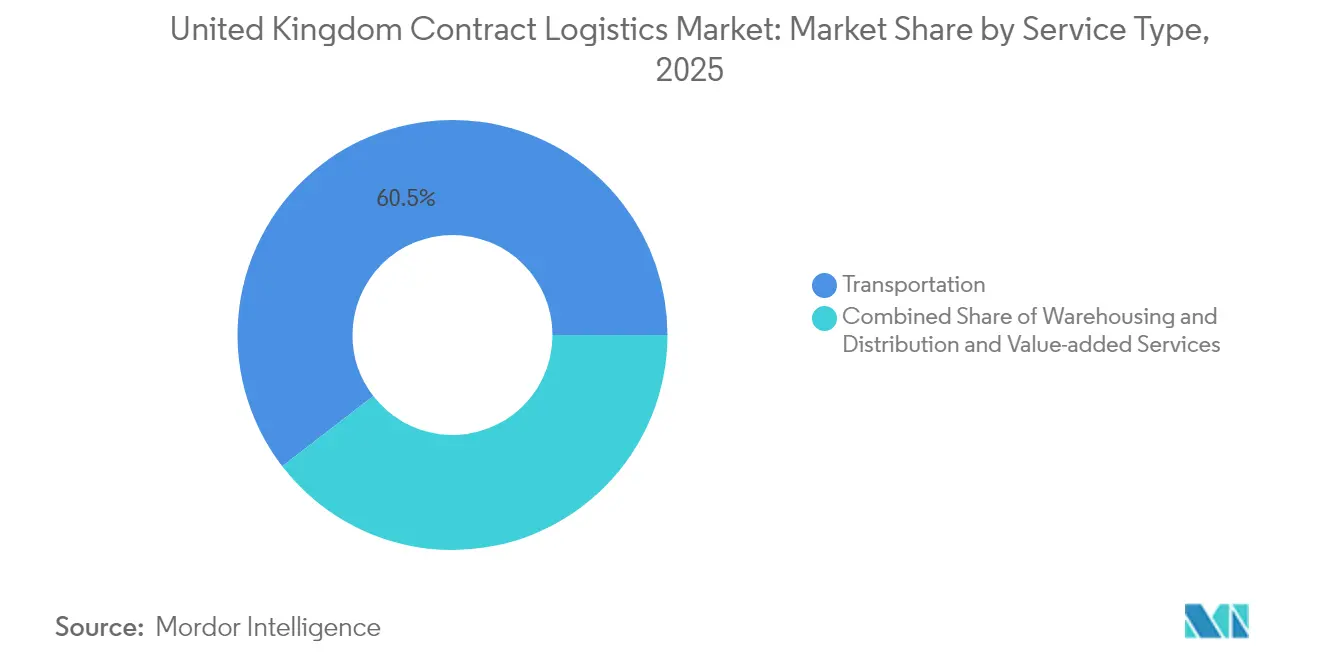
- By service type, transportation led with 60.45% of the United Kingdom contract logistics market share in 2025, while value-added services are advancing at a 3.28% CAGR through 2031.
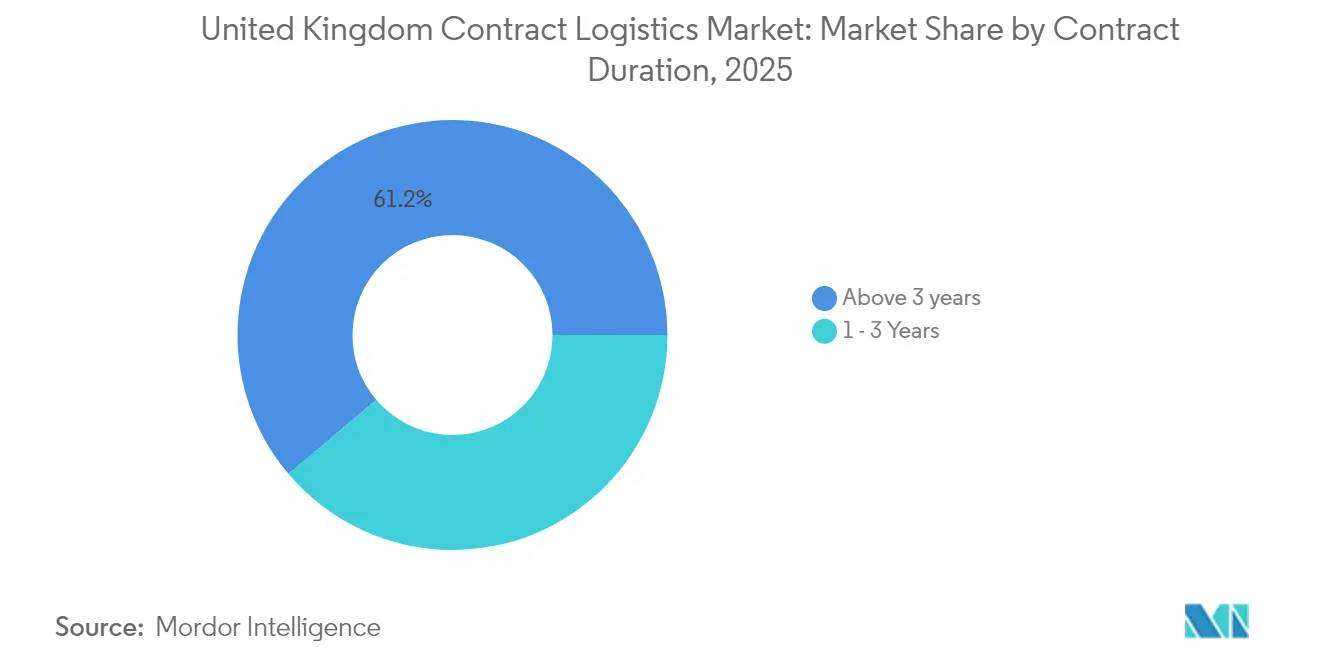
- By contract duration, agreements above three years commanded a 61.20% share of the United Kingdom contract logistics market size in 2025 and are projected to expand at a 3.82% CAGR between 2026 and 2031.
- By end-user industry, retail and e-commerce held 28.60% revenue share in 2025, whereas healthcare and pharmaceuticals are rising at a 4.15% CAGR to 2031.
- By region, England accounted for an 82.60% share of the United Kingdom contract logistics market size in 2025, while Scotland is set to grow at a 3.49% CAGR through 2031.
Note: Market size and forecast figures in this report are generated using Mordor Intelligence’s proprietary estimation framework, updated with the latest available data and insights as of 2026.
United Kingdom Contract Logistics Market Trends and Insights
Drivers Impact Analysis*
| Driver | (~) % Impact on CAGR Forecast | Geographic Relevance | Impact Timeline |
|---|---|---|---|
| E-commerce parcel surge | +0.8% | England urban centers | Short term (≤ 2 years) |
| Warehouse automation and digital twins | +0.6% | England and Scotland manufacturing hubs | Medium term (2-4 years) |
| End-to-end supply-chain visibility demand | +0.5% | National, Brexit-driven urgency | Short term (≤ 2 years) |
| Post-Brexit customs brokerage integration | +0.4% | England ports and Northern Ireland border | Medium term (2-4 years) |
| Retailer micro-fulfilment outsourcing | +0.3% | London, Manchester, Birmingham metros | Long term (≥ 4 years) |
| Cold-chain expansion for pharma and food | +0.3% | National pharmaceutical clusters | Medium term (2-4 years) |
| Source: Mordor Intelligence | |||


E-commerce Parcel Surge Accelerates Fulfilment Infrastructure Demand
Online retail volumes have pushed parcel networks to add urban microhubs and larger automated fulfillment centers. Amazon’s announced USD 50 billion UK investment through 2027 funds four new regional facilities that shorten last-mile distances. Pilot microhubs in London removed up to 12 diesel vans per day and cut 4,186 kg CO₂ in nine months, proving both commercial and environmental value. Localized fulfillment spending could top USD 5.5 billion by 2030 as grocery and fashion chains outsource the task to 3PL specialists. Faster cycle times are becoming a decisive service benchmark, prompting contract logistics providers to expand same-day capabilities. As parcel density grows, the United Kingdom contract logistics market responds by optimizing urban routes and investing in electric delivery fleets to meet city emission rules.
Warehouse Automation Integration Transforms Operational Efficiency
Robotics, AI, and digital twins are now central to warehouse design. Ocado’s Luton site illustrates the shift, with robotic arms already handling 15% of items and targeting 70% within a few years. Government AI grants averaging USD 38,315 per logistics firm underscore national priorities for automation. Digital-twin platforms allow continuous monitoring of space utilization and process flows, cutting commissioning time for new facilities. Robotics-as-a-Service subscriptions lower upfront capital outlays, bringing advanced automation within reach of mid-sized operators. Predictive analytics improves labor scheduling, a critical advantage amid driver and picker shortages. These investments reinforce the value proposition of long-term contracts and push the United Kingdom contract logistics market toward data-driven service models.
Post-Brexit Customs Brokerage Integration Elevates Service Complexity
The rollout of the New Computerised Transit System Phase 5 in January 2025 replaced legacy paper processes with digital transit documentation, yet fallback paper Transit Accompanying Documents remain in force during system outages. Hybrid clearance models employing AI and blockchain have shown productivity gains of up to 20% when benchmarked at Multimodal 2024[1]EORI UK, “Multimodal 2024 highlights,” eori.uk. HMRC has expanded its compliance workforce, increasing audit frequency and raising the bar for service providers. The EU Carbon Border Adjustment Mechanism adds a tariff calculation layer for goods with embedded emissions, making specialized customs support essential. Contract logistics firms that integrate brokerage with transport and warehousing streamline compliance costs and strengthen retention, supporting above-market growth in the United Kingdom contract logistics market.
Cold-Chain Infrastructure Expansion Supports Pharmaceutical Growth
Government commitments of USD 1.3 billion to life-sciences commercialization and USD 2 billion to NHS supply upgrades boost demand for temperature-controlled storage and distribution[2]MHA, “2024 outlook for life sciences and pharmaceuticals,” mha.co.uk. Cold storage rents are rising, prompting speculative warehouse construction in major ports and biotech clusters. Americold and regional peers employ AI forecasting models such as SARIMA and Facebook Prophet to match capacity with vaccine and biologic pipeline schedules. Collaborative multi-tenant facilities reduce transport miles and energy usage, aligning with retailer sustainability goals. Workforce shortages remain a risk, but automation of pallet handling and remote monitoring mitigates some staffing constraints. These trends feed a 4.3% CAGR in pharmaceutical logistics, lifting the United Kingdom contract logistics market beyond traditional retail dependency.
Restraints Impact Analysis*
| Restraint | (~) % Impact on CAGR Forecast | Geographic Relevance | Impact Timeline |
|---|---|---|---|
| Acute driver and warehouse labor shortages | -0.4% | National logistics corridors | Short term (≤ 2 years) |
| Ageing road and rail infrastructure capacity | -0.3% | England corridors and Scotland rail network | Long term (≥ 4 years) |
| Urban congestion-charge escalation | -0.2% | London, Manchester, Birmingham | Medium term (2-4 years) |
| Rising ESG compliance cost burden | -0.2% | Manufacturing-intensive regions | Long term (≥ 4 years) |
| Source: Mordor Intelligence | |||
Acute Driver and Warehouse Labor Shortages Constrain Operational Capacity
Heavy-goods-vehicle driver vacancies reached 19% in Q1 2024, driven by retirements and pay competition from other sectors. Brexit curtailed EU driver inflows while the pandemic prompted early retirements, cutting available skills just as parcel volumes surged. Grant Thornton notes additional headwinds, such as high fuel prices and inflation, that limit wage headroom[3]Grant Thornton, “Haulage sector faces significant headwinds,” grantthornton.co.uk. Logistics employs 8% of the national workforce, yet critical hands-on roles remain hard to fill despite apprenticeships and upskilling schemes. Automation eases some strain, but adoption takes time and capital. In the near term, limited labor availability caps throughput and increases operating costs in the United Kingdom contract logistics market.
Aging Infrastructure Capacity Limits Growth Potential
Royal Mail will end rail freight in October 2024, shifting 10,000 loads per year from rail to road and straining highway capacity. This decision conflicts with the Department for Transport's target of 75% rail freight growth by 2050. Scotland has earmarked USD 150 million for power upgrades on its rail network, but national road and rail maintenance backlogs remain large. Local authorities manage 40% of infrastructure funding, yet budget gaps and staffing shortages delay project delivery[4]Local Government Association, “Invest 2035,” local.gov.uk. Urban congestion charging adds complexity, raising last-mile costs for carriers in London and other major cities. Combined, these factors temper the growth rate of the United Kingdom contract logistics market over the long term.
*Our forecasts treat driver/restraint impacts as directional, not additive. The impact forecasts reflect baseline growth, mix effects, and variable interactions.
Segment Analysis
By Service Type: Transportation Dominance Faces Value-Added Upswing
Transportation services generated 60.45% of 2025 revenue, reflecting the enduring need for reliable multimodal links in the United Kingdom contract logistics market. Sea freight tonnage grew 4% to 60.7 million tons in 2024, boosted by deep-sea imports from China, while DP World’s USD 1.3 billion London Gateway expansion adds berth capacity and full-electric cranes. Road remains the backbone, yet urban emission rules and driver shortages push operators toward alternative fuels and route optimization platforms. Rail capacity suffers after Royal Mail’s withdrawal, adding pressure on highways and warehousing near ports.
Value-added services, though smaller, post a 3.28% CAGR as brands outsource packaging, kitting, and customization. GXO manages end-of-line assembly and cold-chain packing for grocery and e-commerce clients, illustrating how integrated solutions lighten shipper workloads. Robotics enables late-stage customization, meeting marketing needs without slowing throughput. As ESG reporting grows stricter, providers bundle packaging redesign with waste reduction analytics, offering differentiated value. This momentum positions value-added operations to capture incremental share in the United Kingdom contract logistics market over the forecast horizon.


By Contract Duration: Long-Term Partnerships Dominate Strategic Relationships
Contracts longer than three years held 61.20% of the United Kingdom contract logistics market share in 2025, affirming customer preference for stability in a volatile regulatory climate. Shippers seek partners capable of funding automation, customs technology, and ESG upgrades that require multi-year amortization. Recent mega-deals include Amazon’s USD 50 billion multi-year investment across four UK fulfillment centers, locking in contract volumes for chosen 3PLs.
Shorter contracts of one to three years maintain relevance for tactical projects but expand more slowly. Acquisition activity, such as GXO’s purchase of Wincanton, demonstrates how incumbents value embedded long-term contracts. With border processes still evolving, firms commit to extended deals to secure in-house expertise and avoid switching costs. Consequently, long-term arrangements underpin revenue visibility across the United Kingdom contract logistics market.
By End-User Industry: Retail Leadership Meets Healthcare Acceleration
Retail and e-commerce generated 28.60% of 2025 revenue thanks to high parcel volumes and fast replenishment cycles. Amazon, B&M, and DHL each announced significant distribution center investments, cementing retail’s primacy. Same-day delivery expectations spur micro-fulfilment build-outs near London and Manchester, increasing demand for inventory pooling and last-mile orchestration services.
Healthcare and pharmaceuticals register the fastest 4.15% CAGR, reflecting USD 2 billion NHS supply upgrades and robust life-sciences R&D funding. Advanced therapies require ultra-low-temperature handling, pressing 3PLs to expand validated cold-chain corridors. CEVA’s global finished-vehicle logistics pivot illustrates capability transfer from automotive to tightly controlled healthcare shipments. The growth of high-value, temperature-sensitive cargo offers margin upside and dilutes concentration risk for the United Kingdom contract logistics market.
Geography Analysis
England anchors the United Kingdom contract logistics market with an 82.60% revenue share in 2025, supported by the Golden Triangle’s central location and dense motorway web. DP World’s 598,000 sq ft Coventry warehouse automates pallet retrieval, while London Gateway’s new berth enhances deep-sea throughput. London pilots low-emission microhubs that completed 128,000 deliveries in nine months, validating sustainable urban models. Amazon’s forthcoming Hull and East Midlands sites widen regional employment and service coverage, reinforcing England’s primacy.
Scotland posts a 3.49% CAGR through 2031, the fastest among home nations, as the USD 150 million rail electrification program improves connectivity for renewable energy component shipping. Port upgrades support offshore wind turbine logistics, while Glasgow and Aberdeen labs drive pharmaceutical and biotech traffic. The confluence of green energy projects and manufacturing diversification boosts contract values and fuels infrastructure timber demand across distribution estates.
Regulatory Landscape
The United Kingdom contract logistics regulatory environment is shaped by border modernization, customs compliance, and infrastructure planning, with HMRC and the Department for Transport (DfT) central to implementation. Post-Brexit transit digitization progressed with the New Computerised Transit System (NCTS) Phase 5 rollout in January 2025, which raises the importance of integrated customs brokerage, data quality, and contingency procedures during outages, including continued use of paper Transit Accompanying Documents in fallback scenarios. The government also signaled further border-friction reduction initiatives, including work toward an SPS agreement with the EU targeted for mid-2027, which affects documentation and handling requirements for agri-food and controlled product flows.
In road freight and port development, recent statutory and policy actions are relevant to contracting and network decisions. The Heavy Goods Vehicles (Charging for the Use of Certain Infrastructure on the Trans-European Road Network) (Revocation and Consequential Amendments) Regulations 2026 came into force on 2 April 2026, updating the framework that international operators must navigate. For ports and deep-sea linked logistics, a new National Policy Statement for Ports was laid in Parliament on 2 July 2026, influencing consenting and investment pathways that support capacity additions at major gateways. Separately, the government consultation on reforming the customs treatment of low value imports proposes removal of Low Value Import relief and new duty payment and data requirements for consignments under GBP 135 by March 2029, increasing compliance and systems integration needs for e-commerce focused contract logistics models.
Value Chain Analysis
The United Kingdom contract logistics value chain runs from inbound gateways (deep-sea ports, airports, and Channel crossings) to inland multimodal nodes, warehousing and distribution estates, and last-mile networks serving retail and industrial customers. Shippers contract 3PLs for transport management and warehousing, while value-added services such as kitting, labeling, postponement, and returns handling increasingly sit inside regional distribution centers to compress lead times and manage SKU proliferation. Midstream operations depend on logistics real estate, automation and WMS vendors, and labor and subcontracted carrier capacity, with resilience supported by multi-user facilities that pool capacity across end markets.
Network design and cross-border execution rely on public-sector enablers and rail and port operators alongside private 3PLs. DfT governance mechanisms, including the Freight Council and a dedicated directorate for logistics and borders, coordinate policy across departments and underpin the Future of Freight agenda, shaping corridors, standards adoption, and border processes. On the infrastructure side, Network Rail-backed investment to redevelop Barking Eurohub into an international intermodal facility strengthens the rail-linked leg of the chain and provides an alternative routing option for international flows into London and the South East. Competitive dynamics also reflect platform-led service expansion, such as Amazon launching Amazon Supply Chain Services (storage, fulfillment, and transportation access for businesses), and capability alliances, such as GXO forming the Torus Defence Supply Chain alliance with Amentum, Accenture, and A.P. Moller - Maersk, which tightens integration across planning, warehousing, and distribution for specialized verticals.
Competitive Landscape
The United Kingdom contract logistics market shows moderate concentration as global integrators consolidate local expertise. GXO’s USD 957 million acquisition of Wincanton expands sector coverage. DSV’s EUR 14.3 billion (USD 14.9 billion) purchase of Schenker creates a network spanning more than 90 countries. The CMA’s probe into a DHL-Evri parcel merger signals heightened regulatory vigilance over market dominance.
Strategic priorities center on automation, digital visibility, and specialized vertical solutions. CEVA repurposed its automotive competence to establish a finished-vehicle logistics division moving 4 million vehicles annually, illustrating vertical integration. ID Logistics’ entry via a Northampton facility demonstrates foreign appetite for UK consumer goods contracts.
Sustainability drives another layer of competition, with Hellmann adding a dedicated global sustainability division and DHL introducing low-carbon route planning tools. Emerging mid-tier disruptors harness robotics, micro-fulfilment, and data analytics to win urban retail contracts, challenging incumbents to remain agile. Taken together, these moves signal an environment of intensifying rivalry, service innovation, and ongoing consolidation in the United Kingdom contract logistics market.
United Kingdom Contract Logistics Industry Leaders
DHL Supply Chain
XPO Logistics
UPS SCS
GXO Logistics
CEVA Logistics
- *Disclaimer: Major Players sorted in no particular order

Market Opportunities and Future Outlook
Multimodal capacity and rail-connected distribution corridors remain a visible whitespace where contract logistics providers can productize integrated offerings spanning port drayage, inland rail, and large-format warehousing. In 2026, several anchors reinforced this. Maritime Transport opened the SRFI at Segro Logistics Park Northampton supported by over GBP 80 million in rail infrastructure, and Network Rail commenced a GBP 15 million redevelopment of Barking Eurohub to create an international intermodal freight facility under a multi-year program. These projects create practical entry points for 3PLs to bundle rail-enabled linehaul with warehousing and value-added services, particularly for customers looking for alternatives to congested road-only trunking.
Border digitization and data-led compliance create another opportunity area, especially for providers that embed customs and trade data workflows into transport and warehouse execution. Government workstreams highlighted by DfT forums and industrial strategy initiatives place emphasis on supply chain resilience and trade facilitation, including digital border transformation concepts such as a Single Trade Window to reduce duplicated submissions. At the operational layer, ports and logistics sites are scaling technology that 3PLs can extend into contracted solutions. In July 2026, the Port of Felixstowe expanded its electric autonomous truck fleet to 100 units supported by a private 5G network, signaling a pathway for higher-throughput, lower-emission terminal-to-yard moves. In parallel, Amazon Supply Chain Services broadens buyer awareness of end-to-end managed logistics, increasing demand for comparable integrated propositions from traditional contract logistics providers across storage, fulfillment, and transportation.
Recent Industry Developments
- June 2026: DHL Supply Chain announced plans to develop a 194,000 sq ft automated healthcare hub at Infinity Park Derby to serve life sciences shippers, including pharmaceuticals and medical devices. The facility-led move supports DHL's position in regulated, temperature-sensitive and high-service logistics, aligning with growing healthcare and pharmaceutical outsourcing in the United Kingdom.
- May 2025: FedEx announced two new UK hubs near Kingsbury and Marston Gate, consolidating five road hubs into technology-enabled facilities. The network redesign supports higher throughput and service reliability, and it raises the competitive bar for time-definite transport and hub-and-spoke sorting that contract logistics providers often integrate with warehousing and final-mile operations.
- April 2024: GXO closed its acquisition of Wincanton for USD 957 million, adding scale and sector capabilities across aerospace, utilities, and healthcare in the United Kingdom. The combination expanded GXO's domestic footprint and strengthened its ability to bid for longer-duration, multi-service contracts that require investment in automation and specialized compliance processes.


Research Methodology Framework and Report Scope
Market Definition and Coverage
This market is defined as revenues earned in the United Kingdom from outsourced contract logistics services delivered under a contract, typically covering warehousing, distribution, transportation management, and value-added logistics activities for business customers.
Scope exclusions: Pure in-house logistics cost accounting, parcel-only courier revenue not tied to a contract logistics scope, and non-UK delivered services are excluded from this sizing.
Segmentation Overview
- By Service Type
- Transportation
- Road
- Rail
- Air
- Sea
- Warehousing & Distribution
- Value-added Services (Assembly, Labelling, Kitting)
- Transportation
- By Contract Duration
- 1 – 3 Years
- Above 3 years
- By End-user Industry
- Manufacturing & Automotive
- Food & Beverage
- Retail & E-commerce
- Healthcare & Pharmaceuticals
- Chemicals
- Other Industries
- By Region
- England
- Scotland
- Wales
- Northern Ireland
Data Sources, Market Sizing, and Validation
Desk Research
Desk work starts with mapping the UK logistics operating environment so the model is grounded in real activity. We refer to public sources such as the UK Office for National Statistics, the Department for Transport, HM Revenue and Customs trade statistics, the Bank of England macro series, and sector publications from bodies such as Logistics UK.
The desk layer is then used to set boundaries and sanity checks using company annual reports and investor presentations, reputable press coverage on warehouse capacity and take-up, and relevant academic or peer-reviewed logistics studies for productivity and cost-to-serve context. Paid subscriptions for company financials and news intelligence are used selectively to standardize reported revenue time series, and to flag material contract wins or network changes. The sources listed here are illustrative, and other public references were reviewed to collect, validate, and clarify inputs.
Primary Interviews and Surveys
Primary work is used to pressure-test what desk sources cannot show clearly, like the share of outsourced spend, typical contract structures, and how pricing moves with labor, energy, and space constraints. Interviews cover logistics providers, shippers that outsource operations, and operational experts who manage warehousing, transport planning, and value-added activities across the United Kingdom.
Distribution of primary research fieldwork respondents
| Company type | Respondent position |
|---|---|
| Top tier: 28% | CXOs: 20% |
| Mid tier: 52% | Functional/Unit leaders: 32% |
| Smaller Players: 20% | Managers: 48% |
Market-Sizing & Forecasting
Sizing is built using a top-down approach where UK logistics output and outsourced penetration are reconstructed into a contract logistics revenue pool, and then split using service mix cues from interviews. To keep totals from drifting, we corroborate the result with selective bottom-up checks, such as sampled provider revenue mapping to the UK, and volume times price approximations for warehousing and transport-related activities.
Key model inputs include warehousing space dynamics (availability and take-up direction), labor cost movement, road freight and distribution activity indicators, e-commerce fulfillment intensity, and the typical share of value-added services bundled into contracts. For forecasting, scenario analysis is used around the most sensitive drivers, and then the final path is smoothed using trend-based techniques when short-term volatility is visible. Where bottom-up evidence is incomplete for smaller operators, gaps are handled through conservative share assumptions that are validated in follow-up calls and kept consistent with public industry totals.
Data Validation & Update Cycle
Outputs are checked through multiple passes so the numbers remain consistent with real-world signals. We compare the modeled totals against independent metrics like logistics activity trends, warehouse market movement, and reported performance commentary from providers, and then investigate any sharp variance before sign-off.
If a step change is detected, such as a major capacity shift, regulatory change affecting cross-border flows, or a notable pricing reset, the assumptions are re-reviewed and experts are re-contacted to confirm the direction. The report is refreshed annually, and interim updates are made when material events impact the market. Before delivery, a final analyst review is completed so clients receive the latest updated view.
Mordor Intelligence's United Kingdom Contract Logistics Market Size Versus Other Published Estimates
Published market sizes for UK contract logistics can differ because scope boundaries are not always aligned, and because pricing and outsourcing rates are treated differently across models. It also depends on whether the estimate is built from a shorter outlook with aggressive demand recovery, or from a steadier view that stays close to observable operating conditions.
Key gap drivers in this market usually come from what is counted as contract logistics, especially when broader 3PL services or parcel-led revenue streams get pulled into the same pool. Another driver is how warehousing price progression is handled during tight capacity periods, and whether labor cost pressure is passed through within the same year. Currency timing and the refresh cadence also matter, since UK logistics can move with inflation, energy, and network disruptions that shift near-term revenue quickly.
Benchmark comparison
| Source | Market Size | Gaps in Research Methodology |
|---|---|---|
| Mordor Intelligence | USD 21.16 B (2025) | |
| Global Consultancy A | USD 22.36 B (2024) | Uses a 2024 base and a shorter forecast horizon, and its revenue pool can be lifted by faster price escalation assumptions across transport and aftermarket services that may not be validated against UK capacity and labor constraints in the same way. |
| Industry Publisher B | USD 101.24 B (2025) | Applies a much broader definition that can bundle wider outsourced logistics and supply chain management activities beyond typical contract logistics revenue, which expands the counted service set and inflates the total market value. |
Warehouse capacity tightness, labor cost direction, and contract mix checks are the evidence that anchor the 2025 revenue pool in Mordor Intelligence's estimate, which keeps the number focused on contracted logistics delivery rather than wider outsourced supply chain spend. Once scope and price pass-through treatment are aligned, the spread across publishers becomes easier to explain, and the remaining differences are mostly about base-year choice and update timing.


Key Questions Answered in the Report
What is the current value of the United Kingdom contract logistics market?
The market is valued at USD 21.83 billion in 2026 and is on track to reach USD 25.51 billion by 2031.
Which service type contributes most to revenue?
Transportation services deliver 60.45% of sector revenue owing to sustained demand for multimodal goods movement.
Which segment is growing fastest?
Healthcare and pharmaceuticals are expanding at a 4.15% CAGR because of rising cold-chain and life-sciences investment.
Why are longer contract durations gaining popularity?
Shippers prefer multiyear agreements to secure customs expertise, automation investment, and ESG compliance support.
How is Brexit influencing the sector?
New customs rules have increased brokerage demand and pushed providers to integrate real-time visibility and compliance tools.
What infrastructure developments matter most for growth?
DP World’s London Gateway expansion, new Amazon fulfillment centers, and Scottish rail electrification collectively enhance national capacity.
Page last updated on:


 Your data is secure and never sold or shared.


