
Market Overview
| Study Period | 2019 - 2031 |
|---|---|
| Forecast Data Period | 2026 - 2031 |
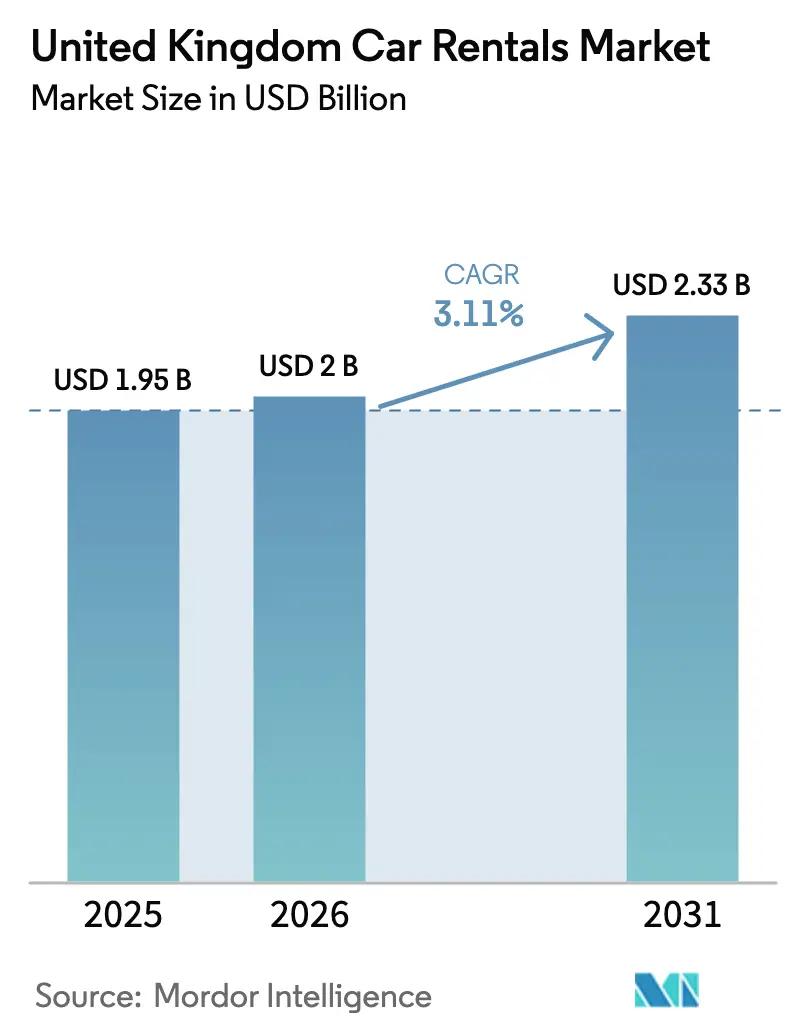
| Base Year Market Size (2025) | USD 1.95 Billion |
| Market Size (2026) | USD 2 Billion |
| Market Size (2031) | USD 2.33 Billion |
| Growth Rate (2026 - 2031) | 3.11 % |
| Market Concentration | Medium |
Major Players *Disclaimer: Major Players sorted in no particular order Image © Mordor Intelligence. Reuse requires attribution under CC BY 4.0. | |
United Kingdom Car Rentals Market Analysis by Mordor Intelligence
The United Kingdom car rental market size is expected to grow from USD 1.95 billion in 2025 to USD 2 billion in 2026 and is forecast to reach USD 2.33 billion by 2031 at a 3.11% CAGR over 2026–2031. Fleet electrification mandates, widening digital adoption, and shifting corporate travel patterns are reshaping growth dynamics without altering the modest headline expansion. Operators are balancing elevated vehicle-acquisition costs against residual-value uncertainty, while mobile-first booking is compressing lead times and forcing heavier investment in yield-management technology. The closure of Zipcar’s local operations in December 2025 removed a high-fixed-cost competitor yet underscored that cost-of-living pressures and expanding congestion zones continue to test capital-intensive models. Growth pockets remain in long-term subscription programs, premium vehicle rentals linked to international arrivals, and business travel demand buoyed by rail strike disruption.
Key Report Takeaways
- By rental duration, short-term rentals held 73.30% revenue share in 2025; long-term and subscription models are projected to expand at a 12.67% CAGR through 2031.
- By booking type, online channels led with a 67.50% revenue share in 2025 and are projected to advance at a 10.81% CAGR through 2031.
- By application, leisure and tourism accounted for a 55.70% revenue share in 2025, while business rentals are projected to grow at a 9.63% CAGR through 2031.
- By vehicle class, economy cars dominated with a 58.90% revenue share in 2025; premium and luxury vehicles are expected to expand at an 11.86% CAGR through 2031.
- By propulsion type, internal-combustion engines represented 81.10% revenue share in 2025, whereas battery-electric vehicles are surging at a 26.60% CAGR through 2031.
- By end-user, individuals generated a 69.30% revenue share in 2025 and are projected to progress at a 10.80% CAGR through 2031.
- By booking channel, off-airport and downtown locations held a 53.50% revenue share in 2025 and are projected to rise at an 11.60% CAGR through 2031.
- By geography, England captured 74.80% revenue share in 2025 and is forecast to grow at an 8.90% CAGR to 2031.
Note: Market size and forecast figures in this report are generated using Mordor Intelligence’s proprietary estimation framework, updated with the latest available data and insights as of January 2026.
Market Trends and Insights
Drivers Impact Analysis of United Kingdom Car Rentals Market*
| Driver | (~) % Impact on CAGR Forecast | Geographic Relevance | Impact Timeline |
|---|---|---|---|
| Digital-First Booking Boom | +0.8% | England (London, Southeast), Scotland (Edinburgh, Glasgow) | Short term (≤ 2 years) |
| EV Incentives and Fleet Mandates | +0.7% | National | Long term (≥ 4 years) |
| Post-Pandemic Leisure Surge | +0.6% | England (coastal regions), Wales, Scotland (Highlands) | Medium term (2-4 years) |
| Duty-of-Care Drives Rentals | +0.5% | England (London, Birmingham, Manchester), Scotland (Edinburgh) | Medium term (2-4 years) |
| Growth of Flex-Rent Models | +0.4% | England (urban centers), Scotland (Glasgow) | Medium term (2-4 years) |
| OEM-Backed Captive Programs | +0.3% | National | Short term (≤ 2 years) |
| Source: Mordor Intelligence | |||
Digital-first Consumer Journey and Mobile Booking Boom
Mobile app downloads for travel services experienced growth, even as website traffic declined. This trend encouraged rental operators to prioritize investments in native apps to sustain their visibility. Online platforms hold a significant share of the UK's car rental market and continue to grow steadily. However, their influence extends beyond just facilitating transactions. Same-day reservations have become increasingly popular, reducing the average booking lead time and emphasizing the importance of real-time fleet allocation tools. Locations situated off-airport and in downtown areas benefit from this shift, as location-based searches now favor proximity over brand loyalty. Independent operators are capitalizing on walk-in demand, while global chains are focusing on algorithm-driven pricing strategies that resemble those used by airlines in yield management practices[1]. This strategic shift is driving higher IT expenditures while simultaneously increasing revenue per available car through improved utilization.
EV-Friendly Government Incentives and Zero-Emission Fleet Mandates
The Zero Emission Vehicle mandate aims to significantly increase the adoption of battery-electric vehicles in new car sales over the coming years. Battery-electric vehicles, while currently a small portion of rental fleets, are experiencing the fastest growth within the United Kingdom's car rental market. Public charging infrastructure has seen substantial expansion, including the addition of rapid charging units to support the growing demand. However, challenges persist, as many operators identify charging availability and customer unfamiliarity with the technology as key obstacles to broader adoption. Collaborations with original equipment manufacturers are helping to address these issues. For example, a partnership between SIXT and Stellantis ensures a consistent supply of battery-electric models equipped with advanced telematics, while also sharing the costs associated with charging infrastructure throughout the rental lifecycle. Additionally, the government's commitment to transitioning all departmental fleets to zero-emission vehicles demonstrates a stable policy environment, which helps reduce uncertainties for private-sector stakeholders.
Post-Pandemic Domestic Leisure Travel Surge
Domestic staycations in the UK have been a significant contributor to the tourism industry, generating substantial revenue. Although the number of trips has not yet returned to pre-pandemic levels, the spending per trip has shown an increase. Leisure travelers hold a dominant share of the car rental market in the United Kingdom, driven by the popularity of self-catering holidays in destinations such as Cornwall, the Lake District, and the Scottish Highlands. These locations have fueled the demand for multi-day car rentals. Scotland has emerged as a key destination for overnight visitors, with a notable portion of tourism revenue linked to self-drive itineraries along scenic routes like the North Coast 500. Car rental operators face challenges in managing fleet deployment to rural areas, which often ties up capital during periods of low demand. However, seasonal shortages in vehicle availability can lead travelers to explore peer-to-peer car rental platforms. To optimize revenue during peak travel periods, operators are increasingly adopting flexible fleet-rotation strategies and implementing dynamic pricing models.
Growth of Subscription-Based Flex-Rent Models
Long-term and subscription products are experiencing significant growth, far outpacing the overall market expansion. Consumers are increasingly shifting away from ownership due to challenges such as limited new-car availability and unpredictable used-car pricing. Instead, they are opting for flexible month-to-month access. Services like SIXT+ in London and Enterprise Travel Direct provide comprehensive offerings that include insurance, maintenance, and mileage within a single payment structure. Additionally, OEM captive programs are leveraging excess production by channeling it into these subscription models, which offer favorable financing terms. While this approach helps distribute inventory risk, it also exposes operators to potential fluctuations in residual values, particularly if manufacturers withdraw their support. Subscription customers typically demonstrate greater loyalty and higher lifetime value, thereby improving revenue stability for providers that can effectively manage the associated capital demands.
Restraints Impact Analysis of United Kingdom Car Rentals Market*
| Restraint | (~) % Impact on CAGR Forecast | Geographic Relevance | Impact Timeline |
|---|---|---|---|
| New-Car Supply Crunch | −0.5% | National | Short term (≤ 2 years) |
| Used-Car Price Swings | −0.4% | National | Medium term (2-4 years) |
| Patchy EV Charging | −0.3% | Rural England, Wales, Highlands, Northern Ireland | Medium term (2-4 years) |
| Strict VAT Rules | −0.2% | Northern Ireland, border regions | Short term (≤ 2 years) |
| Source: Mordor Intelligence | |||
Tight New-car Supply Inflating Fleet Costs
New-car registrations in the United Kingdom have shown steady growth, with expectations of further increases in the near future [2]. Fleet and business volumes have experienced a notable increase, contributing to a tighter market supply. Although semiconductor shortages have improved, they continue to cause delays in delivery times, prompting rental companies to incur additional costs for securing allocations. Premium vehicle models are more readily available compared to high-volume economy cars, which benefits operators focused on airport locations. However, independent operators, who depend on low-margin turnover, face challenges due to this disparity. As vehicle fleets age, maintenance expenses increase, and customer satisfaction declines, which limits the ability to adjust pricing effectively.
Used-Car Price Volatility Depressing Residual Values
Average used-car prices have declined from their peak levels during the pandemic. However, the market continues to experience volatility due to increased auction volumes, primarily driven by the disposal of rental fleets. Battery-electric models experience significant depreciation in their initial year of use. This trend is attributed to rapid advancements in technology and ongoing concerns about driving range, which reduce demand in the second-hand market. Consequently, operators are cautious about accelerating the transition to electrification. They must balance the need to comply with regulatory mandates against the potential for reduced profit margins. Mid-sized firms, lacking access to advanced hedging mechanisms, remain particularly vulnerable to price fluctuations that could significantly impact their profitability.
*Our forecasts treat driver/restraint impacts as directional, not additive. The impact forecasts reflect baseline growth, mix effects, and variable interactions.
United Kingdom Car Rentals Market Segment Analysis
By Rental Duration – Subscriptions Gain Traction
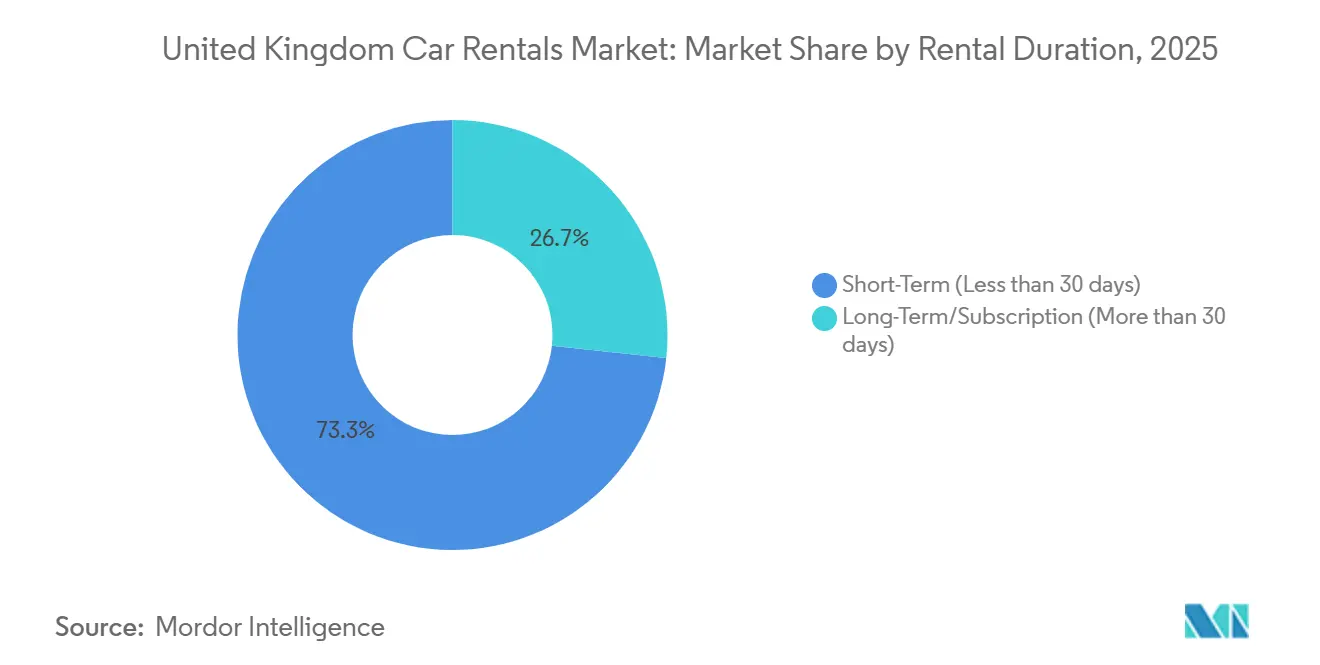
Short-term hires dominated revenue, accounting for 73.30% in 2025, yet face slowing growth as cost-conscious travelers reduce discretionary trips. Long-term and subscription rentals, growing at a 12.67% CAGR, appeal to drivers who are delaying ownership while enjoying bundled insurance and maintenance. The United Kingdom car rental market size for subscriptions is projected to rise sharply from a modest base, driven by OEM financing that reduces operator capital expenditures. Subscription fleets feature newer cars with advanced driver-assistance systems that justify premium fees and enhance safety and compliance metrics for corporates. Operators split their asset pools accordingly, cycling high-mileage economy units through short-term channels and reserving late-model inventory for subscription customers to maximize residual values. Heightened capital intensity is offset by predictable monthly revenue and lower churn rates.
The preference shift reflects trends in structural mobility. Younger urban residents increasingly value on-demand access over ownership, and corporates use subscriptions to cover project-based assignments without expanding company fleets. The United Kingdom car rental market, therefore, benefits from dual demand drivers that mitigate volatility for operators. Providers continue to refine pricing algorithms to account for mileage variability and optional services, improving margin visibility across the subscription term. As OEMs expand direct-to-consumer pilots, rental companies leverage brand recognition and nationwide service footprints to maintain a competitive edge.

By Booking Type – Mobile Apps Reshape Channel Economics
Online reservations accounted for 67.50% of 2025 revenue and are advancing at a 10.81% CAGR, outpacing offline channels as consumers prioritize convenience and price comparison. Mobile apps capture the largest share of digital growth, driven by a 6.3% year-over-year increase in downloads. Same-day bookings compress fleet-planning windows, prompting deeper investment in real-time inventory management. The United Kingdom car rental market share captured by offline methods continues to decline, yet remains significant, particularly at airports and for corporate itineraries that require bespoke billing arrangements.
Aggregators help smaller firms gain exposure but erode pricing control, whereas global chains funnel loyalty members into proprietary apps to limit comparison shopping. Off-airport sites, backed by lower real estate costs, channel savings into dynamic price discounts that attract cost-sensitive leisure travelers. The United Kingdom car rental market size allocated to online channels is projected to exceed USD 1.50 billion by 2030, magnifying the strategic value of digital capabilities. Operators experiment with AI chatbots for guided reservations, though uptake lags visual interfaces where customers compare vehicle classes.
By Application – Business Rentals Outpace Leisure Growth
Leisure retained 55.70% revenue share in 2025, fueled by domestic tourism and international inbound traffic. However, business rentals are growing faster at a 9.63% CAGR, driven by duty-of-care compliance and rail network disruption. Employers view professionally managed fleets as essential for tracking mileage, emissions, and driver behavior. Rentals become cost-effective beyond 100 miles, a standard threshold for inter-city trips between London, Manchester, and Birmingham. Rail strikes reinforce this preference, reallocating travelers to road-based modes.
Leisure demand remains seasonally influential, peaking during July–August holiday periods. Cornwall, Snowdonia, and the Highlands attract staycationers who prefer multi-day hires, creating vehicle allocation challenges for operators. The United Kingdom car rental market benefits from diversified demand streams that mitigate cyclical risk. Customer segmentation enables tailored marketing: digital campaigns target leisure users with early-booking discounts, while account managers service corporate travel departments that schedule block reservations months in advance.
By Vehicle Class – Premium Segment Capitalizes on Airport Traffic
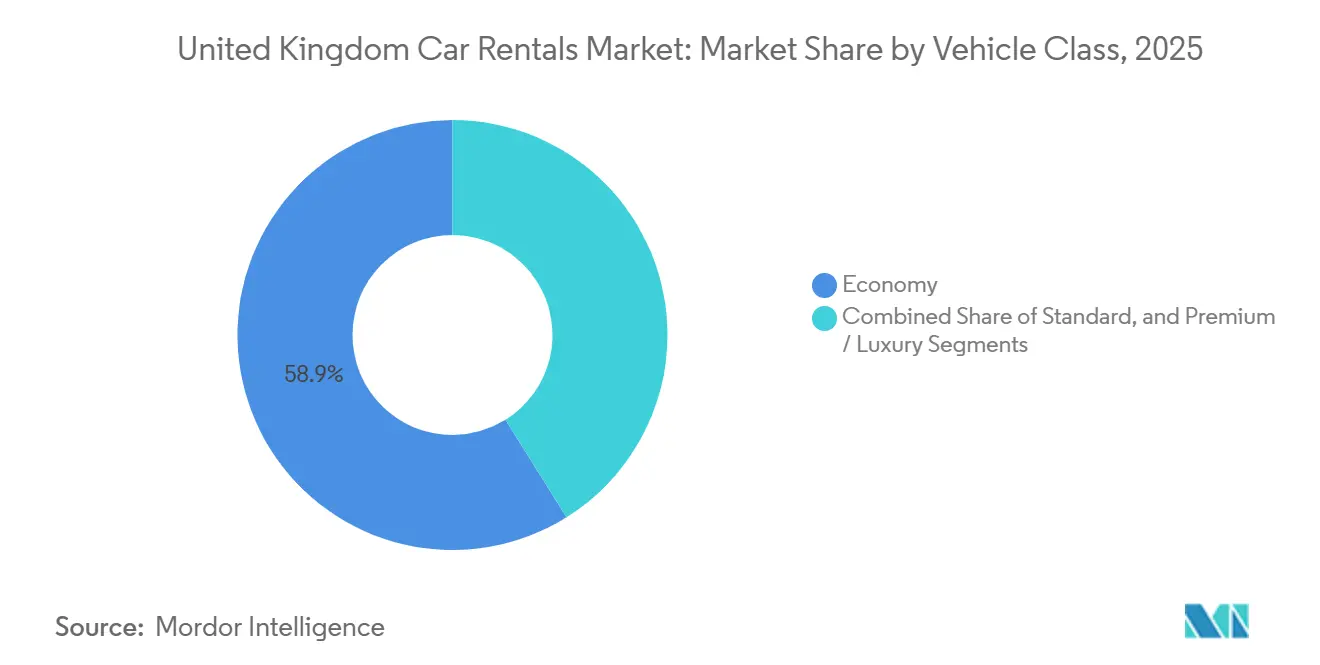
Economy cars dominated the market with a 58.90% share in 2025, catering to budget-minded travelers. Premium and luxury fleets, however, are growing at an 11.86% CAGR, driven by international arrivals at Heathrow, Gatwick, and Manchester airports, which collectively processed over 150 million passengers in 2024. Operators shift fleet mix toward higher-margin vehicles at major terminals, capitalizing on the willingness to pay among inbound tourists and executive travelers. Standard-class cars provide a middle ground, yet they face a margin squeeze between nimble economy rivals and aspirational premium offerings.
Airport infrastructure investments support this trend. Terminal upgrades at Manchester and Heathrow introduce dedicated rental facilities, accelerating pickup times and reinforcing premium customer expectations. The United Kingdom car rental market size for premium vehicles is forecast to nearly double by 2030, driven by OEM partnerships that supply high-spec models under favorable financing terms. Providers must balance inventory rotation to avoid residual-value shocks yet sustain availability for high-yield bookings.
By Propulsion Type – EV Mandate Drives Fastest Growth
Internal-combustion engines remained 81.10% of the 2025 fleet mix but are ceding ground to battery electrics, which are scaling at 26.60% CAGR. The United Kingdom car rental market faces the dual challenge of meeting the 2025 zero-emission quota while managing 20-30% first-year depreciation on EVs. Hybrid models bridge the transition, offering lower emissions without charging downtime. Infrastructure concentration in urban zones constrains the adoption of long-distance leisure, yet the rapid roll-out of chargers and government fleet commitments bolster long-term confidence.
OEM alliances help defray capital costs. SIXT’s Stellantis agreement incorporates telemetry that optimizes charging schedules and reduces downtime, enhancing utilization. Hertz’s earlier U.S. sell-down of EVs serves as a cautionary tale about repair costs and customer education. Operators in the United Kingdom car rental market deploy pilot programs to refine pricing, mileage caps, and charging-fee structures, building operational expertise ahead of stricter quotas.
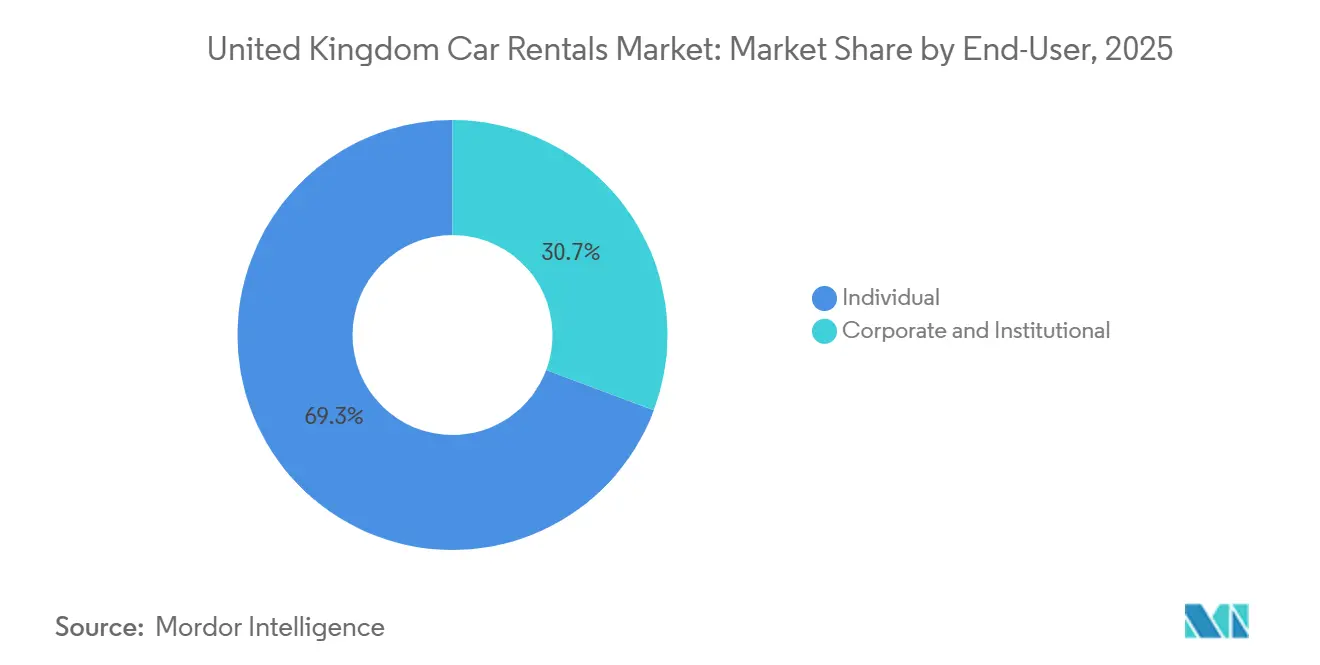
By End-User – Individual Segment Dominates and Accelerates
Individuals generated a 69.30% revenue share in 2025 and are progressing at a 10.80% CAGR, driven by staycations, city breaks, and subscription uptake. Corporations grow more modestly yet deliver steady cash flow and upsell potential through telematics and reporting bundles. Individual renters exhibit higher price sensitivity and book heavily via apps, encouraging promotional pricing and loyalty-point incentives. Corporations negotiate volume discounts and favor central billing, allowing operators to forecast utilization more accurately.
The United Kingdom car rental market benefits from this dual-engine demand model. Operators tailor marketing spend: performance ads target consumers, whereas relationship managers engage travel-procurement teams. As duty-of-care rules tighten, corporates may shift additional volume to managed fleets, marginally reducing individual share yet stabilizing revenue diversity.
By Booking Channel – Off-Airport Gains Share
Off-airport locations held a 53.50% share in 2025 and are projected to rise at an 11.60% CAGR, aligning with the growth of domestic tourism and app-based proximity search. Airport counters remain pivotal for international visitors but face slowing growth relative to broader market expansion. Rental hubs near rail stations and city centers attract travelers continuing journeys after inter-city trains, especially during strike-affected periods. Lower facility costs permit off-airport operators to undercut terminal pricing, widening their appeal.
Operators reposition older vehicles to off-airport fleets while reserving late-model, premium cars for terminals, optimizing yield across channels. The United Kingdom car rental market share for airport channels is resilient but increasingly dependent on premium-focused segmentation. Continuous investment in shuttle-bus efficiency and digital check-in helps mitigate customer wait-time concerns that have historically disadvantaged off-site pickups.
Geography Analysis
England generated 74.80% of market value in 2025 and is set to grow at an 8.90% CAGR through 2031. London's status as a financial-services hub, coupled with its multiple international gateways and a dense motorway network, fuels a consistent demand for transportation services. Business travel spending in England constitutes a significant portion of the national total and drives weekday utilization. While coastal tourism in Cornwall and the South Coast boosts revenues during the summer months, the impending expansion of the congestion charge is pushing operators to hasten the deployment of low-emission fleets.
Scotland, Wales, and Northern Ireland collectively contribute a notable share to the market. Scotland takes the lead, thanks to the allure of self-drive tourism along the North Coast 500 and the burgeoning activity at Edinburgh and Glasgow airports. International visitors make a significant contribution to Scotland's tourism revenue. While Wales attracts tourists to Snowdonia and Pembrokeshire, its smaller population density limits overall revenue. Northern Ireland grapples with the challenge of VAT compliance on cross-border hires, prompting some providers to withdraw from those routes.
Fleet planning across the regions is a complex task. Operators need to schedule vehicles months ahead of peak seasons in the Highlands and coastal areas, all while ensuring acceptable utilization during the shoulder seasons. Disparities in public charging infrastructure hinder the rollout of electric vehicles in rural locales, allowing internal combustion cars to remain prevalent outside major urban centers. As a result, the UK car rental market showcases distinct geographic segmentation, both in terms of vehicle propulsion types and fleet allocation strategies.
Regulatory Landscape
The UK car rental industry operates under consumer protection and fair-trading enforcement that affects pricing and sales practices across both direct operators and intermediaries. Competition and Markets Authority (CMA) expectations for transparent, prominent pricing (including compulsory charges) shape how online channels show headline rates and optional add-ons, particularly as mobile-first bookings reduce decision windows.
Security and data compliance also feed into day-to-day operations. The Department for Transport (DfT) maintains the Rental Vehicle Security Scheme (RVSS), a voluntary code of practice updated and republished on GOV.UK on April 7, 2026, and developed with government, police, and industry stakeholders to reduce vehicle misuse and terrorism risk. Industry self-regulation through the British Vehicle Rental and Leasing Association (BVRLA) adds another layer via member Codes of Conduct and audits aligned to areas including consumer standards and data handling, helping reinforce consistent practices across large, multi-branch operators.
Value Chain Analysis
The UK car rental value chain starts with vehicle sourcing and financing, where operators balance OEM supply agreements, fleet leasing, and remarketing decisions. Procurement is shaped by the transition away from new petrol and diesel vehicles toward 2035, alongside the practical need to keep fleets modern despite higher acquisition costs. BVRLA standards-setting and industry coordination, for organizations responsible for around 5 million vehicles, influence common operating practices, customer service norms, and fleet-management approaches.
Downstream economics depend heavily on residual values and the pace of fleet turn. Used-vehicle price swings, especially for battery electric vehicles, add risk to defleet and remarketing cycles and can lead operators to adjust holding periods, diversify propulsion mix, and use telematics to protect condition and uptime. Service and operations, covering maintenance, damage repair, cleaning, and increasingly charging access and customer guidance, determine utilization. Distribution runs through owned branches and digital channels, where aggregators can raise demand but also compress pricing power and margin control.
Competitive Landscape
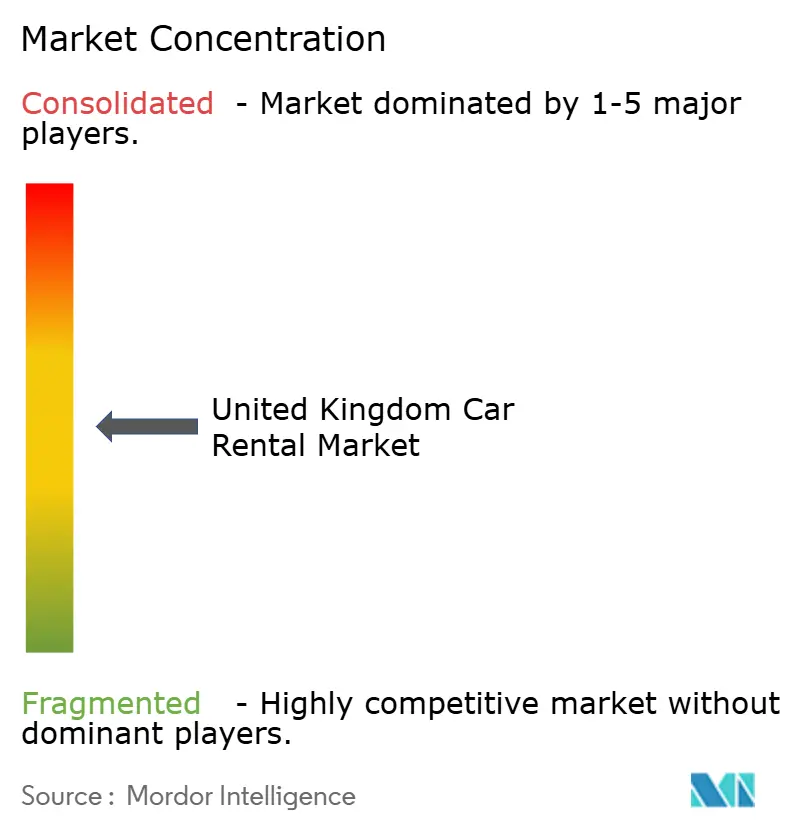
Global giants—Enterprise, Hertz, Avis Budget, SIXT, and Europcar—command a significant combined share, indicating a moderately concentrated market. Through a long-term partnership with Stellantis, SIXT ensures a steady supply of vehicles and advances its goals for electrification. Meanwhile, Hertz has achieved notable growth in its international operations, improving utilization rates and increasing daily revenue [3]. However, Zipcar's exit from the market not only removed a costly competitor but also highlighted the challenges faced by asset-heavy sharing models in high-cost urban areas.
Private equity is increasingly showing interest in the market, as demonstrated by KKR's acquisition of Dawsongroup, which reflects the growing convergence between leasing and rental services. Platforms like Turo, through their partnership with Uber, are expanding their distribution networks and targeting a larger share of the price-sensitive leisure market. As technology becomes a critical differentiator, innovations such as dynamic pricing systems and telematics-based maintenance are helping industry leaders stand out. While the car rental market in the United Kingdom continues to benefit from economies of scale in procurement and residual value management, there remains significant potential in areas such as subscription-based models, rural service coverage, and electric vehicle charging infrastructure.
United Kingdom Car Rentals Industry Leaders
-
SIXT SE
-
Avis Budget Group
-
The Hertz Corporation
-
Europcar Mobility Group
-
Enterprise Holdings, Inc.
- *Disclaimer: Major Players sorted in no particular order
United Kingdom Car Rentals Market Companies Covered in this Report
- Avis Budget Group
- Enterprise Holdings
- Europcar Mobility Group
- The Hertz Corporation
- SIXT SE
- Drivalia
- Green Motion
- Arnold Clark Car and Van Rental
- Easirent
- Practical Car and Van Rental
- U-Drive
- Virtuo
- Getaround (UK)
- Turo
Market Opportunities and Future Outlook
Public sector and institutional demand creates visible whitespace for multi-year, multi-vehicle usage patterns that tend to favor compliant operators with broad coverage and billing capability. A February 2026 procurement notice on Find a Tender for the Welsh Government Vehicle Hire IV Framework (covering cars, LCVs, and specialist vehicles) pointed to active, structured buying, with contract values stated up to GBP 140 million including VAT. Framework work like this tends to favor suppliers that can meet service levels, demonstrate vehicle availability, and deliver reporting requirements across regions.
Fleet transition and product redesign also open room for operators that can package mobility with risk management. The ZEV Mandate and broader electrification drive additional demand for customer education, charging support, and clearer fee structures, while long-term and subscription-style rentals fit a broader shift toward delaying ownership amid vehicle price volatility. BVRLA reporting in 2026 also highlights the ongoing role of salary-sacrifice schemes in supporting leasing adoption, which intersects with rentals through employer-backed mobility benefits and duty-of-care needs that favor professionally managed fleets and telematics-enabled reporting.
Recent Industry Developments in United Kingdom Car Rentals Market
- July 2026: Sixt SE bonds EUR 500 million to fund expansion of premium fleet and international branch network. The financing event supports capital-intensive growth and expands the supplier base for premium rentals in the United Kingdom. The action accelerates UK premium-fleet expansion and cross-border network growth.
- June 2026: Final Rentals and Autorent (Bahwan International Group) integrate 13,000 vehicles into Final Rentals platform. The collaboration strengthens fleet aggregation and supports an asset-light model within the UK market. Increases UK fleet access and reach via partner networks.
- June 2026: Sixt SE launches first-ever Exeter Airport branch, expanding the UK regional footprint. The entry broadens regional coverage and improves visibility at a major travel hub. Captures pent-up demand at transportation hubs and diversifies UK coverage.
United Kingdom Car Rentals Market Report Scope and Research Methodology
Market Definition and Coverage
This market covers revenue earned from renting passenger cars to customers in the United Kingdom, across airport and off-airport locations, for short-term and longer duration needs, whether booked online, via apps, or through direct counters.
Scope exclusions: It excludes vehicle leasing and financing contracts, chauffeur-driven services, and car sharing that is priced primarily as a membership or subscription.
Segments Covered in This Report
- By Rental Duration
- Short-Term (Less than 30 days)
- Long-Term/Subscription (More than 30 days)
- By Booking Type
- Online
- Offline
- By Application
- Leisure / Tourism
- Business / Corporate
- By Vehicle Class
- Economy
- Standard
- Premium / Luxury
- By Propulsion Type
- Internal-Combustion Engine (ICE)
- Hybrid
- Battery Electric Vehicle (BEV)
- By End-User
- Individual
- Corporate and Institutional
- By Booking Channel
- Airport
- Off-Airport / Downtown
- Rail and Mobility Hubs
- By Geography
- England
- Scotland
- Wales
- Northern Ireland
Data Sources, Market Sizing, and Validation
Desk Research
Desk work started with building a consistent view of travel and mobility demand in the United Kingdom, since rental volumes tend to move with arrivals, domestic trips, and business activity. For this, we leaned on public sources such as UK Department for Transport datasets, Office for National Statistics time series, Civil Aviation Authority airport passenger statistics, and VisitBritain tourism releases.
After the demand picture was clear, we used operator disclosures and public documents to connect demand to supply and pricing. Helpful inputs were company annual reports and investor decks, industry association pages, reputable press coverage, and regulatory notes that can affect fleets and city access rules. We also used paid subscriptions for company financials and intelligence, plus an automotive sales and vehicle park database, to sanity-check fleet renewal pace and availability constraints. The sources listed here are illustrative only, and many other public and paid references were also used for data collection, validation, and clarification.
Primary Interviews and Surveys
Primary work was used to confirm how demand is split between airport and urban locations, how corporate accounts and leisure customers behave, and what pricing rules are actually used during peak and off-peak periods. We spoke with a mix of operators, fleet and procurement professionals, channel partners, and travel stakeholders across the United Kingdom so that secondary assumptions could be corrected where they did not match current market behavior. Respondent input was also used to validate the realistic pace of fleet electrification, insurance and repair cost changes, and the degree to which digital booking is shifting mix and utilization.
Distribution of primary research fieldwork respondents
| Company type | Respondent position |
|---|---|
| Top tier: 27% | CXOs: 17% |
| Mid tier: 54% | Functional/Unit leaders: 34% |
| Smaller Players: 19% | Managers: 49% |
Market-Sizing & Forecasting
Sizing was built using top-down reconstruction, where travel indicators and mobility activity in the United Kingdom are translated into an addressable rental demand pool and then converted to revenue using observed price and mix patterns. The model relied on inputs such as airport passenger throughput, domestic trip intensity, business travel cadence, average rental length, utilization by season, and the share of bookings that run through digital channels, which then influence rate realization.
To keep the totals realistic, results were corroborated through selective bottom-up approximations, including sampled location-level rate checks, fleet size and utilization logic, and revenue-per-day cross-checks from public disclosures where available. When data was patchy for smaller locations, gaps were handled by applying regionally consistent utilization ranges and adjusting with interview-led seasonality factors.
For forecasting, scenario analysis was used with a base case that reflects expected tourism normalization, corporate travel steadiness, and fleet refresh constraints, and then tested against higher and lower pricing and utilization paths. Assumptions for daily rate progression were reviewed with practitioners, since insurance, maintenance, and residual values tend to shape how prices are passed through to customers.
Data Validation & Update Cycle
Outputs were checked against independent signals such as airport arrivals, rental day intensity, and reported fleet changes, and then variance was reviewed until the drivers matched the market story. When a metric moved sharply, it triggered a revisit of pricing, utilization, and mix assumptions, followed by selective re-contacts to confirm whether the change was structural or temporary.
Before sign-off, the model and narrative go through multi-step analyst reviews, which includes anomaly checks, arithmetic checks, and consistency checks across years. Reports are refreshed annually, with interim updates when major events materially change demand or pricing, and a final pre-delivery pass is completed so clients receive the latest updated view.
Mordor Intelligence's United Kingdom Car Rental Market Estimate Compared With Other Published Estimates
Published market sizes for UK car rental can look far apart because the boundary is not always the same, and pricing is often treated differently between studies. Differences usually come from what is counted as car rental versus leasing or subscription models, whether self-drive only is used, and how exchange rates and inflation are applied to multi-year series.
In refresh-led reviews, the spread also shows up when daily rate logic is held constant even though utilization and vehicle costs are changing, or when currency timing is not aligned to the year being reported. By rechecking rate realization and utilization against the latest airport and tourism signals and then locking FX to the stated year, Mordor Intelligence reduces drift that can build up when older assumptions are carried forward.
Benchmark comparison
| Source | Market Size | Gaps in Research Methodology |
|---|---|---|
| Mordor Intelligence | USD 2.00 B (2026) | |
| Industry Research Publisher A | USD 2.03 B (2025) | Uses a self-drive focused scope and a different base year, and the total can move depending on whether corporate contracted rentals and longer durations are counted inside the same revenue pool. |
| Industry Consultancy B | USD 3.80 B (2025) | Appears to apply a broader mobility revenue scope and stronger assumed rate expansion, which can lift the total beyond standard passenger car rental activity. |
The table shows that most gaps come from scope and pricing cadence rather than from one single demand metric. When the modeled revenue is kept to passenger car rentals and the pricing inputs are refreshed with utilization checks, the result stays traceable to clearer variables and repeatable steps.
Key Questions Answered in the Report
What growth rate is expected for the United Kingdom car rental market through 2031?
The market is projected to expand at a 3.11% CAGR, rising from USD 2 billion in 2026 to USD 2.33 billion by 2031.
Which rental segment is growing fastest in the country?
Long-term and subscription rentals are advancing at a 12.67% CAGR, outpacing all other duration categories.
How large is online booking’s role in United Kingdom car rentals?
Online channels accounted for 67.50% of 2025 revenue and are expanding at a 10.81% CAGR as mobile apps dominate new demand.
What share of rental fleets are battery electric vehicles?
Battery electric units comprised a small share of fleets in 2025, yet they are scaling at a 26.60% CAGR under zero-emission sales mandates.