
Market Overview
| Study Period | 2020 - 2031 |
|---|---|
| Forecast Data Period | 2026 - 2031 |
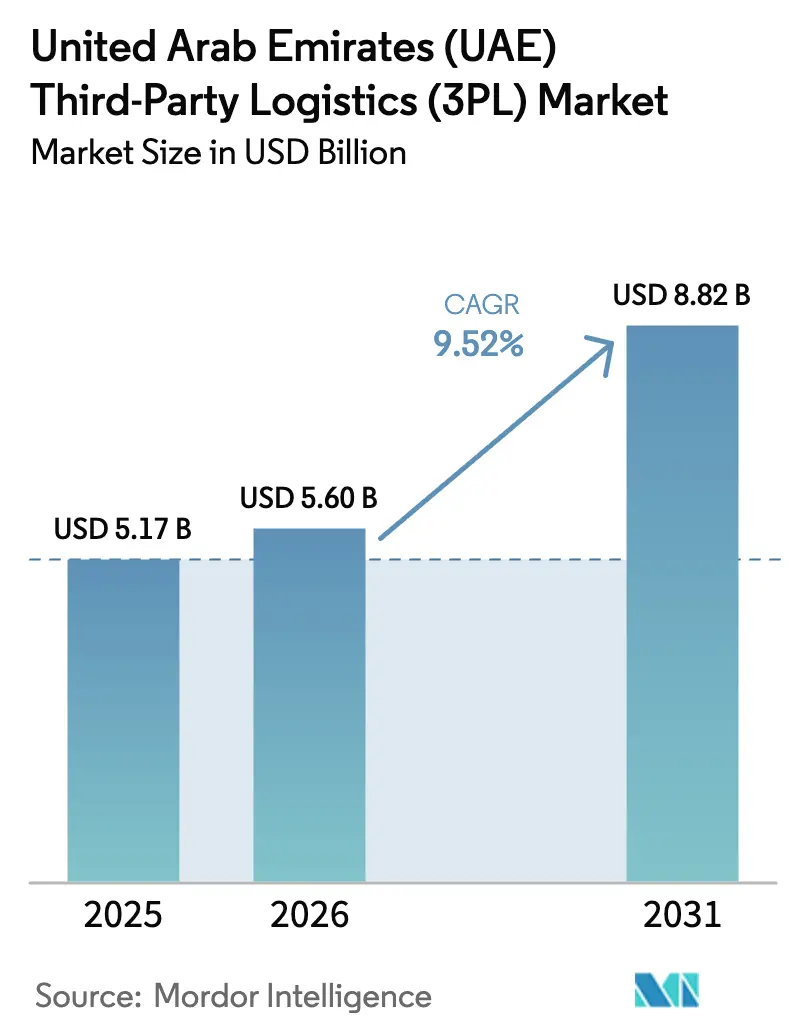
| Base Year Market Size (2025) | USD 5.17 Billion |
| Market Size (2026) | USD 5.60 Billion |
| Market Size (2031) | USD 8.82 Billion |
| Growth Rate (2026 - 2031) | 9.52 % |
| Market Concentration | Medium |
Major Players *Disclaimer: Major Players sorted in no particular order Image © Mordor Intelligence. Reuse requires attribution under CC BY 4.0. | |
United Arab Emirates (UAE) Third-Party Logistics (3PL) Market Analysis by Mordor Intelligence
The United Arab Emirates Third-Party Logistics Market size is estimated at USD 5.60 billion in 2026, and is expected to reach USD 8.82 billion by 2031, at a CAGR of 9.52% during the forecast period (2026-2031).
The sharp expansion reflects a logistics ecosystem where artificial intelligence, automation, and carbon-neutral initiatives converge with the country’s role as a multimodal bridge between Asia, Europe, and Africa. Robust e-commerce demand, free-zone clustering, and government-backed infrastructure programs are pushing providers to invest in advanced fulfillment centers, IoT-enabled fleets, and temperature-controlled facilities. Hybrid operating strategies that combine selected asset ownership with network orchestration capabilities are emerging as the dominant model, allowing providers to hedge against driver shortages and warehouse rent inflation. Meanwhile, the completed 900 km Etihad Rail and the USD 35 billion Al Maktoum International Airport expansion promise to further integrate sea, air, road, and rail corridors, cementing the UAE 3PL market as a preferred Gulf gateway for time-sensitive cargo. Sustainability is another accelerating theme as warehouse operators pilot solar micro-grids and green building materials to align with the UAE’s Net-Zero 2050 vision.
Key Report Takeaways
- By service type, domestic transportation management held 33.26% of the UAE 3PL market share in 2025, while Value-Added Warehousing and Distribution is forecast to grow at a 10.03% CAGR through 2031.
- By end-user industry, energy & utilities commanded 25.71% of the UAE 3PL market size in 2025, whereas Life Sciences & Healthcare is projected to expand at a 12.84% CAGR between 2026 and 2031.
- By logistics model, the asset-light approach accounted for 41.53% share of the UAE 3PL market size in 2025, yet hybrid models are advancing at a 9.91% CAGR through 2031.
- By geography, Dubai captured 66.12% of the UAE 3PL market share in 2025, and the Rest of the UAE is expected to accelerate at an 11.07% CAGR over 2026-2031.
Note: Market size and forecast figures in this report are generated using Mordor Intelligence’s proprietary estimation framework, updated with the latest available data and insights as of January 2026.
United Arab Emirates (UAE) Third-Party Logistics (3PL) Market Trends and Insights
Drivers Impact Analysis*
| Driver | (~) % Impact on CAGR Forecast | Geographic Relevance | Impact Timeline |
|---|---|---|---|
| Rapid E-commerce Penetration | +2.3 | Dubai, Abu Dhabi, with expansion to all emirates | Short term (≤2 yrs) |
| Ambitious national logistics strategy (UAE Logistics Strategy 2030) | +2.1 | National, with infrastructure concentration in Dubai, Abu Dhabi | Long term (≥5 yrs) |
| Expansion of free-zone based fulfillment hubs | +1.4 | Dubai (NIP, JAFZA), Abu Dhabi (ICAD, Khalifa Port) | Medium term (≈3-4 yrs) |
| Growing cold-chain demand in pharma & F&B | +1.6 | Dubai, Abu Dhabi, with a regional distribution reach | Medium term (≈3-4 yrs) |
| AI-driven route-optimization adoption by SMEs | +1.2 | National, with higher adoption in urban centers | Short term (≤2 yrs) |
| Carbon-neutral warehousing pilots | +0.7 | Dubai, Abu Dhabi (pilot phase, limited scale) | Long term (≥5 yrs) |
| Source: Mordor Intelligence | |||
Rapid e-commerce penetration
Digital retail’s share of total UAE transactions is set to rise from 8.2% in 2021 to 26.5% in 2026, pushing annual last-mile volumes from 185 million to 665 million parcels. Third-party logistics providers are responding with micro-fulfillment centers, automated sortation lines, and crowd-sourced delivery platforms that slash order-to-door times. Kuehne + Nagel and Expeditors International each committed to 23,000 m² facilities in Dubai South, confirming that scale logistics infrastructure remains a competitive prerequisite.[1] The driver’s influence is strongest in Dubai and Abu Dhabi, where cash-on-delivery fell below 27% of online transactions after the widespread adoption of digital wallets, thereby removing a historic friction point. Mobile shopping and social commerce add further complexity, requiring 3PL operators to synchronize inventory, order processing, and returns across multiple sales channels. The result is a sustained rise in warehouse automation investments and API-based integrations that let retailers outsource fulfillment while maintaining real-time inventory visibility.
Ambitious national logistics strategy (UAE Logistics Strategy 2030)
The national roadmap aims to elevate the logistics sector’s GDP contribution to 5% and place the country among the world’s top ten logistics hubs. Central to the plan is a USD 35 billion expansion of Al Maktoum International Airport that will handle 12 million tons of cargo annually when fully open in 2031. Parallel upgrades, including the operational Etihad Rail network, forge seamless rail-to-port connectivity across all seven emirates. Regulatory harmonization, single-window customs, unified cargo clearance, and 100% foreign ownership in selected sub-sectors reduce dwell times and attract multinational shippers. The long-term, high-impact driver positions the UAE 3PL market to capture transshipment flows that currently bypass the Gulf, while offering domestic industries faster access to global supply chains.
Expansion of free-zone based fulfillment hubs
Tax-free zones such as Jebel Ali Free Zone (JAFZA) and National Industries Park provide manufacturers and retailers with bonded corridors that link sea and air gateways within minutes. Free-zone tenants benefit from 100% foreign ownership, zero import duties, and on-site customs centers that cut clearance times. These advantages spur demand for integrated 3PL services ranging from kitting to reverse logistics, especially for re-export shipments bound for Africa and South Asia. The medium-term driver also disperses logistics activity beyond Dubai toward fast-developing clusters in Abu Dhabi’s ICAD and Khalifa Port.
Growing cold-chain demand in pharma & F&B
Government spending of AED 4.95 billion (USD 1.35 billion) on healthcare facilities and the rise of telehealth are stimulating demand for GDP-compliant pharmaceutical logistics. RSA Global and Americold’s joint venture to build an 8-chamber, 40,000-pallet cold store in Jebel Ali Free Zone underlines the scale of specialized infrastructure coming online. Fresh food initiatives, including Dubai’s plan to host the world’s largest fruit and vegetable hub, amplify the need for sub-zero warehousing, data-loggers, and validated packaging. Competitive advantage now hinges on real-time temperature monitoring, pharma-grade certifications, and the ability to consolidate multi-sector volumes to maximize asset utilization.
Restraint Impact Table*
| Restraint | (~) % Impact on CAGR Forecast | Geographic Relevance | Impact Timeline |
|---|---|---|---|
| Persistent Driver Shortages | -1.5 | National, particularly acute in Dubai, Abu Dhabi | Medium term (3-4 yrs) |
| Rising warehouse rents in Dubai & Abu Dhabi | -1.8 | Dubai (JAFZA, Dubai South), Abu Dhabi (ICAD) | Medium term (3-4 yrs) |
| Fragmented customs processes across emirates | -1.1 | Cross-emirate operations, particularly Northern Emirates | Medium term (3-4 yrs) |
| Limited rail freight connectivity | -0.6 | National infrastructure development is ongoing | Long term (≥5 yrs) |
| Source: Mordor Intelligence | |||
Persistent Driver Shortages
Federal labor reforms and burgeoning gig-economy alternatives have shrunk the pool of licensed commercial drivers, raising 3PL wage bills by up to 12%. The shortage is most acute for drivers with hazmat, refrigerated, or urban last-mile credentials. Providers are launching retention bonuses, accelerated training pipelines, and controlled trials of autonomous trucks inside industrial zones, yet large-scale automation remains five years out due to pending regulations. Over the medium term, sustained labor tightness is expected to compress margins in domestic haulage unless technology offsets headcount needs.
Rising warehouse rents in Dubai & Abu Dhabi
Prime logistics rents in JAFZA and Dubai South advanced 18% year-over-year in Q3 2025, outpacing general inflation and pressuring operating costs. Warehousing already represents up to 30% of 3PL expense structures, so rent spikes threaten profitability, especially for small providers. Strategies to mitigate the squeeze include high-bay racking, autonomous mobile robots, and migration to lower-cost emirates. New supply pipelines in Abu Dhabi’s ICAD and Sharjah’s free zones may temper rental escalation by 2028, yet location-critical sectors such as e-commerce fulfillment will continue to pay premiums for proximity to airports and express parcel hubs.
*Our forecasts treat driver/restraint impacts as directional, not additive. The impact forecasts reflect baseline growth, mix effects, and variable interactions.
Segment Analysis
By Service Type: Warehousing Complexity Drives Value Migration
Value-Added Warehousing and Distribution segment of the UAE 3PL market is projected to advance at the fastest 10.03% CAGR over 2026-2031. Providers are layering kitting, light assembly, and quality inspection services on top of storage to capture higher margins and reduce client handling steps. DP World’s integrated warehousing platform now combines temperature-controlled space, IoT sensors, and blockchain-verified chain-of-custody, illustrating the move toward turnkey solutions[2]. International Transportation Management remains steady at roughly 34% share due to the country’s strategic re-export role and expanding air-sea corridors.
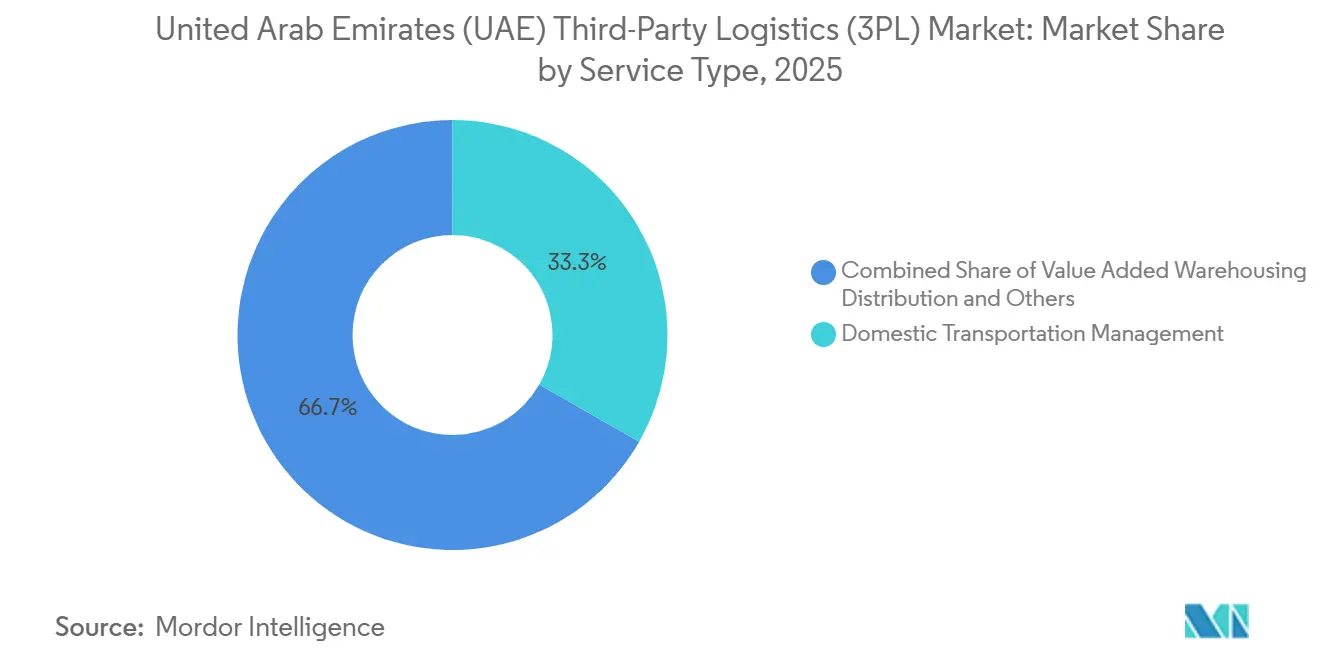
Domestic Transportation Management holds the largest 33.26% slice of the UAE 3PL market share but faces cost pressure from driver shortages and diesel volatility. Network optimization software and route-planning AI help offset these challenges, yet capital outlays may squeeze smaller carriers. Multimodal offerings leveraging Etihad Rail create fresh cross-selling potential by linking inland depots directly to ports, thus reducing drayage times and emissions.

By End-User Industry: Healthcare Logistics Outpaces Traditional Sectors
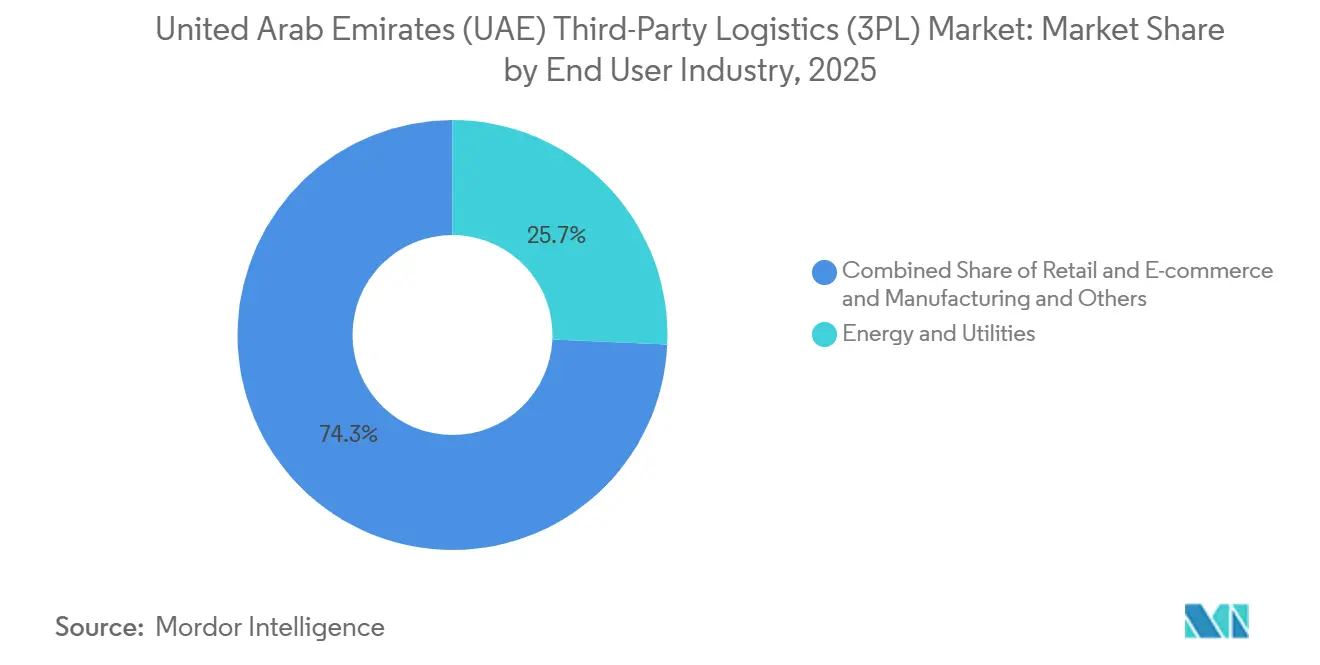
Energy & Utilities led with 25.71% UAE 3PL market share in 2025, supported by ADNOC Logistics & Services’ offshore fleet additions and ongoing hydrocarbon export volumes. Nevertheless, Life Sciences & Healthcare is set to register the highest 12.84% CAGR as specialized storage and time-critical delivery capabilities become mandatory for vaccines and precision-medicine therapies. Abu Dhabi’s Critical Care Transport System standard illustrates how regulation is elevating service-level requirements.
Retail & e-commerce is another bright spot, buoyed by social-commerce adoption and same-day delivery expectations. Manufacturing benefits from the “Operation 300 Billion” policy that incentivizes domestic production, increasing inbound raw-material flows and outbound finished-goods shipments. Finally, Food & beverage logistics is being reshaped by consumer demand for fresh imports, prompting investment in reefers and HACCP-certified cross-docks.
By Logistics Model: Hybrid Strategies Balance Flexibility and Control
Asset-light operators captured 41.53% of the UAE 3PL market size in 2025 by orchestrating carrier networks without heavy balance-sheet commitments. Yet hybrid strategies are climbing at a 9.91% CAGR as market leaders selectively acquire critical assets. DHL Global Forwarding’s takeover of Danzas AEI Emirates, including 20 owned facilities, demonstrates the pivot toward infrastructure control in geographies where service quality and capacity access determine customer stickiness.
Pure asset-heavy models persist in niche areas, such as pharma cold chain, where regulatory compliance and temperature integrity demand direct facility ownership. RSA Cold Chain’s decision to fund its own sub-zero warehouses highlights the barriers to entry for new challengers in specialized verticals. The evolving balance suggests that UAE 3PL market participants will continue to toggle between owning and leasing based on service criticality, risk appetite, and capital availability.
Geography Analysis
Dubai’s unparalleled infrastructure density secured 66.12% of the UAE 3PL market share in 2025. Five-parallel-runway expansion at Al Maktoum International Airport will lift annual freight capacity to 12 million t and reinforce the emirate’s role as the Gulf’s premier air-cargo hub. Bonded corridors within EZDubai enable seamless sea-to-air transfers that bypass traditional customs checks, slashing lead times for high-value electronics and fashion.
Abu Dhabi is closing the gap by aligning logistics assets with its industrial diversification agenda. ICAD and Khalifa Port serve fast-growing clusters in advanced manufacturing, renewable energy components, and healthcare supplies. The emirate’s Department of Health mandates GDP-compliant transport for sensitive medical cargo, creating a specialized service pool that only certified 3PLs can penetrate. Backed by sovereign wealth funds, local players are scaling multi-temperature facilities and investing in route-optimization AI to serve both domestic and regional markets.
Sharjah, Ras Al-Khaimah, and Fujairah, grouped as the Rest of the UAE, are forecast to record an 11.07% CAGR through 2031. Cheaper land, rents up to 30% below Dubai, and new highway links such as the USD 3.5 billion Al Mafraq-Al Ghuwaifat road improve connectivity to Jebel Ali Port and Saudi borders. The completed 900 km Etihad Rail further integrates northern emirates into national trade lanes, allowing 3PLs to stage inventory closer to end customers without sacrificing transit speed[3]. Cost-sensitive clients in FMCG and heavy manufacturing increasingly view these emirates as viable alternatives for large-footprint distribution centers.
Regulatory Landscape
The UAE 3PL environment is shaped by federal and emirate-level authorities that govern customs, border controls, and transport compliance. The Federal Authority for Identity, Citizenship, Customs and Port Security (ICP) oversees trade facilitation mechanisms such as the UAE Authorized Economic Operator (AEO) program, which affects clearance speed, audit requirements, and trusted-trader eligibility for logistics operators managing cross-border and free-zone flows.
Cargo data and safety compliance requirements are tightening across modes. For maritime containers, the Maritime Preload Cargo Information (MPCI) program entered go-live on 19 May 2026, followed by the National Advance Information Centre (NAIC) implementing the No Manifest, No Load policy on 15 June 2026 for inbound and transshipment maritime containers. This adds higher advance-filing, screening, and documentation expectations for freight forwarders and 3PLs. In airfreight, the General Civil Aviation Authority (GCAA) mandates compliance with Civil Aviation Regulations (CAR) Part VI for dangerous goods, raising the operational bar for certified handling, packaging, and acceptance processes for time-sensitive and regulated cargo.
Value Chain Analysis
The UAE 3PL value chain starts with shipper demand from retail and e-commerce, manufacturing, energy, and healthcare, then moves through capacity procurement (linehaul carriers, air and ocean forwarding, and last-mile partners), warehousing and value-added services in free zones and industrial districts, and finally customs release and distribution to domestic or re-export markets. Trade enablement and documentation increasingly run through digital gateways such as Abu Dhabi's Advanced Trade and Logistics Platform (ATLP), which consolidates permits, customs, and logistics processes across air, sea, land, and free zones, reducing manual handoffs among stakeholders.
Infrastructure owners and corridor developers, including ports, airports, and rail-linked inland nodes, anchor the downstream execution layer for 3PLs. Customs corridors and bonded moves also determine cycle times for inter-emirate and transshipment cargo. In 2025, a bonded rail corridor connecting Khalifa Port and Fujairah Terminals via the Etihad Rail network highlighted the push to shift suitable flows from road to rail and streamline customs-controlled transfers. Capacity expansion at key nodes influences service sourcing decisions as well, including AD Ports Group and CMA CGM's plan to expand their joint container terminal at Khalifa Port to 2.7 million TEUs, and Mina Al Hamriya's approved 700-metre quay expansion (July 2025). Together, these changes broaden options for port-centric warehousing, cross-docking, and re-export handling.
Competitive Landscape
The UAE 3PL market features moderate fragmentation punctuated by rapid consolidation moves. DHL Global Forwarding’s integration of 1,100 employees and 20 facilities through its Danzas acquisition bolstered its end-to-end capabilities and solidified its hybrid model positioning. ADQ’s interest in Aramex signals possible sovereign-backed consolidation playbooks that could reshape competitive hierarchies.
Scale alone is no longer sufficient; technology and specialized certifications now drive customer preference. Aramex posted AED 1.6 billion (USD 435 million) in Q3 2025 revenue, with domestic express and logistics units offsetting weaker long-haul volumes, underscoring the pivot toward localized, high-service segments[4]. Kuehne + Nagel’s 45,000-pallet e-commerce hub inside EZDubai exemplifies investments that blend automation with bonded status to shorten order cycles for digital merchants.
Niche specialists remain competitive in areas such as pharmaceutical cold chain, bulk liquids, and reverse logistics. RSA Global’s facility pipeline, Tristar’s hazardous-materials expertise, and GAC’s marine logistics offerings illustrate how focused capabilities can coexist alongside multinational giants. The convergence of scale, technology, and specialization will likely drive further mergers, joint ventures, and free-zone partnerships over the planning horizon.
United Arab Emirates (UAE) Third-Party Logistics (3PL) Industry Leaders
-
Aramex
-
DHL Global Forwarding
-
GAC
-
CEVA Logistics (CMA CGM)
-
FedEx Logistics
- *Disclaimer: Major Players sorted in no particular order

Market Opportunities and Future Outlook
Multimodal inland and rail-linked logistics is emerging as a key whitespace as the UAE formalizes corridor-based freight movement beyond traditional port-centric models. AD Ports Group's move in May 2026 to establish a consolidated multimodal inland logistics network, together with 2025 initiatives such as the bonded rail corridor between Khalifa Port and Fujairah Terminals, creates practical opportunities for 3PLs to productize rail-enabled domestic distribution, bonded inter-port transfers, and inland postponement services for manufacturing and re-export supply chains.
Digital coordination and compliance-ready trade execution are also expanding the opportunity set as advance cargo data mandates spread. The 2026 MPCI go-live and the NAIC No Manifest, No Load policy increase the value of 3PL offerings that bundle filing governance, data quality controls, and exception management across shippers and forwarders. On the SME end of the market, the July 2026 pilot launch of TRUXX's Qawafel national digital land freight platform, including freight price visibility tools, points to continued demand for standardized sourcing and price transparency, supporting integration of platform-based procurement with service guarantees by 3PLs and brokers. In parallel, Sharjah-led corridor and hub projects announced in June 2026, including Gulftainer's Al Dhaid Multi-Modal Trade Corridor and the Sajaa Logistics Complex build-out as a multimodal hub, broaden contract logistics and inventory staging activity outside Dubai while staying connected to national rail.
Recent Industry Developments
- April 2026: DHL Global Forwarding announced the global rollout of an AI-powered predictive logistics platform to strengthen end-to-end visibility and proactive exception handling. This supports UAE shippers that operate through multimodal gateways and free zones, where disruption management and data-driven decisioning are increasingly differentiators in 3PL selection.
- December 2025: DHL Group commenced development of a EUR 120 million, 55,000 sqm multi-user contract logistics warehouse in Dubai South. The project expands large-format, shared-user capacity near the DWC logistics district, reinforcing Dubai South as a magnet for regional distribution and value-added warehousing requirements.
- January 2024: DHL Global Forwarding completed the acquisition of Danzas AEI Emirates, integrating more than 20 facilities and a large local workforce footprint in the UAE. The move strengthened network control and service breadth in forwarding and contract logistics, accelerating consolidation dynamics among multinational-led providers.
Research Methodology Framework and Report Scope
Market Definition and Coverage
For this methodology, the UAE 3PL market covers paid logistics services that shippers outsource to a third party, mainly transportation management, freight forwarding support, warehousing, and value-added logistics billed as service revenue within the UAE.
Scope exclusions: We exclude turnkey facility management, captive in-house logistics operations, and pure digital freight marketplaces where the provider does not deliver the logistics service.
Segmentation Overview
- By Service
- Domestic Transportation Management
- Road
- Air
- More
- International Transportation Management
- Road
- Air
- Sea
- Multimodal / Intermodal
- Value-Added Warehousing and Distribution (VAWD)
- Domestic Transportation Management
- By End-User Industry
- Automotive
- Energy and Utilities
- Manufacturing
- Life Sciences and Healthcare
- Technology and Electronics
- Retail and E-commerce
- Consumer Goods and FMCG
- Food and Beverages
- More
- By Logistics Model
- Asset-Light (Management-Based)
- Asset-Heavy (Own Fleet and Warehouses)
- Hybrid
- By Emirate
- Dubai
- Abu Dhabi
- Sharjah
- Rest of UAE
Data Sources, Market Sizing, and Validation
Desk Research
Desk work starts by building a simple fact base on UAE trade and freight flows, plus logistics capacity signals, and then mapping those signals to outsourced logistics spend. We refer to public sources such as UAE Federal Competitiveness and Statistics Centre releases, Dubai Statistics Center indicators, UN Comtrade trade statistics, World Bank logistics and trade datasets, and World Customs Organization guidance and publications.
To keep assumptions grounded, we also review company annual reports and investor presentations for service mix and regional revenue cues, along with port and airport traffic updates, free zone publications, and reputed business press. Where needed, we use paid subscriptions for company financials and news, shipment-level import and export data, and contracts and tenders to validate activity level directionally in key lanes and sectors. These are illustrative examples only, and many other sources were also consulted for collection, cross-checking, and clarification.
Primary Interviews and Surveys
Primary work focuses on confirming what portion of freight and warehousing demand is actually outsourced, and how pricing is moving across contract renewals. We speak with logistics providers, freight forwarders, warehouse operators, and large shippers in retail, industrials, and e-commerce across the UAE, and then we re-check any outlier inputs with follow-up conversations before finalizing assumptions.
Distribution of primary research fieldwork respondents
| Company type | Respondent position |
|---|---|
| Top tier: 30% | CXOs: 15% |
| Mid tier: 53% | Functional/Unit leaders: 34% |
| Smaller Players: 17% | Managers: 51% |
Market-Sizing & Forecasting
Sizing is built using a combined top-down and bottom-up approach. On the top-down side, we reconstruct the demand pool by linking UAE trade and domestic distribution activity to outsourced logistics intensity, and then translating it into service revenue using observed price and contract patterns.
Inputs that matter in this market include non-oil trade value and re-export intensity, container throughput and air cargo tonnage, warehouse capacity additions in key industrial and free zone clusters, e-commerce fulfillment volumes, and typical contract terms for transport and storage. To corroborate the totals, we run selective bottom-up checks using sampled provider revenue ranges, service-mix splits, and an ASP x volume approximation for warehousing and transport where reliable operating metrics are available. If a segment has limited disclosure, the gap is handled using peer ratios and then re-tested with interview feedback.
Forecasts are produced using scenario analysis, where base, faster, and slower cases are built around trade growth, infrastructure and free zone expansion, and expected rate movements, and then refined using what respondents expect for utilization and pricing over the next contract cycle.
Data Validation & Update Cycle
Validation is done through triangulation across independent signals, then through variance checks that flag results inconsistent with known trade, throughput, or capacity movements. When mismatches show up, assumptions are revisited and a targeted re-contact is triggered with the relevant respondent group.
Before sign-off, the model goes through multi-step analyst reviews, and key sensitivities are tested so the final number can be traced back to a short list of drivers. Reports are refreshed annually, with interim updates for material events like major policy shifts, port capacity changes, or demand shocks, and a final pre-delivery pass is completed so clients receive the most current view.
Mordor Intelligence's United Arab Emirates 3pl Market Size Compared Against Other Published Estimates
Published market values for UAE 3PL do not always line up because the scope line is drawn differently, and because pricing and currency timing assumptions are not the same. Differences also come from how much of warehousing and value-added services is counted, and whether the estimate is refreshed after major contract renewals and capacity additions.
The main gap comes from whether 4PL lead logistics and parcel and express turnover are bundled into the same pool, where Mordor Intelligence counts only fee-based outsourced 3PL services billed for transport, warehousing, and related value-added work (and leaves out captive fleets and pure digital marketplaces).
Benchmark comparison
| Source | Market Size | Gaps in Research Methodology |
|---|---|---|
| Mordor Intelligence | USD 5.60 B (2026) | |
| Industry Publisher A | USD 6.56 B (2024) | Uses an earlier reference year and often includes adjacent logistics revenues that can blend 3PL with broader freight and logistics services, which shifts the total upward depending on what is bundled. |
| Press Release Digest B | USD 7.50 B (2024) | Commonly relies on limited public statements and spot FX conversions, and may mix contract logistics with forwarding and parcel revenue without a consistent rule for excluding captive operations. |
The spread in the table is mostly explained by category bundling, year alignment, and how service revenue is recognized and converted. By keeping inclusions tied to outsourced 3PL billing and re-checking pricing and outsourcing shares through interviews, the final value stays easier to reproduce and audit across updates.
Key Questions Answered in the Report
What is the forecast value of the UAE 3PL market in 2031?
The market is projected to reach USD 8.82 billion by 2031 based on a 9.52% CAGR.
Which service segment is growing fastest in UAE third-party logistics?
Value-Added Warehousing and Distribution is expected to expand at a 10.03% CAGR through 2031.
How big is Dubai’s share of national 3PL activity?
Dubai accounted for 66.12% of shipments and contract revenue in 2025.
Why is healthcare logistics a priority for providers?
Regulatory standards and cold-chain demand push Life Sciences & Healthcare to a 12.84% CAGR, the fastest among end-user sectors.
What model is replacing pure asset-light strategies?
Hybrid approaches that blend selective facility ownership with network management are scaling at 9.91% CAGR.