
Ultra-Low-Power Microcontroller Market Size and Share
Market Overview
| Study Period | 2019 - 2030 |
|---|---|
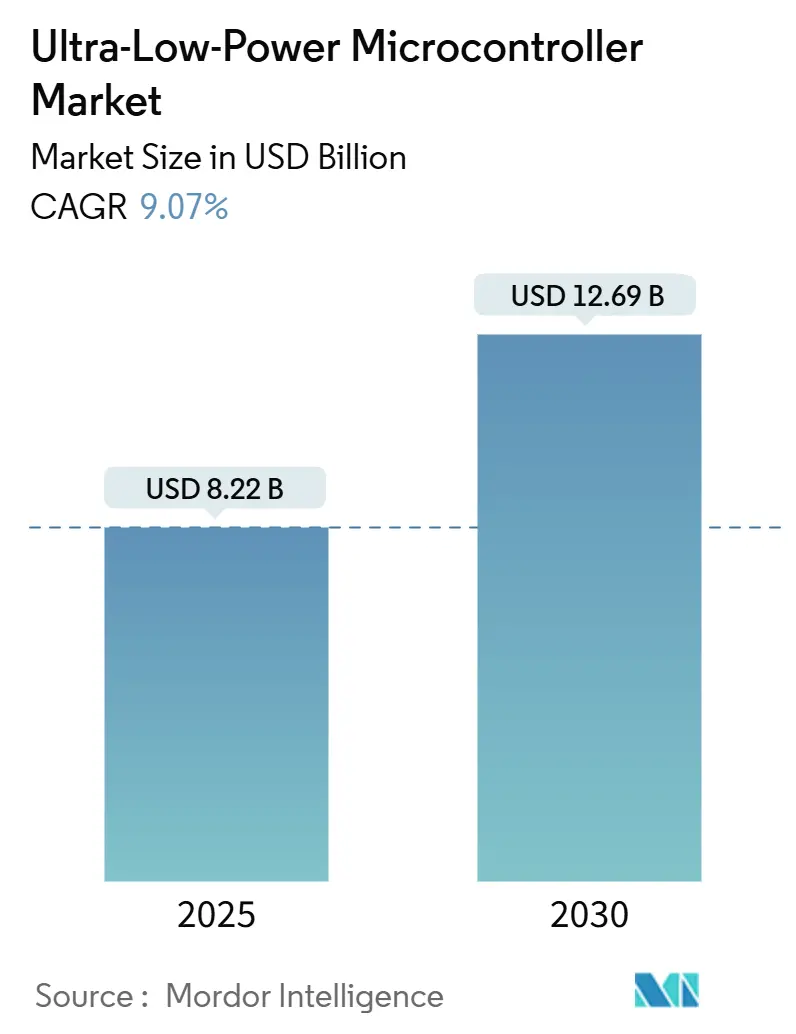
| Market Size (2025) | USD 8.22 Billion |
| Market Size (2030) | USD 12.69 Billion |
| Growth Rate (2025 - 2030) | 9.07 % |
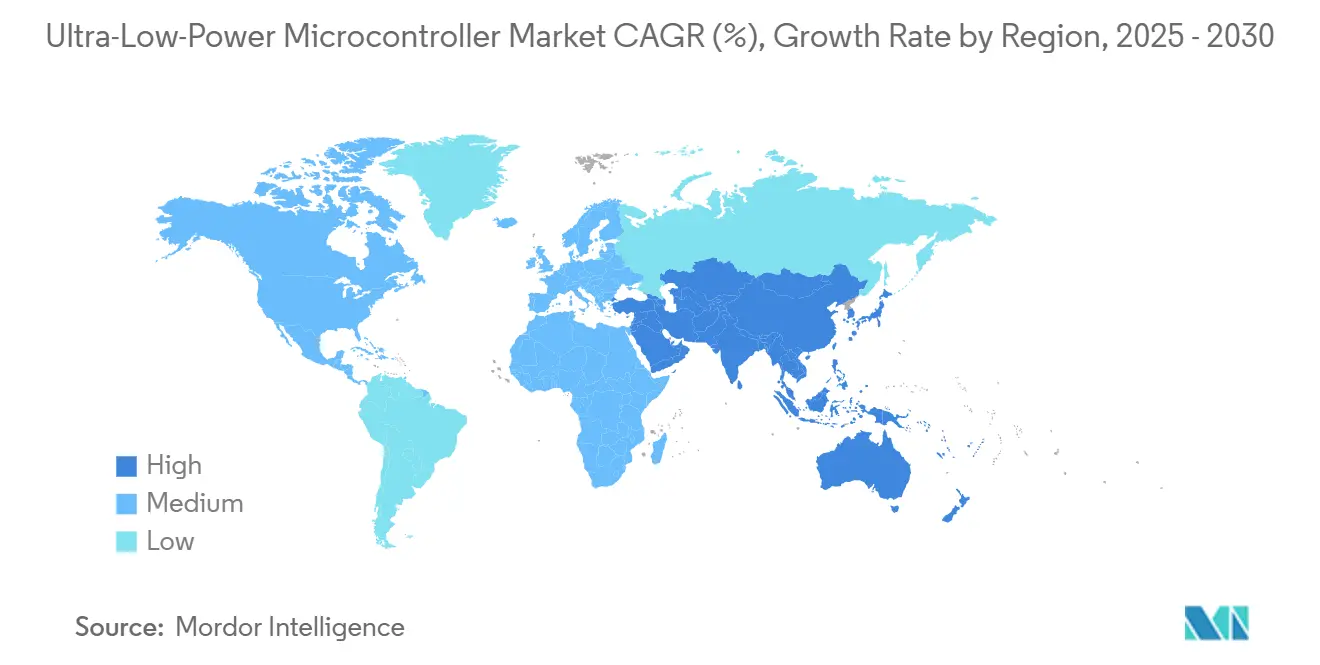
| Fastest Growing Market | Asia Pacific |
| Largest Market | North America |
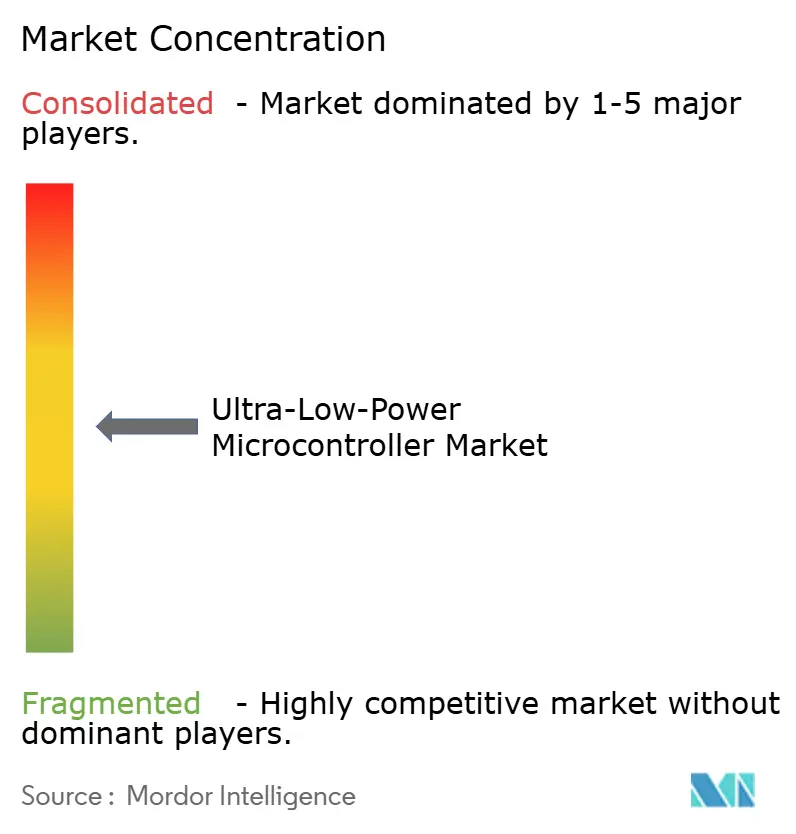
| Market Concentration | Medium |
Major Players *Disclaimer: Major Players sorted in no particular order Image © Mordor Intelligence. Reuse requires attribution under CC BY 4.0. | |
Ultra-Low-Power Microcontroller Market Analysis by Mordor Intelligence
The Ultra-Low-Power Microcontroller Market size is estimated at USD 8.22 billion in 2025, and is expected to reach USD 12.69 billion by 2030, at a CAGR of 9.07% during the forecast period (2025-2030).
Rising deployment of battery-powered IoT nodes, energy-harvesting architectures, and tightening power-efficiency mandates continue to lift demand for devices capable of sub-10 µA/MHz active power. North America sustains early-mover advantages through smart-grid rollouts and mature regulatory frameworks, while Asia-Pacific’s manufacturing scale accelerates adoption across consumer, industrial, and medical domains. OEM focus has shifted from mere sleep-current reductions to holistic energy budgets covering end-to-end sensing, processing, and connectivity, sparking a design race toward sub-threshold silicon, integrated AI engines, and dynamic power-gating schemes. Competitive positioning now hinges on demonstrating decade-long battery life without sacrificing the compute headroom required for on-device learning and secure communications.
Key Report Takeaways
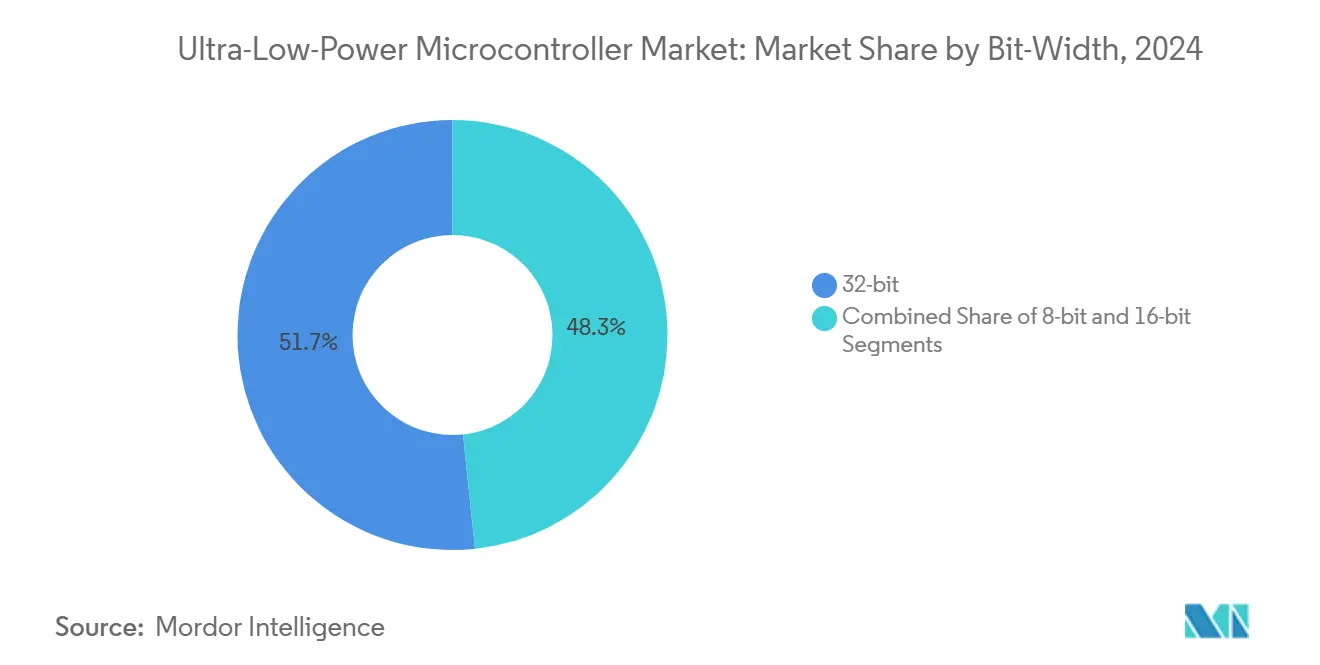
- By bit-width, 32-bit architectures captured 51.67% revenue share in 2024 and are projected to grow at a 9.71% CAGR through 2030.
- By peripheral device type, analog-centric MCUs accounted for 59.78% of 2024 sales, while digital-centric variants are forecast to log a 10.67% CAGR to 2030.
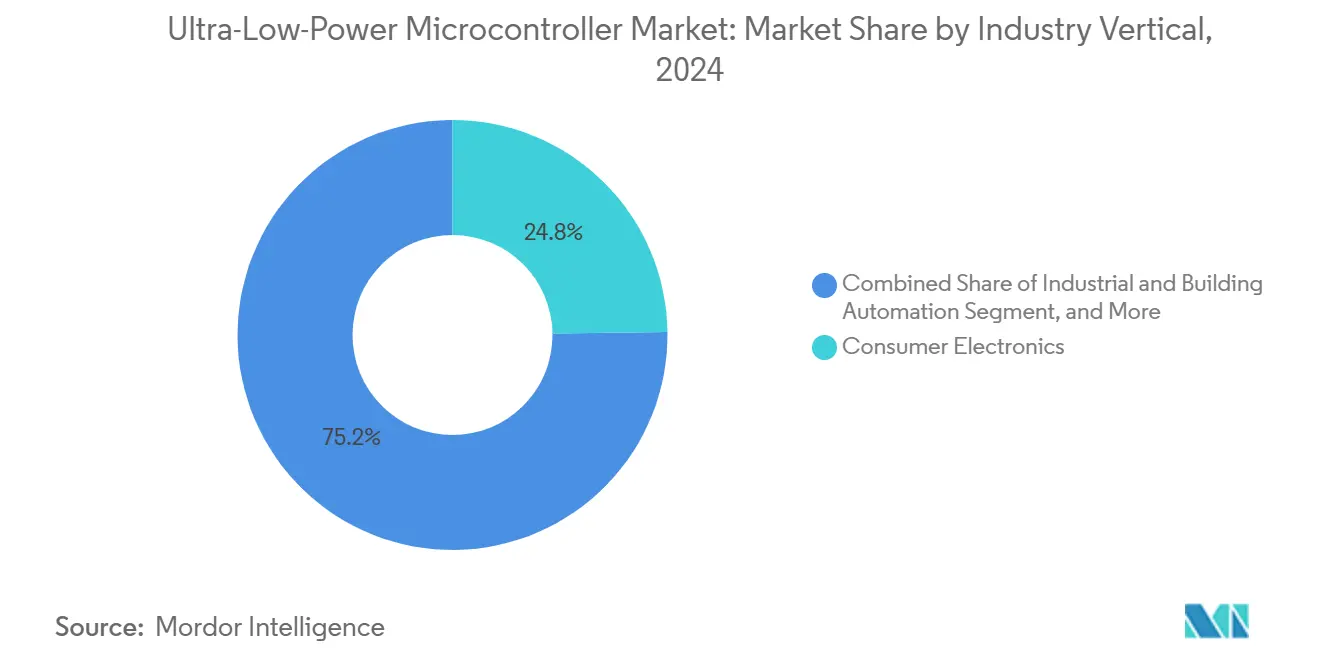
- By industry vertical, consumer electronics dominated with a 24.78% share in 2024; healthcare and medical devices are expected to register the quickest 9.29% CAGR over the forecast period.
- By application, smart-home controllers held 23.86% of the 2024 total, whereas portable and implantable medical devices are poised for a 9.33% CAGR to 2030.
- By geography, North America led with 33.76% market share in 2024, while Asia-Pacific is set to advance at a 10.24% CAGR through 2030.
Global Ultra-Low-Power Microcontroller Market Trends and Insights
Drivers Impact Analysis*
| Driver | (~) % Impact on CAGR Forecast | Geographic Relevance | Impact Timeline |
|---|---|---|---|
| Explosive growth of battery-powered IoT endpoints and wearables | +2.8% | Global, with Asia-Pacific leading adoption | Short term (≤ 2 years) |
| Smart meters and smart home expansion | +2.1% | North America and EU primary, Asia-Pacific emerging | Medium term (2-4 years) |
| Industrial IoT sensors demanding energy-harvesting ULP MCUs | +1.9% | Global industrial hubs, concentrated in Germany, China, US | Medium term (2-4 years) |
| Energy-efficiency regulations for electronic devices | +1.4% | EU RED Directive, US Energy Star, China RoHS | Long term (≥ 4 years) |
| On-chip AI/ML accelerators enabling dynamic power-gating | +1.2% | Global, with early adoption in North America, Asia-Pacific | Short term (≤ 2 years) |
| Sub-threshold RISC-V cores for implantables and medical patches | +0.8% | North America, EU regulatory approval markets | Long term (≥ 4 years) |
| Source: Mordor Intelligence | |||
Explosive Growth of Battery-Powered IoT Endpoints and Wearables
Wearables and sensor nodes now ship in volumes measured in billions, each expected to run multiple sensing and wireless workloads for more than a week on button cells. Ambiq’s Apollo SOC registers 6 µA/MHz active current, letting smartwatches stream biometric data for weeks instead of days. [1] As deployments scale, device makers combine photovoltaic, thermoelectric, and kinetic harvesters under supervisory PMUs that draw mere nanoamperes, turning maintenance-free service lives into a purchasing baseline. OEMs in Asia-Pacific lead cost discipline, while North American brands push spec sheets toward always-on voice and vision features. The resulting appetite for compute-efficient instructions intensifies the use of custom DSP blocks and fine-grained clock domains to trim every microwatt.
Smart Meters and Smart-Home Expansion
Utilities in Europe and North America stipulate 15-year lifespans with sleep currents below 1 µA, driving LoRaWAN-enabled meters that can survive harsh outdoor climates while remaining firmware-upgradeable. [2] Residential demand pivots toward voice-first hubs and gesture-aware controllers that require idle power below 30 µW yet burst into multi-hundred-MHz inference modes. Vendors differentiate through deep-sleep state variety, integrated security IP, and modular RF front-ends that shave weeks off design cycles. Cost-down roadmaps depend on moving to 55 nm FD-SOI, though foundry capacity remains tight.
Industrial IoT Sensors Demanding Energy Harvesting
Factories retrofit rotating-equipment nodes sampling at ≥ 10 kHz; algorithms must execute locally to avoid latency and bandwidth costs. Ultra-low-power microcontrollers with 128-bit DSPs and adaptive sampling firmware cut mean current draw to sub-20 µA, enabling vibration sensors to power entirely from piezo harvesters. [3] German and Chinese facilities favor turnkey modules that bundle PMIC, MCU, and MEMS transducer, reducing BOM while meeting IEC-Ex safety standards. As predictive-maintenance gains prove ROI, suppliers command premium ASPs despite chip price erosion elsewhere.
Energy-Efficiency Regulations for Electronic Devices
The EU’s Radio Equipment Directive and parallel U.S. Energy Star profiles now set active-power ceilings, obliging brands to evidence savings at audit time. Compliance extends beyond standby to compute efficiency, so OEMs adopt dynamic voltage/frequency scaling tied to real-time workload monitors. Certification cost and lead time encourage selecting silicon pre-qualified under SESIP Level 3 or higher. Longer term, Asian regulators plan harmonized eco-design laws, widening the addressable market for next-generation ultra-low-power cores.
Restraints Impact Analysis*
| Restraint | (~) % Impact on CAGR Forecast | Geographic Relevance | Impact Timeline |
|---|---|---|---|
| Design complexity and higher NRE costs | -1.8% | Global, particularly impacting smaller OEMs | Short term (≤ 2 years) |
| Price erosion amid intense vendor competition | -1.5% | Global, with Asia-Pacific markets most price-sensitive | Medium term (2-4 years) |
| Limited compute/memory restricts high-end applications | -1.2% | Global, affecting AI/ML edge applications | Medium term (2-4 years) |
| Fragile supply of low-leakage FD-SOI and other specialty nodes | -0.9% | Global, concentrated in advanced foundry markets | Long term (≥ 4 years) |
| Source: Mordor Intelligence | |||
Design Complexity and Higher NRE Costs
Achieving sub-threshold operation below 0.5 V demands rigorous PVT characterization, expanded ESD structures, and sophisticated power-domain isolation, inflating mask sets and verification hours. Small OEMs lacking analog talent face multi-million-dollar barriers before first silicon, pushing them toward off-the-shelf modules despite higher unit pricing. Firmware must orchestrate sleep-wake latencies under 3 µs, adding RTOS tuning cycles that stretch project timelines. Tool vendors now bundle energy-profiling instrumentation, yet steep learning curves persist.
Price Erosion Amid Intense Vendor Competition
Chinese entrants deliver comparable 32-bit devices at 20–30% lower ASPs, compelling established leaders to bundle BLE or sensor hubs for differentiation. TSMC’s announced 10–20% wafer hikes on 28 nm and specialty nodes compress margins further. Vendors counter with long-term supply agreements and ecosystem lock-ins, but customers in appliance and lighting markets remain price-driven, tempering volume-weighted revenue growth despite unit expansion.
*Our forecasts treat driver/restraint impacts as directional, not additive. The impact forecasts reflect baseline growth, mix effects, and variable interactions.
Segment Analysis
By Bit-Width: 32-Bit Architectures Drive Edge Intelligence
The 32-bit class registered 51.67% of the ultra-low-power microcontroller market share in 2024, and the ultra-low-power microcontroller market size for this group is projected to expand at a 9.71% CAGR between 2025-2030. Demand stems from AI inference, floating-point math, and secure boot requirements that 8-bit and 16-bit cores cannot meet. ARM Cortex-M0+, Cortex-M23, and widening RISC-V IP catalogs compress active power below 80 µA/MHz while maintaining tool-chain parity with higher-performance MCUs. Software reuse across cloud and edge cuts engineering cost, reinforcing 32-bit momentum. Meanwhile, 8-bit devices remain indispensable in cost-critical, single-function sensors where code size rarely exceeds 4 KB. New one-time-programmable flash options shrink die area, letting 8-bit stay relevant for smart-lighting, toys, and simple meters even as 16-bit volumes erode.
The architecture race now orbits integrated AI accelerators delivering 0.5–1 TOPS/W, placing 32-bit firmly at the front of the ultra-low-power microcontroller market. Hybrid compute pipelines offload MAC-heavy layers, letting core clocks drop to sub-10 MHz during inference, thereby extending battery life. Vendors also leverage bit-width-agnostic design flows to port mature peripheral IP from legacy nodes, lowering risk when migrating to FD-SOI. Customer roadmaps increasingly specify flashless 32-bit MCUs that stream code from external FRAM, trading marginal standby current for BOM savings and over-air field upgradability.

By Peripheral Device Type: Analog-Centric Solutions Maintain Dominance
Analog-rich MCUs contributed 59.78% of 2024 revenue, reflecting the premium paid for integrated ADCs, PGAs, and sensor-bias generators critical to low-noise data capture. These parts collapse the BOM count by replacing external amplifiers, improve signal integrity, and cut total quiescent currents to microampere levels. Precision biosignal acquisition for ECG, SpO₂, and EEG monitoring relies on offset voltages below 1 µV and input bias in the picoampere range, benefits hard to replicate through discrete front-ends under tight power budgets.
Digital-centric devices, though smaller in today’s mix, grow fastest at 10.67% CAGR as edge-AI, protocol-heavy, and secure-element applications scale. Here, MCU value resides in integrated accelerators: crypto engines, voice DSPs, and neural cores drive packetized workloads, favoring high-density logic over analog precision. Roadmaps point toward converged architectures where designers can configure on-die analog in the mask-option phase, tailoring a single base die to multiple SKUs for consumer, industrial, and medical SKUs. Such versatility underpins vendor strategies aimed at balancing inventory risk against exploding application diversity in the ultra-low-power microcontroller market.
By Industry Vertical: Healthcare Surges Ahead of Consumer Staples
Consumer electronics accounted for 24.78% of 2024 revenue thanks to wearables, hearables, and smart-home hubs demanding always-on sensing. Yet the healthcare and medical-device segment is forecast to clock the quickest 9.29% CAGR as regulators approve long-duration implanted monitors and patch-format biosensors that require <10 µA average current for multi-year life. Continuous glucose monitors, cardiac rhythm management, and closed-loop drug-delivery pumps tip procurement toward MCUs certified under IEC 60601.
Industrial and building automation hold steady CAGRs around mid-single digits as predictive-maintenance and occupancy-aware climate control achieve enterprise ROI visibility. Automotive adoption accelerates with ADAS standby modules, TPMS, and keyless-entry fobs that must endure −40 °C to +125 °C temperature extremes, pushing suppliers to qualify FD-SOI devices to AEC-Q100 Grade 0. Smart-city and utility deployments, though smaller on revenue today, catalyze volume orders due to 15–20-year battery mandates and LoRa/ NB-IoT backhaul requirements, sustaining mid-term growth for the ultra-low-power microcontroller market.
By Application: Medical Devices Lead Future Upside
Smart-home controllers retained a 23.86% share in 2024, underpinned by voice-assisted lighting, HVAC, and security nodes that ping cloud services around the clock. However, portable and implantable medical devices are set to outpace all segments at a 9.33% CAGR, reflecting demographic shifts and reimbursement models that favor continuous patient data. Ultra-low-power microcontroller market size for these medical applications is poised to cross USD 3 billion by 2030, powered by sub-threshold RISC-V cores capable of always-on ECG classification at <20 µW average draw.
Wearables migrate from fitness to medical-grade metrics such as blood pressure and sleep apnea detection, raising the bar on sensor fusion and edge-based ML inference. Wireless sensor nodes form the backbone of Industry 4.0, batching vibration and temperature data into encrypted packets for gateway-side pre-processing. Smart-metering units adopt ultra-low-power microcontrollers with single-cycle multiply and AES-128 engines, enabling secure billing for water, gas, and electric grids across the globe. Industrial edge controllers integrate new TSN-ready Ethernet MACs to satisfy sub-millisecond deterministic control loops while meeting 1 mA/MHz targets that cap enclosure heat dissipation.
Geography Analysis
North America held 33.76% of global revenue in 2024 on the back of mature smart-grid infrastructure, FDA-cleared medical wearables, and an established design-service ecosystem. U.S. utilities lock in multi-year contracts specifying 15-year battery life, reinforcing demand for integrated PMUs and authenticated wireless stacks. Canada’s residential net-zero housing codes and Mexico’s automotive manufacturing expansion add incremental volume for regional suppliers.
Asia-Pacific is projected to post the fastest 10.24% CAGR, spurred by China’s industrial IoT investments expected to hit USD 150 billion by 2030. Government incentives accelerate domestic MCU design houses, yet global players still dominate premium sub-threshold silicon. Japan and South Korea lead in consumer electronics miniaturization, adopting flip-chip WLCSP packages as small as 1.8 × 1.8 mm for earbuds and smart rings. India’s Smart Cities Mission deploys LoRaWAN-based environmental monitors city-wide, banking on low-cost ultra-low-power microcontroller market solutions to curb maintenance. Australia’s mining automation requires rugged- −40 °C-capable parts with high ESD immunity, offering niche but profitable opportunities.
Europe emphasizes sustainability through the RED Directive and circular-economy measures, prompting OEMs to benchmark energy consumption meticulously. Germany’s Industry 4.0 lighthouse factories specify energy-harvesting sensor kits with a five-year return on investment. The U.K. smart-meter rollout continues to generate volume orders for 32-bit MCUs supporting cellular NB-IoT fallback. France and the Netherlands drive integrated building-automation adoption, valuing SESIP Level 3 cybersecurity to comply with GDPR. Eastern European EMS providers attract relocation projects, securing fresh design wins for low-leakage FD-SOI devices.
Competitive Landscape
The ultra-low-power microcontroller market remains moderately fragmented; the top five vendors collectively accounted for roughly 55% of 2024 revenue, leaving ample room for niche innovators. Texas Instruments, STMicroelectronics, and Microchip Technology leverage deep analog catalogs and broad development-tool ecosystems, bundling BLE, Sub-1 GHz, and LP-Wi-Fi connectivity into single-package offerings that simplify board design. Ambiq Micro and Nordic Semiconductor differentiate through extreme active-power efficiency and protocol-optimized radio stacks, respectively, commanding premium ASPs in wearables and asset-tracking.
Strategic activity centers on vertical software integration: Nordic ships turnkey reference apps from fitness-tracking to medical-patch firmware, reducing customer engineering overheads. STMicroelectronics expanded patent holdings around sub-threshold voltage control, insulating its FD-SOI roadmap against commoditization threats. Vendors also form foundry alliances to secure FD-SOI and 22ULL wafer allocation, mitigating supply risk flagged by 2024’s tight capacity.
M&A momentum targets complementary IP blocks-Microchip’s rumored interest in Atmosic could pair energy-harvesting PMICs with its PIC portfolio. Meanwhile, Chinese suppliers undercut pricing in commodity 8-bit segments, accelerating ASP declines but broadening entry-level adoption. Ecosystem lock-in via cloud-linked IDEs and OTA service platforms becomes a defensive moat as hardware margins tighten across the ultra-low-power microcontroller market.
Ultra-Low-Power Microcontroller Industry Leaders
-
Texas Instruments Incorporated
-
Silicon Laboratories Inc.
-
STMicroelectronics N.V.
-
Microchip Technology Inc.
-
NXP Semiconductors N.V.
- *Disclaimer: Major Players sorted in no particular order
Recent Industry Developments
- January 2025: Nordic Semiconductor unveiled the nPM2100 PMIC, extending primary-cell life to 15+ years through 100 nA quiescent current and multi-source energy-harvesting support.
- December 2024: STMicroelectronics released the STM32WBA5 series with BLE 5.4 and SESIP Level 3 certification for ultra-low-power smart-home nodes.
- November 2024: Ambiq Micro partnered with smart-ring and OTC-hearing-aid brands, embedding Apollo MCUs for week-long biometric monitoring.
- October 2024: Silicon Labs introduced BG29 MCUs featuring 24-bit Σ-Δ ADCs and 2.6 × 2.8 mm WLCSPs aimed at sub-10 µA medical sensors.
Global Ultra-Low-Power Microcontroller Market Report Scope
| 8-bit |
| 16-bit |
| 32-bit |
| Analog-centric |
| Digital-centric |
| Consumer Electronics |
| Industrial and Building Automation |
| Automotive and Transportation |
| Healthcare and Medical Devices |
| Smart Cities and Utilities |
| Aerospace and Defense |
| Wearables and Hearables |
| Wireless Sensor Nodes |
| Smart Metering |
| Portable and Implantable Medical Devices |
| Smart Home Controllers |
| Industrial Edge Controllers |
| North America | United States | |
| Canada | ||
| Mexico | ||
| Europe | Germany | |
| United Kingdom | ||
| France | ||
| Russia | ||
| Rest of Europe | ||
| Asia-Pacific | China | |
| Japan | ||
| India | ||
| South Korea | ||
| Australia | ||
| Rest of Asia-Pacific | ||
| Middle East and Africa | Middle East | Saudi Arabia |
| United Arab Emirates | ||
| Rest of Middle East | ||
| Africa | South Africa | |
| Egypt | ||
| Rest of Africa | ||
| South America | Brazil | |
| Argentina | ||
| Rest of South America | ||
| By Bit-Width | 8-bit | ||
| 16-bit | |||
| 32-bit | |||
| By Peripheral Device Type | Analog-centric | ||
| Digital-centric | |||
| By Industry Vertical | Consumer Electronics | ||
| Industrial and Building Automation | |||
| Automotive and Transportation | |||
| Healthcare and Medical Devices | |||
| Smart Cities and Utilities | |||
| Aerospace and Defense | |||
| By Application | Wearables and Hearables | ||
| Wireless Sensor Nodes | |||
| Smart Metering | |||
| Portable and Implantable Medical Devices | |||
| Smart Home Controllers | |||
| Industrial Edge Controllers | |||
| By Geography | North America | United States | |
| Canada | |||
| Mexico | |||
| Europe | Germany | ||
| United Kingdom | |||
| France | |||
| Russia | |||
| Rest of Europe | |||
| Asia-Pacific | China | ||
| Japan | |||
| India | |||
| South Korea | |||
| Australia | |||
| Rest of Asia-Pacific | |||
| Middle East and Africa | Middle East | Saudi Arabia | |
| United Arab Emirates | |||
| Rest of Middle East | |||
| Africa | South Africa | ||
| Egypt | |||
| Rest of Africa | |||
| South America | Brazil | ||
| Argentina | |||
| Rest of South America | |||
Key Questions Answered in the Report
How large is the ultra-low-power microcontroller market in 2025?
It stands at USD 8.22 billion and is projected to reach USD 12.69 billion by 2030, registering a 9.07% CAGR.
Which region grows fastest for ultra-low-power MCUs?
Asia-Pacific leads with a forecast 10.24% CAGR, driven by China’s expanding industrial IoT and consumer-electronics production.
What bit-width architecture dominates shipments?
32-bit cores hold 51.67% market share and drive the highest 9.71% CAGR due to edge-AI and security requirements.
Why are medical devices important for future demand?
Portable and implantable medical devices require multi-year battery life, pushing adoption of sub-threshold MCUs and fuelling a 9.29% vertical CAGR.
What technological trend shapes next-gen ultra-low-power MCUs?
Integration of AI/ML accelerators alongside energy-harvesting PMUs enables inference at <1 mW, maximizing battery longevity.
How does pricing pressure influence vendors?
Rising Chinese competition and wafer-cost hikes compress ASPs, compelling established players to bundle connectivity, security, and software ecosystems for differentiation.